
Ref Check Format for Volunteers: Template and Questions
Build a ref check format for volunteers with a sample form, behavioral question bank, consent notes and storage rules for nonprofit screening.
On this page
You're staring at forty volunteer applications and a template that asks one thing: would you take this person back? The youth coach slot starts Saturday. Someone still has to count the cash box. A warm yes doesn't tell you whether this applicant can supervise children, handle money, or stay steady when a parent is upset.
A usable ref check format records evidence you can compare across applicants, not a feeling from a single call. In 2023, 28.3% of U.S. adults, more than 75.7 million people, reported formally volunteering through an organization, according to the U.S. AmeriCorps and Census Bureau civic engagement survey as summarized in this volunteer engagement benchmark. That volume is why a shared form beats a sticky note on the fridge.
I would tie every question to the risk of the role, score only what a reference can illustrate, and treat a missing reply as unverified rather than a fail.
Table of Contents
- Form Fields Every Reference Check Needs
- Matching Reference Questions to Volunteer Risk
- Behavioral and Verification Questions to Ask
- Consent, Legal Limits and Record Storage
- Timing Calls and Chasing Responses
- Handling Silent, Vague or Conflicting References
- Pilot the Form With Three High-Risk Roles
Form Fields Every Reference Check Needs
Say you're the coordinator with those forty files. The old sheet stops at rehire. That's an impression, and impressions don't hold up when a parent complains six months later.
What you need on the page is evidence. The U.S. Office of Personnel Management reference-checking guidance lays out a practical sequence: define the competencies through job analysis, obtain consent and reference details, choose people who had a real chance to see the behavior, ask every reference the same behavior-based open questions, record answers on standardized ratings, and combine the notes with the rest of the selection file. One conversation isn't the decision. Phone conversations usually produce more usable detail than a written work-history request, which often goes unanswered.
One page, same columns
Use one page per reference. The header carries the applicant's name, the role, and how you'll reach the reference. Under that, give each competency its own row and a fixed scale. A shared document or a fillable PDF both work. The fields have to match on every file, or you can't compare two candidates for the same shift.
| Field | What to capture | Example entry |
|---|---|---|
| Reference name and relationship | Name, title, organization and how they know the applicant | Former youth league coach, 2019-2023 |
| Observation period | Dates the reference worked with or observed the applicant | Jan 2022 to Jun 2023 |
| Contact log | Channel, date and outcome of each attempt | Phone 3 Mar, no answer; email 5 Mar, replied |
| Competency ratings | One score per role competency on a fixed scale | Supervision: 4 of 5 |
| Behavioral examples | One specific situation the reference observed | Handled a lost child at a park day without raising alarm |
| Contextual qualifiers | Conditions that shaped the behavior described | Was training new staff at the time |
| Evidence quality flag | Direct observation, secondhand or personal | Direct, supervisor |
| Rehire or re-engage eligibility | Yes, no, qualified, with reason | Qualified, would welcome back for weekend events |
Observation period is the field people skip, and it's the one that changes the weight of everything else. A supervisor who saw the applicant for two months a decade ago tells you less than someone who worked beside them every week last year. Write the dates.
Contextual qualifiers stop you from treating a hard week like a character flaw. Evidence quality separates a direct supervisor from a friend repeating a story. If the flag says personal or secondhand, don't let that row outweigh a direct one.
Score each competency from 1 to 5 with written anchors. A 1 is a concern backed by a specific example. A 3 is adequate performance with at least one example. A 5 is consistently strong performance with specific examples. Leave the score blank when no example was given. An empty score is never a low score.
Keep those core fields fixed and add role rows underneath, such as incident reporting for a coach or dual sign-off for a treasurer. Programs that already organize student records in one place know why one layout beats scattered notes. Same habit here.
Practical rule: If you can't point to a behavior on the page, you don't have a rating. You have a compliment.
Common ways the form fails: different questions for each candidate, praise with no example, a personal reference who never saw the work, and letting your overall feeling replace the item scores.
Matching Reference Questions to Volunteer Risk
The form only earns its keep when each question tracks something that could go wrong in that role. Strengths, weaknesses, and "are they a team player" don't tell you how someone behaves in a minivan or at a lockbox.
The Nonprofit Risk Management Center recommends a standardized script for each position, questions that stay job-related, nothing you couldn't legally ask the applicant, and a written record of the answers. Work-history gaps, references, and formal safeguarding checks sit beside each other. None of them stands in for the others. Safeguarding duties change by country. What travels is proportional, documented, role-related screening.
From duty to question
| Volunteer role | Main risk | Reference focus | Paired check |
|---|---|---|---|
| Youth sports coach | Contact with minors | Supervision, boundaries, incident handling | Criminal and sex offender search |
| Driver for participants | Vehicle safety and accidents | Driving reliability, punctuality, incident reporting | Driving record check |
| Cash handler or treasurer | Access to money | Accounting practice, dual sign-off, handling errors | Identity and credit verification |
| Pastoral visitor | Contact with vulnerable adults | Confidentiality, judgement, reporting concerns | Criminal search and address history |
| Front-desk or event helper | Low direct risk | Reliability, communication, following instructions | Identity check only |
A youth coach's main exposure is contact with minors, so you probe supervision, boundaries, and how an incident was handled, then pair the call with a criminal and sex offender search. A driver reference is about reliability behind the wheel and whether problems were reported, paired with a driving record. A treasurer reference is about how money moved and how errors were corrected, paired with identity and credit verification. A pastoral visitor needs questions on confidentiality and reporting concerns, paired with a criminal search and address history. A front-desk helper carries lower direct risk, so reliability and following instructions plus an identity check are enough.
Build it in three moves. Start with that role's row. Require the same core questions for every candidate in the role. Then add two or three narrow questions. For a driver, ask how they reported a near miss. For a treasurer, ask what they did the last time a count didn't match.
Questions about age, family status, religion, health, or disability stay off the script, even when the role is sensitive. The matrix tells you what to ask about the duties. It doesn't invite you to guess from someone's background.
Faith-based teams can scan types of ministry and key skills when they name what a visitor or youth helper does. Put those competencies next to a written volunteer screening policy so the paired check is planned, not improvised after a worrying answer.
Vague answers, unexplained gaps, conflicting dates, or a reference who can't confirm the relationship escalate. You don't place the person while that item is still open.
Behavioral and Verification Questions to Ask
Confirm who you're talking to before you ask about the applicant. Trait labels like "reliable" or "great with kids" feel complete and tell you almost nothing you can defend later.
Confirm the relationship first
- Title and organization: Where did you work with them, and what was your title then?
- Time together: Which months or years did you see their work?
- Direct supervision: Did you assign their tasks, or did you know them mainly as a friend?
If the story sounds thin, call back on a number you found yourself, such as the league office line, not only the mobile the applicant supplied.
Then use one behavioral prompt per competency. Open with "Tell me about a time." Let the reference describe the situation. Ask what happened next and who else was involved. Write the event, not the adjective.
| Competency | Behavioral question | Evidence to record |
|---|---|---|
| Reliability | Tell me about a time this person had to miss or change a commitment. What happened? | Specific event, notice given, outcome |
| Judgement with children | Describe a situation where they were responsible for children. How did they handle a concern? | Action taken, who was informed |
| Boundaries | Tell me about a conflict they had with a participant or colleague. How was it handled? | Behavior described, de-escalation steps |
| Honesty | Can you describe a mistake they made and how they dealt with it? | Admission, correction, follow-through |
| Response to feedback | How did they respond when a supervisor gave them feedback? | Response, change over time |
| Rehire eligibility | Would you work with them again in a similar role? Why or why not? | Yes, no or qualified, with the reason given |
Skip "judgement with children" when the role has no contact with minors. Don't add it just because it sounds thorough.
When the answer stays foggy
Use the same two follow-ups, in this order, every time:
- What did the applicant do first?
- What was the result, and how did you know?
A rehire answer of yes or no is never enough on its own. Ask for the reason. "Qualified, weekends only, because weekday shifts were missed twice" is something you can weigh. "Sure, great person" is not.
Same wording for every candidate in the role. If you improvise the prompt, you can't line the files up later.
If the reference refuses a topic, note the refusal and the competency. Don't fill the gap with your own guess.
Consent, Legal Limits and Record Storage
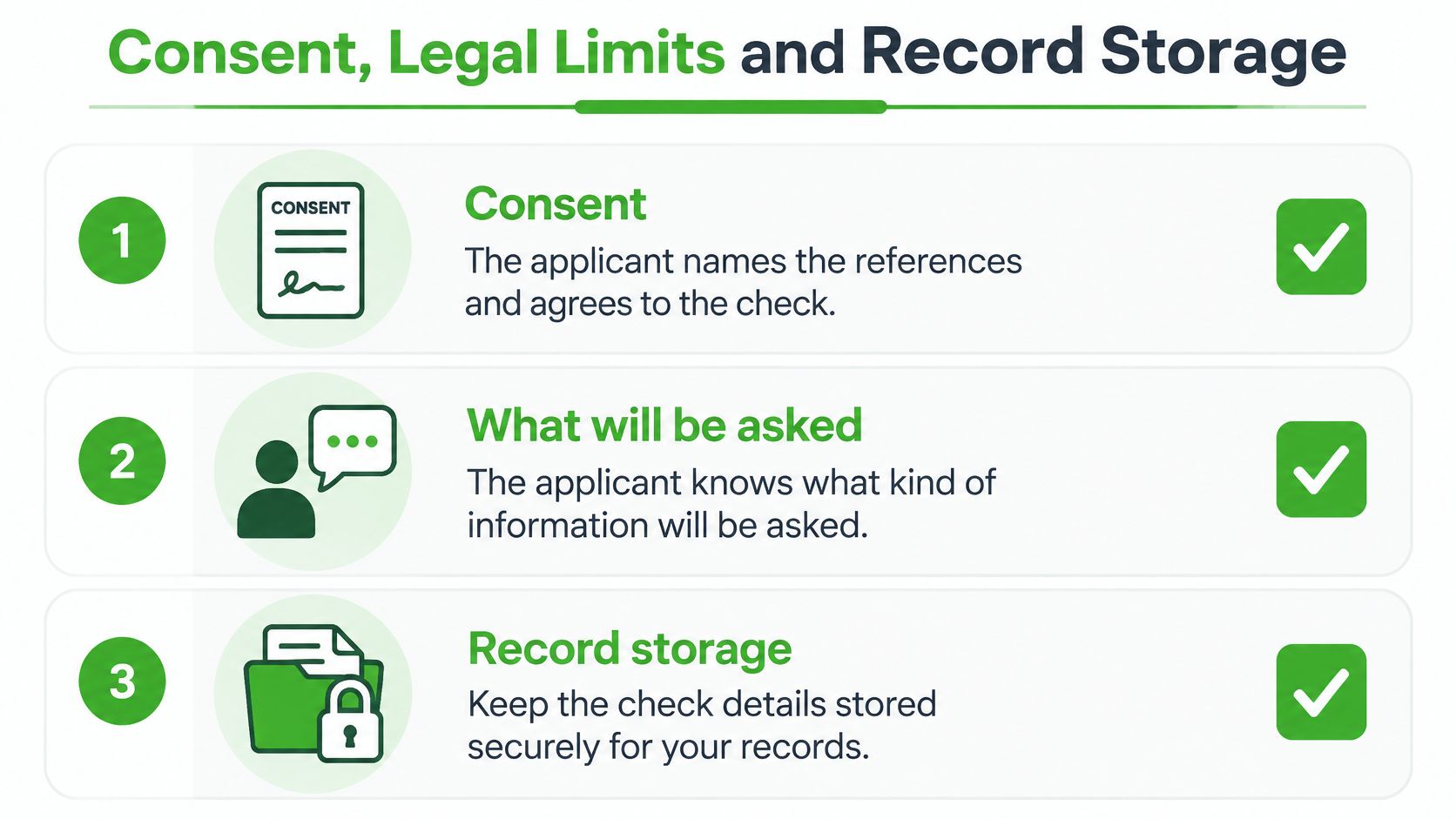
Consent comes before any dial. The applicant names the references, agrees to the check, and knows what kind of information you'll ask. That's a different step from a criminal search or a driving record, which usually needs its own disclosure and authorization. In the U.S., Fair Credit Reporting Act rules apply when a third party runs that check. Read the FCRA disclosure requirements before you hand any part of screening to an outside firm. This is general guidance, not legal advice. Confirm the forms with counsel for your state or country.
What you don't write down
Leave out age, marital status, religion, disability, and pregnancy. Those topics stay off-limits even when the role feels sensitive, and even when a reference volunteers the detail. Mark the line "not recorded, not job-related" and move on. You're screening for the duties, not building a biography.
Teams that place adults with children can compare their consent language with Organic Fostering background check guidance. The fit is the same for a church nursery or a Saturday league: permission first, questions about the work, and a file someone else can audit.
Where the notes live
Keep completed forms in a restricted folder. Store only job-related responses. Set a written retention period, such as deletion after the volunteer's term plus a defined window you check against local rules, rather than keeping every call forever "just in case." Record who opened each file and when.
Before you close the folder, run this list:
- Consent signed: The applicant named the references and agreed to the contact.
- Scope stated: They were told what kind of information you'd ask.
- Same questions: The script matches the role, not a one-off conversation.
- Access list: Only named staff can open the folder.
- Retention date: A delete-by date sits on the file cover.
A reference note that can't be found, or that anyone on the shared drive can edit, won't help you if a placement is challenged.
Timing Calls and Chasing Responses
Reference checks are useful, and they don't carry the placement by themselves. A federal hiring review reports a validity of approximately 0.26 for reference checking as a single measure of job performance, while a separate meta-analysis summarized an average corrected validity of about 0.29 for references and recommendation letters, as set out in this review of reference validity. A favorable call can still be positively biased. Fold it in with identity, eligibility, and a legally compliant background screen.
Structure helps. Job-analysis questions, identical prompts, and standardized scoring make the notes more useful, with reliability in the range of other traditional noncognitive predictors. The practical leak is people who never write back. One large study involving 150,000 candidates and 769,822 reference providers reported an 85.3% provider-compliance rate when completion was tracked and reminders were sent. A reminder workflow changes the yield.
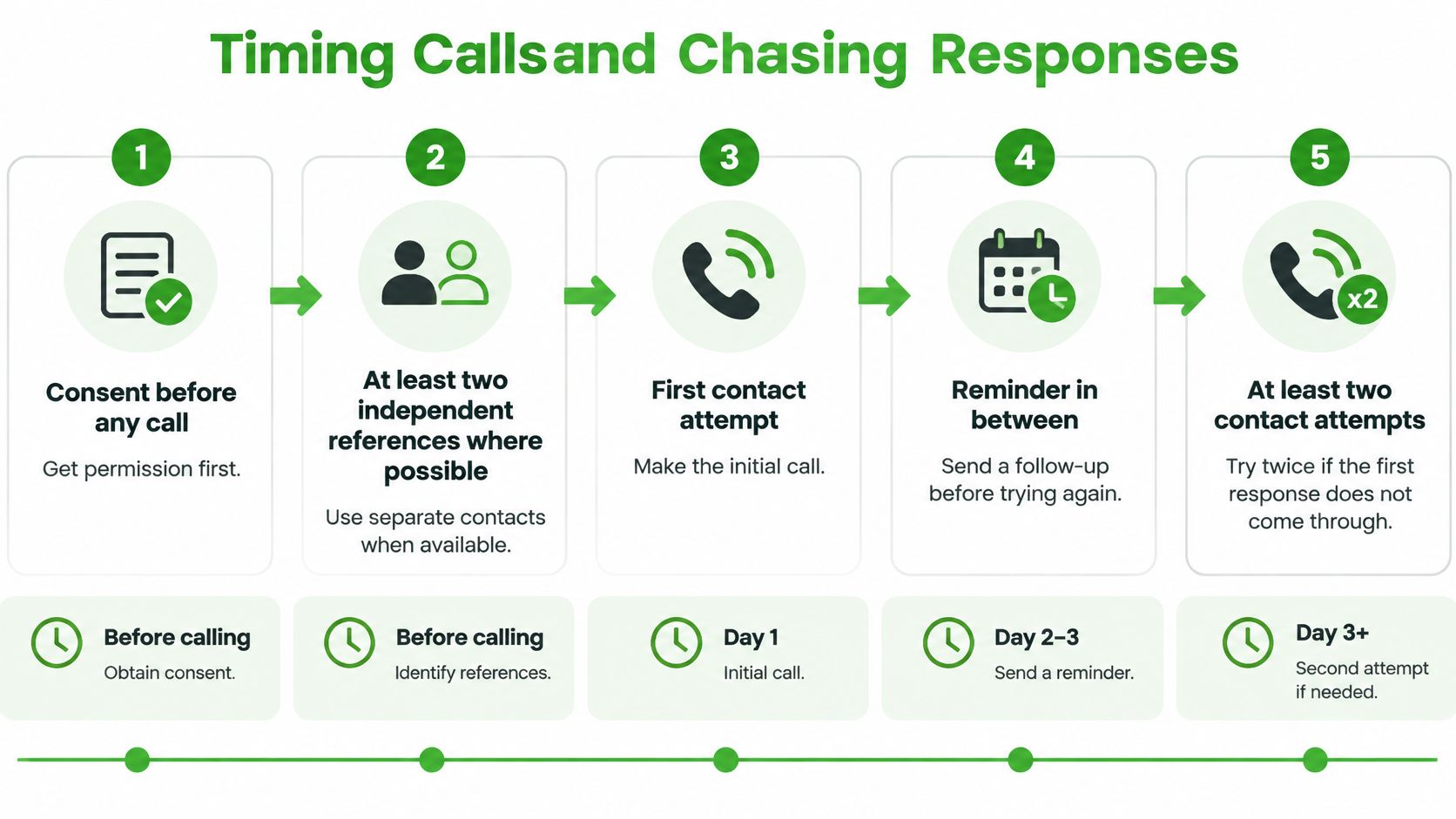
For volunteer programs, use at least two independent references when you can. Require concrete examples tied to safety-relevant competencies. Document unanswered items separately from negative findings. Don't convert a missing response into a failed score.
The fourteen-day clock
| Day | Action | What you log |
|---|---|---|
| 0 | Consent signed and reference details in hand | Date of consent |
| 0 to 1 | First call, question bank in hand | Date, phone, outcome |
| 4 | Email reminder | Date sent |
| 9 | Final call | Date, phone, outcome |
| 14 | Combine the evidence and decide | Pending items listed apart from scores |
- Send consent and collect the reference details.
- Call the first reference and stay on the question bank.
- Log the attempt the same day.
- Send an email reminder on day four if you don't have a completed call.
- Make the final call by day nine.
- Combine the evidence and decide by day fourteen.
Call first. Use a written request only as the fallback when you can't reach them by phone. Someone who hasn't answered is pending, not a negative mark.
New screeners often rush the first call and forget the reminder. A short walk-through of that order keeps the second week from slipping.
Handling Silent, Vague or Conflicting References
The files that cause trouble aren't the clearly poor ones. They're the reference who never picks up, the one who offers only warm praise, the neighbor with no work link, and two people whose dates don't match.
A structured instrument can look very stable. A structured reference reliability study reports internal-consistency estimates of 0.96–0.98 across 8,000 cases, two-week test–retest reliability averaging 0.74 across 1,298 cases, and a correlation of 0.35 with supervisory ratings in a 223-person sample. That supports scoring the same way every time. It doesn't prove any single reference is honest, and a missed call isn't evidence of misconduct.
Silence isn't a finding. Uniform praise isn't proof.
Code the answer, then decide the next step
| Situation | How to record it | Next step |
|---|---|---|
| No reply after two attempts | Unable to verify, logged separately from a negative finding | Ask the applicant for a second reference |
| Warm praise with no example | Note that no example was given | Ask one follow-up question on the same competency |
| Personal reference only | Mark the source as personal | Request a work or program reference |
| Conflicting dates | Flag the discrepancy with both dates | Check against the application and the reference's records |
| Relationship cannot be confirmed | Mark the relationship as unverified | Stop and request another contact |
| Specific negative example | Record the example with its source and date | Second reviewer checks before any adverse decision |
Label the source on every page: direct supervisor, peer, or personal. Each claim in the evidence log gets a date and a name. An adverse decision needs corroboration, meaning a second source or a record, and a second person has to review it before you turn someone away. One annoyed former colleague isn't enough.
Applicants with informal, unpaid, or international experience often have no conventional boss to call. Allow a non-employer reference and flag it. Don't fail the file because there's no payroll supervisor. Store the codes with your compliance documentation so a later reviewer can see why you marked a line unable to verify instead of negative.
Pilot the Form With Three High-Risk Roles
This week, pick the three highest-risk roles you fill. For many programs, those are youth supervision, driving, and handling money. Build a matrix row for each, copy the core fields into one shared form, and add those role rows underneath the fixed ones.
Run the full form on one real applicant before anyone else uses it. Take their references through the question bank. Log every attempt with the date, the channel, and the outcome. Mark anything still unanswered as pending, not as a low score.
Read that test file with a second person against your escalation rules. Note any question that produced only adjectives, and any field the caller skipped because the label was unclear. Change the form once. Then lock it so the next ten applicants see the same page.
You should walk away with three things:
- The form: fixed core fields plus the role rows for those three positions.
- The timing sheet: day 0, day 4, day 9, and day 14 written where the caller can see them.
- The evidence log: dated notes for the test applicant, including any line left blank on purpose.
Put a review on the calendar twelve months out and check the form against current policy and local rules. References inform the decision. They don't make it alone. The form is what you can show when someone asks why a volunteer was placed, or why they weren't.
VolunteerBadge gives nonprofits a place to collect reference responses alongside FCRA-compliant screening, so consent, calls, and role questions don't live in separate inboxes. If you're ready to put this ref check format next to a consistent background check, visit VolunteerBadge and see how the reference step fits the rest of your volunteer screening.
