
FCRA Disclosure Requirements for Volunteer Screening
FCRA disclosure requirements for volunteer screening, including standalone forms, consent rules, adverse action notices, and a checklist.
On this page
You're ready to order a background check for a new volunteer coach. The application is complete, the season is approaching, and someone has added a screening-consent paragraph beneath the emergency contact information. Before you click submit, stop and check the document itself. The problem may not be missing consent language. It may be everything surrounding it.
Table of Contents
- Why FCRA Disclosure Requirements Come First
- The Four Categories of FCRA Notices
- Standalone Disclosure and Written Authorization
- Electronic Consent That Holds Up
- What May Appear on the Disclosure Form
- Adverse Action Notices in the Right Order
- Related FCRA Duties Nonprofits Still Owe
- Quick Reference Checklist and Next Steps
Why FCRA Disclosure Requirements Come First
A church administrator, youth-league coordinator, or food-bank manager shouldn't have to become a legal researcher to request a background check. But someone must own the point at which an application becomes an authorized screening request. That's where FCRA disclosure requirements belong, before the order goes through.
The Fair Credit Reporting Act establishes a federal framework for consumer reporting agencies and organizations that use consumer reports. Employment-purpose screening provides the framework used throughout this guidance. For a volunteer program, confirm the applicable purpose and requirements with your screening provider or counsel rather than assuming that unpaid service removes the issue.
Treat authorization as an ordering gate
Consider a hypothetical library program recruiting reading mentors. The coordinator collects applications, sends names to a screening provider, and plans to distribute consent forms at orientation. That sequence puts the paperwork behind the search instead of ahead of it.
The same mistake can happen when a trusted returning volunteer joins another program. Familiarity with the person isn't a substitute for checking whether the organization has appropriate authorization for the report it's about to request.
Practical rule: Staff should be able to produce the applicable disclosure and authorization before they can release a screening order.
Don't build your process around the expectation that a report will be clear. A clean result doesn't retrospectively fix missing disclosure or authorization. These are conditions for obtaining an employment-purpose consumer report, not paperwork triggered only by unfavorable findings.
Give the coordinator a specific job
Your operating procedure should answer practical questions without requiring staff to interpret a stack of legal forms:
- Which notice applies? Identify the report type and the stage of the screening process.
- Where does it belong? Separate the core disclosure from applications, releases, and unrelated acknowledgments.
- What proves permission? Preserve the authorization and the text the person received.
- Who handles exceptions? Assign investigative-report questions, disputed information, and potential adverse decisions to a named owner.
These aren't interchangeable tasks. A signature on an application doesn't answer every disclosure question, and a later rejection letter can't repair an unauthorized order.
My recommendation is straightforward: make screening permission a controlled step, not an assumption. Staff should know what they must verify, which document they should use, and when they must pause for review. Start by distinguishing the different notices rather than trying to make a single form perform every job.
The Four Categories of FCRA Notices
The most useful way to organize FCRA disclosure requirements is by purpose and timing. Don't start with a template. Start by identifying what the communication is supposed to accomplish.
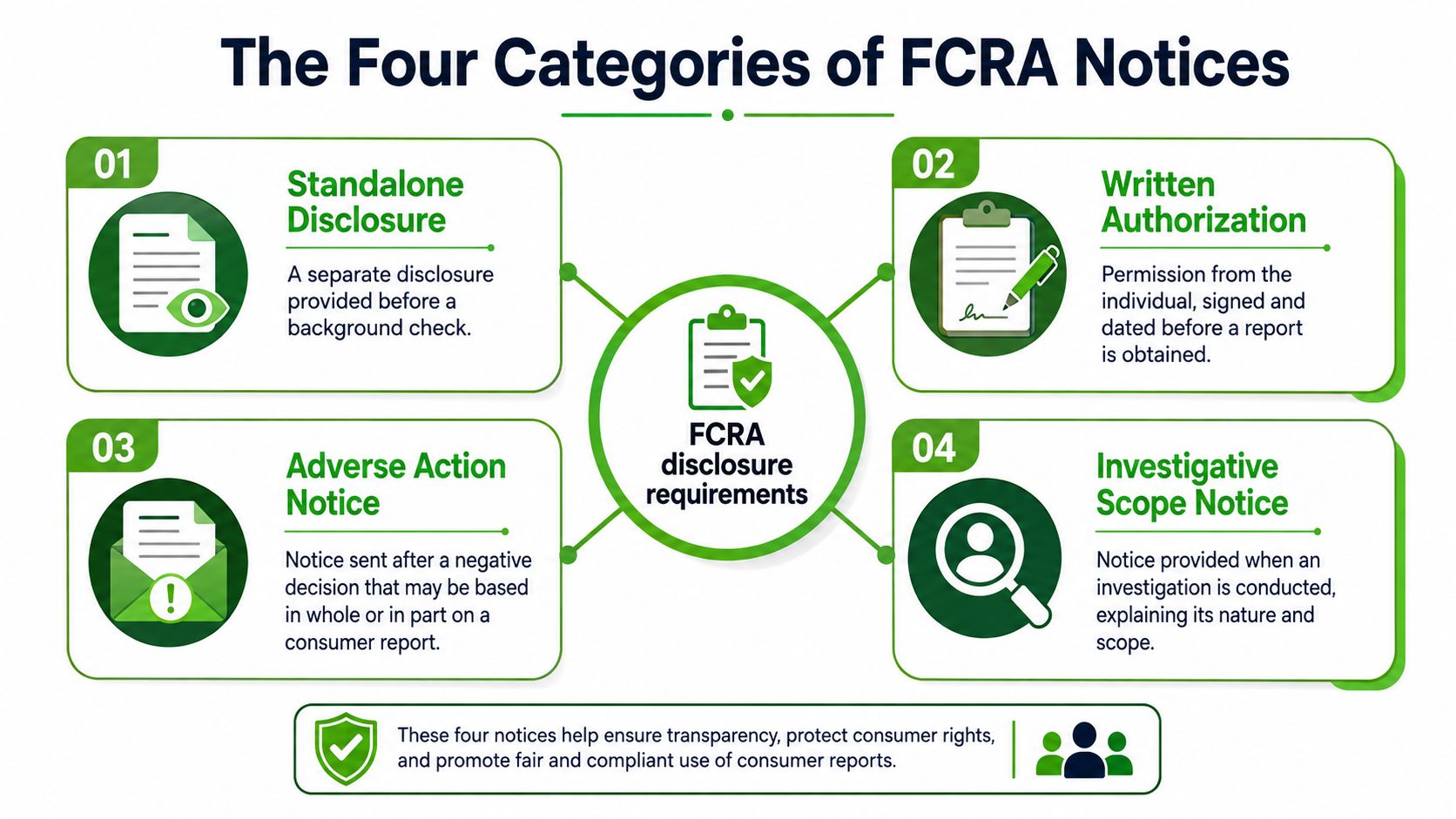
The notice map below separates the major duties.
Before the report is obtained
The standalone disclosure tells the person that an employment-purpose consumer report may be obtained. Its job is notice, not collecting application answers or protecting the organization from liability.
Written authorization records the person's permission to obtain the report. Although it performs a different function, federal guidance permits authorization on the same document as the standalone disclosure. That permission doesn't extend to unrelated waivers and acknowledgments.
Keep the distinction clear in your workflow: presenting a disclosure and receiving authorization are separate events, even when they happen on the same page.
Notices triggered by report type or decision
An investigative consumer report disclosure addresses an investigation into character, general reputation, personal characteristics, or lifestyle. This isn't another name for the ordinary employment-purpose disclosure. It carries its own notice and scope-related duties.
Adverse-action communications arise when information in a report may contribute to a negative employment decision. Their purpose is different again: the person needs an opportunity to review potentially negative information and dispute inaccuracies before the decision becomes final.
The consumer reporting agency also has a separate file-disclosure obligation when a consumer properly requests information from their file. That agency duty belongs on your compliance map, but its explanation doesn't belong inside the initial standalone disclosure.
| Communication | Operational question |
|---|---|
| Standalone disclosure | Has the person been clearly told that a report may be obtained? |
| Written authorization | Has the person given permission before procurement? |
| Investigative-report notice | Does this report type require additional notice and scope information? |
| Adverse-action communications | Could report information contribute to a negative decision? |
Think of these as separate workstreams, not paragraphs to stack onto a volunteer application. A coordinator requesting an initial check needs the disclosure-and-authorization gate. A coordinator reviewing an unfavorable report needs the decision-notice process.
This distinction also helps when evaluating software. Ask the provider to show you when each communication appears, who receives it, and what event triggers it. A platform that stores many forms in one folder still needs a workflow that presents the right document at the right time.
Standalone Disclosure and Written Authorization
The form's central job is narrow: disclose the potential report and obtain permission before procurement. Don't make it double as the volunteer application.
The FCRA became effective on April 25, 1971; the employment-purpose disclosure rule appears in Section 604, codified at 15 U.S.C. § 1681b, as described in the OCC's Fair Credit Reporting Act handbook. The rule requires a clear and conspicuous written disclosure in a document consisting solely of the disclosure, with written authorization obtained before the report is procured; authorization may appear on that same document.
Build a dedicated document
For a nonprofit, the practical starting point is a clearly identified page containing the organization's identity, a plain explanation that it may obtain a consumer report for the applicable screening purpose, and an authorization mechanism.
Don't treat this description as a universal legal template. Have the actual wording reviewed for your program, report type, and applicable requirements. In particular, don't replace the relevant legal purpose with vague language about keeping everyone safe.
Use the checklist below to test the document's basic structure.
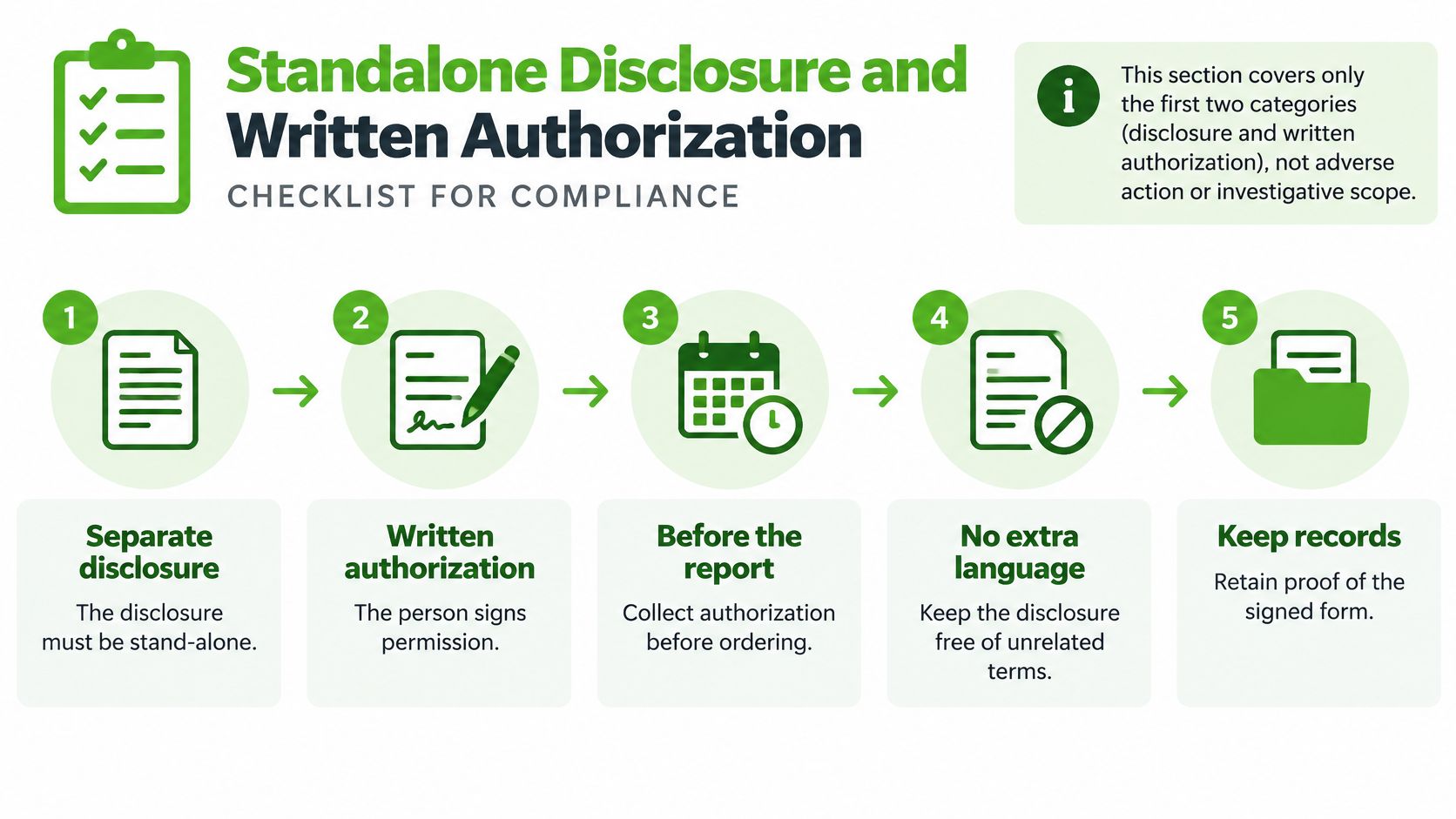
Suppose a youth ministry puts its background-check disclosure between a transportation release and an acknowledgment of its conduct policy. The applicant signs at the bottom of the combined application. That layout conflicts with the standalone-document requirement, even if the disclosure sentence itself is accurate.
The corrected pattern is a dedicated disclosure-and-authorization page within the onboarding workflow. Present it separately from the application and other agreements, and complete authorization before releasing the screening request.
Make continuing screening explicit
If your program intends to obtain additional reports during service, state that continuing purpose clearly and conspicuously. Don't expect a volunteer to infer ongoing permission from an initial application or an indefinite reference to organizational policies.
For example, a youth league planning to screen during continuing service should have counsel review language that addresses that intended use. Staff shouldn't improvise recurring-screening permission by adding a sentence to an old form.
- Identify the requester. The volunteer should recognize the organization seeking the report.
- State the screening purpose. Use direct language rather than a broad agreement to unspecified investigations.
- Capture authorization. Require an affirmative signature or valid electronic equivalent.
- Control ordering. Don't let staff bypass the authorization step because an event is approaching.
The operational test is simple: can the coordinator show the dedicated document and the person's authorization before placing the order? If not, the request isn't ready.
Electronic Consent That Holds Up
Moving a paper form online doesn't solve a content problem. If the paper version combines screening permission with releases and unrelated promises, reproducing it as a checkbox screen preserves the same problem.
A defensible electronic workflow needs both a clean disclosure experience and a retrievable consent record. The EEOC and FTC's background-check guidance explains the standalone notice and written-permission requirements, including clear and conspicuous disclosure when authorization is intended to cover reports throughout employment.
Design a screen with a single purpose
Give disclosure and authorization their own screen or document view. The person shouldn't have to distinguish screening permission from a photo release, emergency-treatment consent, or agreement to a volunteer handbook.
A clear heading, readable text, and an unmistakable authorization control are better operating choices than a crowded page of acknowledgments. Don't preselect permission or rely on the person's submission of unrelated application answers as your consent event.
For electronic-signature instructions, explain only what the person needs to do. If a typed name and confirmation button form part of your legally reviewed signature process, describe that action briefly. Don't use signature instructions as a place to insert a release of claims.
Preserve what happened, not just the current template
I recommend retaining an auditable record that connects the authorization to the actual disclosure presented:
- Document version. Preserve the text shown at the time, not merely the latest template.
- Timestamp. Record when the authorization occurred.
- Identity. Connect the event to the person being screened.
- Authorization event. Record the affirmative action used to provide consent.
These are practical recordkeeping controls, not a claim that every field is a separately enumerated statutory requirement. Their value is evidentiary: staff can explain what the person saw and how permission was captured.
A database entry that says consent received is less useful than a record showing who authorized which text and when.
Keep longer technical explanations and troubleshooting instructions outside the disclosure document. A brief, unobtrusive assistance contact may support access; a lengthy accessibility policy or software agreement can distract from the required notice.
Test retrieval before launching the workflow. Ask a staff member who didn't configure the system to locate a sample authorization and its matching disclosure version. If they can only find today's template, fix the recordkeeping process before relying on it for live screening.
What May Appear on the Disclosure Form
More legal language doesn't necessarily mean more protection. On a standalone disclosure, extra material can create the very risk someone intended to avoid.
The FTC's guidance on using consumer reports emphasizes keeping the employment-purpose disclosure separate from unrelated material. The practical challenge is deciding whether a sentence supports the notice or turns the document into something else.
Apply a sentence-by-sentence relevance test
Ask whether each item helps the person understand who may obtain the report, what the disclosure means, or how to authorize it. If it instead collects application information, releases liability, explains separate rights, or imposes unrelated duties, move it.
Limited identifying details, short descriptions of report categories, or brief explanations may be permissible when they don't distract from the core notice. That isn't a safe harbor for lengthy additions. Keep supporting material restrained and have the final language and layout reviewed together.
What Stays on the Standalone Disclosure
| Form element | Keep with the disclosure | Move to another document |
|---|---|---|
| Organization's name | A concise identification of the requester | Organizational history and program descriptions |
| Consumer-report statement | The clear, conspicuous core notice | Broad descriptions of unrelated investigations |
| Written authorization | Permission for the disclosed report purpose | Unrelated agreements bundled into the signature |
| Recurring-screening language | Clear, limited language addressing the intended continuing purpose | General policy language used to imply permission |
| Electronic-signature mechanics | Brief instructions supporting authorization | Software terms and technical policies |
| Reporting-agency identification | Limited details, if reviewed and nondistracting | Extended vendor explanations |
| Accessibility assistance | A restrained help direction, subject to layout review | Lengthy procedures or policy statements |
| Liability waivers and releases | No | Separate agreement, if appropriate and reviewed |
| Application questions | No | Volunteer application |
| Summary of rights and file-access instructions | No | Separate rights materials |
| State and local notices | Don't combine indiscriminately | Separate applicable notices, with legal review |
Review the layout as well as the wording
A form can contain the correct sentence and still present it badly. Don't surround the disclosure with prominent logos, promotional messages, dense signature terms, or competing acknowledgments.
For a church, a short organization name may be enough identification. A statement of faith, ministry covenant, and conduct agreement serve different purposes and belong elsewhere.
For a youth league, season-specific screening language may explain the intended authorization. Registration questions, medical information, and parent permissions don't support that disclosure.
Editing test: If removing a sentence leaves the screening notice and authorization fully understandable, ask why that sentence needs to remain.
Be especially careful with state and local notices. Don't paste every jurisdiction's language onto the federal form for convenience. Identify what applies, deliver it appropriately, and avoid turning the standalone disclosure into a general rights packet.
Adverse Action Notices in the Right Order
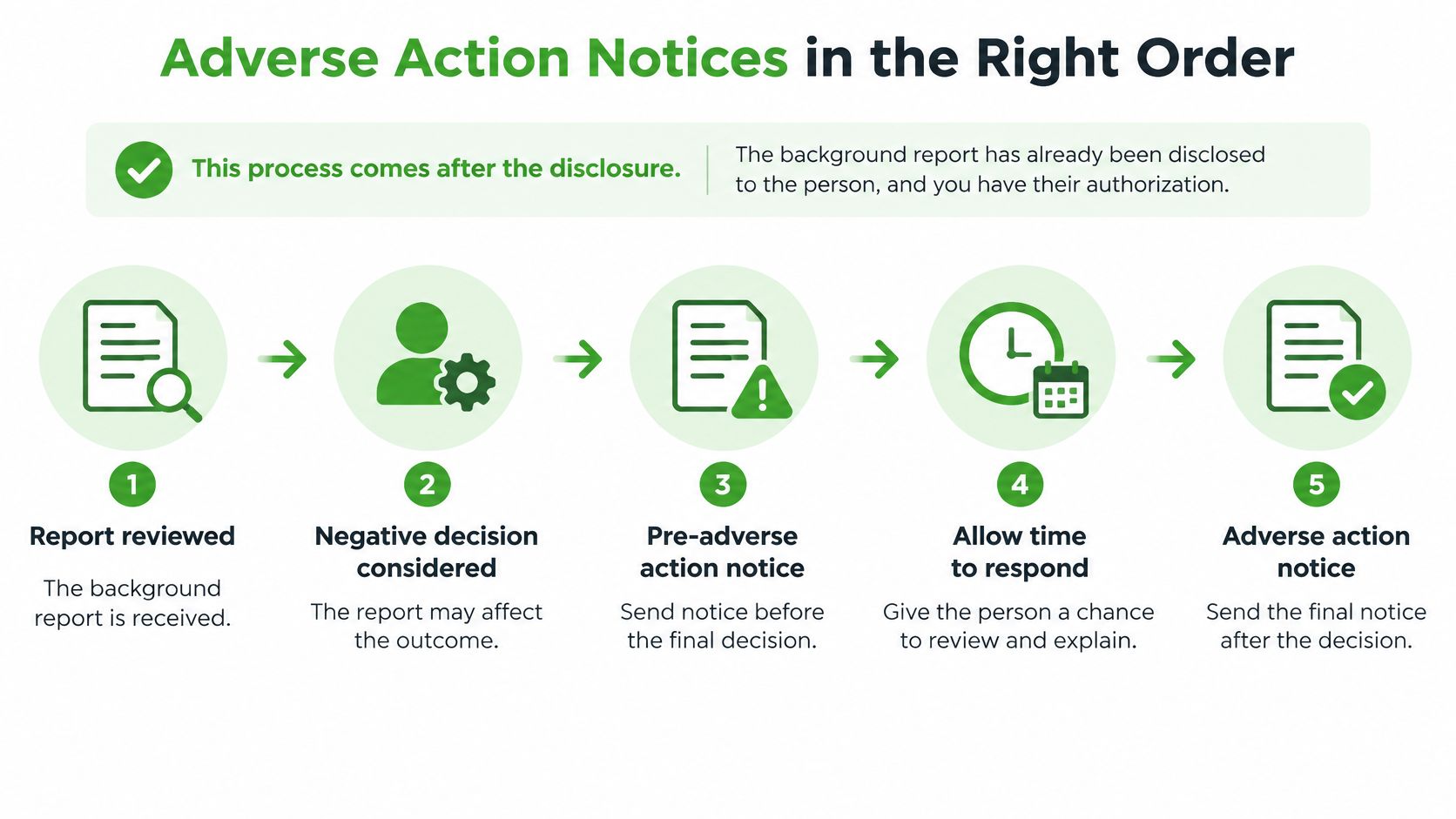
An unfavorable report creates a decision-management task, not an invitation to send an immediate rejection email. Pre-adverse action and final adverse action are different communications. Combining them defeats the purpose of giving the person a meaningful opportunity to review the information first.
The federal process is designed to let the consumer see potentially negative information and dispute inaccuracies before the decision is finalized. The pre-adverse package generally includes a copy of the consumer report and the FCRA summary of rights. If the decision remains unchanged, a final adverse-action notice follows.
The flow below belongs after the original disclosure-and-authorization process.
Pause the decision, not the communication
Consider a hypothetical youth-league board reviewing a prospective coach's report. A reported record may affect the placement, but the board hasn't resolved whether the information is accurate.
The coordinator should initiate the pre-adverse process rather than send a message saying the applicant has already been rejected. The communication must match the actual status of the decision. Staff shouldn't describe an action as tentative while internally treating it as final.
Use a reviewed pre-adverse-action letter workflow to organize the notice and accompanying materials. Don't assume a short email mentioning a background-check concern is an adequate substitute.
Assign responsibility before a difficult report arrives
The organization should decide in advance who performs each task:
- Send the pre-adverse package. Assign a coordinator or authorized provider workflow to deliver the report copy and summary of rights.
- Receive responses. Give the person a clear route for raising an accuracy concern or responding to the notice.
- Review before finalizing. Ensure the decision-maker knows when a response or dispute requires attention.
- Send the final notice. Identify who issues and records the adverse-action communication if the decision remains unchanged.
Don't invent a universal waiting period from memory. Use a legally reviewed procedure that accounts for the applicable requirements and gives the person a genuine opportunity to respond. Avoid automatic finalization that runs without staff knowing whether relevant communication has arrived.
Keep the record consistent
Document the package sent, delivery event, responses received, and final decision. If the screening provider sends notices, confirm that your staff can retrieve the evidence rather than merely see a status label.
The original authorization remains a separate record. A later adverse-action letter doesn't replace it, and the consumer reporting agency's file-access process doesn't replace the organization's notice obligations.
For the volunteer coordinator, the practical distinction is this: considering a negative decision triggers a process; it isn't the same thing as completing that decision.
Related FCRA Duties Nonprofits Still Owe
A clean standalone form doesn't settle every FCRA question. Report scope, consumer access, accuracy, and permissible use require separate controls.
Don't make the coordinator responsible for guessing whether an unfamiliar screening product changes the notice requirements. Require the provider to identify the report type and explain which additional workflow applies.
Investigative reports need separate attention
Section 606, 15 U.S.C. § 1681d, addresses investigative consumer reports involving character, general reputation, personal characteristics, or lifestyle. The FTC has described the notice timing as no later than 3 days after the report is first requested, and the consumer may request information about the investigation's nature and scope.
Treat that as a separate obligation, not permission to delay the ordinary pre-procurement disclosure and authorization. The report's label in a purchasing menu shouldn't be your only basis for deciding which rules apply.
File access belongs to the agency
Under Section 609, a consumer who properly requests file information must receive the nature and substance of information in the reporting agency's file and applicable sources; employment-related recipient information can include recipients from the preceding 2 years, as set out in the FTC's FCRA statutory text. The investigative-report provisions and liability rules discussed here are also addressed in that statutory text.
A coordinator should know how to direct a volunteer to the agency without promising that the organization's copy of a report represents the agency's entire file. Those are different requests.
Accuracy and lawful use still matter
For public-record reporting, examine whether the provider's procedures address duplicative, expunged, sealed, or legally restricted information, and whether criminal charges include disposition information where appropriate. A disclosure form can't compensate for an inadequate reporting process.
Before ordering, also confirm the legitimate screening basis through a reviewed FCRA permissible-purpose process. Consent isn't a reason to order whatever information happens to be available.
- Negligent noncompliance. The statutory framework permits actual damages, court costs, and attorney's fees.
- Willful noncompliance. Punitive damages may also be available.
- False pretenses. The statute provides penalties of up to $5,000, up to 1 year of imprisonment, or both, under the FTC statutory text linked above.
These duties belong in your operating procedure and provider review, not as extra paragraphs on the standalone disclosure. Handle state and local requirements as a separate applicability exercise as well. Separating documents doesn't mean ignoring obligations; it means giving each obligation the correct place, owner, and timing.
Quick Reference Checklist and Next Steps
Before the next screening order, open the actual applicant experience. Don't approve the workflow from a sales description or an administrator's dashboard alone.
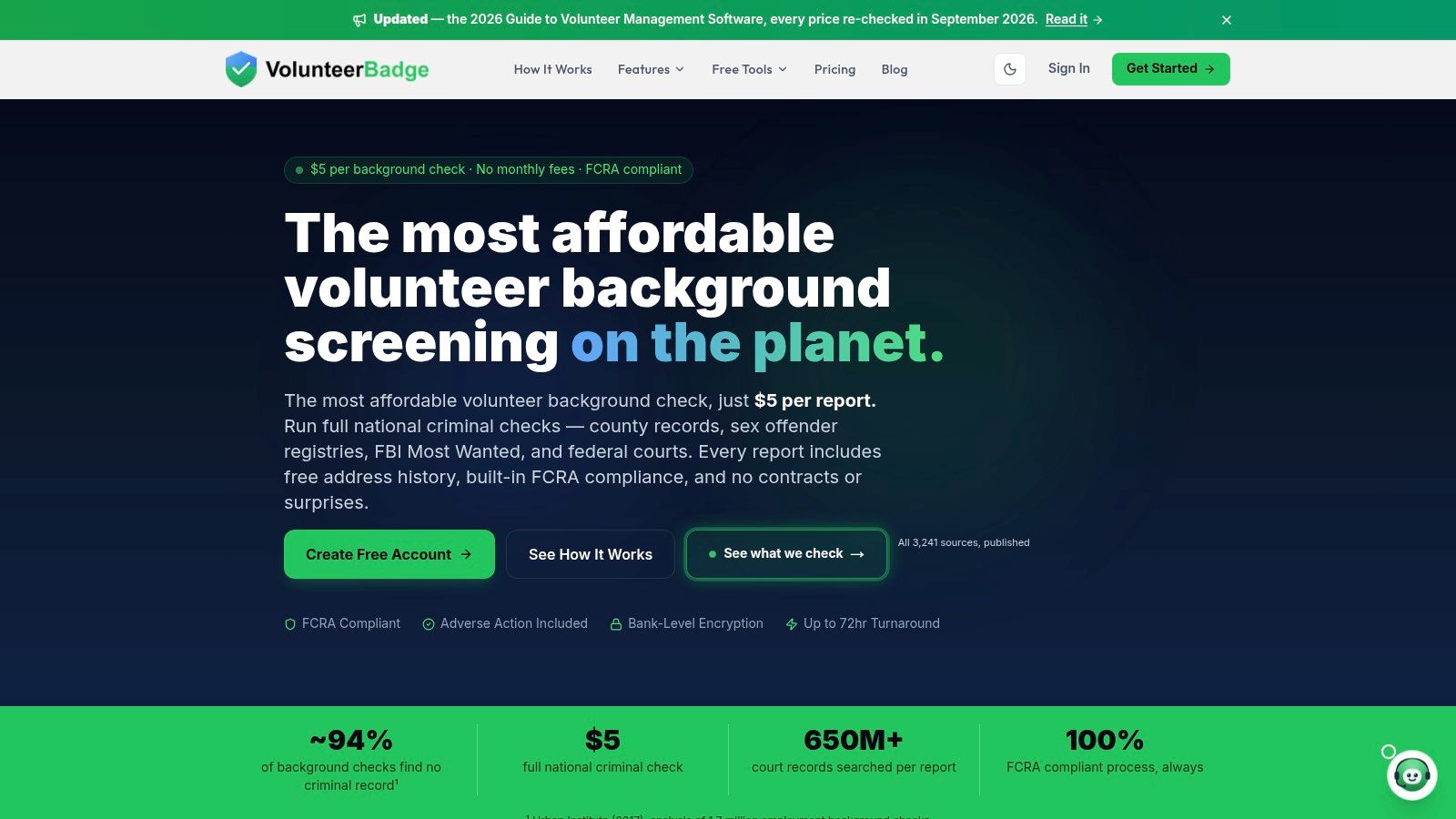
Use the screening interface as a starting point for that review.
Check the ordering gate
Run this checklist against a sample application before asking volunteers to use it:
- Dedicated document. Confirm the disclosure isn't embedded in application questions or unrelated agreements.
- Recognizable purpose. Check that the requester and intended screening purpose are clear.
- Affirmative authorization. Verify that the person must actively provide permission before ordering.
- Retrievable evidence. Locate the document version, timestamp, identity, and authorization event.
- Continuing purpose. If repeat reports are intended, check the reviewed language addressing that use.
- Clean content. Remove releases, unrelated acknowledgments, and indiscriminately combined jurisdictional notices.
- Report-type routing. Confirm that investigative-report duties are handled when applicable.
- Decision routing. Test the pre-adverse and final-notice process before an unfavorable report arrives.
Keep the evidence together through a defined compliance-documentation process. A checklist is useful only if staff can produce the corresponding records.
Choose a workflow you can actually maintain
Manual paperwork can work when someone controls document versions, checks authorization before every order, and tracks decision notices. Its weakness is the number of handoffs staff must manage correctly.
A consumer reporting agency's digital workflow is another option. VolunteerBadge offers nonprofit screening with digital disclosure and authorization, an automated address-history pull, FCRA guidance, and generated pre-adverse and final adverse-action notices. Review the actual implementation rather than assuming that built-in forms eliminate your organization's responsibilities.
For any provider, ask to see the disclosure separately from the full application, a sample authorization record, and the notice-delivery history. Also ask what happens when staff need to correct an applicant's information or investigate a disputed record.
Use the video as another opportunity to examine the screening workflow.
Assign an owner to approve the disclosure text and another operational owner to verify that authorization blocks premature ordering. Those roles can belong to the same person in a small program, but the responsibilities should still be explicit.
Your next action is concrete: open the disclosure flow, remove anything that belongs elsewhere, and retrieve a sample consent record. Run the next volunteer check only after the applicable authorization is on file.
Visit VolunteerBadge to review its digital disclosure-and-authorization workflow and nonprofit screening options. Before placing your next order, confirm the standalone text, test the consent record, and make sure your coordinator knows how to initiate adverse-action notices when needed.
