
Arrests vs Convictions: A Nonprofits Screening Guide
Arrests vs convictions explained for nonprofits screening volunteers. Learn FCRA rules, record types, and policies that protect your organization
On this page
A volunteer coordinator opens a background report for a new youth mentor and finds an arrest from years ago. The entry doesn't show whether charges were filed, dismissed, or resolved in court. The program needs to protect young people, but treating an unclear arrest as proof of wrongdoing could unfairly exclude the applicant and create compliance risk.
That's the practical challenge behind arrests vs. convictions. A report is not a decision. Your job is to identify what the record says, verify how the case ended, and assess any confirmed information in relation to the volunteer role. The question to carry through the process is simple: What does this record establish, and what does it leave unresolved?
Table of Contents
- The Tuesday Morning Dilemma Every Nonprofit Faces
- What an Arrest Actually Is and Why It Is Not a Finding of Guilt
- The Numbers Behind Why Arrests and Convictions Tell Different Stories
- How Each Record Type Shows Up on a Volunteer Background Check
- FCRA Rules That Change How You Can Use an Arrest Record
- Why a Blanket No-Arrest Policy Is a Liability for Nonprofits
- Three Volunteer Scenarios and How to Handle Each One
- Putting It All Together With a Screening Checklist You Can Use Today
The Tuesday Morning Dilemma Every Nonprofit Faces
Start by separating the safety concern from the record's legal meaning. The concern may be serious, especially for a role involving children or vulnerable adults. But an arrest entry alone doesn't tell you that the applicant committed the alleged offense, that a court found them guilty, or that the record belongs to the person you're reviewing.
A defensible response begins with verification, not rejection. Confirm the applicant's identity, identify the court or jurisdiction, and look for the final disposition. If the report doesn't include a disposition, pause the decision and seek reliable court information rather than filling the gap with an assumption.
Practical rule: An unclear record is a reason to investigate the record, not a reason to assume guilt.
That distinction protects both sides of the organization's mission. A nonprofit must take role-related safety risks seriously. It must also treat applicants fairly and follow the rules that apply to consumer reports and adverse decisions. A blanket rule that disqualifies anyone with an arrest may feel efficient, but it ignores what happened after the arrest and whether the information can legally be used.
The coordinator's next steps should be concrete: check the report for a case number and disposition, verify missing details with an authoritative source, and document what was reviewed. If a decision may adversely affect the applicant, follow the required notice and dispute process before making it final. Don't let a database entry stand in for a reasoned decision.
What an Arrest Actually Is and Why It Is Not a Finding of Guilt
An arrest is a law-enforcement action. It records that an officer or agency took a person into custody or formally processed them on suspicion of an offense. It does not, by itself, decide whether the person committed that offense.
A conviction is a court outcome establishing guilt through a guilty plea, trial verdict, or legally equivalent adjudication. That difference matters because the arrest record describes an earlier stage in a case, while a conviction describes a result reached through the legal process.
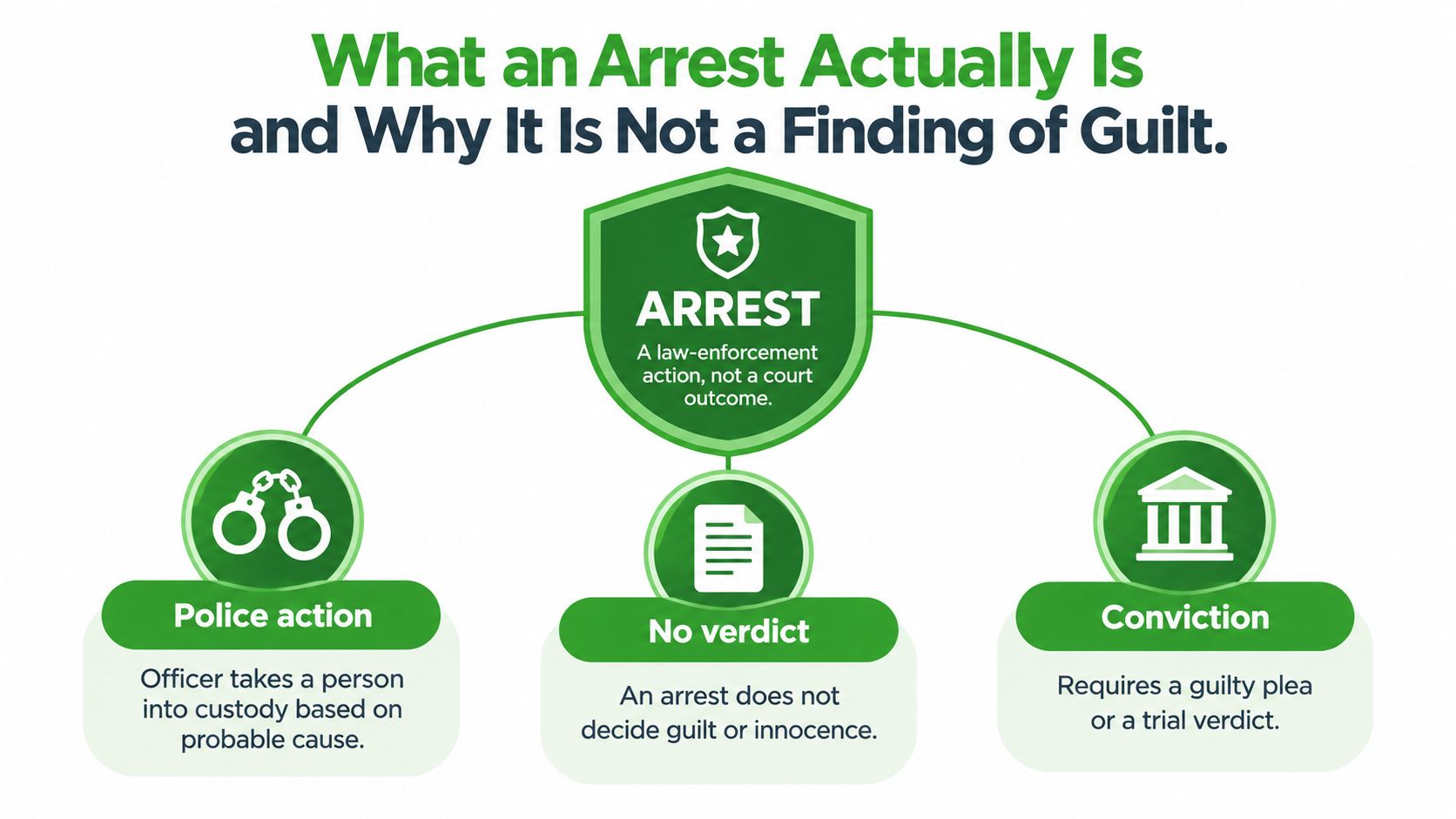
A traffic analogy makes the distinction easier to explain to a board or screening team. Being pulled over isn't the same as receiving a ticket, and receiving a ticket isn't the same as being convicted of speeding in court. Likewise, an arrest signals a law-enforcement event, not a judicial finding of guilt. The analogy isn't a legal test; it's a reminder not to confuse one stage with another.
The legal system separates these stages because allegations need to be evaluated. Prosecutors may decline to proceed, charges may be dismissed, a person may be acquitted, or a case may end through a plea or another resolution. Treating every arrest as a conviction erases those outcomes and assigns a person a conclusion the court may never have reached.
Use a clear definition in your written policy and board materials: an arrest is an allegation-related law-enforcement record; a conviction is an adjudicated finding of guilt or a guilty plea. When staff can use that distinction consistently, they're less likely to overstate what a report proves or make a decision based on an unresolved entry.
The Numbers Behind Why Arrests and Convictions Tell Different Stories
The gap between an arrest and a conviction isn't abstract. In a Bureau of Justice Statistics study of felony arrests disposed in 28 large U.S. jurisdictions, 54 of every 100 adult felony arrests produced a conviction for either a felony or misdemeanor. The same study found that 22 were rejected before formal court charges and 18 were dismissed in court, illustrating how many cases ended without a conviction at those stages of the process (BJS findings on prosecution outcomes for felony arrests).
That study helps explain why a screening team must check the final outcome. An arrest count starts with law-enforcement encounters. A conviction rate, by contrast, applies to cases that reached a particular point in court. Those are different groups, so one number can't be safely applied to the other.
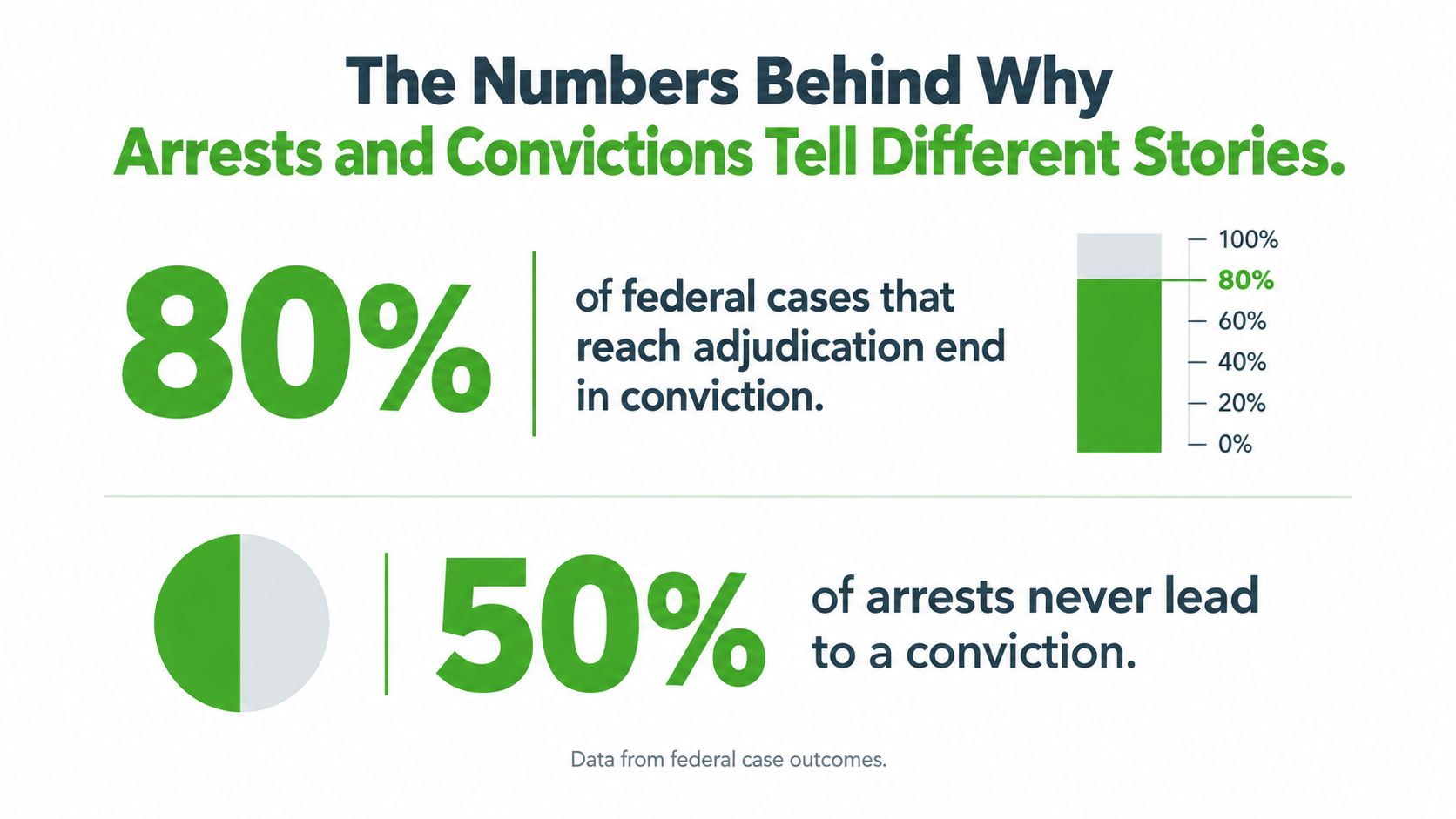
Federal data show the same denominator problem. The Bureau of Justice Statistics reported that nine in ten defendants adjudicated in U.S. district court in FY 2020 were convicted, but that figure applies to defendants whose cases reached adjudication, not every person arrested. Federal arrest totals also changed sharply, from 206,630 in FY 2019 to 78,068 in FY 2021. Those totals measure recorded arrests, not proven guilt (BJS Federal Justice Statistics for FY 2020 and Federal Justice Statistics for FY 2023).
The practical error is to multiply an arrest total by a conviction percentage and treat the result as the number of guilty people. The figures describe different points in a case funnel, with charging decisions, dismissals, pleas, acquittals, and other outcomes in between. For volunteer screening, the takeaway is direct: an arrest entry cannot substitute for a verified disposition.
The following video offers another overview of how arrests and court outcomes differ.
How Each Record Type Shows Up on a Volunteer Background Check
A report may show an arrest without a final outcome, a conviction with a court disposition, or several entries connected to the same event. Don't assume that a charge listed near an arrest is the final charge or that an initial felony allegation remained a felony after the case ended. In a tracking study covering 11 states, 70% of prosecuted felony arrests resulted in conviction, but nearly one-third of those convictions were recorded as misdemeanors rather than felonies; courts dismissed about 23% of cases and acquitted about 1% (U.S. Sentencing Commission criminal-history codebook).
Check the report before weighing the record
Look for enough information to identify the case and understand its outcome. A useful report should distinguish the original event from later court action, rather than presenting a charge as if it were a finding.
| Record Type | What It Means | Required Report Fields | Screening Caveat |
|---|---|---|---|
| Arrest-only entry | A law-enforcement event with no confirmed court outcome in the report | Arrest date, charge, jurisdiction, case identifier, and any available disposition details | Don't treat it as proof of guilt. Verify whether charges were filed and how the case ended. |
| Conviction | A guilty plea, trial verdict, or legally equivalent adjudication | Court, case identifier, disposition type and date, final offense level, and sentence if available | Confirm the final offense and outcome, not just the original allegation. |
| Dismissal, acquittal, or diversion | A non-conviction outcome or an alternative case resolution | Disposition type and date, with enough case information to verify it | Don't relabel a non-conviction as a conviction. Check applicable reporting and use restrictions. |
| Sealed, expunged, or relieved record | A record subject to a legal remedy that may affect its availability or use | Jurisdiction, record status, and reliable information about the relief granted | Don't assume every database updated, or that every retained entry may be used. |
A report deserves closer scrutiny when the identity match is uncertain, the case number or jurisdiction is missing, the disposition is blank, or the entry conflicts with the court record. A search result isn't fully useful just because it names a charge. For a practical walk-through of report fields, see this guide to reading a volunteer background check.
Record relief can complicate searches further. California guidance explains that arrests and convictions receiving automatic relief can remain on a state criminal-history record, and that relief isn't the same as dismissal, sealing, or expungement. For an individual-oriented overview of the issue, consult this resource on how to protect your record after expungement. The coordinator's job is to verify the legal status and final outcome, not infer them from a database label.
FCRA Rules That Change How You Can Use an Arrest Record
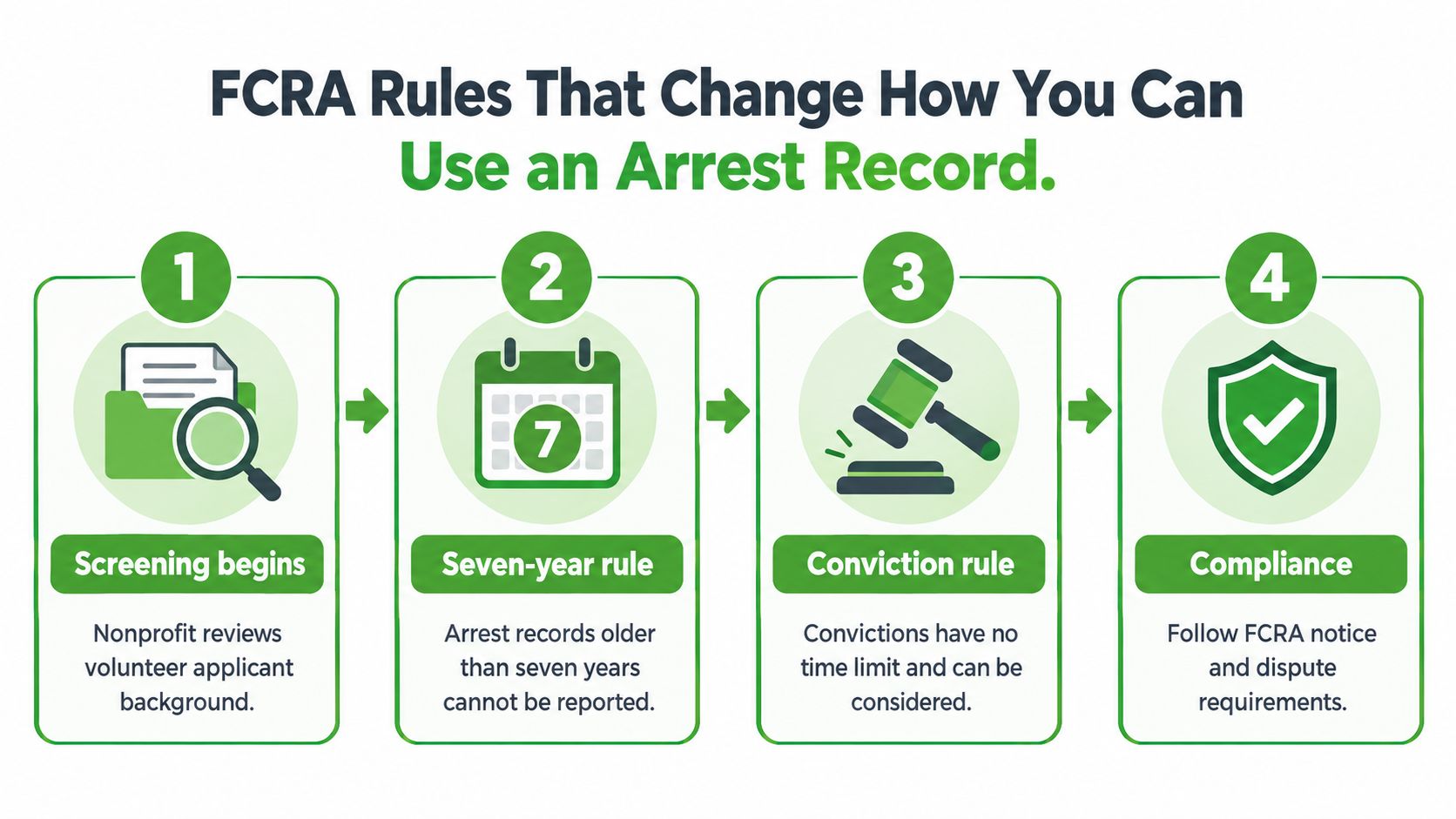
When a nonprofit uses a consumer reporting agency for volunteer screening, the Fair Credit Reporting Act (FCRA) governs important parts of the process. The details matter. An arrest that didn't lead to conviction may be subject to federal reporting limits, including the FCRA's seven-year rule for certain information, while federal law generally doesn't impose the same time limit on conviction records. State law may add restrictions, and a consumer reporting agency's duties are not the same as the nonprofit's responsibilities when making a decision.
Build the workflow around notice and review
Before requesting a report, provide the required disclosure and obtain the applicant's authorization. The disclosure must meet FCRA requirements; don't bury it in a broad application packet or assume that a signature on an unrelated form is enough. A criminal background report also needs a permissible purpose, and the organization should limit access to people with a legitimate screening role.
If a report may lead you to deny or restrict a volunteer opportunity, don't jump straight to a final decision. Provide a pre-adverse action notice, a copy of the report, and the required summary of rights, then allow the applicant an opportunity to review and dispute inaccurate or incomplete information. After considering any response and following the applicable process, send a final adverse action notice if the decision remains unchanged.
An unresolved arrest is not a shortcut around verification, individualized review, or required notices.
The numbers on online records underline why accuracy deserves attention. Recent research estimates that more than 10 million arrests and 14.7 million criminal court proceedings are published online by government agencies each year, and approximately one in five people in the study sample had criminal-record information on the internet (research on online criminal-record information). A record's presence online doesn't establish that it is current, correctly matched, or legally usable.
Train coordinators to record what they reviewed, which details they verified, how the record relates to the volunteer role, and which notices they sent. For an overview of how these obligations apply to criminal checks, see whether the FCRA applies to criminal background checks. The process is part of compliance, not paperwork after the decision.
Why a Blanket No-Arrest Policy Is a Liability for Nonprofits
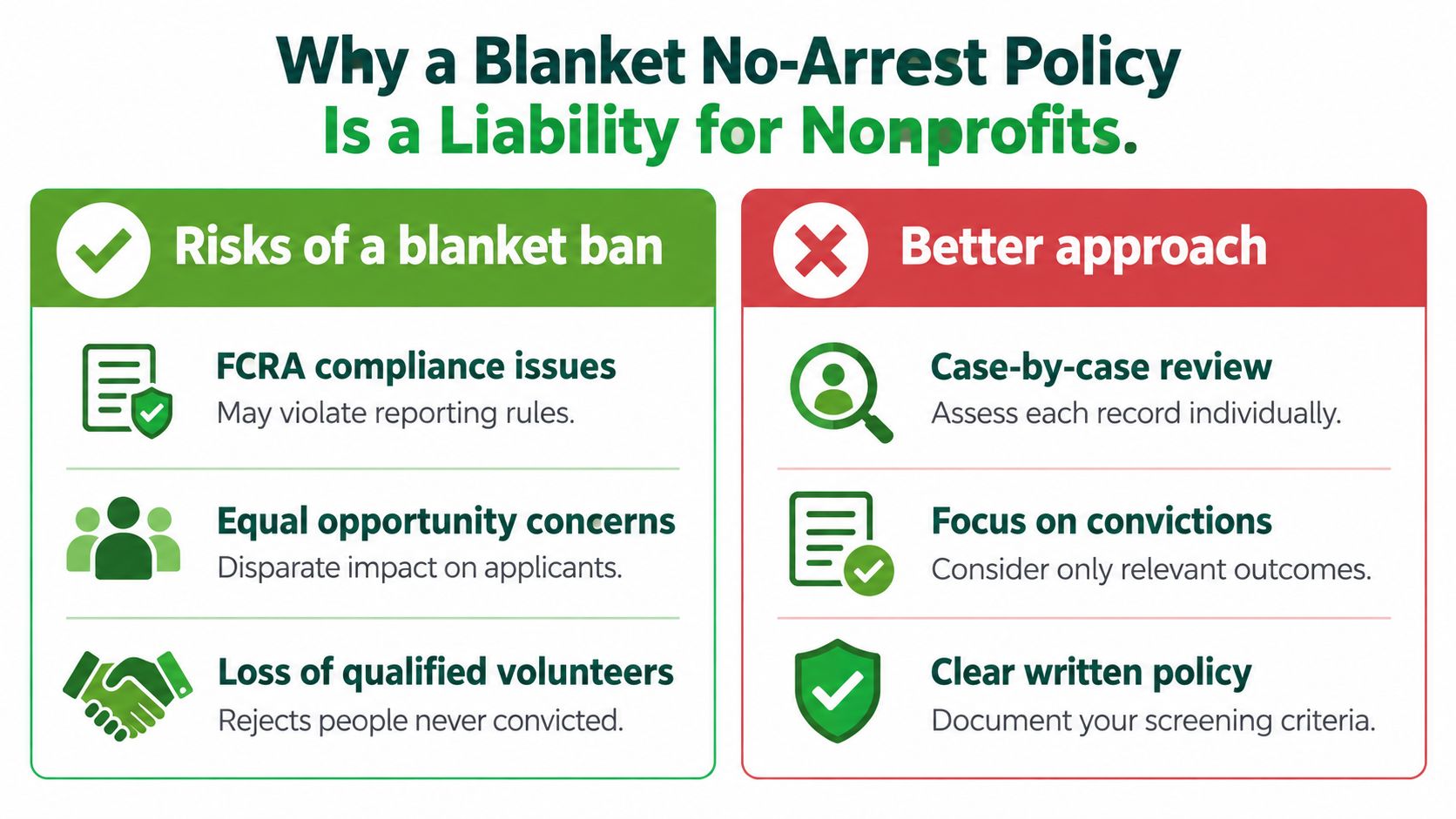
A policy that automatically rejects anyone with any arrest is easy to administer and difficult to defend. It treats an allegation like an adjudicated result, ignores the case's disposition, and can exclude people who were never convicted. A rule that looks simple on paper may also conflict with applicable reporting limits, fair-chance requirements, or the organization's obligation to make an individualized, role-related assessment.
The Equal Employment Opportunity Commission has also cautioned that arrest records alone don't establish that criminal conduct occurred. Its guidance focuses on how criminal-record exclusions can create employment discrimination concerns, including when a policy has a disparate impact and isn't sufficiently job-related and consistent with business necessity. Volunteer roles may raise their own legal questions, so nonprofits should get advice on how relevant requirements apply to their programs instead of assuming a single rule covers every situation.
Replace the blanket rule with a documented assessment
A defensible policy should ask whether the information is verified, what the final disposition was, and whether a confirmed conviction is relevant to the specific role. A theft conviction may raise different concerns for a role handling donations than for a role with no access to funds. A past offense involving violence may require careful review for a youth-facing position, but an arrest that ended without conviction cannot be treated as a proven offense.
Assess the nature of the conduct, the time elapsed, the final outcome, the duties involved, and any relevant evidence of rehabilitation. Give the applicant a meaningful chance to correct errors or provide context, and document why the information does or doesn't affect the role.
Policy language can be straightforward: “The organization reviews verified criminal records individually. An arrest without a conviction is not, by itself, grounds for exclusion. Decisions consider the final disposition, the relevance of verified information to the volunteer role, applicable law, and the applicant's opportunity to respond.”
That rule won't remove every hard call. It will make the organization explain its decision rather than hide behind a shortcut. Use a written volunteer screening policy that applies the same review process consistently, while allowing the organization to address genuine, role-specific safety concerns.
Three Volunteer Scenarios and How to Handle Each One
A food bank applicant has an older misdemeanor theft conviction. First verify that the case and identity match, then confirm the final offense, disposition date, and sentence or completion information. Consider whether the volunteer will handle cash, donor records, or inventory. Ask the applicant for context and relevant evidence of rehabilitation, then document why the confirmed conviction does or doesn't create a role-related concern. Don't let the original arrest charge replace the final court outcome.
A youth sports coach's report lists a dismissed assault charge from college. Confirm the dismissal with reliable court information and correct any inaccurate or incomplete report entry. Since the case ended without conviction, don't describe it as proof that the applicant committed assault. Follow the organization's usual safeguarding checks and role assessment, and document that the charge was dismissed rather than treating the arrest as a conviction.
A faith-based mentor's report includes older arrests, but no convictions. Don't add together arrest entries and treat the total as proof of conduct. Verify each event and its disposition, check whether any record is subject to legal relief, and give the applicant a chance to identify errors. California reporting guidance says records receiving automatic relief can remain on a state criminal-history record, and that relief is distinct from dismissal, sealing, or expungement (California guidance on automatic record relief). A lingering database entry doesn't tell you by itself what may lawfully be considered.
Use the same pattern in each case: verify identity, confirm the outcome, assess the actual role, invite a response where appropriate, and document the reasoning. That gives the organization a record of a fair process, not just a yes-or-no answer.
Putting It All Together With a Screening Checklist You Can Use Today
Before acting on a hit, confirm the applicant's identity, case details, and final disposition. Separate arrests from convictions, check applicable reporting and use limits, and assess verified information against the specific volunteer role. If the report may prompt an adverse decision, follow the required FCRA notices and dispute process, then document the final decision.
For organizations that need a screening workflow, VolunteerBadge is a licensed consumer reporting agency offering nonprofit volunteer background checks, digital disclosure and authorization, plain-English results, and adverse-action notice support. Choose a process your team can explain, apply consistently, and review when records are incomplete.
Use this checklist in your next screening review, then update your written policy so every coordinator follows the same verification and decision steps. VolunteerBadge provides FCRA-compliant volunteer background screening with clear results and adverse-action workflow support. Visit VolunteerBadge to review its screening options for nonprofits.
