
How Long Does Background Check Take
How long does background check take. How long does a background check take for volunteers? Learn realistic timelines, what slows things down, and how nonprofits
On this page
Routine volunteer background checks return in 24 to 48 hours for clean, automated results. A fully compliant eligibility decision usually takes 3 to 7 business days once you factor in identity resolution, FCRA notice steps, and any dispute window.
If you're trying to schedule a first shift, a Sunday service team, or a youth sports sideline, that difference matters more than the marketing copy. People ask how long a background check takes and get a single number back. That answer is usually wrong for nonprofits, because the report arrival time and the cleared-to-volunteer time are not the same thing.
Table of Contents
- Timeline Most Articles Skip
- How a Volunteer Background Check Actually Moves
- What Slows Down a Volunteer Background Check
- Routine Checks Versus Exception Cases
- When the Report Does Not Mean You Are Done
- Why Instant Results Are a Red Flag
- Two Realistic Volunteer Scenarios From Order to Clearance
- Planning Checklist for Volunteer Coordinators
Timeline Most Articles Skip
Most articles sell a fantasy of instant screening or quote one tidy number and stop there. That is not how volunteer screening works. The question that matters is not when a report lands in a dashboard, it is when you can safely and compliantly put a volunteer in front of children, clients, or the public.
Clean checks are fast because they do not need a human to untangle anything. The UK government says 88% of Basic DBS checks were completed within 48 hours in 2024, and those checks usually stay inside central processing because they cover unspent convictions and cautions without a local police-force review (DBS basic checks guide). That is the kind of case where the report really can be quick.
The clock changes the moment deeper screening enters the picture. DBS standards allow up to 14, 28, or 60 days depending on the disclosure type, and police-force involvement has its own service targets up to 60 days (DBS basic checks guide). In the U.S., an FBI Identity History Summary moves faster by electronic submission than by mail, with the government's FAQ saying online requests are typically about 5 to 10 days after receipt and mailed requests can take up to two months (FBI Identity History Summary FAQs).
Practical rule: report availability is a vendor timeline, eligibility clearance is a compliance timeline. Confusing those two is how coordinators over-promise and miss a start date.
If you need a simple benchmark, keep this in mind. Hours to two days for a clean automated result, longer when the check touches local records, fingerprint workflows, or disputes. The same mistake shows up in how long for new cert card, where the useful answer depends on the stage of the process, not the first automated response.
For nonprofit teams, the better reference is a turnaround-time definition like the one in this overview of what turnaround time means, because that is the metric you can manage with volunteers and program staff.
How a Volunteer Background Check Actually Moves
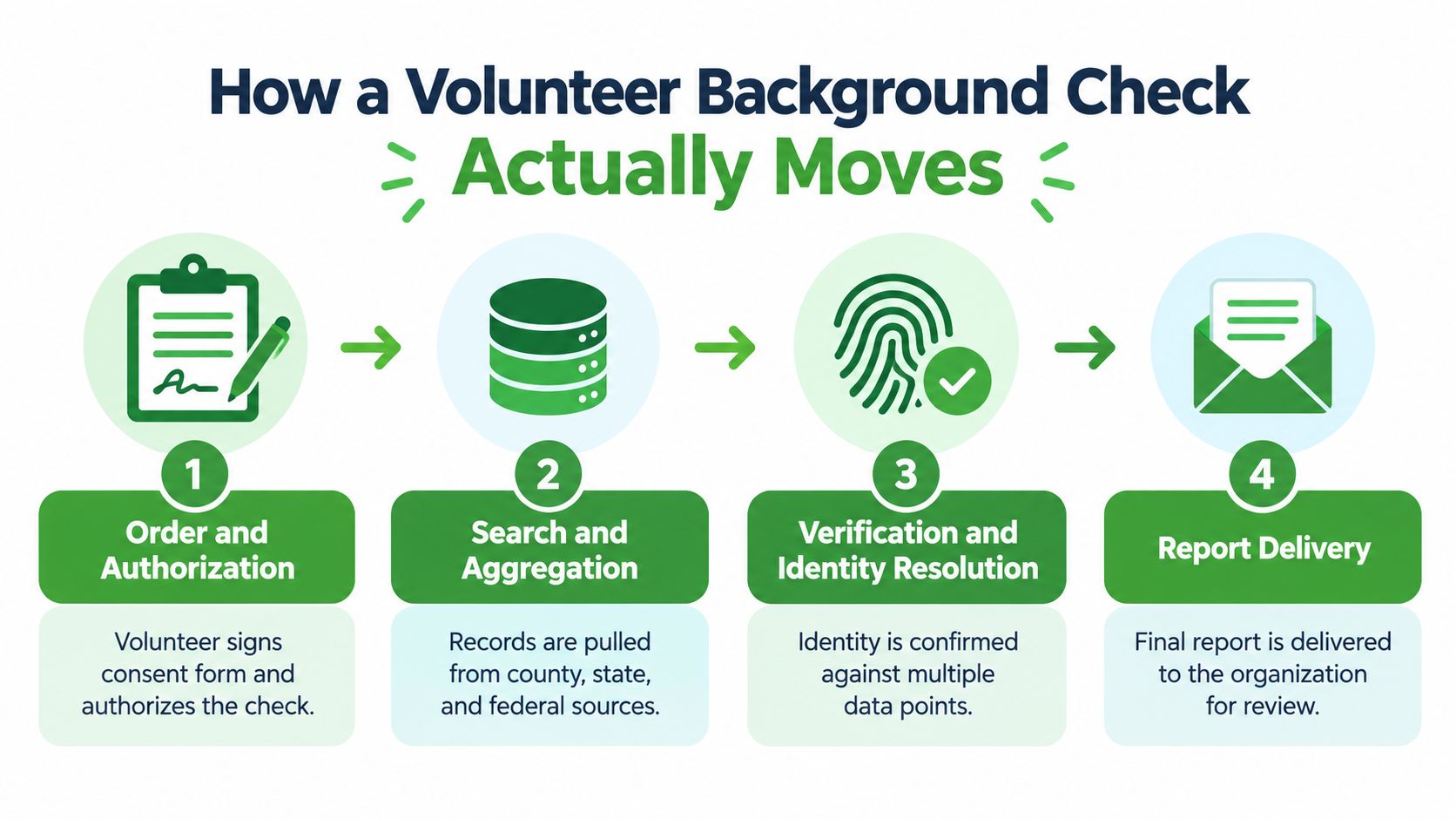
Stage 1 Order and authorization
The first delay is usually self-inflicted. If the volunteer hasn't signed disclosure and authorization, nothing else can legally start under the FCRA framework. A clean intake form, a working email address, and one consistent legal name keep this stage short.
Coordinators lose time by trying to "save" a day. They send incomplete forms, accept nickname-based entries, or forget to collect prior addresses. Then the provider has to circle back, and the check sits idle while everyone wonders why it's not moving.
Stage 2 Search and aggregation
The actual screen happens here. National criminal databases, sex offender registries, OFAC sanctions, federal watchlists, and jurisdictional sources get queried and cross-referenced. Most of the promise of a 24 to 48 hour turnaround lives here, because modern systems can pull routine results quickly when the identifiers line up.
That speed does not mean every result is done. It means the system has found enough information to generate a report, which may still need review if a potential match appears. The report can be fast without being final.
Fast search results are only useful if the source data is clean enough to trust.
Stage 3 Verification and identity resolution
Timelines stretch here. Address history, date of birth, aliases, and county-level source checks reduce false matches, but they also create the possibility of manual review when records are incomplete or inconsistent. If the system can't confidently match the volunteer, a human has to verify what the database could not.
That's also why the same order can move at two very different speeds depending on the person applying. One applicant is a straight-through case. Another triggers county retrieval, clarification, or an exception path.
Stage 4 Report delivery and decision
The report gets delivered first, the decision comes after. That distinction matters because the report can be sitting in your inbox while the legally defensible answer is still pending. A provider may return the file quickly, but your organization still has to review it, document the result, and handle any follow-up correctly.
For teams comparing screening workflows, proof of traction for backers is a useful concept because it shows the same operational split between a data return and a trust decision. In volunteer screening, the workflow only counts when both have happened.
What Slows Down a Volunteer Background Check
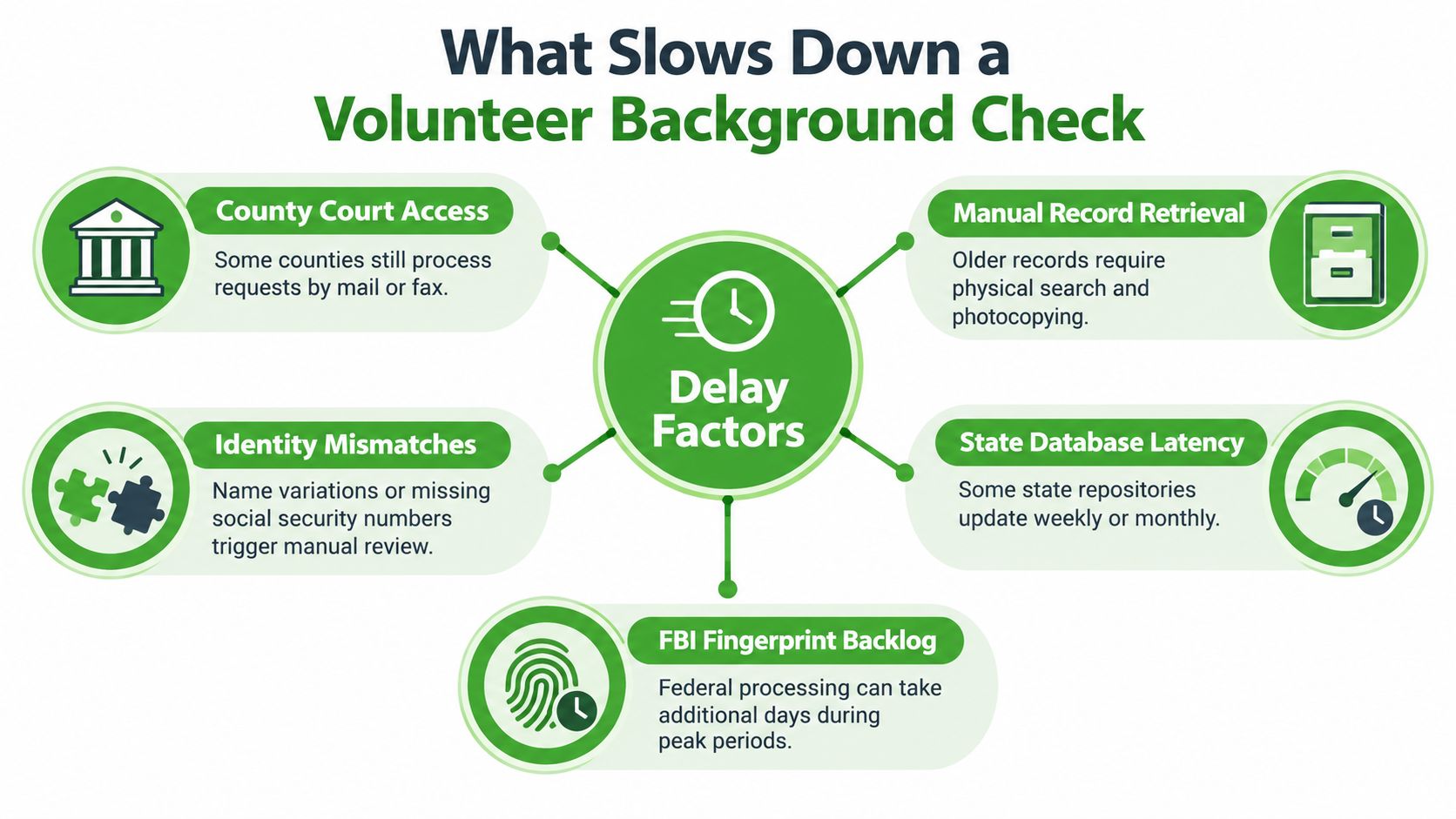
The delays usually come from five places, and none of them are mysterious. County access, manual retrieval, identity mismatches, state database latency, and federal fingerprint review all create different kinds of waiting. Once you know which one you're in, the timeline stops looking random.
County access and manual retrieval
Some counties still don't behave like modern software. The provider may have an index pointer, but the actual file lives at the courthouse, which means someone has to retrieve it. If the courthouse is backlogged, short-staffed, or still handling requests by mail or fax, the check slows down immediately.
That's why a volunteer with prior residence in a hard-to-access county often takes longer than someone with a single, tidy record trail. It isn't the person's fault, and it isn't the provider's “processing speed” in the marketing sense. It's source access.
Identity mismatches and address gaps
A common-name volunteer with a missing address history is a problem the screener can't ignore. The system needs enough data to avoid attaching someone else's record to the wrong person. When it doesn't have that confidence, a human review kicks in.
Coordinators should look at the intake form before they blame the vendor. If the volunteer changed names, skipped a prior address, or entered partial identifiers, the search is more likely to hit a manual lane. That's not an exception, it's a predictable outcome.
Watchlist hits and secondary verification
A watchlist or sanctions hit doesn't mean someone is disqualified. It means the provider has to verify whether the hit is real or a false match. That secondary check adds time, and it should.
For nonprofit teams, the mistake is treating a “hit” as the finish line. It's only the point where the work gets more careful. For a deeper look at manual verification thinking, the Florida business forensic audit steps page is a useful parallel because it shows how document review slows down once evidence has to be checked line by line.
Operational reality: if the record source can't be confirmed cleanly, speed drops. That's normal. What's not normal is a provider hiding the cause.
For a practical explanation of why these delays happen, this guide on why background checks take so long is worth reading alongside your own intake workflow. It'll help your team spot the difference between a routine delay and a process failure.
Routine Checks Versus Exception Cases
A clean-path volunteer is easy to spot before you submit the order. The person uses a current legal name, has a complete address history, and doesn't create extra identity work. Those checks usually move fast because the system can match what it sees without asking for help.
An exception case looks different on intake. Multiple states, a recent name change, a common surname, or missing identity data all push the order toward manual verification. Those are the volunteers for whom you should stop promising same-day clearance.
Clean-path profile
- Current legal name: the name on the form matches the identity data the provider uses.
- Complete address history: there are no unexplained gaps that force backfilling.
- Single-country or local history: fewer source jurisdictions to confirm.
- No ambiguous identifiers: date of birth and other fields line up cleanly.
Exception profile
- Name changes or aliases: the provider has to verify whether records belong to the right person.
- Multiple residences: extra jurisdictions can pull the order into a longer lane.
- Potential record hit: a possible match means human review before clearance.
- Role sensitivity: programs serving minors usually need a more disciplined process, not a looser one.
The fastest way to predict timing is to sort volunteers before you order the check. If the intake form is sloppy, the timeline will be sloppy too. If the intake form is clean, the report is much more likely to arrive inside the normal window.
Recommendation: tell volunteers the timing bucket up front. “Routine checks return in about two days, exception cases take longer” is honest. “We'll get back to you soon” is not a process.
Here's the simplest decision rule. If the applicant looks like a routine match, plan for quick report delivery and a short review. If the applicant has identity friction, plan for a slower path and don't build the calendar around wishful thinking.
| Day | Clean-Path Volunteer | Exception-Path Volunteer |
|---|---|---|
| 1 | Authorization submitted, search starts | Authorization submitted, search starts |
| 2 | Clean report delivered, coordinator reviews | Possible match or county pull appears |
| 3 | Eligibility decision issued | Pre-adverse notice or verification step begins |
| 4 to 5 | Volunteer cleared and scheduled | Volunteer responds with context, provider verifies |
| 6 to 7 | First shift or service assignment | Final review continues |
| 8 to 10 | Not usually needed | Final clearance if a record or identity issue had to be resolved |
When the Report Does Not Mean You Are Done
A returned report is not the same as a cleared volunteer. If the report may support an adverse decision, the workflow still has to include disclosure, authorization, a copy of the report, a summary of rights, and a real chance to dispute inaccurate information. That is the legally careful path, and it takes time.
The sequence is simple. A coordinator reviews the report, sends a pre-adverse action notice if needed, waits for the volunteer to respond, and then checks whether any corrected detail changes the outcome. If the volunteer points out a mismatch, an incomplete record, or a file that belongs to someone else, the timeline stretches until the issue is resolved.
That is why a “clean report in 24 hours” and a “cleared volunteer in 24 hours” are different statements. The first may be true. The second is usually sloppy.
For nonprofits, the risk sits right there. Staff see a result and move too fast. The better move is slower and more defensible, because a fair review protects the volunteer and the organization at the same time.
Consumer reporting agencies are expected to use reasonable procedures to achieve maximum possible accuracy (FTC background checks guidance). If there is a dispute or identity conflict, the process does not end at the first hit. It keeps going.
The EEOC also expects criminal-history decisions to be narrowly scoped and individualized, not automatic (EEOC enforcement guidance). That is why the final decision can land several business days after the report arrives, and that delay is part of compliance, not a system failure.
For teams that need a practical reading guide, how to read background check results is a useful companion. A lot of wasted time comes from reading a status line as a final decision.
Why Instant Results Are a Red Flag
“Results in under a minute” sounds impressive until you ask what got checked. If the system only returns a raw database hit, with no identity resolution, no address history check, and no adverse-action workflow, the process is fast, but it is not reliable.
That kind of speed creates false confidence. A record can attach to the wrong person, a same-name match can slip through, and a program can act before the file has been reviewed properly. Speed matters only after the underlying process holds up.
A fast screen that skips verification is fragile.
The legal issue is straightforward. Criminal history decisions have to consider the nature of the conduct, the time elapsed, and the role involved before anyone makes a final call. An instant hit does not do that work for you, and 15 U.S.C. § 1681b does not give anyone a shortcut around the required steps.
Disclosure, authorization, and adverse-action notices exist so the person can review questionable information and respond before the decision is final. Those steps are the workflow itself, not a formality attached to it.
A slower, documented process is the safer choice. Nonprofits need a screening result they can explain to a parent, a board member, or a regulator without scrambling to defend a rushed decision.
If a vendor cannot explain how it resolves identity, handles disputes, and documents notices, keep looking. The first minute is the easiest part of the job.
Two Realistic Volunteer Scenarios From Order to Clearance
A youth soccer coach submits authorization Monday morning. The identity details match cleanly, the report arrives that day or the next, and the coordinator reviews it before assigning a Saturday sideline shift. The coach is cleared by day 3. That is the routine path coordinators can use for straightforward scheduling, provided the review is complete.
A church volunteer for youth ministry follows a different route. Two prior addresses in different states, a name change, and a possible county match require additional review. The initial report arrives flagged within 48 hours. The coordinator sends pre-adverse notice, the volunteer provides context, and the provider verifies the county record before the organization makes its final eligibility decision. Clearance falls between day 8 and day 10, not when the first report appears.
Those timelines measure different events. Report-arrival time tells you when information first comes back. Eligibility-decision time tells you when the organization can responsibly finish the process. Nonprofits should communicate the second metric, because a returned report does not automatically authorize service.
The difference between these volunteers is identity complexity. Each extra name, address, or possible record match creates another point for review. A clean report may support a quick decision, while a flagged report can require notices, a response period, and record verification.
That distinction should shape scheduling. Give a coach with a clean identity profile a near-term start date only after the coordinator completes the review. Give a youth-ministry volunteer more time, because the organization may need to finish the notice and verification process before deciding eligibility.
Use the slower realistic path for roles tied to a fixed start date. Promising Saturday service based only on the fastest report time leaves no room for a county review or volunteer response. A schedule built around final clearance is easier to explain to volunteers, families, and program staff.
Planning Checklist for Volunteer Coordinators
Start with intake. Collect the volunteer's legal name, prior addresses, and any name changes before you order the check. Ask for the information once, clearly, and don't let a half-finished form into the queue.
Then set expectations in plain language. Tell volunteers whether you're planning around a routine return or whether identity verification could extend the timeline. That conversation prevents the awkward “why is my check taking so long” emails that clog your inbox later.
Put the calendar on the slowest realistic path. If the person is meant to serve on a specific date, build in extra time for verification and any notice steps. A good workflow doesn't pretend every file will be clean.
Before you sign with a provider, ask these questions:
- Which sources are queried? You want to know whether the screen reaches the county, state, federal, and watchlist sources you care about.
- How is address history handled? If the provider can't explain this clearly, expect more false matches later.
- What happens if a county record can't be verified? The answer should be concrete, not vague.
- Are adverse-action notices automated? If not, staff will be doing manual admin work.
- Is pricing transparent? Hidden fees and monthly minimums create avoidable friction.
A coordinator-friendly service should make the process easier to explain, not just faster on a slide deck. It should support FCRA-compliant steps, return plain-English results, and handle the messy cases without making your team improvise. If you're comparing options, VolunteerBadge is one platform built for nonprofits that need that kind of workflow.
If you want a screening process that treats report arrival and clearance as two separate milestones, use VolunteerBadge as your next benchmark. It's built for nonprofits that need fast, FCRA-compliant volunteer screening without guessing when a person is cleared.
