
National Criminal History Records Check: Nonprofit Guide
Learn what a national criminal history records check involves for nonprofits, including why it matters, how to run one, and key compliance steps to follow.
On this page
The most popular advice about a national criminal history records check is also the most dangerous: order one, wait for a green light, and treat the result as proof that a volunteer is safe. That model is wrong. A national search is a useful screening layer, but it's a federated patchwork of records with uneven coverage, identity risks, and missing case outcomes.
Nonprofits get into trouble when they confuse breadth with certainty. A clean report can miss a record from a jurisdiction that hasn't reported it, while a database hit can belong to someone with the same name. The defensible process is straightforward: search broadly, verify locally, distinguish arrests from convictions, and give the applicant a fair chance to challenge inaccurate information.
Table of Contents
- What “National” Really Means
- What the Search Actually Covers
- Why a Database Hit Is a Lead, Not Proof
- FCRA Rules Nonprofits Can't Skip
- A Volunteer Screening Walkthrough
- Nonprofit Best Practices Checklist
- Putting the Layers to Work
What “National” Really Means
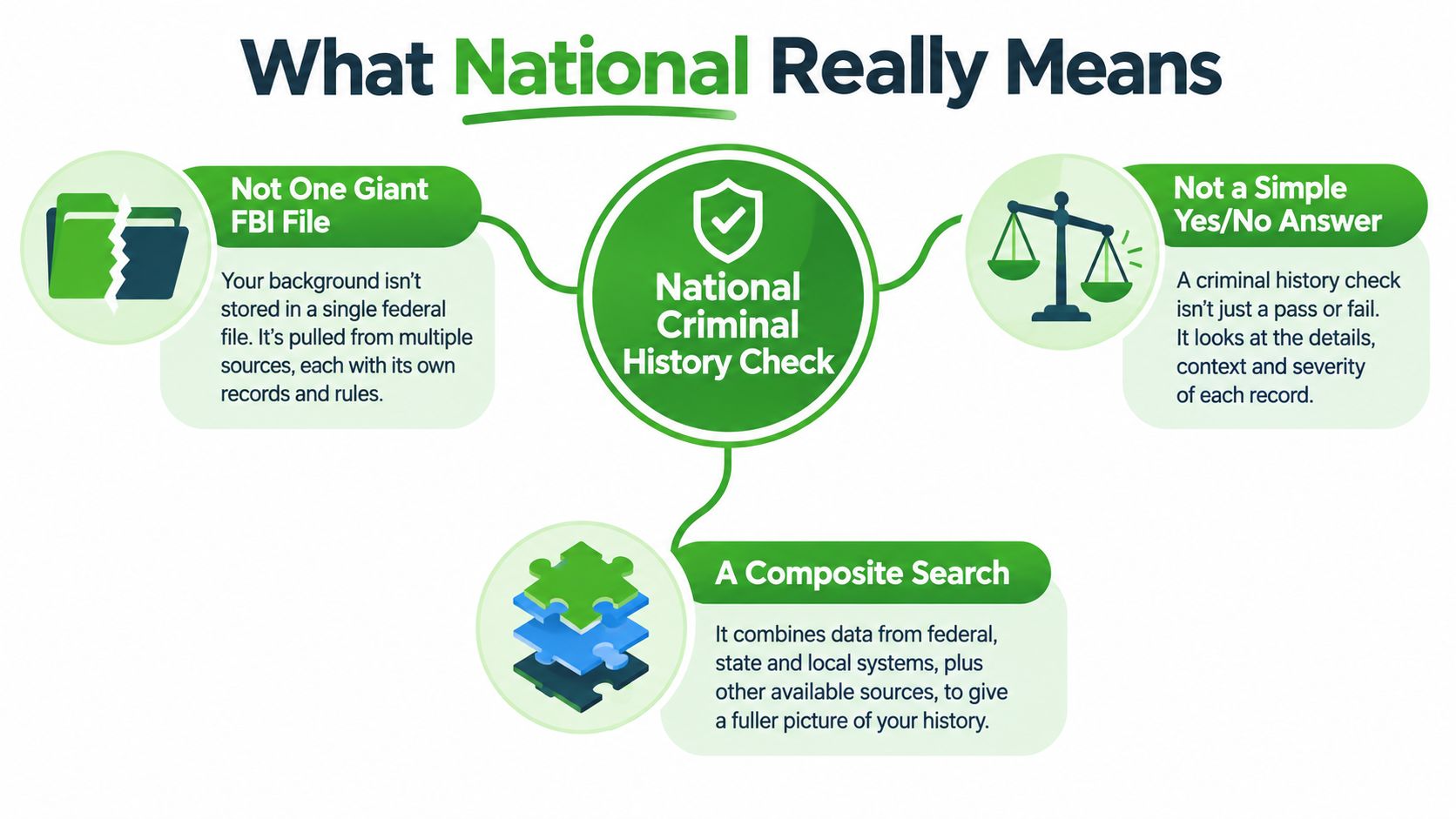
“National” doesn't mean one complete FBI file. It means a vendor combines searches across multiple systems, jurisdictions, and record sources, then presents the results in one report. Think of it more like a search engine than a single courthouse clerk. The interface looks unified, but the underlying records remain distributed.
That distinction matters for churches, youth leagues, schools, libraries, and charities. A national criminal history records check can help identify where a person may have a record, but it usually cannot prove that every relevant court has supplied complete and current information.
The record system is large, but not uniform
The Bureau of Justice Statistics survey of state criminal-history information systems covered repositories in all 50 states, the District of Columbia, and Guam. Those repositories contained records for 114,376,500 people, and more than 95% of the records were automated. That scale can make a report feel definitive, but automation doesn't guarantee completeness.
In 49 states and the District of Columbia, an average of only 69% of arrests in state databases had a final court disposition reported, according to the same survey. An arrest entry may not reveal whether prosecutors declined charges, a court dismissed the matter, the person was acquitted, or the person was convicted.
So a report can be both digitally advanced and incomplete. The system may retrieve an arrest record without its final outcome, or fail to retrieve a record because the relevant jurisdiction hasn't transmitted it or the vendor can't access it.
Treat the national search as the first layer
A responsible policy separates four questions:
- Where might a record exist?
- Does the record belong to this applicant?
- What happened in the case?
- Does the verified conduct matter under the organization's written policy?
The national search mainly helps answer the first question. County and state verification address the second and third. Your screening policy addresses the fourth.
That's why a nonprofit shouldn't buy a product based only on claims such as “nationwide coverage” or “instant results.” Ask which county courts, state repositories, federal courts, registries, and watchlists the vendor searches. If your organization also needs context about federal records, review this guide to a federal criminal background search.
Practical rule: A clean national report is reassuring. It isn't a legal finding that the applicant has no criminal history.
The right mental model saves money, too. A cheap automated search that produces an unverified hit can create hours of staff work, applicant disputes, and legal exposure. A more useful service identifies potential records, explains the source, and supports the follow-up needed to make a fair decision.
What the Search Actually Covers
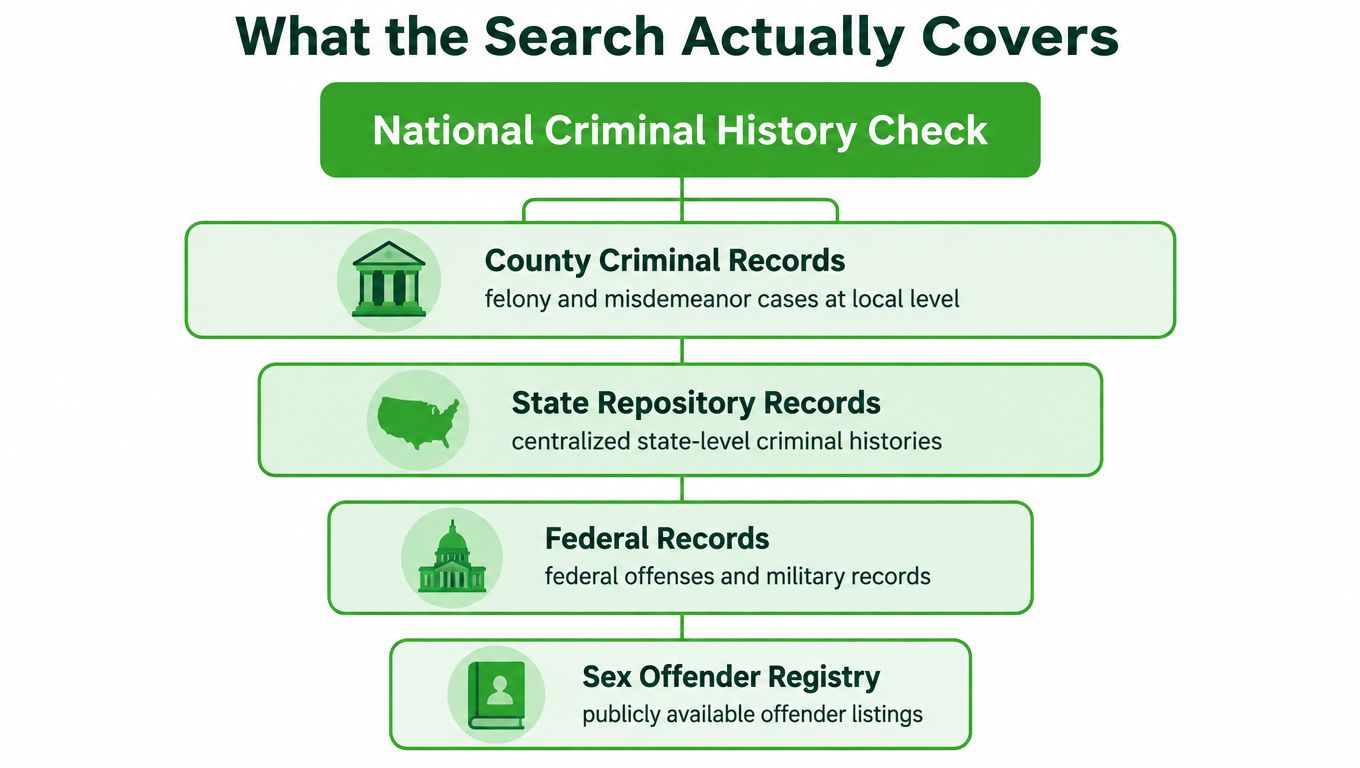
A serious national criminal history records check is a collection of searches, not one database query. Each layer answers a different risk question, and each has limits that should appear in the vendor's product description.
County and state criminal records
County court searches can surface felony and misdemeanor cases filed where the applicant lived, worked, or attended school. They're often the key verification layer because the originating court may contain docket entries, charges, disposition information, and sentencing details that a national index only points toward.
State repositories provide centralized criminal-history information where available. Their coverage and reporting practices vary, and a repository record may still lack a final disposition. A vendor that searches only a state database may miss local records or present an incomplete case history.
Ask whether the product searches actual county courts or merely relies on a compiled database. Those are not interchangeable services.
Federal records and interstate indexes
Federal court searches address offenses prosecuted in U.S. District Courts. They can matter when a volunteer's conduct or history falls outside ordinary state criminal dockets. Federal records shouldn't be assumed to appear in a county or state search.
The Interstate Identification Index, or III, connects the FBI and participating state repositories. It helps route inquiries to relevant criminal-history information, but it doesn't replace verification of the underlying state or county record.
The federal background-check framework illustrates this layered design. The Brady Handgun Violence Prevention Act was enacted on November 30, 1993, and NICS became operational on November 30, 1998. The Department of Justice Office of Inspector General's description of NICS explains that it coordinates checks against the III, the National Crime Information Center, and the NICS Index. NICS is a coordinated search, not one universal criminal-record file.
Registries and watchlists
A broad screening package may also include:
- Sex-offender registries, including state registries and the national public search operated through the NSOPW.
- OFAC sanctions lists, which address sanctions-related concerns rather than ordinary criminal convictions.
- Global watchlists, where the vendor identifies records or alerts outside U.S. criminal courts.
- The FBI Most Wanted list, which addresses a specific public-safety concern and isn't a substitute for court research.
These sources answer different questions. A registry search isn't a misdemeanor search. An OFAC result isn't proof of a conviction. A watchlist alert still requires identity analysis and, where appropriate, source verification.
Before purchasing, request a written coverage matrix. It should say whether the product includes county, state, federal, registry, sanctions, and watchlist searches, and whether potential records are verified before they appear as adverse information.
A vendor that lists every layer clearly is easier to evaluate than one that uses "national" as a catch-all marketing label. The practical question isn't whether the report sounds thorough. It's which sources were searched, what identifiers were used, and what happens when a possible match appears.
Why a Database Hit Is a Lead, Not Proof
A database hit tells you that a record may resemble the applicant's identifying information. It doesn't establish that the applicant is the person named in the record, and it doesn't establish the final legal outcome.
Common names create obvious problems, but they're not the only ones. Maiden names, aliases, misspellings, relocations, incomplete address histories, and inconsistent data entry can all produce false positives. Missing or stale records can create false negatives.
Identity comes before judgment
The III is a useful example. It acts as an index-pointer network connecting criminal-history information, not as a complete file containing every underlying court document. A pointer should send the screening team to the originating repository or court for confirmation.
The Government Accountability Office's review of FBI name checks and fingerprint searches reported that DOJ research found FBI fingerprint searches preferable to III name checks for employment and licensing screening. The concern is simple: relying on a name alone can unfairly exclude someone who doesn't have the disqualifying record.
Your vendor should compare more than a name. The matching process should use legally permissible identifiers such as:
- Full legal name and reported aliases
- Date of birth
- Address history
- Jurisdiction connected to the record
- Case identifiers and offense details
- Other permitted identifiers that help distinguish people
Don't let a vendor's “possible match” label become an automatic rejection. A match is a research task.
Disposition is the second verification
An unresolved arrest isn't the same as a conviction. The distinction is especially important because state repositories often contain arrest information without a documented final outcome.
A January 2025 SEARCH report found that only 73% of all arrests and 71% of felony arrests in state computerized criminal-history repositories had final dispositions attached, leaving a substantial share without a documented outcome, as summarized in this overview of criminal record checks and disputes.
That gap changes the decision process. When a report shows an arrest, the reviewer must determine whether the case was dismissed, resulted in an acquittal, ended in a conviction, remains pending, or falls under a legally protected category such as a sealed or expunged matter.
A record that hasn't been verified is not a defensible reason to exclude a volunteer.
The right response to a hit is controlled escalation. Confirm the identity first. Then retrieve the originating court record. Review the disposition and relevant dates. Apply the same written criteria used for every person in the same volunteer role. If the applicant disputes the result, pause the decision while the dispute is investigated.
FCRA Rules Nonprofits Can't Skip
Many nonprofit leaders assume the Fair Credit Reporting Act only matters to large employers. That's a costly assumption. If an organization obtains a consumer report for employment-like screening, including a volunteer role involving children, vulnerable adults, or financial responsibility, it needs a process built around permissible purpose, authorization, accuracy, and adverse-action rights.
Start before ordering the report
Use a stand-alone disclosure that tells the applicant a consumer report may be obtained for screening. Obtain written authorization before ordering the report, and define the permissible purpose for the screening.
Don't bury the disclosure in a general volunteer application full of unrelated waivers. Keep it clear, separate, and easy to understand. Your national criminal record check consent form guidance can help your team identify the documents that belong in this stage.
The provider also carries accuracy duties. The Federal Trade Commission's FCRA guidance for background-screening companies requires consumer reporting agencies to maintain reasonable procedures designed to assure the maximum possible accuracy of reported information.
That includes preventing reports from attributing another person's conviction to the applicant, duplicating the same offense, or including expunged or sealed records where the law prohibits reporting.
Build the adverse-action sequence
If your organization is considering exclusion based on a report, don't jump directly to a final decision. Give the applicant:
- A copy of the report.
- A summary of FCRA rights.
- Notice that adverse action is being considered.
- A meaningful opportunity to dispute inaccurate or incomplete information.
If the applicant disputes the report, pause the decision and investigate. The organization must review the response rather than treating the original vendor result as conclusive.
If the organization still decides not to accept the applicant, issue the final adverse-action notice with the required information, including the consumer reporting agency's contact details where applicable. The exact timing and state-law requirements can vary, so nonprofits should use counsel or a qualified compliance resource for their jurisdiction.
Protect both sides with an audit trail
Keep the application, disclosure, authorization, report, source verification, correspondence, dispute materials, decision rationale, and notices together. The file should show what the organization knew, what it verified, which policy it applied, and how it handled the applicant's response.
The FTC also requires a provider using public-record criminal information for employment or similar FCRA purposes to notify the consumer that the information is being reported or maintain strict procedures ensuring that it's complete and up to date. Your vendor should be able to explain which control it uses.
A Volunteer Screening Walkthrough
Marcus applies to volunteer with a youth program. He has lived in several places, uses a shortened version of his middle name, and doesn't remember every address from the previous decade. A rushed nonprofit might order a name-based search immediately. A defensible program starts with the paperwork and identity data.
The application and identity review
The coordinator gives Marcus a stand-alone disclosure and obtains written authorization. The application captures his full name, prior names, date of birth, and address history. The system flags a gap in the addresses he provided, so the coordinator asks him to clarify it before ordering the criminal search.
That step prevents a basic coverage failure. If Marcus lived in a county he omitted, a search based only on his current address may not identify the right local court.
The organization then orders the national search across the sources promised by its policy. The report returns a possible misdemeanor from a county Marcus didn't list. The coordinator doesn't reject him and doesn't dismiss the result. The team treats it as a lead.
County verification changes the meaning
The originating county court confirms that the case belongs to Marcus. The docket shows that the matter was resolved through deferred adjudication and later dismissed after he completed the required conditions. The report's initial arrest or charge entry didn't tell the whole story.
The coordinator checks the organization's written policy and applicable law before deciding whether the verified matter is relevant. The review also considers whether the record is reportable and whether it can lawfully be used for this role.
If the organization is considering exclusion, it sends the report and FCRA rights summary before making a final decision. Marcus disputes the way the result is described and supplies court documentation. The coordinator pauses, reviews the documents, and updates the file.
DOJ research has found FBI fingerprint searches preferable to III name checks for employment and licensing screening, which reinforces the central lesson: name-only reliance can unfairly exclude people who don't have a disqualifying record. Fingerprints may improve identity matching, but they don't eliminate incomplete court reporting or stale dispositions.
For organizations comparing automated screening workflows, it's also useful to find out about the filtering system and ask how potential matches are classified before a human reviewer acts on them.
What the file should contain
At the end, Marcus's file should show the disclosure, authorization, address clarification, search report, county verification, disposition documents, applicant correspondence, policy analysis, and final decision. The record demonstrates process, not just outcome.
The common shortcuts are predictable. Small nonprofits skip the address review, treat the first hit as proof, and send a final rejection before the applicant can respond. Those shortcuts are precisely what turn an ordinary screening issue into a fairness and compliance problem.
Nonprofit Best Practices Checklist
Put this operating standard in front of every coordinator who orders a check. Consistency matters more than having the most elaborate vendor dashboard.
Get written authorization first. Use a stand-alone disclosure and authorization before ordering a consumer report. Document the permissible purpose.
Resolve identity before buying the search. Collect address history, prior names, and other permitted identifiers. Ask about gaps or inconsistencies before spending a screening credit.
Apply one written policy to comparable roles. Define the conduct that matters, the lookback rules allowed in your jurisdictions, and the difference between a pending case, arrest, conviction, dismissal, and sealed or expunged matter.
Separate hits from findings. A name match is a lead. Verify it at the originating county or federal court before treating it as relevant.
Use human review for exceptions. Automated filters can sort records, but a trained reviewer should assess identity, disposition, legal restrictions, and role-related risk.
Pause for disputes. Before adverse action, provide the report and FCRA rights summary. Don't finalize the decision while the applicant is actively disputing an apparent error.
Keep a complete decision file. Retain the application, authorization, report, verification documents, notices, correspondence, and rationale according to FCRA, state, and organizational retention requirements.
Ask about unverifiable records and refunds. If a county record exists but can't be verified under FCRA procedures, require the vendor to explain whether the fee is refunded and how the record is removed or corrected.
Data handling continues after the decision. Limit access to screening files, avoid leaving reports in shared inboxes, and use a documented destruction process. For old devices and paper records, nonprofits can review guidance on secure data destruction for charities.
A useful vendor review includes questions about source coverage, identity matching, county verification, dispute handling, audit logs, report retention, and support for pre-adverse and final adverse-action notices. If the salesperson can't explain what happens after a hit, the product isn't ready for a serious volunteer program.
Putting the Layers to Work
Give your board this model: the national search provides breadth, county verification provides accuracy, the FCRA process provides fairness, and the dispute mechanism provides accountability. Each layer solves a different problem. Removing one leaves a predictable weakness.
The trade-off is real. Speed can reduce verification, automation can miss context, and a lower upfront price can create more staff work when a report is incomplete. Don't pay for a broad search and then skip the human review that makes the result defensible.
Use this order:
- Disclosure and written authorization.
- Address-history review.
- National search across the sources promised by the vendor.
- County or federal verification of potential matches.
- Pre-adverse-action notice, report copy, and FCRA rights summary.
- Dispute review and documented decision.
- Final adverse action only when the organization still intends to exclude the applicant.
For registry and international-risk questions, keep the scope clear and review the relevant global watchlist screening guidance rather than assuming a criminal search answers every screening need.
A clean national report is useful, but it isn't dispositive. A database hit is a lead, not an exclusion warrant. Nonprofits that follow the layers protect applicants, reduce avoidable disputes, and make decisions they can explain to their boards, funders, and communities.
VolunteerBadge helps nonprofits request FCRA-compliant volunteer checks with disclosure and authorization support, address-history review, broad criminal-record and watchlist searches, and adverse-action workflow guidance. Visit VolunteerBadge to build a screening process that verifies records instead of treating database results as proof.
