
OFAC Foreign Sanctions Evaders List: A Complete Guide
Understand the OFAC foreign sanctions evaders list: what it is, how it differs from SDN, compliance implications for nonprofits, and screening steps.
On this page
A volunteer coordinator submits a passport, address history, and consent form. The organization runs a criminal background check, reviews the person's references, and sees no obvious concern. Then a sanctions search produces an alert against a foreign name that appears similar to the applicant's. The screening vendor can flag the name, but it can't decide whether the person is on the list.
That is the governance gap behind many OFAC Foreign Sanctions Evaders List questions. A name alert isn't automatically a confirmed violation, and a clean current search doesn't prove that a person or organization was never listed in the past. Nonprofits need a controlled process for verifying identity, pausing activity, assigning decision authority, and preserving the evidence behind the final decision.
Table of Contents
- Why the OFAC Foreign Sanctions Evaders List Matters for Nonprofits
- What the FSE List Is and How It Works
- FSE List Versus SDN List Differences
- How FSE Designation Affects Transactions and Compliance
- Screening Workflows for Volunteer Background Checks
- Managing Historical FSE Status and Archive Changes
- Integrating OFAC Screening into Nonprofit Safeguarding
- Practical Steps for Ongoing FSE Compliance
Why the OFAC Foreign Sanctions Evaders List Matters for Nonprofits
A youth sports league might recruit a volunteer coordinator who recently moved from abroad. The applicant passes the organization's ordinary criminal screening, but the league's process checks only familiar watchlists and doesn't include OFAC's non-SDN programs. That gap can remain invisible until a bank, donor, payment processor, or international partner asks a more specific sanctions question.
The FSE List exists for a different purpose from a conventional criminal-record search. It identifies foreign individuals and entities that OFAC determines have violated, attempted to violate, conspired to violate, or caused violations of U.S. sanctions on Iran. It also covers foreign persons who facilitate deceptive transactions for or on behalf of sanctioned parties, as described in OFAC's overview of other sanctions lists.

Where the exposure appears
Nonprofits can encounter sanctions exposure in ordinary operations:
- Volunteer onboarding: A volunteer's name can resemble an FSE entry, especially when transliteration or aliases are involved.
- Donor acceptance: A donor, foundation, or intermediary may have international ownership or payment relationships that require additional review.
- Partner selection: A foreign school, sports club, relief organization, supplier, or local implementing partner may create U.S.-related transaction risk.
- Payments and grants: A bank or payment provider may stop a transfer after detecting a program-specific hit, even when the nonprofit's internal check was limited.
A useful guide to OFAC sanctions country screening can help coordinators understand why country context matters, but country screening alone isn't enough. The organization still has to screen the person or entity, compare identifiers, and determine what the specific program tag means.
The practical lesson is simple: sanctions screening is a separate control from criminal background screening. A nonprofit that works with volunteers, donors, vendors, or overseas partners should define when OFAC screening occurs, who reviews an alert, and what happens before the organization allows the relationship or transaction to continue.
The video below provides another visual introduction to the subject.
A responsible process protects more than the organization's legal position. It also prevents staff from making an unsupported accusation based on a similar name, while ensuring that a genuine match receives prompt attention.
What the FSE List Is and How It Works
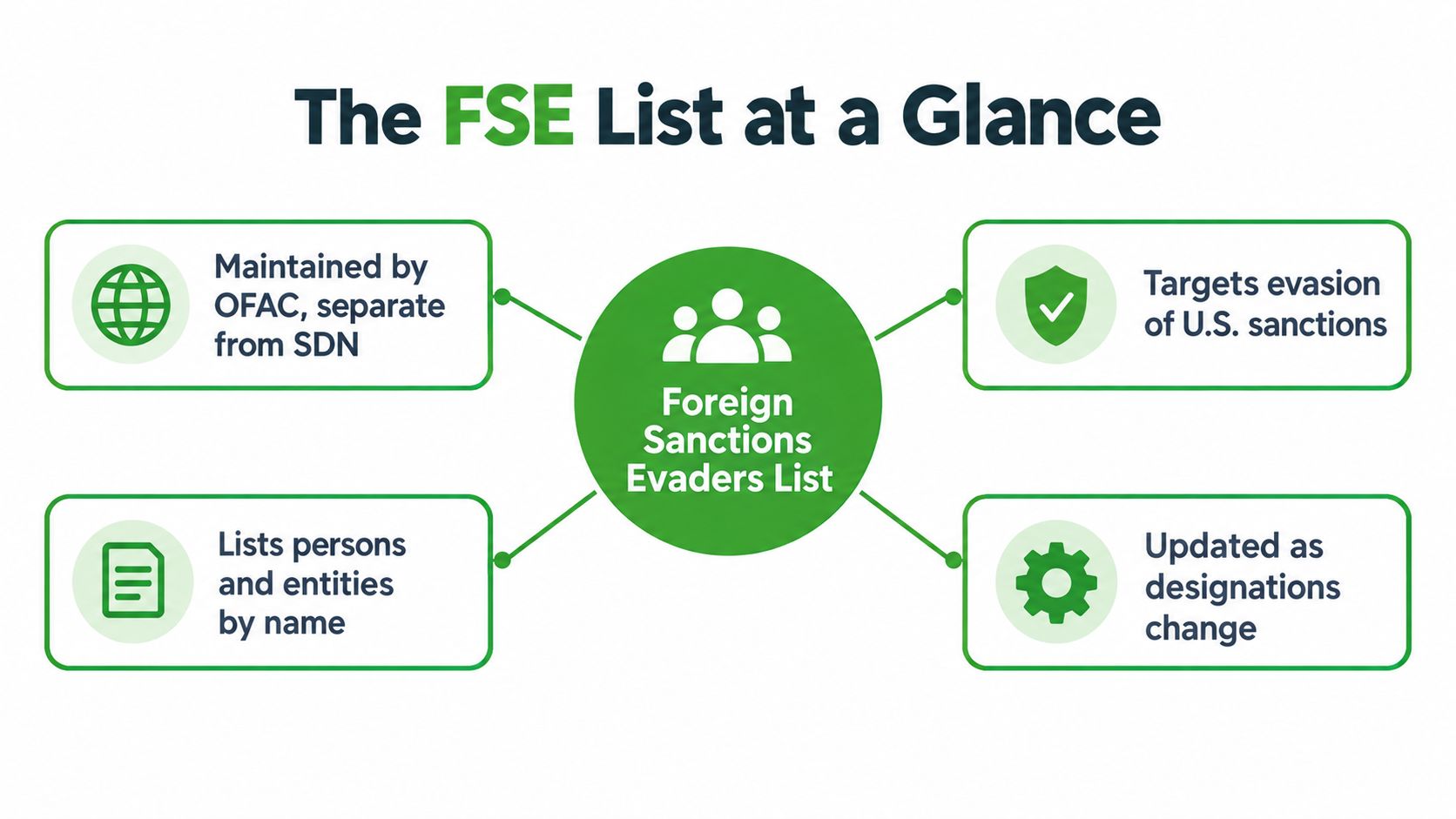
The Foreign Sanctions Evaders List is a distinct OFAC sanctions list created under Executive Order 13608. It focuses on foreign individuals and entities connected to sanctions evasion involving Iran, including people OFAC determines violated, attempted to violate, conspired to violate, or caused violations of U.S. sanctions. The list also reaches foreign persons who facilitate deceptive transactions for or on behalf of sanctioned parties.
The FSE List is not the Specially Designated Nationals List. That distinction matters because the program label tells the reviewer which legal framework and consequences require analysis. The same person or company can appear on both lists, so a screening result must preserve the exact list and program information rather than recording only “OFAC hit.”
Reading an FSE entry correctly
In OFAC's Sanctions List Search, FSE entries can be recognized through program tags beginning with “FSE-” and a “Non-SDN” list designation. That presentation gives an operations team an immediate reason to avoid treating every OFAC result as an SDN result.
OFAC states that transactions by U.S. persons, or transactions occurring within the United States, involving FSE-listed parties are prohibited. The rule can therefore affect a nonprofit even when the listed party isn't located in the United States. A U.S. bank, U.S. person, U.S.-based service provider, or transaction routed through the United States can bring the issue into the organization's workflow.
The list is best understood as a targeted sanctions-evasion control. It doesn't replace broader sanctions screening, country-risk review, ownership analysis, or transaction monitoring. It adds a program-specific layer for conduct involving sanctioned parties and deceptive transactions.
Practical rule: Save the program tag, list designation, full name, aliases, and identifying details from the result. A bare screenshot that says “possible match” won't support a careful later review.
For a nonprofit, the operational question isn't just whether a name appears. It is whether the listed identity and the person or entity in front of the organization are the same, and if so, whether the proposed activity is prohibited or may require authorization or exemption analysis.
FSE List Versus SDN List Differences
The most common error is to collapse every OFAC result into the same response. The FSE List and SDN List are separate, and their consequences aren't identical. FSE status generally creates transaction prohibitions, while SDN status can carry asset-blocking consequences. A party may appear on both, which is why the reviewer must examine the complete result rather than relying on a list name remembered from a training slide.
| Attribute | FSE List | SDN List |
|---|---|---|
| Primary focus | Foreign sanctions evasion and deceptive transactions connected to applicable Iran-related authorities | A broader range of sanctions programs and designated persons |
| List designation | Non-SDN list, with program tags beginning with “FSE-” | Specially Designated Nationals and Blocked Persons list |
| Typical legal effect | Transaction prohibitions for covered U.S. persons and U.S.-related transactions | Transaction prohibitions plus blocking consequences under the applicable authority |
| Screening response | Verify identity, review the exact program, and assess the transaction | Verify identity, stop the relevant activity, and assess blocking obligations |
| Relationship between lists | A person can appear here and also appear on the SDN List | A person can appear here and also appear on the FSE List |
A name alert isn't a final finding
OFAC instructs organizations to compare the complete listing with available identifying information. That evidence can include government identification, birth records, or corporate-registration documents, and OFAC's potential-match guidance makes clear that OFAC doesn't confirm potential matches or false positives for the organization.
That creates a decision responsibility for nonprofit leadership. An automated system can find a candidate match, but it can't establish identity when names are common, translated differently, abbreviated, or shared by unrelated people.
A defensible review should compare:
- Names and aliases: Include original spelling, transliterations, former names, and alternate corporate names.
- Personal identifiers: Review date of birth, nationality, address, and available identity documents.
- Entity information: Compare incorporation details, registered addresses, directors, and ownership information.
- Transaction context: Consider the service, payment, grant, or relationship that triggered the alert.
The organization should document who reviewed the alert, what evidence they examined, why the result was confirmed or cleared, and what restrictions applied while the review was open. The goal isn't to make a government determination that OFAC itself doesn't provide. The goal is to make and retain a reasonable, evidence-based internal decision.
How FSE Designation Affects Transactions and Compliance
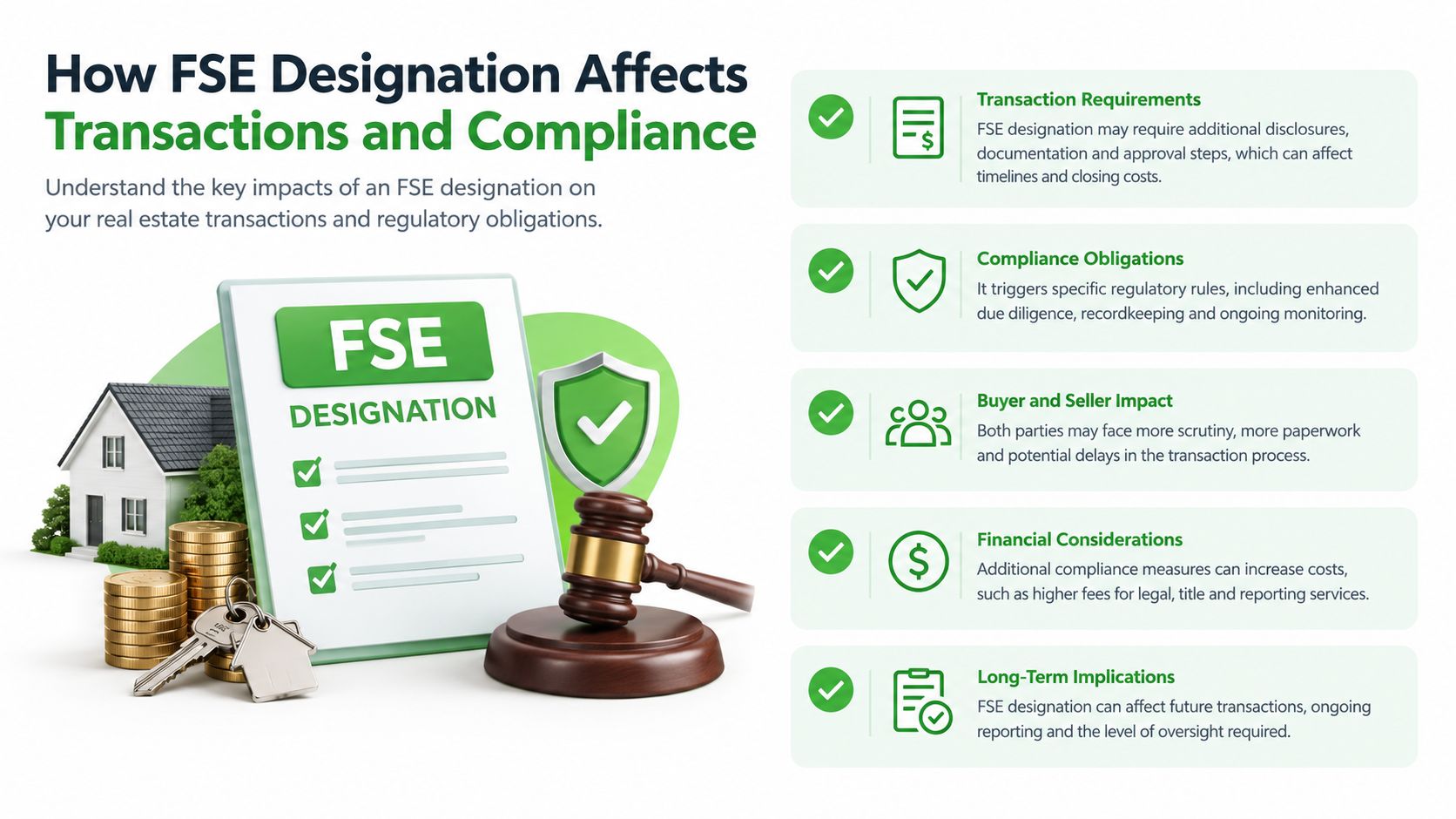
An FSE designation generally creates a transaction prohibition, not automatic asset blocking. U.S. persons, and transactions conducted through the United States, are generally prohibited from directly or indirectly providing or procuring goods, services, financial services, or technology to or from an FSE without OFAC authorization, subject to applicable exemptions. OFAC's FSE introduction explains that property of an FSE doesn't have to be blocked solely because of the FSE listing, unless the person is also designated under another authority, such as the SDN program.
That distinction changes the response. A nonprofit shouldn't automatically freeze every asset or relationship just because an automated name alert contains an FSE result. It also shouldn't let a potentially covered payment proceed while staff casually investigate.
A controlled response to a potential hit
Use a staged workflow:
- Pause the relevant activity. Hold the payment, onboarding decision, grant, contract, or service that could involve the alerted party. Don't characterize the person as sanctioned before identity verification is complete.
- Preserve the result. Save the search date, source, exact name, program tag, list designation, aliases, and identifying information.
- Check other OFAC status. Determine whether the party also appears on the SDN List or another applicable list. The consequences may differ.
- Review the transaction. Identify the parties, services, goods, technology, financial institutions, and U.S. connections involved.
- Escalate authority. Assign a trained compliance lead, executive, or external sanctions counsel to decide whether the result is confirmed, cleared, or unresolved.
- Assess authorization. If the identity appears to match, examine applicable exemptions or licensing options before anyone resumes the activity.
A policy that says “block everything” may prevent an unauthorized transaction, but it can also mishandle property and create unnecessary disruption. A policy that says “the software will decide” leaves the organization unable to explain its reasoning. The stronger approach separates identity resolution, transaction analysis, and legal authorization.
For nonprofit leaders reviewing broader consequences, OFAC penalties for noncompliance offers useful operational context. The immediate priority, however, is accurate containment and documented decision-making, not speculation about a penalty.
Screening Workflows for Volunteer Background Checks
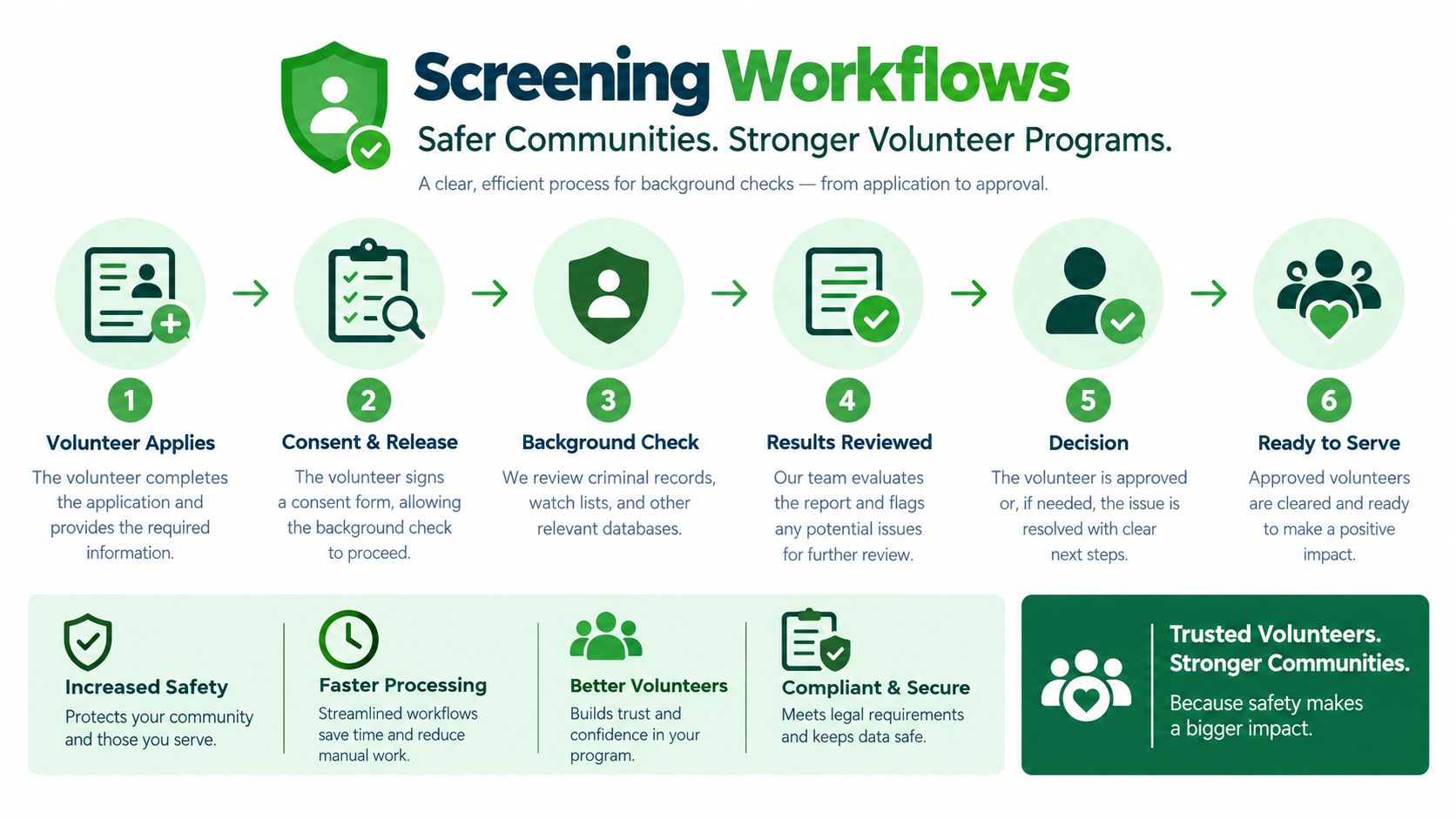
A volunteer screening workflow should treat FSE review as a date-sensitive control, not a single checkbox completed at onboarding. The right process combines sanctions searching with identity collection, criminal screening, address history, safeguarding review, and an escalation route that a volunteer coordinator can follow without improvising.
A practical sequence looks like this:
Start with reliable applicant data
Collect the legal name, former names, aliases, date of birth, nationality where appropriate, current and prior addresses, and consent required for the broader background process. For an entity, collect the registered name, trading names, incorporation location, registered address, directors, and relevant ownership information.
Search and record the exact result
Run the OFAC search during onboarding and preserve the result, including the list name and program tag. A nonprofit can use an OFAC sanctions list search workflow as part of a broader screening process, but the search result still requires human review when the system identifies a possible match.
Assign the decision before an alert occurs
The volunteer coordinator can gather documents and pause onboarding, but that person shouldn't automatically have authority to clear a sanctions alert. Set a written route to a compliance owner, executive, board-designated reviewer, or qualified external adviser. The policy should state what happens if identity data cannot be verified, including whether the relationship remains paused.
Organizations that need a deeper review of a prospective partner or donor can consult due diligence investigations explained to distinguish routine screening from broader identity, ownership, and relationship research.
Keep the evidence with the disposition. Record the matching and nonmatching identifiers, documents reviewed, reviewer, decision, date, and any restrictions placed on the activity. Don't write “false positive” without explaining why the evidence supports that conclusion.
Re-screening should reflect the organization's risk profile and the fact that sanctions lists change. Higher-risk international partnerships, recurring payments, and long-lived volunteer or donor relationships need a defined review cycle. The exact interval should come from the organization's risk assessment and policies, not from an invented universal schedule.
Evidence beats confidence. If the team can't verify the identity, the correct status is unresolved, not cleared.
The best workflow is the one staff can execute consistently. A capable screening tool won't compensate for missing identifiers, unclear ownership, or a policy that gives nobody authority to make the final call.
Managing Historical FSE Status and Archive Changes
A current clean result answers a narrow question: whether the search found a current listing at the time it ran. It doesn't establish that the individual or entity was never listed, and it doesn't resolve what happened during an earlier payment, grant, contract, or partnership.
OFAC's official archive records historical change files for 2014, 2016, 2019, 2020, 2021, 2022, and 2025. Those files document additions, modifications, and removals across multiple years, as shown in the OFAC archive of sanctions-list changes.
Why an empty list still requires attention
OFAC states that on December 18, 2025, it removed the remaining name from the FSE List, leaving the active list empty as of that date. The agency also cautions that new names may be added in the future. An empty active list is therefore a point-in-time condition, not a permanent assurance that the sanctions program no longer matters.
That matters when a nonprofit conducts retrospective review. Suppose a bank asks about a foreign partner involved in an earlier payment, or a board committee examines a donor relationship from a prior period. A present-day search may show no active FSE listing, while the relevant question concerns the party's status when the transaction occurred.
Build a historical review file
Use the official change archive when the timing matters. Preserve:
- The transaction date: Record when the payment, contract, onboarding, or service occurred.
- The search date: Show when the organization checked the party.
- The identity set: Keep the name, aliases, address, nationality, incorporation data, and other identifiers used.
- The historical result: Note additions, modifications, and removals relevant to the review.
- The decision record: Explain whether the organization found a match, cleared an alert, or escalated the matter.
Don't treat archive research as a substitute for current screening. Use it when the organization must answer a historical question that a current list search can't answer by itself.
Integrating OFAC Screening into Nonprofit Safeguarding
Safeguarding programs and sanctions controls address different risks, but they meet in the same operational workflow. A nonprofit decides who can access children, vulnerable adults, funds, data, facilities, and international programs. That decision should consider criminal history, sex-offender records, identity consistency, references, and sanctions exposure without pretending that one check answers every question.
Keep the controls distinct
A criminal background check evaluates available records under applicable consumer-reporting rules. An OFAC search evaluates sanctions-list information. Address history can help resolve identity, but it isn't proof that a person is or isn't an FSE-listed party. Staff should explain these differences to applicants and apply the same criteria consistently across comparable roles.
For U.S. consumer reports, the organization also needs to follow applicable FCRA processes, including disclosure, authorization, permissible purpose, accuracy procedures, and required adverse-action notices. A sanctions alert shouldn't become an excuse to bypass fair screening procedures or disclose sensitive information to people who don't need it.
Make escalation part of safeguarding
A potential FSE hit may require a temporary pause in onboarding, payment, or access. That pause should be respectful and controlled. Tell the applicant or partner only what the organization's policy and legal advice permit, limit internal access to the case file, and avoid language that treats an unresolved alert as misconduct.
A useful safeguarding policy can assign different responsibilities:
- Volunteer coordinator: Collects identifiers, initiates screening, and pauses activity.
- Compliance reviewer: Compares the result with identity evidence and checks the exact program.
- Program leader: Explains operational consequences and protects service continuity.
- Executive or counsel: Decides how to handle unresolved or confirmed high-risk cases.
A clean current check also shouldn't override historical concerns. If the organization is reviewing a prior relationship, it should preserve the earlier search and consult relevant archive records rather than relying on today's result.
The strongest programs are transparent about limits. They don't promise that screening eliminates risk. They show that the organization uses consistent controls, documents decisions, and escalates uncertainty before it becomes a payment, access, or reputational problem.
Practical Steps for Ongoing FSE Compliance
A small charity can put a workable process in place without creating a separate legal department. Start with a written policy that names the populations covered, such as volunteers, employees, donors, vendors, grantees, and international partners. Then define the trigger points for initial screening, re-screening, transaction review, and historical investigation.
Train the people who will see alerts first. They need to recognize that an FSE result isn't automatically an SDN result, that a similar name isn't proof of identity, and that the organization must pause relevant activity while it verifies the facts.
A practical operating checklist
- Write the escalation path: Identify who can pause activity, who can review evidence, and who can clear or escalate a result.
- Capture full identifiers: Collect names, aliases, dates of birth, nationalities, addresses, and entity-registration details where relevant.
- Preserve exact results: Save the list name, program tag, search date, and complete record.
- Review concurrent status: Check whether the party appears on the SDN List or another applicable OFAC program.
- Analyze the activity: Determine whether the proposed goods, services, financial services, technology, or payment involves a covered U.S. connection.
- Use archive records when needed: A current clean result doesn't resolve a historical-status question.
- Train and test the process: Review sample alerts and confirm that staff know when they lack authority to clear a case.
Consider a volunteer coordinator who receives a possible FSE match late in the onboarding process. The coordinator shouldn't decide that the applicant is sanctioned, and shouldn't let the application proceed as if nothing happened. The correct operational move is to pause the relevant activity, gather reliable identifiers, send the file to the designated reviewer, and record the decision with enough detail for a later audit.
That habit is more valuable than a policy sitting in a shared drive. FSE compliance is a living workflow, sustained by current searches, historical awareness, careful identity resolution, and accountable decisions.
VolunteerBadge provides nonprofit volunteer screening that includes OFAC sanctions searches alongside criminal and watchlist checks, with digital disclosures, address-history information, and FCRA workflow support. Visit VolunteerBadge to review how its screening tools can fit into your organization's documented onboarding and escalation process.
