
What Do Companies Look for in Background Checks: 2026 Guide
What do companies look for in background checks? Ten common screens, from criminal records and sex offender registries to OFAC and FCRA compliance steps.
On this page
Most background checks come back clean. That's why the popular advice, “run every search available,” misses the practical question. A nonprofit doesn't need the same screening package for a youth mentor, a one-day event helper, a treasurer, and a volunteer driver. It needs checks that match the access, responsibility, and foreseeable risk attached to each role.
So what do companies look for in background checks? They usually look for identity-linked criminal records, qualifications, work history, driving safety, financial responsibility, and inconsistencies that could change a placement decision. Criminal-history screening remains the most established component, but employers commonly review several categories together. SHRM and Charles Koch Institute research found that 73% of HR professionals reported criminal-history checks, compared with 50% conducting drug tests and 46% verifying education.
The list below treats each screen as a decision, not a data grab. For every check, you'll see what it can show, what it can't prove, which volunteer roles justify it, and how to handle a possible adverse result under the Fair Credit Reporting Act, or FCRA. Use this background investigation guide from Paradigm International as additional process context, then build your own role-based policy.
Table of Contents
- 1. Criminal History Records
- 2. Sex Offender Registry Verification
- 3. Address History and Residency Verification
- 4. Employment History Verification
- 5. Federal Watchlists and OFAC Sanctions Checks
- 6. Driving Record and Motor Vehicle History
- 7. Credit History and Financial Responsibility
- 8. Professional License and Credential Verification
- 9. Social Media and Online Presence Review
- 10. Reference Checks and Consistency and Pattern Analysis
- 10-Point Background Check Criteria Comparison
- Turn This List Into a Written Screening Policy
1. Criminal History Records
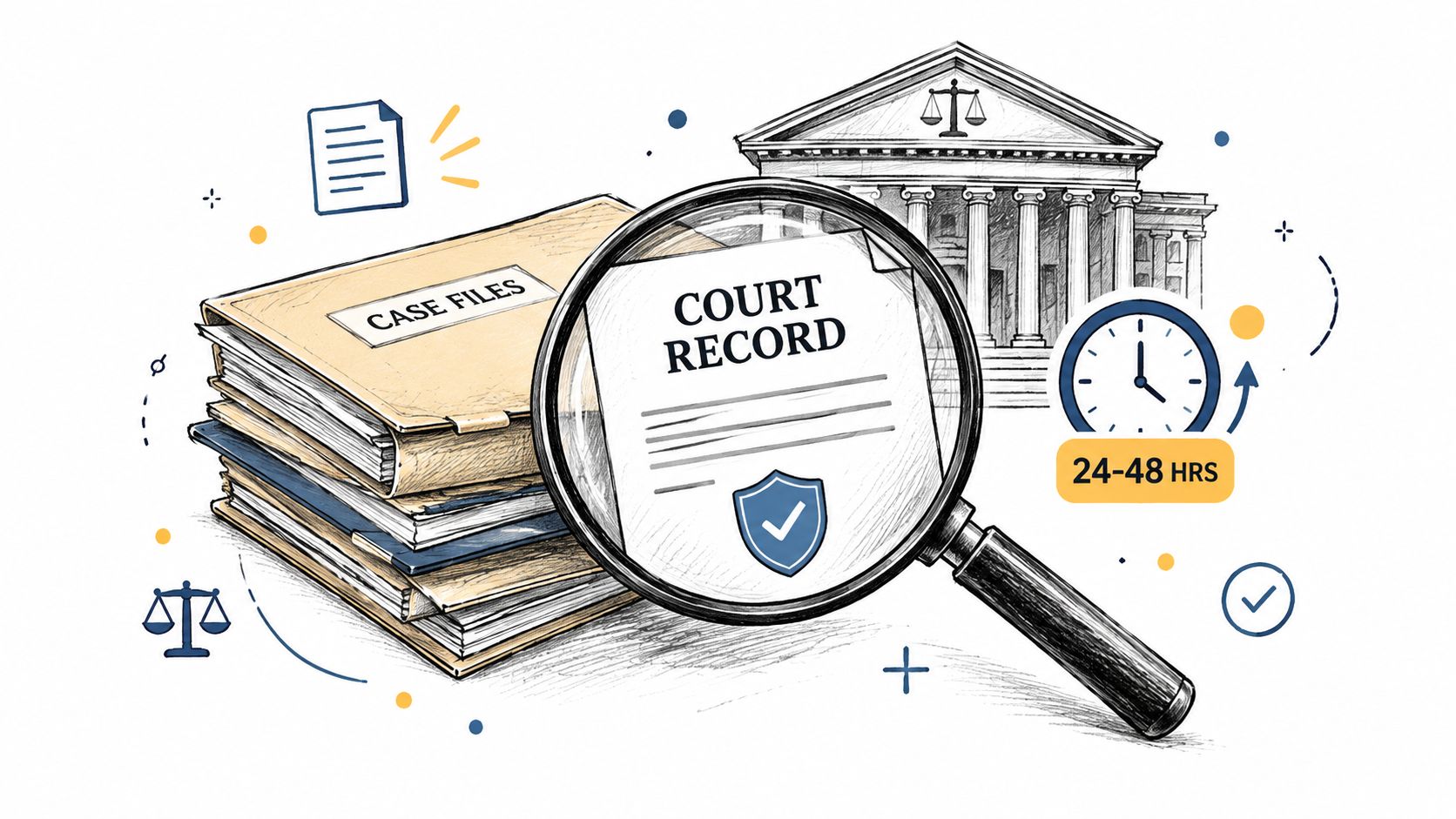
A criminal-history search helps with one decision: whether a volunteer can be placed in a role with a specific level of access, trust, or autonomy. For nonprofits, that means matching the search to the assignment. A youth mentor, a pantry cashier, a treasurer, and a one-day event helper do not present the same risk or need the same review. A proper search may pull county, state, and federal court records, then check whether any felony, misdemeanor, pending case, or final disposition is relevant to the role.
Organizations use criminal checks because certain records can affect placement decisions tied to safety, money handling, or unsupervised access. As noted earlier in the article, EEOC guidance draws an important line between an arrest and proof that misconduct occurred. That matters in practice. An arrest record alone is not the same as a conviction, and it should not be treated as if it answers the whole question.
The useful question is narrower. What does this result suggest about this role?
A youth sports league may find a conviction related to child endangerment before assigning unsupervised coaching duties. A church may find a theft conviction before giving a volunteer access to donation storage or cash handling. An after-school program may see an assault case and decide the person should not be placed in a direct-contact role, or may need a closer review of the disposition and the age of the record before making that call.
What the result can and can't prove
A criminal record can surface a possible safeguarding, financial, or conduct concern. It cannot prove the record belongs to the applicant until identifiers, jurisdiction, and case disposition are confirmed. It also cannot tell you whether the person's circumstances changed, whether the conduct is job-related today, or whether a less sensitive volunteer assignment would still be appropriate.
FCRA steps apply here in a practical sequence. Disclose the check and get authorization before ordering it. If the report could lead to a negative decision, send pre-adverse action materials, give the applicant a chance to dispute or explain the record, then make the final adverse-action decision only after review.
Practical rule: Match the offense, the age of the record, and the level of access to the actual duties.
VolunteerBadge offers national criminal searches across county, state, and federal courts, plus FCRA workflow support. For organizations that also work in regulated youth settings, staff administration CE for Ohio schools adds a useful example of how screening duties become role-specific and procedural, not just reactive.
2. Sex Offender Registry Verification
A sex-offender registry check informs a high-stakes access decision: can this person be placed in a role involving children, youth, vulnerable adults, or intimate personal access? It's especially relevant for youth ministries, schools, camps, youth sports, residential programs, and organizations that provide direct care.
A school might identify a tutor on a registry before the person starts working with students. A church may find that a youth-group applicant is registered in a jurisdiction the applicant didn't disclose. A sports league may uncover a registration connected to another state before assigning the candidate as a coach.
The result still requires identity verification. A name match by itself isn't enough, particularly when names, birth dates, or addresses overlap. Confirm the person's identity and the registry details before recording a decision.
Use the check consistently
Organizations should tell candidates that registry screening is a routine requirement for specified roles, not an improvised response to one applicant. Apply the same written rule to every person seeking comparable access. That consistency supports both safeguarding and fair process.
For a high-risk youth-facing role, an organization may define a verified registry match as disqualifying under its policy. The policy should state that rule before screening starts, identify the roles covered, and explain who reviews exceptions, if any. Avoid treating an unverified match as conclusive.
FCRA duties still apply when a consumer reporting agency supplies the information. Give the required disclosure and authorization before the report, protect the report from unnecessary access, and follow pre-adverse and final adverse-action procedures when the report contributes to a decision.
VolunteerBadge includes searches of sex-offender registries across all 50 states as part of its nonprofit screening workflow. Whatever provider you use, ask how it resolves identity matches, updates registry data, and documents the basis for a reported result.
3. Address History and Residency Verification
Address history informs a basic identity question: where has the applicant lived, and which jurisdictions may hold records that a current-address search would miss? It can also reveal unexplained gaps, inconsistent information, or a mismatch between the application and the screening file.
Suppose a volunteer application shows no residence history for two years. That gap may reflect travel, temporary housing, school, caregiving, or an ordinary data error. It may also identify a jurisdiction that needs follow-up. A youth organization could find that the applicant claims to have lived in one state while the available address history points elsewhere. A church reviewing a treasurer might notice several moves that overlap with unexplained employment gaps.
Address history isn't evidence of wrongdoing. It's a map for verification.
Use discrepancies as questions
Review the address timeline alongside the candidate's application and employment history. If an address appears during the period of a relevant court matter, it may help establish whether the person could be the individual connected to that record. If the timeline conflicts with the application, ask for clarification before treating the inconsistency as deception.
A practical workflow is to pull address history early, identify missing jurisdictions, and then order the searches needed for the role. VolunteerBadge describes this approach in its guide to address history in background checks. Its automated address-history pull is intended to flag gaps before a screening credit is used.
A missing address is a prompt for verification, not a finding.
Document the question, the applicant's explanation, and the reviewer's conclusion. Keep the notes factual. “Applicant stated they lived with family during the gap” is more useful than “applicant seemed suspicious.”
FCRA notice and authorization requirements still apply to the consumer report process. If an address-related discrepancy contributes to an adverse decision, include accurate report information and give the applicant an opportunity to dispute it.
4. Employment History Verification
Employment verification answers whether the experience and timeline on the application can be confirmed. For volunteers, the check matters most when the person claims specialized experience, supervisory responsibility, financial duties, or work with children and vulnerable people.
A nonprofit may discover that a proposed youth-program director overstated child-development experience. A church could learn that a finance volunteer's previous employment ended under circumstances the application omitted. A school might find an unexplained gap inside an otherwise detailed work history.
The check has limits. Many employers will confirm only dates, job title, and sometimes eligibility for rehire. A refusal to provide more information doesn't prove poor performance. A confirmed job doesn't prove that the volunteer performed every duty claimed.
Build a consistent verification record
Use the same questions for comparable applicants. Confirm the employer, position, dates, and responsibilities, then record what the source said. Don't turn a reference conversation into an informal investigation that varies from person to person.
Cross-reference employment dates with address history. A geographic mismatch may be harmless, such as remote work or a temporary move, but it deserves a question. An employment gap may reflect caregiving, illness, education, or unemployment rather than deception.
Ask before rejecting: An unusual gap is a reason to seek context, not a conclusion about character.
If a former employer confirms only dates and position, record that limitation rather than inferring a negative reference. If the applicant disputes the report, pause the decision and provide a channel for correction. When a consumer report is involved, follow the FCRA pre-adverse and final adverse-action sequence.
5. Federal Watchlists and OFAC Sanctions Checks
Watchlist and sanctions screening informs whether the organization can lawfully proceed with a person whose identity may match a government restriction. It matters most for nonprofits receiving federal funding, handling regulated transactions, working internationally, or operating programs that interact with government-funded partners.
An international aid organization may need to resolve a possible sanctions match before giving a volunteer access to financial or logistics systems. A nonprofit with a federal grant may include watchlist screening in onboarding. A church with government-funded activities may need a documented process rather than an informal name search.
A possible OFAC or watchlist match isn't automatically proof that the volunteer is the listed person. Names can match while dates of birth, addresses, nationality, or other identifiers do not.
Resolve identity before action
Compare full names, middle names, alternate spellings, known addresses, and other identifiers. Record what was checked and why the match was confirmed or cleared. Escalate uncertain results to the person responsible for compliance instead of asking an untrained coordinator to make a final legal judgment.
VolunteerBadge includes FBI Most Wanted and OFAC screening in its stated nonprofit check offering. Its OFAC sanctions programs resource provides background for organizations building a screening process, but each nonprofit still needs a policy appropriate to its funding and activities.
FCRA procedures apply when the information comes through a consumer reporting agency and influences a volunteer decision. Provide notice and authorization before the report, and use the adverse-action process if the organization is considering exclusion.
Resolve the match, not the name. A close name match should start an identity review, not end one.
6. Driving Record and Motor Vehicle History
A motor vehicle record informs one specific decision: can the volunteer safely and lawfully operate a vehicle for the organization? It belongs in the package for drivers, transportation coordinators, mobile outreach workers, and anyone transporting children, older adults, or other vulnerable participants.
A youth organization might find multiple impaired-driving convictions before assigning a volunteer to transport athletes. An after-school program could discover that a proposed driver's license is suspended. A community transportation nonprofit may identify a pattern of serious accidents or violations that requires a different assignment.
A driving record can show violations, license status, suspensions, and accidents reported by the relevant jurisdiction. It can't predict exactly how a person will drive tomorrow, and a minor ticket doesn't carry the same significance as impaired driving, reckless driving, or a suspended license.
Set role-specific thresholds
Require a current license and appropriate insurance documentation before a volunteer drives on the organization's behalf. Define which findings trigger follow-up, temporary restriction, or disqualification. Focus on patterns and safety-related conduct rather than treating every minor infraction alike.
The check should complement, not replace, a criminal search. A DUI may appear in both systems, while licensing information can reveal a current suspension that a court-record search doesn't frame as an operational issue.
Organizations can use this explanation of MVR checks when designing their process. Tell applicants in advance that driving records will be reviewed for driving roles, obtain authorization, and protect the report as sensitive information.
If a driving result may lead to exclusion, give the applicant the report and required FCRA notices. Let them challenge an inaccurate license status or record before finalizing the decision.
7. Credit History and Financial Responsibility
Credit screening informs whether a volunteer assigned direct financial control presents a documented concern that requires further review. It may be relevant for treasurers, donation processors, grant administrators, bookkeepers, and volunteers with authority to move funds.
It shouldn't be a routine screen for every volunteer. A person helping at a food pantry doesn't become safer because an organization reviews their credit report. A finance committee member with access to accounts raises a different question, and the organization should be able to explain why the check relates to the duties.
A report may contain payment history, collections, bankruptcies, or other financial information. It can't prove that someone will steal, and a low score alone doesn't establish dishonesty. Medical bills, job loss, divorce, housing disruption, and other circumstances can affect credit without indicating financial misconduct.
Review context, not a score
Disclose the credit check clearly and obtain written authorization. Use an FCRA-compliant provider, limit access to people who need the information, and store the report securely. Define in advance which patterns require explanation and which, if any, are incompatible with the specific role.
A church reviewing a proposed treasurer might ask about active collections tied to unpaid taxes. A nonprofit might discuss recent bankruptcies with a fundraising coordinator before deciding whether to assign direct handling of donations. In both cases, the applicant should have an opportunity to provide context.
A credit report is a financial-risk signal, not a character certificate.
If the report contributes to an adverse decision, follow the FCRA process. That includes the required pre-adverse information and a final notice after the organization has considered any dispute or explanation. Don't share unrelated financial details with other volunteers or program staff.
8. Professional License and Credential Verification
Credential verification answers whether a volunteer has the qualification and current authorization required for a regulated role. It matters in healthcare, counseling, education, childcare, and other positions where the organization or the people it serves rely on professional standards.
A medical nonprofit may find that an applicant's nursing license is suspended. A school could discover that a tutor's teaching credential has expired. A youth organization might verify that a volunteer counselor holds the current license claimed on the application, then review whether the licensing board lists disciplinary action.
The credential itself isn't enough. A photocopy can be outdated, altered, or connected to the wrong person. Verify the license number, issuing state, current status, expiration date, and relevant disciplinary information through the licensing board where possible.
Separate qualification from suitability
A valid license shows authorization to practice. It doesn't guarantee good judgment, reliability, or fit for a particular volunteer program. Conversely, a minor licensing infraction may not justify exclusion from every role. The organization needs written criteria that connect the result to the duties.
Ask candidates for the license number and issuing state at the start of the process. Confirm continuing education or renewal requirements when the role requires them. Record the date of verification because license status can change.
For healthcare roles, compare credential information with criminal-history results, but don't assume that one source validates the other. If a report identifies a discrepancy, give the applicant a chance to correct an outdated board record or explain the circumstances.
FCRA steps apply when a consumer reporting agency supplies credential information and it influences the decision. For direct board verification, separate organizational policy and applicable professional rules may also matter. Avoid presenting the screening process as legal advice, and escalate unusual licensing issues to qualified counsel or the relevant regulator.
9. Social Media and Online Presence Review
An online review informs whether publicly available conduct creates a role-related concern that formal records haven't addressed. It can be relevant for volunteers who represent the organization publicly, communicate with minors, moderate online communities, or hold visible leadership roles.
A nonprofit might find public posts describing behavior that conflicts with a safeguarding role. A youth organization could see public comments directed at minors that require immediate review. A church may identify public hate speech or discriminatory content that conflicts with the responsibilities of a community-facing volunteer.
Online review is easy to misuse. A profile may belong to someone else. Posts can lack context, be satirical, or be outdated. Personal beliefs, lawful private conduct, and protected activity aren't automatically evidence that someone is unsuitable.
Keep the review narrow and objective
Write a policy before searching. Review only public information, don't request private passwords or access, and use the same process for comparable candidates. Record the URL, date, exact content, and role-related reason for concern without adding subjective labels.
If an image or post may affect a decision, ask the applicant whether the account is theirs and invite an explanation. Don't treat a screenshot or search-engine result as a verified fact. A false identity match can create the very risk the screening process is supposed to prevent.
Use online review as supplemental information, not as the primary screen. Formal criminal, registry, license, and identity checks have defined sources and verification steps. Social media usually doesn't.
If a third-party screening company compiles online information into a consumer report, FCRA obligations may apply. If staff perform the review internally, the organization still needs consistent, documented, nondiscriminatory decision-making.
10. Reference Checks and Consistency and Pattern Analysis
Reference checks answer a human question that databases can't: how did the applicant behave in roles similar to the one they want? Pattern analysis then compares that account with the application, address history, employment verification, credentials, and formal records.
A nonprofit might hear from a former organization that a volunteer struggled with boundaries, even though no public record identifies the issue. A youth program may see an employment gap, address gap, and court record in the same period, then discover that the timeline has an ordinary explanation. Another applicant may provide a consistent history across references and objective records.
The pattern isn't the decision. It's the reason to ask better questions.
Build a single timeline
Use a consistent reference questionnaire and request a mix of professional and personal references appropriate to the role. Open-ended questions often produce more useful information than “Was this person good?” Ask about reliability, boundaries, communication, responsibility, and how the person handled supervision.
Create a timeline that places applications, addresses, employment, credentials, and verified records in sequence. Then identify gaps or conflicts that need clarification. Don't assume that frequent moves indicate deception. Don't excuse repeated contradictions without asking what happened.
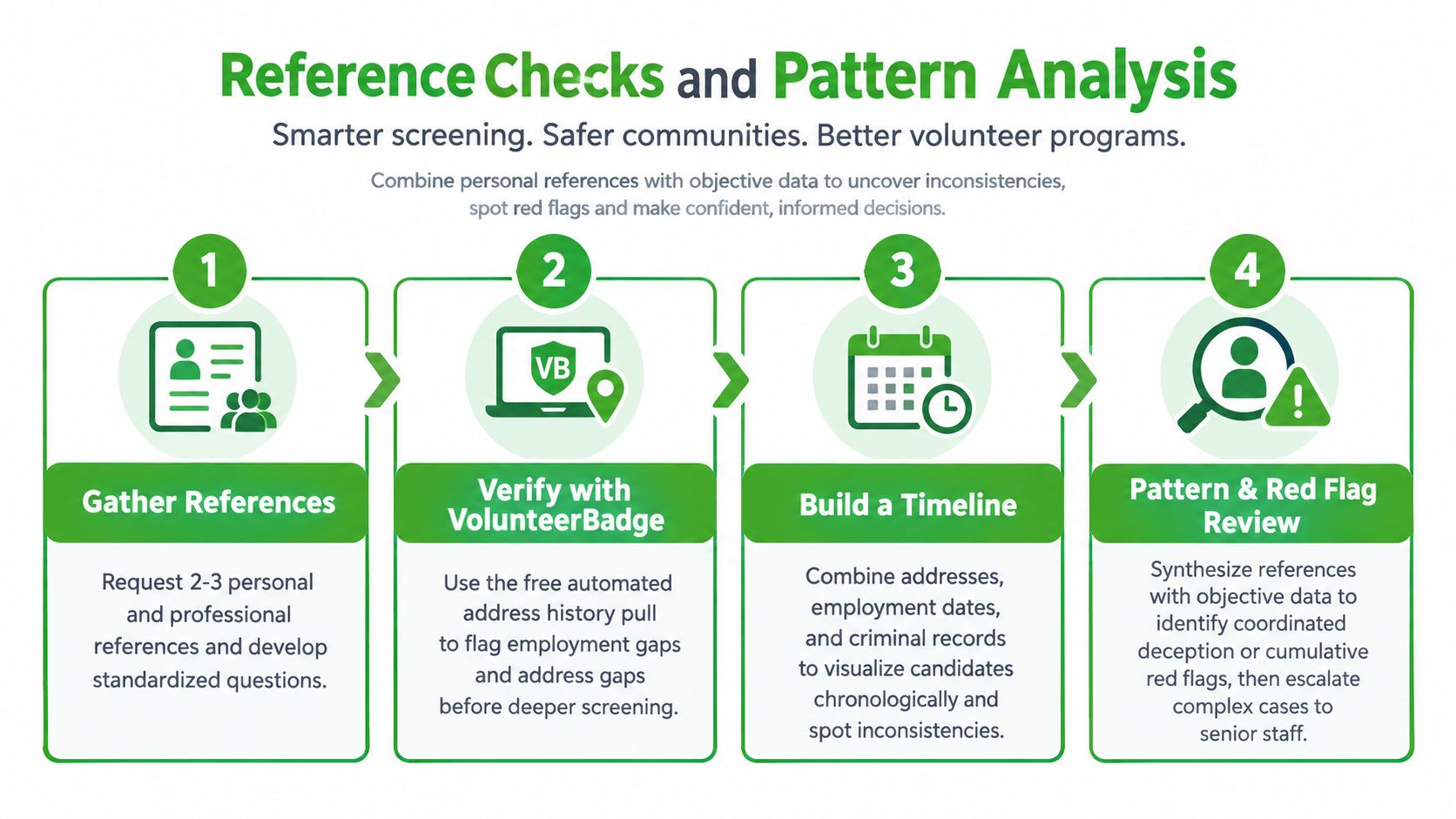
Escalate complex findings to a senior reviewer who wasn't involved in the initial conversation. That second review can separate an innocent life circumstance from a genuine identity or conduct concern.
Use references to test consistency, not to collect gossip.
If a reference report or other consumer report may lead to exclusion, follow FCRA notice and dispute procedures. Give the applicant enough information to understand and challenge the adverse information. Keep the final decision tied to the role, the verified facts, and the organization's written policy.
For a visual explanation of reference-check workflow, use the volunteer screening and pattern-analysis video.
10-Point Background Check Criteria Comparison
| Screening Type | 🔄 Implementation Complexity | ⚡ Resources & Speed | ⭐ Expected Effectiveness | 📊 Primary Outcomes | 💡 Ideal Use Cases / Key Advantages |
|---|---|---|---|---|---|
| Criminal History Records | Moderate, automated national county/state/federal searches with FCRA workflows | Low cost ($4.95/check); 24–48 hr turnaround ⚡ | ⭐⭐⭐⭐⭐, very effective for documented convictions | Identifies felony/misdemeanor convictions; reduces liability; clear plain‑English reports 📊 | Volunteer roles with vulnerable populations; affordable national coverage; auto adverse‑action notices 💡 |
| Sex Offender Registry Verification | Low, automated 50‑state + NSOR integration | Included at no extra cost; near real‑time updates ⚡ | ⭐⭐⭐⭐⭐ for registered offenders (limited for unregistered cases) | Prevents registered predators from access; meets legal screening requirements 📊 | Mandatory for child/youth/vulnerable‑adult roles; strongest safeguard vs known offenders 💡 |
| Address History & Residency Verification | Low, automated 7–10 yr pull with gap detection | Free pre‑check before credits; immediate results ⚡ | ⭐⭐⭐⭐, effective at flagging discrepancies and identity issues | Detects address gaps, misrepresentation, and supports contextualizing records 📊 | Pre‑screening to save resources; identity consistency checks; use before full checks 💡 |
| Employment History Verification | Moderate, often manual outreach to prior employers; can be time‑consuming | Higher effort and slower (days–weeks); may require candidate consent | ⭐⭐⭐⭐, reliable for confirming claims but dependent on employer cooperation | Confirms experience, uncovers fabricated positions, flags performance issues 📊 | Roles requiring specific experience/leadership positions; combine with address history 💡 |
| Federal Watchlists & OFAC Sanctions Checks | Low, automated federal/global watchlist integrations | Included in standard pricing; real‑time updates ⚡ | ⭐⭐⭐⭐, strong for listed individuals; false positives possible | Ensures compliance with sanctions; prevents legally barred volunteers 📊 | Nonprofits with federal funding/grants or international programs; legal compliance critical 💡 |
| Driving Record & Motor Vehicle History | Moderate, state DMV checks often required separately | Varies by state; may incur separate fees and delays | ⭐⭐⭐⭐, effective at identifying driving‑related risks | Reveals DUI/DWI, suspensions, accident patterns; reduces transportation liability 📊 | Roles involving vehicle operation (drivers, transport coordinators); youth transport programs 💡 |
| Credit History & Financial Responsibility | High, FCRA rules, explicit consent, and adverse‑action procedures required | Regulated process; requires consent and secure handling; moderate speed | ⭐⭐⭐, useful for financial risk but not definitive of dishonesty | Flags bankruptcies, liens, collections for finance roles; supports asset protection 📊 | Treasurer/fundraiser/finance roles only; use sparingly and with full FCRA compliance 💡 |
| Professional License & Credential Verification | Moderate, must know license type/issuing state; may require board contact | Time‑consuming; varies by profession and state | ⭐⭐⭐⭐, very effective to confirm current licensure and sanctions | Confirms active licenses, disciplinary history, expiration dates 📊 | Healthcare, education, counseling and other regulated roles; meets regulatory requirements 💡 |
| Social Media & Online Presence Review | Low–Moderate, manual review with legal/ethical risk management | Low direct cost but needs trained reviewers; variable speed | ⭐⭐⭐, supplemental tool; context‑sensitive and subjective | Reveals public behavior, misrepresentation, reputational risks 📊 | Community‑facing or youth‑facing roles as a supplement; use with strict policy to avoid bias 💡 |
| Reference Checks & Consistency / Pattern Analysis | High, multi‑source synthesis and expert analysis required | Resource‑intensive and slower; requires skilled staff | ⭐⭐⭐⭐⭐, excellent for holistic judgments and hidden patterns | Provides character insights, detects coordinated deception, validates timelines 📊 | Final validation for sensitive positions; complex or borderline cases; complements database checks 💡 |
Turn This List Into a Written Screening Policy
A list of available checks isn't a screening policy. A policy tells coordinators which check belongs to which role, what each result means, who reviews it, and what happens before the organization says no.
Start with the role that carries the greatest access or responsibility. For a youth mentor, that may include identity verification, address history, criminal records, and sex-offender registry screening. A volunteer driver needs a motor vehicle record and a current license review. A treasurer may need financial-role screening, employment verification, identity checks, and a criminal search focused on relevance to financial access. A one-day event helper with no unsupervised participant contact may justify a narrower process.
Write the role-to-check decision before inviting candidates to apply. Otherwise, coordinators tend to add searches after seeing a worrying detail, which creates inconsistent treatment and makes explanations harder.
Your policy should specify:
- Required checks by role: State which searches apply to youth contact, transportation, financial control, regulated practice, and public representation.
- Result categories: Define verified concern, unresolved discrepancy, irrelevant information, and clear result.
- Follow-up standards: Explain when staff ask for documents, request an explanation, or obtain a second review.
- Decision ownership: Name the person or committee authorized to approve, restrict, or decline placement.
- Retention and access: Limit sensitive reports to people who need them and set a secure record-handling process.
- FCRA steps: Confirm disclosure, authorization, report delivery, pre-adverse notice, dispute review, and final adverse-action notice before a decision is finalized.
The EEOC emphasizes that criminal-record decisions should be related to the job and consistent with business necessity. Its background-check guidance supports a context-based approach rather than blanket exclusion. The same principle improves operations: a coordinator can explain why a check was ordered, what the result showed, and how the organization responded.
Accuracy deserves its own control. SHRM reported that accuracy was a priority for 49% of North American respondents in 2022, down from 75%, while a later 2024 result placed accuracy ahead of cost and speed. The SHRM survey coverage also reports that 40% of North American employers identified previously undisclosed criminal convictions among frequent discrepancies. For a nonprofit, the practical lesson is simple: fast results don't help if the report belongs to the wrong person or omits the jurisdiction that matters.
Screening frequency deserves a written decision too. One-time pre-placement screening may not fit a volunteer who remains in a youth-facing or transportation role for years. SHRM reports that 98% of organizations conducting background checks include criminal-record searches, while only 4% reported continuous or rolling checks, 15% rescreened annually, and 13% screened after a triggering event in the cited survey. That SHRM analysis supports a risk-based rescreening policy, not an assumption that every volunteer needs the same schedule.
Draft the role-to-check table for your organization's highest-risk volunteer position this week. List the access that role provides, select only the checks that inform a real decision, define the follow-up and disqualification rules, and have the responsible reviewer confirm the FCRA steps before the first report is ordered.
VolunteerBadge offers nonprofits FCRA-compliant screening with national criminal searches, sex-offender registry checks, OFAC and watchlist screening, address-history review, and plain-English results. Visit VolunteerBadge to see how its volunteer-focused workflow can support a role-based screening policy.
