
What Is Global Watch List
What is global watch list. Learn what a global watch list is, who maintains it, and how nonprofits use it in FCRA-compliant volunteer background screening
On this page
A global watch list is a set of databases, not one master list, used to flag individuals, entities, vessels, and organizations subject to international sanctions, law-enforcement notices, or heightened scrutiny. The UN Security Council's consolidated sanctions list contained more than 1,000 listed individuals and entities in its 2024 update, while 14 of 31 sanctions regimes established since 1966 remained active.
A volunteer coordinator at a community nonprofit may encounter this issue during an ordinary application. A new mentor's name is checked, an alert appears, and the report uses the broad label “global watch list.” The name looks familiar, but the applicant's date of birth and address don't match the listing.
The coordinator now faces a practical question: does the alert indicate a real restriction, or has a common name produced a false positive? The answer depends on the source, the identifiers, the applicable jurisdiction, and the organization's review process. A responsible screening program treats the alert as a starting point for identity resolution, not as proof of wrongdoing.
Table of Contents
- The Volunteer Coordinator Who Almost Rejected the Wrong Person
- What a Global Watch List Is
- How Watch Lists Became Targeted Instead of Country-Wide
- The Major Watch List Categories and Who Maintains Them
- How Global Watch-List Checks Fit into Volunteer Screening
- Why Most Matches Are False Positives and How to Resolve Them
- FCRA and Privacy Rules That Apply to Watch-List Results
- A Repeatable Screening Workflow Your Nonprofit Can Adopt
The Volunteer Coordinator Who Almost Rejected the Wrong Person
A mid-sized youth mentoring nonprofit was preparing to place a new volunteer with teenagers. The applicant had completed the organization's disclosure and authorization process, supplied an address history, and agreed to a background check. The report returned a possible global watch-list match for a person with the same name.
The coordinator searched the report again. The listing involved an international designation, but the record contained a different nationality and a different birth date. The volunteer's name was common, and the report didn't say “this person is sanctioned.” It said that the available information required review.
That distinction matters. A screening alert can identify a possible overlap between an applicant and a record maintained by a government or intergovernmental authority. It doesn't establish identity, criminal conduct, or legal liability by itself.
Practical rule: A name match is an investigation prompt, not a final volunteer decision.
The phrase global watch list creates confusion because it sounds like one searchable database with a single definition. In practice, it describes a layered screening process that may include United Nations designations, national sanctions lists, law-enforcement notices, politically exposed person data, and other specialized sources. Each source has its own inclusion rules, legal purpose, update schedule, and consequences.
A nonprofit therefore needs a precise working definition before it acts on a result. The key questions are straightforward:
- Which sources were searched?
- Which country's rules apply?
- What identifiers matched?
- What restriction or concern does the underlying record describe?
- Who reviewed the result, and how was the decision documented?
The coordinator in this example didn't reject the volunteer automatically. Instead, the organization compared the listing with the applicant's identifying details and recorded why the alert did or didn't correspond to the person being screened. That approach protects the applicant from an unfair decision while giving the nonprofit a defensible safeguarding process.
What a Global Watch List Is
A global watch list is a screening layer assembled from multiple authoritative databases. Governments and intergovernmental bodies use these sources to identify people, companies, vessels, organizations, and other entities subject to restrictions or increased scrutiny.
The term can be understood through a library catalog. One catalog covers fiction, another legal materials, and a third archival collections. Searching the library reveals records that may matter, but each entry still requires review. Watch-list screening follows the same logic: a search surfaces possible records, and a reviewer examines the underlying listing and its identifiers.
Depending on the sources used, a check may support:
- Sanctions enforcement, including asset freezes and transaction restrictions.
- Counterterrorism controls, focused on designated individuals, groups, or networks.
- Nonproliferation controls, involving weapons programs, related goods, or technology.
- Anti-money-laundering controls, in which organizations assess exposure to restricted parties and illicit finance.
- Travel, trade, and financial restrictions, such as travel bans, arms embargoes, commodity controls, or limits on financial services.
Different record types answer different questions. A sanctions designation imposes legal restrictions without a court judgment. A law-enforcement notice may ask authorities to locate or investigate someone. A politically exposed person record identifies a public role that may require enhanced due diligence. A criminal-record search examines whether a relevant court or law-enforcement record exists in the searched jurisdiction.
The UN Security Council shows the scale and persistence of this system. Since 1966, the Council has established 31 sanctions regimes, and 14 remained active in the UN's 2024 update. Its consolidated list contained more than 1,000 individuals and entities at that point (UN Security Council sanctions information).
For a nonprofit, the working definition should be operational: a global watch-list check searches specified international and national risk sources, compares results with applicant identifiers, and sends possible matches for review under the applicable legal and privacy framework.
A vendor advertising “global coverage” should name the layers included. Ask about list categories, jurisdictions, source owners, update frequency, alias coverage, and search timestamp. Without those details, the label describes marketing scope rather than a screening control the nonprofit can evaluate.
How Watch Lists Became Targeted Instead of Country-Wide
Modern watch-list screening makes more sense when viewed as a change in sanctions policy. The UN Security Council first imposed sanctions in 1966 against Southern Rhodesia, now Zimbabwe. Earlier sanctions were often broad, country-level measures that could affect wide groups of people and businesses.
The policy direction changed significantly in 1994, when the Security Council moved toward targeted measures. Instead of restricting every person or company connected with a country, authorities increasingly named specific individuals, entities, networks, or activities. Measures could include travel bans, asset freezes, arms embargoes, and restrictions on commodities or technologies associated with weapons programs. The historical shift is described in the UN's account of targeted sanctions and monitoring mechanisms (UN history of targeted sanctions).
That model created the basic operating logic behind today's screening systems:
- An authority identifies a person or entity.
- The authority publishes a record with available identifiers and applicable measures.
- Organizations determine whether they're dealing with that designated party.
- They prevent prohibited transactions or access where the rules require it.
- They investigate uncertain matches rather than treating every similar name as confirmed.
The process became more structured when the Security Council introduced sanctions-monitoring groups in 1999. By 2014, the UN reported 11 monitoring groups, teams, and panels operating globally, adding investigation and implementation support to the designation process.
This history explains why a watch-list check can't be a one-time database lookup. Authorities may add, amend, or remove designations. A regime may expire, while an older record can remain relevant for years. The oldest active regime concerns Somalia and dates to 1992, according to the UN's sanctions information.
A nonprofit doesn't need to become a sanctions historian, but it does need to recognize the operational consequence. Screening must use current source data, preserve the search result, and allow the organization to revisit a prior decision when a list entry or an applicant's identifying information changes.
The Major Watch List Categories and Who Maintains Them
A report labeled “global watch list” usually combines several categories. They overlap, but they aren't interchangeable. The UN Security Council Consolidated List covers parties subject to Security Council measures. National authorities maintain their own sanctions and law-enforcement sources, while commercial providers may organize public records into searchable products.
The following comparison shows why source scope matters:
| Category | Maintained By | Inclusion Trigger | Typical Restriction |
|---|---|---|---|
| UN sanctions designations | United Nations Security Council | A Security Council sanctions decision | Asset freezes, travel bans, arms embargoes, or commodity restrictions |
| National sanctions lists | National governments and regulators | A domestic sanctions program or legal designation | Transaction, asset, trade, investment, or travel restrictions |
| Regional sanctions lists | Regional authorities, such as the European Union | A regional legal act or foreign-policy measure | Financial, trade, travel, or asset restrictions within the applicable jurisdiction |
| Law-enforcement notices | Police and law-enforcement bodies | A request to locate, identify, or investigate a person | Possible detention, investigation, or information sharing, depending on the notice |
| Politically exposed person data | Specialized screening providers | A prominent public function or close relationship | Enhanced due diligence, not automatic prohibition |
| Specialized safety registries | National or state authorities | A qualifying criminal or regulatory record | Access, safeguarding, employment, or supervision consequences under local law |
The UN list is one important source, not a universal substitute for national screening. In the United States, the Treasury Department's Office of Foreign Assets Control maintains sanctions programs with different legal structures and restrictions. A nonprofit that serves international communities may also need to consider the rules of the countries where it operates, sends funds, or engages contractors.
Law-enforcement notices require especially careful interpretation. An alert may reflect a request for information rather than a conviction or sanctions designation. A politically exposed person record generally describes a public role and can trigger enhanced review, but it doesn't prove misconduct. Sex-offender registries and criminal records are separate categories with their own coverage limitations and legal requirements.
For a practical overview of how OFAC sanctions programs are organized, nonprofits can consult this guide to OFAC sanctions programs. The important question isn't whether a provider uses the phrase “global.” It's whether the provider tells you which official sources are included and what each result means.
A screening report should identify the source category, source owner, search date, and relevant legal consequence. That information helps a volunteer coordinator distinguish a sanctions alert from a law-enforcement notice, a PEP indicator, or a criminal-record result. It also makes the organization's process easier to explain to an applicant who asks why a review occurred.
How Global Watch-List Checks Fit into Volunteer Screening
A watch-list check is one layer in a volunteer-screening workflow. It sits beside identity verification, county and state criminal searches, federal court searches, and applicable sex-offender registry searches. Each layer answers a different question, so a global result shouldn't replace a broader screening program.
The data flow usually begins with the applicant. The organization collects a full legal name and, where permitted and necessary, structured identifiers such as date of birth, address history, aliases, nationality, and identity or corporate details. The screening system then compares that information with records from the selected sources.
The Financial Action Task Force identifies alternate names, birth data, addresses, nationalities, and identification numbers as important information for reliable matching and effective asset freezes (FATF guidance on identifying information). Names alone are weak evidence because people can share names, change names, use transliterations, or appear in records with spelling variations.
A useful report should show:
- Search scope: The categories and jurisdictions included.
- Source provenance: The authority or database behind each alert.
- Search timing: When the data was checked.
- Applicant identifiers: Which fields were used for comparison.
- Disposition: Whether the organization cleared, escalated, or confirmed the result.
The output is normally a possible-match alert, not a final finding. A coordinator compares the applicant's identifiers against the underlying listing, requests additional documentation only when justified, and sends an ambiguous result to a second reviewer. The organization should also control access to sensitive personal information and retain only what its policies and applicable laws allow.
Volunteer programs vary widely. A youth ministry, animal-rescue group, and community sports league may need different screening scopes and different safeguards. A general resource on trust and screening for pet sitters shows why organizations serving people or animals need to connect screening decisions with the actual responsibilities of the role.
The core point is simple: a global watch-list result is an identity-resolution alert. It becomes meaningful only after the organization establishes whether the applicant is the listed person or entity and what legal rule applies to the match.
Why Most Matches Are False Positives and How to Resolve Them
Broad matching improves the chance of finding a real match, but it also produces more alerts that don't belong to the applicant. Common names create obvious problems. Transliteration differences, diacritics, weak aliases, incomplete applicant data, and inconsistent address records add more ambiguity.
The U.S. Treasury's Office of Foreign Assets Control warns that many potential matches are false positives and instructs organizations to compare the full listing with available identifying attributes before treating an alert as valid (OFAC guidance on potential matches). A provider that returns a name similarity without the underlying record gives a coordinator too little information to make a fair decision.
Start with identity, not the alert label
A nonprofit can use a repeatable resolution sequence:
- Normalize the search. Compare standard name forms while preserving diacritics, alternate spellings, aliases, initials, and transliterations.
- Compare multiple identifiers. Check date and place of birth, nationality, addresses, identity numbers, employer or organization details, and corporate registration information where relevant.
- Review the source record. Read the designation or notice, including its program, date, listed aliases, and stated measures.
- Assess confidence. Separate a strong multi-field match from a single shared name.
- Escalate uncertainty. Send unresolved alerts to a designated reviewer and pause the relevant placement or transaction only when the organization's risk policy and applicable law justify that step.
- Record the decision. Document the fields compared, evidence reviewed, reviewer, date, and final disposition.
A defensible file should show why the organization cleared or escalated an alert, not merely that someone clicked a status button.
The organization shouldn't automatically reject a volunteer because a name resembles a listed person. It also shouldn't dismiss a potentially meaningful alert without recording the comparison. Both shortcuts create avoidable risk.
OFAC guidance recognizes that organizations may maintain false-hit lists to reduce repeated alerts, but those entries need documented reassessment when meaningful information changes, such as ownership, address, birth date, or business activity (OFAC guidance on false-hit lists). For a nonprofit, that means a previous clearance shouldn't become a permanent assumption if the applicant's information or the source record changes.
A practical screening system can support this process with confidence scoring, source snapshots, searchable case notes, and second-level approval. Those features don't replace judgment. They make the judgment consistent, reviewable, and less dependent on one coordinator's memory. Organizations looking at the mechanics of an OFAC sanctions list search should focus on the quality of identifier comparison, not merely the speed of the initial query.
FCRA and Privacy Rules That Apply to Watch-List Results
A nonprofit can create legal exposure by treating a watch-list alert as a shortcut around consumer-reporting obligations. In the United States, when a screening report is used to decide whether to accept, reject, or remove a volunteer, the Fair Credit Reporting Act may apply to the report and the screening provider.
That can require a clear, stand-alone disclosure before the check and written authorization from the applicant. If the organization is considering an adverse decision based on the report, it generally needs a pre-adverse-action process that gives the person a meaningful opportunity to review and dispute inaccurate information, followed by the required final notice if the decision remains unchanged.
The exact procedure depends on the facts, the role, the provider, and applicable federal, state, and local rules. A nonprofit should use qualified legal guidance rather than assume that a volunteer relationship eliminates consumer-reporting duties. This overview of whether the FCRA applies to criminal background checks can help coordinators identify the questions that require closer review.
Privacy belongs inside the workflow
A watch-list result often contains sensitive personal information. Limit access to staff who need it, use a written retention schedule, and avoid copying unnecessary details into email or informal notes. The organization should also apply its anti-discrimination policy consistently and avoid using nationality, ethnicity, religion, or a name pattern as a substitute for verified identity.
The decision file should connect the alert to the evidence:
- The source and date of the search.
- The exact listing or notice reviewed.
- The applicant information compared.
- The reviewer's conclusion.
- Any notice or dispute process provided.
- The final placement decision and its rationale.
A previous false-positive determination can be useful, but it isn't an irreversible exemption. The source may change, or the person's identifying information may change. Maintaining a careful reassessment procedure protects both the nonprofit and the individual.
Tools used for related due diligence, such as how Grantlas scores funders, illustrate a broader principle: a score or flag organizes information, but people still need to understand the underlying record before making a consequential decision. Screening technology should support documented review, not hide it behind a binary green or red result.
A Repeatable Screening Workflow Your Nonprofit Can Adopt
Define the list scope in writing, collect structured identifiers rather than only a full name, and run a check that records the sources and search time. Review every possible match against the underlying record, document the comparison and disposition, and reassess when list entries or applicant information changes.
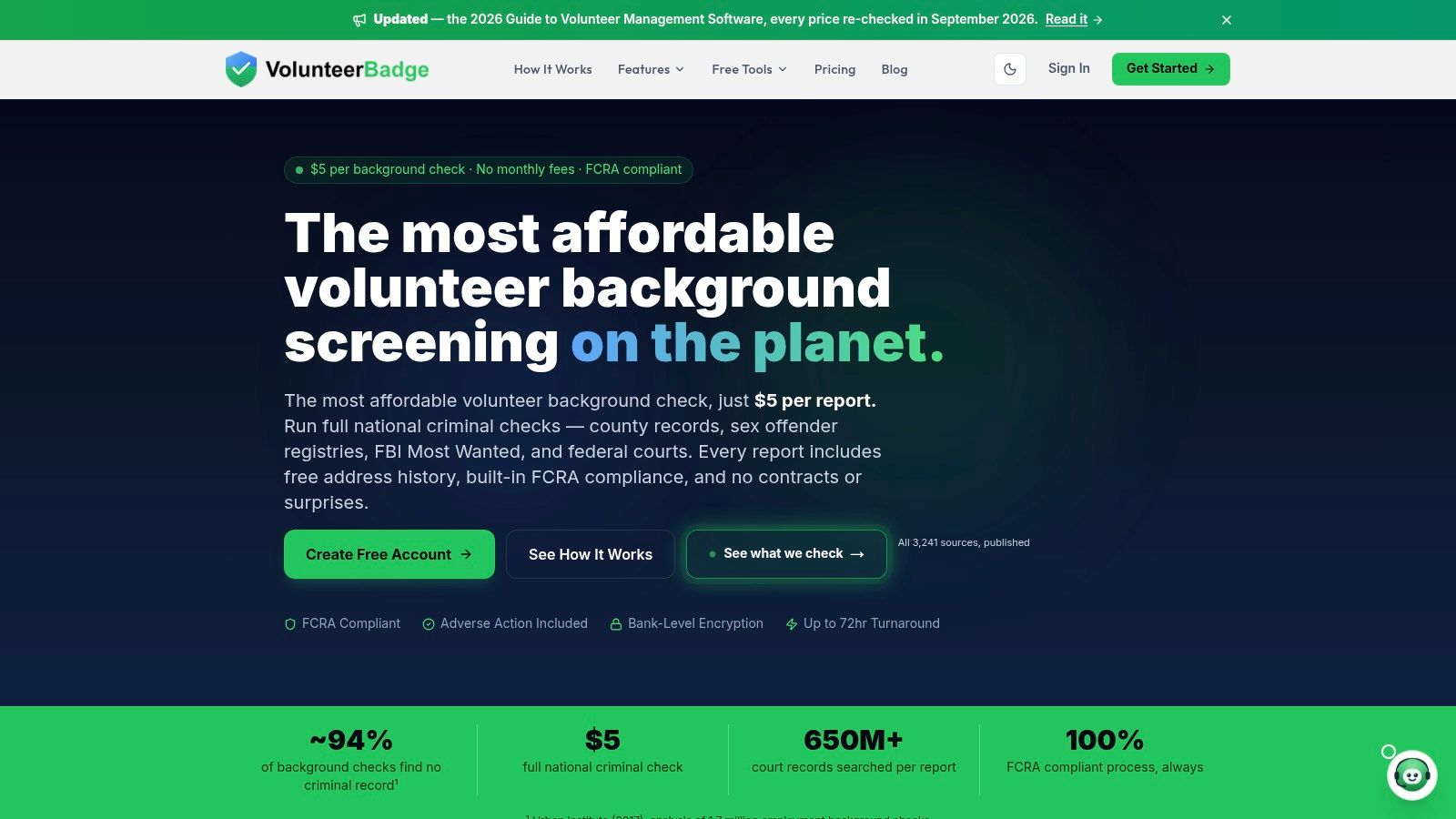
A purpose-built service such as VolunteerBadge packages criminal searches, sex-offender registries, FBI Most Wanted data, OFAC sanctions, and global watchlists with digital disclosure and authorization, address-history checks, plain-English results, and adverse-action notices. The organization still needs to define its policy and review alerts, but a structured workflow can reduce missed steps.
Use this checklist in your written procedure:
- Scope the sources: Record the lists, jurisdictions, and update expectations.
- Collect identifiers: Gather the information needed to distinguish similar names.
- Preserve evidence: Keep the source record, timestamp, and search result.
- Review carefully: Compare the complete listing, not just the alert name.
- Document disposition: Record who reviewed the result and why.
- Reassess: Revisit prior decisions when relevant details change.
The following video provides another way to visualize how global watch-list screening fits into broader background screening:
A global watch-list check protects a nonprofit only when it's scoped, current, identifier-based, and reviewed by a human. Treating it as one universal database or an automatic rejection engine defeats the purpose of responsible screening.
VolunteerBadge combines nonprofit-focused volunteer screening with global watchlists, OFAC sanctions, criminal searches, registry checks, digital authorization, and FCRA workflow support. Visit VolunteerBadge to review how your organization can make watch-list alerts easier to verify, document, and handle consistently.
