
Does FCRA Apply to Criminal Background Checks Explained
Does FCRA apply to criminal background checks? Learn when it does, employer duties, and volunteer exceptions in this clear 2026 guide.
On this page
Yes, the FCRA applies when a third-party consumer reporting agency compiles the criminal history for employment or similar eligibility decisions, but not when you look up public court records yourself. The key question is who assembled the information and why the organization is using it.
A volunteer coordinator might face this question while preparing for a new youth program. A church wants to screen adult volunteers. A sports league needs to review coaches. A nonprofit director finds a county court database and wonders whether using a vendor would bring a federal credit-reporting law into the process.
The answer isn't “criminal checks are covered” or “criminal checks aren't covered.” The source of the information and the purpose of the decision determine whether the FCRA applies. A self-directed public-record search generally sits outside the FCRA, while a report prepared by a third-party screening company for an eligibility decision generally falls within it.
That distinction matters because an FCRA-covered process includes procedural duties. Before ordering a report, the organization must provide a clear disclosure and obtain written authorization. If the report may lead to a negative decision, the organization must follow adverse-action procedures that give the person an opportunity to review and dispute inaccurate information. The Federal Trade Commission's employer background check guidance remains the central federal reference for these steps.
This guide explains the rule in practical terms, with nonprofit volunteer screening at the center. You'll see how the law defines a consumer report, how outsourced screening differs from an in-house court lookup, what organizations must do before and after a check, and why state reporting limits can add another layer of obligations.
Table of Contents
- Introduction Does FCRA Apply to Criminal Background Checks
- What the FCRA Is and Why It Covers More Than Credit
- When Criminal Background Checks Become Consumer Reports
- Outsourced Reports Versus In House Court Lookups
- Employer and Nonprofit Duties Before and After a Check
- Common Misconceptions About Reporting Limits and Exceptions
- Choosing a Compliant Path for Volunteer Screening
Introduction Does FCRA Apply to Criminal Background Checks
A volunteer coordinator is preparing to place new helpers at a youth event. A screening provider sends disclosure and authorization forms, and someone asks why a law associated with credit reports applies when the organization is reviewing criminal records.
The answer depends less on the type of record than on who compiles it and why it will be used. The FCRA can cover a criminal-history report when a third party prepares it for an eligibility decision. A nonprofit that reviews a court record itself is in a different position from one that receives a report assembled by a screening company.
The FTC explains that background screening reports can be consumer reports when they help determine eligibility for employment, housing, insurance, credit, or other covered purposes. Companies that prepare and sell those reports may be consumer reporting agencies under the FCRA. See the FTC's plain-language explanation of background checks.
Use two questions to sort out the starting point:
- Who prepared the report? An outside screening company may be a consumer reporting agency. An organization checking a public court website itself is not using that same reporting channel.
- Why will the information be used? Deciding whether someone may work with children, drive participants, serve at an event, or access a vulnerable population can be an eligibility purpose.
For example, a nonprofit employee may search a county court database, read the record, and document the result directly. That process generally falls outside the FCRA. If the nonprofit orders a compiled criminal-history report to decide whether to approve a volunteer, the FCRA may govern the screening process.
The framework is a starting point, not a complete jurisdiction-by-jurisdiction answer. State and local rules, the volunteer role, and the provider's workflow may impose additional requirements. Beginning with the report's source and intended use helps the organization avoid treating every criminal check as either automatically covered or automatically exempt.
What the FCRA Is and Why It Covers More Than Credit
Think of the FCRA as a referee for information that one party collects about a person and supplies to another party for an important eligibility decision. The referee isn't deciding whether the applicant gets the job, housing, or volunteer role. Instead, the law sets rules for collecting, reporting, sharing, and responding to information that may affect that decision.
Congress enacted the FCRA in 1970, and the law reaches beyond traditional credit data. The statutory concept of a consumer report includes information bearing on a person's character, general reputation, personal characteristics, or mode of living. A criminal-history report can fit that description because decision-makers may use it to evaluate a person's eligibility.
A consumer reporting agency, often called a CRA, is a business that assembles or evaluates information about people to furnish consumer reports to third parties for permitted purposes. A background screening company can qualify when it compiles criminal records for an employer, nonprofit, landlord, insurer, or another decision-maker.
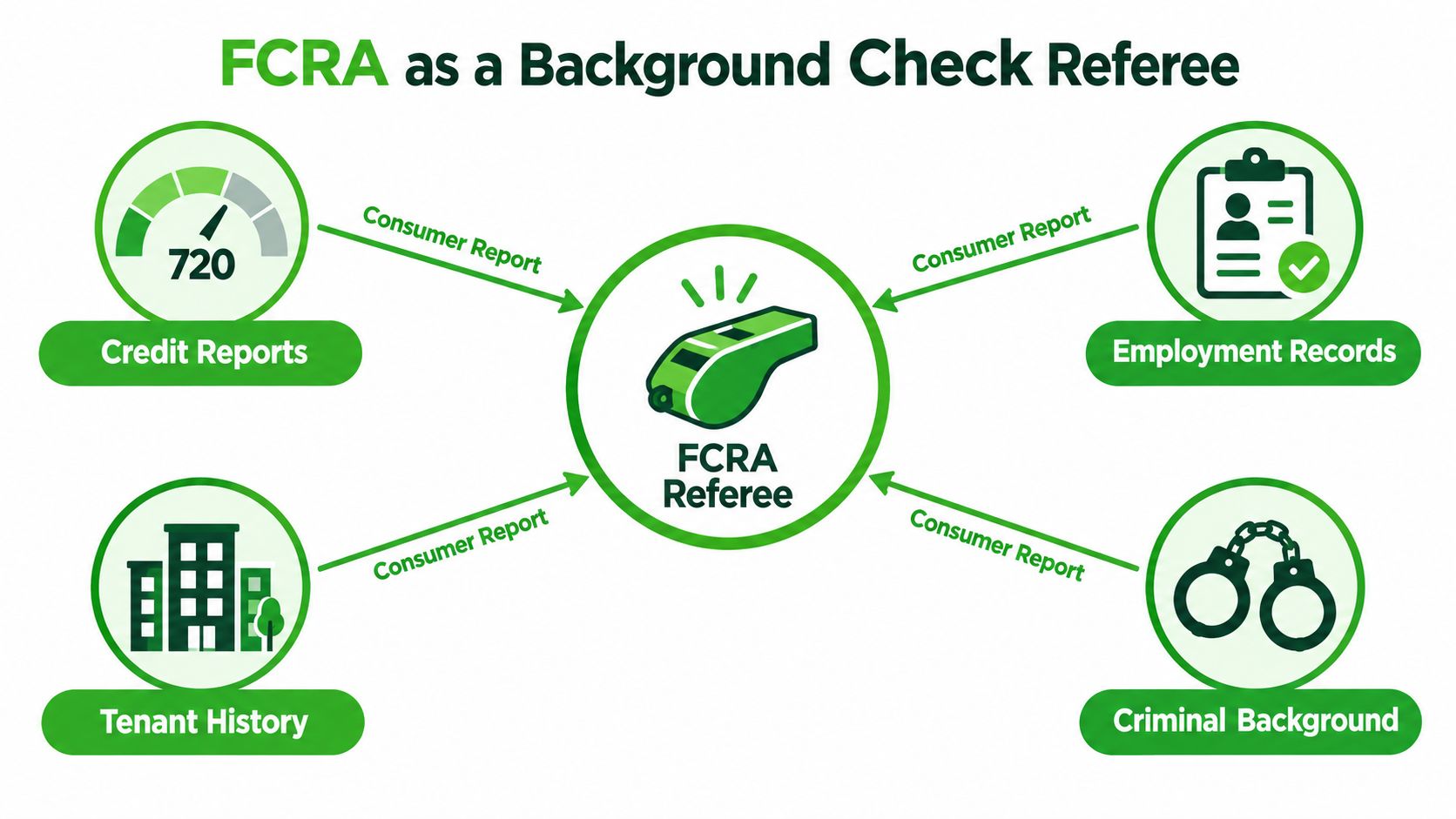
Why the label matters
The label “consumer report” isn't limited to something with a credit score. It describes the role the information plays in a decision and the way a business prepares and provides it. That's why criminal screening can fall under a statute many readers first associate with banks and credit bureaus.
The historical shift is practical. Informal reference-checking usually involved an organization contacting people directly. Once third-party databases and screening companies became part of the decision process, criminal screening moved toward regulated consumer reporting. The FCRA helps establish boundaries around notice, consent, accuracy, and the person's opportunity to respond.
For nonprofit teams, the important lesson is simple: the subject matter alone doesn't determine coverage. A report doesn't become FCRA-regulated merely because it mentions an arrest or conviction. The organization must look at the report's source and intended use.
You can review the related explanation of FCRA compliance for a nonprofit-oriented overview of the same framework. Keep the analogy in mind: the FCRA acts like a referee when a third party assembles personal information for a decision that affects access, eligibility, or opportunity.
When Criminal Background Checks Become Consumer Reports
A nonprofit volunteer coordinator asks a screening vendor for a criminal-history report before allowing a coach to work with children. Whether the FCRA applies depends less on the words “criminal background check” than on two connected questions: who compiles the report and why the organization will use it.
A company that assembles background information for others may be a consumer reporting agency. This explanation of what qualifies as a consumer reporting agency can help clarify that role. The FTC's Advisory Opinion on criminal-history reports explains that when consumer reporting agencies provide criminal histories for covered purposes, they are furnishing consumer reports and must follow the FCRA.
The second part is the intended use. Employment, housing, insurance, and related eligibility decisions can be covered purposes under federal law. A volunteer decision may raise the same issue if the report helps determine whether someone may serve, enter a facility, supervise participants, or access a program.
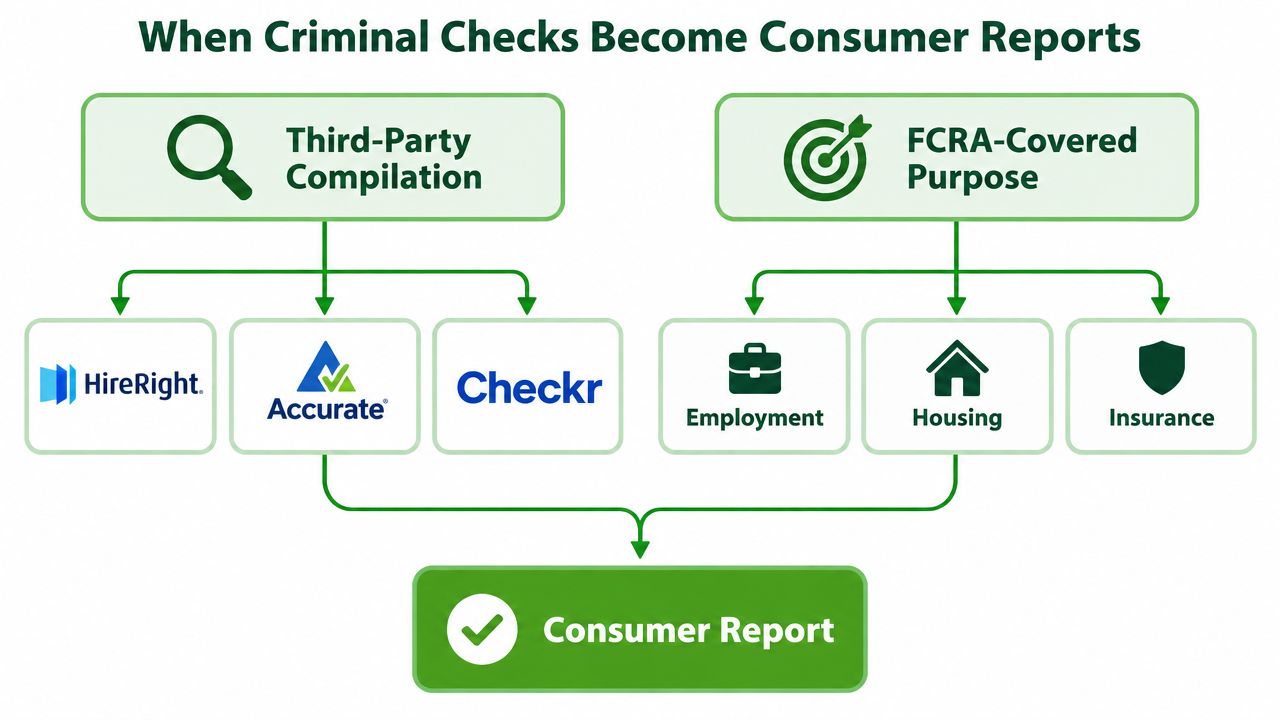
Applying the test to volunteers
A volunteer does not have to be an employee for the organization to make a meaningful eligibility decision. If a third-party CRA prepares the report for that decision, the nonprofit should treat the process as FCRA-sensitive. That generally means using the required disclosure, obtaining written authorization, and following the adverse-action process when applicable.
Consider two workflows:
- A youth league searches a public county court website itself, reviews the available record, and documents its own findings. That direct process generally falls outside the FCRA, although other laws and accuracy duties may still apply.
- The same league orders a compiled criminal-history report from a screening company and uses it to decide whether a coach may participate. The report can qualify as a consumer report, so the FCRA workflow becomes relevant.
The record may be identical. The workflow has changed.
Practical rule: Classify the check by identifying the compiler, the recipient, and the decision the information will influence. The presence of criminal history alone does not answer the question.
A nonprofit should verify what the vendor provides. A database subscription, court-record retrieval service, and CRA may involve different products and responsibilities. Written procedures should reflect the purchased service, not the informal label “background check.”
Outsourced Reports Versus In House Court Lookups
Two organizations may search for the same criminal record and face different federal treatment. The dividing line is usually the workflow, not the name of the search.
An outsourced report is assembled by a third-party screening company for the nonprofit's decision. That arrangement generally creates a consumer report when the purpose is FCRA-covered. An in-house lookup means the organization obtains public court information directly and performs its own research, which generally falls outside the FCRA under the source-and-use distinction described by the FTC.
Neither option should be treated as automatically risk-free. A direct public-record search can still produce mistaken identity, incomplete information, outdated entries, or inconsistent treatment. Choosing not to use a CRA may remove the FCRA's specific consumer-report workflow, but it doesn't eliminate the need for a fair, careful, and legally appropriate screening policy.
The following matrix helps classify the process:
| Search Method | FCRA Applies | Why It Matters |
|---|---|---|
| A CRA compiles a criminal-history report for a hiring decision | Generally yes | Disclosure, written authorization, and adverse-action duties apply |
| A CRA prepares a report for a nonprofit volunteer eligibility decision | Generally yes | The organization should use an FCRA-compliant volunteer workflow |
| Staff search public court records directly | Generally no | The organization is conducting its own research rather than receiving a CRA report |
| A staff member uses a third-party database but assembles the decision file internally | Depends on the service and use | Confirm whether the provider is functioning as a CRA and whether it furnishes a consumer report |
| A vendor supplies records but the organization uses them for an unrelated personal purpose | Not automatically | Coverage depends on the report's purpose and the statutory requirements |
Why nonprofits need a written boundary
Volunteer programs often operate across different counties, facilities, and states. One coordinator may use a vendor, while another may copy information from a court portal. Without a written process, the organization can accidentally apply different standards to people performing similar work.
Start with a decision record:
- Identify the source: Record whether the information came from a CRA, a court, or another provider.
- Define the purpose: State whether the report supports employment, volunteer approval, access, housing, insurance, or another decision.
- Assign responsibility: Decide who reviews results and who communicates with the applicant.
- Preserve consistency: Use the same process for comparable roles and situations.
A direct county records search explanation can help coordinators understand what public-record research involves. The organization should then decide whether that method is appropriate for its capacity, geography, accuracy needs, and legal environment.
The choice of vendor changes the duties. Once a CRA prepares the report, the nonprofit can't treat the result like an informal note from a public website. It needs a controlled process from disclosure through final decision.
Employer and Nonprofit Duties Before and After a Check
Once a third-party report is involved, the organization should treat screening as a sequence rather than a single purchase. The FCRA's required steps protect the applicant or volunteer before the check occurs and again if the report may influence a negative decision.
Before ordering the report
The organization must give the person a clear pre-screening disclosure and obtain written authorization before ordering the report, according to the FTC's federal guidance. The disclosure should explain that a consumer report may be obtained for the relevant decision. Authorization shows that the person received the notice and gave permission.
Keep the process separate from ordinary program materials. A volunteer application, code of conduct, waiver, and screening disclosure serve different purposes. Combining unrelated language can make the notice harder to understand and can create avoidable compliance questions.
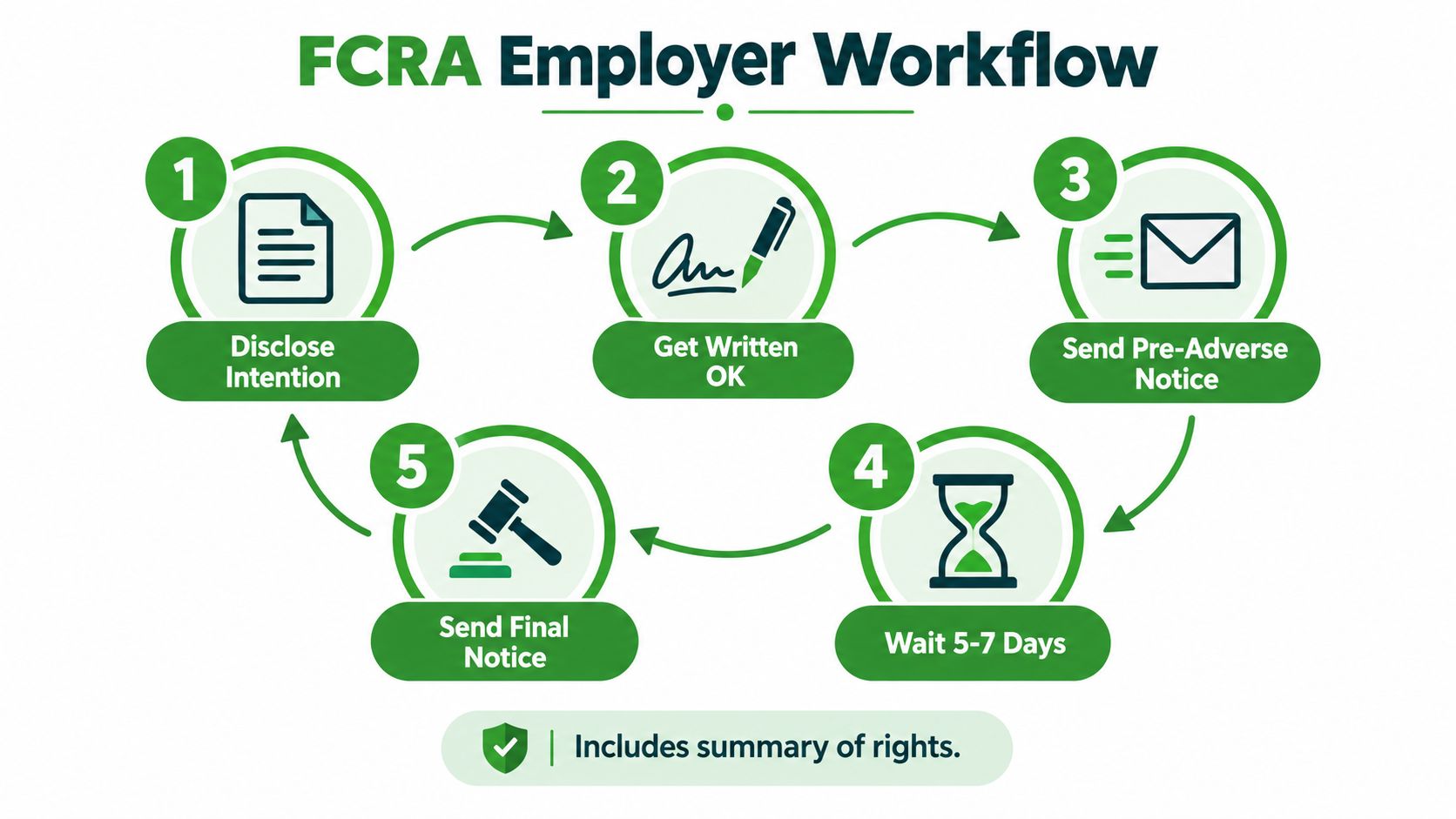
If the result may cause a negative decision
Don't make the final decision immediately after seeing a potentially disqualifying record. The adverse-action process has two stages:
- Pre-adverse notice: Tell the person that the organization is considering adverse action, provide a copy of the report, and provide the required summary of rights.
- Final adverse notice: If the organization proceeds after allowing the person to review and respond, send notice that the adverse action was taken.
The purpose is practical. Criminal records can be inaccurate, incomplete, or connected to the wrong person. The person needs a genuine chance to identify an error or provide context before the organization closes the door.
Before a final rejection, give the person the report and a meaningful opportunity to challenge inaccurate information.
A volunteer coordinator should document when the disclosure was delivered, when authorization was received, when the report was sent, and when each decision notice went out. The team should also know who handles disputes and who pauses the decision while a dispute is reviewed.
Fair treatment matters beyond the FCRA paperwork. Organizations that want a broader workplace perspective can review these steps nurses can take against workplace bias, especially when screening decisions may affect people from protected groups.
The FCRA process doesn't tell a nonprofit whom to accept. It requires a transparent procedure around the report. The organization still needs a role-related, consistently applied screening policy and should consider whether other federal, state, or local rules affect the decision.
Common Misconceptions About Reporting Limits and Exceptions
A common shortcut says, “The FCRA allows seven years.” That statement is incomplete and can lead organizations to make the wrong decision.
Federal law bars reporting certain non-conviction information older than seven years in some employment contexts, while convictions can often still be reported federally. The FCRA compliance overview from Cisive also notes that states including California, Massachusetts, Washington, and Texas may impose stricter limits.
The result is a layered system. A nonprofit may need to check the federal FCRA baseline, the law of the state where the role occurs, rules connected to the applicant's location, and the adverse-action requirements governing the decision.
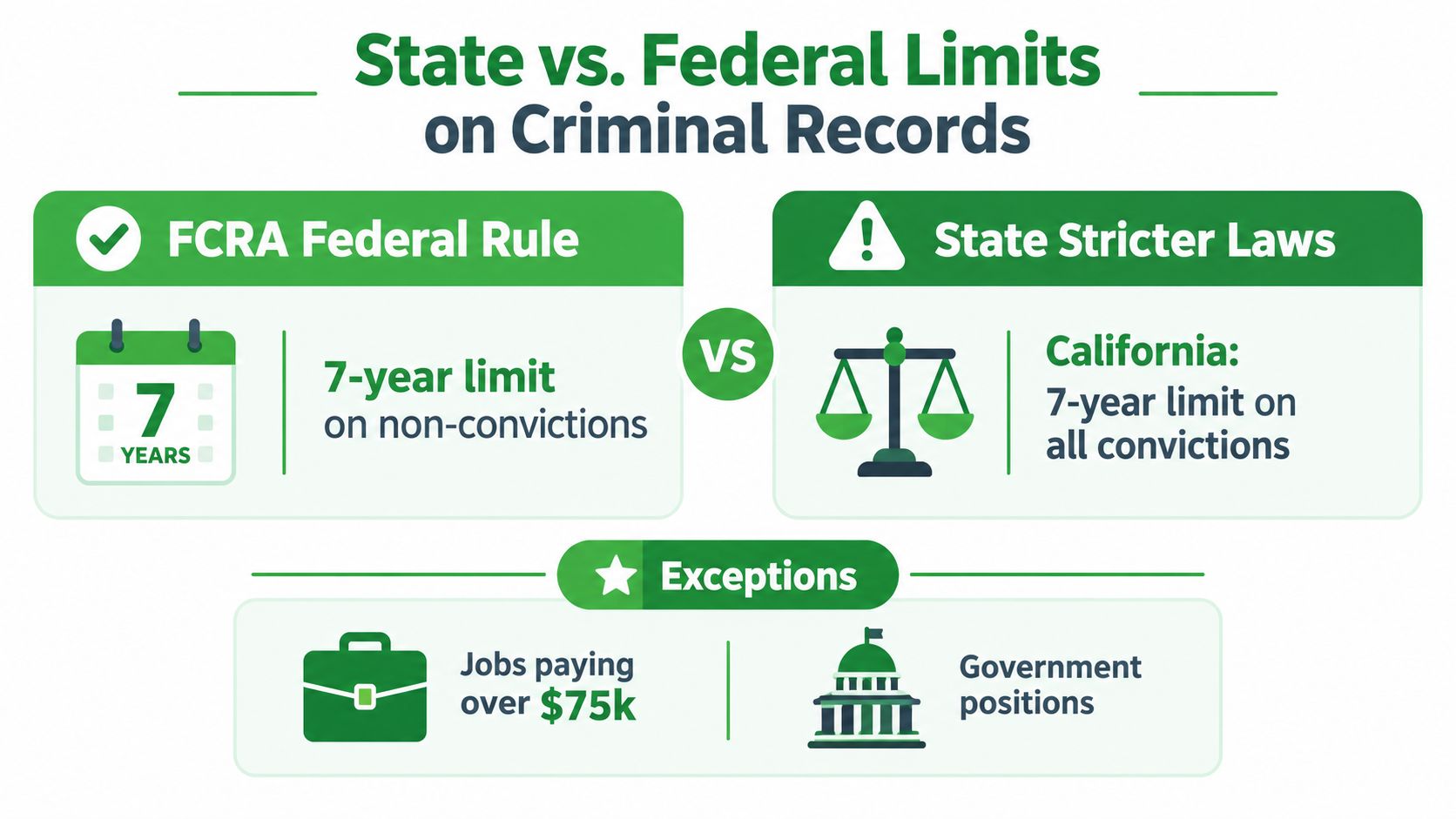
Three assumptions to avoid
Assumption one, “Every criminal record disappears after seven years.” The federal rule described above concerns certain non-conviction information in some employment contexts. It doesn't create one universal expiration date for every criminal record.
Assumption two, “Convictions can always be reported.” Federal treatment doesn't override stricter state restrictions. A state may limit what a provider can report or what an organization may consider.
Assumption three, “Volunteer screening has no lookback issue.” A volunteer role can still involve an eligibility decision, and the applicable state rules may still matter. The organization should never assume that unpaid status removes every reporting or use restriction.
Why the exception question matters
Reporting limits aren't the only concern. A record may be legally reportable but still require careful review for identity, relevance, accuracy, and consistency. A broad rule that rejects anyone with any criminal history can create separate fairness and discrimination concerns, even when the report itself was obtained properly.
For a nonprofit, a responsible policy should state which roles require screening, what categories of information matter to those roles, and who reviews close cases. If the program operates in multiple states, the coordinator should confirm whether the provider applies location-specific restrictions or whether the organization must manage them independently.
The contrarian lesson is straightforward: FCRA compliance isn't a single federal checkbox. It combines the reporting rules, state limitations, the source of the report, the purpose of the decision, and the steps taken after a potentially negative result.
Choosing a Compliant Path for Volunteer Screening
A nonprofit can make the source-and-use test part of its intake process. Before selecting a screening method, ask:
- Will staff gather public records directly, or will a CRA compile the report?
- What decision will the information influence?
- Does the provider supply a standalone disclosure and written authorization workflow?
- Can the organization send the report and rights summary before final adverse action?
- Does the process account for state-specific reporting restrictions?
- Can the team document decisions and respond to disputes?
An in-house search may be workable for a small, clearly defined program, but it requires staff time, consistent research methods, careful identity matching, and a process for handling errors. A CRA may provide a more structured workflow, but the nonprofit still remains responsible for using the report lawfully and making its own decision.
VolunteerBadge is one example of a nonprofit-focused CRA offering criminal background screening with disclosure, authorization, and adverse-action support. Its workflow is designed to help organizations manage volunteer checks through a structured FCRA process, but any provider should be evaluated against the same criteria rather than selected solely by brand or price.
The practical takeaway is:
- Classify the source and purpose.
- Use a clear disclosure.
- Obtain written authorization.
- Review the report for accuracy and relevance.
- Follow pre-adverse and final adverse-action steps when required.
- Check state reporting and use limits before applying the result.
Screening should protect participants without treating applicants as guilty because a database produced an entry. Build a process that is accurate, explainable, and respectful from the first disclosure through the final decision.
VolunteerBadge helps nonprofits obtain FCRA-compliant volunteer background checks with authorization and adverse-action workflows built into the screening process. Visit VolunteerBadge to review a structured option for handling criminal background checks while respecting volunteer rights.
