
How Long Does Fcra Background Check Take
How long does fcra background check take. How long does an FCRA background check take? Get realistic timelines for instant, county, federal, and sex offender
On this page
A standard FCRA-compliant background check typically returns in 1 to 5 business days for a clean automated file, while manual county verification or a dispute can stretch the process into several weeks. The FCRA doesn't set one universal deadline for completing the search, so the answer depends on which records must be verified and whether the file needs review.
Your Saturday food bank event is two weeks away. Three drivers still need approval, the volunteers have submitted their forms, and your inbox has produced no useful update. That silence doesn't necessarily mean the screening company has stalled. The fast database searches may already be complete while a county clerk, school, former employer, or dispute review is holding the report open.
For nonprofit programs, the most useful planning rule is simple: standard files are usually measured in business days, but manual verification can move the schedule into weeks. The consumer reporting agency, or CRA, often processes its own automated searches quickly. The upstream record source, especially a county courthouse, is more likely to control the finish date.
The practical question isn't only “how long does FCRA background check take?” It's which component is still pending, who controls that component, and what action can remove the delay. The sections below separate the main searches, the legal timing rules, and the workflow decisions that matter when volunteers are waiting to start.
Table of Contents
- The Quick Answer Every Nonprofit Coordinator Wants
- What an FCRA Background Check Covers
- Turnaround Times for Each Search Component
- The FCRA Timing Rules That Shape Every Screening
- Factors That Slow a Background Check Down
- What a Nonprofit Should Expect From Disclosure to Final Decision
- Practical Ways to Speed Up Volunteer Screenings
The Quick Answer Every Nonprofit Coordinator Wants
A clean, standard screening package often returns within 1 to 5 business days, according to neutral industry guidance on background check turnaround. Automated components, including identity verification and broad database searches, can return in 24 to 72 hours when records are digitized and third parties respond promptly.
That estimate changes when the CRA must verify a record manually. A volunteer who has lived in multiple counties, shares a common name, or triggers a courthouse review can wait several weeks, particularly when a court requires a physical record pull or when the volunteer disputes information. The delay usually isn't caused by the CRA's software. It comes from the source that must confirm whether a possible match belongs to the right person and what the official record says.
The first question to ask
Don't ask only whether the check is “in progress.” Ask which component is pending:
- Identity trace: Has the address history and identity information matched cleanly?
- National criminal database: Did the broad search return a possible record requiring source verification?
- County criminal search: Is a clerk or court researcher still retrieving the record?
- State or federal search: Is the relevant repository responding within its normal processing window?
- Registry and sanctions screening: Have the sex offender, OFAC, or watchlist layers cleared?
Practical rule: For a volunteer queue, county verification is usually the first bottleneck to investigate, not the instant database search.
The CRA can often deliver a clean automated result quickly. It can't force an unresponsive courthouse to index records faster, and it must verify a potentially adverse record before reporting it. That distinction helps you give volunteers an honest update instead of promising a date the screening provider can't control.
What an FCRA Background Check Covers
An FCRA background check is a consumer report prepared by a consumer reporting agency, or CRA, for a permissible purpose such as deciding whether someone may work or volunteer. It is a regulated screening process, not a free personal lookup, search engine result, or informal police-records request.
For a nonprofit, the report usually combines several searches. Each layer answers a different operational question:
- Identity trace and address history. This helps confirm the volunteer's identity, identify known aliases, and locate jurisdictions that may need a deeper review.
- National criminal database search. This broad index can surface possible records quickly. A possible match still requires verification with the original court or repository before it should affect a decision.
- State and federal criminal searches. These provide coverage through state repositories and federal courts when the role or screening policy calls for them.
- County court records. County searches often supply the source-level detail needed to confirm whether a record belongs to the volunteer and what the official disposition says.
- Sex offender and sanctions screening. A package may include national registry coverage, OFAC screening, and other watchlist searches selected for the nonprofit's risk policy.
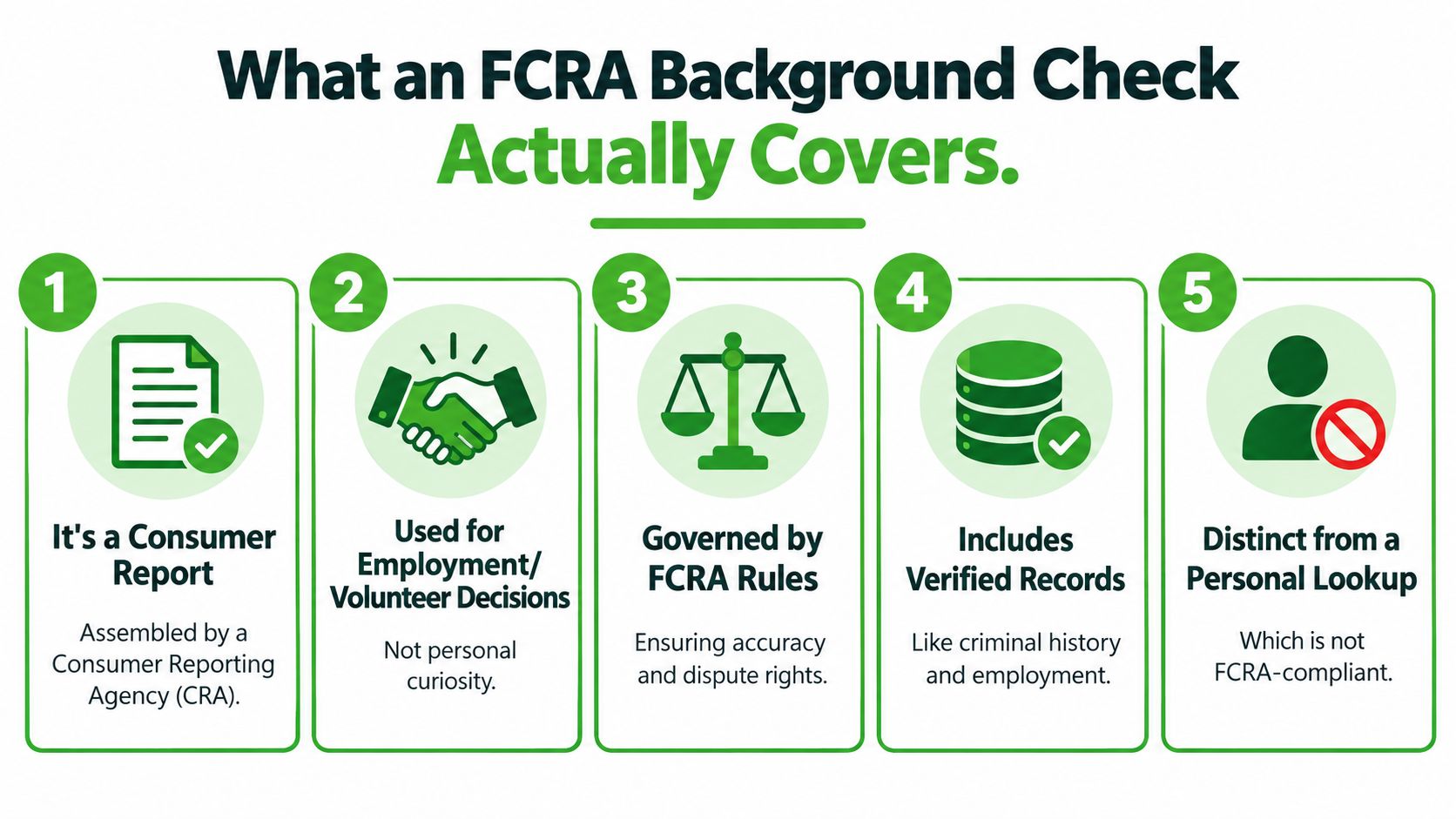
A food bank that requires driver credentials may see the county criminal search become the bottleneck, while the national database returns within minutes. That distinction matters when volunteers are waiting for orientation. The broad database can identify a lead, but only a source-level check can verify it. A courthouse clerk, local researcher, or state repository may control the final timing.
Why volunteer screening falls under the FCRA
A nonprofit does not avoid FCRA duties because the person is unpaid. If the organization uses a CRA's consumer report to evaluate volunteer eligibility, it needs a clear standalone disclosure and the volunteer's authorization before ordering the report.
If potentially disqualifying information appears, the nonprofit also needs a fair review process. Before making a final adverse decision, it should provide the volunteer with the report and an opportunity to identify inaccurate or incomplete information. The FTC's guidance for information furnishers explains the reinvestigation framework for disputed consumer-report information.
The practical rule is simple: fast retrieval is only one part of compliance. The report must connect to the correct person, rely on an appropriate source, and be handled fairly when the nonprofit is considering a negative decision.
Turnaround Times for Each Search Component
The fastest way to estimate completion is to separate the package into its component searches. The following operational ranges describe common workflow patterns, not a legal promise. Actual timing depends on the jurisdiction, the quality of the applicant's information, and the response speed of the record source.
| Search Component | Typical Turnaround | Common Bottleneck |
|---|---|---|
| Identity trace and SSN validation | Under 30 seconds to a few minutes | Incomplete or inconsistent personal data |
| National criminal database | Minutes to a few hours | Possible match requiring county verification |
| Sex offender registry search | Minutes to a few hours | Name or identity match needing review |
| OFAC and watchlist screening | Minutes to a few hours | Similar-name match and manual identity comparison |
| State criminal repository | 1 to 3 business days | State-specific processing and repository access |
| Federal criminal search | 3 to 7 business days | Federal court access and verification workflow |
| Fingerprint-based FBI channeler result | 3 to 7 business days | Fingerprint quality and channeler processing |
| Electronic county court search | Same day to 48 hours | Court indexing and local availability |
| Manual county courthouse pull | 3 to 10 business days | Clerk retrieval, physical files, or court backlog |
| Exceptionally delayed county search | Past 3 weeks in some jurisdictions | Severe local backlog or limited access |
The national criminal index, identity trace, sex offender registry, and OFAC layer are generally the quick portion. They can flag a possible record, but they don't eliminate the need for a deeper search when the result needs confirmation. Treating an index hit as a final answer is fast, but it isn't a reliable FCRA workflow.
State repositories and federal searches add a different kind of delay. Their timing depends on the repository or court system, not on the CRA's queue. Fingerprint-based results also have their own processing path, so coordinators should distinguish a name-based package from a fingerprint check when setting expectations. For a closer comparison of fingerprint-specific timing, see this guide to how long a fingerprint background check takes.
County searches decide the finish date
County records are where nonprofit queues most often slow down. An electronic county may return a result the same day or within 48 hours, while a court that requires clerk retrieval can take 3 to 10 business days. A small number of jurisdictions can extend beyond three weeks when access is limited or the court has a substantial backlog.
The total doesn't usually equal every county's time added together. If the volunteer lived in five counties, the CRA can process those searches in parallel. The report generally waits for the slowest required verifier, assuming no dispute or separate verification remains open.
That makes address history essential. A complete history routes the search to the correct courts at the start. A missing address, common name, or unresolved identity conflict can turn a quick database result into a manual investigation.
The FCRA Timing Rules That Shape Every Screening
The FCRA doesn't create one fixed completion deadline for every background search. It creates timing obligations around disputes and adverse action, and those obligations can extend the overall process even when the initial search was fast. The CFPB's FCRA examination procedures distinguish the investigation and reporting obligations from a universal search-completion deadline.
| FCRA Clock | Duration | Trigger / Required Action |
|---|---|---|
| Dispute reinvestigation | 30 days generally | CRA receives a dispute and must investigate the challenged information |
| Extended reinvestigation | Up to 45 days | Consumer provides additional relevant information during the investigation |
| Pre-adverse review period | Commonly about 5 business days | Nonprofit sends the report and notice before final adverse action |
Disputes can change the calendar
A CRA generally has 30 days to reinvestigate a dispute. That window can extend by 15 additional days, reaching 45 days, when the consumer supplies additional relevant information during the investigation. The FTC also states that furnishers generally complete their part of the investigation within the same 30-day framework.
For a volunteer, this means a record that looked complete on the first pass may remain unresolved after the nonprofit receives a dispute. The CRA may need to contact the data furnisher, return to the source, compare identifying details, and update the report. The organization shouldn't treat the original database result as final while that process is active.
Adverse action adds another review stage
If the nonprofit may reject or remove a volunteer because of report information, it should send a pre-adverse-action notice with the report and the required summary of rights. Federal law doesn't establish one fixed pre-adverse waiting period, but federal guidance commonly uses 5 business days as a reasonable period before final action.
That pause protects the volunteer's opportunity to review the information and respond. A nonprofit that skips it may finish the administrative task sooner, but it creates a compliance problem and undermines the fairness the FCRA requires. For an operational overview, use this guide to FCRA compliance for nonprofits.
A quick report isn't a compliant decision until the nonprofit has completed the required review steps.
Factors That Slow a Background Check Down
The delay usually has a recognizable cause. Coordinators can reduce avoidable waiting by collecting better information before the order and by asking the CRA precise status questions once a search is pending.
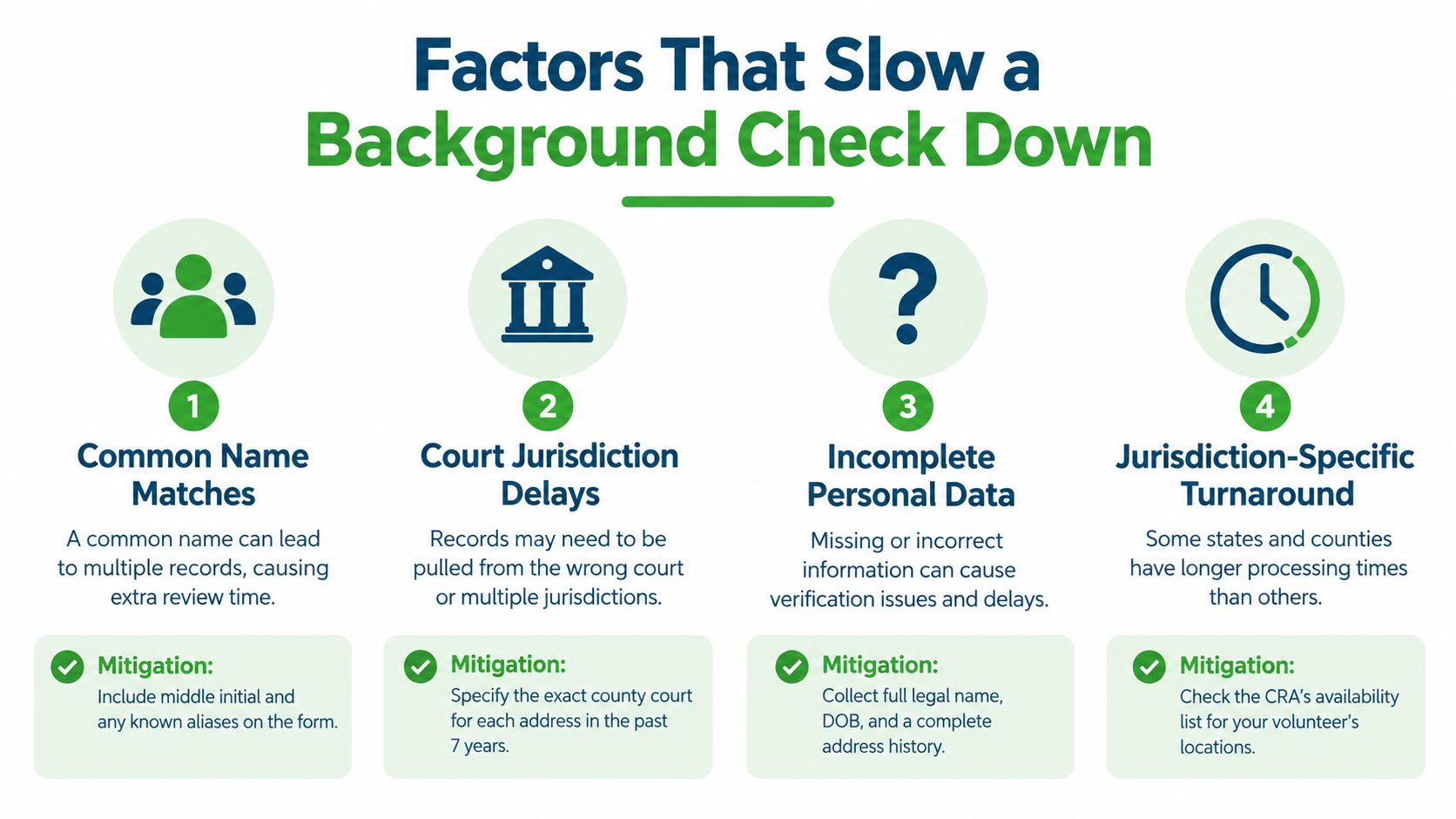
Identity ambiguity
A common name can produce records belonging to someone else. The CRA then needs stronger identifiers and may need a manual court pull, which can add 3 to 10 business days when the court researcher must verify the record.
Collect the volunteer's full legal name, middle name or initial, known aliases, date of birth, and complete address history. A complete form gives the CRA more ways to separate the volunteer from unrelated records.
Jurisdiction access
Some counties provide electronic access, while others require a clerk request, a local researcher, or physical retrieval. Out-of-state searches can be especially difficult when the vendor lacks direct court-runner capacity in that jurisdiction.
Before choosing a provider, ask whether it has direct access in the counties most common among your volunteers. If a rural county routinely requires manual retrieval, paying for a direct courthouse pull may be more practical than waiting through a standard channel.
Incomplete forms
An unreadable consent form, missing address, inconsistent legal name, or unsigned disclosure can stop the process before the CRA reaches the records. The volunteer may believe the screening has started while the order is waiting for corrected information.
Use a digital intake form that validates required fields before submission. Send the disclosure and authorization together, and assign one staff member to monitor incomplete applications rather than allowing corrections to sit in a general inbox.
Court backlogs and older records
Large metropolitan courts may publish processing times that exceed two weeks, while older or archived records can require additional retrieval. International education or employment verification can also take several weeks because the CRA depends on institutions or records systems outside its normal domestic workflow.
Build a buffer into volunteer onboarding when the role involves children, transportation, financial access, or another higher-risk assignment. You can also ask the CRA for a component-level status rather than accepting a generic “pending” label. This explanation of why background checks take so long is useful when training coordinators to identify the actual hold-up.
Active disputes
Once a volunteer disputes a result, the reinvestigation clock becomes the controlling timeline. Tell candidates that a dispute may extend resolution into a month or more, rather than promising that the original screening date still applies. The right response is to document the dispute, preserve the report version, and let the CRA complete its investigation before making a final decision based on the challenged information.
What a Nonprofit Should Expect From Disclosure to Final Decision
The clean-file workflow is relatively straightforward. The nonprofit provides a standalone FCRA disclosure, obtains written authorization, and submits complete information. With a ready digital form, that opening step can happen the same day.
After submission, automated layers may populate within minutes to a few hours. County, state, and federal verifications then arrive as their source systems respond, with many standard files completing within 1 to 5 business days. A clean report can usually move to the nonprofit's review as soon as the final required component arrives.
The operational sequence
- Disclosure and authorization: Give the volunteer a clear standalone disclosure and obtain written permission before ordering.
- Order submission: Send the completed identity, address, and authorization information to the CRA.
- Search and verification: Let the CRA run automated databases, then verify potential records at the appropriate court or repository.
- Report delivery: Review the completed report and apply the nonprofit's written, role-related criteria.
- Adverse-action review: If the report may lead to a negative decision, send the pre-adverse notice, include the report and rights summary, and allow the review period.
- Final decision: Consider any response, then issue the final notice if the adverse decision remains.
A clean file can move from submission to approval in minutes to one day after the required searches finish. A file that triggers adverse-action procedures can take roughly 7 to 14 days, depending on when the notice is sent and whether the volunteer responds. Those are workflow expectations, not FCRA universal deadlines.
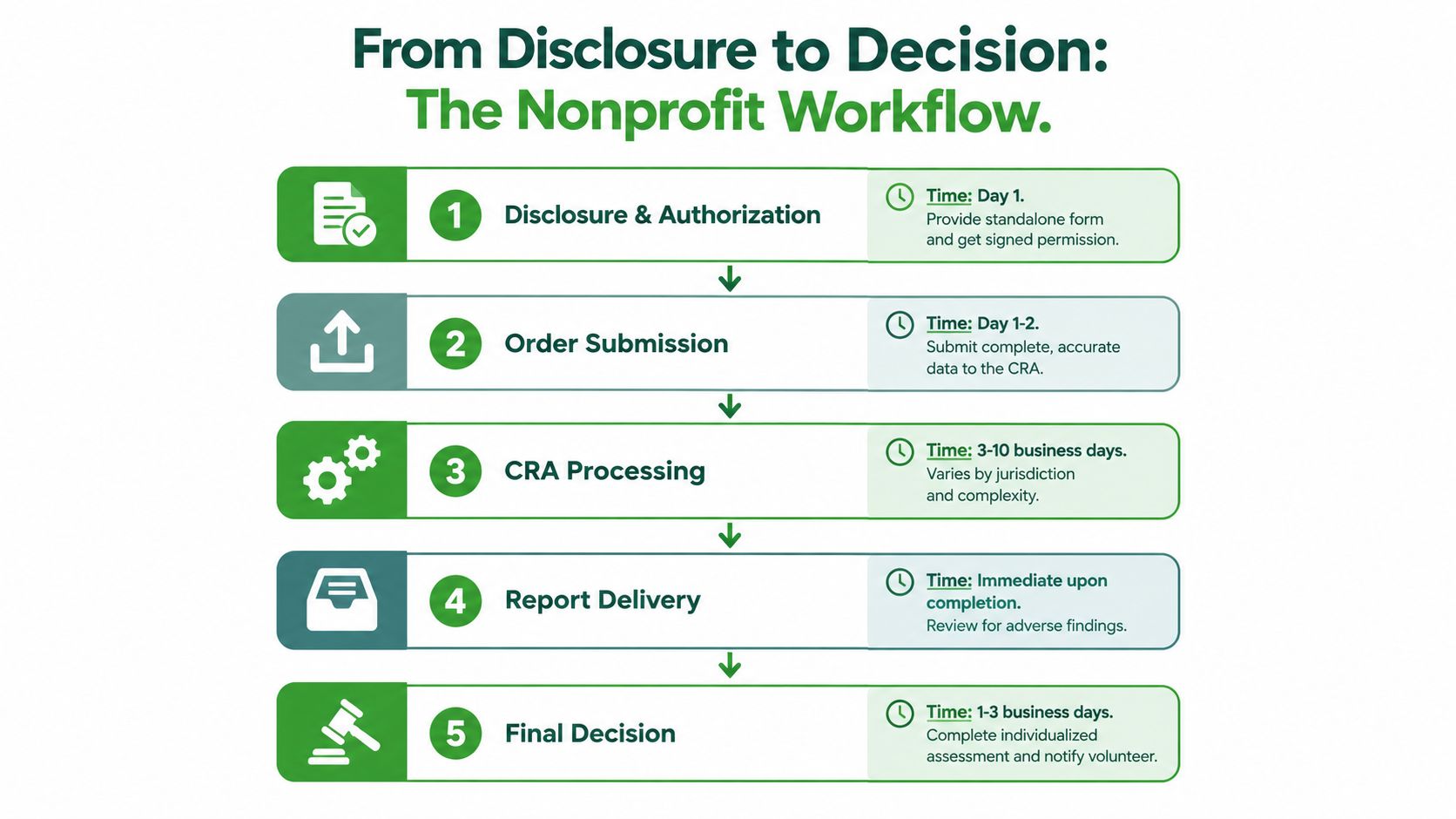
The nonprofit should separate report completion from decision completion. A report may be ready while staff still need to conduct an individualized review, contact the volunteer, or complete pre-adverse and final notices. A status dashboard that shows each component prevents the common mistake of treating “one pending county” as a mysterious vendor-wide delay.
This short video illustrates the sequence coordinators should document from intake through decision:
Practical Ways to Speed Up Volunteer Screenings
Start before the volunteer presses submit. Collect the full legal name, aliases, date of birth, current address, prior addresses, and working contact details in one complete intake. For roles requiring broad history, the address record should cover the applicable lookback period, so the CRA can identify the correct counties on the first pass.
Use a single signup packet for the standalone disclosure, authorization, and screening information. That prevents the search from waiting for a separate consent email or an unreadable attachment.
A practical coordinator checklist looks like this:
- Collect complete data: Ask for every required identity field and address.
- Confirm jurisdictions: Map each prior address to the correct county court.
- Validate forms: Check that disclosure and authorization are signed before ordering.
- Monitor exceptions: Review pending statuses daily and escalate only the component that is late.
Prioritize automated layers first, but don't mistake an instant result for a finished FCRA report when source verification is required. In counties known for slow retrieval, compare the cost and timing of a direct courthouse pull with the standard vendor route. Brief volunteers that disputed records can add 30 to 45 days under the applicable reinvestigation framework, as described in the FTC's consumer-report information guidance, so they can correct identity information before ordering.
VolunteerBadge provides nonprofit-oriented FCRA screening with digital disclosure and authorization, automated address-history checks, county, state, and federal searches, registry and sanctions screening, and adverse-action notices. To compare the workflow with your current process or start a volunteer screening program, visit VolunteerBadge.
