
National Criminal Record Check Consent Form Template
Build an FCRA-compliant national criminal record check consent form with our step-by-step template, state tips, and storage best practices.
On this page
A volunteer coordinator opens an email from a parent asking who saw his son's dismissed trespassing charge from years ago. The coordinator searches the volunteer file and finds a copied HR template buried inside an onboarding PDF. It contains a signature, but no clear explanation of the report, no reliable record of when the disclosure was shown, and no answer to the most important question: what exactly did the volunteer authorize?
That situation is more common than it should be. A national criminal record check consent form isn't paperwork to attach after the screening decision. It's the legal gateway to requesting a consumer report, and a weak form can undermine the entire process. The Fair Credit Reporting Act, enacted in 1970, established the core requirement that an employer provide a clear, conspicuous disclosure and obtain written authorization before ordering a background report. The FTC's guidance on keeping background-check disclosures simple reinforces that the disclosure must stand alone.
Nonprofits also need to manage the practical issues that generic templates ignore. A recurring volunteer may need fresh consent for a later screening, a mobile workflow must preserve the standalone disclosure, and an audit file must prove what the person saw, signed, and authorized before the report was ordered. The recommendations below are designed to prevent those failures before they become an expensive legal problem.
Table of Contents
- Why the Consent Form Is the Riskiest Part of Volunteer Screening
- The Core Elements Every FCRA-Compliant Form Must Include
- Handling Re-Consent and Recurring Volunteers
- Electronic Signatures, Mobile Collection, and Audit-Ready Proof
- State-by-State Variances That Change Your Form Language
- Storage, Retention, and How to Survive an Audit
Why the Consent Form Is the Riskiest Part of Volunteer Screening
The consent form is the point where your organization asks a person to authorize access to sensitive personal information. That makes it more than an administrative step. It establishes the connection between the volunteer, the organization ordering the report, the screening provider, and the permissible purpose for obtaining the report.
The FCRA framework requires a clear and conspicuous disclosure and the applicant's written authorization before a consumer report is procured. The FTC distinguishes the disclosure from the authorization itself. The disclosure must be presented in a standalone written format, while the written permission may appear in the same document or a separate authorization form. That distinction matters because organizations often treat one signature as proof that every paragraph in an onboarding packet was accepted.
Practical rule: If a volunteer can't identify the disclosure and authorization as a dedicated screening document, your form is probably doing too much.
Three mistakes create repeated trouble:
- Bundling the consent with a waiver: A liability release, volunteer agreement, dispute waiver, or employment application can distract from the disclosure and create the impression that the person accepted unrelated terms as a condition of screening.
- Using vague scope language: “Background check” doesn't tell the volunteer what information may be obtained or how it will be used. A defensible form identifies the purpose and categories of records within the report.
- Treating an old signature as permanent: A volunteer who returns for recurring service may be screened again under a different cycle, role, or provider. The original signature may not clearly authorize that later report.
The Ninth Circuit's interpretation of the standalone-document requirement, discussed in legal commentary by 2020, allowed signature and date lines while still requiring the document to consist solely of the disclosure. That's a useful design principle for nonprofits. Put the disclosure first, keep unrelated promises out of it, and collect authorization only after the volunteer has had a meaningful opportunity to read the language.
This is also where fair-chance practices intersect with consent design. A consent form authorizes a report, but it doesn't give an organization permission to use criminal history carelessly or inconsistently. Teams building structured screening for fair hiring can use the same discipline in volunteer programs, separating the decision process from the act of obtaining the report.
The Core Elements Every FCRA-Compliant Form Must Include
Build the form as a standalone disclosure and authorization document. Don't place it inside a volunteer handbook, general application, liability waiver, or broad onboarding agreement. The FCRA disclosure and authorization form guidance is useful as a practical reference, but your organization still needs to verify that the language matches its actual screening workflow.
The form should answer six questions in an obvious order.
Start with the purpose and the parties
First, state plainly that the organization may obtain a consumer report for a permissible purpose under the FCRA. Identify the organization as the end-user. If the screening is for a volunteer role, say so. Don't force the reader to infer whether the report relates to employment, volunteer service, tenancy, or another relationship.
Next, define the report's scope. “National criminal search” by itself may still be too broad if the provider also searches state repositories, county courts, sex-offender registries, sanctions lists, or other sources. Name the categories your process actually uses. If a channeler or accredited body is involved, identify that role accurately rather than inserting a technical name that doesn't describe the workflow.
Include rights, authorization, and lawful-use language
Provide the required Summary of Rights under 15 U.S.C. § 1681g, either in the required materials or through a working, clearly labeled link. A buried hyperlink that fails on a phone is not a reliable delivery method.
The authorization must include a signature and date line. It should state that the volunteer authorizes the organization and its consumer reporting provider to obtain the specified report for the stated purpose. Add language confirming that the information won't be used in violation of federal or state equal opportunity law.
| Required Block | Common Mistake to Avoid |
|---|---|
| Clear disclosure | Hiding the disclosure inside an application or volunteer agreement |
| End-user identification | Naming only the screening vendor and not the organization receiving the report |
| Report scope | Using “comprehensive background check” without naming record categories |
| Summary of Rights | Providing a broken, buried, or inaccessible link |
| Signature and date | Accepting an undated signature or a typed name with no signing record |
| Lawful-use statement | Omitting the statement about federal and state equal opportunity laws |
The mobile version must preserve the same structure. The disclosure should appear before the signature, and it should be on a separate screen from other agreements. Don't use conditional logic that hides required text until after submission. Don't pre-check an authorization box. The volunteer should actively review and accept the authorization, and your system should preserve the exact version presented.
A simple test catches many defects: send the form to someone outside your compliance team and ask what report they authorized, who would receive it, and why it was being obtained. If they can't answer without guessing, rewrite the form.
Handling Re-Consent and Recurring Volunteers
A signed form from an earlier screening cycle shouldn't automatically be treated as permission for every future check. The major operational gap is that many templates explain how to authorize one report but say little about recurring volunteers, re-screening frequency, renewal triggers, or retention of the renewed authorization. Guidance for national criminal record check consent forms also warns against indefinite future checks, while Canadian instructions recognize that consent can have a limited validity window and that records need to be retained for audit purposes. See the national criminal check instructions for an example of that more controlled approach.
Choose between two models.
One-time authorization fits a single event, a finite cohort, or a short deployment. The form identifies the role and authorizes the report connected to that screening event. It's clean, easy to explain, and easy to audit.
Ongoing authorization can work for a recurring program, but it must define the duration or screening cycle. Open-ended language such as “any future background checks” is a poor substitute for a real policy. State the role, the screening purpose, the expected cycle, and the events that end the authorization.
The FCRA doesn't establish a universal expiration date for every consent form. Your form and policy therefore need to set the clock. A practical clause could invalidate consent after the defined screening period, a material role change, or a break in service. Use the organization's approved legal language, and don't insert timing rules casually.
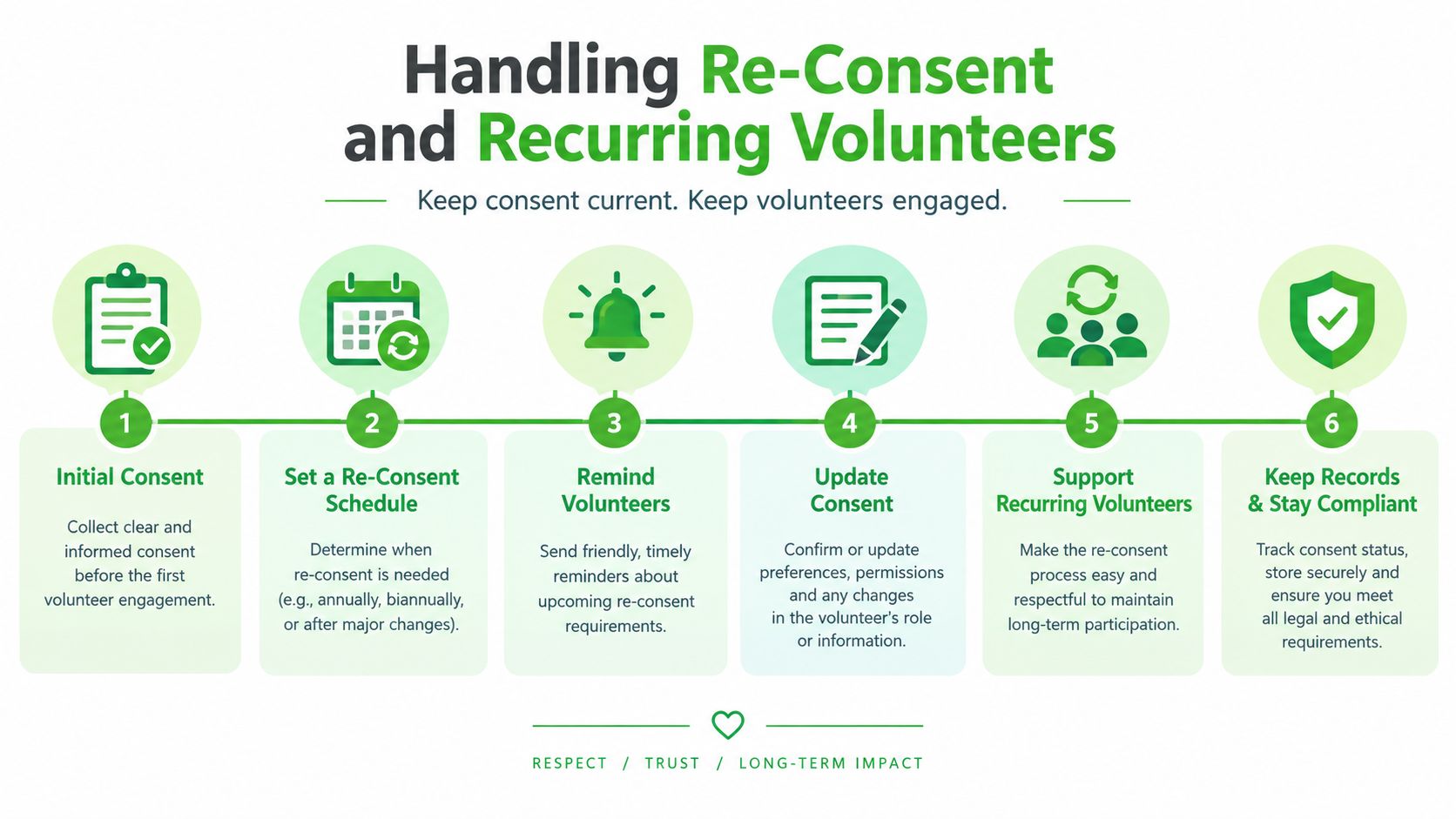
Make renewal an operations process
Tie each renewal to the volunteer's anniversary or service cycle rather than creating one annual rush. The system should create a renewal task, send the volunteer a fresh disclosure and authorization, store the signed record beside the original, and block the screening request until the current authorization exists.
When a volunteer signs again, preserve the relationship between the old and new records. Keep the form version, signature date, screening purpose, role, and report-order date together. That evidence is far stronger than a spreadsheet cell marked “renewed.”
Electronic Signatures, Mobile Collection, and Audit-Ready Proof
Electronic consent can be valid under the ESIGN Act in most U.S. states, but validity isn't the same as audit readiness. A typed-name checkbox, drawn signature, or platform-native signature can document agreement only if the workflow shows what the person saw, what they accepted, and when the organization received authorization.
Mobile collection creates a specific conflict. Phones encourage short screens, collapsed sections, scrolling, and conditional questions. The standalone-document rule requires the disclosure to remain identifiable and complete. If a volunteer sees only a summary, misses a category hidden behind a link, or signs a screen that combines the disclosure with a waiver, your audit file may not prove informed authorization.
Engineer the signing ceremony
Use a dedicated consent screen or document. Show the full disclosure before the authorization control, make required links functional, and prevent submission until the volunteer has completed the required review steps. Initialing every paragraph isn't always legally required, but it can create a stronger record that the person moved through each disclosure block.
Avoid these failure modes:
- Pre-checked boxes: They weaken evidence of affirmative consent.
- Buried hyperlinks: A rights document that can't be opened or located later is a poor audit artifact.
- Compressed summaries: A short mobile summary shouldn't replace the complete disclosure.
- Mixed agreements: Don't place a liability waiver or unrelated volunteer promise on the same consent document.
- Unstable versions: Never overwrite the form after signing. Preserve the exact document version.
The digital consent form workflow guidance can help teams evaluate electronic collection, but the core requirement remains operational proof.
Preserve the evidence, not just the signature
Your audit record should capture:
- The signed disclosure and authorization
- The exact document version or hash
- The signing timestamp
- The signing sequence
- The volunteer's account or identity record
- The delivery and completion status
- The report-order timestamp
- The method used to authenticate the signer
An IP address and user-agent record can add context, but they shouldn't be your only identity control. Match the signing record to the volunteer's application, email or phone verification, and account history. A regulator will want to know whether the signature belongs to the person screened and whether authorization came before the report request.
Run a retrieval test. Give a staff member the volunteer's name and ask them to produce the signed form, disclosure version, audit log, and report-order evidence without contacting the screening vendor. If they can't assemble the packet quickly, the organization doesn't yet have audit-ready proof.
State-by-State Variances That Change Your Form Language
A federal consent form isn't a complete multistate compliance program. The FCRA governs the consumer-report transaction, but state and local rules can change when you ask about criminal history, which records you may consider, and what supplemental notices or portals your workflow requires.
Don't solve this by adding every possible state warning to one oversized form. That approach creates clutter and increases the chance that volunteers won't understand the authorization. Use a core federal disclosure, then apply a jurisdiction-specific supplement or workflow rule when the volunteer's location, role, or screening destination requires it.
Separate timing rules from report scope
Fair-chance laws can delay the point at which an organization asks about criminal history. In jurisdictions such as New York City and Los Angeles, local fair-chance rules can affect timing after a conditional offer. If your form appears at the initial application stage, the problem may be the workflow rather than the wording.
California programs also need careful treatment of records that may be restricted, sealed, juvenile, or unrelated to a lawful screening decision. The form should not promise that every record found will be used. It should describe the report categories accurately and route decision-making through the applicable state and local rules.
Massachusetts can require additional caution around questions concerning misdemeanors and police records. A nonprofit should confirm whether its screening process involves a state criminal-record system or a related report category that needs separate language. Pennsylvania and Washington are examples of states where state-level screening processes or portals can create additional consent and notice requirements alongside federal paperwork.
| State or jurisdiction | Variance type | Required form addition |
|---|---|---|
| California | State and local fair-chance restrictions, including treatment of restricted records | Add the applicable state and local notice language, and delay criminal-history inquiries when required |
| New York City | Fair-chance timing requirements | Present criminal-history questions and related consent at the legally permitted stage |
| Los Angeles | Local fair-chance timing requirements | Align the authorization workflow with the conditional-offer process |
| Massachusetts | Limits affecting criminal-history questions and state record processes | Review questions and add state-specific notices before collecting consent |
| Pennsylvania | State screening portal or process requirements | Pair federal disclosure and authorization with the required state process |
| Washington | State screening portal or process requirements | Confirm state consent and notice requirements before ordering the report |
This table is a screening-planning aid, not a substitute for jurisdiction-specific legal review. A volunteer's work location, residence, role, and the report source can all change the applicable rule. Have counsel review the state supplement once, then lock the approved language and version-control it.
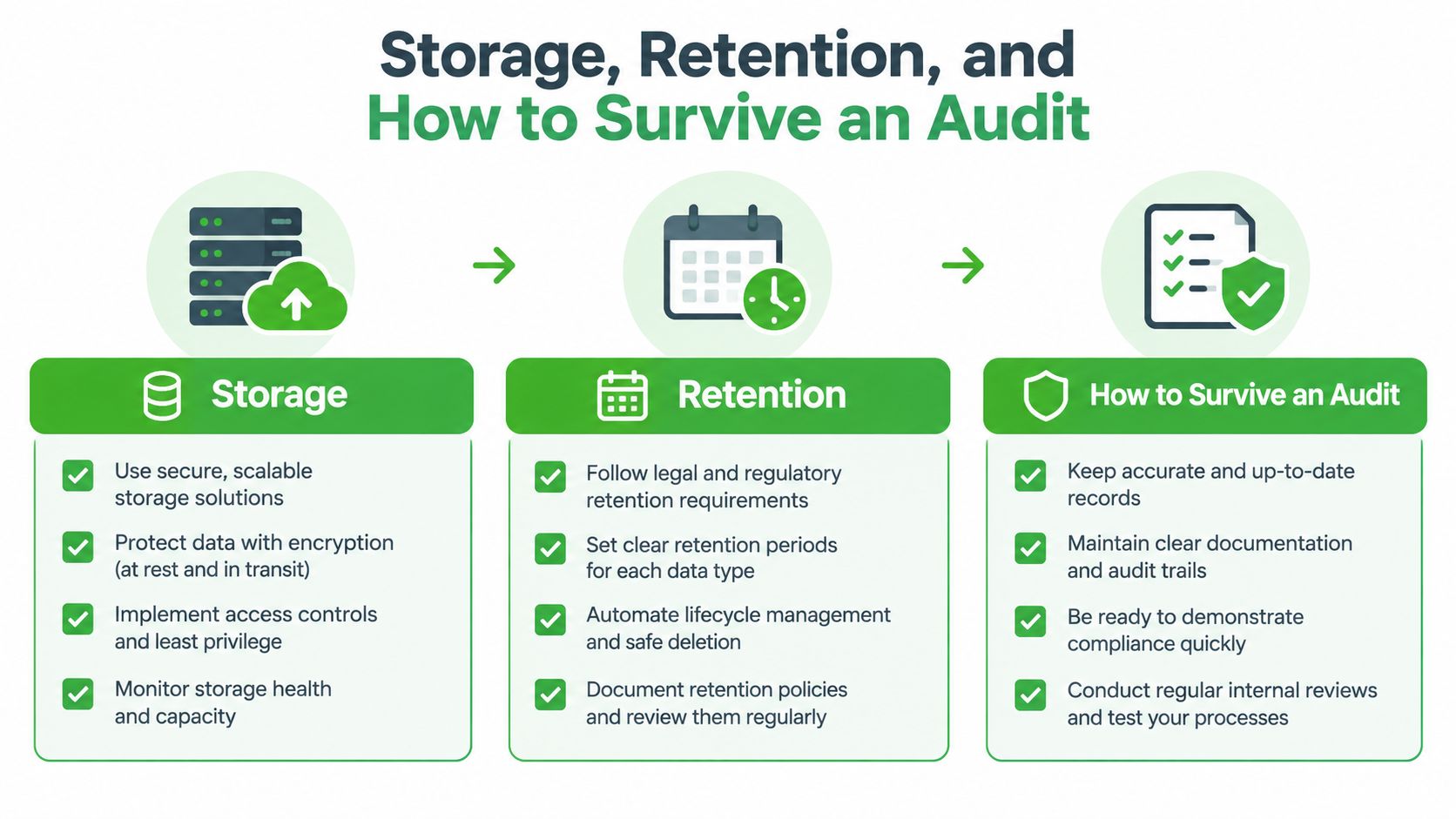
Storage, Retention, and How to Survive an Audit
A signed authorization has value only if you can retrieve it and prove that it came before the report request. Store the disclosure, authorization, screening report, and decision records in a controlled system with clear relationships between them. Don't leave the only copy in an email inbox or a coordinator's personal drive.
For employment purposes, the FCRA requires consent records to be retained for at least five years, as described in the compliance guidance supplied for this workflow. Volunteer programs should adopt a documented retention schedule that accounts for the last screening, the end of the volunteer relationship, applicable state rules, and any dispute or investigation hold. Don't delete records because a volunteer becomes inactive.
Build a clean audit packet
An auditor or regulator may ask for the complete chain of events, not just the signature. Your packet should contain:
- Signed authorization: Include the signature, date, signer identity, and document version.
- Delivered disclosure: Preserve the exact language the volunteer received.
- Rights materials: Store the Summary of Rights or evidence of the working delivery method.
- Screening report: Keep the report connected to the authorization that permitted it.
- Decision correspondence: Retain pre-adverse and adverse action notices when applicable.
- Final disposition: Document the outcome and the date the organization closed the process.
Use role-based permissions. Volunteer coordinators may need to know whether screening is complete, while fewer staff should access the underlying report. Encrypt stored records, separate consent forms from report results where practical, and maintain an access log so the organization can identify who viewed sensitive information.
For teams improving document governance, a plain-language overview of how records management services work can help clarify indexing, access, retention, and retrieval responsibilities. Your internal process should also define who owns the archive when a coordinator leaves.
A quarterly audit drill is more valuable than an annual scramble. Pull three random volunteer files, confirm the consent predates the report, verify that the disclosure version matches the signed version, check the rights materials, and confirm that any recurring authorization was still valid when the report was ordered. Document the result and fix defects immediately. The compliance documentation checklist can support that review.
A single consent may support repeated checks only when the form clearly authorizes ongoing screening and your policy defines the applicable cycle and triggers. Don't assume an old signature covers a new role, a renewed volunteer relationship, or an entirely different report.
VolunteerBadge offers a digital disclosure and authorization flow for nonprofit screening, with electronic consent stored alongside the application and a separate re-screen consent link for later checks. Visit VolunteerBadge to review a workflow that can help your team collect, preserve, and retrieve authorization before ordering a national criminal record check.
