
OFAC Sanctions Country List: Nonprofit Guide
Navigate the OFAC sanctions country list for volunteer screening. Learn how comprehensive and targeted sanctions impact nonprofit compliance and background
On this page
A static list of “banned countries” is the most popular answer to the OFAC question, and it's also the wrong starting point for most nonprofit screening programs. The Office of Foreign Assets Control doesn't maintain one fixed blacklist of countries that tells you whether every person, donor, volunteer, vendor, or partner from a jurisdiction is prohibited.
The practical question is more demanding: which sanctions program applies, which regions are covered, whether the person or organization is designated, and whether the proposed activity is authorized? A country check can be useful, but it can't replace screening against current sanctions lists and investigating potential matches. That distinction matters for any nonprofit that accepts volunteers, sends funds abroad, organizes international programs, or works with communities connected to higher-risk regions.
Table of Contents
- The Myth of a Single OFAC Country Blacklist
- Understanding Broad Versus Targeted Sanctions
- Navigating the Current Broad Embargo Regions
- The Scale of the SDN List and Global Screening
- Integrating OFAC Checks into Volunteer Onboarding
- Why Manual OFAC Searches Fail Nonprofits
- Automating Compliance with VolunteerBadge
- Real-World Scenarios in Sanctions Screening
The Myth of a Single OFAC Country Blacklist
Most nonprofit directors searching for an “OFAC sanctions country list” want a short document they can attach to an onboarding policy. They expect to see a sequence of country names followed by a simple instruction: reject applicants from these places. OFAC's own sanctions programs and country information shows why that approach doesn't work. The agency publishes sanctions programs and country-related information, not one permanent list of universally banned jurisdictions.
Some programs are broad and country-oriented. Others target particular people, companies, sectors, vessels, aircraft, or activities. The same country may appear in OFAC materials because it has a geographic program, while the actual restriction relevant to your nonprofit applies only to designated actors or a particular type of transaction.
Practical rule: Treat the country list as a risk indicator, not as a clearance decision.
This distinction is easy to miss because program names often use country or regional labels. A volunteer coordinator may see a Russia-related, Venezuela-related, or Libya-related program and assume that every person connected to that country is prohibited. That conclusion can cause two problems at once. It may lead to unfair over-screening of legitimate applicants, while still missing a designated person whose current address is somewhere else.
A useful explainer on economic sanctions for Model UN can help program leaders understand why sanctions are used as a policy tool, but operational screening requires a more granular process. Nonprofits should also distinguish sanctions screening from a broader OFAC background check, which may sit alongside criminal-record and identity checks.
Why a country-only check is incomplete
A geographic lookup generally answers one narrow question: does the applicant have a connection to a location covered by a particular program? It doesn't answer whether:
- The applicant's name matches a blocked individual or organization.
- A nonprofit partner is owned or controlled through a designated entity.
- A payment involves a sanctioned bank, vessel, or intermediary.
- The activity is permitted under an applicable authorization.
- The relevant restriction covers an entire jurisdiction or only a region within it.
The answer can also change. OFAC updates programs, designations, and country guidance as policy and geopolitical conditions change. A spreadsheet downloaded months ago may no longer reflect the current framework.
For nonprofit leaders, the sensible replacement for the “banned countries” checklist is a documented, risk-based workflow. Collect reliable identity information, screen against relevant OFAC lists, review possible matches, record the decision, and escalate uncertain cases. That process is more work than checking a country box, but it addresses the risk OFAC presents.
Understanding Broad Versus Targeted Sanctions
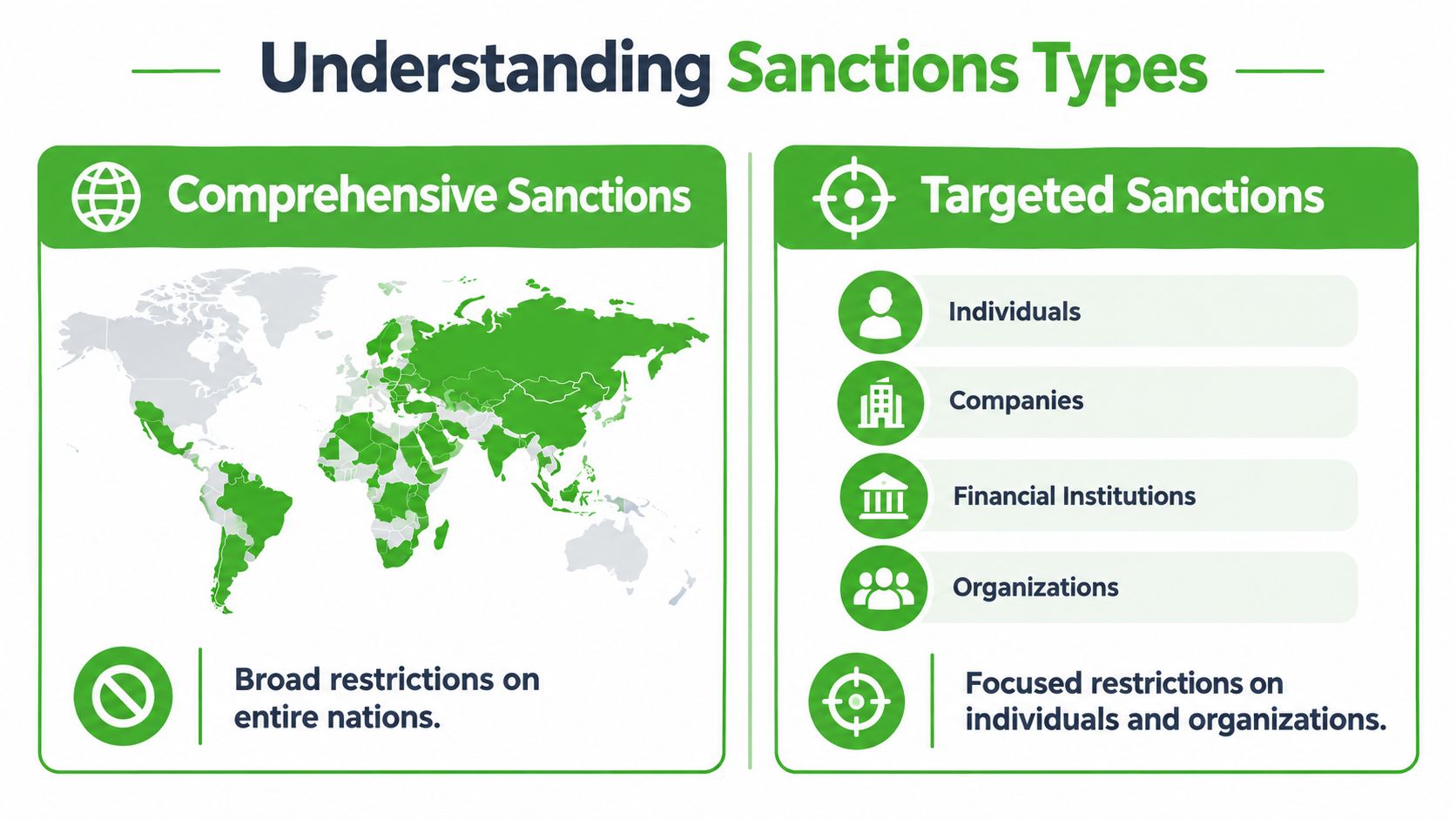
A country label rarely tells a nonprofit enough to make a screening decision. OFAC programs use different structures, and the practical question is how a proposed activity, person, organization, or transaction fits those structures. Broad, country-oriented sanctions restrict activity connected to a jurisdiction or region. Targeted sanctions identify particular individuals, entities, groups, vessels, aircraft, sectors, or activities. Organizations therefore need geographic review and list-based screening, not a single country checklist.
A broad geographic program raises questions about the transaction itself, the parties involved, and any authorization that may apply. A nonprofit arranging travel, sending funds, purchasing supplies, or supporting activities connected to the jurisdiction should examine each part of the proposed activity. The starting position is restrictive, but the governing regulations and licenses determine what is allowed.
Targeted restrictions create a different risk. Someone may live in a country associated with a sanctions program without appearing on an OFAC list or being barred from every ordinary activity. The concern may instead involve that person, their employer, a bank, a supplier, or a partner because one of those parties is designated or operates in a restricted sector.
The same applicant can create different risks
Two volunteer applications can produce opposite screening outcomes. One applicant may have been born in a country associated with a targeted program but show no apparent connection to a designated party. Another may have been born in a country without a broad country embargo, while their employer or financial intermediary appears under a targeted program. A country-only process could reject the first applicant and overlook the second.
Screening should therefore collect more than nationality. Depending on the role and risk, records may include the applicant's full legal name, former names, date of birth where appropriate, current and previous addresses, employer or organization details, and payment information. These identifiers help reviewers separate a genuine match from someone with a similar name.
The official OFAC Sanctions List Search tool supports this review across list types, including the SDN List, the Foreign Sanctions Evaders List, and the Sectoral Sanctions Identifications List. It assists with research, but it does not set the nonprofit's policy. The organization must define which lists it checks, how reviewers investigate possible matches, and when an uncertain result goes to counsel or another designated decision-maker.
Three decisions for nonprofit policy
- Geographic review: Does the proposed activity involve a country, territory, or region covered by a broad program?
- Party screening: Does an applicant, partner, vendor, bank, or other relevant party match an OFAC designation?
- Activity analysis: Is the volunteer role, payment, service, or program authorized, restricted, or prohibited?
A clear geographic result does not answer the second and third questions. A geographic connection also should not trigger automatic rejection without identity and activity analysis. This three-part process reduces missed designations while giving staff a defensible basis for proportionate decisions.
Navigating the Current Broad Embargo Regions
A nonprofit does not need another static “banned countries” spreadsheet. It needs a review process that follows OFAC's changing country-oriented programs, regional restrictions, designated parties, and activity rules. OFAC program information identifies geographically focused programs involving places such as Cuba, Iran, North Korea, Russia, Venezuela, Belarus, Libya, and others. The relevant geography may be a territory or part of a country, not the entire national border.
Ukraine shows why country labels can mislead. A volunteer's citizenship, current residence, and actual location of activity may point to different compliance questions. Screening records should capture the specific region connected to the work, travel, funding, or services instead of reducing every geographic issue to a national category.
Replace the banned-countries spreadsheet
A four-row internal review table gives staff a practical replacement for a static country list. It also keeps regional designations and program changes visible during each review.
| Review category | Operational question |
|---|---|
| Broad geographic program | Does the activity involve a jurisdiction or region subject to broad restrictions? |
| Targeted country program | Does the activity involve a designated person, entity, sector, or transaction type? |
| Regional restriction | Is the specific territory covered even if the wider country is not? |
| Changed program status | Has OFAC recently amended, removed, or narrowed the relevant restrictions? |
The Syria position shows why the fourth row belongs in the workflow. OFAC states that it no longer maintains broad sanctions on Syria or blocking sanctions on the Government of Syria, while restrictions on specific listed actors remain. An outdated rule that treats Syria as fully banned could stop permissible activity. A conclusion that Syria is clear could miss a designated individual or organization.
The table should support a decision, not replace one. Staff need a recorded answer for the relevant program, territory, parties, and activity, with an escalation path when the facts do not fit a clear category.
Review the activity and regional connection
A volunteer's birthplace does not by itself determine sanctions exposure. Reviewers should identify what the person will do, who will receive funds or services, which entities participate, and whether payment or procurement channels add risk. Humanitarian, educational, religious, and community programs may still require careful review when they involve listed parties or restricted regions.
A location can trigger enhanced review, but the defensible outcome depends on the full set of parties and activities.
For an applicant connected to a higher-risk location, automatic rejection creates one kind of problem, while an informal exception creates another. The practical response is a documented review using current OFAC program information, list screening, and legal advice when the facts remain uncertain. The organization should preserve the date and source of the guidance used, so a later reviewer can understand why the application was approved, restricted, or escalated. A program status can change, and the record must show which rule informed the decision at that time.
The Scale of the SDN List and Global Screening
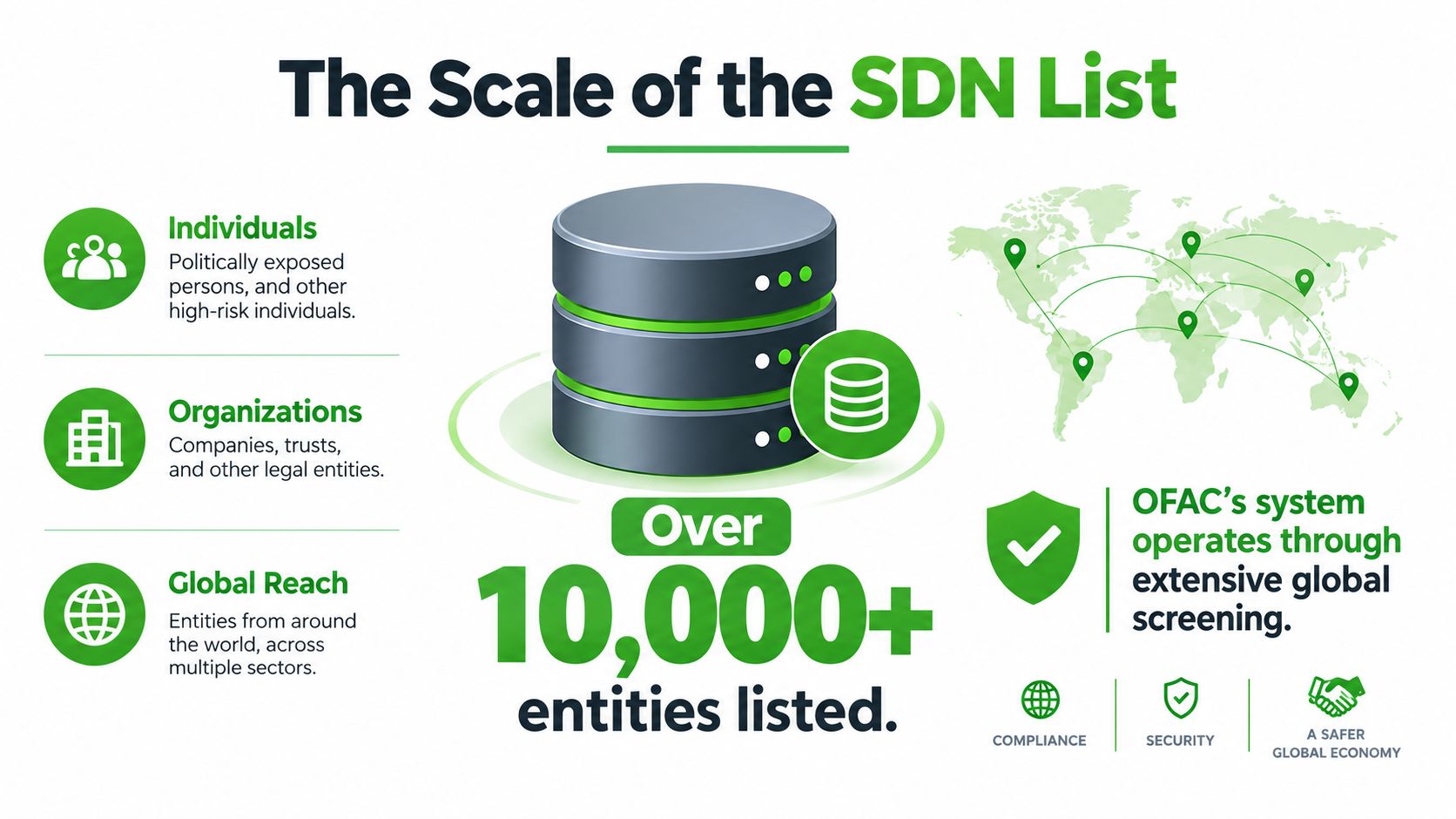
The SDN List changes the nature of the problem. OFAC isn't asking organizations to check a short roster of countries. Its sanctions infrastructure includes individuals, entities, groups, vessels, and aircraft, with entries tied to different legal authorities and program codes. The OFAC Sanctions Programs Atlas helps users understand country-linked programs, while the list service supports program identifiers that can be incorporated into screening logic.
A public benchmark illustrates the scale. On October 7, 2015, the SDN List contained more than 15,200 entries spanning 155 countries, as described in the verified OFAC list information. That historical benchmark is enough to show why manual country-by-country review is an unsuitable operating model. The list has continued to function as a global data resource rather than a narrow blacklist of governments.
What screening has to recognize
A reliable process needs to compare more than an exact spelling. Relevant records can contain:
- Legal names: The name shown on an application may differ from the name on an official designation.
- Aliases: Former names, alternate spellings, transliterations, and other identifiers can affect matching.
- Locations: Addresses and countries help reviewers separate two people with similar names.
- Entity relationships: A nonprofit partner or vendor may require deeper ownership and relationship review.
- Program codes: The designation's authority helps determine what restriction may apply.
This is why a “no exact match” result doesn't necessarily mean the applicant is cleared. It means the available data did not produce a direct result under the search settings used. A possible match also isn't proof of wrongdoing. It's a trigger for comparing identifiers and determining whether the record refers to the same person or organization.
A workable review sequence
Start with automated matching against current list data. Route possible matches to a trained reviewer, who compares the applicant's name, date of birth, address, nationality, employer, and other available identifiers. Record the search date, lists checked, search terms, result, reviewer, and disposition.
Nonprofits that want a deeper explanation of the operational process can review this guide to an OFAC sanctions list search. The important point is consistency. A documented false-positive resolution is useful when the same applicant later applies for another role, while an undocumented manual search leaves the organization unable to demonstrate what it checked.
Integrating OFAC Checks into Volunteer Onboarding
OFAC screening should be part of onboarding, not an improvised search after a coordinator becomes suspicious. The check can run alongside criminal-record searches, sex-offender registry checks, identity verification, and safeguarding reviews, provided the organization explains the process clearly and handles personal information responsibly.
Collect identifiers once
The application should request the information needed to distinguish the applicant from other people. That normally includes a full legal name, former or alternate names, date of birth where lawful and necessary, current address, and relevant address history. If the role involves an organization, international payment, or overseas program, collect the corresponding entity and transaction details too.
The form should explain why the information is requested. Applicants are more likely to provide accurate details when they understand that the organization is screening for regulatory and safeguarding reasons rather than making assumptions about nationality.
Run the checks in a controlled sequence
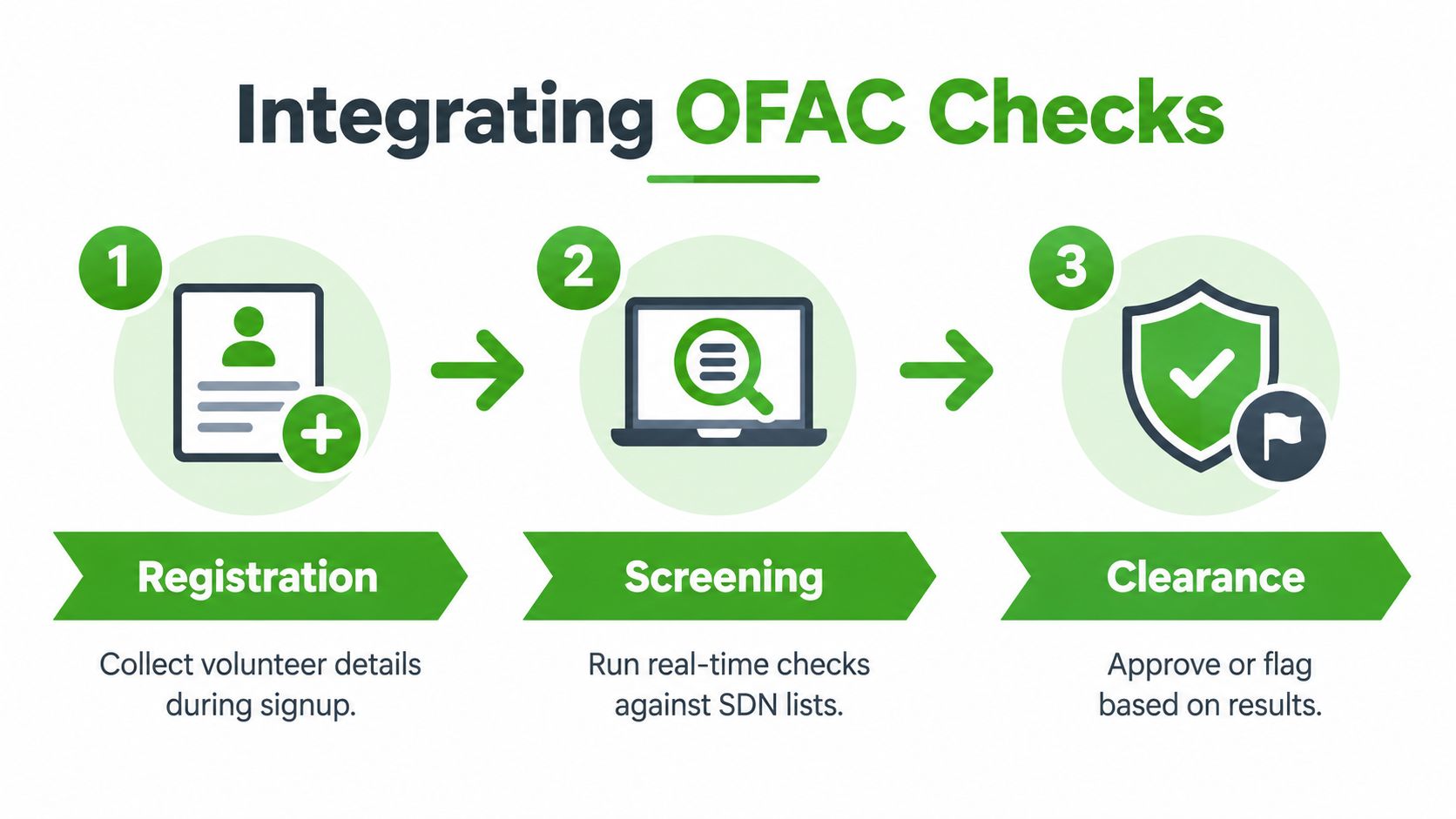
A practical workflow looks like this:
- Registration: Obtain consent and collect identity details through a secure application process.
- Data validation: Identify missing names, inconsistent addresses, or unexplained gaps before relying on a search result.
- Screening: Check relevant OFAC lists and other approved sources using current data.
- Human review: Investigate potential matches with additional identifiers. Don't treat a name similarity as a final determination.
- Decision and recordkeeping: Clear, escalate, or decline according to the written policy, preserving the rationale.
The organization should decide in advance who can resolve a possible match. Volunteer coordinators shouldn't be left to make difficult sanctions judgments alone, particularly when the result involves a common name or incomplete records.
Handle adverse decisions carefully
A potential sanctions match should remain confidential and should never become an informal conversation among staff or volunteers. Give the applicant a fair opportunity to correct inaccurate information, and apply the same criteria to comparable applicants. Where a consumer report is involved, the nonprofit should follow its FCRA procedures and use the required disclosures and notices for any adverse action.
For a broader operational overview, nonprofits can examine OFAC sanctions compliance for volunteer programs. The objective isn't to make onboarding intimidating. It's to move the sensitive work into a repeatable process that produces a clear answer without asking coordinators to remember every list and program change.
Why Manual OFAC Searches Fail Nonprofits
The free OFAC search interface has a legitimate purpose. It helps a compliance officer research an individual result, inspect program information, and understand how OFAC records are organized. It isn't, by itself, a complete volunteer-screening system.
Manual searches depend on the person entering the right information, using appropriate variations, interpreting the result correctly, and saving enough evidence to show what happened. A coordinator may search only the applicant's current name, overlook a former name, miss a transliteration, or stop after a country lookup produces no concern.
The common failure points
Exact-name dependence creates false confidence. A designation may use an alternate spelling, while the application may contain a nickname or a different ordering of names. Common names create the opposite problem, generating possible matches that require careful comparison rather than automatic rejection.
Inconsistent timing creates gaps. One coordinator may search at application time, another may search only after a concern arises, and a third may rely on a saved PDF from an earlier review. Without a defined trigger and refresh process, the organization can't demonstrate that applicants were handled consistently.
Weak audit trails make decisions difficult to defend. A browser history doesn't show which search terms were used, which list versions were consulted, what identifiers were compared, or why a result was cleared. A compliant workflow should create those records automatically or make them easy to retain.
Use the public tool for research, not as the whole workflow
Manual research remains valuable when a system produces a possible match. A reviewer can use OFAC's official records to inspect the designation, compare program tags, and determine whether the applicant's identifiers align. That's different from asking every volunteer coordinator to perform and document a complete screening process by hand.
A manual search is an investigation tool. It's not a control framework.
Nonprofits should also avoid describing every possible match as a sanctions violation. Screening identifies risk signals. The organization still needs to investigate identity, activity, authorization, and the applicable policy before making a decision. If the facts are unclear, escalation to qualified sanctions counsel is safer than guessing.
Automating Compliance with VolunteerBadge
Automation addresses the administrative weaknesses that make manual screening unreliable. A nonprofit can define the data it collects, the lists it checks, the review thresholds it uses, and the records it retains. The software then applies that process consistently instead of leaving each coordinator to develop a personal search habit.
VolunteerBadge is one option designed for nonprofit volunteer screening. According to the publisher's product information, it combines OFAC sanctions and global watchlist screening with national criminal searches, all 50-state sex-offender registries, and the FBI Most Wanted list. It also provides a digital disclosure and authorization, an automated address-history pull, FCRA workflow guidance, and notices for pre-adverse and final adverse action.
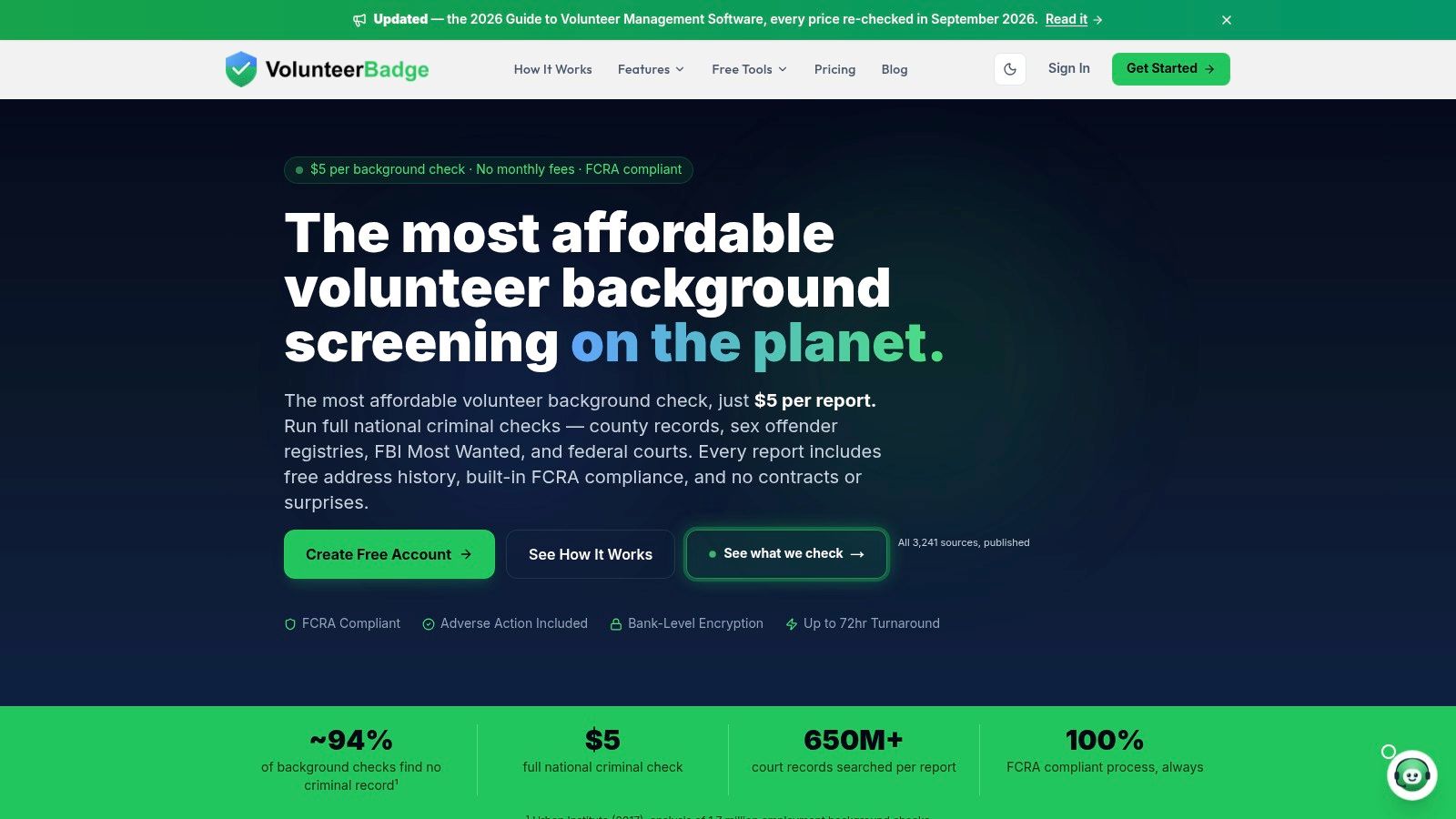
The stated price is $4.95 per check with no monthly subscription, and the service offers web, NLP, REST API, and webhook access. Those details may matter to a small nonprofit that wants screening inside an existing application process rather than a separate browser routine. The organization should still confirm current pricing, data coverage, and contractual terms before adopting any provider.
What to verify in a screening vendor
A product demo should answer operational questions, not just show a clean dashboard.
- List coverage: Which OFAC lists and global watchlists are included, and how are updates delivered?
- Matching logic: Does the system use aliases, name variations, dates of birth, addresses, and other identifiers?
- Review controls: Can staff document why a possible match was cleared or escalated?
- FCRA support: Are disclosures, authorization, dispute handling, and adverse-action notices built into the workflow?
- Integration: Can the nonprofit trigger a check from its volunteer-management system through an API or webhook?
- Record retention: Can authorized staff retrieve an audit record without exposing sensitive information broadly?
The right tool won't eliminate judgment. It should reduce repetitive searching, surface incomplete information, route ambiguous results to the right reviewer, and make the organization's decisions reproducible.
A nonprofit should also avoid treating automation as permission to reject applicants without review. The software's result is an input to the organization's process. Staff still need to assess whether the match is genuine, whether the activity is restricted, and whether the decision follows the organization's policy and applicable law.
Real-World Scenarios in Sanctions Screening
Consider a youth sports league that uses a country-only intake question. An applicant lives in the United States, was born abroad, and has no connection to a broadly restricted jurisdiction in the league's spreadsheet. The league approves the volunteer without screening the applicant's full name against list-based designations.
Later, a possible match appears through a banking or partner review. The designation concerns a specific individual, not the applicant's country of birth. The league's original process failed because it treated geography as the conclusion instead of using geography to determine the depth of review.
The correct response would have been proportionate. The league could have collected the applicant's full legal name and relevant identifiers, screened the name against applicable lists, and routed any similarity to a reviewer. If the identifiers did not match, the organization could document a false-positive clearance. If they did match, the matter could be escalated before the volunteer received access to funds, facilities, or program systems.
A regional connection hidden in incomplete records
A church offers a volunteer role involving international relief coordination. The applicant's form includes a current address but omits an earlier residence and an alternate name. A manual country check produces no result because the coordinator searches only the current address and the preferred name.
An automated address-history process flags the missing information for review. The church asks the applicant to clarify the discrepancy, then screens the corrected identity data against relevant OFAC lists and program information. The result may be a clearance, an escalation, or a decline, but the decision is based on verified identifiers rather than an assumption about nationality.
This approach also protects applicants. Without address and identity comparison, the church might either miss a genuine concern or unfairly reject someone because their name resembles a listed person. A good workflow manages both risks.
Build decisions around investigation
OFAC's country guidance and FAQs emphasize the need to follow internal policies and investigate potential matches. A location lookup can't tell a nonprofit whether two people with similar names are the same person, whether a region-specific restriction applies, or whether an activity has an authorization.
For directors, the practical standard is straightforward:
- Define which applicants, partners, vendors, and transactions require screening.
- Collect enough identifiers to support meaningful matching.
- Use current OFAC list data, not an archived country spreadsheet.
- Review possible matches instead of making instant assumptions.
- Document the search, decision, escalation, and any applicant correction.
- Reassess the policy when OFAC changes a program or designation.
A nonprofit doesn't need to turn every volunteer application into a bank-style investigation. It does need a process that recognizes sanctions as a dynamic, list-based and regional compliance issue. That is the difference between a defensible screening program and a checkbox that creates false reassurance.
VolunteerBadge combines OFAC and global watchlist screening with broader volunteer background checks, automated address-history review, and FCRA workflow support. Visit VolunteerBadge to review the current screening options and connect the process to your nonprofit's onboarding system.
