
Adverse Action Notice How Many Days After Pre-Adverse Notice
Adverse action notice how many days between pre-adverse and final notices? Get the FCRA timing rules, the five-business-day benchmark, and templates
On this page
The FCRA doesn't set a fixed number of days between a pre-adverse action notice and a final adverse action notice, but FTC guidance and a 1999 advisory opinion have made five business days the practical minimum waiting period before issuing the final notice. That pause gives the person time to review the report, dispute errors, and respond before the decision becomes final.
A volunteer coordinator usually encounters this issue without warning. A screening report arrives, a board member wants an answer, and the person named in the report may be someone your church, youth league, or nonprofit already knows personally. The difficult part isn't only deciding whether the record matters. You also have to send the right notices, count the waiting period correctly, and avoid treating an incomplete report as a final answer.
The practical rule is straightforward, but the surrounding details cause confusion. The five-business-day benchmark applies to the pause between notices, not to every FCRA deadline. The FCRA also gives consumers a 60-day period after an adverse action notice to request more information or a free copy of the report, while credit decisions under ECOA generally use a separate 30-day notification standard. FTC guidance on adverse action notices distinguishes these obligations clearly.
Table of Contents
- When a Volunteer Background Check Forces a Hard Conversation
- What a Pre-Adverse and Final Adverse Action Notice Actually Are
- How Many Days Between the Two Notices Under the FCRA
- Other FCRA and ECOA Deadlines That Often Get Confused With This One
- A Volunteer Program Timeline and Pre-Adverse Notice Template
- When Five Business Days Is Not Enough and When It Is Too Long
- A Reusable Adverse Action Workflow and Final Notice Template
When a Volunteer Background Check Forces a Hard Conversation
Maya coordinates volunteers for a small youth-services nonprofit. On Thursday afternoon, a screening report arrives for a returning soccer coach. The report shows a misdemeanor from five years ago. Maya knows the applicant, knows the applicant's family, and remembers how dependable the coach has been with children and parents.
The report still doesn't look complete. The offense description is short, the identifying information doesn't seem conclusive, and Maya can't tell whether the record belongs to the person she knows. The program director wants a recommendation before Monday's staff meeting. Maya wonders whether she should call the volunteer immediately, wait for more information, or send a formal letter.
That moment creates two separate responsibilities. First, the nonprofit must make a fair, role-related decision. Second, if the decision may be based in whole or in part on a consumer report, the organization must follow the FCRA adverse action process before denying the placement. Background-report errors can include mismatched identities, incomplete records, and outdated information, which is why a coordinator shouldn't rely on a quick impression. This guide to common background check errors is useful when a report raises questions rather than providing a clear answer.
Practical rule: A report that raises concern is not the same thing as a final decision.
Maya's nonprofit doesn't get a special shortcut because the role is unpaid. Volunteer programs that obtain consumer reports and use them to decide whether someone may serve generally act as users of those reports. The process should therefore give the applicant a real opportunity to inspect the information and challenge inaccuracies.
By the end of this article, Maya should be able to answer the questions that tend to stall nonprofit offices: How many days should pass? What belongs in each notice? When does the clock start? What happens if the applicant disputes the record? The safest workflow is consistent, documented, and built around the five-business-day practical benchmark.
What a Pre-Adverse and Final Adverse Action Notice Actually Are
Think of the two notices as two different messages in a sequence.
A pre-adverse action notice says, “We may take a negative action based on this report, but we haven't made the final decision yet.” Under FCRA Section 615(a), the notice should go out before the organization finalizes a denial or similar restriction. It must include a copy of the consumer report and a written summary of the person's rights under the FCRA.
The purpose is practical, not ceremonial. The volunteer needs to see the exact information under consideration, understand the right to challenge inaccuracies, and know where to send a dispute. A nonprofit shouldn't describe the report only in general terms and expect the applicant to reconstruct what the screening company found.
The final adverse action notice comes later, after the organization has considered any response and made its decision. It tells the person that the adverse action was taken, identifies the consumer reporting agency that supplied the report, and explains the person's right to dispute the report's accuracy. The notice should also make clear that the reporting agency didn't make the nonprofit's decision.
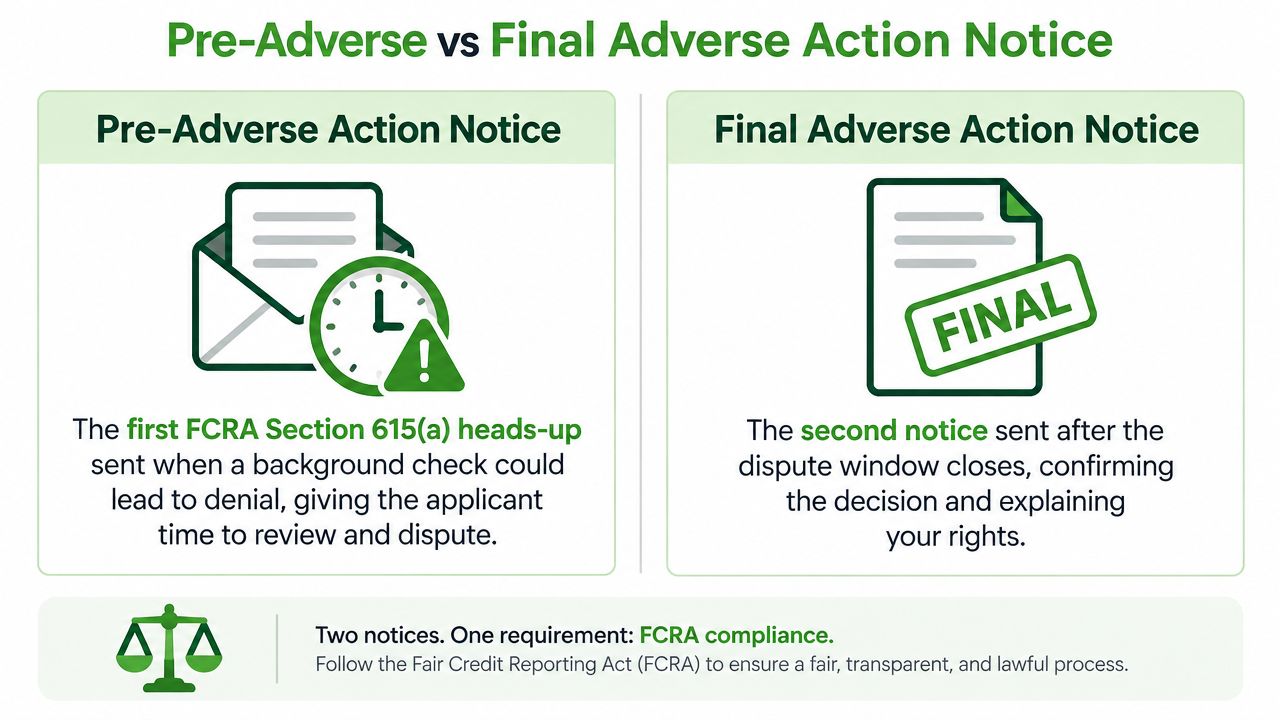
The sequence matters
The notices aren't interchangeable, and they aren't optional stages that a program can combine for convenience.
- Review the report. Confirm that the report appears to concern the right person and identify the information that may affect the volunteer decision.
- Send the pre-adverse package. Include the report, the FCRA Summary of Rights, and a clear statement that no final decision has been made.
- Allow a reasonable response period. The practical benchmark is covered below, but a dispute or unusual circumstance may justify more time.
- Review the response. Give corrected information and disputes meaningful attention before finalizing the decision.
- Send the final notice if the decision remains adverse. Identify the reporting agency and explain the relevant rights.
A church administrator may be tempted to make a phone call first because the applicant is familiar. A personal conversation can provide context, but it shouldn't replace the formal pre-adverse package when the report may affect the decision. The notice creates a consistent record and protects the applicant's opportunity to correct an error.
How Many Days Between the Two Notices Under the FCRA
The answer to adverse action notice how many days is more precise than “wait a few days,” but less rigid than a statutory countdown. The FCRA doesn't establish a fixed number of days between the pre-adverse and final notices. Instead, the practical standard is a reasonable pause that gives the person a meaningful opportunity to review and dispute the report.
FTC guidance and industry practice commonly treat five business days as the minimum reasonable waiting period. A 2017 court decision found that three days was insufficient in circumstances where the employer had promised five days, reinforcing the importance of the five-business-day benchmark. Compliance guidance on the timing between notices explains why the benchmark has become so influential.
Count business days, not calendar days
Suppose a nonprofit delivers the pre-adverse notice on Monday. The organization should generally allow Tuesday through the following Monday as the response period, with the final notice not sent before the following Monday after the five-business-day interval has run. The organization should also account for the delivery date, weekends, and applicable holidays under its written procedure.
Email, hand delivery, and mail raise a separate operational issue. The program should document when the notice was delivered or made available, rather than relying only on the date a staff member drafted it. If delivery is uncertain, sending the final notice too quickly creates avoidable risk.
| Delivery Method | Day Notice Sent | Day Clock Starts | Day Final Notice Allowed |
|---|---|---|---|
| Monday | Monday, if delivery is recorded | After the five-business-day period has elapsed | |
| Hand delivery | Monday | Monday | After the five-business-day period has elapsed |
| Monday | According to the organization's documented delivery practice | After the recipient has had a reasonable opportunity to receive and review it |
Don't treat the date as a casual administrative detail. If your team regularly loses track of dates, a short exercise to assess your deadline habits can prompt a useful conversation about ownership, reminders, and escalation.
A dispute changes the timeline. If the volunteer says the record belongs to someone else or supplies documentation that could alter the decision, pause the final action and coordinate with the consumer reporting agency. The five-business-day benchmark is a minimum practical starting point, not permission to finalize a decision while a credible dispute is still unresolved. For a fuller operational overview, review these FCRA notice requirements for screening programs.
Other FCRA and ECOA Deadlines That Often Get Confused With This One
Nonprofit administrators often search for one “adverse action deadline,” but several different clocks may appear in related compliance materials. They have different triggers, different responsible parties, and different purposes.
The 60-day period is a post-notice consumer right. After receiving an adverse action notice, the consumer may request more details or a free copy of the consumer report during that period. That window doesn't tell the nonprofit how long to wait between its pre-adverse and final notices. It gives the consumer a remedy after the final notice. FTC information on consumer reports and adverse action describes this distinction and the requirement to provide the report and Summary of Rights before employment-related adverse action.
The 30-day standard belongs primarily to credit-side adverse action rules under ECOA and Regulation B. A creditor generally has to notify an applicant after receiving a completed application or taking action on an existing account within that framework. That isn't the employment or volunteer-screening waiting period.
Other FCRA timing rules can concern fraud alerts or the reporting agency's handling and retention duties. Those rules may apply to a different party or a different event. They don't restart, replace, or shorten the pause between a nonprofit's two notices.
| Deadline | Triggering Event | Statute | Responsible Party |
|---|---|---|---|
| Five-business-day practical pause | Pre-adverse notice is delivered | FCRA Section 615(a), FTC guidance and practice | Employer, nonprofit, church, or other report user |
| 60-day consumer remedy period | Consumer receives the final adverse action notice | FCRA notice framework | Consumer exercises the right, reporting agency responds |
| 30-day credit notification standard | Completed credit application or adverse account action | ECOA and Regulation B | Creditor |
| Fraud-alert response timing | A qualifying alert or related credit event is received | Applicable FCRA credit provisions | Creditor or report user, depending on the duty |
| Record-retention requirement | Reporting agency's records reach the applicable retention point | FCRA reporting provisions | Consumer reporting agency |
The table is a map, not a substitute for the facts of a case. A volunteer coordinator should identify the role, the report's use, the notice being prepared, and the party responsible for the next action before selecting a deadline.
A Volunteer Program Timeline and Pre-Adverse Notice Template
Maya can make the process manageable by assigning each event a date and owner. The following workflow is a practical model for a nonprofit, church, or youth league. It assumes the report may support an adverse decision and that no dispute has extended the process.
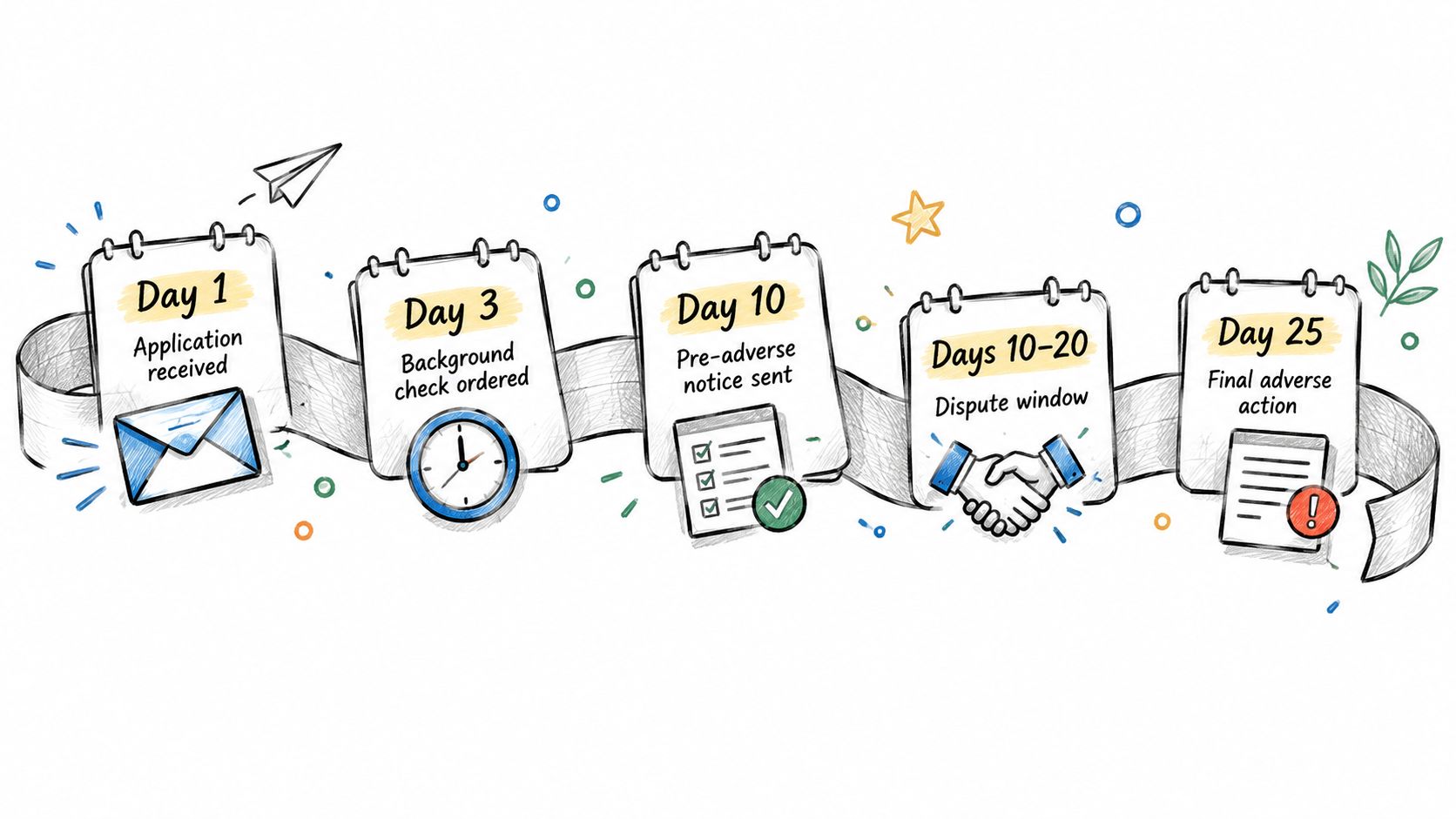
A workable calendar
- Day 0, authorization: The volunteer submits the application and signs the FCRA disclosure and authorization required for the screening.
- Days 1 through 3, screening: The consumer reporting agency and screening workflow gather and return the report.
- Day 4, preliminary review: The coordinator checks identity details, reviews the record, and decides whether the report may affect placement.
- Day 4, pre-adverse notice: The nonprofit sends the report, the FCRA Summary of Rights, and a notice stating that the decision isn't final.
- Days 5 through 9, response period: The organization waits through the practical five-business-day minimum and monitors for a dispute or explanatory information.
- Day 10, final review: If no unresolved issue exists, the nonprofit can complete its decision review and determine whether to send the final notice.
The exact dates depend on delivery and the organization's documented counting method. The FTC's employer guidance confirms the core package, including the report and Summary of Rights, but a coordinator should use a written procedure rather than rely on memory.
Adaptable pre-adverse wording
Subject: Notice that volunteer placement is under consideration
We are writing on behalf of [Nonprofit, church, or youth league name] because information in a consumer report may affect your application to serve as [role]. No final decision has been made.
Enclosed are a copy of the consumer report and the document titled Summary of Your Rights Under the Fair Credit Reporting Act. The report was provided by:
Consumer reporting agency: [CRA name]
Address: [CRA mailing address]
Telephone or dispute contact: [CRA contact information]If you believe any information in the report is incomplete or inaccurate, you may contact the consumer reporting agency using the information above and provide supporting information. You may also contact [nonprofit contact name and contact details] if you want us to consider additional context before a final decision is made.
We will not finalize the decision before [date], allowing at least five business days for you to review the report and respond. This notice isn't a final adverse action notice, and the nonprofit has not yet made its final decision.
Keep the wording accurate to the actual process. Don't say the nonprofit will wait until a specific date if staff members aren't prepared to monitor disputes through that date.
A short video can help train new coordinators, provided staff still follow the organization's written procedure.
When Five Business Days Is Not Enough and When It Is Too Long
Five business days is a practical minimum, not an automatic finish line. A nonprofit creates risk when it sends the final notice before confirming that the pre-adverse package reached the volunteer, before the response period has elapsed, or while a credible dispute is still being investigated.
A longer pause is sensible when the volunteer disputes identity or accuracy, supplies court documents, or explains information that could change the decision. It may also be necessary when the consumer reporting agency needs time to investigate the dispute, when the volunteer is overseas or deployed, or when a state rule for a particular volunteer role provides a longer protection.
Don't close the file just because the calendar moved forward. Close it when the response has been reviewed and the decision is documented.
A program should record why it extended the waiting period. The note can identify the dispute date, the documents received, the agency contacted, the new review date, and the staff member responsible for follow-up. That record shows that the delay was part of a genuine review rather than an improvised attempt to repair a defective process.
The opposite problem also matters. An unexplained delay can make the original pre-adverse notice look stale or suggest that no decision was pending when the notice was sent. If the organization pauses for an extended period, it should reassess whether the report remains current, whether new information has emerged, and whether a fresh notice is appropriate before acting.
State and local requirements can add protections for specific settings, particularly youth programs and roles involving children. A national FCRA workflow shouldn't be treated as a complete review of every jurisdiction's volunteer-screening rules.
A Reusable Adverse Action Workflow and Final Notice Template
A reliable workflow turns the timing rule into assigned actions:
- Receive and log the report. Record the report date, role, reviewer, and information that may affect placement.
- Confirm permissible purpose and authorization. Verify that the organization obtained the required disclosure and authorization before requesting the report.
- Send the pre-adverse package. Include the report, Summary of Rights, dispute instructions, and a statement that the decision isn't final.
- Start and monitor the waiting period. Record delivery and hold the final-notice function until the practical five-business-day minimum has passed.
- Review responses. Check disputes, corrected records, explanations, and any reinvestigation result before making the decision.
- Document the decision. Record the role-related reason, decision maker, date, and materials considered.
- Send the final notice. Identify the action, the consumer reporting agency and address, the agency's noninvolvement in the decision, and the right to dispute accuracy or request the report.
A final notice can use this structure:
Subject: Final adverse action notice
After reviewing information in a consumer report, [organization name] has decided to [deny volunteer placement or restrict the role] for [role]. The decision was based in whole or in part on information in the report.
The report was provided by:
Consumer reporting agency: [CRA name]
Address: [CRA address]
Telephone or website: [CRA contact information]The consumer reporting agency didn't make this decision and can't explain the specific reason for our decision. You have rights under the FCRA, including the right to dispute inaccurate or incomplete information and to request a free copy of your report within the applicable post-notice period.
For questions about our decision, contact [organization contact]. For questions about the report, contact [CRA contact].
Use an approved form and obtain legal review when the role, jurisdiction, or facts are unusual. This final adverse action notice guide can help administrators check the contents before sending.
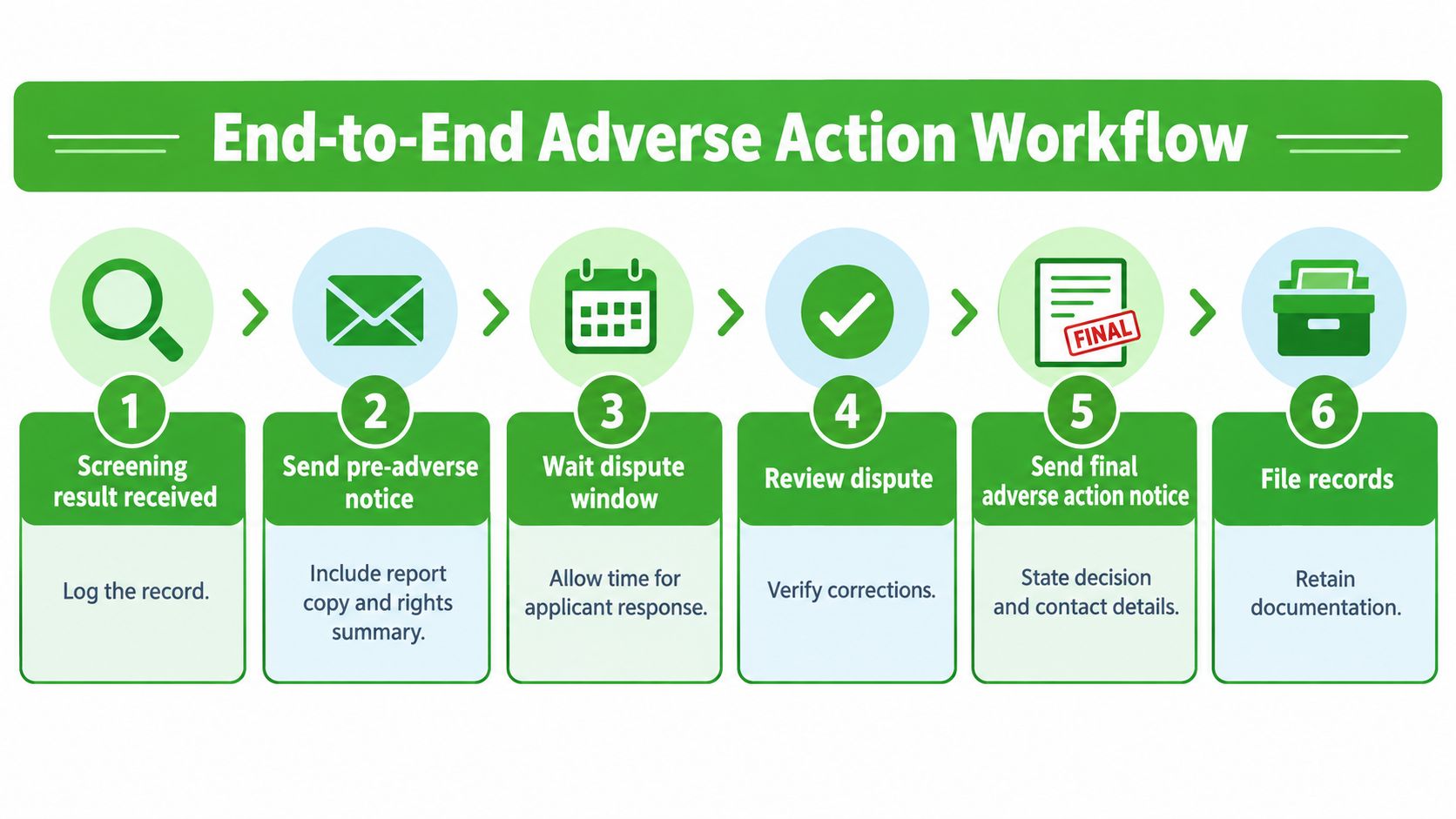
Store the report, proof of pre-adverse delivery, dispute communications, review notes, and final notice in a controlled compliance file. Put the workflow in screening software or a case-management system rather than on a sticky note, so dates, reminders, ownership, and delivery evidence stay together.
VolunteerBadge offers nonprofit-focused background screening with automated pre-adverse and final adverse action notices, a tracked waiting period, and FCRA guidance within the screening workflow. If your church, youth league, or volunteer program needs a repeatable way to manage these steps, visit VolunteerBadge to review the available process.
