
Sex Offender Registry Restrictions: A Nonprofit Guide
Understand sex offender registry restrictions, state variations, and how to build FCRA-compliant volunteer screening policies for nonprofits.
On this page
A volunteer coordinator opens a routine background-check report and sees a registry match. The applicant is qualified, the program needs help, and the role may involve vulnerable people. Within minutes, the coordinator is asking the wrong first question: “Can we reject this person immediately?”
The better question is, what do the applicable laws require, what does the report establish, and what risk does this specific role create? Sex offender registry restrictions can affect where a registrant lives, works, or appears, but they don't create a universal federal rule that automatically answers whether a nonprofit may accept a volunteer. A rushed blanket decision can expose an organization to legal, operational, and reputational problems.
Table of Contents
- The Volunteer Screening Dilemma
- Understanding Federal and State Registry Laws
- The Risks of Blanket Bans vs. Individualized Assessment
- Building an FCRA-Compliant Screening Workflow
- Balancing Safety, Mission, and Legal Compliance
- Key Takeaways for Nonprofit Leaders
The Volunteer Screening Dilemma
The coordinator prints a registry report, calls the executive director, and freezes a qualified volunteer's application. The program needs help, yet a strict residency or site restriction may make the proposed assignment unlawful. One staff member wants an immediate rejection. Another notices that the name and birth date still require confirmation. No written policy explains who decides, what evidence counts, or how the applicant can respond.
That gap creates the actual liability. A registry record may signal a serious concern, but it does not replace identity verification, state-specific analysis, or an assessment of the specific duties. The nonprofit must establish whether the record belongs to the applicant, identify any restriction that applies, and determine whether the role creates a risk the organization cannot accept.

Serving children, survivors, older adults, or people with disabilities makes caution appropriate. Panic still produces poor decisions. An unverified match can identify the wrong person, while ignoring a confirmed result can expose participants and violate applicable restrictions. A blanket ban may also eliminate suitable volunteers when a lawful, supervised assignment could be available.
Why the first decision matters
Pause the application instead of rejecting it automatically. Limit access to the report, preserve the screening record, and assign a trained reviewer. Compare the report with the application, verify identity through reliable records, and examine the proposed duties, location, supervision, and contact with participants.
A sound volunteer vetting process separates screening facts from final eligibility decisions. The report provides information. The nonprofit then applies its policy, the relevant law, and the facts of the assignment.
The scenario may be uncommon, but staff need a consistent response when it occurs. A 2017 Urban Institute study analyzing 1.7 million employment background checks found that roughly 94% returned no criminal finding whatsoever. That finding supports disciplined procedures, not complacency. A confirmed registry entry should trigger disclosure, an opportunity to correct inaccurate information, and any required adverse action process before the organization makes a final decision.
The operational cost of vague rules
A vague policy creates two predictable failures. Qualified volunteers can be rejected without an individualized review, while familiar applicants may receive informal exceptions. Both outcomes undermine equal treatment and make the nonprofit's decisions difficult to defend.
Write the policy before the next report arrives. Define prohibited duties, decision authority, verification steps, applicant notice and response rights, documentation standards, and escalation to counsel when state or local law is unclear. The policy should permit individualized assessment where the law allows it, while enforcing restrictions that actually apply.
The goal is not to accept every applicant. It is to make every decision careful, explainable, and tied to the actual risk.
Understanding Federal and State Registry Laws
A nonprofit can approve a qualified volunteer, then discover that the person cannot legally enter the service site or live within the required distance of it. That result exposes the hidden trap in registry compliance: registration rules and location restrictions are different questions, and a single national policy will not answer both.
The federal framework sets a baseline, while state and local law often controls the practical limits on participation. The Jacob Wetterling Act, Megan's Law, and the Adam Walsh Act shaped modern registration and notification policy. The Adam Walsh Act introduced the Sex Offender Registration and Notification Act, commonly called SORNA, which replaced earlier federal standards.
SORNA establishes federal registration and notification requirements. Sexually violent predators must verify their addresses every 90 days and register for life. Other registrants generally register for 10 years. Those duties address registration. They do not, by themselves, create a nationwide ban on volunteering or working for every nonprofit.
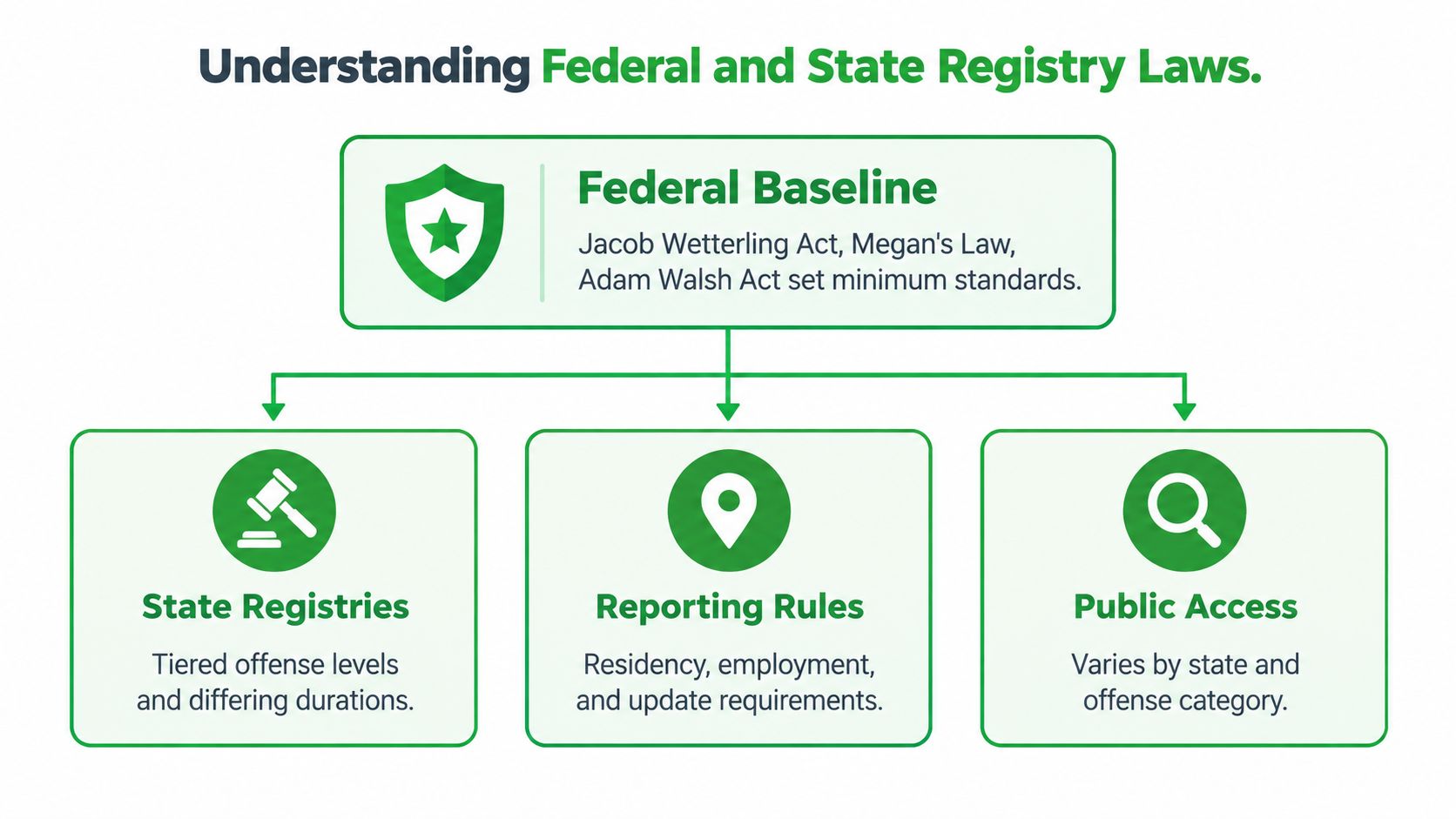
Where location restrictions arise
Residency restrictions govern where a person may live. Loitering restrictions may regulate lingering in specified places. Presence restrictions can prohibit being in particular locations, while entry restrictions can bar access altogether. For a nonprofit, those rules may affect a volunteer's workplace, service site, transportation route, housing situation, or event schedule.
A 2023 statutory analysis found residency restrictions in 38 states, loitering restrictions in 18, presence restrictions in 19, and entry restrictions in 14 (statutory analysis). These categories do not create one uniform national rule. They show why organizations operating across jurisdictions must assess each site and assignment separately. A sex offender registration requirements guide can organize that review, but it cannot replace verification of controlling law.
Operational rule: Treat the worksite, service location, and volunteer's relevant jurisdiction as separate legal questions.
Federal guidance confirms that residency restrictions and safety zones are not part of SORNA standards (federal SORNA FAQs). States and local jurisdictions set those rules, so the answer can change from one location to another. Before scheduling a registrant, identify the governing provisions and confirm whether they apply to the person's offense category and planned activity.
Registration status is only one legal fact
Court conditions, probation terms, and state reporting duties may also affect participation. The registry may not disclose every condition relevant to a volunteer assignment. Someone seeking information about possible removal, relief, or a registration-status change may consult how to get off the registry as a starting point for understanding why qualified legal advice matters.
The nonprofit should not interpret those rules for the applicant or promise a legal result. Give the person a clear opportunity to provide documentation, apply the organization's disclosure and adverse action procedures, and direct legal questions to an attorney or appropriate legal service. Then document the site, duty, restriction, and reason for the placement decision.
The Risks of Blanket Bans vs. Individualized Assessment
A strict residency rule can leave a nonprofit unable to place a qualified volunteer, even when the proposed work has no direct participant contact. The organization may then reject suitable people because a housing restriction is easier to apply than a role-specific review. That shortcut creates legal and operational risk without proving that the assignment itself is unsafe.
A blanket ban treats every registry match as the same. It ignores the offense's age and circumstances, the applicant's current legal status, the duties involved, supervision, and the difference between direct access to participants and behind-the-scenes work. It can also produce inconsistent treatment when staff make exceptions for familiar applicants. A policy that claims to protect the community may leave the nonprofit with arbitrary decisions it cannot explain.
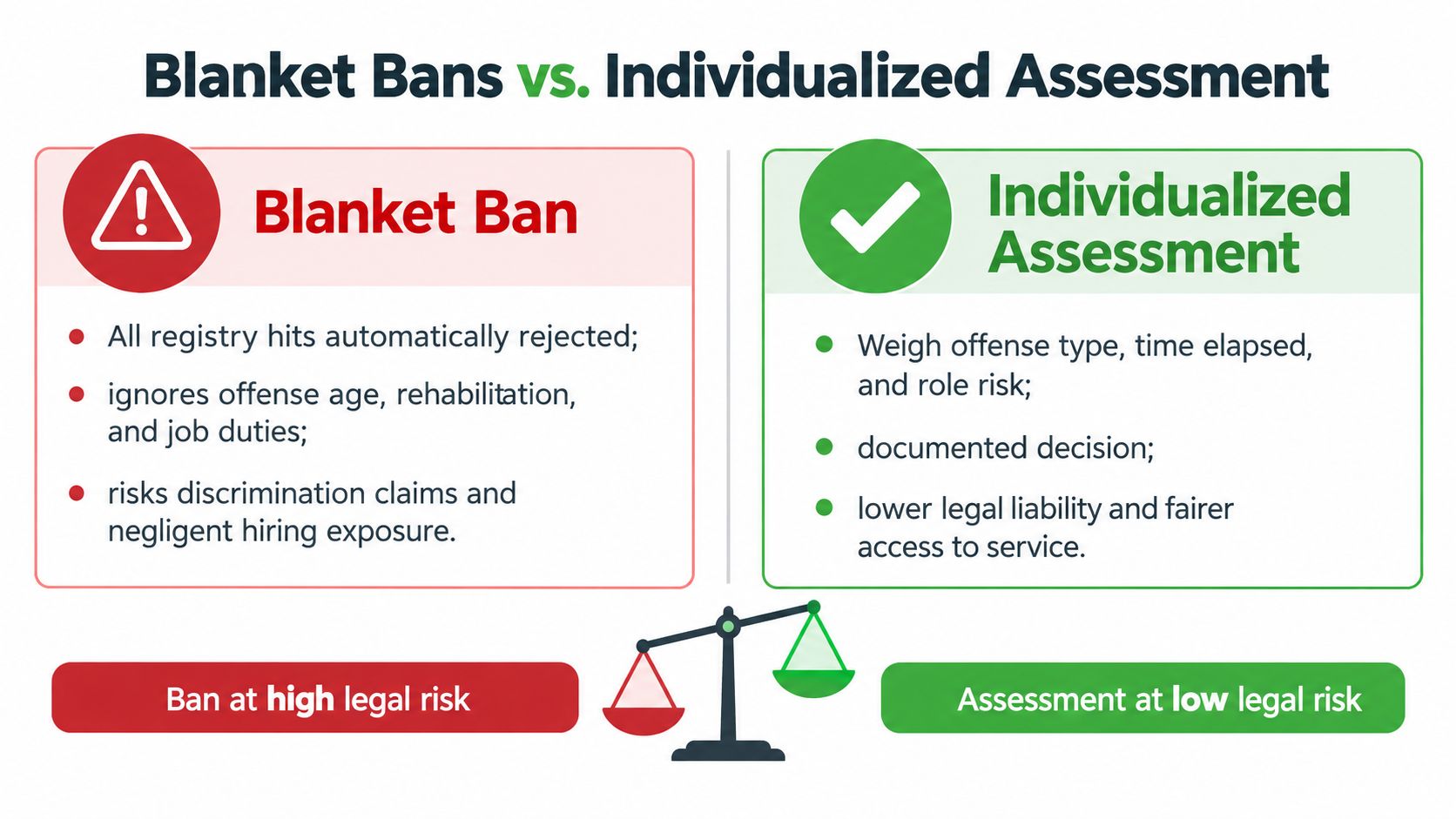
Two approaches, two risk profiles
| Blanket ban | Individualized assessment |
|---|---|
| Rejects every registry match automatically | Reviews the specific record and assignment |
| Does not distinguish identity, offense context, or duties | Verifies identity and considers relevant facts |
| Can shrink the volunteer pool without measuring role risk | Matches restrictions and safeguards to the actual placement |
| Creates a thin decision record | Produces a documented, reviewable rationale |
Individualized assessment does not require accepting every applicant. It requires a defensible decision based on the record and the assignment. Review the offense category, time elapsed, current restrictions, evidence of rehabilitation where legally appropriate, honesty in the application, supervision, access to participants, transportation, overnight duties, and whether redesigning the role can remove prohibited contact.
More restriction is not automatically more safety
Geographic exclusion alone does not reliably show that a volunteer assignment is safe or unsafe. In a two-state study of Michigan and Missouri, researchers found that registrants were less likely to live in restricted zones after the laws took effect, but the shifts were not statistically significant. Post-release recidivism changed only marginally and inconsistently across the states (quasi-experimental evaluation).
That evidence should shape nonprofit policy. Enforce a valid residency or presence restriction, but do not treat a housing location as a complete proxy for volunteer risk or add exclusions unrelated to the role.
Risk-management principle: Use the narrowest restriction that satisfies the law and protects participants, then document why it fits the assignment.
A youth mentoring role with unsupervised contact may be inappropriate, while a supervised facilities role may still be barred by a local presence rule. In another case, the facts may support exclusion from every volunteer role. The compliant path is clear disclosure, documented adverse action procedures, and individualized assessment. The goal is disciplined judgment, not automatic reaction.
Building an FCRA-Compliant Screening Workflow
A nonprofit can have a reasonable eligibility policy and still create liability through a defective screening process. The Fair Credit Reporting Act, or FCRA, governs consumer reports used for employment purposes, and volunteer screening can raise the same procedural concerns when the organization uses a consumer reporting agency.
Start before ordering the report. Give the applicant a clear, standalone disclosure that a background report may be obtained for screening, obtain written authorization, and provide the required notices. Don't bury the disclosure in an unrelated application packet or treat consent as an informal checkbox.
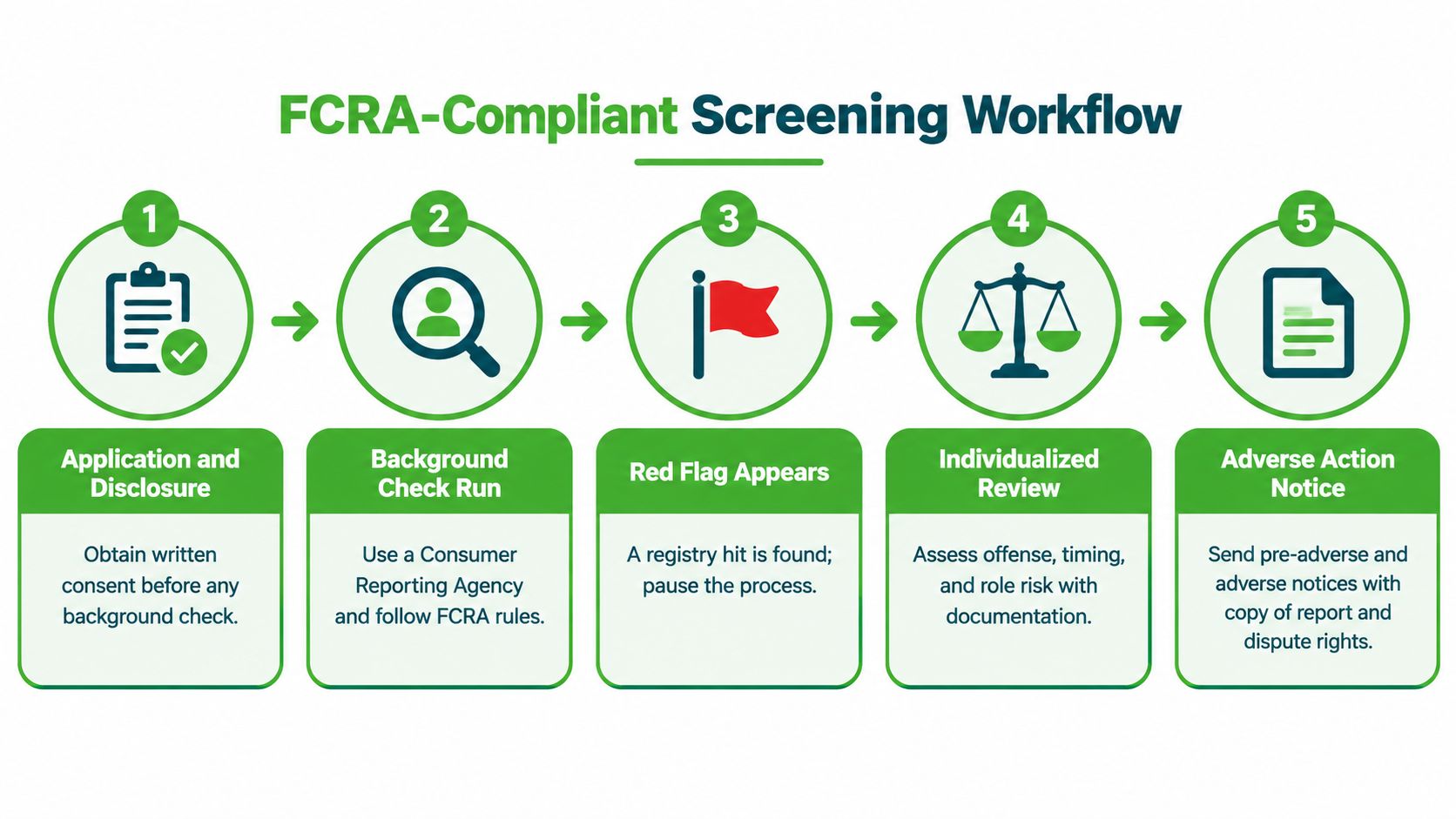
Follow the sequence
Collect disclosure and authorization. Explain the screening purpose in the required format and obtain permission before ordering the report.
Order through a compliant consumer reporting agency. Use a provider that follows applicable accuracy, permissible-purpose, disclosure, and dispute procedures. Confirm that the report identifies the source and supplies information staff can review.
Pause at a potentially disqualifying result. Don't tell the applicant that the decision is final. First verify identity, compare the report with the application, and check whether the record is current and legally relevant.
Conduct the individualized review. Consider the offense, timing, role duties, access level, restrictions, supervision, and any response from the applicant. Keep the reviewer focused on relevant facts, not rumor or social media commentary.
Use pre-adverse and final adverse action procedures when required. Before rejecting the applicant based in whole or in part on the report, provide the pre-adverse action notice, a copy of the report, and the required FCRA rights summary. Give the applicant a meaningful opportunity to dispute inaccurate information. If the final decision remains adverse, send the final notice with the required consumer reporting agency information and dispute rights.
The exact timing and content should be reviewed with counsel and the reporting agency. Staff should never treat the pre-adverse notice as a formality. A wrong identity, outdated record, or missing disposition can change the decision.
Process safeguard: No one should receive a final rejection until the applicant has had a fair chance to challenge inaccurate report information.
The evidence also argues against using registry status as a stand-alone prediction tool. Meta-analytic evidence found that the effect of registration and notification policies is highly sensitive to the statistical specification, with some models showing no significant recidivism impact and others showing complex trade-offs (meta-analysis). For a nonprofit, that supports careful case review rather than automatic assumptions.
Use a written decision form that records the verified identity, legal research, role analysis, applicant response, safeguards considered, decision maker, and date. A guide to whether the FCRA applies to criminal background checks can help coordinators understand the compliance issues before they build the workflow.
Balancing Safety, Mission, and Legal Compliance
A nonprofit can face a hidden legal and operational trap when a strict residency rule makes it impossible to place a suitable volunteer. Screening should protect participants without converting uncertainty into an automatic exclusion. Separate three questions: can the person legally be at the location, can the person perform the duties, and does the organization's policy permit the assignment?
Federal law does not create one nationwide set of residency restrictions or safety zones under SORNA. States and local jurisdictions establish those rules. A nonprofit operating across several sites must therefore check the requirements for each program location instead of copying one national rule into every handbook, as noted earlier.
Build a policy staff can actually use
Give coordinators a short decision path:
- Verify the jurisdiction. Identify every state and local location connected to the assignment.
- Define the role. Record access to participants, transportation, overnight duties, private communications, and supervision.
- Confirm the record. Resolve identity questions and unexplained database entries before relying on the result.
- Apply the restriction. Identify the specific legal rule, rather than treating registry status as proof of unacceptable risk.
- Assess alternatives. Consider supervised duties, no-contact assignments, or another site only when the option is lawful and safe.
- Document the outcome. Record the facts, policy basis, safeguards, reviewer, and decision.
The organization should not impose a blanket ban because an individualized review requires more work. A lawful, documented assessment can distinguish a prohibited location or duty from an assignment where supervision and defined boundaries address the actual risk.
Train more than the volunteer coordinator. The executive director, program managers, board members, and anyone who receives screening information should know who may access reports and who may communicate decisions. Confidentiality failures can harm applicants and weaken participant trust.
Make fairness operational
Transparency does not require publishing sensitive screening criteria. Tell applicants that screening occurs, explain that a report may require further review, and provide a clear channel for correcting errors or submitting relevant information. Use the same process for known applicants, referrals, and high-profile volunteers.
Review the policy whenever a program changes location, serves a different population, or expands into another jurisdiction. Counsel should examine unusual cases involving local presence rules, court conditions, or conflicting state requirements. A mission-driven organization can set firm safeguards while still making a documented, role-specific decision.
Key Takeaways for Nonprofit Leaders
Strict residency restrictions can create a hidden staffing problem: qualified volunteers may be unable to serve at a facility even when their proposed duties present no meaningful access to participants. More restrictions do not automatically make a nonprofit safer. Research found little to no measurable public-safety benefit from sex offender residence restrictions, and displacement from buffer zones did not reliably reduce reoffending rates (evaluation of residence restrictions). Leaders still must follow valid location rules, but should not treat every registry record as proof that a blanket ban works.
Use these priorities:
- Audit the policy. Remove vague language such as “any registry record is disqualifying” unless counsel confirms a specific legal requirement.
- Map the jurisdictions. Identify state and local rules for each facility, event, and service location.
- Define role risk. Separate unsupervised participant contact from supervised, administrative, or remote duties.
- Verify before deciding. Resolve identity and record discrepancies before communicating an adverse outcome.
- Follow FCRA procedures. Provide disclosure and authorization, then complete pre-adverse action, dispute, and final adverse action steps.
- Assess individually. Consider the role, location, supervision, time elapsed, and documented safeguards instead of applying a blanket ban.
- Document the decision. Record the facts, policy basis, reviewer, safeguards, and reasoning.
- Train decision makers. Limit report access and prohibit improvised exceptions.
- Review regularly. Update policies when programs, locations, or applicable laws change.
The standard is manage foreseeable risk through lawful, consistent, role-specific decisions. That approach protects participants, preserves mission capacity, and gives staff a defensible response when a difficult report arrives.
VolunteerBadge provides volunteer background checks, sex offender registry searches, address-history review, and FCRA-oriented adverse action workflows. Visit VolunteerBadge to evaluate a process for verification, individualized review, and consistent documentation.
