
Sex Offender Registration Requirements Guide for Nonprofits
Understand sex offender registration requirements by tier and state, plus what nonprofits must know to screen volunteers compliantly and confidently.
On this page
A volunteer application lands in your inbox. The applicant looks great on paper. They've worked with kids, they've got local references, and they're ready to start this weekend. Then your registry search returns a hit, or worse, it returns nothing even though the address history suggests the person has lived in multiple states. That's the moment when most nonprofits realize they don't need a vague policy. They need a working decision process.
I've screened enough volunteers to know where teams get stuck. They assume sex offender registration requirements are simple. They aren't. They assume there's one permanent national list. There isn't. They assume a clean search in one state answers the question. It doesn't.
What matters is operational reality. Registration is a tiered compliance system. It depends on the law of the jurisdiction, the underlying offense, sometimes the offense date, and where the person lives, works, or attends school. If your screening process ignores any of that, you're relying on luck.
For churches, youth leagues, schools, libraries, and community nonprofits, the job isn't to debate criminal justice policy. The job is narrower and more practical. You need to decide whether a volunteer is eligible, whether more review is required, and whether your records show you handled the screening responsibly. That means checking the right jurisdictions, reading registry results carefully, and not making assumptions based on a single label or a single state website.
Use this guide the same way a busy compliance lead would. If you need the big picture, read straight through. If you're trying to answer a live screening question, jump to the section on where registration applies, the section on state differences, or the workflow section. Those are the parts that keep organizations from missing obvious gaps.
Table of Contents
- Introduction to Sex Offender Registration for Nonprofits
- How Federal Registration Law Evolved and What It Means Today
- Understanding the Three Tier System and Registration Duration
- Who Must Register and Where Registration Applies
- Registration Duration Verification and Notification Rules Explained
- Key State by State Differences Nonprofits Should Know
- How Nonprofits Should Screen Volunteers Using Registry Data
- Quick Reference Glossary and Related Resources for Fast Lookups
Introduction to Sex Offender Registration for Nonprofits
The real problem nonprofits are trying to solve
Most organizations don't search sex offender registration requirements out of curiosity. They search because a person wants access to children, vulnerable adults, transportation duties, overnight trips, counseling roles, or unsupervised space. The registry question shows up right when you have to make a decision, not when you have time for a law school seminar.
That's why I don't recommend a loose standard like “we checked the registry.” That phrase is almost useless. Which registry? Which state? Based on what address history? Did you check where the person works or goes to school? Did the result reflect current law in that jurisdiction? A lot of nonprofit risk comes from pretending those details don't matter.
What a useful screening approach looks like
A solid process does three things:
- Checks beyond one home state: A person's obligations may connect to residence, employment, or school. If your search only follows the mailing address on the application, you can miss a reportable jurisdiction.
- Treats federal law as a floor: Federal standards matter, but they don't erase state variation. Your policy should assume local rules may be stricter.
- Separates screening from speculation: Registry status is one compliance signal. It doesn't answer every safety question by itself, and it shouldn't be read carelessly.
Practical rule: If your volunteer policy can't tell staff what to do with an out-of-state address, a recent move, or a match in a different jurisdiction, your policy isn't finished.
What to check and what to ignore
Check the identity match first. Check the jurisdictions tied to the person's address history and current role. Check whether your program puts the volunteer in a high-trust position.
Ignore internet folklore. Ignore the idea that every listed person is on one permanent national roster forever. Ignore summaries that flatten everything into “registered for life.” That's often wrong, and it leads to sloppy decisions.
Nonprofits need a workflow, not a slogan. The rest of this guide stays focused on that.
How Federal Registration Law Evolved and What It Means Today
Federal sex offender registration law didn't start as one clean national system. It grew in layers, and that's why nonprofit screening still has friction built into it.
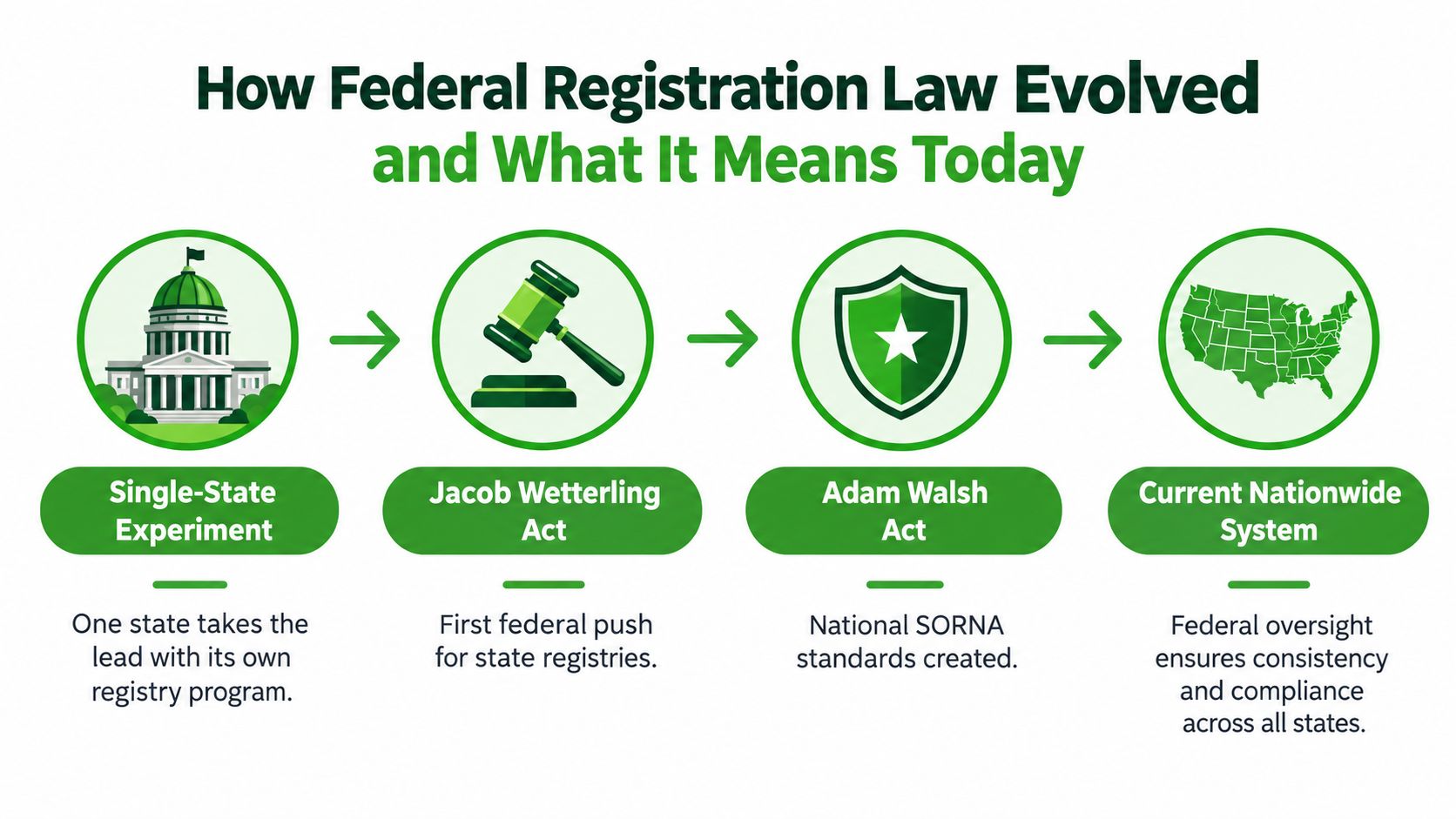
California created the first sex offender registry in 1947, long before Congress imposed broad federal standards, and by August 1996 Massachusetts became the last state to establish registration and notification provisions, meaning all states had some form of registry framework by then, as summarized in the history of sex offender registries in the United States.
The federal government set the floor, not the whole house
Congress passed the Jacob Wetterling Crimes Against Children and Sexually Violent Offender Registration Act in 1994, which required states to create registration programs and marked the start of federal standardization, and the federal framework was later strengthened when the Adam Walsh Child Protection and Safety Act was enacted on July 27, 2006, replacing the Jacob Wetterling framework and creating more stringent national standards under SORNA, according to the same federal and state registry timeline summary.
That sequence matters because a lot of nonprofit staff assume “federal law” means one rule applies the same way everywhere. It doesn't. Federal law tells states the minimum structure. States still decide many details that affect real-world screening.
Here's the plain-English version:
- State systems came first.
- Federal law forced standardization.
- SORNA created stronger national benchmarks.
- States still vary in how they implement and apply those benchmarks.
Why older offenses and court rulings still matter
If you screen adults who may have old convictions, old addresses, or moves across state lines, the legal timeline isn't trivia. It changes outcomes. A person with an older offense may fall under a different rule set than someone convicted later. A later court decision can also change whether someone must remain registered.
That's why I tell nonprofits to stop thinking in terms of “once on, always on.” The system doesn't work that neatly.
Federal registration law gives you a structure. It does not give you a shortcut.
What this means for nonprofit decisions
When you get a registry result, don't jump straight to a moral conclusion and don't assume the record tells the entire legal story. First ask:
- Which jurisdiction controls this result
- Is the person currently required to register there
- Could offense date or later litigation affect status
- Does your volunteer role trigger your own stricter organizational standard
That last point is important. Your nonprofit can choose standards that are stricter than bare legal minimums for volunteer eligibility. What you can't do is confuse your policy choice with the underlying law.
Understanding the Three Tier System and Registration Duration
The SORNA tier model gives nonprofits a baseline way to interpret duration and reporting frequency. It does not solve every screening question, but it gives you a solid starting point. If your staff can't distinguish Tier I from Tier III, they're guessing.
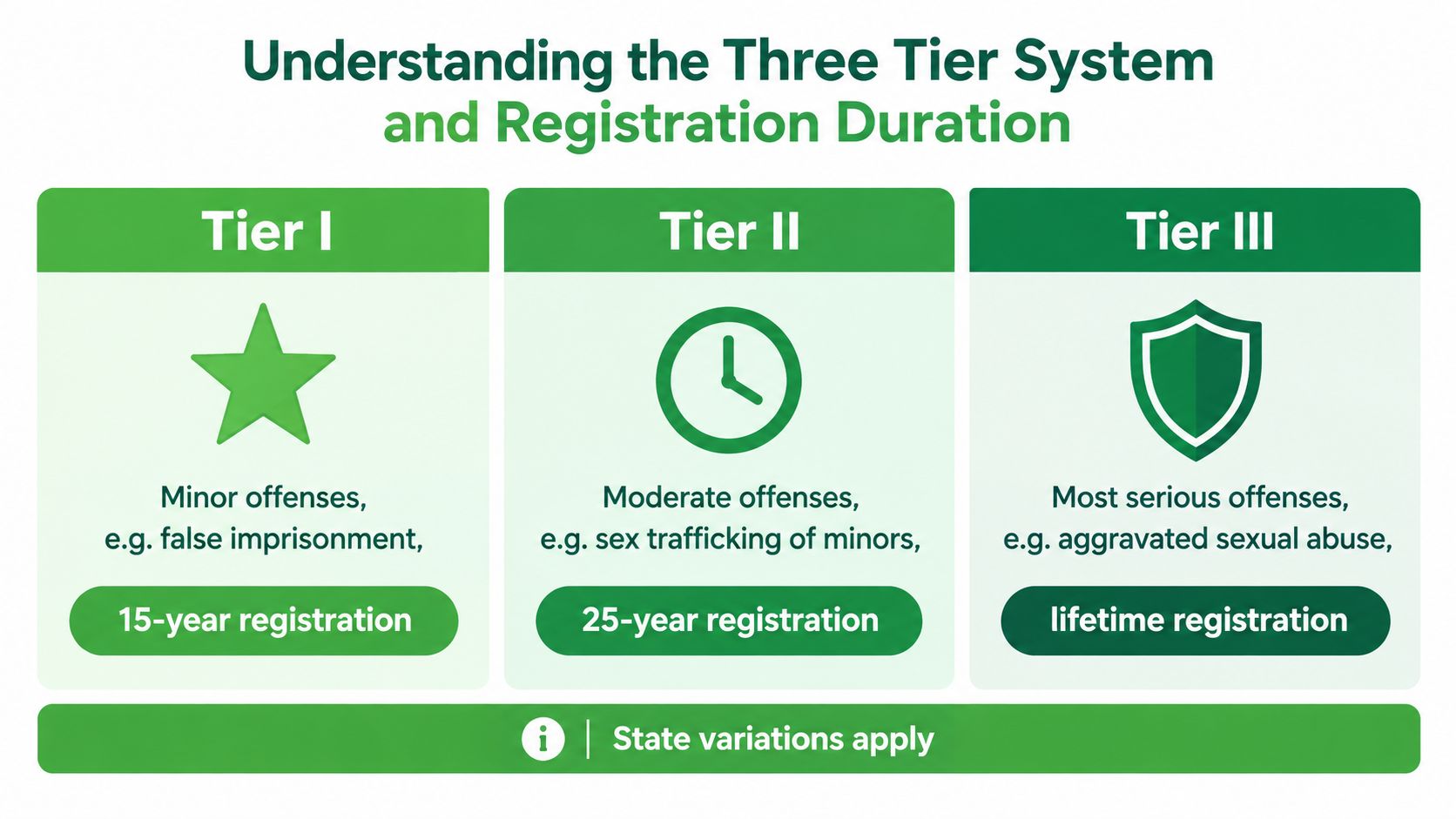
Under SORNA's minimum framework, Tier I registrants register for 15 years and appear annually, Tier II registrants register for 25 years and appear every 6 months, and Tier III registrants register for life with in-person updates every 3 months, according to the SMART Office summary of current SORNA requirements.
Read the tiers as minimums, not promises
Nonprofits make a basic mistake. They see a federal tier chart and assume the chart is complete. It isn't. The same SMART Office guidance notes that jurisdictions may impose stricter rules, including lifetime registration for all offenders or rules that suspend the registration period during custody or civil commitment. For screening purposes, that means the federal chart is your floor.
If a staff member says, “Tier I means this person is done after 15 years,” the answer should be: maybe under the federal minimum, but confirm the controlling state rule before relying on it.
Here's the comparison you need at a desk:
| Tier | Minimum Duration | Verification Frequency |
|---|---|---|
| Tier I | 15 years | Annually |
| Tier II | 25 years | Every 6 months |
| Tier III | Life | Every 3 months |
What the tiers mean in practice
Some teams want offense labels for every tier. I'd caution against overconfidence there unless you are reviewing the actual legal classification in the jurisdiction at issue. For nonprofit screening, the safer use of tiers is practical:
- Tier I: Lower reporting frequency, but still an active compliance obligation.
- Tier II: Longer duration and more frequent in-person verification. This should trigger closer review for any role involving routine access to minors.
- Tier III: Lifetime registration under the federal floor and the most intensive reporting cadence. Most nonprofits won't need a nuanced policy choice here. They'll need a firm one.
Later in the section, this video offers a plain-language walk-through that many coordinators find easier than reading statutes:
A decision matrix for volunteer coordinators
Use the registry result to answer three separate questions, not one:
- How long is the registration duty expected to last: Start with the tier, then verify the state rule.
- How often should the person be reporting in person: Frequent reporting means active compliance is easier to test and easier to miss if your search is narrow.
- Does your role justify any discretion at all: For child-facing programs, many nonprofits choose bright-line exclusions once a confirmed registry match is established.
Don't let a tier number lull your staff into speed. The point of the tier system is to structure follow-up, not eliminate it.
Who Must Register and Where Registration Applies
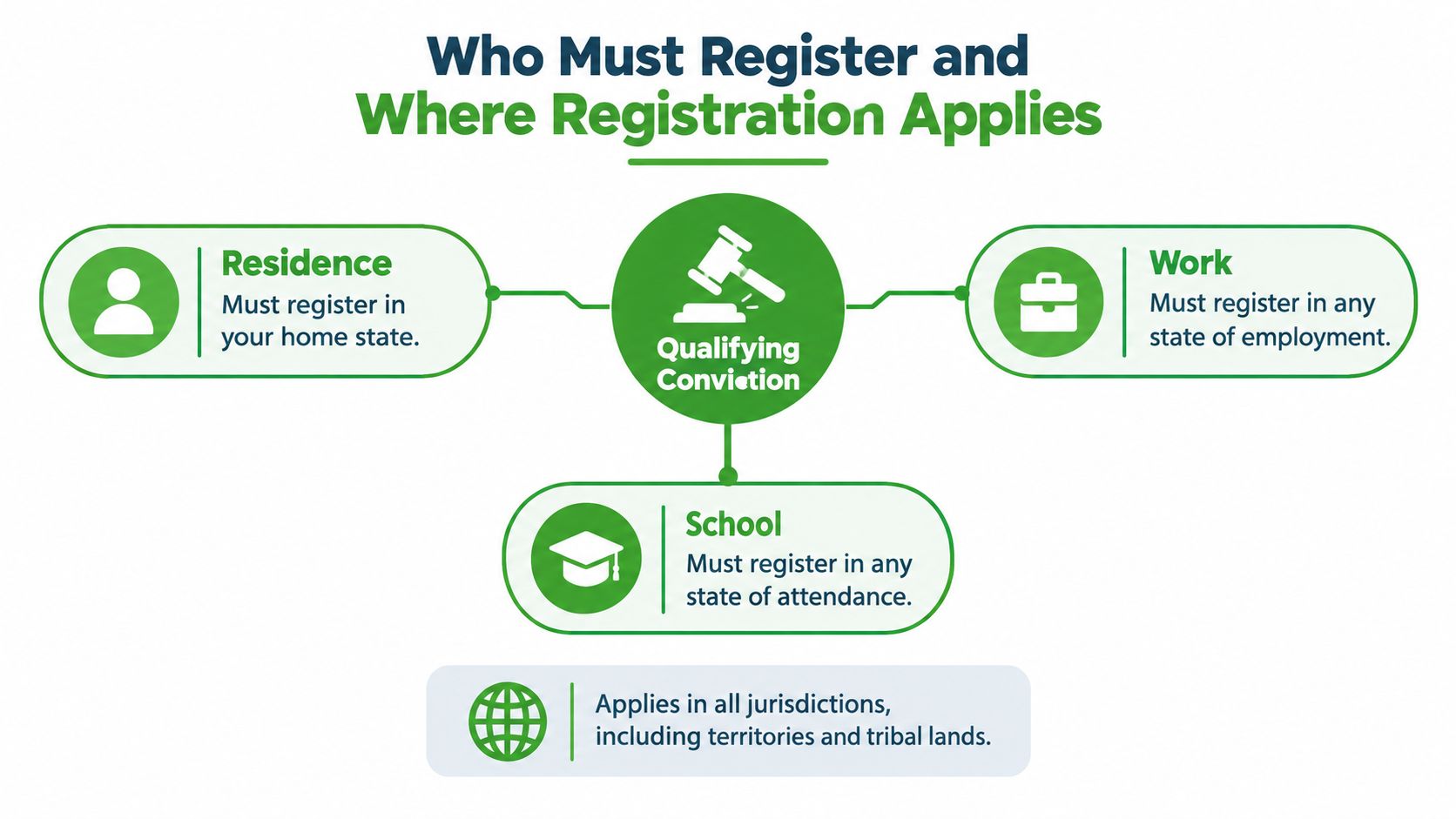
This is the part nonprofits can't afford to get wrong. Registration doesn't only attach to one home address in one state. Under the federal SORNA framework, a sex offender must register in every jurisdiction where the person resides, works, or attends school, and initial registration must happen before release from custody or within 3 business days after sentencing if no prison term is imposed, as set out in 34 U.S.C. 20913.
The three-jurisdiction rule changes how nonprofits should search
A lot of organizations still run screening like it's a one-address problem. It isn't. If a volunteer lives in one state, coaches in another, and attends classes in a third, registration obligations may reach all three.
That means your screening process should treat these as separate checks:
- Residence: Where the volunteer lives, not just what appears on the form.
- Employment or service location: Where the person works or regularly performs duties.
- School attendance: Any jurisdiction tied to student status.
A common nonprofit example is simple. A youth coach lives near a state border and drives into another state every week for practices. If your team only checks the home-state angle, you may miss a reporting obligation tied to the work or activity location.
The update rule is fast and unforgiving
Federal law also requires any change of name, residence, employment, or student status to be reported in person within 3 business days to at least one affected jurisdiction, which then transmits the update to the others, under the same federal registration update rule in 34 U.S.C. 20913.
For nonprofits, the takeaway is operational, not theoretical. Address-history verification matters because registry compliance follows movement. A single-state lookup can miss a recent move, an undisclosed work jurisdiction, or a mismatch between the application and the person's reporting footprint.
What to ask when the addresses don't line up
When an address history raises questions, ask direct ones:
- Which states has this person lived in recently
- Do they volunteer, work, or coach across state lines
- Are they currently enrolled anywhere that changes jurisdiction
- Does the application omit an address that appears in screening data
If the address trail is messy, assume the registry question is messy too. Slow down and verify.
That's not overkill. It's basic nonprofit risk control.
Registration Duration Verification and Notification Rules Explained
A registry match isn't the end of the inquiry. You still need to understand whether the registration period is active, what verification schedule applies, and whether a later legal change might affect the person's current status.
Duration is about more than the original sentence
Nonprofit coordinators often lump registration into the same mental bucket as background check lookback periods. That's sloppy. A criminal history lookback question and a registration-duration question are not the same thing, and if you need a separate primer on ordinary screening windows, this overview of how long background checks go back helps keep those issues distinct.
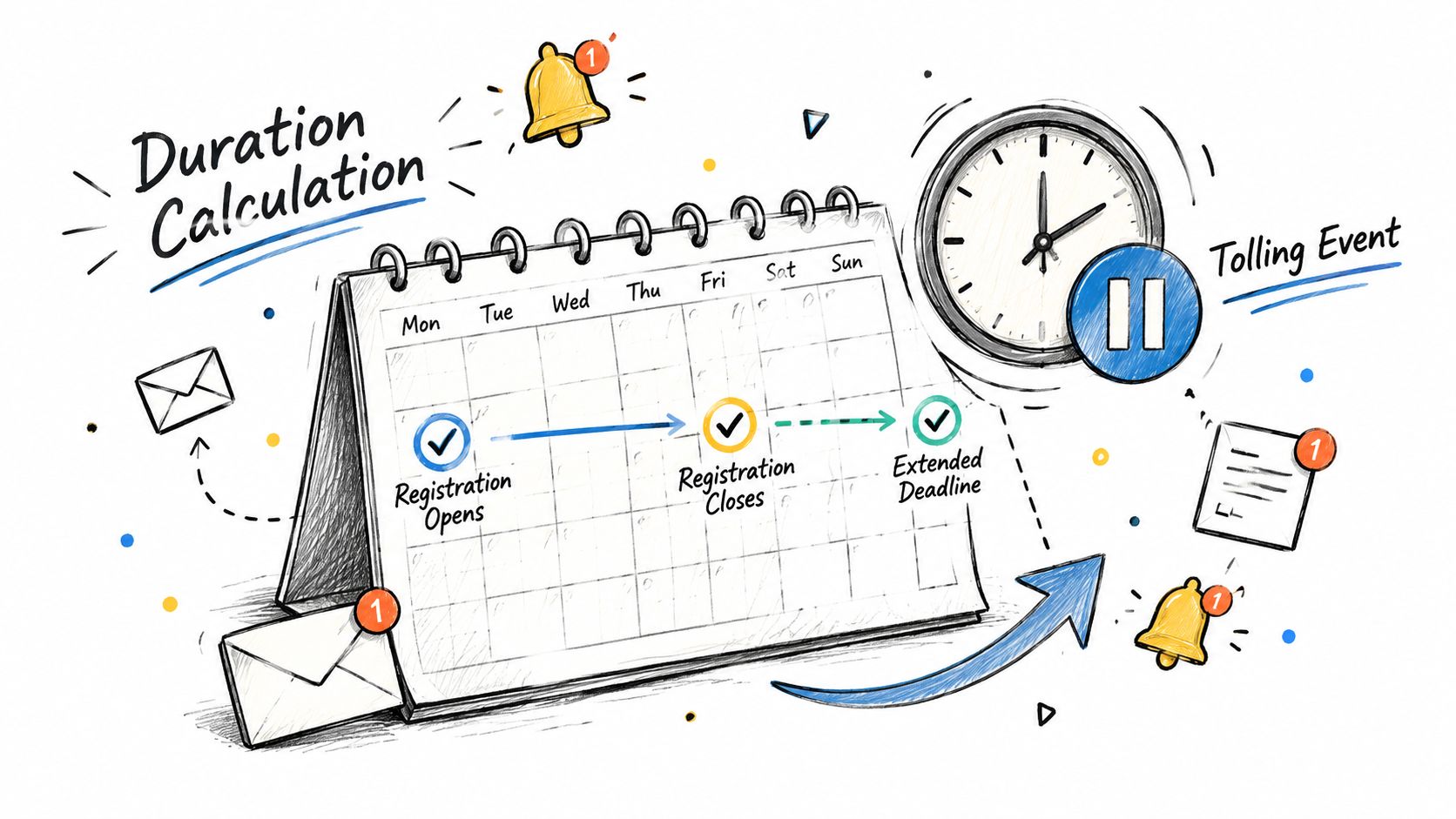
Registration duration depends on the legal framework that applies to the person and the jurisdiction. As noted earlier in the tier discussion, some jurisdictions impose stricter rules than the federal baseline and may suspend the running of the registration period during custody or civil commitment. So don't treat the calendar like it runs in a straight line just because the original conviction is old.
Verification and notification are not interchangeable
Staff also confuse verification with notification.
Verification is the reporting duty. It's the required in-person appearance or update cadence tied to registration status.
Notification is who gets access to what information. In practice, some information may be public-facing while other information is restricted to law enforcement use. For volunteer screening, that distinction matters because a public website may not tell you everything you need to know about compliance status, especially when a jurisdiction updates rules after litigation or statutory change.
Why offense date can change the answer
One of the biggest mistakes I see is the assumption that a person's status is fixed forever. It isn't. Michigan is a useful cautionary example. The state reported that it removed more than 20,000 people from its registry after a September 2026 court ruling found that the 2021 amendments could not be applied retroactively to people whose offenses occurred before July 1, 2011, out of roughly 43,000 registered or required-to-register individuals, according to an official Michigan State Police statement on SOR compliance.
That's why offense date belongs in your review notes whenever a registry question is close or confusing.
A cleaner nonprofit timeline
When your team reviews a registration issue, track it in this order:
- Start with current registry status: Is the person presently listed in the controlling jurisdiction?
- Check the duration framework: Federal tier as baseline, state rule as controlling detail.
- Review interruption issues: Custody or similar factors may affect whether the period has fully run.
- Flag offense date questions: Especially if later court decisions may have changed the result.
- Document your policy decision: Legal registration status and volunteer eligibility are related, but they are not identical.
That structure keeps your screening record usable if someone later asks why the organization approved, denied, or escalated the volunteer.
Key State by State Differences Nonprofits Should Know
You do not need a fifty-state essay taped to your wall. You need to know which kinds of variation change screening decisions.
The big mistake is treating sex offender registration requirements as one national rule with cosmetic state differences. In practice, the differences are operational. They change who appears, how long they remain listed, what the public can see, and which jurisdiction controls the answer when a person has moved.
The patterns that actually matter
Some states follow the federal minimum structure closely. Others go further. Some rules turn on offense date or later court rulings. Some public registry websites are straightforward. Others are sparse enough that you need more verification before relying on them.
Use this pattern table as a screening lens:
| Variation Pattern | What Changes | Screening Implication |
|---|---|---|
| State exceeds federal floor | Duration, frequency, or breadth of registration duty is stricter than the SORNA minimum | Don't rely on federal tier assumptions alone |
| Offense-date-specific rules | Older and newer cases may be treated differently | Capture offense date when a result is disputed or unclear |
| Different public-notification practices | Public website may show less than the full law-enforcement record | A public search may not answer the compliance question by itself |
| Multi-state movement issues | Residence, work, and school create overlapping obligations | Pair registry review with address history every time |
| State-specific removal or litigation effects | Registry coverage can expand or shrink after legal changes | Re-check current state rules before making a final eligibility call |
How to identify the controlling jurisdiction
When a volunteer has moved, commutes across state lines, or attends school elsewhere, ask a practical question first: Which state's current rule am I relying on for this decision? If you can't answer that, you're not done.
Here's the order I use:
- Current residence jurisdiction
- Any state tied to regular work or volunteer activity
- Any state tied to school attendance
- Any recent prior state that appears in address history and could explain gaps
If your team wants a broader state-level context on registry concentration and why state comparisons can be misleading without legal context, this overview of which state has the most sex offenders per capita is worth reading alongside your screening policy.
What nonprofits should stop doing
Stop treating a national database hit or no-hit as a final answer. Stop assuming a moved volunteer only matters in the new state. Stop writing policies that say “check the registry” without specifying address-history review and jurisdiction follow-up.
A state-by-state difference only matters if it changes your decision. Build your policy around those differences, not around trivia.
That approach keeps your process lean without making it careless.
How Nonprofits Should Screen Volunteers Using Registry Data
A workable screening system isn't built around fear. It's built around consistent checks, plain-English review notes, and an approval process staff can follow on a busy day.
The first rule is simple. Run a registry search as part of a broader volunteer review, not as a stand-alone ritual. Good volunteer screening asks whether the person is eligible for the specific role, whether the identity is confirmed, and whether the jurisdictions checked match the person's real-world footprint. If you want a wider nonprofit perspective on policy design, this guide to volunteer background screening gives useful context for building role-based review standards.
A screening workflow that holds up
This is the workflow I recommend for nonprofits:
- Start with disclosure and authorization: Don't improvise consent. Use a documented intake process before you run any search.
- Review address history before spending time on results: If the person has undisclosed moves, overlapping residences, or out-of-state ties, your registry review should widen immediately.
- Run a 50-state registry search when the role justifies it: Especially for youth, transportation, mentoring, caregiving, counseling, and overnight programs.
- Match the record carefully: Name-only similarities are not enough. Confirm identity markers before escalating or denying.
- Apply the same adjudication standard every time: Decide in advance which roles require automatic exclusion, which require committee review, and which require more fact gathering.
How to read a registry result in plain English
Registry data should answer practical questions:
- Is this the same person
- Is the person currently listed
- Which jurisdiction is driving the listing
- Does the role involve vulnerable populations or unsupervised access
- Does your policy allow any discretion here
If your answer to the first question is shaky, stop. False assumptions cause bad denials and bad approvals.
If your answer to the second and third questions is yes, don't water it down with soft language. Record the finding clearly and apply your written policy.
What to do with address-history gaps
Address-history gaps are where weak nonprofit screening breaks down. If the application says one thing and the search history says another, don't “note it for later.” Resolve it before placement.
A practical tool-based approach can help here. For example, VolunteerBadge's sex offender registry check explains how registry searches fit into a broader screening workflow, and VolunteerBadge itself is one CRA option that includes all 50-state sex offender registry searches, digital disclosure and authorization, address-history review, and FCRA adverse-action tooling. If county records exist but can't be verified under FCRA standards, the fee is refunded. That kind of setup is useful because it connects the registry issue to the address trail instead of treating them as separate tasks.
Don't confuse policy decisions with recidivism claims
One more point that gets mangled constantly. Many organizations assume failure to register proves heightened future sexual danger. The evidence cited in a forensic psychology report says otherwise. It found failures to register or similar location-related noncompliance were around 3%, and the summarized studies did not show significant differences in sexual recidivism between compliant and noncompliant registrants; the same report also states that a separate U.S. DOJ evaluation found registered sex offenders were not less likely to recidivate than non-registered sex offenders, according to the expert report discussing registration compliance and recidivism evidence.
That doesn't mean nonprofits should ignore registry status. It means you should use registry data for what it is. A compliance and eligibility signal. Not a shortcut to broad psychological claims.
Quick Reference Glossary and Related Resources for Fast Lookups
Busy teams need definitions they can use without rereading a statute.
Glossary for common registry terms
- SORNA: The federal Sex Offender Registration and Notification Act framework. For nonprofits, think of it as the baseline structure, not the full answer in every state.
- Tier I: Lowest federal tier under the minimum SORNA model. Shortest minimum duration and least frequent in-person verification of the three tiers.
- Tier II: Middle federal tier. Longer duration and more frequent reporting than Tier I.
- Tier III: Highest federal tier under the minimum model. Lifetime registration under the federal floor and the most frequent in-person verification.
- Registration: The legal duty to provide and update required information in the relevant jurisdiction.
- Notification: The part of the system that governs what information is disclosed and to whom.
- Verification: The recurring in-person confirmation or reporting requirement tied to active registration status.
- Controlling jurisdiction: The state, territory, tribal jurisdiction, or other authority whose current rules you need to confirm for the specific person and facts at issue.
- Address-history gap: A missing, conflicting, or undisclosed residence pattern that may point to an unsearched jurisdiction.
Quick lookup checklist for coordinators
Use this before final approval:
- Confirm identity first: Don't act on a loose name match.
- Check all live jurisdictions: Residence, work, and school can all matter.
- Compare application and address history: Gaps need follow-up, not a shrug.
- Ask whether offense date matters: Especially if a result appears inconsistent or recently changed.
- Separate legal status from policy choice: Your organization may set stricter volunteer standards than the legal minimum.
- Document the reason for the decision: If you approved, denied, or escalated, write down why.
Related resources worth keeping handy
Your staff may also need support materials that go beyond screening. For organizations that work with survivors, prevention teams, or community education efforts, these safety resources for sexual assault can be a useful companion set of materials.
And keep your own internal policy pack tight. The best version usually includes:
- A role matrix: Which positions require registry review and which require full background screening.
- An escalation script: What staff say when a result needs further review.
- A documentation template: Short notes for identity confirmation, jurisdiction checked, and final action.
Good compliance work isn't about knowing everything from memory. It's about knowing what to verify before you say yes.
If your team needs a screening process that matches how sex offender registration requirements work, VolunteerBadge gives nonprofits a practical way to run checks with address-history review, 50-state registry coverage, and built-in FCRA workflow support. Use it when you need more than a one-state lookup and want a cleaner record of how your organization made the call.
