
How Long Do Background Checks Go Back Explained
Learn how long do background checks go back for criminal, employment and volunteer screening, plus FCRA limits and state rules that affect results.
On this page
There is no single background-check window. Under federal law, convictions can often be reported indefinitely, while most non-conviction adverse items are generally capped at 7 years and bankruptcies at 10 years, with the record type and state law determining what appears.
A volunteer coordinator may be trying to approve a new coach before the next practice, onboard a driver for a food pantry, or clear a mentor for a youth program. The applicant asks, “How long do background checks go back?” One vendor says seven years. Another report shows an older conviction. A dismissed case appears with a recent date, and suddenly a simple onboarding decision feels like a legal puzzle.
The confusion comes from treating “background check” as one search with one clock. In reality, a report can combine county court records, statewide repositories, federal cases, registry data, identity information, and other verifications. Each source may follow different retention, reporting, and update rules.
For nonprofits, the practical question isn't only how far back a search reaches. It's also whether the record is reportable, whether it was verified, whether it relates to the volunteer role, and whether local law permits the organization to consider it. The sections below translate those questions into a record-type framework you can use when creating a fair, consistent screening policy.
Table of Contents
- Why Lookback Periods Confuse Every Volunteer Coordinator
- How Federal Reporting Rules Shape What You Can See
- Lookback Periods by Background Check Type
- When the Clock Starts and Why Old Records Reappear
- State Limits and International Rules That Override the Baseline
- What Lookback Means for Nonprofit Volunteer Screening in Practice
- Choosing the Right Screening Window for Your Organization
Why Lookback Periods Confuse Every Volunteer Coordinator
A church volunteer submits a form to help with children's activities. A youth league needs a coach cleared before the season begins. A community organization receives a report that lists an old arrest, a later dismissal, and a conviction from a different jurisdiction. The coordinator searches online for one answer to “how long do background checks go back” and finds several answers that seem to contradict one another.
The answers may all be reasonable because they refer to different parts of the process. A federal reporting limit isn't the same as a state restriction. A criminal conviction isn't treated like an arrest that never led to conviction. A national database search isn't the same as a verified county-court search. The date shown beside a case may also be a disposition date rather than the date of the original arrest.
One question hides several decisions
Think of a background check as a set of filing cabinets, not one camera pointed at a person's entire past. One cabinet contains criminal court records. Another contains registry information. Another may contain identity and address history. The screening provider has to identify the right jurisdictions, search the relevant sources, and follow applicable reporting rules.
For a nonprofit, that means the answer can change based on:
- Record type: A conviction, non-conviction arrest, bankruptcy, civil judgment, and collection don't share one federal reporting period.
- Court or registry source: County courts may hold records that a broad database only flags, while federal courts maintain a separate system.
- Jurisdiction: State law can restrict reporting or use more tightly than the federal baseline.
- Role and decision: A volunteer working alone with children may require a different package and review standard than someone helping at a public event.
- Record status: Dismissed, sealed, expunged, pending, and convicted cases can have different consequences.
Practical rule: Never write “seven years” as your entire screening policy. Write down which record types you consider, which jurisdictions you search, and how you handle verified results.
By the end of this guide, you should be able to read a report without assuming that an old date automatically makes a record irrelevant or that a visible record automatically makes it disqualifying. You'll also have a clearer basis for choosing screening depth, asking a provider about timing, and documenting decisions that treat applicants consistently.
How Federal Reporting Rules Shape What You Can See
The Fair Credit Reporting Act, or FCRA, provides the federal framework that consumer reporting agencies commonly use for employment and similar screening reports. The simplest way to understand it is to picture several clocks running at once.
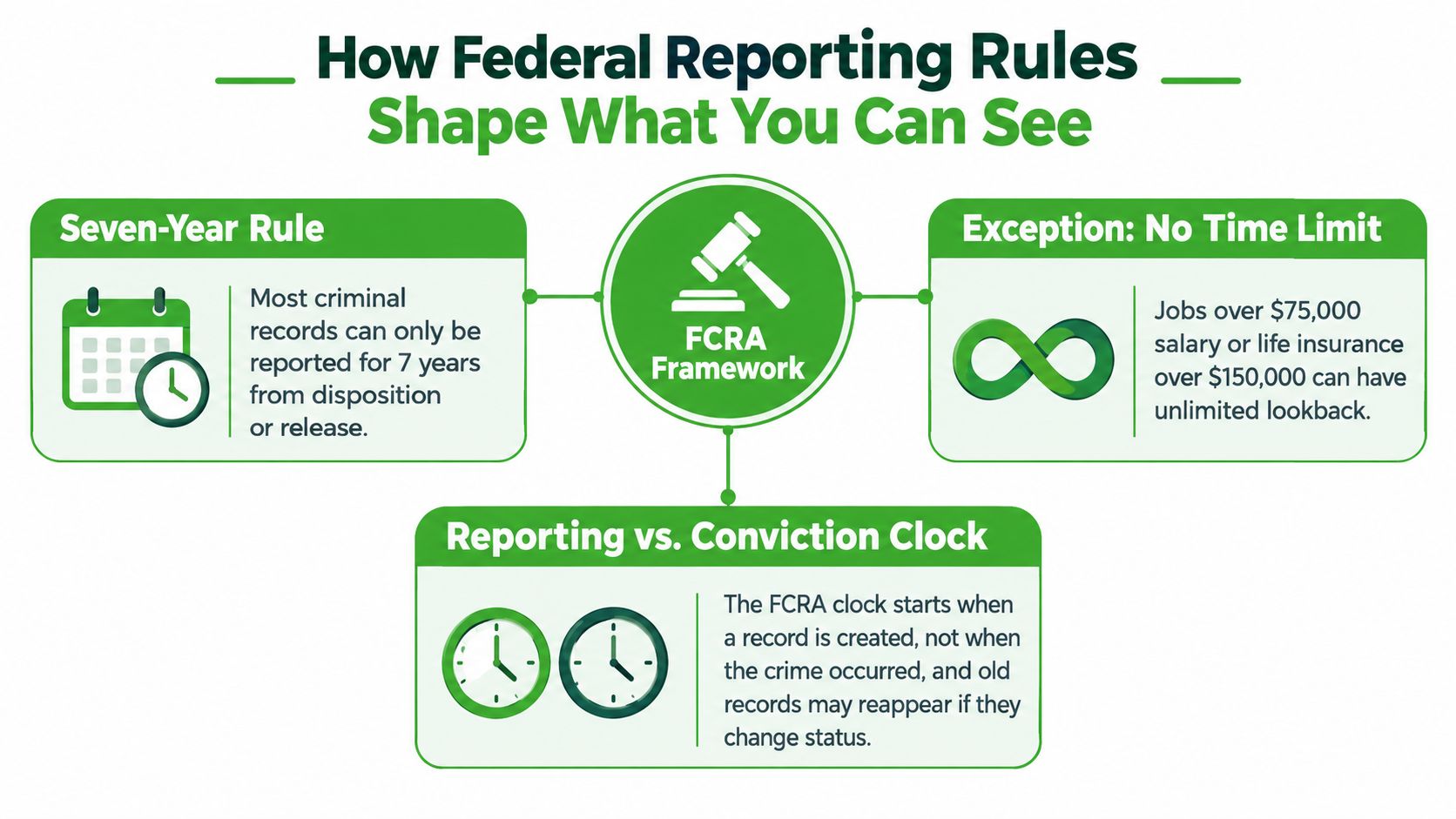
For many non-conviction adverse items, the federal clock generally limits reporting to 7 years. That category can include arrests that didn't lead to conviction, civil suits, civil judgments, paid tax liens, collections, and similar adverse information. Bankruptcy is generally treated differently, with a 10-year federal reporting period. These rules are summarized in Checkr's explanation of how far background checks go back.
Convictions often operate on another clock. Under federal law, a criminal conviction can be reported indefinitely in many cases unless a state rule, expungement, sealing order, or another restriction changes the result. That's why a nonprofit may see a conviction older than seven years even though an arrest without conviction from the same general period may be excluded.
Read the report by record category
Use this sequence when reviewing a result:
- Identify the record. Is it a conviction, an arrest without conviction, a civil item, a bankruptcy, or something else?
- Find the relevant date. The report may use disposition, entry, filing, or another legally significant date instead of the event date an applicant remembers.
- Check the jurisdiction. Federal rules create a baseline, but state law may impose additional restrictions.
- Confirm accuracy. Match identifiers and verify the record with an appropriate primary source before considering it.
- Apply the role standard. Decide whether the verified information is relevant to the volunteer's actual duties.
A useful FCRA overview for criminal background checks can help coordinators distinguish the reporting rules from the separate decision-making obligations. The FCRA primarily governs how consumer reports are obtained, furnished, and used. It doesn't create a universal rule that every nonprofit must reject or accept a person based on a particular record.
The federal framework also contains important limits and exceptions. The relevant salary threshold can affect whether some reporting limits apply, and state law may be stricter. Nonprofits shouldn't treat a federal baseline as permission to search every record forever or as a guarantee that every older item will disappear.
A reportable record is not automatically a disqualifying record. Reporting answers what may be included. Adjudication answers what your organization should do with accurate, relevant information.
Lookback Periods by Background Check Type
Different searches answer different questions. A county criminal search looks for records in a particular court jurisdiction. A statewide search can broaden coverage but may depend on the quality and completeness of the state repository. A national database sweep can identify possible hits and jurisdictional leads, but it shouldn't replace verification where a record matters.
The phrase “national background check” can therefore create false confidence. Broad coverage and historical depth aren't the same thing, and neither guarantees that a recent filing in a local court will appear without a county-level search.
| Check Type | What It Searches | Typical Lookback |
|---|---|---|
| County criminal search | Local criminal court records, including relevant felony, misdemeanor, and pending-case information | Depends on the record type, court availability, and applicable law |
| Statewide criminal search | A state repository or statewide criminal-history source | Depends on repository coverage, record status, and state rules |
| Federal criminal search | Federal court records, which are separate from most state and county systems | Depends on the record and reporting rules |
| National database sweep | Aggregated or multi-jurisdictional records used to identify possible matches and search leads | Depends on source quality, update practices, and legal limits |
| Sex offender registry search | Applicable registry records | Depends on registry rules and the status of the listed record |
| Employment or credit-related check | Employment information or credit-report information, when legally permitted and relevant | Often follows separate FCRA and state-law restrictions |
Match the search to the volunteer's duties
A volunteer who works independently with children, transports participants, handles donations, or enters a resident's home presents different screening questions from a volunteer staffing a public registration table. The organization should start with access and vulnerability, not with a standard package chosen for everyone.
For example, a national search can provide a broad starting point, while a federal criminal background search addresses a separate court system. A role involving children may also require registry screening under organizational policy, insurance requirements, or applicable law. A driving role may call for motor-vehicle information rather than relying only on criminal records.
Understand what each result can and can't prove
A database hit is a lead, not a final finding. Names can be shared, identifying details can be incomplete, and records can be updated at different speeds. County verification may be necessary when a possible match could affect a volunteer decision.
Employment and credit-related checks also require care. They aren't interchangeable with criminal searches, and the organization must have a lawful, role-related reason to request them. A broad package can create unnecessary compliance and fairness problems if it gathers information the role doesn't require.
The best screening window is therefore the one that fits the record type, source, role, and jurisdiction. It isn't necessarily the longest window available.
When the Clock Starts and Why Old Records Reappear
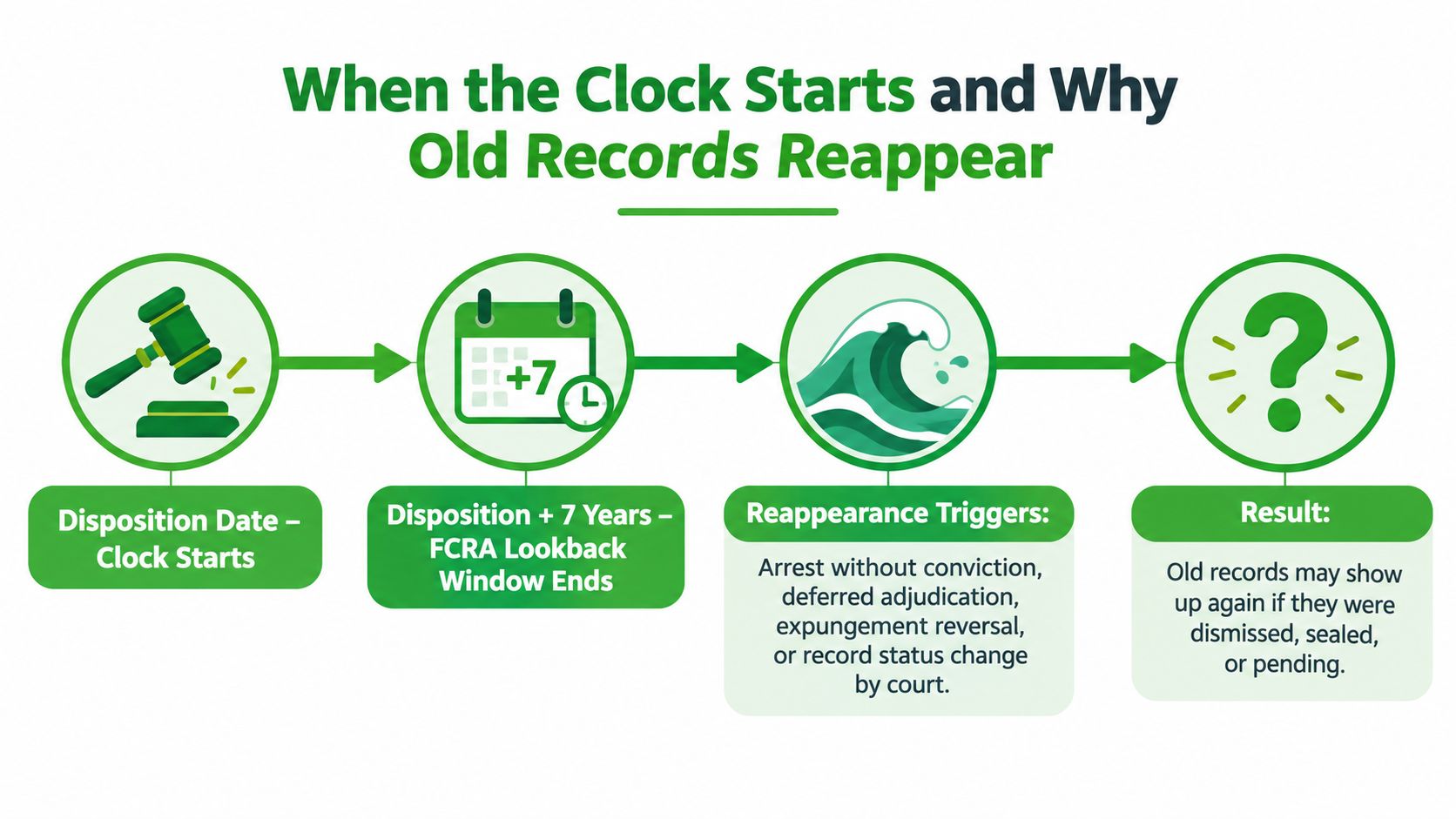
Applicants often remember the date of an arrest or lawsuit. Reporting rules may focus on a different date. For many non-conviction adverse items, the relevant seven-year period can begin at disposition or entry into the record, rather than at the original arrest date. ClearCheck's discussion of background-check timing describes why a case filed earlier but resolved later may remain reportable longer than an applicant expects.
Consider a simple timeline. An arrest happens, the case remains open, and the court later records a dismissal. If the reporting clock is tied to disposition, the dismissal date can matter more than the arrest date when determining whether the item falls within the applicable period. The same logic can affect civil matters and collections, where the date attached to the adverse item may not match the date the person first experienced the underlying event.
Each item has its own clock
The CFPB explains that the seven-year period is tied to each adverse item's own date. A later event doesn't restart or reopen the reporting period for an older item, as described in the CFPB background-screening report.
Suppose an older collection remains on a report and a new collection appears later. The new item has its own timing. The later collection doesn't reset the clock on the earlier one. Likewise, a new background check doesn't revive an otherwise stale item because the provider searched again.
Why a report can look inconsistent
Old records may seem to “reappear” for several reasons:
- Status updates: A pending case may later receive a disposition, changing how the record is displayed.
- Identity matching: A new address or alias can connect a person to a jurisdiction that wasn't previously searched.
- Source differences: One provider may use a database lead, while another verifies directly with a court.
- Reporting errors: Duplicate, incomplete, or outdated information may require correction.
A nonprofit should pause when a report contains a confusing date or status. Ask the screening provider to explain the source, the identifiers used, and the applicable reporting logic. Don't treat a resurfaced record as proof that the original clock restarted.
State Limits and International Rules That Override the Baseline
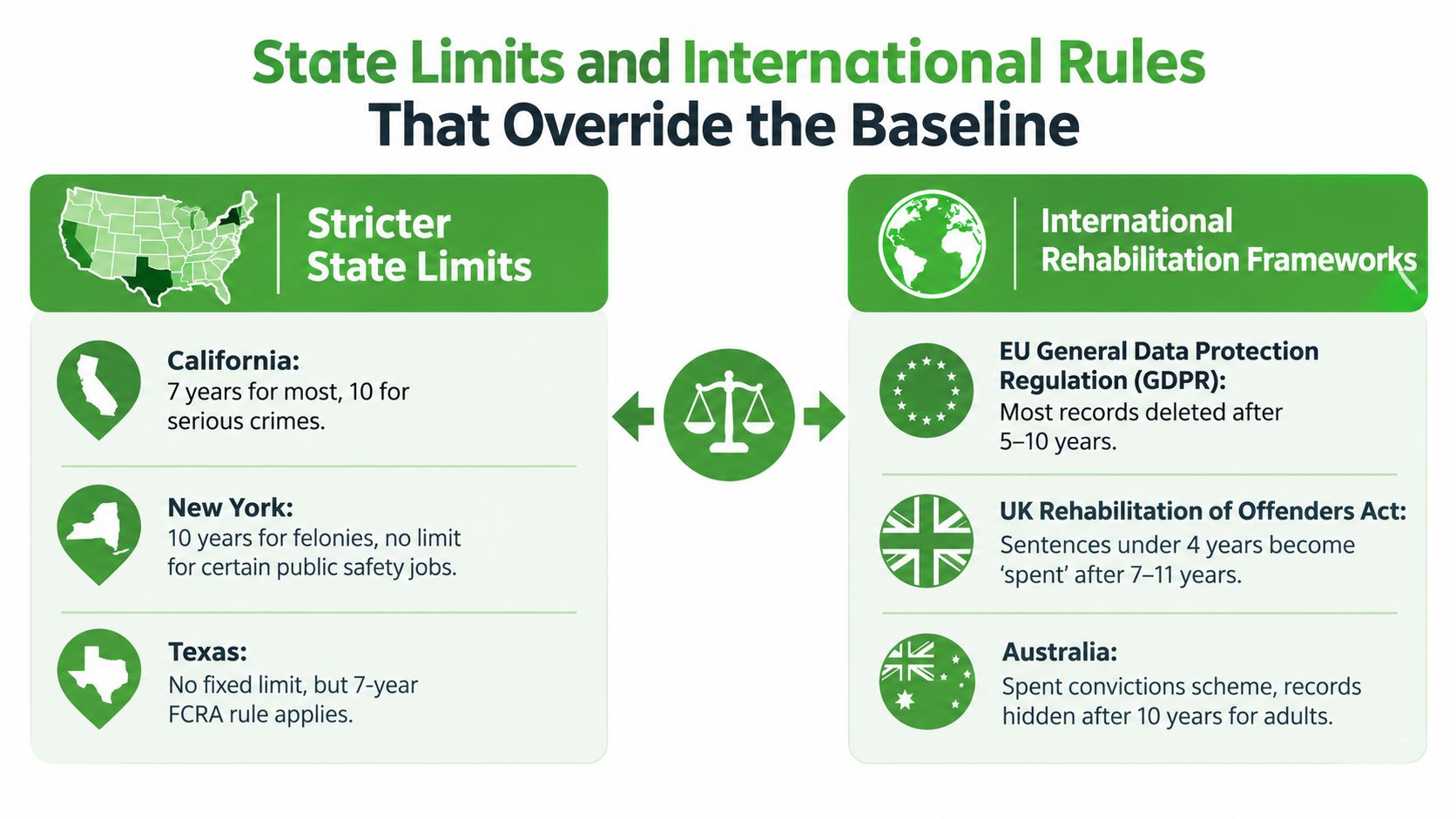
Federal law supplies a widely used baseline, but it doesn't settle every volunteer-screening question. States may limit the reporting or use of criminal information more strictly, and rules can differ based on the record, the role, the employer, and whether a record was sealed or expunged.
A state restriction may affect a conviction even when federal law would otherwise allow continued reporting. That means a nonprofit operating across state lines shouldn't copy one jurisdiction's policy into every program. It should identify where the volunteer will serve, which law applies to the decision, and whether the organization has a documented process for reviewing restrictions.
The United Kingdom uses rehabilitation periods
The United Kingdom provides a different model. Rather than relying primarily on a credit-style reporting cap, the Rehabilitation of Offenders Act uses sentence-based rehabilitation periods that begin at the end of the sentence, including licence time. Under the guidance cited by SHRM's discussion of reporting windows and rehabilitation rules, an adult custodial sentence of more than 4 years has a 7-year rehabilitation period, while a sentence of less than 1 year has a 1-year period.
Many convictions become “spent” after the relevant period, although enhanced checks can still disclose some records depending on the role and filtering rules. A nonprofit recruiting volunteers in the UK must therefore ask whether the record is spent and what level of check the role permits, rather than importing a U.S. seven-year assumption.
International caution: “Old” doesn't have one legal meaning across countries. Rehabilitation, spent-record, filtering, privacy, and role-specific rules can all change the result.
The same principle applies to U.S. states. Expungement or sealing may remove or restrict access to a record, but coordinators shouldn't promise applicants that a record will never appear anywhere. The organization should rely on current jurisdiction-specific guidance and ask counsel when the role, record, or legal requirement is unclear.
For a broad-search perspective, nonprofits can also review this national crime database search guide. It should be used to understand coverage and limitations, not as a substitute for checking the law governing the actual screening decision.
What Lookback Means for Nonprofit Volunteer Screening in Practice
A nonprofit doesn't need the same screening depth for every person. A volunteer sorting donated clothing at a supervised public event may have limited access and limited responsibility. A mentor meeting a child alone, a driver transporting participants, or a volunteer entering a client's home requires more careful role-based planning.
Start with a written risk tier. The policy should describe the duties, the people served, the access granted, and the checks required for that role. It should not say that every applicant receives “the most complete check available.”

Build the package around exposure
A practical policy can distinguish among:
- General service roles: Identity verification and an appropriate criminal search may be sufficient when the volunteer has no unsupervised access.
- Youth and vulnerable-person roles: Add the registry and jurisdiction-specific searches required by law, insurance, or organizational policy.
- Driving and financial roles: Consider motor-vehicle or financial checks only when the duties justify them and the applicable rules permit them.
- Multi-location volunteers: Use address history to identify jurisdictions that a broad search might not fully cover.
Address history matters because a person may have lived, worked, or used an alias in a jurisdiction that isn't obvious from the application. A gap doesn't prove misconduct, but it does give the coordinator a reason to request clarification before treating a search as complete.
Review results fairly
An old but reportable conviction shouldn't trigger an automatic reaction unless the organization's lawful, role-specific policy says so and the decision is otherwise permitted. Examine the offense, its relationship to the duties, the record's current status, and any information the applicant provides. Apply the same process to every applicant in the same role.
If the organization may take adverse action based on a consumer report, it needs to follow the FCRA process, including the required pre-adverse and final notices. Give the applicant a meaningful chance to review and dispute inaccurate information before finalizing the decision.
Churches and faith-based ministries may also find this Grain guide to church background checks useful when designing policies for clergy, children's programs, and other ministry roles. The important takeaway is consistency: define the role, select relevant checks, verify potential matches, and document the decision.
Choosing the Right Screening Window for Your Organization
A sound nonprofit policy answers four questions before a coordinator orders a report:
- What access does the role provide? Consider children, vulnerable adults, homes, vehicles, money, private information, and unsupervised contact.
- Which searches match that access? Select county, state, federal, registry, identity, driving, or other checks only when they serve a clear purpose.
- Which rules apply? Check federal requirements, state limits, local requirements, and any rules connected to the volunteer's location or role.
- How will the organization review results? Define verification, individualized assessment, applicant dispute handling, and adverse-action steps before the first report arrives.
Keep a written record of the policy version, the searches ordered, the dates reviewed, and the reason for the decision. That documentation helps coordinators avoid inconsistent treatment and makes it easier to explain why a record was considered or excluded.
The answer to “how long do background checks go back” is therefore a decision framework, not a single number. Federal reporting rules, record dates, source coverage, state limits, and role relevance all matter. When those pieces are aligned, nonprofits can screen responsibly without confusing a database hit with a verified finding or an old record with an automatic disqualification.
VolunteerBadge helps nonprofits request FCRA-compliant volunteer background checks with digital disclosure and authorization, address-history review, broad criminal and registry searches, and guided pre-adverse and final adverse-action notices. Visit VolunteerBadge to build a repeatable screening workflow that matches each volunteer role to the right lookback and review process.
