
What State Has the Most Sex Offenders Per Capita?
Discover what state has the most sex offenders per capita based on 2026 data. We analyze numbers & impact for nonprofit volunteer screening.
On this page
National comparisons often identify Oregon as having the highest per-capita rate of registered sex offenders. That ranking can orient a discussion, but it does not determine whether an individual volunteer presents a risk. Differences in registration laws, reporting practices, population size, and record maintenance can all affect state-level figures.
For nonprofits serving children, survivors, older adults, people with disabilities, or other vulnerable groups, the practical issue is how to interpret the measure responsibly. A state rate describes a population-level pattern. It does not establish an applicant's conduct, current risk, or suitability for a particular role.
Volunteer managers should use jurisdictional data to strengthen consistent screening procedures, not to make assumptions about people based on residence. Decisions should rely on individualized, relevant records and documented criteria, with adverse-action procedures aligned to the Fair Credit Reporting Act when a consumer report is used. This approach supports protection without turning a broad statistic into a substitute for compliant review.
Table of Contents
- Answering the Question Directly
- State Rankings for Registered Offenders Per Capita
- Why Some States Have Higher Rates Than Others
- How Nonprofits Should Interpret This Data
- Common Misconceptions About Offender Registries
- Frequently Asked Questions for Nonprofits
- Should our policy be different for volunteers from high-rate states?
- How reliable are online public registries for formal screening?
- What should we do when a registry search produces a possible match?
- Does a national check replace local court research?
- How should a nonprofit document its screening policy?
Answering the Question Directly
Oregon has the highest reported rate of registered sex offenders per resident in the cited national comparisons. The 2025 comparison lists 790 registered sex offenders per 100,000 residents in Oregon, followed by Arkansas at 640 per 100,000 and Alaska at 478 per 100,000. The underlying comparison from SafeHome also places Oregon sixth by total registrant count.
The distinction is operationally important. A per-capita rate adjusts registrant totals to population size, while a raw count measures the number of people registered. A smaller state can therefore rank higher by rate even when a larger state has more registrants overall. Nonprofits recruiting across state lines may need both measures when planning screening coverage, but neither measure determines an applicant's suitability.
The same comparison reports about 795,000 registered sex offenders nationwide, or roughly 241 per 100,000 people. Oregon's reported rate is therefore more than three times the national average. That gap can reflect differences in registration laws, population characteristics, reporting practices, and record maintenance. It is not a complete measure of current danger in every community.
A separate benchmark identified Oregon at 688 registered sex offenders per 100,000 residents in 2019, compared with 536 in Arkansas and 491 in Delaware. Statista's presentation of that benchmark indicates that Oregon ranked first across different reporting periods, although the reported rate changed.
Practical meaning for nonprofit leaders: Use state rankings to check whether your screening policy accounts for interstate movement and registry variation. Do not presume misconduct by applicants from a particular state.
The defensible conclusion is specific: Oregon has the highest reported concentration of registered offenders per resident in these comparisons. The figures do not justify calling it the most dangerous state or making an employment or volunteer decision based solely on state residence. A compliant process should evaluate relevant records individually and follow applicable Fair Credit Reporting Act procedures when a consumer report is used.
State Rankings for Registered Offenders Per Capita
Per-capita rankings answer a narrower question than total counts. The calculation divides registered offenders by the state population and multiplies the result by 100,000. That adjustment makes states with different population sizes easier to compare, but the result still changes with registry counts, population estimates, and record-maintenance practices.
The verified comparison available for this article identifies three leading state rates. It does not establish a complete top-ten ranking, so the table reports only the supported entries rather than filling missing rows with estimates.
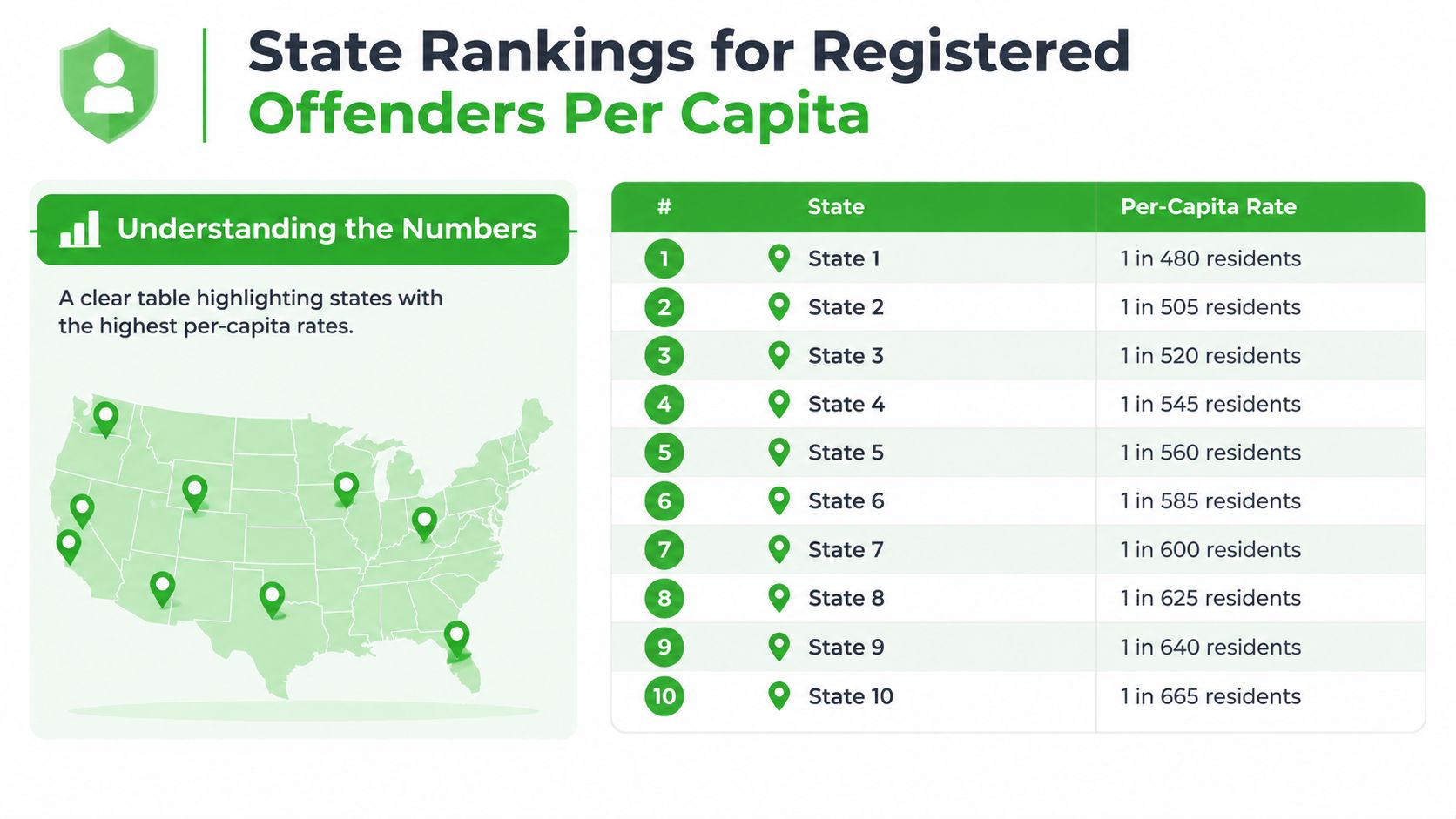
| Rank identified in the verified comparison | State | Registered offenders per 100,000 residents |
|---|---|---|
| 1 | Oregon | 790 |
| 2 | Arkansas | 640 |
| 3 | Alaska | 478 |
Oregon also ranked sixth by total registrant count in the same comparison, showing why rate and volume support different operational decisions. A high rate does not tell a nonprofit how many applicants it will screen, how many registrants live near a program site, whether a record remains current, or whether a particular candidate has a disqualifying offense.
Why the denominator changes the interpretation
Raw totals are more relevant to workload. A larger state may generate more searches, address histories, and possible records even when its normalized rate is lower. Per-capita rates are more useful for comparing states and deciding whether a nonprofit's screening policy should cover applicants with interstate histories.
A ranking cannot determine an individual's suitability. It can, however, signal that a state-only search may be inadequate for a volunteer program whose applicants have lived, worked, or studied in multiple jurisdictions.
What nonprofits should take from the table
The table supports three limited conclusions:
- Oregon leads the cited comparison: Its reported rate is 790 per 100,000 residents.
- Arkansas and Alaska are separate data points: Their rates differ, and registry rules and record practices may also differ.
- The ranking informs policy, not adjudication: It can support nationwide or multi-jurisdiction screening coverage, but it cannot replace an individualized review.
Volunteer managers should not turn state residence into a shortcut for exclusion. Use the same written process for every applicant, verify relevant records, assess them against the duties and risks of the role, and follow applicable Fair Credit Reporting Act procedures when a consumer report is used. That approach uses the table as a planning tool while protecting applicants from unsupported assumptions.
Why Some States Have Higher Rates Than Others
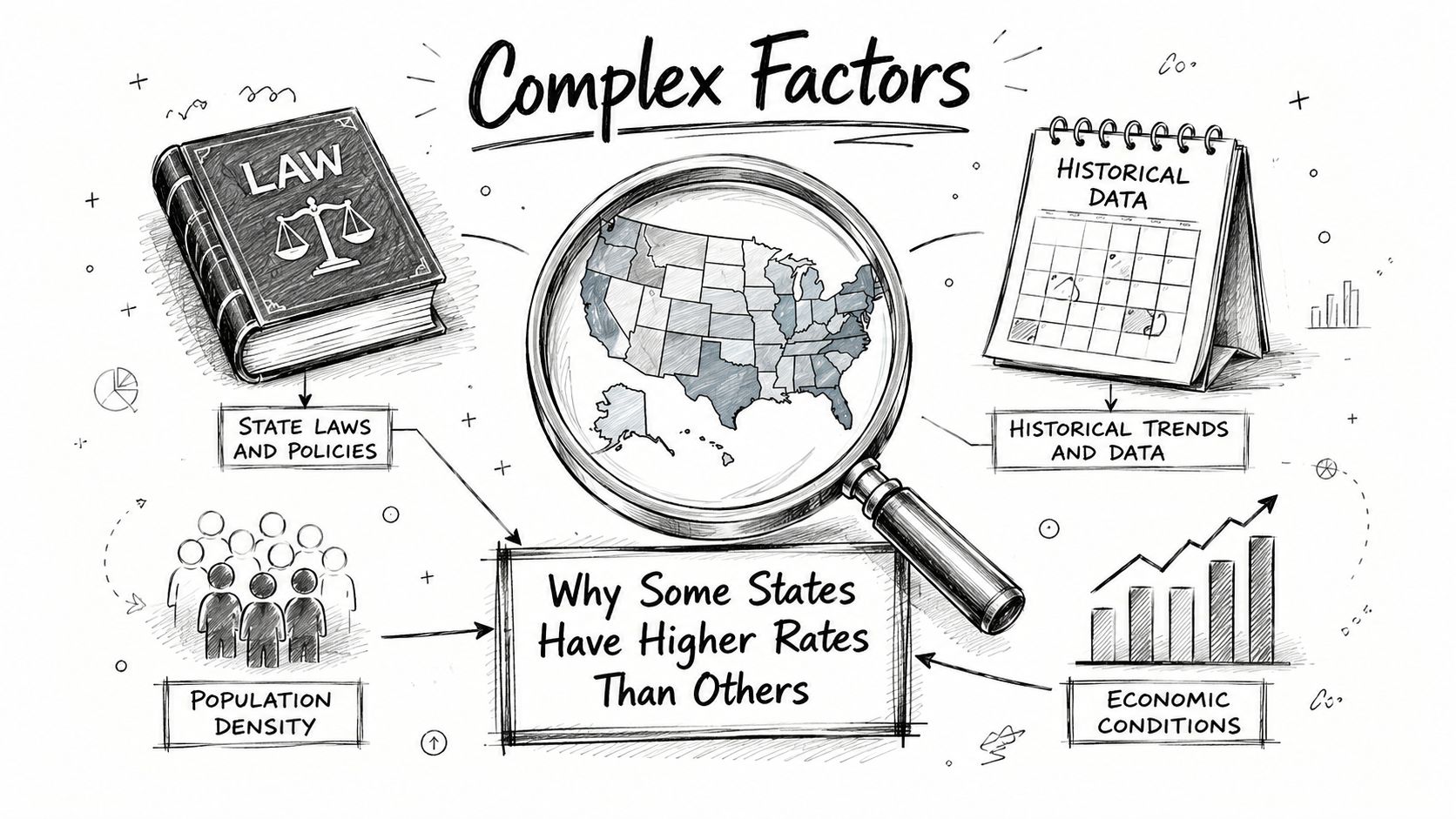
A high registered-offender rate doesn't have one universal explanation. The figure is produced by a measurement system that combines the number of people listed, the population used as the denominator, and the rules and practices that determine who appears in a registry and how records are maintained.
The calculation itself is registered offenders divided by state population, multiplied by 100,000. The International Centre for Missing and Exploited Children's registry map and explanation emphasizes that state-level differences can reflect registration law, enforcement, mobility, and population structure. It also notes that higher-rate states tend to cluster in the Northwest and Upper Midwest, while Maryland, Indiana, and Connecticut appear near 125 to 164 per 100,000 in that reporting.
Registration rules shape the count
States don't necessarily define registration categories, duration, address reporting, or public disclosure in identical ways. A state with broader requirements or more persistent registration can produce a larger registry than a state with narrower rules, even when the underlying patterns of sexual offending aren't directly comparable.
That means a registry count is partly a record of legal policy. It reflects who the state requires to register and how long those requirements remain active. A nonprofit should treat the registry as important screening information, but not as a uniform national dataset created under identical conditions.
Population structure affects the denominator
Per-capita rates can move when population estimates change. A state with a smaller population can show a larger rate from a comparatively modest registry count, while a more populous state can have more registrants but a lower normalized rate.
Mobility adds another complication. Volunteers may live in one state, work in another, attend school elsewhere, or have prior addresses across several jurisdictions. A state ranking can't reveal that history, which is why a single-state search is an incomplete control for organizations with mobile applicants.
For a broader explanation of how public access and record availability affect screening decisions, nonprofit leaders can review this guide on whether criminal records are public.
Enforcement and reporting complete the picture
Registry systems depend on agencies recording, updating, and sharing information. Differences in enforcement and administrative practice can affect what appears in public databases and how quickly records change. Those differences don't make registry data useless, but they do make it unsafe to interpret a rate as a direct danger score.
The operational lesson is simple. A higher state rate should prompt careful coverage and verification, not a presumption about every resident or applicant.
How Nonprofits Should Interpret This Data
State-level registry data should inform a nonprofit's screening design while individual decisions remain tied to verified records and role-related criteria. Organizations serving vulnerable populations should apply the same written process to comparable volunteer roles across jurisdictions. Applicants may have records connected to several states, and risk does not stop at a state boundary.
The volunteer role sets the review scope. Someone who supervises children alone, transports participants, handles sensitive personal information, or enters a client's home may require more extensive screening than someone working at a supervised public event. Document those distinctions before reviewing applicants. Changing the standard after seeing an unsettling record or an applicant's state address creates inconsistency and may undermine fair decision-making.
Build coverage around people, not rankings
A defensible workflow generally accounts for:
- Current identity details: Collect identifying information through a clear disclosure and authorization process.
- Address history: Review prior jurisdictions so the search is not limited to the applicant's current state.
- Registry coverage: Include applicable state and national sex-offender registry sources.
- Court verification: Investigate potential matches through authoritative court records before making a decision.
- Role relevance: Apply written criteria that connect the record to the duties and risks of the volunteer position.
A national search can matter when an applicant has moved between states. A high-rate state does not make an individual applicant more suspicious. State rankings instead show that registry systems differ, so a narrow search may leave gaps in coverage. A sex offender registry check covering relevant jurisdictions is one component of a broader screening process.
Organizations building a transparent volunteer intake experience should also consider this checklist of nonprofit website tips. Clear privacy explanations, accessible forms, and plain-language consent instructions help applicants understand what the organization collects and why.
Keep FCRA requirements in the decision process
If a nonprofit uses a consumer report for volunteer eligibility, it should understand its obligations under the Fair Credit Reporting Act, commonly called the FCRA. Those obligations include obtaining proper authorization, providing required disclosures, handling potential adverse decisions through the appropriate notice process, and giving the applicant a meaningful opportunity to dispute inaccurate or incomplete information.
A registry hit is not automatically a verified conviction, and a name match is not automatically the applicant. A compliant process separates an initial search result from a completed investigation. Comparing identifiers and verifying the underlying record helps prevent identity confusion before the organization relies on the information.
For practical background on what a report may contain, nonprofit leaders can review what shows on background checks.
VolunteerBadge is one screening option for nonprofits. Its service includes a national criminal search, all 50 state sex-offender registries, and additional watchlist searches, with digital disclosure and authorization, address-history review, and automated pre-adverse and final adverse action notices. Whether an organization uses that service or another FCRA-focused provider, its policy should remain consistent, documented, and individualized.
Common Misconceptions About Offender Registries
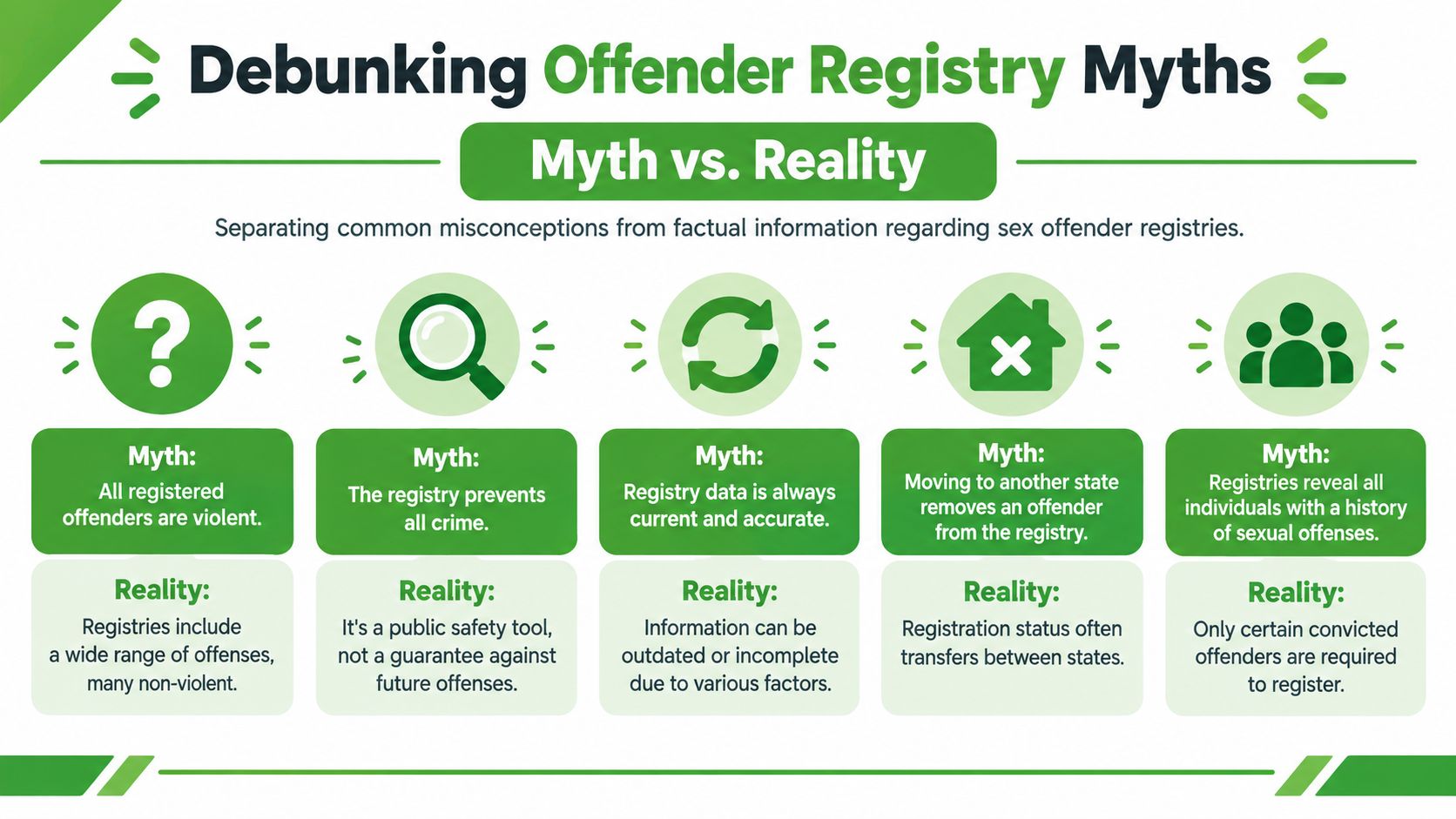
Registry data helps organizations identify records that deserve attention, but it doesn't answer every question about risk. Misreading the data can produce two kinds of harm: a nonprofit may overlook a relevant record because it relies on an incomplete search, or it may unfairly exclude a person based on an unverified match or a broad assumption.
Myth one, a high per-capita rate means the state is inherently more dangerous
Reality: The rate measures registered people relative to population. It can also reflect differences in registration law, enforcement, mobility, and population structure, as documented in the earlier registry analysis. The ranking identifies a concentration in the registry, not a complete measure of danger in every neighborhood or program setting.
Myth two, every registered person presents the same risk
Reality: Registries contain people with different offense histories and legal circumstances. A nonprofit should review the specific record, the role, the timing and disposition of the case, and any applicable law or policy instead of treating every listing as identical.
Myth three, a public registry search is enough
Reality: Public registry information can be incomplete, outdated, or difficult to match confidently. It may not establish identity or provide the full court context needed for a fair decision. A formal screening process should verify potential matches and follow FCRA procedures where a consumer report is used.
Myth four, the current state is the only state that matters
Reality: Applicants move. A current address doesn't necessarily capture prior jurisdictions, and a state ranking can't reveal where an applicant previously lived or worked. Address history and nationwide coverage reduce the risk of a narrow search.
Myth five, a registry guarantees public safety
Reality: A registry is a public safety and information tool, not a guarantee that all offenses will be prevented or that every relevant person will appear in it. A nonprofit still needs supervision, boundaries, reporting procedures, two-adult practices where appropriate, and training for staff and volunteers.
A fair process asks two separate questions: What information is relevant to this role, and has the organization verified that the information belongs to this applicant?
Frequently Asked Questions for Nonprofits
Should our policy be different for volunteers from high-rate states?
No. The policy shouldn't impose a different presumption or automatic exclusion based on state residence. Instead, use the state ranking as a reminder to apply nationwide screening consistently, especially when volunteers have lived, worked, or studied in multiple jurisdictions.
Role-based standards are more defensible than geography-based assumptions. The organization can require additional review for positions involving unsupervised access to vulnerable people, but it should apply that requirement to everyone in the same role.
How reliable are online public registries for formal screening?
Public registries are useful sources for awareness and preliminary research, but they shouldn't be treated as a complete formal screening process. Records can be incomplete, outdated, or difficult to match to a specific person without additional identifiers and court verification.
A nonprofit should document which sources it searches, how it resolves possible matches, and how it handles conflicting information. If the organization relies on a consumer report, it should also confirm that its disclosure, authorization, review, and adverse-action procedures meet FCRA requirements.
What should we do when a registry search produces a possible match?
Pause the decision and verify the record. Compare identifiers, obtain the underlying disposition where available, and give the applicant the opportunity to explain or dispute inaccurate information before taking adverse action.
Don't communicate an unverified allegation to program staff, participants, or the public. Limit access to authorized decision-makers and protect the applicant's privacy throughout the review.
Does a national check replace local court research?
Not necessarily. A national search can help identify leads across jurisdictions, but potential records may still require verification through county or state court sources. The organization's provider and policy should explain how searches are conducted, what records are verified, and what happens when a record can't be confirmed.
How should a nonprofit document its screening policy?
Write the policy before the next applicant applies. Define covered roles, required searches, consent language, individualized review criteria, decision authority, dispute handling, confidentiality, retention, and periodic policy review. Train volunteer managers to follow the same process rather than making informal exceptions.
For a nonprofit, the most useful answer to “what state has the most sex offenders per capita” is not a state-based exclusion rule. It's a stronger reason to use broad, verified searches and fair decision procedures.
VolunteerBadge provides nonprofit-focused, FCRA-compliant volunteer background screening that includes national criminal searches and sex-offender registry checks across all 50 states. Visit VolunteerBadge to review how your organization can build a consistent screening workflow for volunteers who serve vulnerable populations.
