
FCRA Notice Requirements Guide for Nonprofits
Master FCRA notice requirements for volunteer screening with templates, timing rules, and compliance checklists to keep your nonprofit audit-ready.
On this page
A volunteer coordinator receives a background screening result that raises a concern. The program director says, “Let's decline the application today.” The coordinator sends a short email, forgets to attach the report and Summary of Rights, and never records when the volunteer had an opportunity to respond. The organization may have made a reasonable safety decision, but it handled the FCRA notice requirements poorly.
That distinction matters. The Fair Credit Reporting Act doesn't prohibit a nonprofit from making an adverse decision based on a consumer report. It requires the organization to follow a transparent process so the individual can understand what information was used and challenge inaccurate or incomplete records. This guide is written as a lookup reference for volunteer coordinators, church administrators, youth program directors, and other nonprofit staff who need a workable process rather than a law-school outline.
Use the headings to jump to the stage you're handling. The main workflow has four points: disclosure and authorization before a report is obtained, pre-adverse action before a negative decision is finalized, final adverse action after the decision, and risk-based or score-related notices when those rules apply. A nonprofit that uses a consumer reporting agency is generally the “user” of the consumer report, even when a vendor performs the search and supplies the result.
Practical rule: A background check result can inform a decision, but it doesn't replace the notice process. Keep the safety review and the compliance workflow connected, but don't treat them as the same task.
Table of Contents
- Introduction to FCRA Notice Requirements for Volunteer Screening
- Complete Categories of FCRA Notices You Must Know
- Disclosure and Authorization Notices Before You Run a Check
- Pre-Adverse and Final Adverse Action Notices Step by Step
- Required Content for Every FCRA Notice Compared
- Sample Language and Templates for Nonprofit Compliance
- Timing Delivery Methods and State Variations Explained
- Quick Reference Checklists Cross References and Troubleshooting
Introduction to FCRA Notice Requirements for Volunteer Screening
A seasonal program starts in two weeks, a coach needs clearance, and a new volunteer is waiting to serve. The coordinator orders a background report, sees a concerning record, and sends a quick rejection email. The report and required rights information never reach the volunteer, and no one records when the person could respond. The safety concern may be legitimate, but the organization has not shown a fair, traceable notice process.
The FCRA's core adverse-action notice rule dates to 1970. The FTC explains that when a consumer report user takes adverse action for credit, insurance, or employment reasons, the consumer must receive notice and specific information about the reporting agency, its role, and the consumer's dispute rights. That consumer-report framework also matters in volunteer screening when a nonprofit uses report information to decide whether someone may participate. The federal baseline is summarized in the FTC's FCRA notice guidance.
For a volunteer program, “adverse action” may include declining an applicant, removing someone from consideration, or restricting participation because of information in a consumer report. The organization's internal label does not determine the process. If the report contributed to a negative decision, pause the decision record and check whether both the pre-adverse and final adverse stages apply.
The reference map
Use disclosure and authorization before ordering a report. If the report could support a negative decision, follow the pre-adverse and final workflow. Confirm each required field with the notice content comparison, then adapt the sample templates rather than drafting from memory.
“Consumer” here means the individual who is the subject of the report, not necessarily a borrower. The consumer reporting agency supplies information. The nonprofit decides whether the volunteer may serve. The final notice should make that separation clear.
A missed notice can prevent a volunteer from correcting mistaken identity information, outdated records, or an incomplete account. It can also leave the nonprofit unable to show that coordinators applied the same process across applicants. Keep the notice event, delivery method, report, response opportunity, and decision date together in one screening record. That simple control protects the program while giving applicants a meaningful chance to address inaccurate information.
Complete Categories of FCRA Notices You Must Know
The easiest way to identify the right notice is to locate the volunteer's position in the screening lifecycle. Don't begin with a letter template. Begin with the event that occurred, then match that event to the notice category.
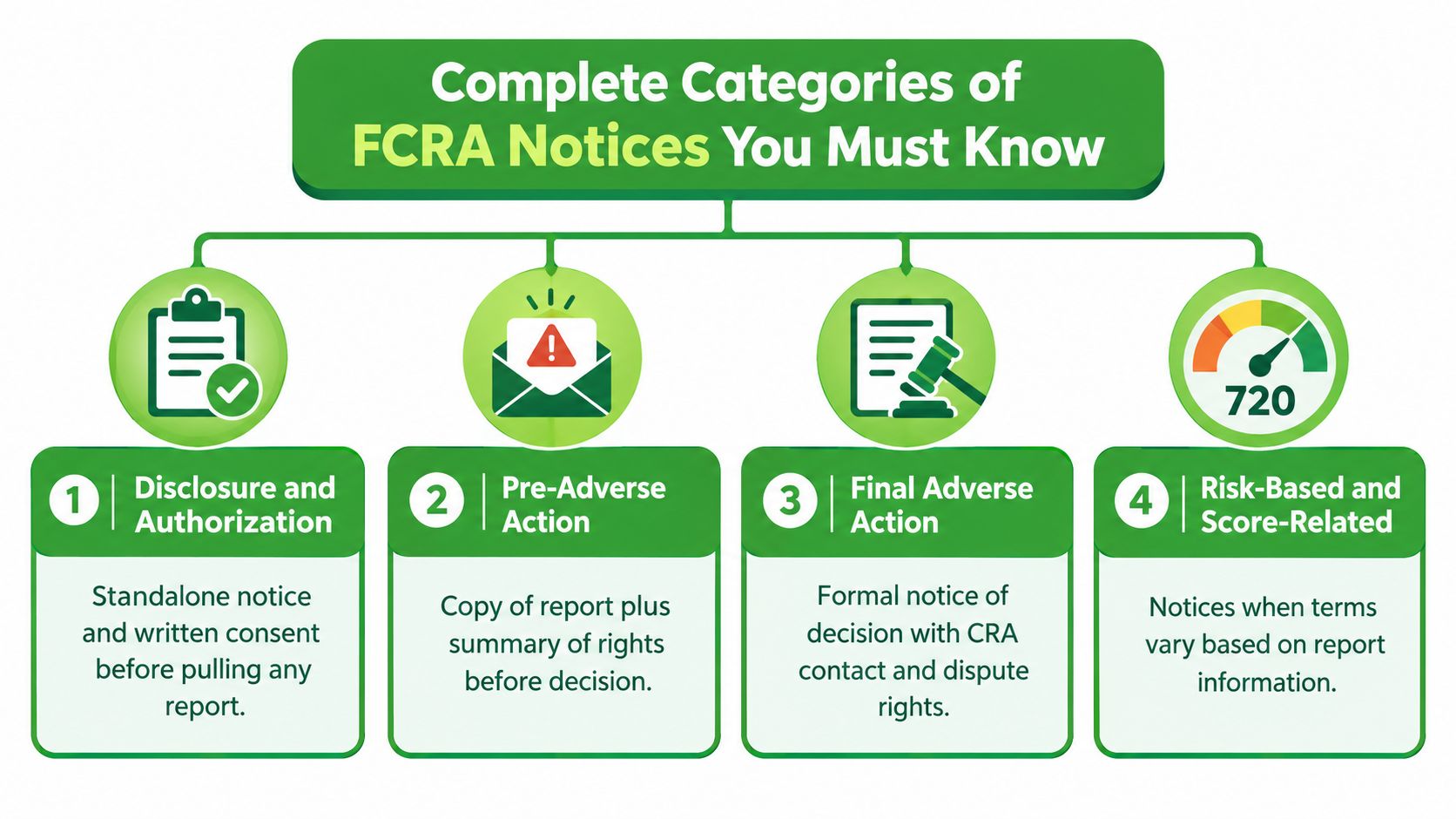
Disclosure and authorization
This is the gateway notice. Before the nonprofit obtains a consumer report, it must give the volunteer a clear disclosure that a report may be obtained and obtain the individual's written authorization. The disclosure should stand on its own rather than being buried inside the volunteer application, waiver, code of conduct, or liability release.
Trigger: the organization plans to obtain a consumer report.
Audience: the volunteer who will be screened.
Operational question: Can the coordinator show the exact disclosure presented and the authorization captured before the report request?
This stage is covered in detail under Disclosure and Authorization Notices Before You Run a Check.
Pre-adverse action
A pre-adverse notice is a warning that the nonprofit is considering a negative decision based in whole or in part on the report. It isn't the final decision. The package should include a copy of the consumer report and a written copy of the consumer's rights.
Trigger: the report may contribute to adverse action.
Audience: the volunteer who is the subject of the report.
Operational question: Has the volunteer received the report and rights summary before the organization finalizes or implements the decision?
Final adverse action
The final notice confirms that the nonprofit has taken adverse action after reviewing any response. The notice can be delivered orally, in writing, or electronically under the federal baseline described by the CFPB, but the organization should choose a channel that leaves reliable evidence of delivery.
Trigger: the adverse decision is final and report information contributed to it.
Audience: the affected volunteer.
Operational question: Does the notice identify the reporting agency and explain the agency's limited role and the volunteer's dispute rights?
Risk-based and score-related notices
Risk-based notices are most familiar in credit decisions, but they belong in the taxonomy because a report-based decision can trigger additional disclosures when terms vary or a credit score is used. FTC materials describe score-related content that can include the numerical score, score range, key adverse factors, score creation date, and score provider. Review the FTC consumer-report guidance for adverse-action and risk-based notices before adapting a general template to a decision that involves credit-score information.
For ordinary volunteer criminal or public-record screening, the first three categories are usually the practical focus. Don't add score language merely because it appears in a generic template. Use the notice that matches the report and decision.
Disclosure and Authorization Notices Before You Run a Check
The first document should answer one plain question: Will this organization obtain a consumer report about me for volunteer screening? It shouldn't make the volunteer hunt through an application packet to find the answer.
The disclosure must be clear and conspicuous and presented as a standalone document. In practical terms, keep it separate from the volunteer application, liability waiver, dispute-resolution provision, confidentiality promise, or unrelated acknowledgment. A signature block can authorize the report, but it shouldn't turn the disclosure into a multi-purpose contract.
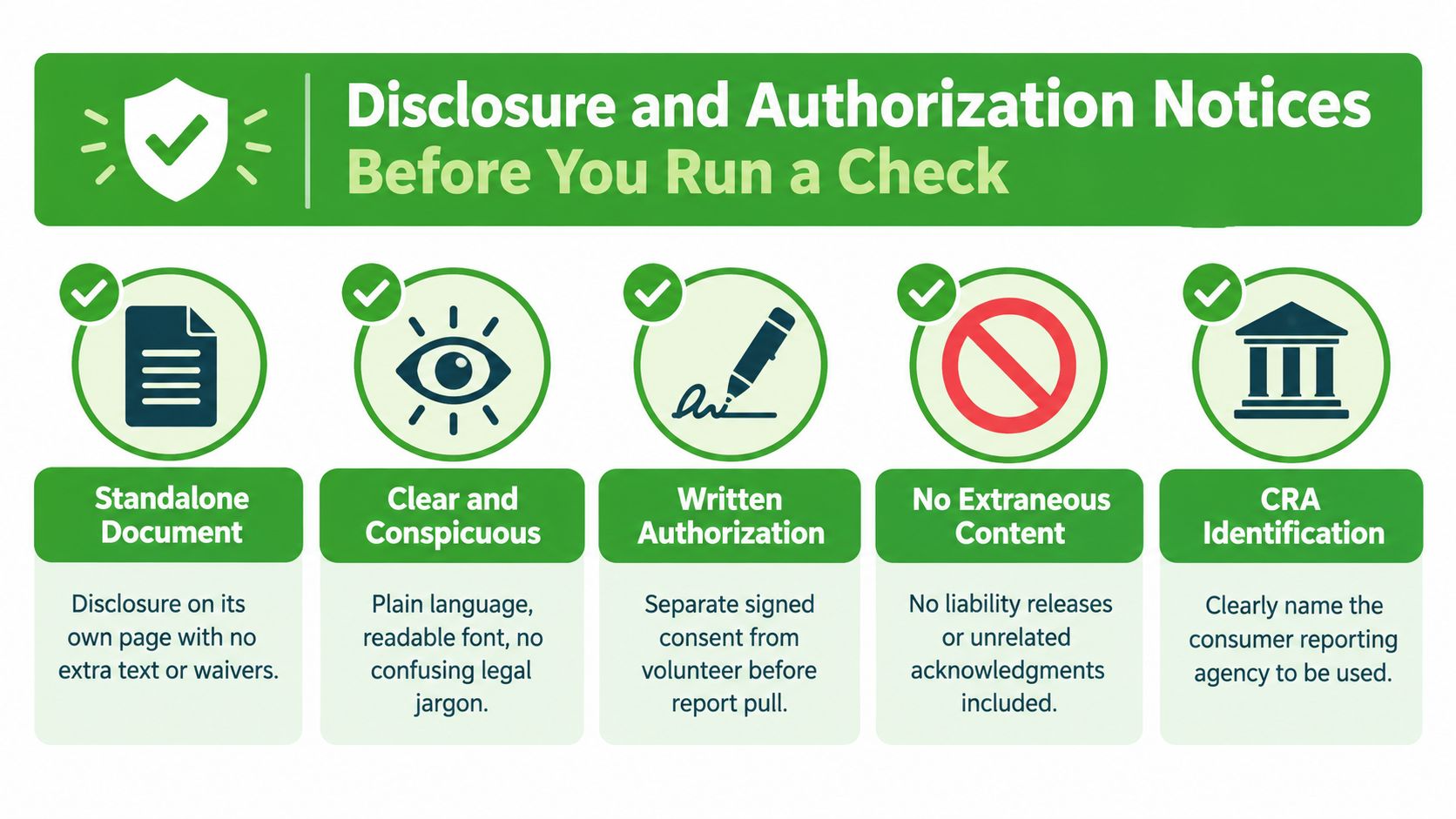
Build the document around five controls
- Standalone document: Give the FCRA disclosure its own page or clearly separated digital screen.
- Plain language: Tell the volunteer that the nonprofit may obtain a consumer report for volunteer-screening purposes.
- Written authorization: Capture a clear signature or electronic consent before ordering the report.
- No extraneous terms: Don't attach a liability release, waiver, or unrelated promise to the disclosure.
- Identifiable screening party: Name the consumer reporting agency or otherwise provide the required identifying information used in the screening process.
A compliant nonprofit statement might read:
Volunteer background-screening disclosure
[Organization name] may obtain a consumer report about you for volunteer-screening purposes. The report may be used to evaluate your eligibility to participate in [program or activity].Authorization
I authorize [Organization name] to obtain a consumer report about me for volunteer-screening purposes. I understand that the report may be used in evaluating my volunteer application or continued participation.Name: ____________________
Signature: ____________________
Date: ____________________
That sample is intentionally narrow. Your legal reviewer or screening provider should confirm whether additional disclosures are needed for the specific report, jurisdiction, or program. The key drafting discipline is to avoid turning the FCRA disclosure into a general-purpose consent form.
A weak version says, “By applying, I agree to all policies, release the organization from liability, consent to any investigation, and waive claims.” It combines unrelated terms, obscures the report disclosure, and makes it harder to prove that the volunteer gave informed authorization.
Preserve the evidence
Save the version shown to the volunteer, the completed authorization, the date and time of consent, and the identity of the person or system that initiated the report. Electronic consent can work when the system records the action and allows the volunteer to retain a copy. A screenshot alone may not show the full transaction, so retain the actual document or a reliable audit record.
For a practical companion document, use this nonprofit FCRA disclosure and authorization form guide. Treat any vendor-generated form as a starting point, not an excuse to stop reviewing the workflow.
Pre-Adverse and Final Adverse Action Notices Step by Step
The adverse-action process has two distinct decisions: the organization's preliminary decision to consider a negative outcome, and the final decision after the volunteer has a meaningful opportunity to respond. The CFPB's FCRA procedures describe this employment-related two-step workflow, including the report and written rights summary before the decision and a separate notice after the decision is final.
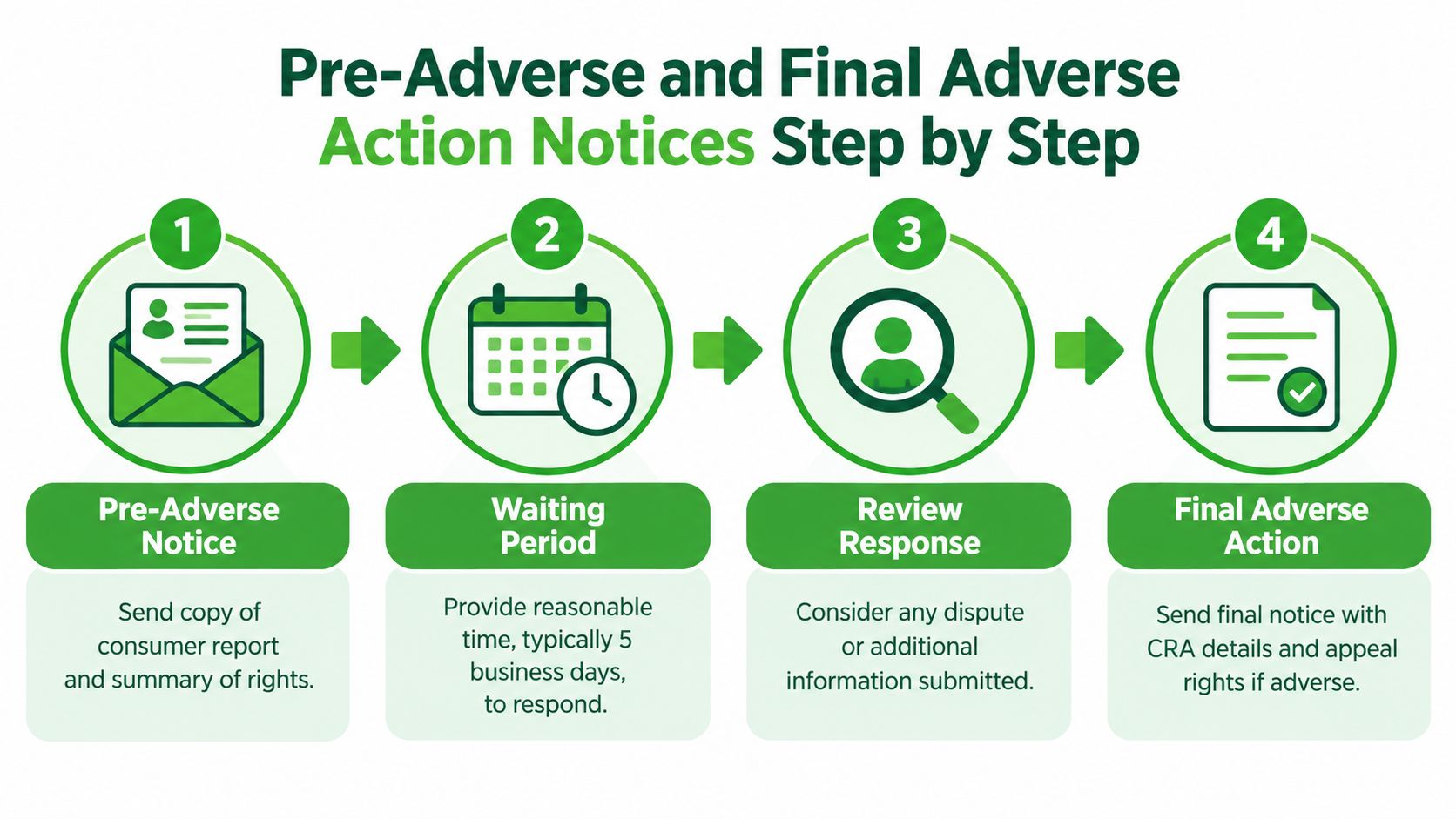
Step one, pause before finalizing
When the report contains information that may affect eligibility, the coordinator should not send a rejection first and investigate the notice requirement later. Mark the file as pending review and assemble:
- A pre-adverse notice stating that the nonprofit is considering adverse action.
- A complete copy of the consumer report used in the review.
- The applicable Summary of Rights.
- Clear instructions for reporting an error or supplying relevant information.
- A delivery record showing when the package was sent.
The pre-adverse package gives the volunteer a chance to identify inaccurate or incomplete information. It also gives the nonprofit a chance to correct a mistaken identity, review a disputed record, or reconsider a decision that relied on information the volunteer can explain.
The law requires a reasonable opportunity to respond, but the federal materials supplied here don't establish a universal waiting period for every volunteer program. Don't hard-code a short pause because it fits a software workflow. Establish a written organizational policy, account for applicable state or local requirements, and make sure the volunteer receives the package before the final decision is implemented.
Step two, review and document
During the pause, record whether the volunteer responded, disputed the report, supplied documents, or requested clarification. Route disputes through the appropriate consumer reporting agency process, and don't let an automated status change finalize the decision while the review remains open.
A coordinator should be able to answer four audit questions:
- When did the organization decide that adverse action was being considered?
- When did the volunteer receive the report and Summary of Rights?
- What response, if any, did the volunteer provide?
- Who approved the final decision, and when?
The pause is part of the compliance control. It shouldn't be treated as dead time between two automatically generated emails.
Step three, send the final notice only after the decision
If the nonprofit proceeds with adverse action, send a separate final notice. The federal baseline allows oral, written, or electronic delivery, but written or electronic delivery is usually easier for a small nonprofit to prove later. The final notice must identify the consumer reporting agency, explain that the agency didn't make the decision and can't provide the specific reasons for it, and describe the volunteer's dispute and free-report rights.
The final notice isn't the same as the pre-adverse letter with a new subject line. It marks a separate event. Keep both records, preserve the report version used in the review, and ensure the final notice is sent after the organization has considered any timely response.
Required Content for Every FCRA Notice Compared
Templates fail in predictable ways. A coordinator copies the agency phone number but omits the address, includes the report but not the rights summary, or tells the volunteer to contact the nonprofit for reasons that only the decision-maker can explain. A side-by-side check helps separate what belongs before the report from what belongs after an adverse decision.
The FTC describes standardized final-notice content, including the reporting agency's name, address, and telephone number, a toll-free number for nationwide agencies, the agency's non-decision statement, and the volunteer's dispute and free-report rights. The comparison below is a practical control, not a substitute for reviewing the applicable law and program facts.
FCRA Notice Content Requirements at a Glance
| Required Field | Disclosure and Authorization | Pre-Adverse Package | Final Adverse Notice |
|---|---|---|---|
| Purpose of screening | Explain that a consumer report may be obtained for volunteer screening | State that the report is being considered in the decision | State that adverse action was taken and that the report contributed to the decision |
| Volunteer authorization | Obtain clear written or electronic authorization before the report is pulled | Not a replacement for the original authorization | Not required as a new consent event |
| Consumer report | Not yet obtained or attached | Attach the report relied on | Identify the report-based basis without treating the agency as the decision-maker |
| Summary of Rights | Not generally the adverse-action package | Include the written rights summary | Explain dispute rights and the right to request an additional free report |
| CRA name | Identify the agency used, consistent with the screening process | Identify the agency connected to the attached report | Required |
| CRA address and phone | Include as appropriate to the disclosure and vendor workflow | Include for clear routing of questions and disputes | Required, including a toll-free number for nationwide agencies |
| Agency role | Explain the screening purpose | Make clear that the agency supplied information for review | State that the agency didn't make the decision and can't give specific reasons |
| Dispute right | Tell the volunteer how authorization and screening work | Give the volunteer a practical route to dispute inaccurate or incomplete information | State the right to dispute inaccurate or incomplete information |
| Free report deadline | Not the adverse-action deadline | May be explained as part of the rights materials | State the right to request an additional free report within 60 days, as described by the FTC |
| Score information | Not applicable unless a score is being used | Include only when the relevant score rules apply | Include the numerical score, range, key adverse factors, creation date, and provider when required and applicable |
The final notice should identify the exact agency that supplied the report used in the decision. Don't substitute the nonprofit's address, a platform's general support address, or a different vendor's contact information.
Keep the table beside the template in your internal procedure. The coordinator who sends the notice should be able to check every field without interpreting a long legal memo.
Sample Language and Templates for Nonprofit Compliance
A useful template makes the next action clear without assuming every volunteer program follows identical requirements. Replace bracketed fields, confirm the reporting agency's current contact information, and have counsel review language used across multiple jurisdictions.
Use the disclosure, pre-adverse, and final adverse forms as one workflow. Record which report supported the decision, which agency supplied it, what was sent, and when delivery occurred. The final notice must name the exact consumer reporting agency behind the report, not the nonprofit, a platform's general support address, or another vendor.
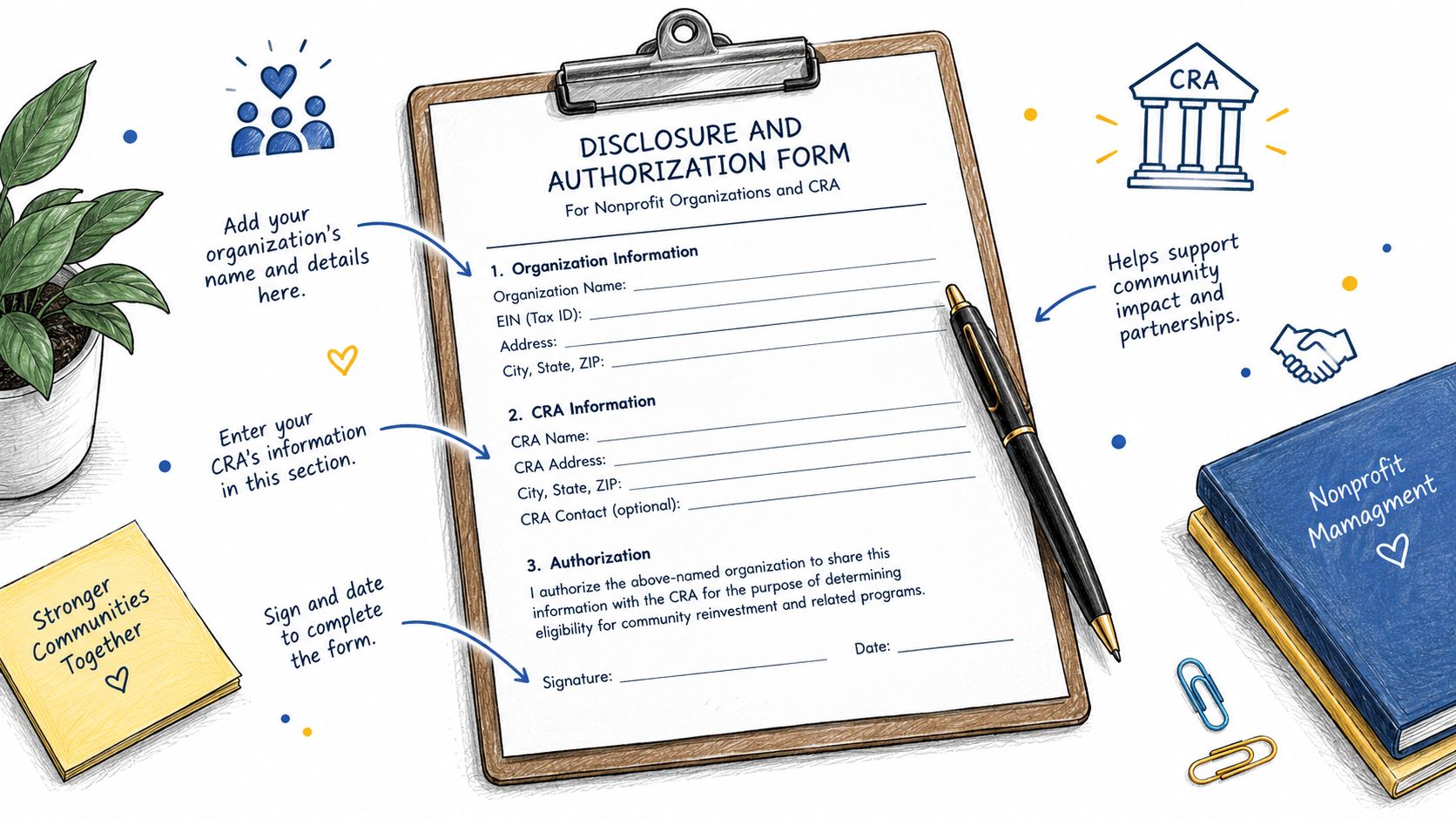
Standalone disclosure and authorization
Volunteer background-check disclosure and authorization
[Organization name] may obtain a consumer report about you for volunteer-screening purposes. The report may be used to evaluate your application or continued participation in [program name].I authorize [Organization name] to obtain a consumer report about me for these volunteer-screening purposes. I confirm that the information I provide for screening is accurate to the best of my knowledge.
Volunteer name: [Full name]
Signature or electronic authorization: [Authorization record]
Date: [Date]
Keep this form focused. A liability release, employment certification, or broad waiver can distract from the disclosure and authorization instead of improving it.
Pre-adverse notice
Subject: Background screening review
[Volunteer name], [Organization name] is considering an adverse decision regarding your volunteer application or participation based in whole or in part on information in the enclosed consumer report. No final decision has been made.Enclosed are a copy of the consumer report and the Summary of Rights. If you believe the report contains inaccurate or incomplete information, you may dispute it with [CRA name] using the contact information below. You may also provide relevant information to [organization contact].
Consumer reporting agency: [CRA name]
Address: [CRA address]
Telephone: [CRA phone]Please review the enclosed materials and respond through [secure response method].
Before sending, confirm that the report and written rights information are included, the response route works, and the coordinator can identify the notice in the case file.
Final adverse-action notice
Subject: Final volunteer screening decision
[Volunteer name], [Organization name] has decided not to approve [your volunteer application / your participation in program name]. This decision was based in whole or in part on information in a consumer report supplied by [CRA name].[CRA name] didn't make this decision and can't provide the specific reasons for it. You have the right to dispute with [CRA name] any information in the report that you believe is inaccurate or incomplete. You also have the right to request an additional free copy of your report from [CRA name] within 60 days of receiving this notice.
[CRA name]
[Address]
[Telephone]
[Toll-free telephone number, if applicable]
Use this adverse-action notice template for nonprofits as a drafting reference. Then compare the completed notice with the actual report, named agency, decision, and delivery record. Keep the comparison table beside the template in the internal procedure, so the sender can check each field without interpreting a lengthy legal memo.
Timing Delivery Methods and State Variations Explained
Federal delivery flexibility doesn't eliminate process discipline. CFPB guidance says a final adverse-action notice may be oral, written, or electronic. The pre-adverse package, however, must contain the report and written rights information before the final decision. For most nonprofit teams, written or electronic delivery is easier to audit than an oral conversation.
Choose the channel using three questions:
- Can the volunteer access it securely? Don't send sensitive screening information to an unverified address or expose it in a shared inbox.
- Can the organization prove delivery? Preserve the sent record, timestamp, recipient, attachments, and any electronic acknowledgment.
- Does the channel satisfy other applicable rules? State and local laws may impose stricter requirements than the federal baseline.
Electronic delivery works best when the volunteer has consented to electronic communications where required, can access the documents, and can retain or download them. Paper delivery may be preferable for applicants who lack reliable digital access. An oral final notice can be legally available under the federal framework, but it creates a heavier documentation burden, especially when the volunteer later asks what was said and when.
State variations deserve their own review. Some jurisdictions regulate background-check notices, timing, permissible uses, individualized assessment, or the treatment of particular records. A national nonprofit shouldn't assume that one federal template works everywhere. Maintain a jurisdiction matrix that identifies the program location, screening purpose, report type, required notices, delivery channel, and any local review step.
Score-related rules also require care. Post-2008 amendments expanded notice obligations when a credit score is used, including possible disclosure of the numerical score, score range, key adverse factors, date created, and score provider. The Consumer Compliance Outlook materials also describe the consumer's 60-day period to request a free report after adverse action.
Delivery decision: Use the channel that protects privacy and leaves the clearest record. Flexibility is permission to choose, not permission to document less.
Quick Reference Checklists Cross References and Troubleshooting
Use this page during live screening. If a box is missing, pause the workflow instead of trying to repair the record after the decision.
Before requesting a report
- Standalone disclosure: Confirm the volunteer saw a separate FCRA disclosure.
- Clear purpose: Confirm the document identifies volunteer screening as the purpose.
- Authorization captured: Verify written or electronic consent came before the report request.
- Version preserved: Save the exact disclosure and authorization presented.
- Identity matched: Confirm the report belongs to the correct volunteer before review.
Before finalizing adverse action
- Decision status: Mark the file as considering adverse action, not final.
- Report attached: Send the report used in the review.
- Rights summary included: Attach the written Summary of Rights.
- Pause recorded: Log delivery and the organization's response window.
- Response reviewed: Record disputes, corrections, and additional information.
- Final notice checked: Confirm the agency name, address, phone, non-decision statement, dispute right, and free-report language.
For document retention and an audit trail, use this compliance documentation guide. It's especially useful when several staff members share screening duties or when a volunteer coordinator changes mid-season.
Fixes for common failures
Missed disclosure: Don't order the report and hope a later consent cures the problem. Stop, document what happened, and obtain qualified compliance advice about whether the screening can proceed.
Bundled notices: Don't send the pre-adverse and final notices together. The volunteer must receive the report and rights summary before the final decision, and the organization should preserve an auditable pause.
Incomplete CRA details: Pull the agency's current legal name, address, telephone number, and applicable toll-free number from the report or approved compliance record. Don't rely on a staff member's memory.
Unclear result: A record match isn't automatically a final eligibility decision. Verify identity, review the report carefully, and give the volunteer the required opportunity to dispute before concluding the process.
VolunteerBadge provides nonprofit screening workflows with digital disclosure and authorization, report delivery, and automated pre-adverse and final adverse-action notices when needed. Visit VolunteerBadge to review a screening option designed to help volunteer coordinators keep the report, rights materials, timing pause, and final notice connected in one process.
