
Sex Offender Registry National Search Guide for Nonprofits
Is there a single sex offender registry national database? Learn how state registries, NSOPW and FBI systems work and how to screen volunteers effectively.
On this page
There isn't one single public national sex offender registry that serves as the one authoritative database for everyone. What the public can use is the Dru Sjodin National Sex Offender Public Website, which pulls together registry data from all 50 states, the District of Columbia, U.S. territories, and 150+ tribal jurisdictions, while the FBI's National Sex Offender Registry remains restricted to law enforcement.
That gap trips people up all the time. A volunteer coordinator hears “national registry,” opens one website, runs one search, and assumes the answer is complete. Then a hard question follows: if the search comes back clear, is the person clear?
Usually, that's the wrong question.
For nonprofits, churches, youth leagues, and schools, the issue isn't whether a site looks nationwide. It's whether your screening process is reliable enough to support a safe, consistent, and compliant decision. A public nationwide portal can be useful. It can also create false confidence if you treat it like a perfect master file.
The confusion starts with language. “National” sounds like one database, one standard, one answer. The system doesn't work that way. It works more like a network of separate state and jurisdiction records that are shared upward, displayed differently, and accessed through different channels depending on who you are.
That distinction matters when you screen volunteers. If your process stops at one public search, you may miss identity issues, alias issues, address history gaps, or records that haven't flowed cleanly through every layer yet. If your process uses registry checks as one layer among several, the same search becomes much more useful.
Table of Contents
- Introduction Why National Registry Searches Confuse Everyone
- How State Registries Became the Foundation of the System
- Understanding the Two National Layers and How They Differ
- What Registries Can and Cannot Tell You About Risk
- How to Search Effectively Across Jurisdictions
- Real World Examples for Volunteer Screening Programs
- Building a Compliant and Complete Screening Approach
Introduction Why National Registry Searches Confuse Everyone
The image of a giant federal file cabinet often comes to mind. There is an assumption that a national sex offender registry means one central list, maintained in one place, with one final answer. That mental model feels sensible, but it doesn't match how the system operates.
The public side is a federated search tool. In plain language, that means one website gathers information from many different jurisdictions rather than acting as the original home of every record. The law-enforcement side is different again. So when a nonprofit says it ran a “national” registry search, that phrase can mean less than the team realizes.
Why the word national creates false certainty
A public search can cover a lot of ground and still not be the same thing as an authoritative national database. States and other jurisdictions create and maintain their own records. Federal systems coordinate access and standards, but they don't erase local differences in timing, completeness, or disclosure.
Think about airline booking sites. One site may show flights from many carriers, but that doesn't make the booking site the airport's control tower. It's useful, broad, and convenient. It still depends on what each carrier provides.
Practical rule: If a registry search feels simple, your follow-up process needs to do the hard part.
That's especially important for volunteer screening. A youth sports league, an after-school tutoring program, or a church nursery team may want a yes-or-no safety signal. Registries don't give that. They give one type of record check.
Where volunteer coordinators usually get stuck
Confusion tends to show up in three places:
- Search scope: Staff may think “national” means every possible record everywhere.
- Search identity: A name-only match can be misleading when applicants have common names, aliases, or prior addresses in multiple states.
- Decision weight: Teams may treat a clear registry result as proof of low risk, even though it isn't designed to predict future behavior.
A registry result is a flagging tool, not a full risk decision.
That's why experienced coordinators build a process instead of relying on a portal. The portal is only the first layer.
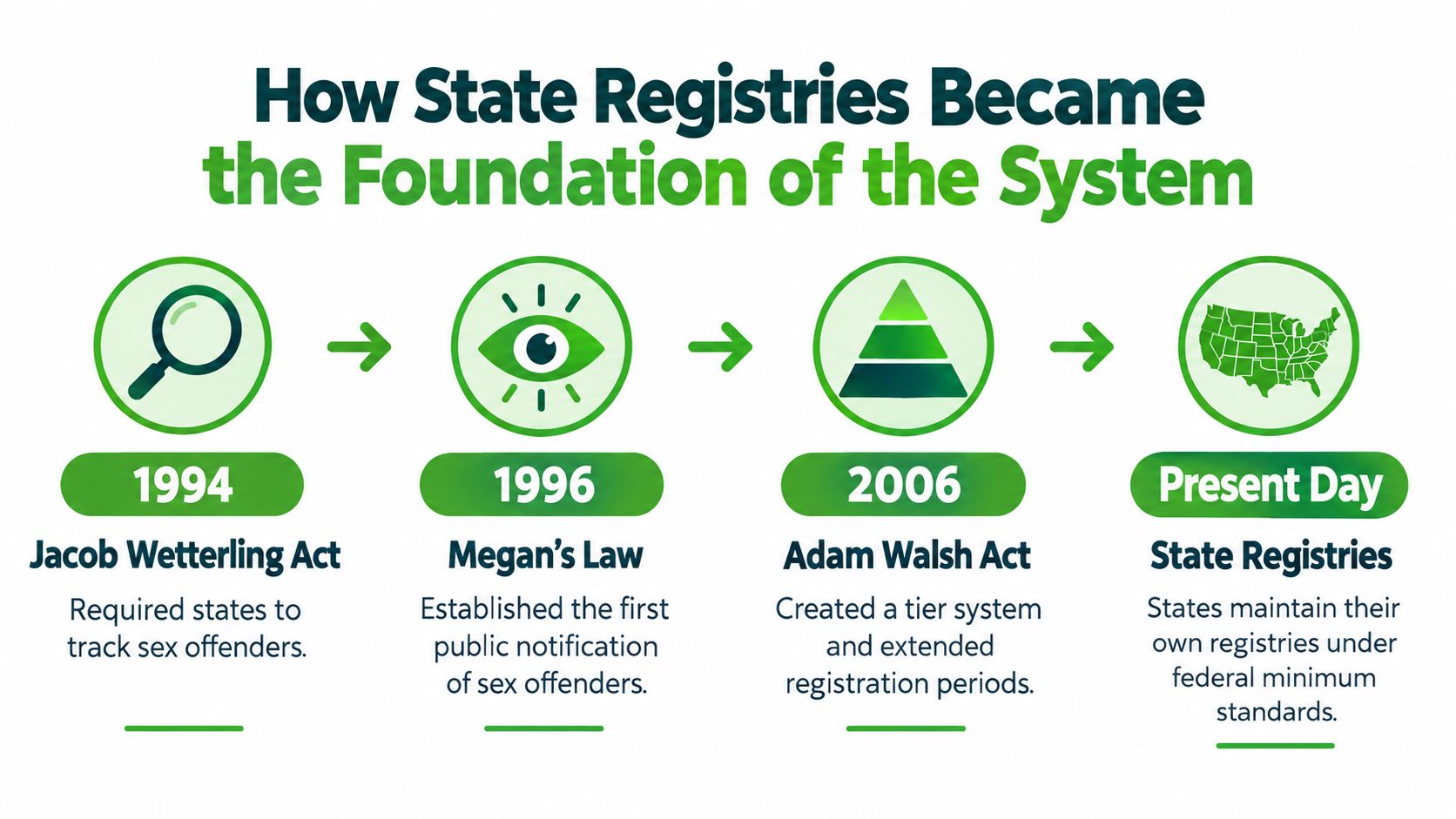
How State Registries Became the Foundation of the System
The system started with states, not with one all-knowing federal database. Federal law created standards and pushed jurisdictions to register and share information, but the underlying records still come from state and local structures.
According to the SMART Office legislative history of SORNA and earlier federal laws, the modern U.S. framework began in 1994 with the Jacob Wetterling Act, which created the first federal standards for registration and notification. Before that year, there was no federal law governing sex offender registration in the United States. The system expanded in 1996 through the Pam Lychner Sexual Offender Tracking and Identification Act, which established the National Sex Offender Registry as a law-enforcement-only FBI database, and it was revised again in 2006 by SORNA. That same legislative history notes that by 2003, 50 states, the District of Columbia, and 3 territories had contributed all then-applicable records, totaling over 300,000 records, to the NSOR.
A better analogy than one giant database
Think of the system like independent libraries feeding a shared catalog.
Each library owns its own books, updates its own shelves, and follows some shared cataloging rules. A statewide or national catalog can help you search across many libraries. But the catalog only works as well as each library's entries, timing, and local rules.
That's how a sex offender registry national search makes more sense. The states are the libraries. The larger systems are the catalog layers.
What this means for nonprofit screening
If state registries are the foundation, your workflow should reflect that fact.
- Start broad: A national public portal helps you cast a wide net.
- Validate locally: State registry pages may show details or limitations that matter for confirmation.
- Expect variation: Different jurisdictions may present data differently, hide some fields, or update on different schedules.
If you need a plain-language overview of how obligations differ across jurisdictions, this guide to sex offender registration requirements can help frame the issue for volunteer policy teams.
Why federal standards didn't erase local differences
Federal laws pushed coordination. They didn't turn every jurisdiction into one uniform system. States still handle their own registration administration, and that affects what the public can search and how quickly records appear across systems.
For volunteer coordinators, that means consistency has to come from your process, not from assuming the government's system is presented the same way everywhere.
Understanding the Two National Layers and How They Differ
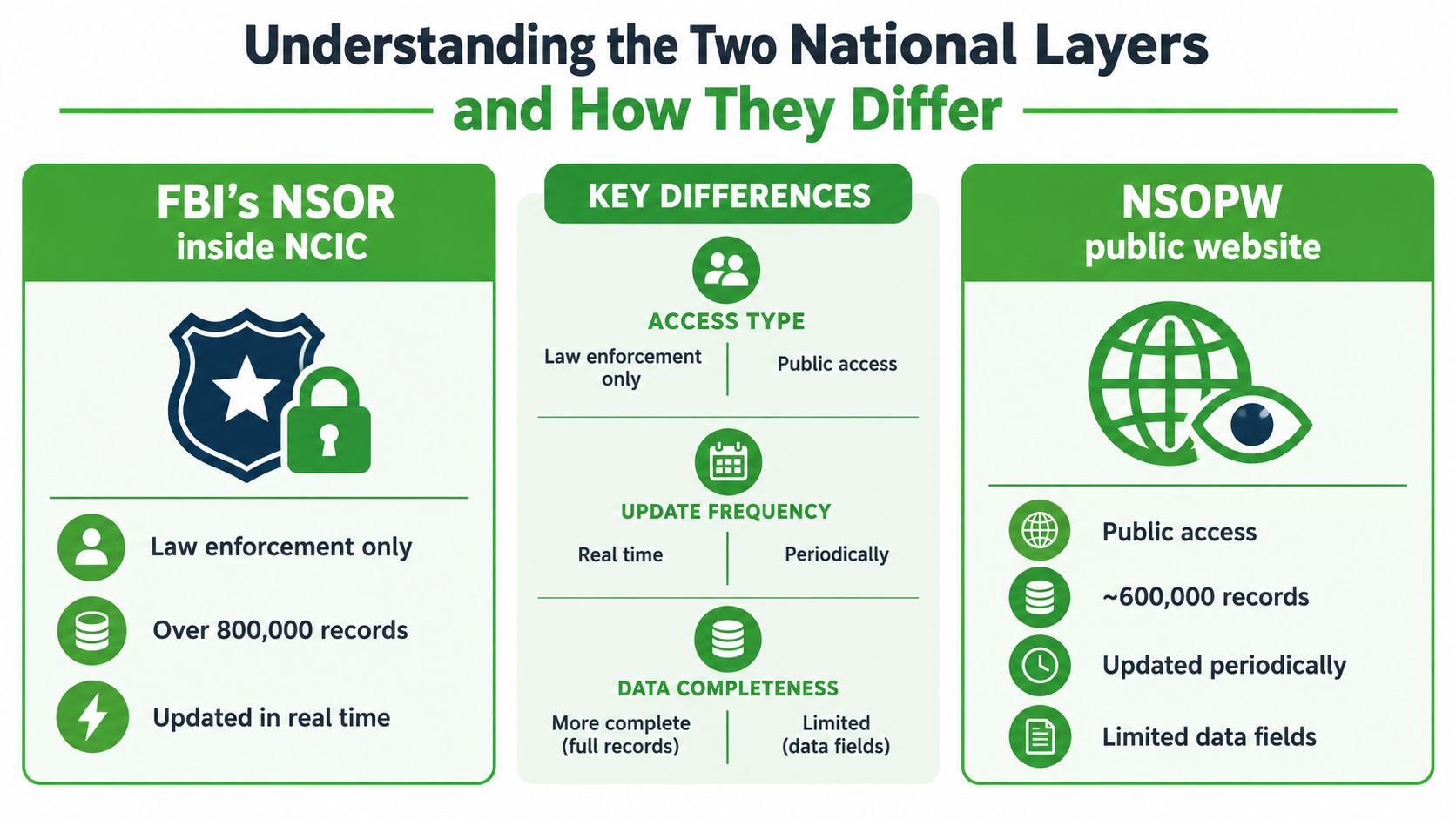
When people say “national registry,” they usually blend two separate layers into one. That's the root of the misunderstanding.
The FBI explains that the national architecture is split between the National Sex Offender Registry inside NCIC, which is for law enforcement, and the Dru Sjodin National Sex Offender Public Website, which is the public-facing search layer that federates data from jurisdictions across the country. The FBI also notes that the public site is not the underlying law-enforcement data store, and that data quality depends on the completeness and freshness of jurisdictional submissions. You can review that structure on the FBI's sex offender registry overview.
Side by side comparison
| Layer | Who can use it | What it does |
|---|---|---|
| FBI NSOR in NCIC | Criminal justice users | Supports law-enforcement access to registry data |
| NSOPW public website | General public | Lets users search aggregated registry information from participating jurisdictions |
That comparison changes how you should talk about results internally. A staff member who says, “I checked the national registry,” may have used only the public aggregation layer.
Why the public website still matters
This doesn't make NSOPW unhelpful. It makes it context-specific.
For nonprofits, the public site is often the fastest broad first pass. It can reveal whether a name and location appear in publicly available registry data across multiple jurisdictions. That's valuable when screening applicants who may have moved.
If your team also uses larger screening packages, it helps to understand where a registry search fits inside a broader national crime database search. A registry hit and a criminal-record hit are related, but they are not the same thing.
The public layer helps you search widely. It doesn't convert a multi-jurisdiction system into one perfect answer.
The operational lesson for volunteer programs
Don't write internal policy as if the public portal is the final authority. Write it as a screening component that triggers follow-up.
That one shift changes everything. Instead of asking, “Did the national site clear them?” ask, “Did the national site reveal anything that needs identity verification, state-level review, or court-level confirmation?”
What Registries Can and Cannot Tell You About Risk
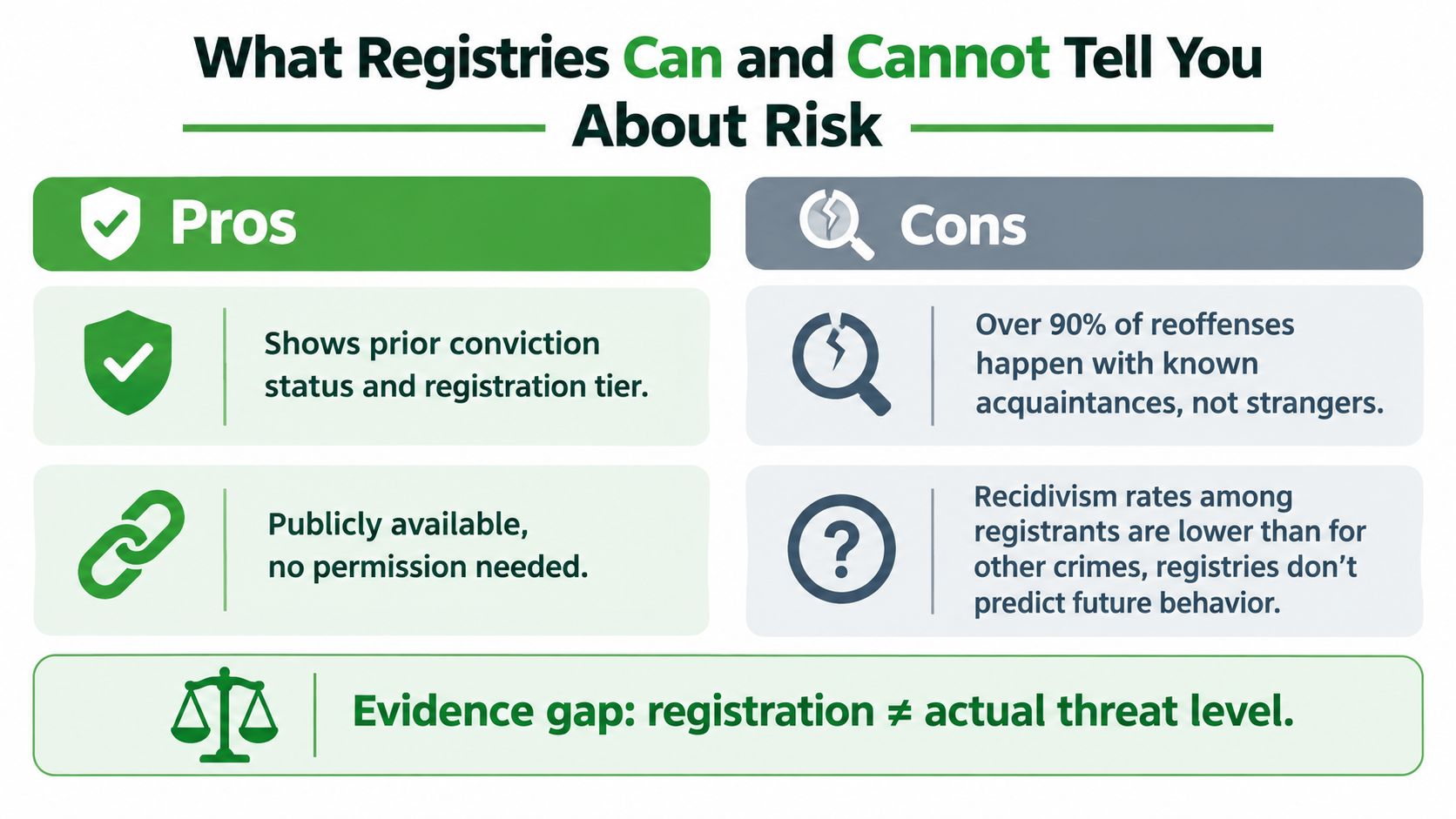
A registry can tell you that a person appears in registry data. It cannot tell you whether that person is safe for a specific volunteer role today, under your supervision model, with your population served.
That limitation isn't just common sense. The evidence base on registration and notification systems has been weaker than many people assume. The DOJ Office of the Inspector General review described the national setup as two linked registries and discussed research summaries showing that panel-data and multi-dataset studies did not support the hypothesis that registries materially reduce rape or sexual abuse rates on their own, as summarized in the DOJ OIG review of the national sex offender registry system.
What a registry can do well
A registry works best as a risk-identification and compliance control.
- Known-record flagging: It can identify whether someone appears as a known registrant in available records.
- Cross-jurisdiction awareness: It can help surface records outside your immediate county or state.
- Basic escalation trigger: It tells your team when to stop and verify before moving forward.
What a registry cannot do well
A registry is not a prediction engine.
It doesn't measure character, supervision quality, current access to vulnerable people, or whether a role has safeguards strong enough to reduce risk. It also can't solve for record lag, jurisdictional differences, or offenses that occurred before any registration requirement existed for that person.
Recent legal and policy commentary also highlights how public demand for registry-style systems remains high even where strong effectiveness evidence is limited, which is part of why the “registry equals safety” assumption persists. That tension is discussed in this analysis of registration and notification policy discourse.
If a role involves children or vulnerable adults, a clear registry search should lower panic, not lower standards.
The practical screening takeaway
For volunteer coordinators, the right mindset is simple. Use registry results to flag, not to clear.
A complete review usually needs identity matching, address history, aliases, and criminal court records alongside registry searching. When those layers line up, you have a much stronger basis for a decision than any one registry screen could provide alone.
How to Search Effectively Across Jurisdictions
A strong workflow is repeatable. It doesn't depend on one staff member's instincts, and it doesn't stop at one portal.
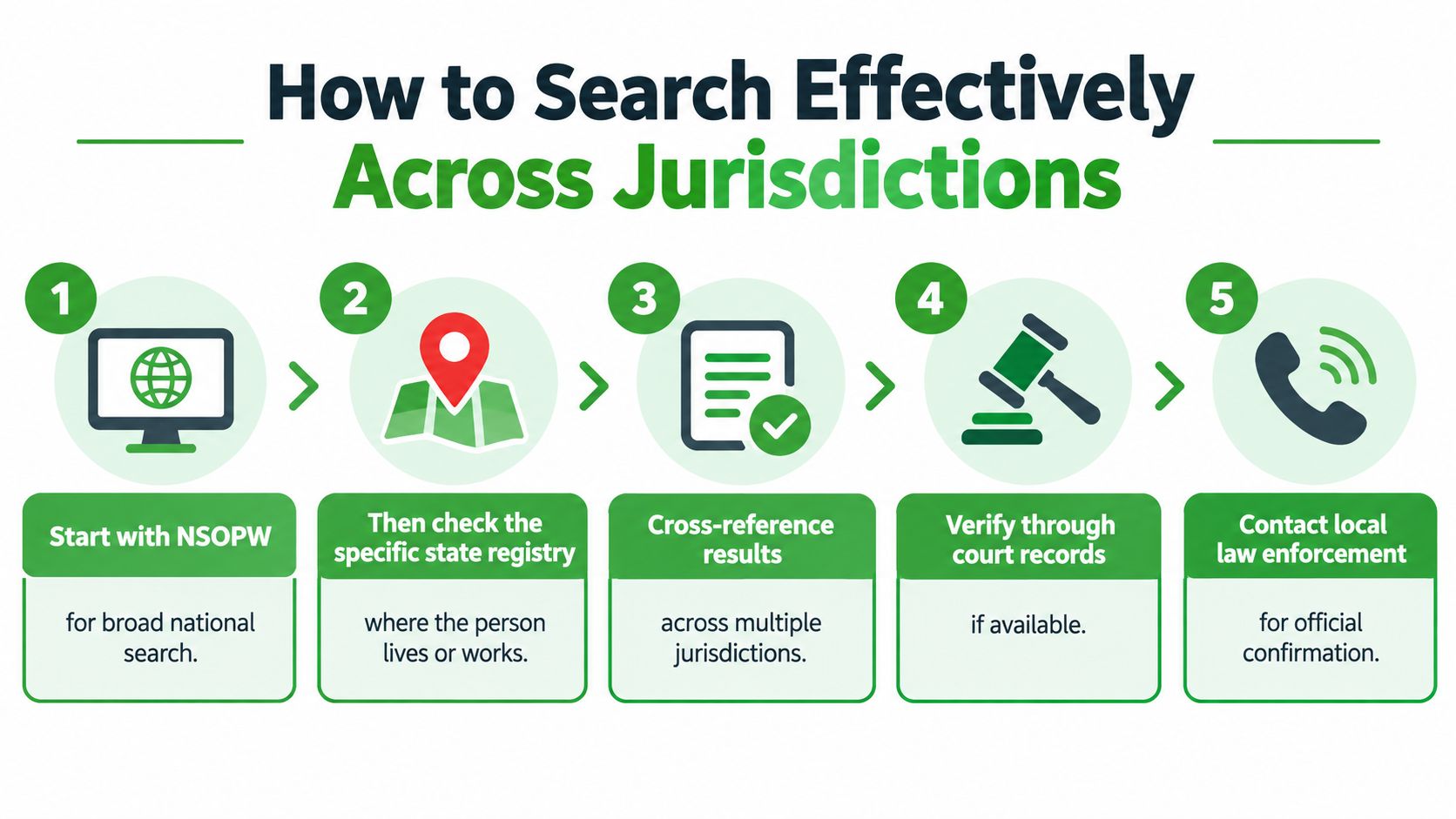
Start with a broad search, then narrow and verify. That sequence helps you catch cross-state issues without treating a broad public result as final proof.
A practical search workflow
Run the public nationwide search first.
Use NSOPW as your opening screen when an applicant may have lived in more than one jurisdiction.Check the relevant state registries next.
Focus on the person's current state, recent prior states, and any state tied to known addresses, schooling, or volunteer history.Confirm identity details.
Match full name, date-related identifiers if lawfully available in your process, and location clues. A common name by itself isn't enough.Review address history.
Address history often explains why a broad search found something that a local team didn't expect, or why a local-only search missed another jurisdiction entirely.Verify with court records when needed.
If a registry result raises a question, court-level verification gives better decision support than guessing from a listing.
Where people make mistakes
The most common error is stopping too soon. The second most common error is matching too loosely.
- Common names: “James Wilson” or “Maria Garcia” can produce confusing search results.
- Old addresses: A person may have moved, but an older jurisdiction can still matter.
- Alias issues: Some records may sit under alternate spellings, prior names, or suffix differences.
- Disclosure differences: One state may show more public detail than another.
International and cross-border confusion
The phrase sex offender registry national gets even more confusing when people compare countries. A U.S. public search experience doesn't translate neatly abroad.
A Department of Justice global survey reported that 18 countries had enacted sex offense registration laws by 2014, 29 countries by 2016, and 41 countries had sex offender notification systems or something comparable in a 2022 survey. The same survey summary notes that Canada created its National Sex Offender Registry in December 2004, and Canadian federal data reported 43,707 individuals required to register as of April 18, 2023. It also notes that Canada's federal registry is not a public U.S.-style search tool. That overview appears in this survey summary on sex offense registration laws around the world.
A simple checklist for policy teams
- Use one written workflow: Every applicant should go through the same sequence for the same role category.
- Document follow-up triggers: Decide in advance what requires state-level review or court verification.
- Separate flagging from decisioning: A search result starts review. It shouldn't end it.
- Keep your process FCRA-aware: If you use a screening provider, make sure disclosures, authorization, and any adverse action steps are handled correctly.
Real World Examples for Volunteer Screening Programs
Policies make sense faster when you test them against real situations.
A youth sports league screens a new assistant coach who moved recently. The league runs a public national search and finds nothing. If the process ends there, the board may feel reassured. A better process checks the states tied to the applicant's recent address history and confirms criminal court records where questions arise. The difference isn't paranoia. It's discipline.
Example one with a recent move
A volunteer relocates from one state to another and applies quickly. The local chapter only knows the current address.
The registry-only approach says, “No hit found, proceed.” The layered approach says, “Run the broad search, confirm prior addresses, then check the relevant states tied to that history.” That second path is slower, but it matches how the system is built.
Example two with a common name
A church screens a children's ministry volunteer with a very common name. The public search shows a possible match in another jurisdiction.
Many teams either panic or dismiss the result. Both are mistakes. The right move is to verify identity markers and check underlying records before making any decision. A common-name false match can create unnecessary harm. A weak review can create unnecessary risk.
Clear communication matters as much as the search itself. Tell leadership what was checked, what was confirmed, and what still needs review.
Example three with a multi-site nonprofit
A regional nonprofit uses a unified app for volunteer coordination to manage scheduling, forms, and onboarding across several locations. That setup helps standardize who can start service and when background steps must be complete, but it still doesn't replace screening judgment. The coordinator needs a workflow that pairs the app's intake data with address review, registry searching, and any court-level follow-up required by policy.
In all three scenarios, the lesson is the same. Registry checks are useful. Registry-only decisions are weak.
Building a Compliant and Complete Screening Approach
A solid screening policy accepts one uncomfortable truth. There is no single public national answer that can substitute for process.
Federal guidance also reinforces that the public-facing system doesn't reveal everything the same way in every jurisdiction. The SMART Office registry requirement FAQs explain that public access, completeness, and disclosure rules vary, and that some information is specifically exempt from public display. That's why the “national” label can mislead well-meaning volunteer programs into overconfidence.
A practical decision framework
Use role-based depth rather than one blanket habit.
- Low-contact roles: You may still run standard screening, but direct-access concerns are lower.
- Youth-serving roles: Add stronger identity checks, tighter supervision rules, and more careful review of multi-jurisdiction history.
- Leadership roles: Apply the most documented and consistent workflow, because these volunteers often gain trust quickly and move across functions.
If your team wants a plain-language overview of how one registry layer fits into a fuller workflow, this guide to a sex offender registry check is a useful companion.
What good compliance looks like in practice
Good compliance is boring in the best way. The same role gets the same screening steps. The same red flags trigger the same follow-up. The same adverse decision process is used every time a provider-covered report contributes to a negative outcome.
That consistency protects people on both sides. It protects your organization from sloppy decision-making, and it protects applicants from being judged on incomplete or misunderstood information.
The simplest takeaway
Treat the sex offender registry national search as one layer, not the layer.
When nonprofits combine broad registry screening with address history, alias review, criminal court checks, and role-specific supervision, they move from symbolic screening to operational screening. That's where safety and compliance start to line up.
VolunteerBadge provides nonprofit background screening that fits this layered approach, including sex offender registry searches across all 50 states along with county, state, and federal court checks, address history review, and FCRA process support. If you want a screening workflow that helps your team avoid registry-only decisions and document follow-up clearly, visit VolunteerBadge.
