
OFAC Penalties for Noncompliance Explained
Understand OFAC penalties for noncompliance, from civil fines to criminal risk. Learn how nonprofits can use screening to mitigate sanctions exposure.
On this page
Most advice about OFAC penalties starts with billion-dollar bank settlements and ends with a vague instruction to “screen everyone.” That framing is incomplete and dangerous for nonprofit leaders. The central question isn't whether a charity resembles a multinational bank. It's whether the organization can show that it used reasonable screening procedures, investigated potential matches, documented its decisions, and responded quickly when something went wrong.
OFAC enforcement is factor-weighted, not formula-driven. A screening failure doesn't produce a predetermined fine. The organization's conduct, awareness, compliance controls, remediation, cooperation, and effect on sanctions objectives all influence the outcome. For a nonprofit, a defensible process can matter as much as the screening result itself.
Table of Contents
- Why Nonprofits Face Real Sanctions Exposure
- Understanding Civil and Criminal Penalty Ranges
- How OFAC Evaluates Compliance Programs
- The Financial Impact of Voluntary Self-Disclosure
- Integrating OFAC Screening into Volunteer Onboarding
- Managing Potential Matches and Escalation Protocols
- Building a Defensible Sanctions Compliance Posture
Why Nonprofits Face Real Sanctions Exposure
The assumption that OFAC only targets global banks no longer reflects the enforcement reality. Recent enforcement has increasingly reached professional intermediaries, asset managers, digital-asset businesses, nonbank financial institutions, and individuals. A nonprofit, school, church, or volunteer program may not trade internationally, but it can still encounter sanctions risk through donors, vendors, beneficiaries, contractors, payment providers, overseas partners, or intermediaries.
The exposure often appears indirectly. A local organization might rely on a foreign partner to distribute aid, accept a donation routed through another institution, or appoint a volunteer whose identity resembles a designated person. The initial screening may not be the hardest part. The greater weakness is often what happens afterward, especially when staff clear a potential match without recording why, leave the issue unresolved, or continue onboarding while waiting for someone else to decide.
Recent enforcement analysis points to a broader focus beyond traditional banking. Sidley's review of 2025 sanctions enforcement describes actions involving nonbank entities and individuals, alongside a more assertive posture in certain serious matters. That shift should change how nonprofit directors think about risk.
Indirect relationships create direct problems
A sanctions program doesn't become irrelevant because an organization works domestically. Risk can arise from:
- Intermediary relationships: A partner, payment processor, grant administrator, or supplier may connect the organization to a sanctioned person or jurisdiction.
- Volunteer and beneficiary records: A name may match an entry on an OFAC list, even when the organization has no international commercial activity.
- Post-screening decisions: Ignoring a possible match or failing to escalate it can create a more serious record than an isolated, good-faith screening error.
- Weak documentation: A coordinator may remember why a result was cleared, but an auditor or regulator needs an accessible record showing the identifiers reviewed and the decision made.
A lightweight spreadsheet or one-time manual search might produce a result, but it rarely creates a complete audit trail. Nonprofits need to treat sanctions screening as an operating process, not a box checked during onboarding.
Practical rule: A potential match should trigger a documented decision path, not an informal conversation and a deleted alert.
The risk isn't limited to onboarding. Organizations should establish controls for recurring relationships, changes in donor or partner information, payment activity, and rescreening when a volunteer renews or changes roles. The more vulnerable the beneficiaries or the more complex the partner network, the less acceptable an undocumented workflow becomes.
Understanding Civil and Criminal Penalty Ranges
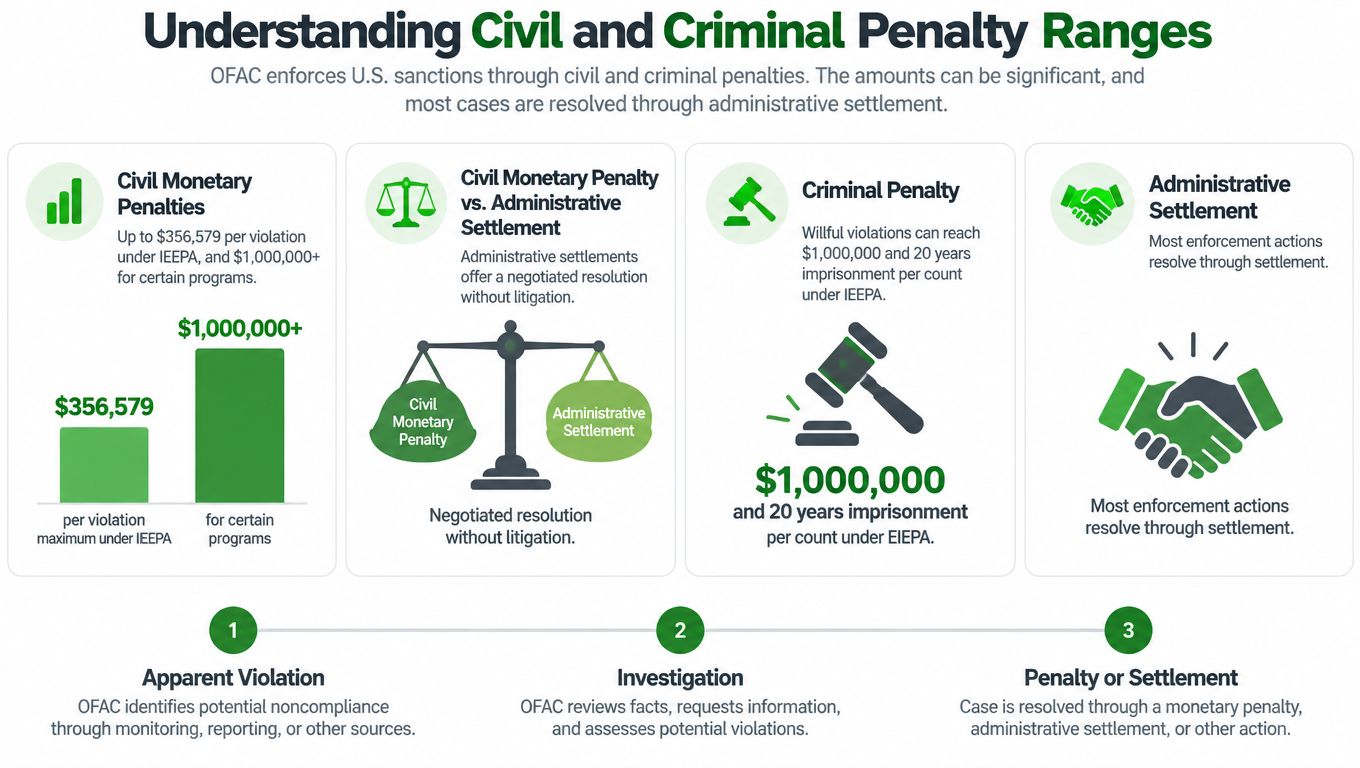
OFAC penalties for noncompliance take several forms. The agency may issue a cautionary letter, finding of violation, civil monetary penalty, or negotiated settlement. It may also refer apparent violations for criminal investigation while pursuing civil action. A nonprofit should therefore avoid treating a civil inquiry as evidence that criminal exposure is impossible. The outcome depends on the facts, the applicable sanctions program, and the nature of the conduct.
Penalty maximums change. OFAC states that civil penalties vary by sanctions program and are adjusted annually under federal inflation-adjustment law. A ceiling listed in an old compliance memo may no longer apply. OFAC's published enforcement information for 2023 provides the agency's program and enforcement context.
Annual totals mask the distribution of risk
OFAC reported 17 civil enforcement actions and $1,541,380,594.08 in penalties and settlements in 2023, while 2024 recorded 12 actions and about $48.8 million. The difference shows how sharply annual totals can shift when a small number of major matters are included. It also shows that noncompliance exposure is not limited to modest administrative fines. OFAC's 2023 enforcement totals show why headline totals need careful interpretation.
A prior milestone makes the same point. In 2019, OFAC published 26 enforcement actions totaling about $1.289 billion, including settlements involving UniCredit at $611 million and Standard Chartered at $657 million. OFAC later reported that 2023 exceeded that scale, and Treasury announced a $968 million OFAC penalty in the Binance settlement, described as one of the largest sanctions penalties in history. Those matters involve organizations and conduct unlike a local nonprofit's screening mistake, yet they establish the financial seriousness of sanctions enforcement. OFAC's 2019 enforcement information documents that historical pattern.
For a smaller nonprofit, the headline totals are warning signs, not a forecast. Regulators assess the surrounding facts. A documented screening decision, preserved identifiers, prompt escalation, and voluntary disclosure can give the organization a more defensible enforcement posture than an undocumented process followed by silence.
Reporting failures can create separate exposure
A reporting failure can carry its own civil money penalty, even when OFAC does not charge an underlying sanctions violation. Under the current penalty schedule in 31 C.F.R. Part 501, Appendix A, failure to furnish required information can be penalized up to $29,150, or up to $72,876 when OFAC believes the matter involves a transaction above $500,000. Late filing penalties can reach $3,550 when filed within 30 days and $7,104 after 30 days. Blocked-asset reports can add $1,422 for each 30-day period overdue, up to 10 years.
These figures do not predict what a nonprofit will pay. They identify why deadline ownership matters. When the organization identifies a blocked asset or reporting obligation, assign responsibility for the calendar, fact review, and contact with counsel or OFAC. A disciplined response limits the risk that financial consequences grow after discovery.
How OFAC Evaluates Compliance Programs
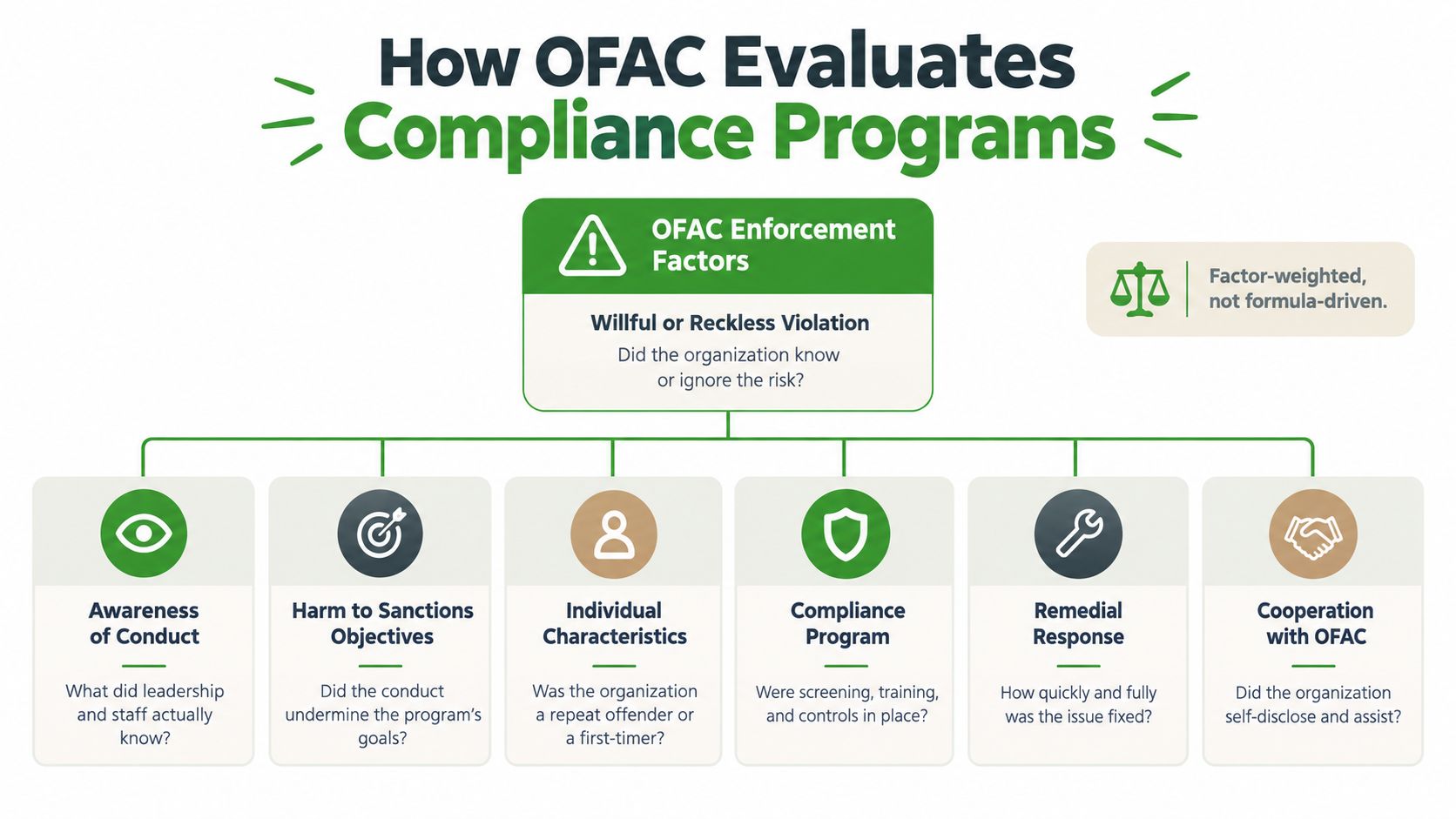
OFAC doesn't use a rigid calculator that assigns the same fine to every screening failure. Its enforcement framework evaluates the facts through general factors, including whether the conduct was willful or reckless, what the organization knew, the harm to sanctions objectives, the characteristics of the violator, the adequacy of its compliance program, its remedial response, its cooperation, and the deterrence impact.
That approach creates a practical distinction between two organizations that make a similar technical mistake. One has written procedures, trained staff, reliable screening records, a clear escalation owner, and evidence of prompt remediation. The other has no consistent workflow, no match log, and no explanation for why staff continued processing a questionable relationship. The underlying alert may look similar, but the enforcement posture can be materially different.
Turn the factors into operating controls
Nonprofit directors should translate the enforcement factors into evidence that staff can create during ordinary work:
- Define ownership. Name the person responsible for sanctions screening, escalation, record retention, and regulatory contact. A policy without an owner is an instruction without accountability.
- Capture the screening logic. Preserve the list version or screening source, the search terms used, the date of the check, and the identifiers supplied by the applicant or counterparty.
- Record the match analysis. When an alert appears, document the name variations, date of birth, address history, nationality or other available identifiers, and the reason the reviewer cleared or escalated it.
- Separate clearance from escalation. Staff who can resolve obvious false positives should know when they must stop and refer the issue to a compliance officer, senior director, or legal counsel.
- Document remediation. If the organization discovers a control failure, record the root cause, affected relationships, corrective action, responsible owner, and completion date.
- Preserve cooperation evidence. Keep communications, review notes, and records showing that the organization responded openly and promptly.
OFAC's own guidance confirms that the existence and adequacy of a sanctions compliance program, along with remedial response and cooperation, can mitigate a penalty. The OFAC Enforcement Guidelines should guide the design of the evidence trail, not merely the selection of a screening vendor.
For a volunteer program, that means a screening tool is only one component. The organization also needs a repeatable adjudication process. This guide to OFAC sanctions compliance can help volunteer managers connect list screening with written procedures, review ownership, and escalation records.
A failed control is easier to defend when the organization can show what the control was supposed to do, who reviewed the exception, and what changed afterward.
The Financial Impact of Voluntary Self-Disclosure
Large bank penalties attract attention, but they can distract nonprofit directors from the factor-weighted reality of OFAC enforcement. For a smaller organization, the financial outcome often turns on what happened after detection: whether staff stopped the activity, preserved reliable records, investigated promptly, corrected the control failure, and cooperated with OFAC.
Voluntary self-disclosure can materially improve the organization's position. The federal enforcement guidelines recognize mitigation for substantial cooperation without self-disclosure, and they provide additional consideration when an organization reports its own conduct. OFAC also addresses self-disclosure in guidance for virtual-currency cases. The practical point is clear: documented screening and a disciplined response give the organization evidence to present when penalty factors are assessed.
These benefits are not automatic. OFAC evaluates whether the disclosure was voluntary, timely, complete, and supported by cooperation. Do not submit an incomplete account just to claim that the organization reported. Establish the facts, preserve relevant records, define the scope, correct the immediate problem, and obtain appropriate legal advice before deciding what to disclose.
Build the response before the incident
A written response workflow should assign ownership before a potential violation appears:
- Detection: Pause the relevant transaction or onboarding decision while staff determine whether the alert is plausible.
- Preservation: Retain screening results, applicant data, communications, payment records, and reviewer notes. Prevent routine systems from overwriting evidence.
- Investigation: Determine whether the alert is a false positive, a prohibited relationship, a reporting problem, or an unresolved issue requiring counsel.
- Remediation: Address the immediate exposure and correct the process failure that allowed it.
- Disclosure decision: Decide whether and how to approach OFAC based on the facts, timing, applicable program, and legal advice.
- Deadline control: Assign every reporting deadline to a named owner and require documented confirmation of submission.
A nonprofit should know in advance who can stop a payment, preserve records, authorize an investigation, and approve a disclosure. That decision map can directly affect the organization's financial exposure because it determines whether the response is prompt, consistent, and defensible. Build it before staff face a possible match, not after a regulator requests the records.
Integrating OFAC Screening into Volunteer Onboarding
Screening should fit into onboarding without becoming an improvised research project. Start with a consistent intake record that captures the volunteer's full legal name, date of birth, current address, and other identifiers the organization is permitted and equipped to collect. Incomplete identity data creates avoidable ambiguity when a name resembles a listed person.
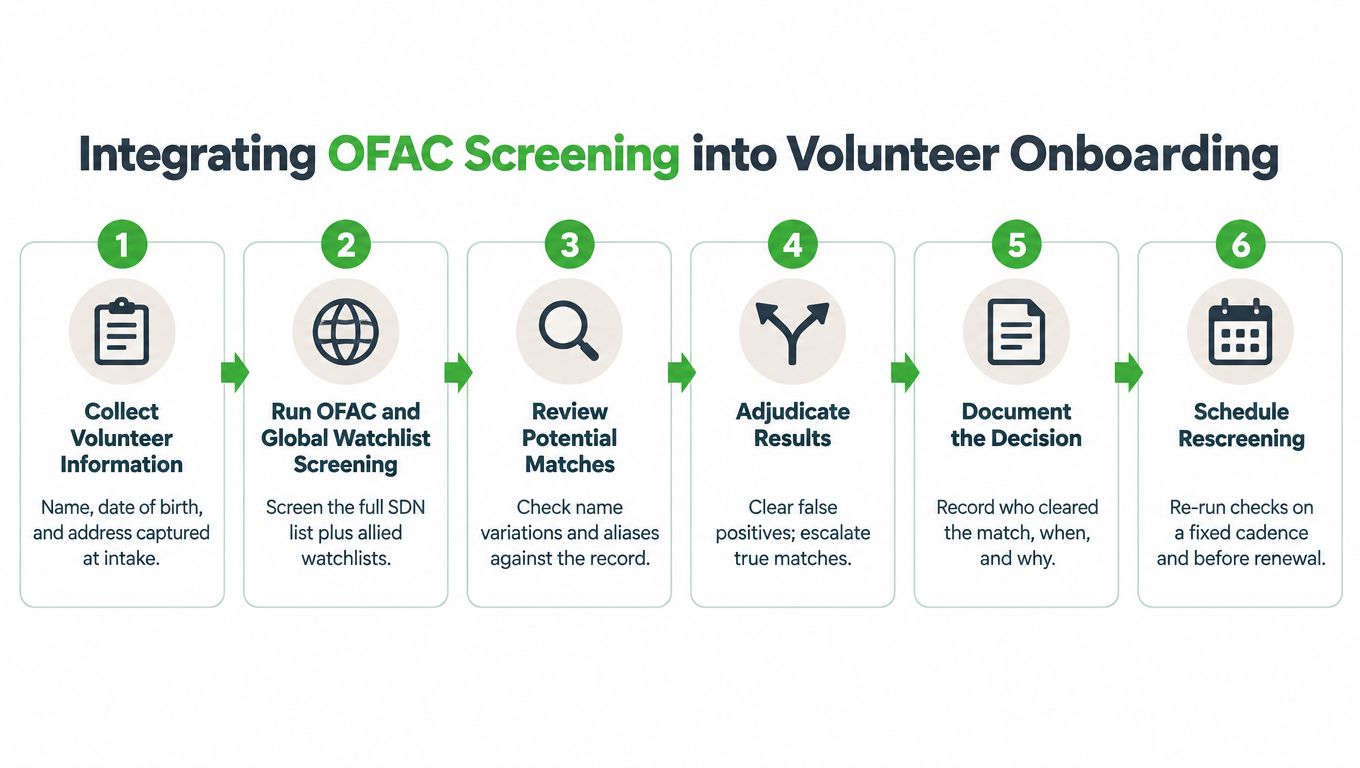
Use a controlled six-step workflow
First, collect and authorize. Give the applicant the required disclosure and authorization documents before obtaining a consumer report. Keep the signed authorization with the screening record and limit access to people who need the information.
Second, run the screening. Use a reputable provider or an integrated sanctions-screening service that can search OFAC lists and relevant global watchlists. If the organization also conducts criminal background checks, keep the sanctions result identifiable within the overall report so staff don't overlook it.
Third, review potential matches. Treat a name hit as an alert, not a conclusion. Compare available identifiers and check whether the listed person and the applicant are the same individual.
Fourth, adjudicate. Clear a false positive only when the reviewer has documented the comparison. Escalate a plausible match rather than allowing a volunteer coordinator to make an unsupported judgment under time pressure.
Fifth, document the decision. Record the reviewer, date, identifiers considered, decision, and any follow-up. Don't rely on a vendor's alert screen as the organization's entire audit trail.
Sixth, rescreen at defined points. Establish a cadence that fits the organization's risk and rescreen when a volunteer renews, changes responsibilities, or becomes connected to a new program or partner.
For organizations using consumer reports, FCRA compliance must remain separate from sanctions judgment. The disclosure, authorization, permissible purpose, privacy controls, and adverse-action process all require disciplined handling. If a result affects a volunteer decision, staff should follow the provider's legally reviewed process and give the applicant the required opportunity to address inaccurate information.
A workflow can be embedded into an applicant tracking system through an API, webhook, or other integration. It can also support a human review queue so that urgent alerts don't disappear into email. This overview of OFAC background checks provides additional context for connecting sanctions screening with volunteer screening procedures.
Here is the required visual demonstration of the workflow:
Don't automate the decision itself. Automate data collection, list updates, alert routing, reminders, and record creation. A qualified reviewer still needs to determine whether a potential match is credible and what escalation is appropriate.
Managing Potential Matches and Escalation Protocols
A potential match should slow the process down, not trigger panic. Consider a volunteer whose name resembles an OFAC-listed individual. The coordinator shouldn't reject the applicant immediately, and shouldn't clear the alert because the person seems trustworthy. The coordinator should pause the relevant onboarding step, preserve the alert, and compare secondary identifiers.
Start with the information already collected. Review the date of birth, address history, aliases, nationality or other available identifiers, and the listed person's profile. A materially different birth date or incompatible location may support a false-positive determination, but the reviewer should write down that reasoning. A close match with missing or conflicting identifiers needs escalation.
A defensible escalation sequence
- Pause the affected activity. Don't permit the applicant to access a sensitive role, receive funds, or participate in the relevant transaction while the alert remains unresolved.
- Restrict disclosure. Share the alert only with staff who need to investigate it. Avoid informal discussion that exposes private applicant information.
- Compare identifiers. Examine spelling variations, aliases, dates of birth, addresses, and other reliable identifiers. Don't treat a matching name as sufficient proof.
- Record the analysis. Note the source of the alert, information reviewed, reviewer, date, and conclusion. If information is missing, record that limitation.
- Escalate credible matches. Refer a plausible match to the designated compliance lead or legal counsel. Staff shouldn't contact a listed person, move funds, or make promises about the outcome without direction.
- Apply the correct applicant process. If a consumer report affects the volunteer decision, follow the applicable FCRA adverse-action procedure. A sanctions concern and a consumer-report dispute may overlap, but they aren't the same issue.
- Close the record carefully. Document whether the applicant was cleared, rejected, or held pending further review, and preserve the supporting evidence.
A provider's result shouldn't replace judgment. This resource on OFAC sanctions list searches can help coordinators understand why identity matching and human adjudication matter.
The organization should also define who can approve a clearance, who can suspend onboarding, and who contacts counsel. That clarity prevents a common failure mode, where everyone assumes someone else is handling the alert. If the match is credible or the organization has already provided funds or services, preserve all records and seek qualified sanctions counsel promptly.
Building a Defensible Sanctions Compliance Posture
A defensible posture doesn't mean promising zero risk. It means showing that the nonprofit identified its exposure, assigned responsibility, used reasonable procedures, investigated exceptions, and improved controls after problems appeared. OFAC's factor-weighted approach makes that evidence operationally valuable.
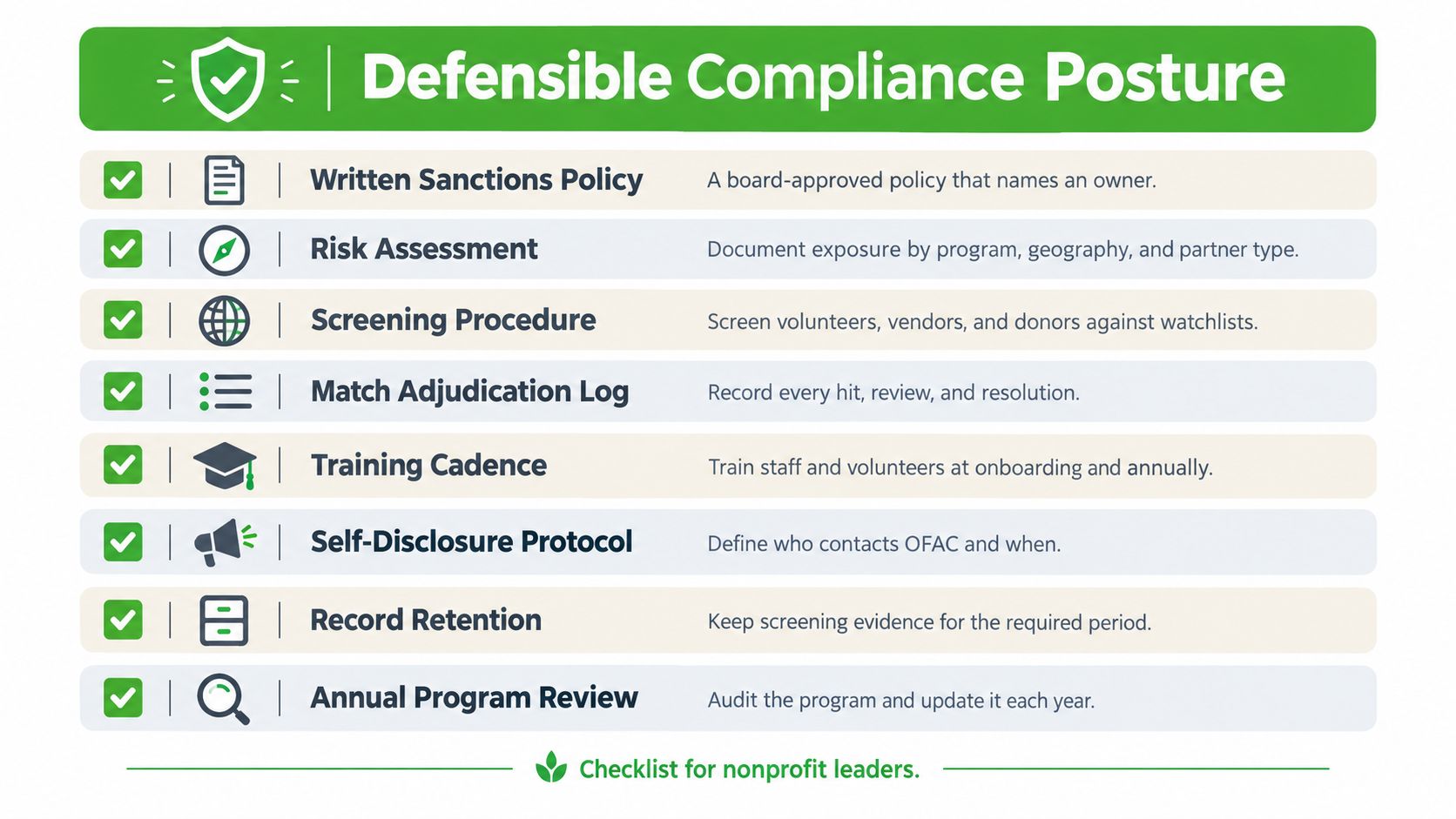
Use this audit checklist with your board, executive director, or compliance owner:
- Written sanctions policy: Does the policy identify the organization's risks, controls, and responsible owner?
- Risk assessment: Has the organization considered donors, volunteers, beneficiaries, vendors, partners, payment channels, and jurisdictions?
- Screening procedure: Does the workflow cover onboarding, relevant renewals, and changes in relationship?
- Match adjudication log: Can staff show how every alert was reviewed and resolved?
- Training: Do coordinators know when to pause activity and escalate?
- Self-disclosure protocol: Is there a documented path for investigation, legal review, reporting, and cooperation?
- Record retention: Can the organization retrieve screening evidence, decisions, and remediation records?
- Program review: Does leadership periodically test whether the controls still work in actual operations?
The most important shift is simple. Stop treating sanctions screening as a one-time search. Treat it as a documented control that continues through review, escalation, reporting, and remediation.
VolunteerBadge combines OFAC and global watchlist screening with nonprofit volunteer background-check workflows, including applicant disclosures, authorization, and guidance for adverse-action steps. Visit VolunteerBadge to evaluate whether its screening workflow fits your organization's onboarding and sanctions compliance process.
