
Why Are Background Checks Important for Nonprofits
Why are background checks important for nonprofits and volunteer programs? Learn how screening protects people, ensures FCRA compliance, and builds donor trust.
On this page
A background check can uncover information that a thoughtful interview never will. That's why 98% of organizations conduct background checks, while 70% of volunteers support screening and 48% say they feel safer when screening is required, according to Sterling Volunteers' industry report. The counterintuitive lesson is that responsible screening usually strengthens volunteer confidence rather than undermining it.
For nonprofit leaders, the question isn't whether background checks are important. It's whether your process is accurate, role-specific, legally defensible, and consistent enough to protect the people you serve. Screening protects more than physical safety. It supports FCRA compliance, reduces negligent-selection exposure, preserves donor confidence, and gives your board evidence that the organization manages access to vulnerable people responsibly.
Table of Contents
- What Background Checks Really Protect in Practice
- The Core Layers of Safety and Risk Mitigation
- Legal and FCRA Considerations for Volunteer Screening
- How Screening Builds Donor and Community Trust
- Choosing the Right Check Types for Each Role
- Addressing Common Objections and Misconceptions
- A Practical Implementation Plan for Small Budgets
What Background Checks Really Protect in Practice
A youth-services nonprofit places a new volunteer in a mentoring role. Three months later, a routine records review reveals a concealed conviction relevant to the access that volunteer has been given. The director now has more than a difficult personnel conversation. The organization must consider the child's safety, insurance questions, board accountability, parent confidence, and whether its onboarding process was defensible in the first place.
That scenario doesn't require a dramatic incident to expose a weak system. A volunteer may have unsupervised access, transport a participant, handle donations, or enter a family's home. If the nonprofit never verified identity or assessed the role's risks, “we interviewed them carefully” won't answer the central question: What did the organization do to prevent a foreseeable problem?
Operational rule: Screening is not a judgment about someone's worth. It's a control for managing access, responsibility, and risk.
Background checks protect the people at the center of your mission first. That includes children, older adults, people with disabilities, clients receiving crisis support, and families who reasonably assume that your organization has vetted the adults around them. They also protect staff who supervise volunteers, because supervisors shouldn't be left to discover serious concerns informally or after harm occurs.
The board and executive director carry a separate responsibility. A documented process helps demonstrate that the organization considered foreseeable risks, matched safeguards to each role, and treated applicants consistently. It can't eliminate liability, but it gives the organization a stronger operational record than an informal promise that “everyone seemed trustworthy.”
Safety is a continuing discipline
Screening shouldn't end when the volunteer receives a badge. Long-term volunteers can change roles, gain more access, or face new circumstances after onboarding. The National Council of Nonprofits' guidance on screening recommends assessing the risk of each position, selecting suitable tools, and applying the process consistently and lawfully.
That approach is more useful than a universal package. A one-time event helper and a youth mentor shouldn't automatically receive identical scrutiny, but neither should be processed through undocumented discretion. Families and guardians looking for safe programs may also benefit from practical resources such as Vanta Sports for parents and guardians, especially when they want to understand how organizations approach participant protection.
Your public explanation can stay simple. Explain which roles require screening, what the process checks, how consent works, and how the organization handles potentially disqualifying information. For a plain-language overview of the records a report may contain, see what shows on a background check.
The Core Layers of Safety and Risk Mitigation
A strong screening program works like a set of locked doors. One lock may fail or cover only one entrance. Several relevant controls, applied in the right order, make it harder for an identity problem, incomplete record, or role mismatch to become an incident.
Identity verification comes first. It confirms that the person completing the application is the person who will show up. Think of it as checking a ticket at the door. Without it, a clean report attached to the wrong identity creates false reassurance.
Criminal-history screening adds context. A nonprofit shouldn't treat every record as equivalent. A conviction relevant to unsupervised contact with children deserves a different assessment from an unrelated, old matter that doesn't connect to the role. The decision should follow a written standard, not an instinctive reaction to a database hit.
Registry and watchlist searches close specific gaps. They're not substitutes for court research, and they don't make a report complete by themselves. They are additional controls for organizations that need to assess access to vulnerable populations or sensitive activities. Teams that need a deeper explanation can review global watchlist screening.
Match each layer to a failure mode
A driving record matters when a volunteer transports clients. A reference check matters when the role depends on judgment, reliability, or prior work with vulnerable people. Credential verification matters when someone claims a certification that the program relies on.
- Identity: Reduces the risk of screening the wrong person.
- Court records: Helps identify convictions that may be relevant to the role.
- Registries and watchlists: Adds targeted checks beyond a basic criminal search.
- Motor vehicle records: Supports safer decisions for transportation duties.
- References and credentials: Tests whether qualifications and past responsibilities are genuine.
No layer answers every question. A database search may need court-level verification. A reference may offer useful context but cannot replace records research. A clean report also doesn't prove that someone will behave well in every situation. The practical goal is not certainty. It's layered, documented risk reduction that reflects the access the volunteer receives.
Legal and FCRA Considerations for Volunteer Screening
A background check can create legal exposure if your organization treats it as a simple pass-or-fail form. Staff may run a report, see a concerning entry, and reject the applicant immediately. That shortcut can produce a second problem through inaccurate records, inconsistent decisions, or failure to provide required notices.
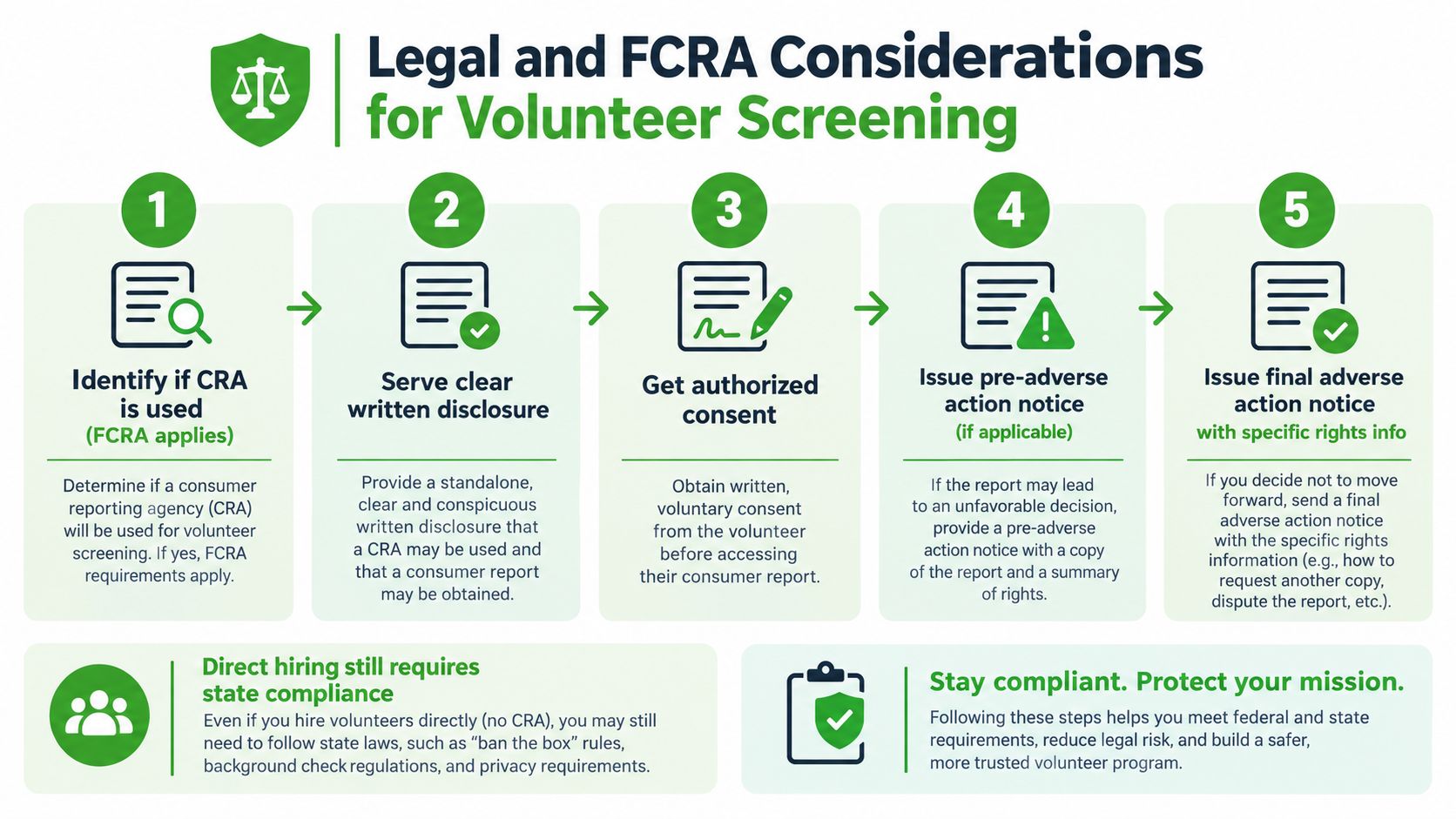
The Fair Credit Reporting Act applies when a consumer reporting agency provides information for a covered decision. Volunteer status can complicate the analysis, while paid employment usually fits more clearly within standard employment-screening rules. State and local laws, insurance requirements, grant conditions, and the vendor's role may also shape the process. Calling someone a volunteer does not remove every compliance duty. Review the Fair Credit Reporting Act and criminal background checks before setting policy.
What a defensible workflow looks like
Use a written disclosure that explains the screening in clear language. Obtain authorization before ordering a report, and keep that authorization separate from unrelated application language where required. If a report could affect eligibility, give the applicant a meaningful chance to review the information and dispute errors before making a final decision.
Build these controls into the written procedure:
- Disclosure and consent: Explain what the organization will check and obtain authorization before ordering the report.
- Accuracy review: Confirm that the record belongs to the applicant and that the information is current, relevant, and supported.
- Pre-adverse action: If the report may lead to rejection, provide the required materials and time to respond.
- Individual assessment: Consider the record's nature, its connection to the volunteer role, and the applicant's explanation.
- Final notice: If the organization proceeds with an adverse decision, provide the required information about the decision and the applicant's rights.
Published research has documented frequent false positives in background checks, often caused by identity confusion, as discussed in this legal analysis of background-check accuracy. Treat verification and dispute handling as operating controls. A vendor report alone is not a reliable basis for exclusion.
Arrest information requires the same discipline. An arrest does not prove a conviction, so do not base a screening decision on an arrest alone. Create a consistent adjudication matrix, document why each record matters to the role, and obtain jurisdiction-specific legal advice before adopting rules on timing, disclosures, or exclusions. That recordkeeping helps the organization explain its decision if an applicant, insurer, funder, or regulator questions the process.
How Screening Builds Donor and Community Trust
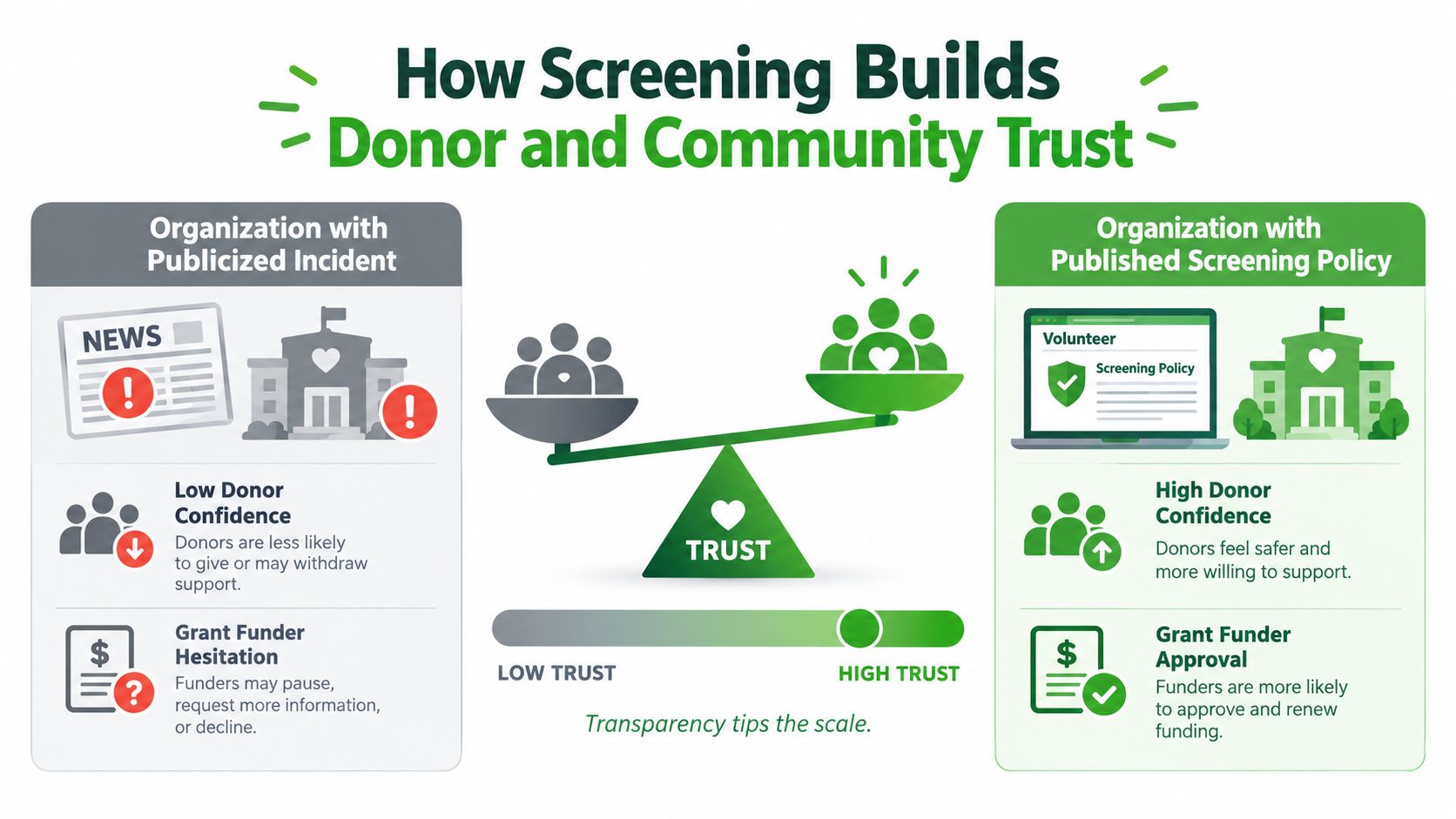
Donors rarely ask for a technical explanation of your search architecture. They want to know whether the organization understands its duty of care and can explain how it manages risk.
Consider two organizations competing for the same community support. The first has no published volunteer-screening policy and responds to questions with general assurances. The second explains which roles require checks, how it obtains consent, how it handles inaccuracies, and how it reviews decisions. The second organization gives donors something concrete to evaluate: a repeatable control rather than a promise based on personal impressions.
That distinction matters after an incident, but it matters before one as well. Grant applications, partner reviews, board discussions, and parent inquiries often expose whether safeguarding practices exist beyond a policy binder. A written screening program can show that the nonprofit has thought through access, supervision, record accuracy, and escalation.
Trust is built through visible consistency
A screening policy won't guarantee continued donations, and it shouldn't be marketed as a badge of perfection. It does signal that leadership takes operational maturity seriously. The strongest policies are clear enough for applicants to understand and specific enough for coordinators to apply without improvising.
Your website can state:
- Which volunteer roles require screening.
- Whether transportation, financial access, or solo contact triggers additional checks.
- How applicants authorize the process.
- How the organization handles records that may be inaccurate or irrelevant.
- Whether recurring volunteers are reviewed again under the organization's policy.
The historical shift toward formal screening reflects this broader expectation. A Sterling Volunteers report on screening adoption found that screening had become more common across the sector, while some organizations still screened nobody or only part of their volunteer population. The lesson isn't to copy another nonprofit's exact policy. It's to stop treating safeguarding as optional just because the organization is small.
Choosing the Right Check Types for Each Role
The right question isn't “Which package should we buy?” It's “What could this volunteer access, influence, transport, or control?” The answer should determine the depth of screening.
A one-time event helper who works in a supervised public area may need identity confirmation and a basic, role-appropriate search. An after-school tutor has more sustained contact with children, so criminal-history screening and identity verification deserve greater attention. A mentor who meets a young person alone, a driver transporting clients, and a volunteer treasurer each create different exposures.
| Volunteer Role | Exposure Level | Recommended Check Components |
|---|---|---|
| One-time event helper | Low, supervised contact | Identity verification and a role-appropriate criminal search |
| Food pantry or reception volunteer | Moderate public and client contact | Identity verification, criminal-history search, and reference review where relevant |
| After-school tutor | Sustained contact with children | Identity verification, criminal-history search, and relevant registry screening |
| Youth mentor with solo access | High interpersonal exposure | Layered criminal searches, relevant registry and watchlist screening, references, and documented adjudication |
| Client driver | Transportation exposure | Identity verification, criminal-history search, driving-record review, and authorization for recurring checks where applicable |
| Finance volunteer | Asset and information exposure | Identity verification, criminal-history search, reference or credential verification, and additional financial controls where legally appropriate |
Escalate when the role justifies it
A nationwide database search can help identify where deeper research may be needed, but it shouldn't be treated as the final answer. Independent guidance warns that aggregated databases can be outdated or miss county-level convictions, and reports that 50% of criminal-history checks were limited to a single state while only 32% of organizations re-screened volunteers periodically in the cited nonprofit screening survey (background-check guidance for schools).
Use county-level research when a search points to a jurisdiction, when the role carries substantial access, or when the applicant's address history requires clarification. Add driving records only when driving is part of the assignment. Verify licenses or credentials only when the role depends on them. For volunteers with ongoing exposure, establish a documented review schedule instead of relying on a single onboarding event.
The decision rule is straightforward: a check is overkill when it has no connection to the role, and skipping it is negligent when the role creates foreseeable access to people, vehicles, money, or sensitive information. Keep right-to-work and identity administration separate from safeguarding decisions, and use specialist guidance on managing right to work expiry when those obligations apply.
Addressing Common Objections and Misconceptions
Volunteer-dependent nonprofits hear the same objections repeatedly. Each points to a real concern, but none supports an undocumented or inconsistent process. Screening protects the organization only when it is tied to the role, applied consistently, and handled with the required notices and consent.
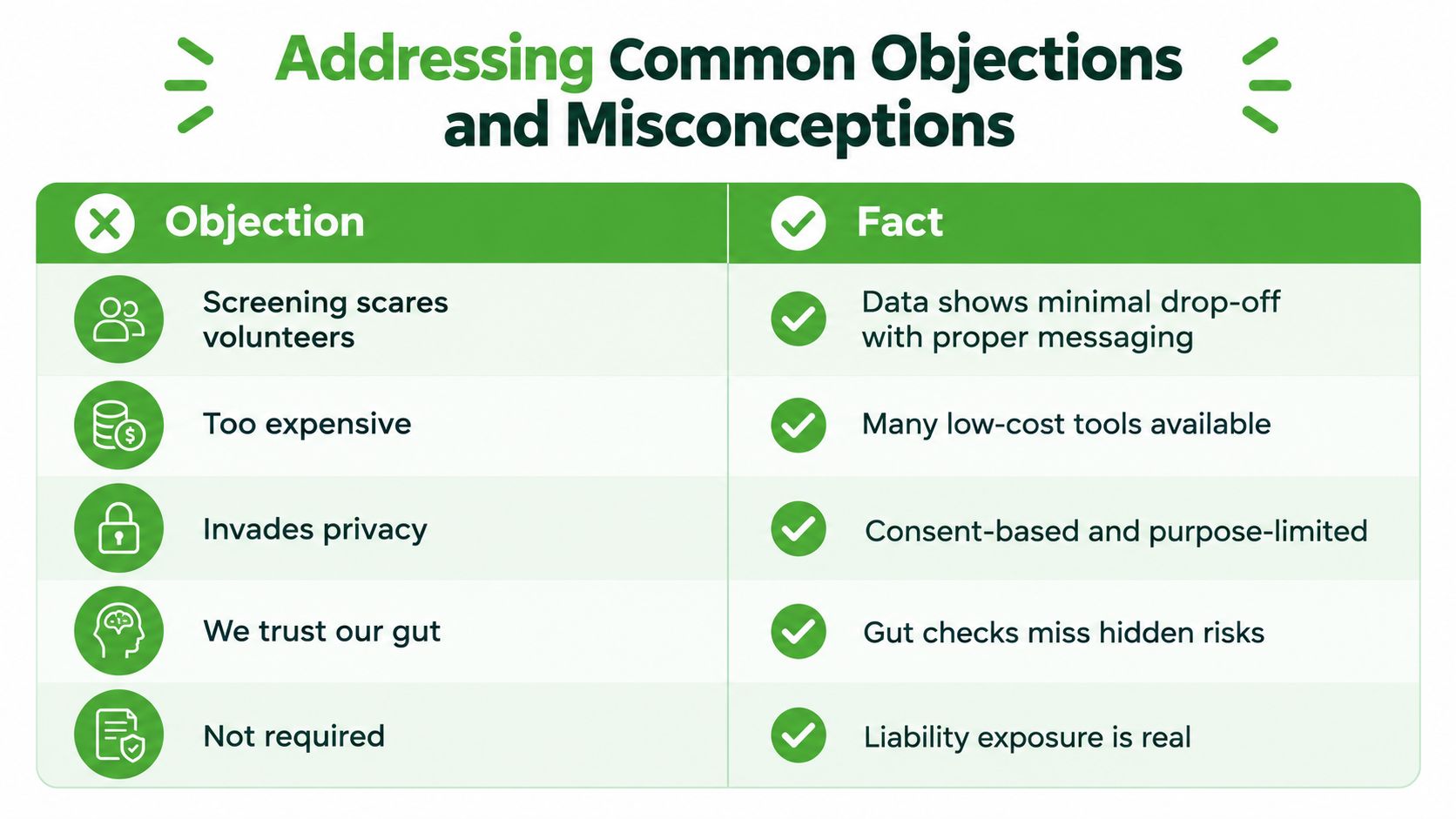
“Screening will scare away volunteers.” Poor messaging can discourage applicants. Explain which roles require checks, why the organization uses them, how personal information is protected, and how records are assessed fairly. The Sterling Volunteers' survey findings support a practical conclusion: clear screening policies can be presented as a normal safeguard rather than a signal that every applicant is suspect.
“We interview everyone carefully.” Interviews reveal communication, judgment, and apparent fit during a short conversation. They do not verify identity, uncover every relevant conviction, confirm a driving record, or validate a claimed credential. Use interviews for suitability. Use records-based checks for facts an interview cannot establish.
“We can't afford it.” Segment roles before setting a screening budget. A supervised, low-contact assignment may require fewer controls than solo youth mentoring, driving, financial access, or unsupervised contact. The larger liability cost is an incident followed by questions about why the organization had no documented safeguard, consistent decision rule, or evidence of reasonable care.
“People with records deserve a second chance.” They do. A fair program reviews relevance, recency, seriousness, rehabilitation, and the actual duties involved. An arrest alone is not proof of misconduct. Give applicants a clear way to dispute inaccurate information, and record the job-related reasons for any eligibility decision.
“The FCRA only applies to paid staff.” Do not make that assumption. FCRA duties can depend on how a consumer report is obtained and used, while state law, insurers, and funders may add requirements. Before launching screening, confirm how the provider manages stand-alone disclosures, written authorization, accuracy disputes, pre-adverse notice, and final adverse-action notices. Those steps protect applicants and give the nonprofit evidence that its process was controlled.
Practical standard: If two applicants receive different treatment for the same role, explain the difference with documented, job-related facts, not a coordinator's intuition. Consistency is how screening supports liability control and donor confidence.
A Practical Implementation Plan for Small Budgets
A small team can build a credible program without creating a giant compliance project. Assign one owner, write down the rules, and make the workflow repeatable.
1. Write the policy around role risk
Create a short matrix for low, moderate, and high-exposure roles. Define which positions involve children, vulnerable adults, transportation, money, home visits, or unsupervised contact. State which checks apply to each category and who makes the final decision.
Don't copy a policy from another organization without checking fit. Your program should reflect your mission, insurance requirements, local rules, and the access your volunteers receive.
2. Select a screening provider carefully
Compare providers on more than turnaround time. Ask whether they verify identity, search the jurisdictions that matter, explain database limitations, support applicant disputes, and provide compliant disclosure and authorization materials. Confirm who handles pre-adverse and final adverse-action steps when a report may affect eligibility.
A nonprofit-friendly provider should also offer understandable reports. Your intake coordinator shouldn't need to decode unexplained status labels before deciding whether additional research is necessary.
3. Build consent into intake
Put the disclosure and authorization step before the check, not after it. Store the completed forms securely, limit access to people who need the information, and tell applicants how they can question a result.
Create a simple exception path for incomplete addresses, mismatched identities, or records requiring county-level verification. Never let a coordinator “work around” a mismatch because a program needs the volunteer immediately.
4. Train the person making decisions
Give coordinators a written adjudication guide. It should explain what information is relevant to each role, when to escalate a result, how to document the reasoning, and how to avoid using arrest information as a substitute for a conviction.
Have a second reviewer participate in higher-risk decisions. That creates consistency and reduces the chance that one person's assumptions determine whether an applicant is accepted.
5. Review ongoing roles
For recurring volunteers, define when the organization will reassess access and whether another check is appropriate. A screening report becomes less useful when a volunteer changes duties or the organization ignores new information.
Track complaints from participants, families, donors, and staff. Log incidents, near misses, unresolved identity questions, and adverse decisions. Review the log periodically for patterns, then update the policy when the same weakness appears more than once.
The best first-week checklist is short:
- Assign ownership: Name the person responsible for screening records and decisions.
- Map exposure: List every volunteer role involving vulnerable people, driving, money, or unsupervised access.
- Draft standards: Define the checks and decision rules for each role.
- Test the workflow: Complete a sample disclosure, authorization, review, and dispute path.
- Publish the explanation: Add a plain-language screening statement to the volunteer application.
- Schedule review: Put recurring role reviews on the operations calendar.
VolunteerBadge offers nonprofit-focused volunteer background screening with digital disclosure and authorization, identity and criminal-history screening workflows, and automated guidance for adverse-action steps. If you want to replace ad hoc checks with a documented process, visit VolunteerBadge and review whether its workflow fits your organization's roles and compliance needs.
