
Volunteer Screening Policy: A Practical Guide for Nonprofits
Build a defensible volunteer screening policy with FCRA-aligned steps, role-based risk tiers, consent templates, and rescreening rules your nonprofit can act
On this page
A parent asks which checks your youth program runs. A board member wants the screening file before approving a new program. Then a database search returns a possible record for a volunteer who has been active for years, and nobody can explain who reviewed it, what standard was applied, or whether the volunteer had a chance to correct an error.
That situation exposes the weakness in many nonprofit programs. A sentence such as “a background check will be conducted” sounds responsible, but it doesn't tell staff which volunteers are covered, what the check includes, how results are assessed, or what happens when a report may lead to exclusion. A defensible volunteer screening policy turns those decisions into a repeatable workflow.
Screening also has to fit the broader volunteer experience. Organizations arranging charity team building in Adelaide or other community activities still need clear boundaries when volunteers move from a one-off event into ongoing contact with participants. And coordinators should explain processing delays plainly, rather than leaving applicants guessing about why background checks take so long.
Table of Contents
- Why Most Volunteer Screening Policies Fail When It Matters
- Anatomy of a Defensible Volunteer Screening Policy
- Tiering Volunteer Roles by Risk Before You Run a Single Check
- FCRA Mechanics Your Policy Has to Get Right
- Setting a Rescreening Cadence That Matches the Risk
- Consent, References, and Interviews in the Same Workflow
- What a Clean Report Does Not Replace
Why Most Volunteer Screening Policies Fail When It Matters
The failure usually starts before anyone orders a report. A coordinator copies a template, changes the organization's name, and leaves broad language about “appropriate checks.” Months later, a supervisor assumes every volunteer was screened, while the coordinator believed the policy applied only to people working directly with children. Both people acted reasonably under their own interpretation, yet the organization has no reliable answer when someone asks what happened.
A policy isn't a decorative compliance document. It is the operating system for decisions about coverage, consent, search scope, review, approval, and records. If those decisions remain unwritten, staff make them informally. That creates uneven treatment, weak documentation, and avoidable disputes.
Practical rule: If a new coordinator can't follow the policy without asking what you meant, the policy isn't finished.
A strong document answers practical questions in plain language:
- Who is covered: Identify programs, roles, contractors, interns, and recurring or one-time volunteers.
- What applies: Match each role to checks, references, interviews, training, and supervision requirements.
- Who decides: Name the trained reviewer and the person with authority to approve, restrict, or decline placement.
- What happens after a possible hit: Require verification, individualized review, and the legally required notices before exclusion.
- Where records live: Specify access controls, retention, destruction, and the audit trail.
The distinction matters most when the result is ambiguous. A name-only database match may belong to somebody else. A pending case isn't the same as a conviction. An old offense may be irrelevant to one role and highly relevant to another. A policy that treats every alert as disqualifying invites arbitrary decisions, while a policy with no decision standard invites inconsistency.
Leaders should read their current document as if they were an auditor who knows nothing about the organization. “Appropriate,” “as needed,” and “when necessary” are not controls unless the policy defines who decides and what evidence supports that decision. A usable policy makes the workflow visible before a difficult case arrives.
Anatomy of a Defensible Volunteer Screening Policy
A coordinator should be able to run the workflow on a busy intake day without guessing. Build the policy around the decisions made before placement, after a report arrives, and when a candidate may be excluded.
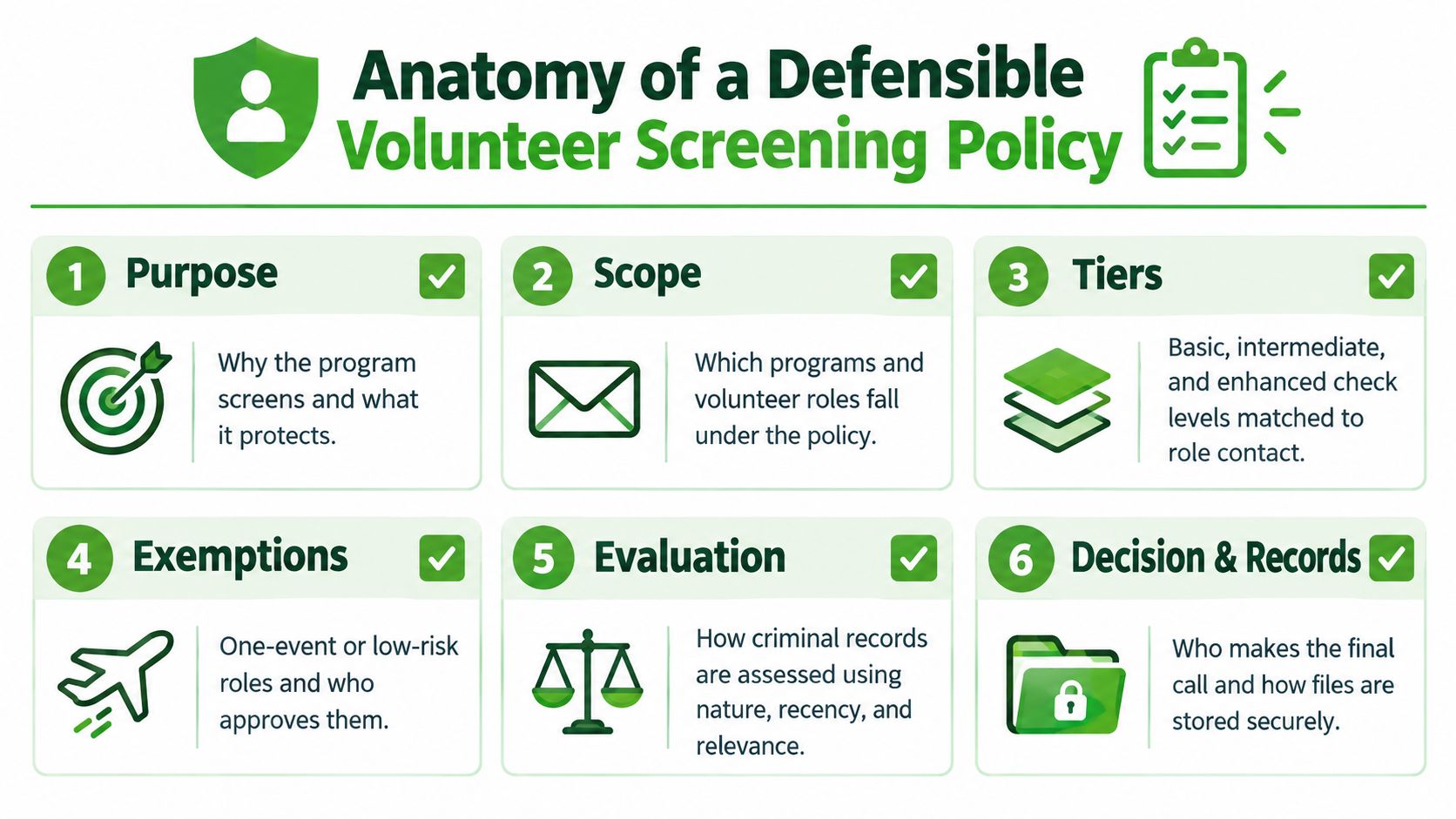
- Purpose: State that screening supports participant safety, responsible placement, consistent decisions, and legal compliance. Do not promise that screening removes risk.
- Scope: Identify covered programs and roles, including volunteers working remotely, off-site, alone, or around vulnerable people.
- Role tiers: Connect each risk level to specific checks and safeguards.
- Exemptions: Define clearly low-risk exceptions, such as a supervised one-time event, and name the approver.
- Evaluation: Require verification and an individualized, role-related review. A database alert is a lead for investigation, not an automatic rejection.
- Decision and records: Name the decision-maker, secure storage location, access permissions, retention rule, and policy owner.
The policy-versus-execution gap is substantial. A survey of 517 nonprofit human-service organizations found that 12% reported no volunteer screening. It also found that 65% treated an accusation of child abuse as disqualifying, while only 42% reported checking state child-protection records. The survey findings and their implications for organizations working with children offer a useful benchmark for reviewing your own process. The gap between stated disqualification standards and actual record checks is where much of the liability exposure lives.
Clauses worth adding
Write instructions that control action, not broad promises:
- Before placement: “No covered volunteer may begin the assigned role until required screening, authorization, orientation, and approvals are complete.”
- Results: “A possible match triggers record-level verification and individualized review. It is not a final decision.”
- Escalation: “Identity mismatches, pending matters, restricted records, and uncertain dispositions must go to the designated reviewer.”
- Re-screening: “The organization will re-screen according to role tier and listed event triggers.”
- Governance: “The policy owner will review the document on a defined schedule and after material legal, program, or incident changes.”
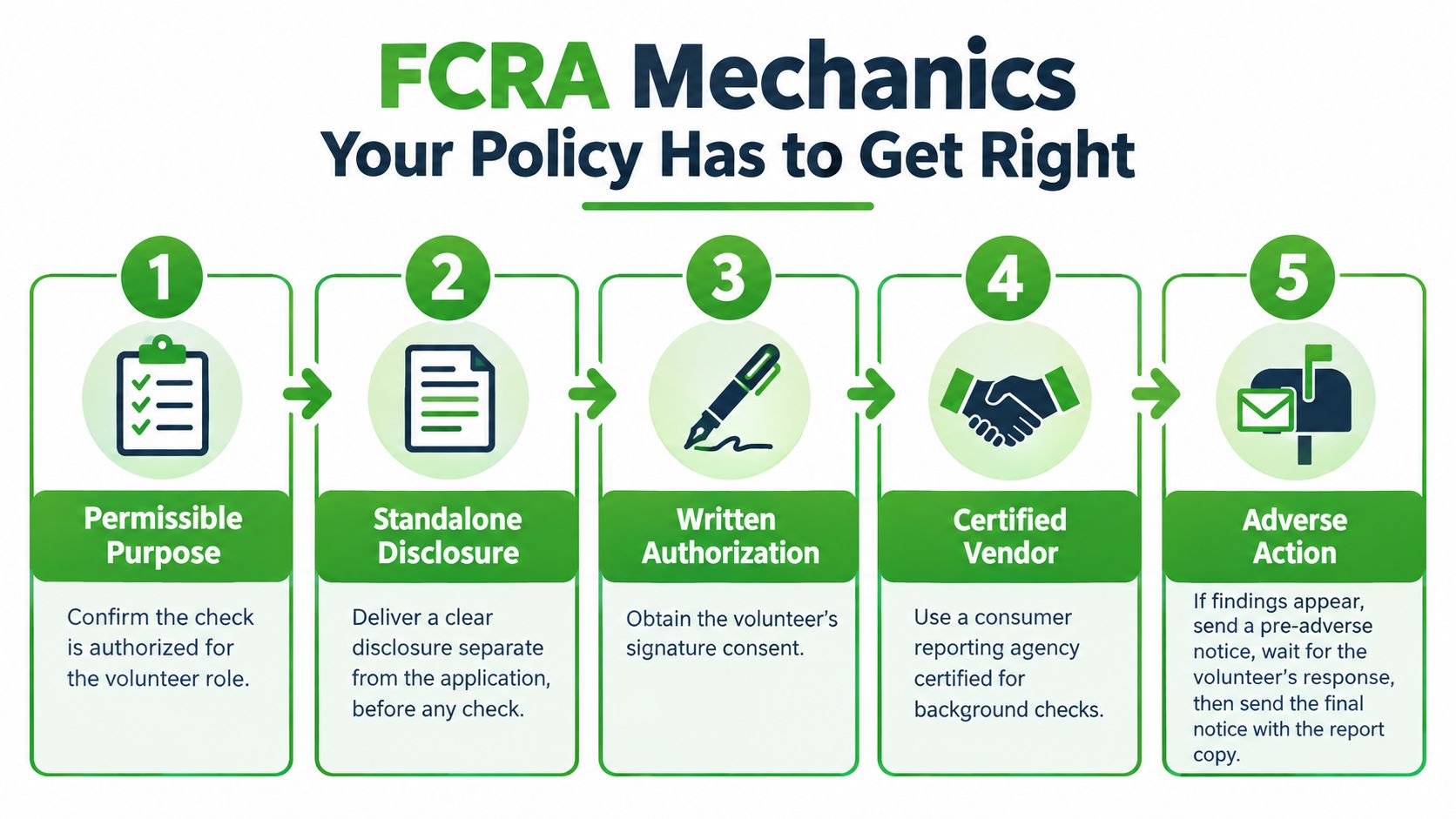
Write the workflow in the order a coordinator performs it: establish a permissible purpose, obtain authorization, order the appropriate report, verify any possible match, conduct the individualized review, and issue required pre-adverse and adverse-action notices when applicable. That sequence is what turns a template into an auditable process.
Requirements differ by location and setting. Compare the policy with applicable local obligations instead of importing another jurisdiction's template. An overview of Australian security clearance rules illustrates why screening requirements must match both the role and the regulatory context.
Tiering Volunteer Roles by Risk Before You Run a Single Check
Don't begin with a vendor package. Begin with the role.
A volunteer who mentors a child alone needs a different control set from someone sorting donated goods in a staff-supervised room. Applying the same package to everyone can waste resources and frustrate low-risk applicants. Applying a minimal check to everyone can leave the highest-exposure roles under-protected.
Build the matrix around contact, access, independence, vulnerability, and mobility. Ask whether the volunteer can be alone with a participant, transport someone, access sensitive information, enter a private home, handle money, or move between sites without direct supervision. Then document the checks and safeguards that follow from those answers.
| Risk Tier | Example Roles | Required Checks |
|---|---|---|
| High | Youth mentor, overnight chaperone, coach, volunteer with unsupervised contact | Identity and address verification, appropriately scoped criminal-history searches, legally relevant registry checks, references, structured interview, required training, documented supervision, and recurring re-screening |
| Moderate | Off-site driver, client-facing intake helper, community outreach volunteer | Identity verification, role-appropriate criminal-history checks, driving or license review where relevant, references, interview, training, and defined supervision |
| Low | Donation sorter, event greeter, administrative helper in a supervised setting | Identity confirmation where required, basic application review, interview or reference process appropriate to the role, orientation, and clear limits on access |
The table is a starting structure, not a universal legal answer. A low-contact role can become higher risk if the volunteer gains unsupervised access, while a high-risk role can change when the program adds transportation or overnight activity. The coordinator should record the reason for each tier so staff turnover does not change the standard.
Make placement depend on the tier
The screening decision belongs inside onboarding, not in a separate administrative silo. Before a volunteer receives access, the coordinator should confirm that the required report, references, interview, training, and supervisor assignment are complete. A practical volunteer onboarding workflow can help connect those checkpoints without creating duplicate forms.
Review the matrix whenever a volunteer changes roles. A person who passed screening for a supervised office assignment shouldn't automatically inherit approval for direct work with children or vulnerable adults.
FCRA Mechanics Your Policy Has to Get Right
When a third-party consumer reporting agency provides a report, the Fair Credit Reporting Act workflow needs to appear in the policy in the order staff perform it. The main tripwire is treating consent as boilerplate buried inside a long volunteer agreement.
Start with purpose and disclosure
First, identify the permissible purpose for obtaining the report. The organization should document why the report relates to the volunteer role and ensure the requested search is legally appropriate.
Before ordering the report, give the applicant a clear, standalone disclosure that a consumer report may be obtained for screening. Keep that disclosure separate from unrelated acknowledgments, waivers, codes of conduct, and application language. Then obtain written authorization. The policy should instruct staff not to order a report until both steps are complete.
A useful internal sequence is:
- Confirm the role and permissible purpose.
- Deliver the standalone disclosure.
- Obtain written authorization.
- Order through the reporting agency.
- Review any possible match at the record level.
- Send pre-adverse-action materials if exclusion may follow.
- Consider the response and verify the final decision.
- Send the adverse-action notice if the organization declines or otherwise takes adverse action.
The organization can use a dedicated FCRA disclosure and authorization form, but it still needs to confirm that the form and process fit its use case.
Treat a hit as a question
A database hit isn't a finding that the volunteer committed an offense. Require staff to verify identity, jurisdiction, case details, disposition, and other available record information. The reviewer should compare the verified information with written, role-related criteria and document why the record does or doesn't affect placement.
Geographic scope deserves explicit attention. The Child Safety Pilot Program operated from 2003 through 2011, conducted more than 105,000 checks, and found that more than 40% of applicants with concerning criminal histories had offenses recorded outside the state where they applied, as reported in the U.S. Department of Justice Office of the Inspector General report. A single-state search can therefore be materially narrower than the risk history a youth-serving organization needs to evaluate.
Follow the adverse-action sequence
If verified information may lead to exclusion, the organization should send a pre-adverse-action notice, a copy of the report, and the applicable FCRA rights summary. The volunteer needs a meaningful opportunity to dispute inaccurate or incomplete information. Staff should pause the final decision long enough to receive and assess that response under the organization's documented process.
If the organization proceeds, the final adverse-action notice must identify the reporting agency, explain that the agency didn't make the decision, and provide information about the volunteer's dispute and free-report rights. The policy should assign responsibility for each notice and preserve proof that it was sent.
Setting a Rescreening Cadence That Matches the Risk
A volunteer cleared for weekend youth activities may later gain unsupervised access, drive participants, or return after a long absence. The original report cannot capture those changes. Screening is a point-in-time snapshot, so the cadence itself becomes the control. Set it by role tier, not by habit.
A defensible pattern is every 24 months for high-tier roles, every 36 months for moderate roles, and event-triggered checks for low-tier roles. Adjust the schedule when the duties, access, supervision, or population changes. Put the interval, owner, required authorization, and completion record in the policy so coordinators can administer it consistently.
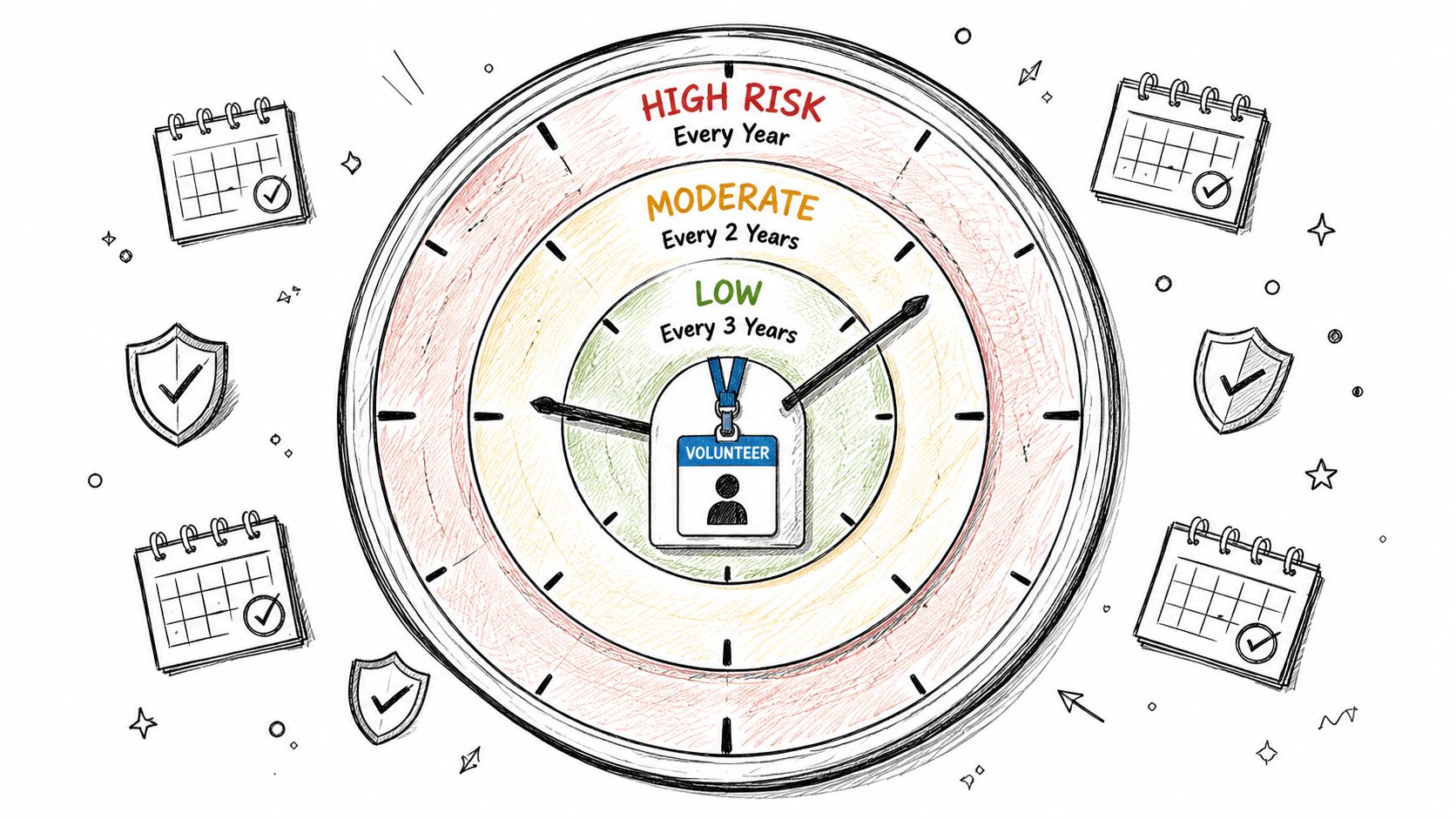
High-exposure roles need the shortest review interval and the clearest event controls. Moderate roles require a defined periodic check that matches their access. Low-risk roles may rely more on supervision and checks tied to role changes, but the policy must state that choice plainly.
List off-cycle triggers
Do not leave coordinators to decide case by case. Name the events that require a review:
- Role change: The volunteer takes on direct, unsupervised, overnight, transport, or home-visit duties.
- Program change: The organization adds a population, site, or activity with greater exposure.
- Compliance signal: A credible concern, required disclosure, or relevant information reaches the organization.
- Extended return: A volunteer comes back after a substantial absence and needs renewed authorization.
- Record uncertainty: A prior report was incomplete, unresolved, or connected to an identity mismatch.
Apply the same trigger rules to people in comparable roles. Tell existing volunteers that rescreening follows the position's requirements, not an individual accusation. Give them advance notice, repeat the required authorization process, identify the staff contact for questions, and record the outcome. That approach keeps the cadence understandable and gives the organization evidence that it followed its own policy.
Consent, References, and Interviews in the Same Workflow
Consent, references, and interviews should form one intake path. They shouldn't become three disconnected checklists that ask volunteers for overlapping information and leave coordinators unsure which step is complete.
Begin with the role assignment. The coordinator explains the duties, access, supervision, and required checks before collecting information. The standalone disclosure then tells the volunteer that a consumer report may be obtained for the stated screening purpose, and written authorization follows as a separate step. That order supports informed consent because the volunteer knows what the process relates to before signing.
References add context that a database can't provide. Ask the same core questions for each reference:
- How does the reference know the volunteer, and for how long?
- What responsibilities did the volunteer hold?
- How did the volunteer respond to boundaries, supervision, and feedback?
- Did the volunteer work with children, vulnerable people, money, vehicles, or confidential information?
- Would the reference place the volunteer in a similar role again?
Don't turn the interview into an informal substitute for screening. Use structured questions and record factual answers. Ask about relevant experience, availability, comfort with supervision, understanding of boundaries, and any gaps or unexplained transitions in the volunteer history. Give the applicant a chance to explain discrepancies before staff draw conclusions.
Keep the record auditable
A simple intake record should show:
- Role and assigned risk tier.
- Disclosure delivered and authorization received.
- Identity and report order status.
- Reference contacts and factual notes.
- Interview date, interviewer, and outcome.
- Training and supervisor assignment.
- Final placement decision and reviewer.
Store the record securely and limit access to people who need it. The policy should distinguish screening information from ordinary volunteer files, especially where sensitive personal data or dispute correspondence is involved.
What a Clean Report Does Not Replace
A passing report doesn't supervise a volunteer, teach boundaries, or tell a participant how to report a concern. Screening is a gate, not a safety program.
The strongest post-placement controls are behavioral and operational. Supervisors need to know where volunteers work, who should be present, what contact is acceptable, and how quickly concerns move to leadership. Volunteers need a code of conduct that defines boundaries rather than relying on everyone's personal judgment.
Put the controls in the right documents
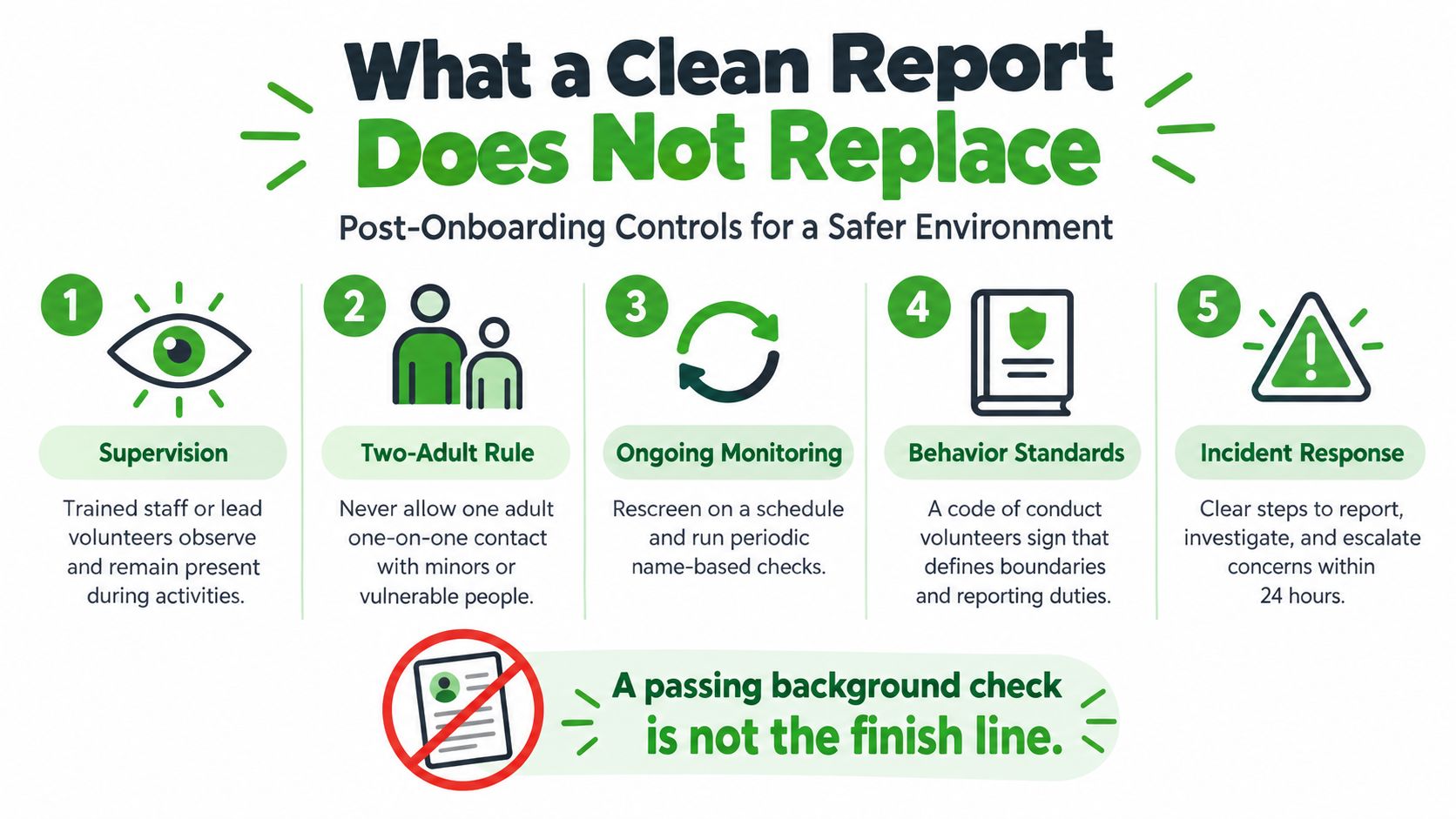
Your screening policy should connect to, but not duplicate, the following controls:
- Supervision: Assign a named supervisor and define observation, check-ins, and escalation duties.
- Two-adult expectations: Set rules for one-on-one contact with minors or vulnerable participants, including exceptions and approval.
- Training: Require orientation on boundaries, safeguarding, reporting, confidentiality, and role-specific risks.
- Behavior standards: Have volunteers sign a code of conduct that describes prohibited behavior and reporting obligations.
- Incident response: Give staff a clear route to report, document, investigate, and escalate concerns.
The screening policy should state when these controls must be complete. The supervision or safeguarding policy should explain how they operate day to day. Separating the documents makes ownership clearer, but the coordinator must verify the links during onboarding.
A clean report also doesn't fix poor coverage. The Child Safety Pilot Program showed why a geographically narrow search can miss relevant records. The lesson isn't to order every available product for every role. It is to define search scope deliberately, document the rationale, and pair screening with supervision.
Roll out the policy in an accountable sequence
Give leadership a concrete implementation plan:
- Draft the purpose, scope, tier definitions, exemptions, review standard, decision authority, and records rules.
- Build the role matrix and test it against actual programs.
- Finalize the standalone disclosure, authorization, review criteria, and adverse-action workflow.
- Set periodic and event-driven re-screening rules.
- Brief supervisors on boundaries, reporting, and documentation.
- Communicate the change to current volunteers, not only new applicants.
- Obtain board or executive approval where governance rules require it.
- Set a policy review date and assign an owner.
Avoid launching only for new volunteers while leaving current high-exposure volunteers outside the process. Don't let a vendor's default package become your policy. Don't allow one person to make undocumented exceptions. And don't store reports in an open shared folder just because it is convenient.
A board-ready checklist is short: every covered role has a tier, every tier has required checks, every check has a documented consent path, every possible hit has a review standard, every exclusion has the correct notices, and every active role has supervision after placement. That is what turns a template into a working volunteer screening policy.
VolunteerBadge helps nonprofits run role-based volunteer background screening with digital disclosure and authorization, identity and address-history checks, configurable re-screening settings, and FCRA workflow support. Review the platform at VolunteerBadge and use it alongside your written policy, tier matrix, supervision rules, and adverse-action process.
