
What Is a Turnaround Time for Volunteer Background Checks
What is a turnaround time for volunteer background checks? Learn typical TAT ranges, what slows results, and how to set expectations with volunteers.
On this page
Turnaround time is the full elapsed time from request submission to a completed result, including queue and verification time. For volunteer screening, VolunteerBadge results arrive in 24–48 hours, while county checks commonly take 1–5 days.
A volunteer has completed the application, agreed to the screening, and told the program director they're ready to help at Saturday's food distribution. The coordinator wants to say yes, but the clearance still hasn't arrived. Each day of waiting creates another message to answer, another schedule to adjust, and another opportunity for the volunteer to lose momentum.
That's where understanding turnaround time helps. It isn't just how long a search takes inside a database. It's the time that passes from submitting the request to receiving the finished, reviewable result. A database search may move quickly, while a county verification, missing address detail, or manual record review takes longer.
For a nonprofit, this distinction affects more than administration. It shapes volunteer onboarding, event staffing, communication, and confidence in the screening process. A clear expectation helps you protect safety without leaving willing people in the dark.
Table of Contents
- Introduction Why Turnaround Time Matters for Your Volunteers
- What Turnaround Time Means in Background Checks
- How Turnaround Time Is Measured Across Three Stages
- Typical Turnaround Time Ranges by Check Type
- What Causes Turnaround Time to Change
- How to Set Clear Expectations With Volunteers
- Planning Faster Onboarding Without Cutting Corners
Introduction Why Turnaround Time Matters for Your Volunteers
A volunteer coordinator often works backward from a fixed date. The youth program begins next week. The church's meal service needs another driver. The community cleanup has a full schedule and not enough team leads. Someone is ready to serve, but the background check is still pending.
That delay can feel personal to the applicant. They may wonder whether they completed something incorrectly or whether the organization changed its mind. Meanwhile, the coordinator may be trying to check a status, fill a vacant shift, and avoid promising a start date that screening timelines can't support.
Turnaround time, or TAT, is an operational measure of elapsed time. In a screening context, it starts when the request is submitted and ends when the completed result is available. It can include intake, consent, queue time, searches, verification, review, and delivery. Treating only the database query as TAT gives coordinators an incomplete picture.
Practical rule: Tell volunteers when the check begins, what range to expect, and what may cause a delay.
The consequences of unclear timing appear in ordinary nonprofit situations:
- Event staffing: A delayed clearance can leave a coordinator scrambling to replace a volunteer.
- Volunteer momentum: People who are eager to help may disengage when they receive no update.
- Trust: Plain explanations make screening feel like a consistent safety process rather than an unexplained hurdle.
- Planning: A coordinator can schedule orientation and supervised activities more responsibly when the screening stages are visible.
The answer to “what is a turnaround time” becomes useful when it changes how you plan. Instead of promising that every applicant will clear on the same schedule, you can separate fast database results from slower verification work, communicate ranges, and create a reasonable buffer before a volunteer's first unsupervised assignment.
This approach doesn't mean lowering screening standards. It means planning around the actual work involved, so responsible screening and a welcoming volunteer experience support each other.
What Turnaround Time Means in Background Checks
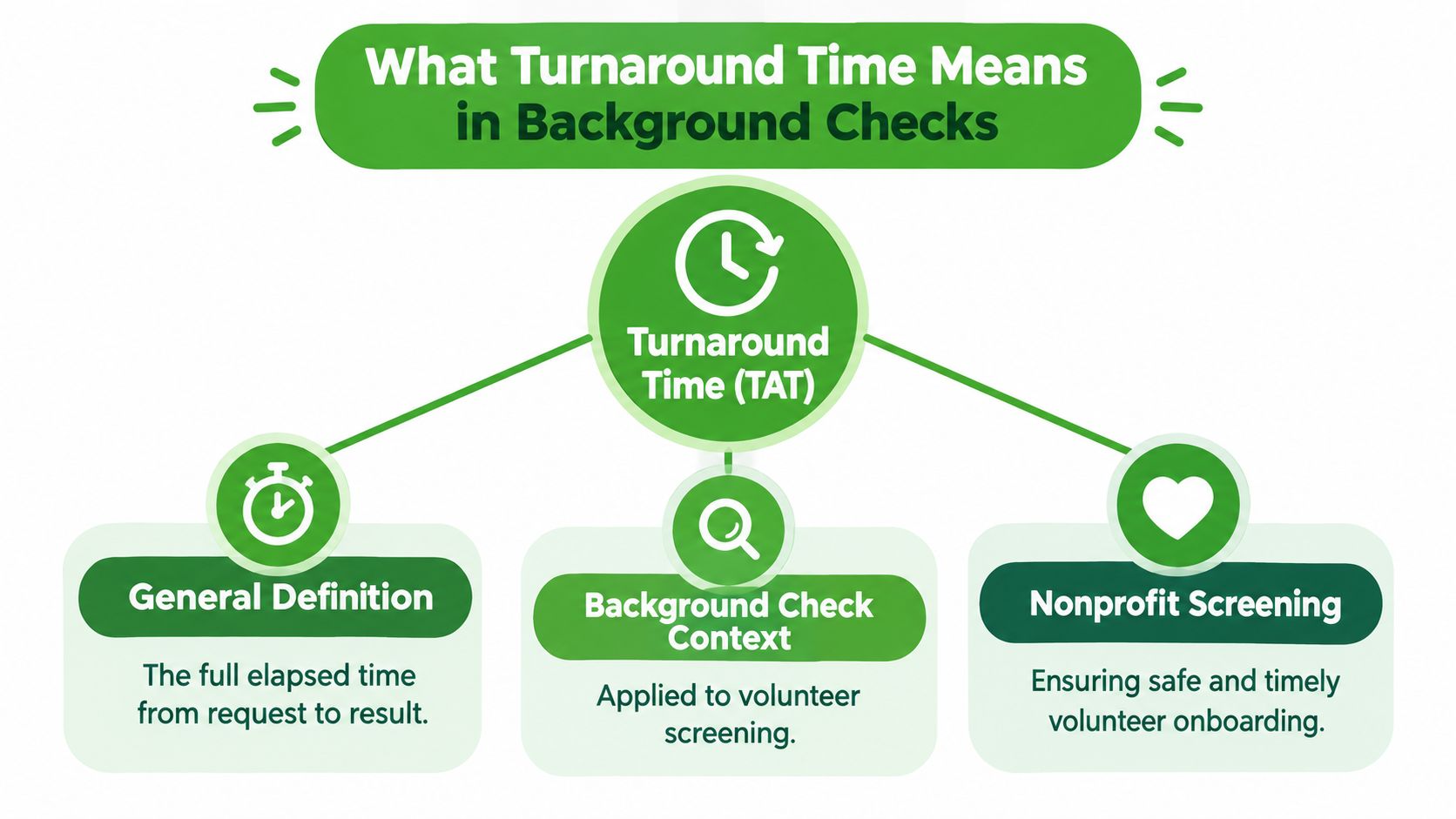
The simplest definition is the full elapsed time from submitting a request to completing the result. That includes time when a request is waiting in a queue, not only the moments when a person or system is actively searching records. Neutral explanations of the term distinguish this complete duration from related measures such as lead time and cycle time, which may be defined differently depending on the workflow (this overview of turnaround time discusses those distinctions).
Consider ordering a package. Processing at the warehouse may take only a short time, but the total time also includes the order entering the system, waiting for fulfillment, traveling through the delivery network, and arriving at your door. If you measure only warehouse handling, you miss the experience that matters to the recipient.
A background check works in a similar way:
- Request submission: The organization starts the check and collects the required authorization.
- Information gathering: The screening process uses identifying information and address history to determine where searches or verifications may be needed.
- Search and verification: Records are searched, and potential matches may require confirmation through a relevant jurisdiction or source.
- Review and delivery: The result is reviewed and released in a form the organization can understand and use.
Why the full elapsed time matters
A fast initial search doesn't always mean the complete check is finished. A record may need county-level verification, or an applicant's history may contain an address gap or name variation that requires clarification. The first step can be nearly immediate while a later step adds days.
That's why a single service-level promise can confuse nonprofit teams. It may describe the expected time for a standard search, while the applicant is waiting for a different component. A useful status update should identify which stage is complete and which stage remains open.
The nonprofit version of the definition
For volunteer coordinators, TAT answers a practical question: When can I responsibly treat this volunteer's screening as complete? The answer isn't the moment a search starts or when an initial database response appears. It's when the required screening work has been completed, reviewed, and reported in accordance with the organization's process.
Use the term consistently in internal policies and volunteer communications. If your team means “time until the final report is ready,” say that. If a vendor provides separate estimates for national searches and county verification, keep those components visible rather than combining them into an unexplained average.
How Turnaround Time Is Measured Across Three Stages
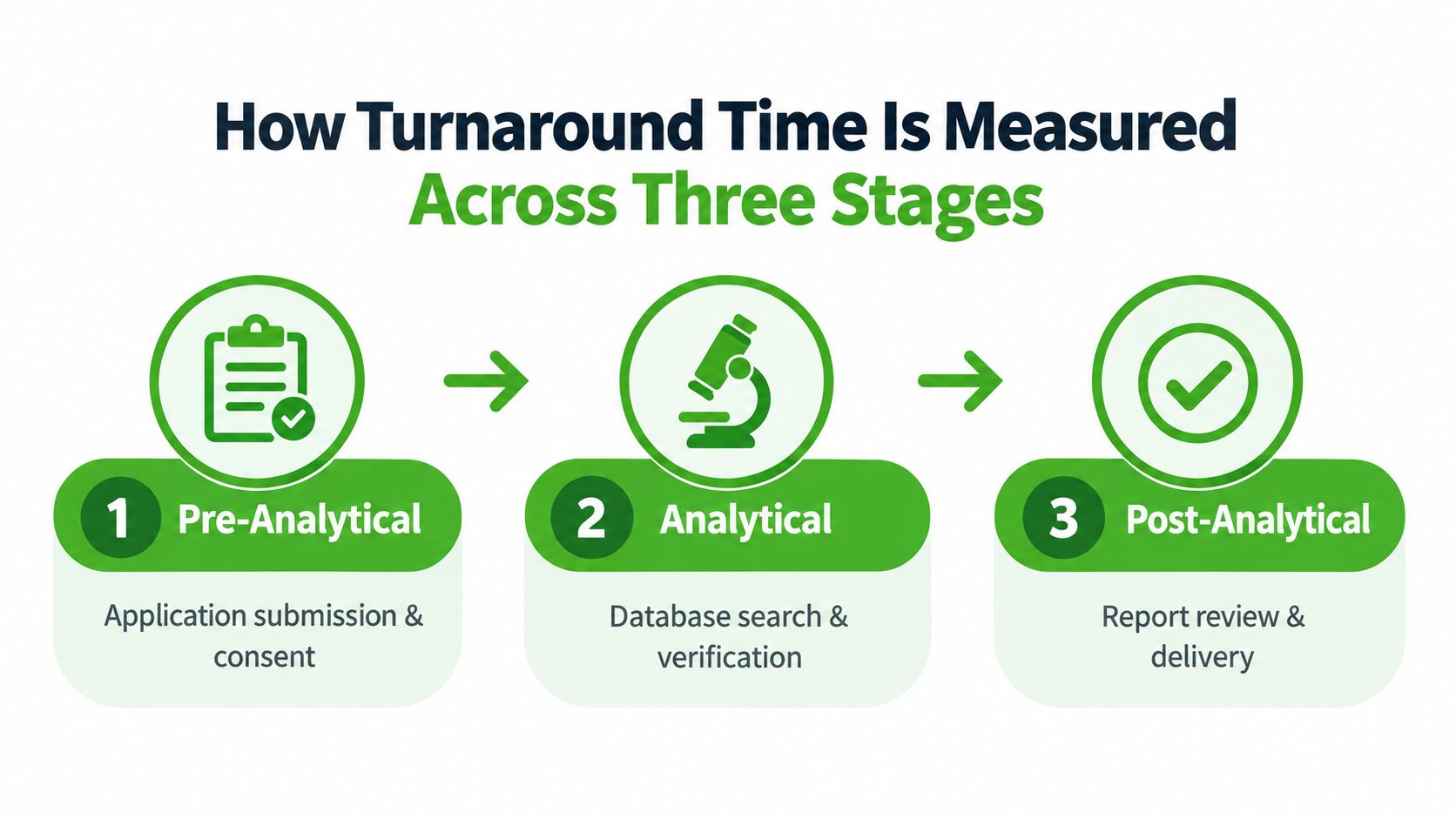
Laboratory medicine offers a helpful model for understanding elapsed time. A review of laboratory TAT explains that the metric is commonly measured from sample receipt to validated result reporting, and that published studies often divide the work into pre-analytical, analytical, and post-analytical stages (laboratory turnaround time research). The same logic maps cleanly to volunteer background screening.
Pre-analytical work
This stage begins before the search itself. For a nonprofit, it includes submitting the applicant's information, collecting disclosure and authorization, checking identifying details, and gathering address history. Missing information or inconsistent entries can create follow-up work before the main search proceeds.
A coordinator who sends an incomplete request may unintentionally add waiting time. The screening provider may need clarification, or the applicant may need to correct information before the next stage can start.
Analytical work
The analytical stage is the search and verification work. It can include a national criminal search, jurisdiction-specific research, and review of possible records. A broad database result may arrive quickly, but a county record may require additional verification before it can be reported for compliant screening.
This is the point where check type and jurisdiction have the greatest effect on timing. Two volunteers who submit forms on the same day may have different TAT because their records require different levels of confirmation.
Post-analytical work
The final stage includes reviewing the findings, resolving reporting requirements, and delivering the result. A report that contains a potential record may need human review before release. That review is part of the completed process, not an optional activity outside TAT.
The three-stage model gives coordinators a better diagnostic question than “Why is this taking so long?” Ask instead:
- Pre-analytical: Was the request complete and properly authorized?
- Analytical: Is a search or jurisdictional verification still pending?
- Post-analytical: Is the report undergoing review or awaiting delivery?
That sequence turns a vague delay into a status that can be explained to the volunteer.
Typical Turnaround Time Ranges by Check Type
Background checks don't have one universal timeline because each component depends on different records and verification steps. Recent guidance gives the following typical ranges for common screening components (background check timing by component):
| Check Component | Typical Turnaround Range | Variability Driver |
|---|---|---|
| National criminal search | 1–3 days | Record availability and the need to identify relevant jurisdictions |
| County criminal search | 1–5 days | County access, courthouse processes, and manual verification |
| Employment verification | 2–5 days | Employer response and the completeness of applicant information |
| Education verification | 2–7 days | Institution response and verification requirements |
| International record search | 20 days or more | Country-specific access, language, process, and record availability |
These ranges are more useful than a single average because they show where the uncertainty lives. A national search may return within its usual window, while an education verification remains open because the institution has not confirmed the information. An international search can extend substantially beyond domestic components because access and verification practices differ by country.
VolunteerBadge states that its volunteer screening results arrive in 24–48 hours, while county searches commonly take 1–5 days. Its product information describes a national criminal search spanning county, state, and federal courts, along with sex offender registries and watchlist searches. For a nonprofit comparing providers, the important question is what the stated result time includes and how exceptions are handled.
Read the range as a planning tool
A range isn't a guarantee. It helps you decide when to start a check and when to send a status update. If an applicant needs an education or international verification, don't use the national search estimate as the expected completion date.
A clear estimate names the component, the usual range, and the condition that could extend it.
The practical lesson is simple. Ask for component-level timing, keep the stages visible, and avoid telling every volunteer that their result will arrive on the same schedule.
What Causes Turnaround Time to Change
A screening request can begin with clean information and still take longer than another request submitted at the same time. The difference usually comes from the records and jurisdictions involved, not from a single overall processing speed.

Record availability and jurisdiction coverage
A volunteer who has lived in one area may require a simpler path than someone who moved across several counties. Each relevant jurisdiction can introduce its own search and verification process. If a county record exists but can't be verified under applicable requirements, the provider may need to continue investigating or report that the component remains unresolved.
Courthouse operations also vary. Staff availability, access methods, record indexing, and manual retrieval can all influence the elapsed time. The screening company can't make an unavailable record appear instantly, and a responsible provider shouldn't treat an unverified record as a completed result.
Applicant information and follow-up
Incomplete address history, name variations, and inconsistent dates can create questions. A coordinator may see this with a volunteer who uses a middle name on one form, an abbreviated name elsewhere, and leaves out a former address. The initial search might be quick, but the follow-up needed to confirm identity can extend the process.
Automated address-history tools can help flag gaps before a credit is used, but the coordinator still needs a clear way to ask the volunteer for clarification. Accurate information at intake reduces avoidable back-and-forth.
Volume and workflow conditions
High application volume can affect queue time, especially around seasonal programs, school enrollment periods, holiday events, or large community projects. A provider's review workflow also matters when a report contains a potential record and requires human attention.
For a deeper explanation of these delays, see why background checks take so long. The useful mindset is to identify the open component rather than assume the entire system has stopped.
After a substantive check of the likely causes, coordinators can use visual explanations when training staff or explaining the process internally.
A good status message might say that the initial search is complete but county verification is still pending. That tells the volunteer what is happening without suggesting a problem where there may be a normal jurisdictional delay.
How to Set Clear Expectations With Volunteers
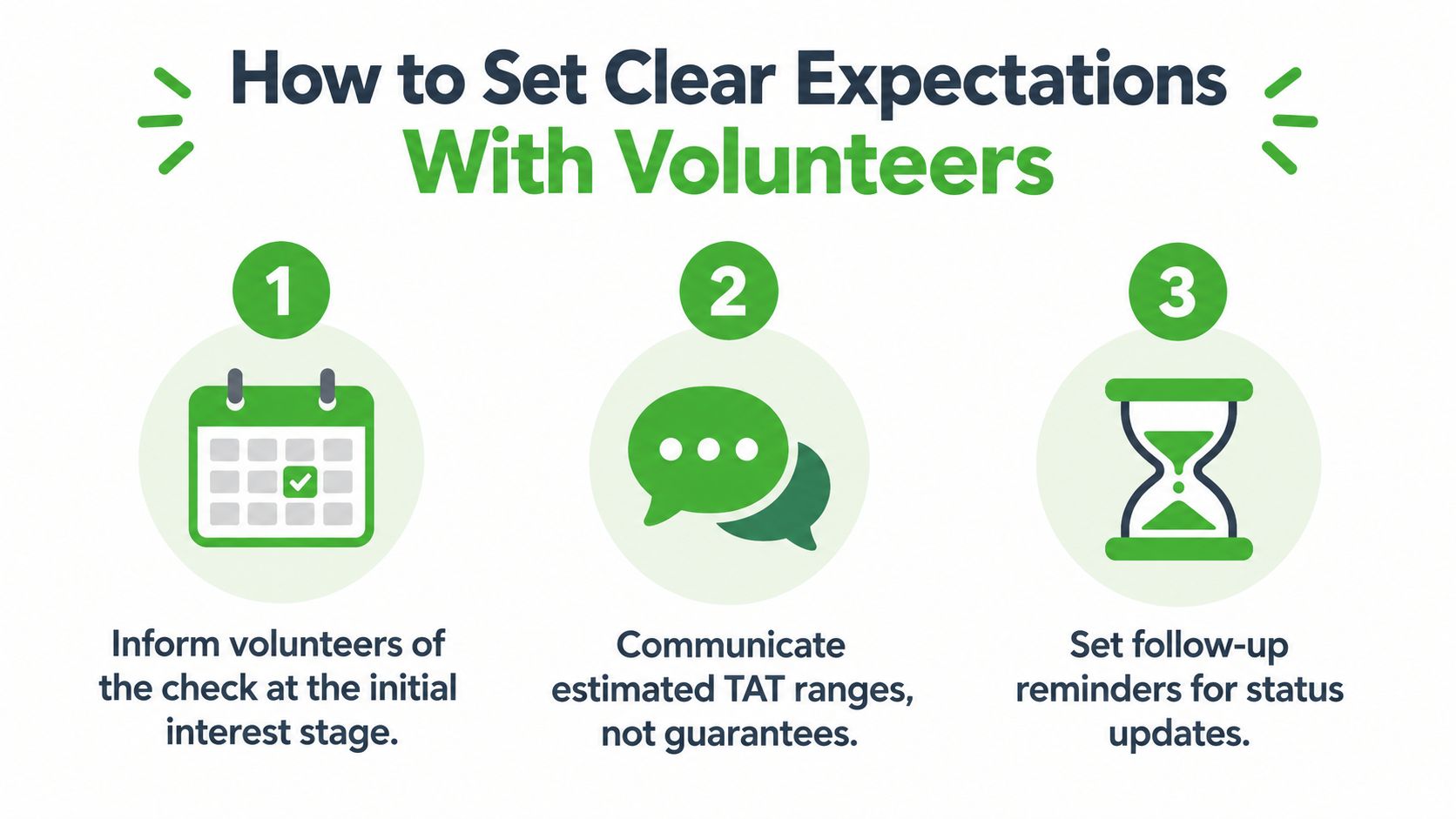
Expectation-setting starts before the applicant submits the form. Tell people that screening is part of the onboarding process, explain that the completed result can include verification time, and give an estimated range rather than a guaranteed finish date.
Use plain language in the disclosure and authorization workflow. A volunteer doesn't need a technical explanation of every search source, but they do need to know what information they'll provide, why authorization is required, and how the organization will communicate if clarification is needed.
Give the estimate at the right moment
Mention the check during the initial interest conversation, not after the volunteer has committed to a first shift. Early notice lets applicants plan around the process and reduces the chance that they interpret screening as a last-minute obstacle.
A short explanation can be enough:
“The check begins after you complete the authorization. Some results arrive quickly, but county or other verification work may take longer. We'll update you if anything needs your attention.”
Build onboarding around the pending period
Don't schedule a volunteer for responsibilities that require completed screening before you have the result. You can still keep the relationship active through orientation, policy training, supervised preparation, or non-sensitive tasks, depending on your organization's rules.
Create a simple status routine:
- At submission: Confirm that the request was received.
- During the expected window: Send a brief update if the result isn't ready.
- When clarification is needed: Explain exactly what information the volunteer must provide.
- At completion: Confirm the next approved onboarding step.
Use tools that reduce avoidable friction
Free digital disclosure and authorization, automated address-history flagging, plain-English reports, and auto-generated pre-adverse and final adverse action notices can reduce manual coordination. They don't eliminate jurisdictional waiting time, but they can prevent incomplete submissions and make the next action clearer.
For a broader onboarding workflow, use this volunteer onboarding guide. The aim is to keep applicants informed while preserving the organization's screening and compliance requirements.
Planning Faster Onboarding Without Cutting Corners
A fast onboarding process doesn't depend on pretending every check is identical. It depends on separating the stages, starting early, collecting accurate information, and telling volunteers what the estimate covers.
Use this checklist when reviewing your process:
- Define completion: Decide whether TAT ends when the report is delivered, reviewed, or approved for the volunteer's assignment.
- Separate components: Keep national, county, employment, education, and international work visible instead of hiding them inside one average.
- Collect complete information: Make address history, names, dates, and authorization easy to submit correctly.
- Plan a buffer: Start screening before the first assignment, especially when a role involves children, vulnerable adults, transportation, or access to sensitive information.
- Track exceptions: Record which stage is pending so staff can give a useful update.
- Protect compliance: Never trade required verification or FCRA procedures for speed.
- Review the commercial model: Check whether the provider charges monthly fees, explains its result window, and addresses records that can't be verified.
VolunteerBadge lists $4.95 per check, no monthly fees, a refund when county records exist but can't be verified under FCRA guidelines, and results in 24–48 hours in plain English (fast background checks for volunteer programs). Its stated workflow also includes digital disclosure and authorization, address-history flagging, and adverse action notices.
The central answer to “what is a turnaround time” is therefore broader than a stopwatch reading. TAT is the elapsed journey from request to usable result, and each stage can shape the finish date. Nonprofits that plan around those stages can protect volunteer enthusiasm without weakening safety practices.
Review your current volunteer workflow, identify the longest screening component, and move the request earlier than the first assignment. For a screening process with clear timing, plain-English reporting, and nonprofit-focused tools, visit VolunteerBadge and start planning onboarding around the full turnaround time.
