
Disposition of Cases: A Volunteer Screening Guide
Learn how to handle the disposition of cases in volunteer screening, ensuring fair decisions and clear documentation for your organization.
On this page
You're reviewing a background check for a volunteer who wants to help with your church's children's program. A criminal case appears, but the outcome field says only disposed. The program leader needs an answer, the volunteer is waiting, and you can't tell whether the court dismissed the charge or entered a conviction.
Table of Contents
- Why a Single Line on a Screening Report Matters
- What a Case Disposition Actually Means
- Common Disposition Types and What Each One Signals
- Reading Dispositions at the Charge Level vs the Case Level
- How Dispositions Fit into FCRA Adjudication
- When Sealed or Expunged Records Resurface on a Report
- A Coordinator Checklist for Interpreting Court Dispositions
- Turning Disposition Literacy into Fair Screening Decisions
Why a Single Line on a Screening Report Matters
Consider a hypothetical youth ministry coordinator reviewing that report. The applicant has provided references and completed the organization's onboarding paperwork, but the coordinator hesitates over an unfamiliar court entry. Approving the applicant without clarification feels careless; rejecting them because a case exists feels unfair.
The problem isn't necessarily the applicant's history. It's that the report hasn't answered the question the coordinator needs answered: What happened to the allegation? A completed court proceeding and a finding of guilt aren't interchangeable.
Separate the information problem from the decision
The coordinator's immediate task should be to resolve the incomplete record, not to decide whether the applicant is a suitable volunteer. Those are different tasks, and combining them encourages assumptions.
A practical response would be to mark the application for clarification, contact the screening provider, and request the actual outcome. The coordinator can explain to the applicant that the organization needs complete information before continuing its review, without suggesting that an accusation establishes misconduct.
Practical rule: An unclear disposition is a reason to investigate the record, not a reason to invent its meaning.
For a youth-serving organization, both errors matter. An unexplained entry might conceal information relevant to safeguarding, or it might describe a charge that never resulted in conviction. Neither possibility justifies guessing.
Make the outcome a required field
Treat disposition as an adjudication field in your screening process, alongside identity verification and the role under consideration. Don't allow a report's completion status to substitute for the court's outcome.
Your internal screening worksheet should distinguish:
- Record completeness: Does the report contain enough verified information to interpret the entry?
- Legal review: Can the organization lawfully consider that information in this screening context?
- Suitability review: Does information that may be considered affect eligibility under the organization's role-specific policy?
This separation gives a coordinator a defensible next action even before the final answer is available. It also keeps a confusing database label from becoming an automatic rejection.
What a Case Disposition Actually Means
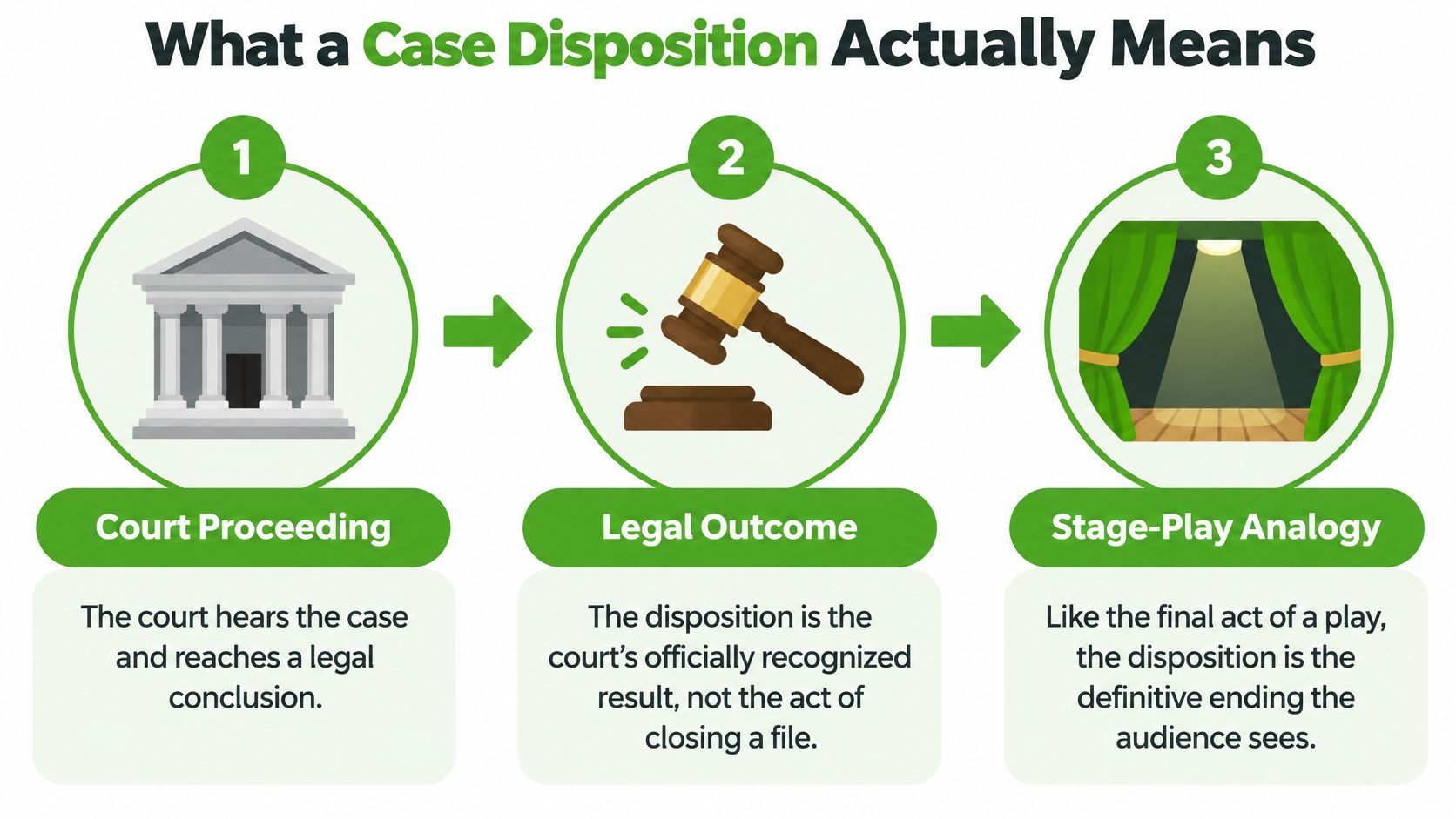
A case disposition is the court's officially recorded, legally recognized outcome. Think of a criminal proceeding as a stage play: charging introduces the allegation, hearings develop the proceeding, and the recorded disposition identifies how the matter resolved. The ending isn't always a finding of guilt.
The process illustration offers a useful starting point, though a later court order can change a previously recorded result.
Distinguish events from outcomes
For screening purposes, keep these concepts separate:
- Arrest: A person was suspected or processed, not necessarily convicted.
- Filed charge: An allegation entered the court process.
- Disposition: The recorded legal outcome supplies the context needed to interpret that proceeding.
The distinction has long mattered in court research. In 1985, approximately 1.5 million felony cases were disposed of across 3,235 state felony courts, and about 69% resulted in conviction, according to the Bureau of Justice Statistics' historical state felony-court report. That's a historical benchmark, not a current conviction rate, but it illustrates why counting completed cases doesn't tell you how they ended.
Read the result, not just the status
A report marked closed or disposed still needs an outcome category. Ask whether the entry reflects dismissal, acquittal, conviction, or a different resolution, rather than treating the status label as the answer.
For jurisdiction-specific context, Olson & Sons' resource on DUI dismissal strategies for Kona is a relevant starting point for questions about dismissal in that setting. It isn't a substitute for the actual court record or advice about your organization's screening obligations.
A case can also contain separate charges with different outcomes. That means your adjudication worksheet needs space for both the overall case and its individual counts. Otherwise, even a correctly identified case can produce a misleading screening summary.
Common Disposition Types and What Each One Signals
Court terminology becomes less intimidating when you translate each label into a verification question. Don't start by asking whether the label sounds serious. Ask what legal result it records and what remains to be checked.
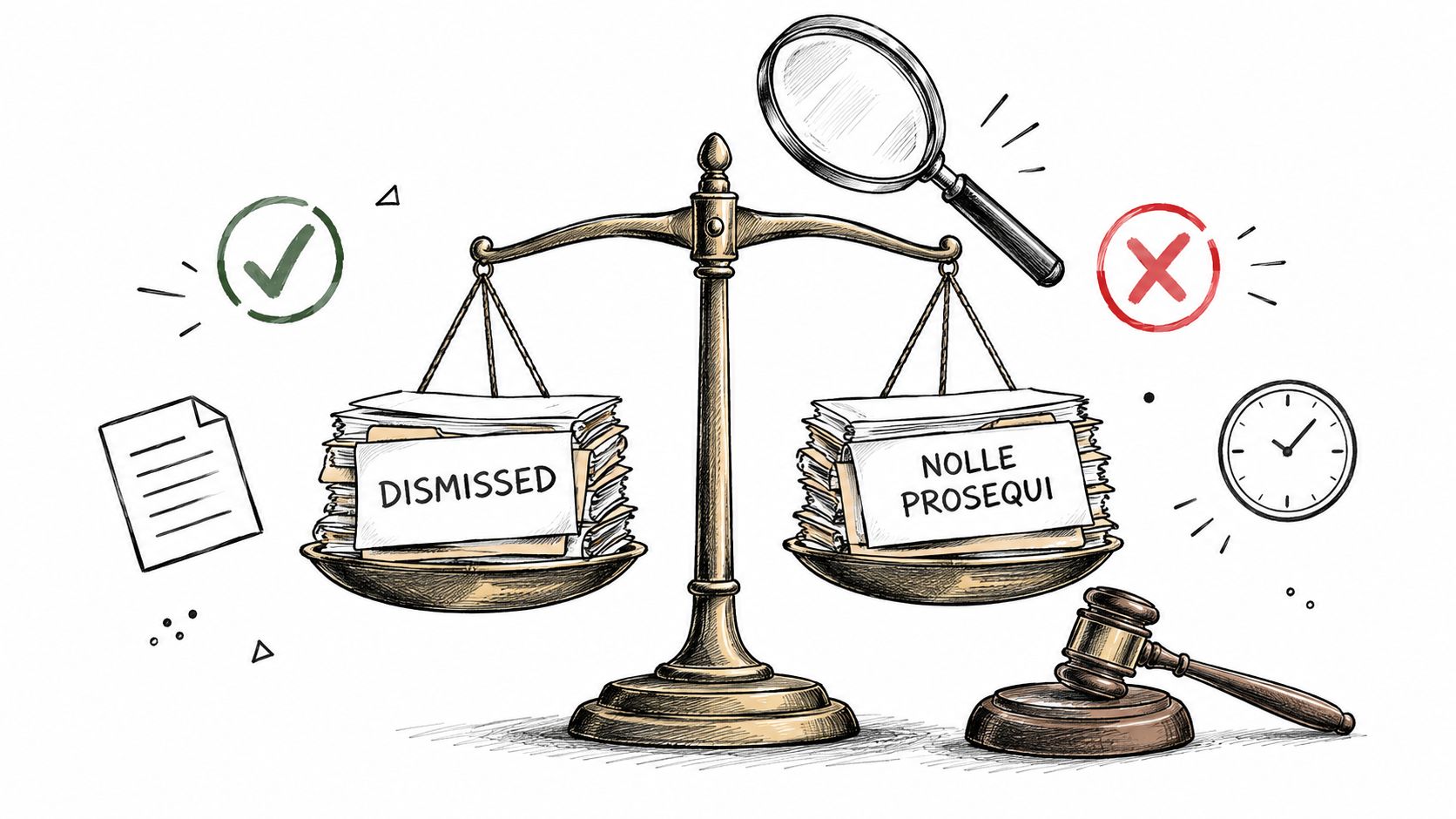
This illustration highlights labels that shouldn't be confused with convictions.
Outcomes that need different treatment
Dismissed identifies a dismissal rather than a conviction on that charge. Nolle prosequi indicates that the prosecution isn't pursuing the charge; preserve the exact wording and verify its jurisdiction-specific effect. Acquitted records a not-guilty outcome, not a conviction.
Guilty requires attention to the resulting judgment, whether the proceeding involved a plea, bench trial, or jury trial. Nolo contendere, or no contest, shouldn't be treated as a dismissal because the label doesn't say guilty. Verify the judgment and obtain legal guidance about how it may be considered.
Deferred adjudication, diversion, and a stay of adjudication require particular care. Don't assume either a conviction or an unconditional dismissal from the program's name. Miles Hansford Law Firm's discussion of how a stay of adjudication works provides context for questions to raise with counsel about that terminology.
Use outcome data without making predictions
The Bronx District Attorney reported 24,164 dispositions in 2022, including 14,944 dismissals or adjournments in contemplation of dismissal (61.8%), 7,942 convictions (32.9%), 16 acquittals (0.1%), and 1,262 other dispositions (5.2%); felony and misdemeanor conviction rates were 45.3% and 28.3%, respectively, in its case outcomes report. The combined dismissal/ACD category shouldn't be read as proof that every included matter had already reached an unconditional dismissal.
These figures describe that jurisdiction and period, not an individual applicant's likely outcome. For intake staff, the practical distinction between arrests and convictions in volunteer screening is more useful than predicting results from aggregate data.
The following video is an optional companion to your terminology review.
Pending and unknown should remain unresolved categories. Sealed, expunged, or vacated entries require verification of the operative order and its effect, rather than reliance on an older summary. None belongs in an automatic guilty/not-guilty sorting rule.
Reading Dispositions at the Charge Level vs the Case Level
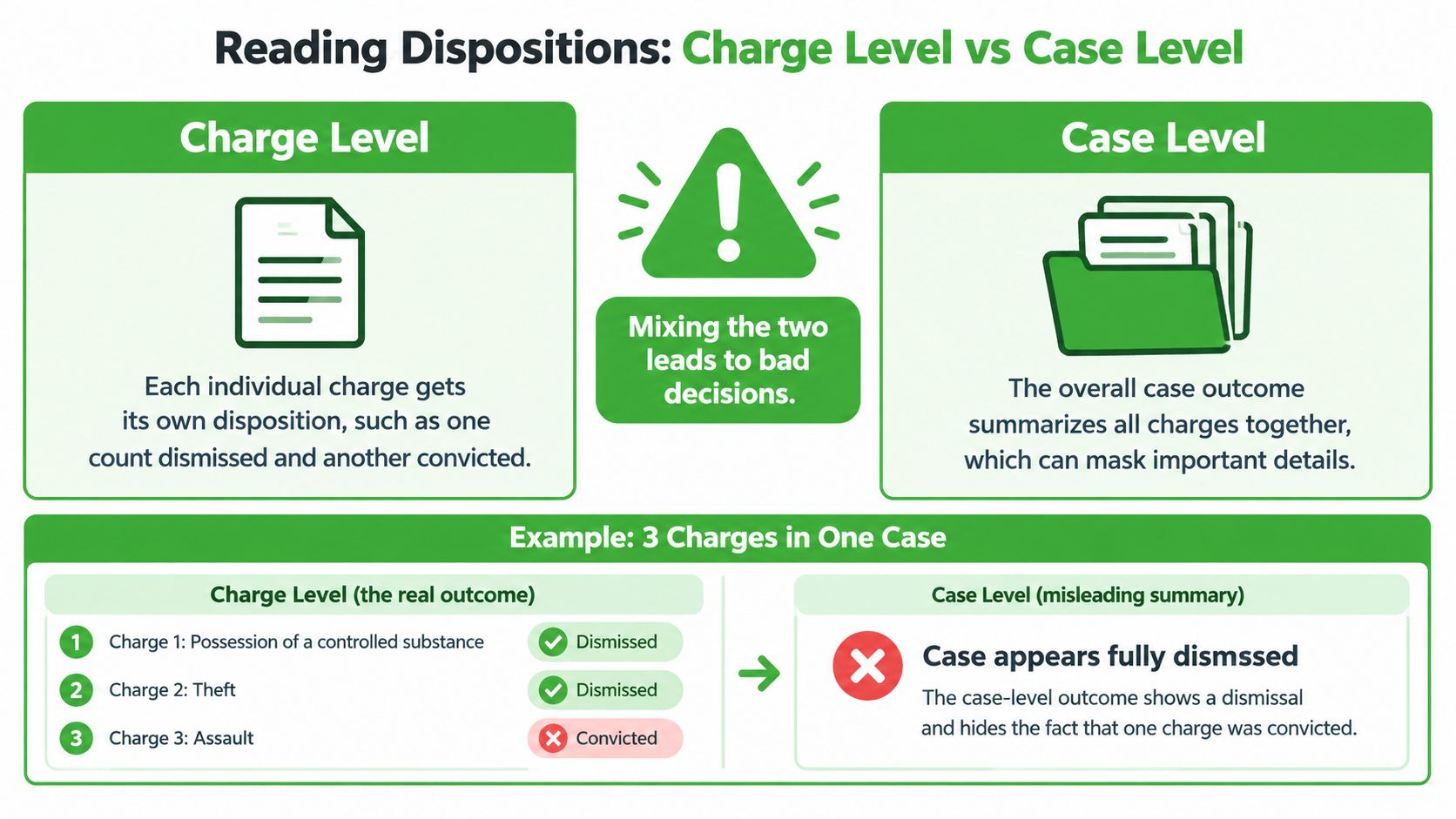
Suppose, in a hypothetical application, a report lists a theft charge and a reduced misdemeanor under the same case number. The theft count was dismissed, while the applicant entered a guilty plea on the reduced charge. A summary that labels the entire case theft conviction would misdescribe what happened.
The reverse error is also possible. A reviewer might notice the dismissed count and conclude that the entire case ended without conviction. The Bureau of Justice Statistics' criminal case-processing framework recognizes legally distinct outcomes and the importance of preserving results when individual charges resolve differently.
The comparison below shows why a summary alone can conceal important details.
Preserve both views
| Record view | Screening meaning | FCRA-related review concern | Coordinator response |
|---|---|---|---|
| Dismissed count | That count didn't produce the listed conviction | An inaccurate summary could overstate the record | Retain the dismissal separately |
| Convicted count | A conviction is recorded on that count | The exact offense and judgment need verification | Assess only the verified result |
| Case summary | An overview of the proceeding | Aggregation can obscure mixed outcomes | Reconcile it with every count |
| Missing count outcome | The record is incomplete | An assumption could create an inaccurate decision | Request clarification |
A useful record model retains the original charge, any amended charge, and the outcome attached to each. Staff should be able to trace the summary back to those underlying entries without reconstructing the case from memory.
Don't transfer a conviction from one count onto another count that the court dismissed.
Before relying on an adverse entry, confirm the defendant, court, case number, charge, disposition date, and outcome category. If the report mixes an original accusation with a later conviction on a different offense, ask the provider to clarify the relationship.
Keep jurisdiction-specific court wording alongside your normalized internal categories. That lets your organization compare records consistently without discarding legal distinctions that a reviewer or applicant may need to examine later.
How Dispositions Fit into FCRA Adjudication
Disposition review supports accurate adjudication, but it doesn't establish FCRA compliance by itself. Your organization also needs a counsel-reviewed process for obtaining and using consumer reports, communicating proposed decisions, and handling disputes. Confirm how federal, state, and local requirements apply to your particular volunteer arrangement.
For scale, federal courts reported 82,823 criminal defendants disposed of during the period ending December 31, 2025, including 77,447 convictions and 5,376 non-conviction outcomes, in the federal judiciary's defendant disposition table. Those are defendants, not a directly interchangeable count of state cases or individual charges.
Build a review process before making a decision
Use the workflow below as an orientation, not as permission to notify an applicant only after rejecting them. Where a pre-adverse action process applies, it must precede the final adverse decision.
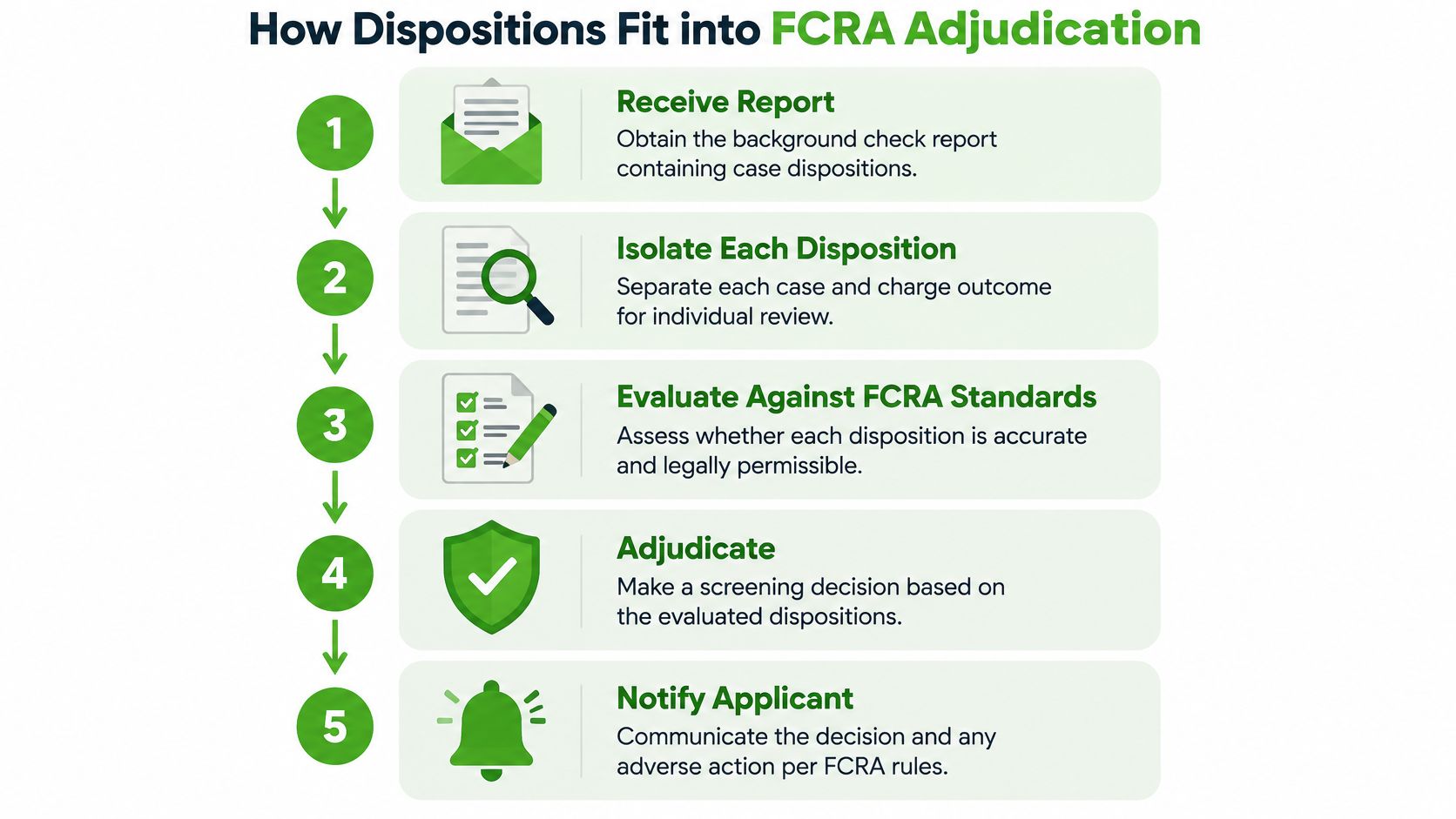
- Receive and verify: Confirm that the report belongs to the applicant and resolve incomplete or contradictory outcomes before relying on them.
- Evaluate the role: Apply your written criteria to information you may lawfully consider. An individualized assessment should examine relevance to the assignment rather than substitute a blanket rule for judgment.
- Communicate a proposed adverse decision: When the applicable process requires it, provide the pre-adverse notice, report copy, and rights information before finalizing rejection.
- Allow review and correction: Follow applicable timing requirements and give the applicant a meaningful opportunity to identify errors. Don't invent a universal waiting period for every jurisdiction.
- Finalize and document: Reconsider corrected information and issue any required final adverse action notice only after completing the review.
Keep the dispute separate from suitability
If an applicant says a conviction belongs to someone else, that's an accuracy issue first. Asking whether the alleged conduct would disqualify them doesn't resolve the mistaken identity.
Ask the screening provider to investigate through its dispute process, and request relevant documentation from the applicant without treating their inability to obtain it immediately as proof against them. A practical guide to FCRA compliance for nonprofits can support staff training, while counsel should approve the organization's actual notices and decision rules.
When Sealed or Expunged Records Resurface on a Report
An applicant tells you that a record was expunged, but your report still displays the old disposition. Don't frame the disagreement as a credibility contest. The report and the applicant may be referring to different versions of the record.
By 2025, 13 U.S. states had enacted automatic criminal-record-expungement policies, with many states also offering petition-based relief for certain non-convictions or low-level offenses after a waiting period, according to research on automatic criminal-record expungement policies. An older database extract may therefore omit a later order or retain an outdated outcome.
Separate legal status from database visibility
A record's appearance in a search doesn't settle whether it may lawfully be reported or considered. Ask the provider to verify the current court status and the effect of any sealing, expungement, correction, or vacatur order.
A historical disposition and the currently operative court record may tell different stories.
Your review should distinguish:
- Court status: What does the current order or authoritative record establish?
- Search status: When did the provider retrieve or verify its information?
- Reporting eligibility: May this information appear in the report under the applicable rules?
- Decision eligibility: May your organization use it for this volunteer role?
Record the dates that answer different questions
The disposition date identifies the recorded outcome event. The verification timestamp identifies when someone checked the information, and a later relief order may have its own date. Preserve those fields separately rather than overwriting them with a generic updated date.
Likewise, don't confuse statistical categories such as filed, terminated, and pending with a legal reporting period. A court's reporting calendar doesn't establish whether an applicant's record is eligible for inclusion in a screening report.
Set a documented refresh and recheck policy appropriate to your program and applicable law. When an applicant raises a credible correction issue, verify it rather than waiting for the next routine screening cycle.
A Coordinator Checklist for Interpreting Court Dispositions
Use a consistent worksheet so that a substitute coordinator can understand the file without relying on an informal conversation. The National Center for State Courts' data guidance emphasizes retaining the legal disposition date and manner of disposition, supported by validation and auditing.
Verify the record before classifying it
- Match identity: Compare the full name, date of birth, and other available identifiers. Don't rely on a name alone.
- Match the proceeding: Confirm the court, jurisdiction, and case number.
- Reconcile the chronology: Compare filing and disposition dates with address history as a consistency check, not proof that residence determines where a case could occur.
- Preserve charge detail: Keep amended charges and their outcomes distinct.
- Check later events: Look for relief orders, corrections, unresolved conditions, or missing results.
- Document review: Log the record source, verification timestamp, reviewer, outstanding questions, and action taken.
Disposition Labels and Their Screening Meaning
| Disposition Label | Screening Meaning | Coordinator Action |
|---|---|---|
| Conviction | A guilty outcome is recorded | Verify the judgment and apply lawful role criteria |
| Dismissed or acquitted | A non-conviction outcome is recorded | Don't classify it as a conviction |
| Deferred or diversion | The label alone may not resolve status | Verify conditions and current outcome |
| Pending or unknown | Review remains incomplete | Seek clarification |
| Sealed, expunged, or vacated | A later legal event needs examination | Verify its effect before use |
Use the worksheet alongside a guide to reading a volunteer background check, not instead of the underlying report. Flag contradictions for human review, restrict access to sensitive records, and assign responsibility for follow-up.
The strongest audit trail explains not only what the coordinator decided, but which verified information supported that decision.
Turning Disposition Literacy into Fair Screening Decisions
The disposition of cases isn't a courtroom vocabulary test. It's an exercise in separating what you know, what you still need to verify, and what your organization may appropriately do with the answer.
A coordinator who makes those distinctions can respond calmly to an intimidating entry. Instead of promising immediate approval or announcing rejection, they can identify the missing information, assign a reviewer, and explain the next step to the applicant.
Make careful review routine
Use the same standard of accuracy for a familiar community member and a new applicant. Personal trust shouldn't excuse an unresolved record, and an unfamiliar name shouldn't invite a harsher interpretation.
- Protect participants: Resolve relevant uncertainty rather than overlooking it.
- Protect applicants: Base decisions on verified, legally usable information.
- Protect the mission: Keep a review trail that another authorized person can follow.
A court outcome supplies context, not a complete risk assessment. Your organization still needs trained people, clear eligibility criteria, and consistent safeguards for the volunteer role itself.
Before your next application review, add required outcome fields to your worksheet and identify who handles unclear dispositions. That small operational change gives staff a concrete alternative to both automatic rejection and rubber-stamping.
VolunteerBadge offers volunteer background screening for nonprofits, with plain-English results, digital disclosure and authorization, and guidance for handling adverse action. Visit VolunteerBadge to explore a screening process that helps your team turn verified court outcomes into documented, carefully reviewed volunteer decisions.
