
How to Screen Volunteers Safely and Fairly
Learn how to screen volunteers with consent, multi-state checks, FCRA-compliant reviews, consistent adjudication, and tools that protect safeguarding.
On this page
You're short on mentors, practice starts Saturday, and a stack of volunteer applications is waiting for a yes or no. Most coordinators know that moment. Speed matters, but a rushed approval can create a problem you'll own for months. Learning how to screen volunteers well means building a decision system you can repeat under pressure, not buying a report and hoping it's enough.
Table of Contents
- Why Volunteer Screening Needs a Complete System
- Set Screening Policies Before Checking Applicants
- Build a Repeatable Volunteer Screening Workflow
- Choose Checks That Match the Applicant and Role
- Review Results With Consistent FCRA-Safe Decisions
- Connect Screening Tools Without Losing Human Review
- Reduce Risk and Preserve Volunteer Relationships
Why Volunteer Screening Needs a Complete System
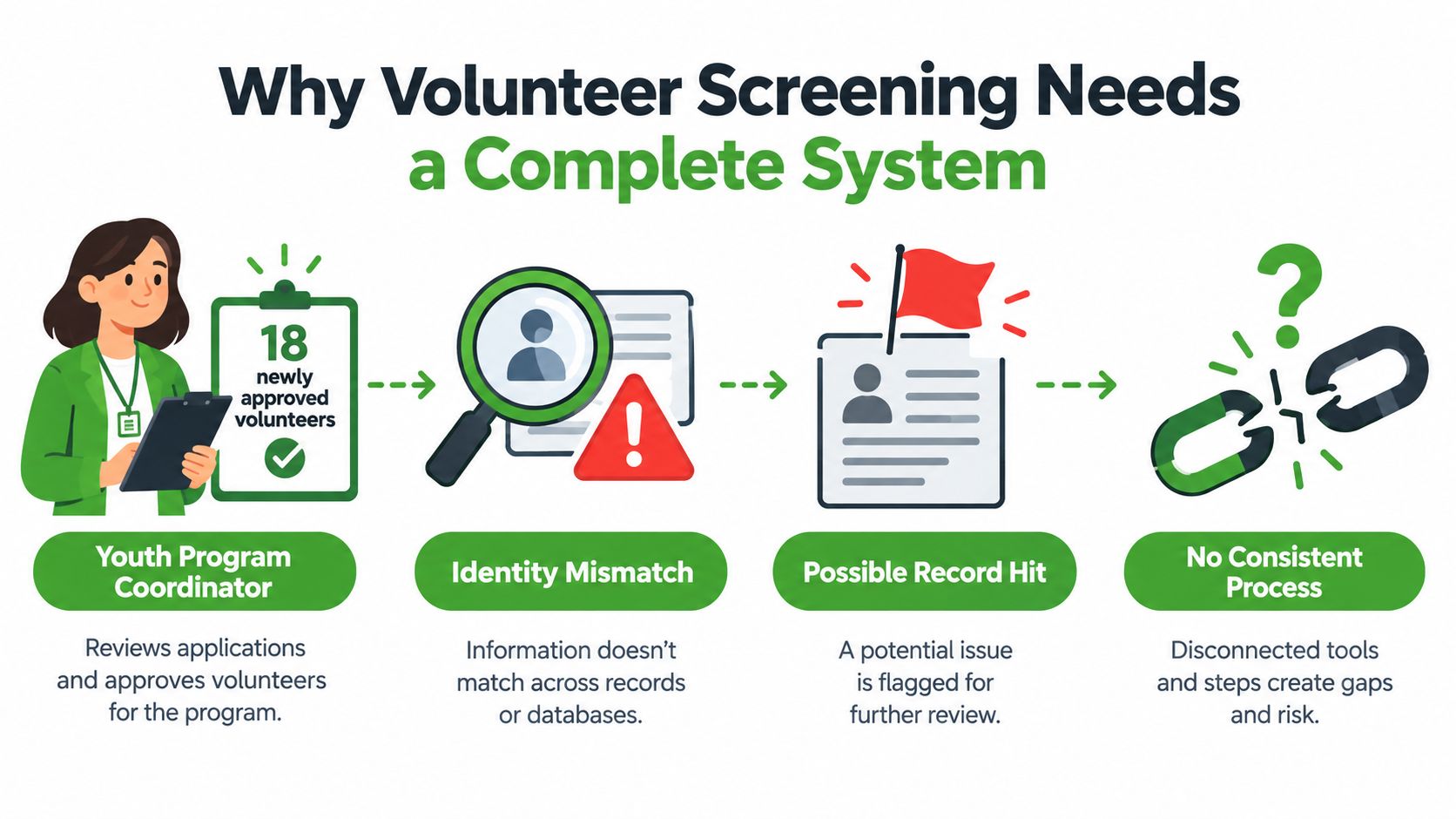
A youth program coordinator I worked with had 18 newly approved volunteers on a Monday roster and no agreed process by Friday. One applicant's date of birth didn't match her application, another had lived in three states, and a third produced a possible record hit under a former name. Nobody knew who should pause the placement, what to ask, or where to write the decision down.
That's the gap a single database search can't close. You need authorization before you search, identity checks that tell you where to search, a reviewer who can separate a possible match from a verified record, and supervision after approval. A report is one input in that chain.
What a Local Search Misses
The evidence for searching beyond your own state is blunt. A federal Child Safety Pilot Program analysis reported that more than 41% of applicants whose records raised concerns had committed an offense in a state other than the state where they applied, while more than 50% of applicants with identified criminal histories had falsely reported no criminal history. A state-only search and an honor system would've missed a lot of those people.
That doesn't mean self-disclosure is worthless. Ask the question, because a candid answer gives you context and a chance to talk. Don't treat the answer as verification.
A clear report reduces uncertainty. It doesn't certify that a person is safe.
Screening Sits Inside Safeguarding
Treat the background check as one control alongside others you control every week. Structured interviews test judgment and boundaries, references test reliability, and training sets expectations before a volunteer meets a child or vulnerable adult. Supervision and incident reporting catch what no records search can predict.
When those pieces connect, you get a defensible answer to a parent, a funder, or your own board. When they don't, you're left with a PDF and a guess.
Set Screening Policies Before Checking Applicants
Write the policy before you collect anyone's sensitive information. If you invent criteria after a hit appears, you'll apply them unevenly, and the applicant who challenges you will be right to ask why their case was handled differently. Policy first also lets you tell applicants exactly what you're asking for and why.
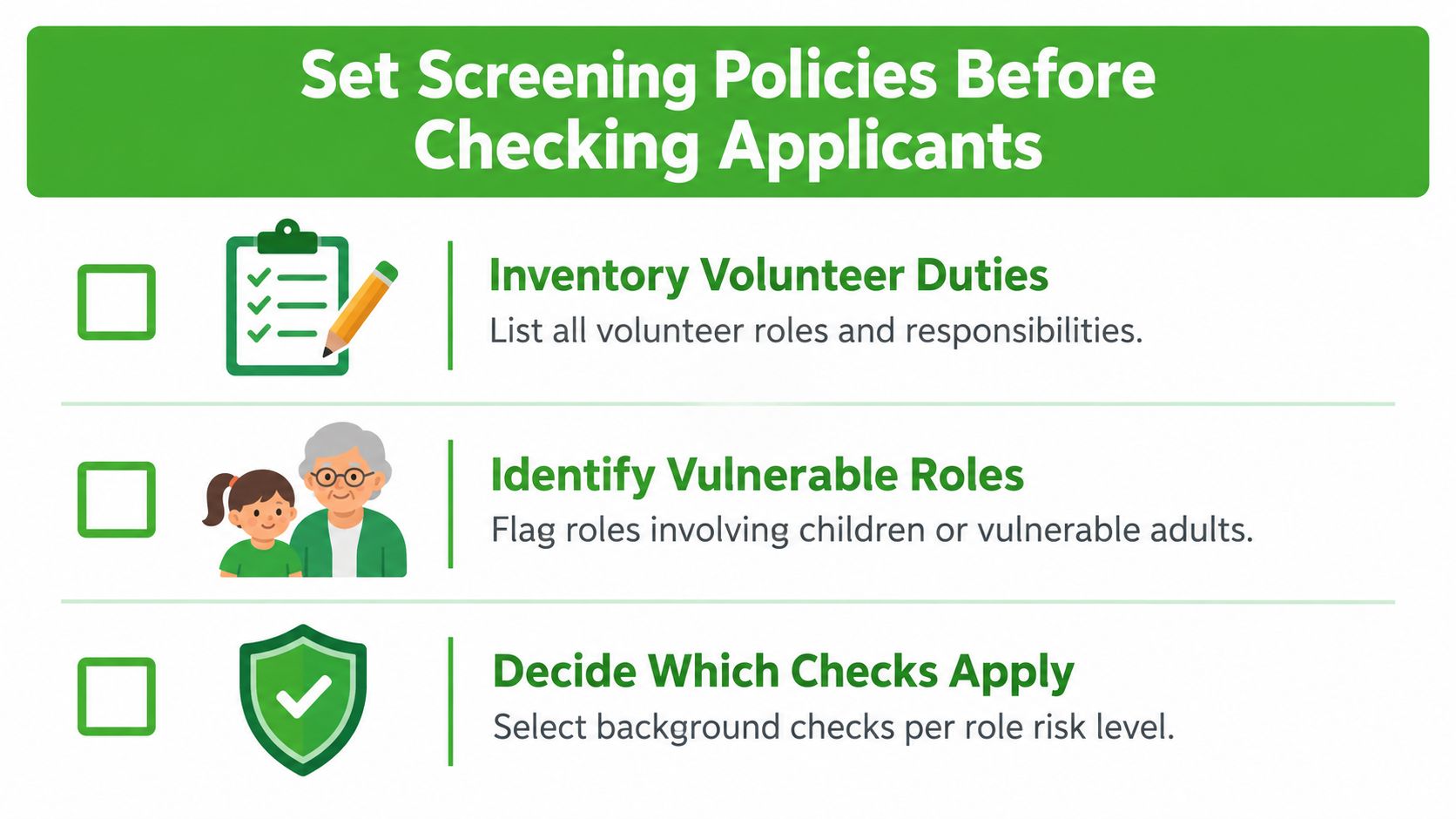
Start by inventorying what volunteers do, not what the role title says. Note who they meet, whether they're ever alone with participants, whether they drive, handle money, or access personal data. That exposure, not a generic risk label, should drive the depth of screening.
Match Depth to Exposure
A library aide who shelves books in a staffed public room isn't in the same position as a youth soccer coach who runs closed practices and drives players home. The coach warrants deeper criminal and registry checks, references, and periodic re-screening. The aide may need a lighter check plus supervision rules, provided your policy says so in advance and applies to every aide.
Document which offenses or findings disqualify someone for each role type, and which ones trigger individual review instead. Vague language like "any concerning history" hands the decision to whoever is on duty. Specific criteria protect participants and applicants at the same time.
Tell Applicants What Will Happen
Your disclosure packet should cover the purpose and scope of screening, what authorization you're requesting, how long you'll retain the information, and who to contact with questions. People share accurate details more readily when they understand the process. Surprises later read as bad faith, even when they aren't.
Before you launch, confirm these items are settled.
- Approved criteria: Disqualifying and review-triggering findings are written down by role.
- Named reviewers: Specific people, not "staff," own adjudication and escalations.
- Notice language: Disclosure, authorization, and adverse action wording is ready before the first application.
- Secure handling: Access is limited, storage is defined, and retention periods are set.
That checklist is dull work. It's also what makes every later decision consistent.
Build a Repeatable Volunteer Screening Workflow
A workflow a busy coordinator can't follow won't survive the first busy month. Build a sequence simple enough for a small nonprofit to run on a spreadsheet, but structured enough that a larger organization can automate parts of it later. Each stage should produce a record the next stage can rely on.
Begin with a complete application capturing full legal name, prior names, date of birth, and address history. Then present the disclosure and get authorization before any search runs. Skipping that order creates compliance problems and, practically, it signals to applicants that you're careless with their information.
Verify Identity Before You Spend
Address history is where cheap problems get caught. Compare what the applicant listed against what an address pull returns, and look for unexplained gaps, addresses in states they didn't mention, or a name variation you didn't know about. Resolve those questions before you order the full check, not after you've paid to search the wrong jurisdictions.
The reason is in the mismatch data. A U.S. nonprofit survey on volunteer screening found that 42% of applicants with criminal records had a record in a different state from where they applied, 23% appeared under a different name, and 6% used a different date of birth from the one associated with their criminal history. Identity validation isn't an enhancement. It's how the search finds anything at all.
Pause Rules for Common Mismatches
Write escalation rules for the situations you'll meet. When they occur, pause adjudication, ask for clarification and supporting identity documents, and verify any potentially disqualifying record through an authoritative source before you decide.
- Name changed after marriage: Collect the prior name, add it to the search, and keep the explanation in the file. This is routine, not suspicious.
- Variant spelling across records: Search the variant as an alias and confirm identifiers match before treating any hit as belonging to your applicant.
- Date of birth discrepancy: Stop and resolve it with documentation. Searching on a wrong date produces false clears and false hits.
- Conflicting records: Don't vote between them. Escalate to your named reviewer and verify at the source.
Keep an Audit Trail as You Go
Record consent, searches performed, who reviewed them, the decision rationale, notices sent, and timing. Build that trail during the process, because reconstructing it months later from inboxes doesn't work. It also makes handoffs painless when the coordinator who started a file is away.
Finish with a clear final step. The volunteer is approved, approved for a different role, or not approved, and the file moves to secure retention with a re-screening date if the role requires one. Nobody should start a shift in a "probably fine" status.
Choose Checks That Match the Applicant and Role
More searching isn't automatically better searching. Each component answers a different question, and stacking searches you can't interpret just creates noise for your reviewer. Pick components based on the jurisdictions in the applicant's history and the exposure in the role.
County criminal searches go to where many records originate and can confirm details a database summary glosses over. State searches widen the net within a state but vary in completeness. Federal searches cover offenses handled in federal courts, which county and state searches don't capture. Used together, they reduce the chance that a relevant record sits in a court you never checked.
Registry and watchlist searches serve narrower purposes. Sex offender registries across all states matter for any role involving children or vulnerable adults, because registration can sit in a state the applicant left years ago. The FBI Most Wanted list, OFAC sanctions, and global watchlists flag specific categories of concern, but a name appearing there is a lead to verify, not a conclusion about your applicant.
| Screening component | Primary purpose | Reviewer consideration |
|---|---|---|
| County, state, and federal criminal records | Find criminal history in the courts tied to the applicant's address history | Confirm identifiers match and the offense is relevant to the role |
| Sex offender registries | Identify registration that may bar work with children or vulnerable adults | Verify the registrant is your applicant, not a same-name match |
| FBI Most Wanted and OFAC sanctions | Surface fugitive or sanctioned status | Treat as a serious flag requiring authoritative verification |
| Global watchlists | Flag internationally listed individuals | Check source reliability before drawing any conclusion |
| Address history | Reveal jurisdictions, aliases, and timeline gaps | Resolve inconsistencies before ordering criminal searches |
Read Results as Leads, Not Verdicts
A match means a record shares identifiers with your applicant. It doesn't yet mean the record is theirs, that it's accurate, or that it matters for the role. Your reviewer confirms identity first, then weighs relevance, which is where structured conversations with references help round out the picture. If you're building that part of the process, these questions to ask when doing a reference check are a practical starting point.
Plain-English results help a non-lawyer coordinator act quickly, but speed shouldn't compress judgment. A fast, readable report still deserves the same identity confirmation and contextual review as a slow one. That's how to screen volunteers without turning a search result into a verdict.
Review Results With Consistent FCRA-Safe Decisions
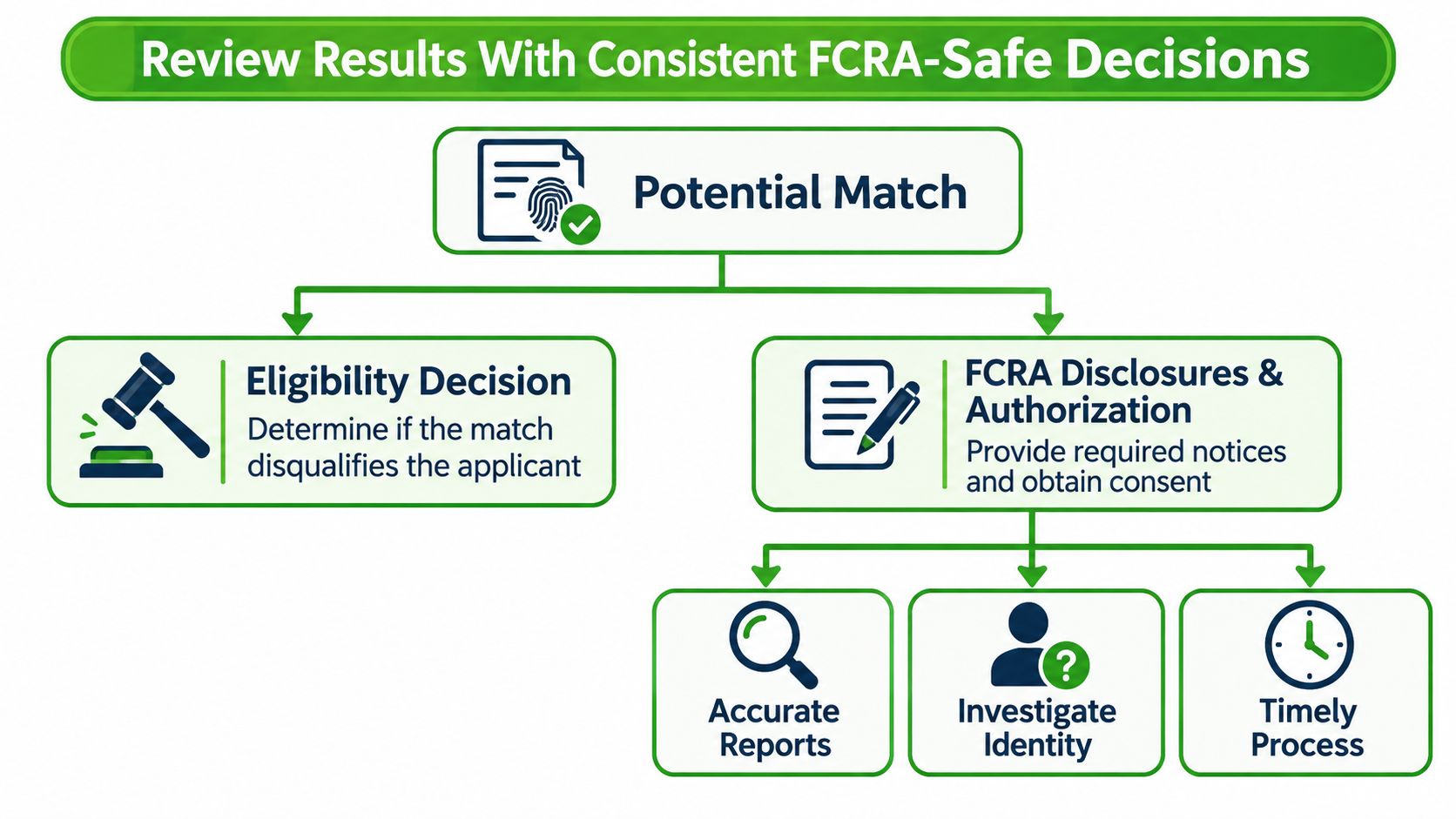
The most common adjudication mistake is treating every hit as an automatic no. It feels safe, but it isn't consistent, and it isn't necessarily fair or defensible. Separate detection from decision. The report detects, your policy and a human reviewer decide.
That separation has a legal backbone when a third party provides the report. You need proper disclosure and authorization up front, accurate reports you review rather than rubber stamp, and required pre-adverse and final adverse action notices with a real opportunity to respond before a decision becomes final. If you're formalizing your own process, it helps to review background check procedures from Alignmint alongside your policy draft, then check your notice steps against the adverse action notice requirements before you rely on them.
Use an Adjudication Worksheet
Give reviewers the same fields for every flagged file so two similar cases get similar treatment. Your worksheet doesn't need to be elaborate, but it should force the reasoning into the open.
- Report item: What exactly was found, and in which jurisdiction.
- Identity confirmation: How you established the record belongs to this applicant.
- Role relevance: Why this finding does or doesn't bear on these specific duties.
- Elapsed time and corroboration: How long ago it occurred and what else supports your view.
- Decision and rationale: The outcome, the reviewer's reasoning, notice date, and how any response was resolved.
Applied consistently, that structure handles the hard cases. A probable name match stays open until identity is confirmed. An accurate but old conviction gets weighed against role relevance and elapsed time instead of triggering an automatic rejection. An unverified county record goes back for verification, and an alias mismatch gets resolved before anyone decides.
Name the Equity Trade-Off Honestly
Overly broad rules exclude people from the very communities your programs serve, shrink your volunteer pool, and can undermine your mission. Vague rules do the opposite damage, inviting inconsistent calls that track a reviewer's instincts. The Nonprofit Risk Management Center guidance recommends documenting disqualifying offenses and post-flag procedures while also considering whether screening policies reinforce the social inequities nonprofit programs seek to alleviate.
Practical rule: Don't reject on an arrest alone or a watchlist appearance alone. Verify, contextualize, then decide.
Stricter controls belong on higher-risk roles, like unsupervised work with children. Everywhere else, individualized review with a written rationale protects participants without pretending broad exclusion equals safety.
Connect Screening Tools Without Losing Human Review
Automation should move paperwork, not make eligibility decisions. Connect your application system to your screening provider so applicant data enters once, flows accurately, and lands in the right queue. Judgment calls stay with named humans who can be asked later why they decided what they decided.
The image below shows the kind of side by side review your process should protect, even when the data arrives automatically.
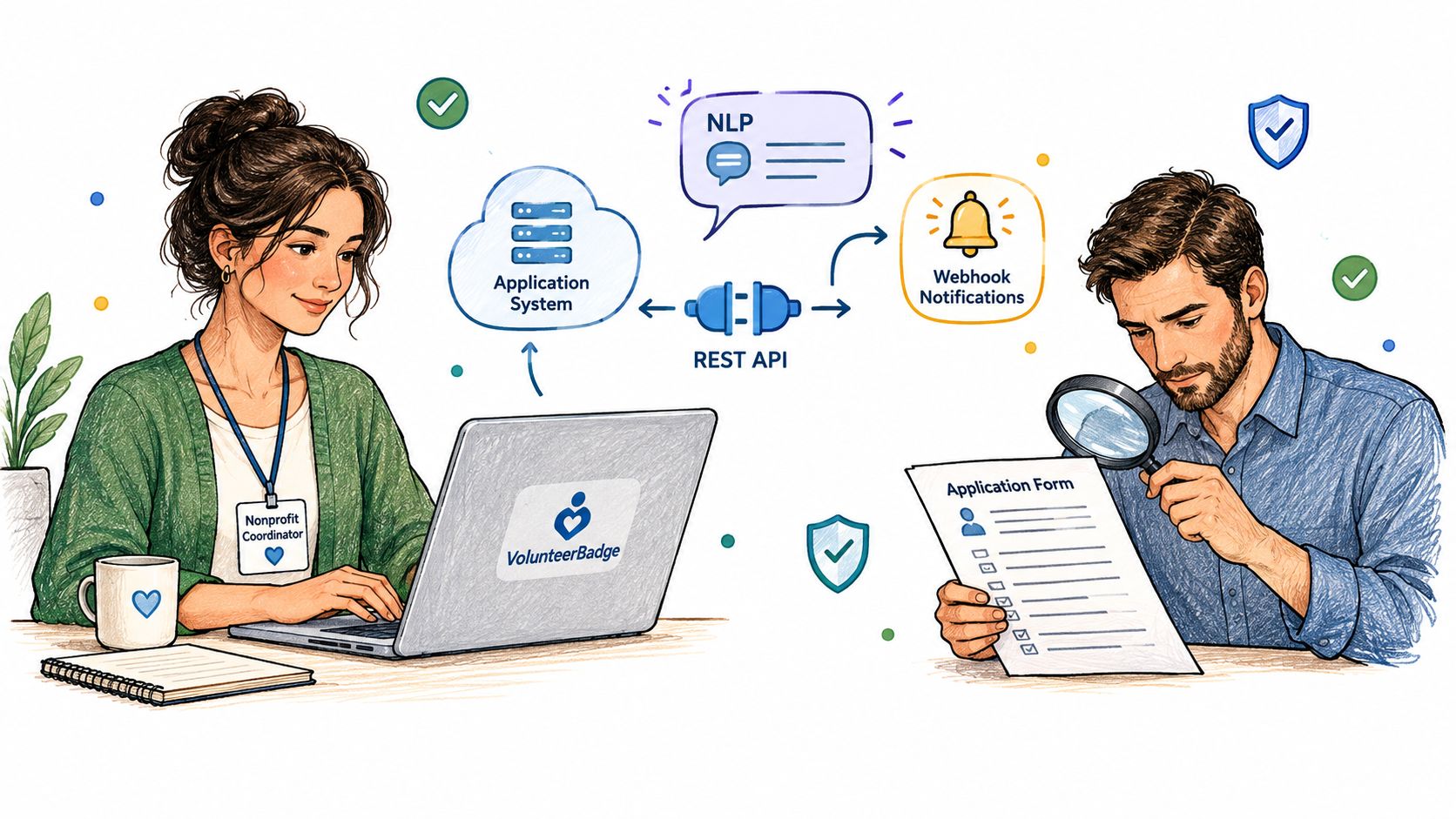
VolunteerBadge is one option built for this pattern. It returns plain-English results in 24 to 48 hours and flags address-history gaps before a check credit is spent, so the reviewer's queue fills with resolved identity data instead of raw hits. It also collects the signed disclosure and authorization with each application and automates adverse-action notices, which covers the compliance plumbing while your team handles the decisions. The tool serves the workflow. It does not replace it.
A Workable Integration Pattern
When an applicant signs the application and authorization, your system creates the check through the API with the role's screening package attached. A webhook then updates the coordinator's queue when results land, so nobody polls a dashboard. If a result may lead to an adverse decision, that event starts your notice process and routes the file to a reviewer instead of closing it. A walkthrough of the technical side is covered in this background check API integration guide.
Some steps stay manual or policy controlled by design. Disclosure acceptance, identity exceptions, adjudication, response handling, and final approval shouldn't fire automatically from a status change. Automating them saves minutes and costs you defensibility.
The short video below walks through how these connections work in practice.
Guardrails That Keep the Integration Honest
Build in access controls so only authorized reviewers see report contents. Prevent duplicates so a resubmitted form doesn't create two paid checks or two conflicting files. Handle retries so a failed webhook doesn't lose a result.
Log every automated event into the same audit trail your manual steps use. If the integration can't show who saw what and when, it's a liability dressed as efficiency.
Reduce Risk and Preserve Volunteer Relationships
Approval isn't the finish line. It's the point where supervision, training, and reporting start carrying the weight that screening can't. Organizations that forget this end up well screened on paper and exposed in practice.
The staying power problem is real. An Office of Justice Programs survey of nonprofit volunteer screening found that only 32% of surveyed nonprofits reported periodic volunteer re-screening, and only about half of organizations conducting criminal checks searched in more than one state or used national databases. Narrow, one-time screening is the norm you're trying to beat.
Your Operating Checklist After Approval
- Structured interviews and references: Keep them for roles with participant access, even when the report is clear.
- Role-specific training: Cover boundaries, supervision rules, and what to do when something feels wrong.
- Supervision and incident reporting: Give volunteers a named contact and a clear reporting path, then act on reports visibly.
- Risk-based re-screening: Schedule it for continuing high-exposure roles, for example annually, and whenever duties change.
- Periodic policy review: Revisit criteria and workflows as roles, laws, and your volunteer base change.
Communicate Like a Person, Not a Portal
Explain why you're requesting information before you ask for it. Keep applicants informed during review, and distinguish a technical delay from an adverse decision so silence doesn't read as rejection. Avoid stigmatizing language when you ask about a record. You're verifying fit for a specific role, not passing judgment on a life.
Watch for the failures that undo good systems. Screening only at onboarding, relying on a single state, applying inconsistent standards, starting a paid check before resolving identity, and assuming a clean result removes the need for supervision will each break the chain. Name them in your policy so new coordinators inherit the lesson.
Start small and in order. Write the policy, test the workflow on a few applications, assign your reviewers, and fix what the test exposes. That's how to screen volunteers in a way that protects participants and keeps good people willing to serve.
VolunteerBadge gives your team digital disclosure and authorization, address-history flags before you spend a credit, plain-English results, FCRA guidance with adverse-action automation, and API and webhook connections at no extra cost, so your screening system runs fast without losing human review. See how it fits your volunteer workflow at VolunteerBadge and put a repeatable, fair process in place before your next onboarding round.
