
Check if U Have a Warrant: Free Options and How to Verify
Learn how to check if u have a warrant using county court portals, sheriff offices and clerk calls, plus what paid searches miss and what to do if one appears.
On this page
The popular advice to search your name online and trust the result leaves out the most important step: checking what that website covers. If you're searching “check if u have a warrant,” start with the likely issuing county, not a website promising an instant nationwide answer. A useful lookup identifies a record you can verify, or tells you which office to contact next. It doesn't settle your legal status by itself.
Table of Contents
- Why One Search Rarely Settles the Question
- Where Warrants Are Recorded and What Each Source Covers
- Details to Gather Before You Search
- How to Check Online and Escalate Step by Step
- What a Blank or Matching Result Really Means
- Confirm the Warrant and Plan Your Next Move
Why One Search Rarely Settles the Question
A blank result isn't clearance. The United States has no single public national database of active warrants. Counties, municipalities, states, and federal agencies maintain separate systems, and public access doesn't include everything officials can see.
An official portal can still have limits. It may show only adult criminal warrants, exclude confidential matters, or update on a schedule. Read the coverage notices on tools such as the San Diego County warrant search before interpreting an empty screen.
Practical rule: Treat a public search as a preliminary check, not a certificate that no warrant exists.
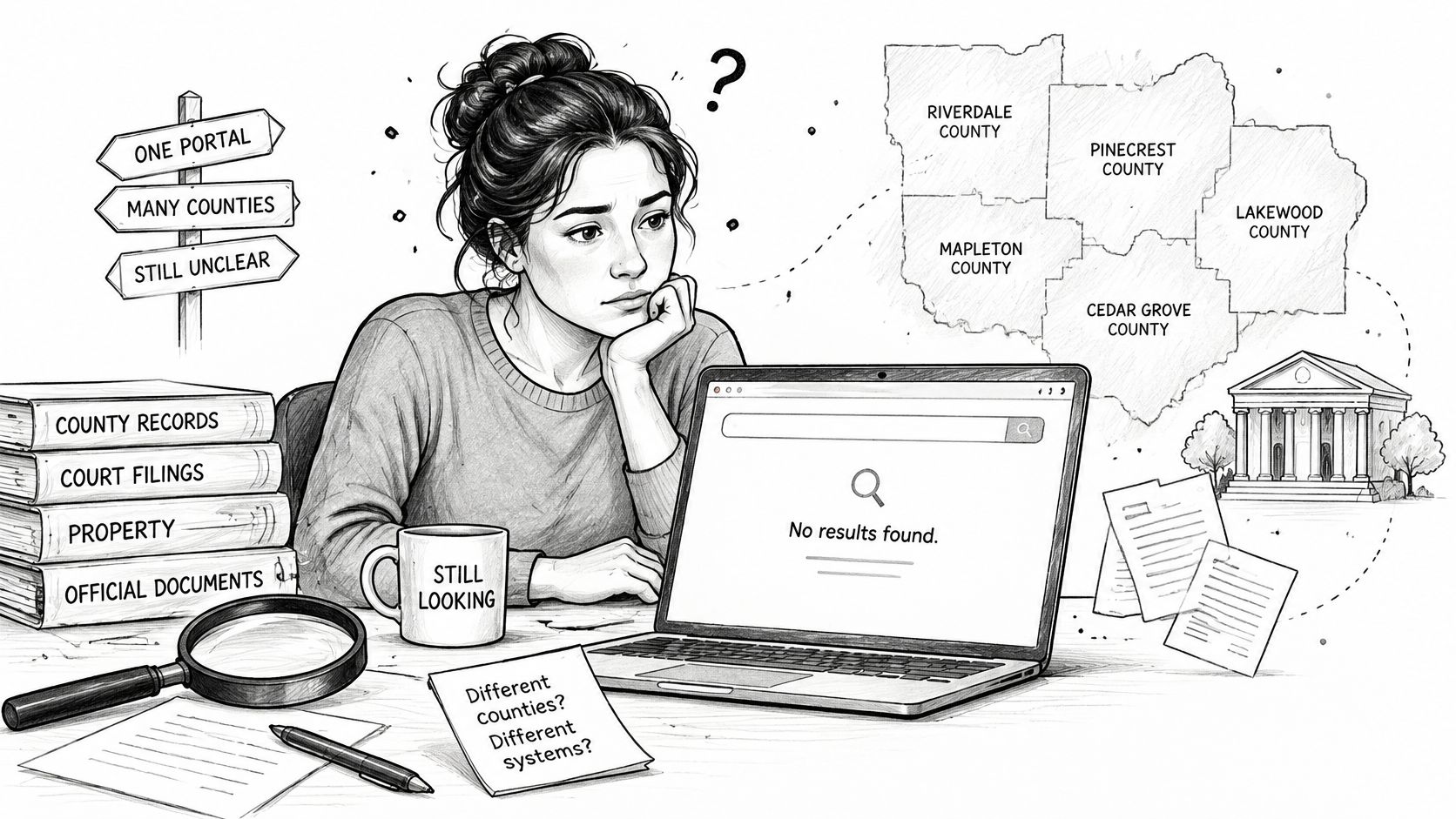
Your current county's results don't resolve an old matter elsewhere. Equally, a broad name search can turn up another person's record and create unnecessary panic.
There are limits at the federal level, too. PACER provides federal docket access, not a dependable public inventory of every active federal warrant. The FBI's NCIC warrant index is restricted to authorized agencies; a private website can't give consumers live access to it.
The dependable approach is jurisdiction-first: identify likely issuing locations, search their official records, and obtain confirmation from the responsible court or agency before relying on a result.
Where Warrants Are Recorded and What Each Source Covers
Warrant check sources by coverage, cost and limit
| Source | What It Covers | Cost | Main Limit |
|---|---|---|---|
| County sheriff or court online warrant lookup | Publicly listed active warrants issued in that county | Free | County-only coverage; scheduled updates |
| State court or judicial branch portal | Participating courts' dockets and case status | Usually free | Some counties or court types aren't included |
| Courthouse clerk or sheriff records phone line | Status information for the issuing county | Free inquiry | Identifying details required; phone disclosure may be restricted |
| In-person request at sheriff or clerk counter | Status information in the issuing county | Free inquiry | Government ID may be required; an active warrant can lead to immediate arrest |
| FBI Identity History Summary | Arrest and fingerprint-linked history | Processing fee | Not a nationwide warrant docket; proof of identity required |
| Paid background or people-search report | Aggregated court and database records | Paid report | Can contain outdated records, omissions, or same-name errors |
| PACER federal case search | Federal court dockets | Per-page fee | Not a reliable public search for every active federal warrant |
Choose the source by the underlying matter
Start with the office connected to the incident or case. If you have a citation identifying a municipal court, contact that court rather than assuming the county's general criminal search includes it. If you only know the county, the courthouse clerk or sheriff's records office can help identify the appropriate route.
A state judicial portal can help locate a case when you don't remember the courthouse. Check its participating-court list before treating it as statewide coverage. A case-search tool and a warrant-search tool also serve different purposes: finding a docket is useful, but you still need the current warrant status.
For a Georgia matter, Brian Hansford Law's guide on how to search for Georgia warrants offers jurisdiction-specific context to use alongside official records. For broader questions about access restrictions, our guide to whether criminal records are public explains why some information may not appear online.
Use free routes before buying a report
Say you moved from one county to another and still have paperwork from the earlier address. Search both locations, prioritizing the court named on the paperwork. Buying a broader report before checking that court can add expense without answering whether its order remains open.
Paid reports are most useful when you need a lead about an unfamiliar case or jurisdiction. They're less useful when you already know exactly which clerk holds the file.
Record the source name, date, and time of each check. If a clerk later sees a different status, you'll be able to explain precisely what you found rather than referring vaguely to something online.
Details to Gather Before You Search
Prepare an identification sheet before opening search tools. You want consistent search terms and enough information to distinguish your record from someone else's, without sending sensitive documents to an unverified website.
Build your search file
- Full legal name. Copy it as it appears on your government-issued ID, including middle names and suffixes, so you don't accidentally narrow the search incorrectly.
- Previous names and spelling variants. Include former surnames, maiden names, and names used on earlier paperwork; an older case may use a name you no longer use.
- Date of birth. Use it to distinguish same-name records whenever the portal or office permits that comparison.
- County and state history. List places where you lived, worked, received citations, or had court matters, with approximate dates to organize your inquiries.
- Case, citation, and ticket numbers. Pull these from notices, envelopes, and court papers because a case number is more precise than a name search.
- Government-issued photo ID. Have it available for an office's identity-verification process, but confirm the submission method before sending a copy.
- A search log. Leave space for search terms, results, office contacts, and any reference number provided.
Don't impose an arbitrary cutoff on your location history. If an older court notice is the reason you're concerned, include that jurisdiction even if you moved away long ago.
Keep your identification sheet private. Your working notes can reference a document without containing a full copy of it.
Separate places to investigate from confirmed issuing jurisdictions. Living in a county makes it worth considering; a notice naming a court makes that office a priority.
How to Check Online and Escalate Step by Step
The Georgia government's warrant-search guidance recommends identifying the person and relevant county, then contacting that county's sheriff or courthouse. It also warns that disclosure policies differ and an in-person inquiry can result in custody.
Use this workflow to organize the search before making calls.
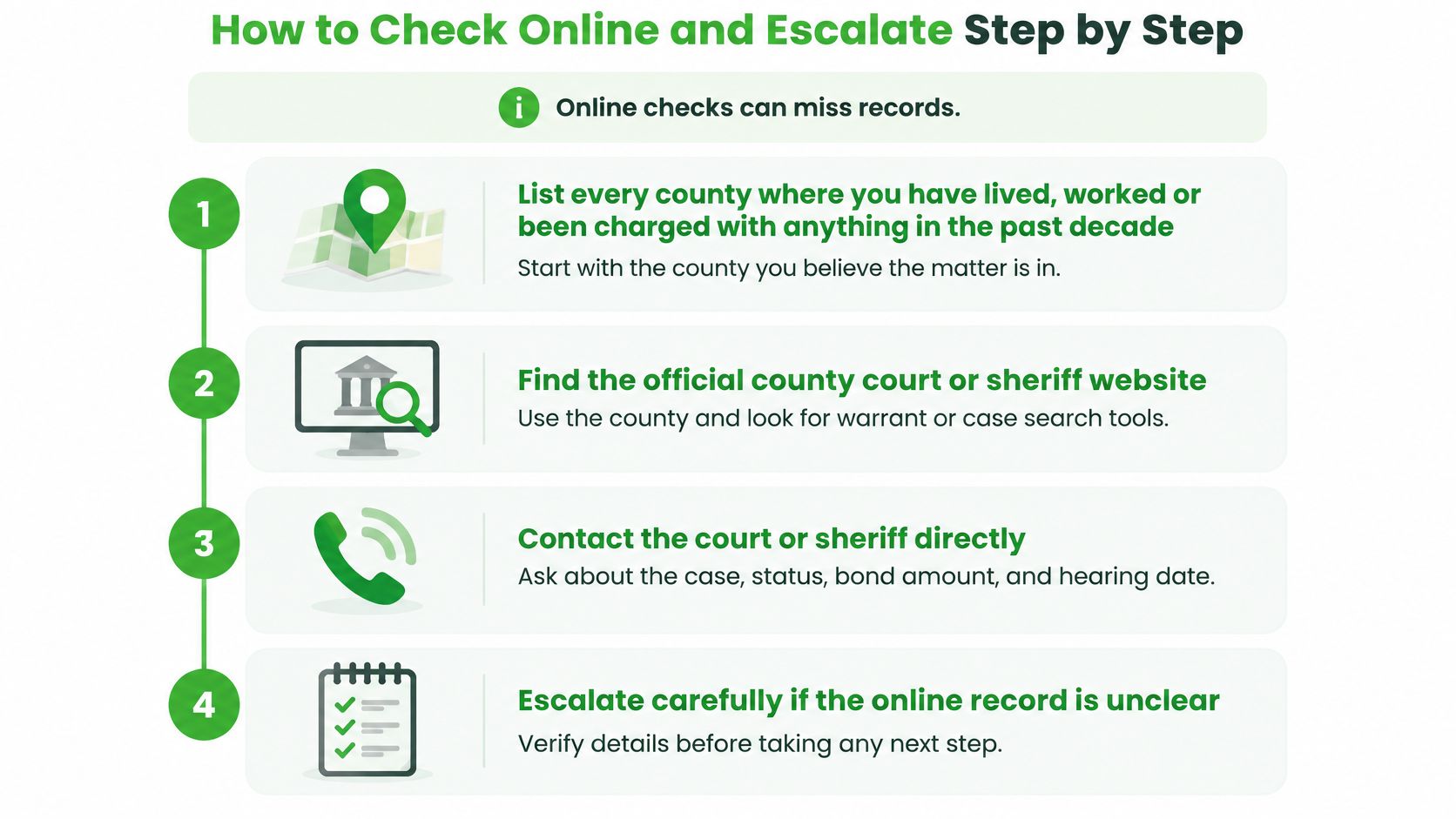
Search first, then verify
Prioritize your jurisdiction list. Put the county or court connected to a missed appearance, citation, or unresolved notice first. Add other locations connected to possible court matters rather than searching neighboring counties at random.
Find the official county sheriff or court website. Access the county government or judicial branch website and go to its warrant or case-search tool, then check which courts the tool includes.
Search with consistent identifiers. Enter your legal name and date of birth where supported, then repeat with relevant previous names or spelling variants. If the tool accepts only a name, don't treat the resulting list as an identity match.
Save the useful details from each possible record. Note the case number, charge, issuing court, issue date, and displayed status, and distinguish an old docket entry from a current status field.
Separate possible matches from confirmed records. If the name matches but the birth date differs, flag the discrepancy rather than accepting the record as yours. Continue the rest of your jurisdiction search.
Call when the online result is absent, ambiguous, or apparently active. Ask, “Can your office confirm whether there's an active warrant under this name and date of birth, and whether it remains open?” Have your case number ready and ask which office can verify anything the first office can't disclose.
Speak with a lawyer before an in-person inquiry. Some offices require government ID or won't disclose warrant information by phone, and appearing in person can lead to immediate custody. If you're told to come to the counter, ask counsel to investigate the procedure and help plan your next step instead of arriving unprepared.
Escalate with the case details
For a Bexar County matter, the Law Office of Bryan Fagan PLLC's explanation of options for resolving outstanding warrants can help you prepare questions for counsel. Local procedure matters, so don't assume advice about one county applies elsewhere.
If you're also reviewing broader records, our online criminal record check guide helps distinguish that task from verifying a particular court order.
The accompanying video offers another format for reviewing the process.
A complete working search has a documented outcome for every likely jurisdiction, not just a collection of screenshots. Mark unanswered inquiries as unresolved, not clear.
What a Blank or Matching Result Really Means
What each result usually means and what to do next
| What You See | What It Usually Means | Next Step |
|---|---|---|
| Blank result in the county portal | No match appeared within that portal's indexed records and coverage | Check earlier or otherwise relevant counties and call the clerk |
| Name matches but date of birth differs | Likely a same-name record belonging to someone else | Compare identifiers, then confirm with the court |
| Active warrant listed for your name and date of birth | An apparently open court order associated with your identifiers | Call the issuing court and speak to a lawyer before any appearance |
| Old arrest with a closed case | An arrest record and closed case, not proof of an active warrant | Request the case disposition from the court |
Read the record type, not just the name
An arrest record, a charge, a case disposition, and an active warrant answer different questions. A report showing an arrest doesn't establish that a court currently wants you to appear or that an arrest order remains outstanding.
Read the entry's label and surrounding docket information. If a report lists a warrant-related event without showing what happened afterward, ask for the current status rather than interpreting the historical event yourself.
A different birth date is a significant mismatch, but it isn't a reason to stop checking your own matters. The sensible response is to keep that record separate and ask the court to resolve the identity question if it could affect you.
A matching name starts an identity check. It doesn't finish one.
Understand what the FBI summary can establish
The FBI's Identity History Summary guidance describes fingerprint-linked information from arrests and certain other submissions, requires proof of identity and a processing fee, and assigns responsibility for source-data corrections to contributing agencies. That makes it useful for reviewing identity-linked history, but not for certifying the absence of a local warrant.
If you obtain the summary, use it for the question it can answer. For a missing disposition or incorrect source entry, identify the contributing agency and follow its correction process; for a current warrant question, contact the relevant court or sheriff separately.
Paid summaries can also preserve outdated information or associate unrelated records with your name. Our guide on how to read a background check can help you separate identifying details, case events, and outcomes.
For employment, housing, travel, or immigration paperwork, don't turn an incomplete search into an unqualified statement that you're clear. Have the court or a lawyer verify the relevant facts, and get legal advice if you're unsure how an application's question applies to your record.
Confirm the Warrant and Plan Your Next Move
A warrant is a court-authorized process, not a finding of guilt. The Constitution Annotated explanation of warrant requirements describes the probable-cause and particularity requirements governing issuance. Your immediate task is to establish what order exists and how the issuing court expects it to be addressed.
Keep the verification and appearance plan together.
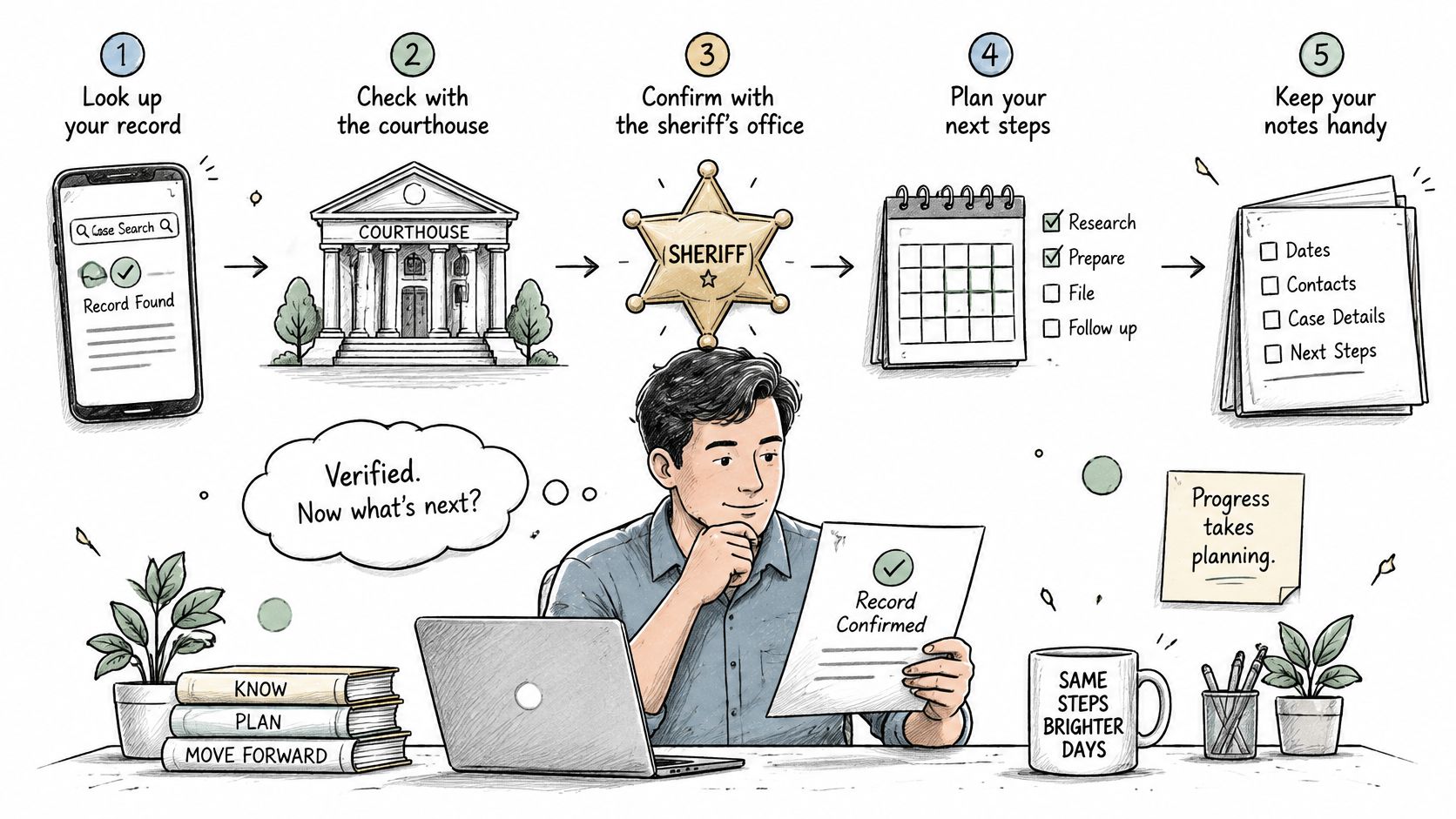
Turn confirmation into a practical plan
Get the operative details. Ask the issuing court or sheriff for the case number, charge, current warrant status, any bond amount, and any hearing date. Record which office supplied the information and ask how to obtain written case documentation.
Contact a criminal defense attorney in the issuing jurisdiction. If you can't afford counsel, ask the court or public defender's office how eligibility and appointment work; don't assume representation is available before a case is reviewed.
Assemble your documents. Bring photo ID, notices, citation paperwork, proof of address, and relevant court correspondence. If a notice went to an old address, preserve the envelope and any documents that help explain the timeline.
Ask counsel whether a court date, voluntary appearance, or surrender can be arranged in advance. Discuss bond and custody possibilities explicitly, because scheduling an appearance isn't a guarantee that you won't be detained.
Verify the outcome afterward. Ask what document will show that the court addressed the warrant and when the record should reflect the change. Keep that document with your case papers rather than relying on a verbal update alone.
Make the next decision on confirmed facts
Don't pay, travel, or appear based solely on a third-party report or someone else's description of your case. Get procedural instructions from the responsible office and legal advice from counsel, especially if different sources disagree.
Start now with the court named on your paperwork, or the most likely issuing jurisdiction on your list. Confirm the record, then plan any required appearance with counsel instead of making an unplanned counter visit.
VolunteerBadge helps nonprofits screen volunteers with criminal-record searches, identity review, and plain-English results with FCRA guidance. Visit VolunteerBadge to build a responsible volunteer screening workflow, while keeping current warrant confirmation with the issuing court or agency.
