
Do Speeding Tickets Stay on Your Record? Yes, Usually
Do speeding tickets stay on your record? Usually 3 to 5 years, depending on state, offense and which record is checked. Here is how each clock works.
On this page
Yes, an ordinary speeding conviction usually stays visible for roughly 3 to 5 years in major U.S. states, while serious or criminal-level speeding can stay much longer. Your state's DMV rules determine the exact period.
The counterintuitive part is that your points can disappear before the conviction does. A driver can have no active points and still have a speeding conviction visible to someone reviewing their driving history.
For a volunteer coordinator, that distinction matters. You're not just asking whether someone received a ticket. You're deciding which record to check, what the final outcome was, and whether that history matters for the work they'll do.
Table of Contents
- How Long Speeding Tickets Stay on Record by State
- Three Clocks and Which Roles Need Which Records
- Reading a Motor Vehicle Record Against a Criminal Check
- When the Ticket Came From Another State
- Set a Written Look-Back Window and Follow FCRA Steps
- Confirm the Right Record Before You Screen
How Long Speeding Tickets Stay on Record by State
A citation and a conviction aren't interchangeable. A citation is the ticket alleging a violation. A conviction is the legal outcome establishing responsibility, and that outcome is what the retention periods below generally concern.
The jurisdiction and offense classification matter more than a nationwide rule of thumb. Connecticut's DMV record-retention guidance is a starting point for understanding how ordinary traffic violations and serious offenses receive different treatment.
Speeding conviction and point retention by jurisdiction
| Jurisdiction | Ordinary speeding conviction | Serious or reckless speeding | Points |
|---|---|---|---|
| Connecticut | Generally 3 years | Some serious violations remain active for 10 years | Confirm the applicable DMV point rule |
| New York | Through the end of the conviction year plus 3 additional years | DWI convictions: 15 years; DWAI convictions: 10 years | Stop counting after 24 months, as explained below |
| Virginia | Common speeding convictions: 5 years | Speeding classified as reckless driving: 11 years | 2 years |
| Typical major U.S. state, general range | About 3 to 5 years | Longer, depending on the offense | Varies by state |
| Your licensing jurisdiction | Confirm the current DMV retention schedule | Check the exact offense classification | Confirm separately from conviction retention |
The impaired-driving entries provide a comparison with more serious offenses. DWI, driving while intoxicated, and DWAI, driving while ability impaired, aren't categories of ordinary speeding. Don't apply their retention periods to a routine speeding conviction.
Read the period carefully
New York's conviction-year approach isn't the same as counting a fixed period from the day of the traffic stop. Virginia's separate treatment of points and convictions also shows why a point total alone can't answer whether a historical violation remains visible.
A driving-history entry is also a different question from criminal-record relief. If a Connecticut matter involves impaired driving rather than ordinary speeding, The Law Offices of Attorney Angel Lugo's discussion of pardon rules for Connecticut DUI convictions provides context for that separate issue.
Practical rule: Ask which record the retention period describes before treating it as an expiration date.
For screening programs, how far background checks go back is a related coverage question, not a substitute for the DMV's schedule. This table concerns conviction visibility. It doesn't establish when a driver's points stop counting or when an insurer stops considering the offense.
Three Clocks and Which Roles Need Which Records
Think of a ticket as a parcel tracked by different offices. The licensing agency updates its point counter, the driving-history system retains the conviction, and the insurer evaluates the violation for pricing. Each office follows its own calendar.
The distinction is visible in the New York State driver point system: speeding points stop counting toward the point total 24 months after the violation, while the conviction can remain visible and relevant to insurance. No active points doesn't mean no recorded conviction.
This illustration separates the systems that readers often combine.
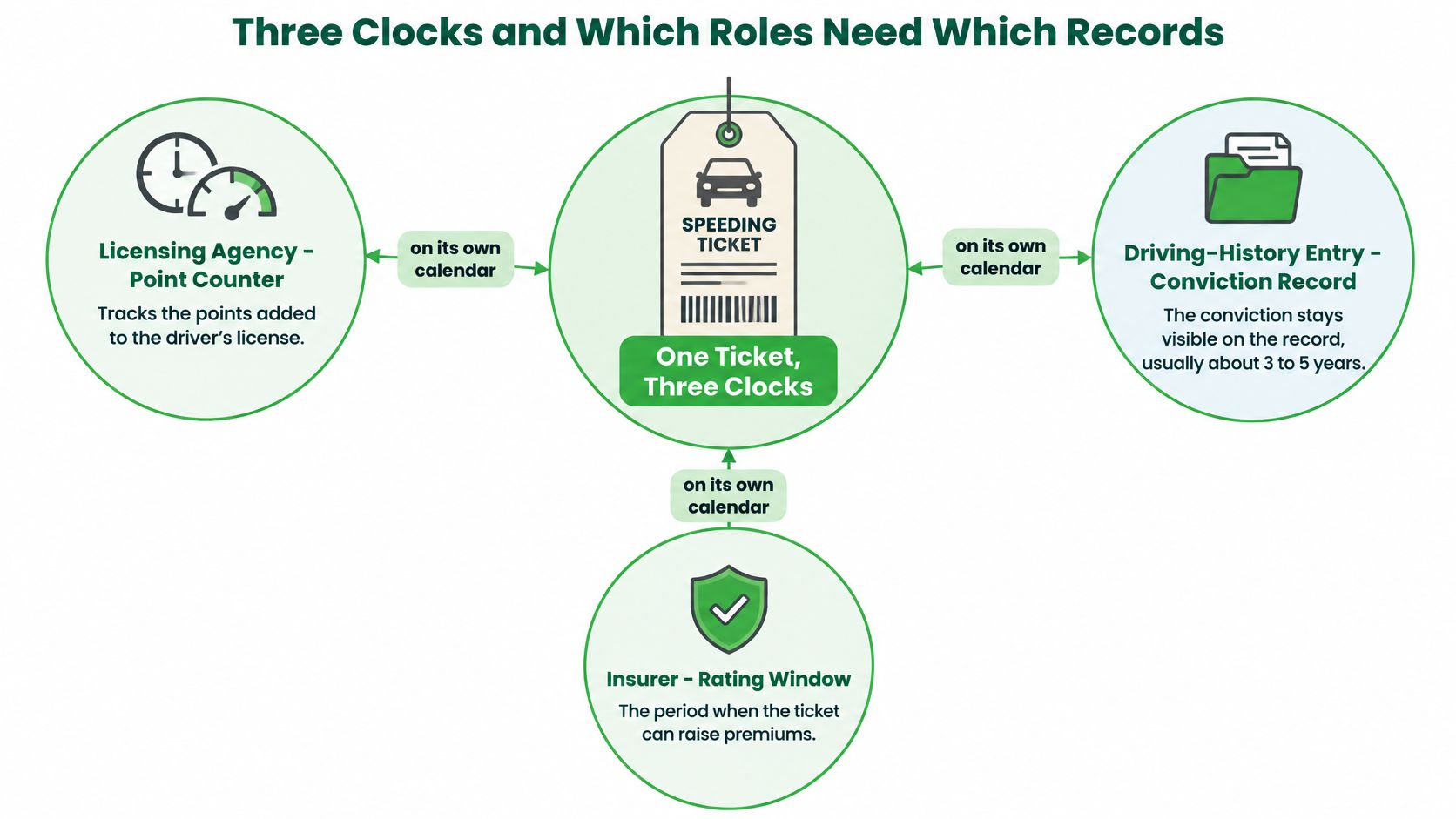
Insurers commonly review minor moving violations for about 3 years and serious violations for up to 5 years, although some may look back 7 years, according to this explanation of insurance surcharges after a ticket. Completing a defensive-driving course, successfully contesting a citation, or receiving a nonmoving disposition may produce a different insurance outcome. None should be assumed to erase every record automatically.
Match the record to the responsibility
The following is a suggested role-based screening framework, not a statement that every listed check is legally required. Adjust it to your organization's duties, safeguarding policy, insurer requirements, and applicable law.
| Role | Does speeding history matter? | Records to check |
|---|---|---|
| Volunteers who drive clients or children | Yes, review recent convictions and patterns | Motor vehicle record plus criminal check |
| Staff or volunteers using organization vehicles | Yes, and insurer approval may depend on it | Motor vehicle record and insurer requirements |
| Youth sports coaches who drive a team | Yes, alongside child-safety screening | Motor vehicle record, criminal check, and sex offender registry |
| Event or front-desk volunteers who never drive | Rarely relevant to the assigned duties | Criminal check and sex offender registry, where appropriate to the role |
A front-desk volunteer shouldn't face a driving-history review merely because a client driver does. Start with the actual responsibility, then select the record that answers the relevant question.
For each driving-history review, capture conviction date, disposition, offense level, point status, and the jurisdiction's retention rule. “Disposition” means how the case ended, such as dismissal or conviction. Those details support a clearer decision than a checkbox asking whether the applicant has ever received a ticket.
Reading a Motor Vehicle Record Against a Criminal Check
A criminal search and a driving record are different archives. As a rough analogy, a criminal search examines records of criminal cases, while a motor vehicle record, or MVR, resembles a licensing agency's history of the driver.
Don't assume a criminal search will reveal every traffic disposition. A reckless-driving matter may raise different questions from an ordinary speeding violation, and the provider's actual search coverage matters. This explanation of what an MVR check includes can help coordinators distinguish driving-history screening from criminal screening.
The illustration highlights that difference.
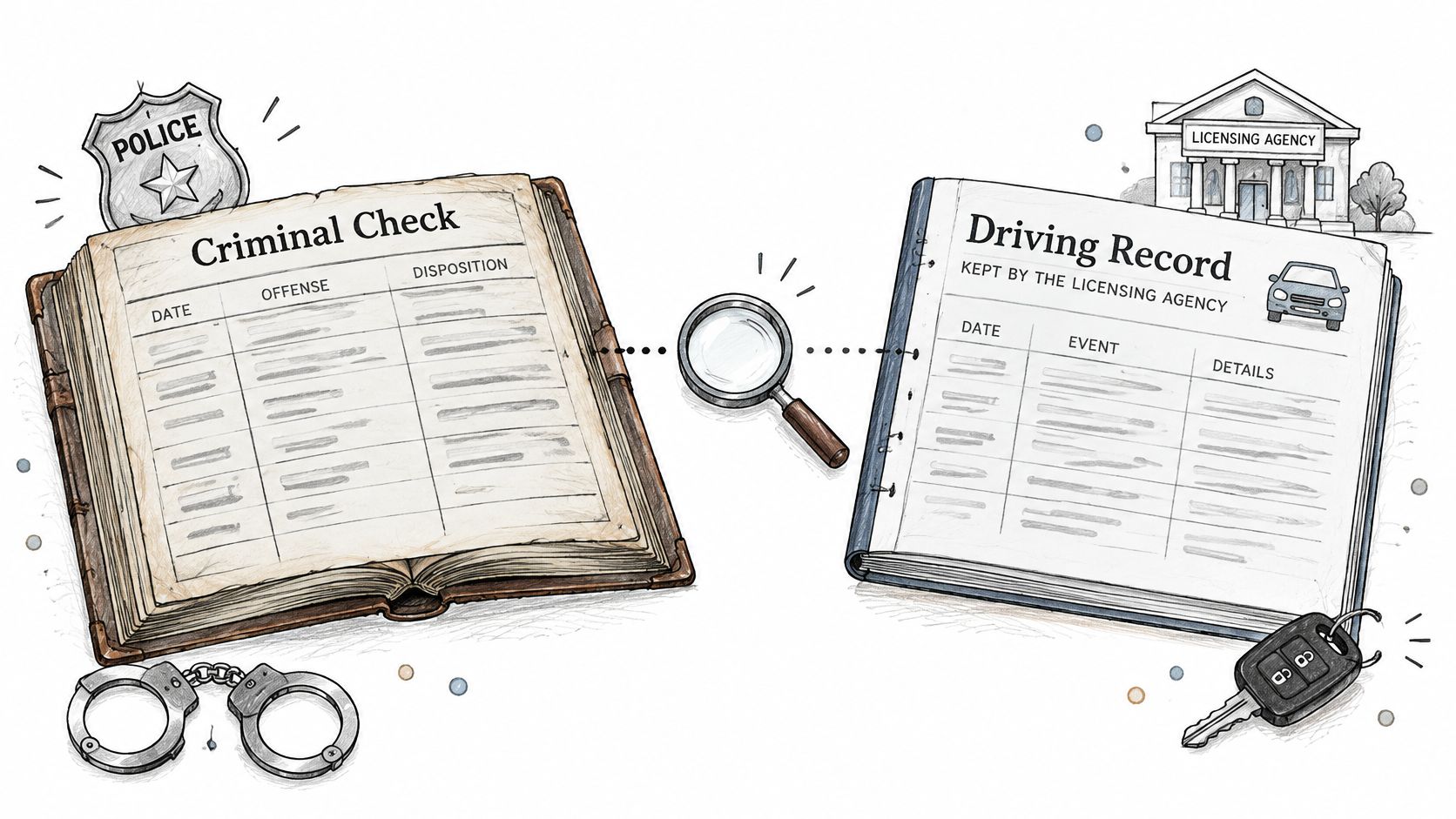
What each check can answer
Treat these as selection guidelines. Confirm the contents of the particular report before relying on it.
| Check type | Ordinary speeding shown? | Points shown? | Best use |
|---|---|---|---|
| National criminal background check | Don't assume routine traffic coverage | Not a substitute for DMV point information | Criminal-history screening; confirm any registry or watchlist components |
| Motor vehicle record | The appropriate record for retained driving convictions | Check the report's point fields | Roles involving driving |
| County or state court search | Potentially, if the relevant case and court are covered | Not the licensing agency's point accounting | Verifying a particular case or disposition |
| Insurance-based driving report | Depends on the carrier and report | Depends on the product | Insurance evaluation, not a substitute for role-based screening |
Severity also matters. The NHTSA summary of state speed laws gives Nevada examples of 2 points for 1 to 15 mph over, 4 points for 16 to 25 mph over, and 6 points for more than 25 mph over. It also describes New York's rule under which three speeding and/or misdemeanor traffic violations within 18 months can trigger mandatory revocation of at least six months.
These examples explain why “speeding” alone isn't enough information. Check the current applicable rule before making a licensing or eligibility decision.
A practical review sequence
- Confirm coverage first. Identify the record source, report date, and state covered. A report can only answer questions within its scope.
- Locate both dates. Record when the violation happened and when the conviction occurred. Determine which date starts the applicable retention or review period.
- Read the outcome. A dismissed citation generally shouldn't be treated as a conviction. A guilty plea, judgment, or unresolved unpaid citation requires attention to the state's procedures.
- Identify severity. Note the offense classification, speed band, and any special location, such as a school or work zone.
- Check current licensing consequences. Separate active points from retained convictions, and examine any relevant repeat-offense rule.
- Apply your policy. Compare the verified information with your written review window and the insurer's requirements.
Consider a hypothetical volunteer whose record shows a minor speeding conviction, expired points, and no other entries. Don't turn that into an automatic approval or rejection.
First verify the source and dates, then confirm that the entry is a conviction. Review the offense details, establish the current point and license status, and apply the organization's existing rule. The decision should explain why the verified record does or doesn't affect the driving assignment, rather than merely noting that a ticket appeared.
When the Ticket Came From Another State
An out-of-state ticket adds a coverage question before it adds a timing question. Don't assume a report from the current licensing state contains every relevant event from every other jurisdiction. Equally, don't assume it contains only locally issued tickets without checking how that report handles out-of-state information.
Ask the applicant about previous licensing states and any relevant unresolved traffic matters. Use that information to investigate gaps, rather than treating an address-history result as proof of a driving conviction.
Compare coverage before comparing dates
A coordinator can use a simple coverage log:
| Information to document | Why it matters |
|---|---|
| Current and former licensing states | Identifies where additional driving-history questions may arise |
| State where the citation was issued | Helps locate the court or agency handling the case |
| States and report types actually searched | Shows the limits of the review |
| Final disposition and supporting record | Prevents an allegation from being mistaken for a conviction |
| Retention rule used | Explains how the reviewer interpreted the dates |
The state comparisons above demonstrate why a universal expiration date won't work. Before deciding that an entry is too old to appear, identify which agency's record you're reading and which retention rule applies.
A targeted court search may help resolve a missing or unclear disposition, provided the search covers the relevant court and case type. It shouldn't replace the driving record when the question concerns licensing status or points.
A missing entry is a reason to check coverage, not proof that the event never happened.
If an out-of-state citation was dismissed, document the dismissal rather than relabeling it as a conviction. If the outcome remains unclear, ask for verification before applying a conviction-based exclusion.
Keep the coverage log with the screening file. Another coordinator should be able to see what was checked, what wasn't checked, and why any additional search was requested.
Set a Written Look-Back Window and Follow FCRA Steps
Set the decision rule before reviewing an applicant's report. A written look-back window defines which past events your organization considers relevant to a particular role. It isn't the same as the period a DMV retains an entry.
For example, a policy might distinguish an isolated older minor conviction from repeated recent convictions or a serious driving offense. That's a policy design example, not a universal legal standard. Choose the actual window with your insurer and qualified legal adviser, then apply it consistently to comparable staff and volunteer driving duties.
Write a rule someone else can apply
Your policy should identify:
- Covered roles: Specify which assignments involve driving and what type of transport they require.
- Review triggers: Define which offense categories or patterns require closer evaluation.
- Decision authority: Name who may approve, restrict, or decline a driving assignment.
- Correction process: Explain how applicants can identify errors or provide missing case outcomes.
When a consumer report may lead to an unfavorable decision, address the applicable Fair Credit Reporting Act, or FCRA, requirements. Review the organization's FCRA disclosure and authorization process before ordering reports, and obtain guidance on how the law applies to your screening arrangement.
Keep notice and review separate from the final decision
The process should address these stages in order:
- Pre-adverse action. Before finalizing a covered unfavorable decision, provide the required notice materials, including the report and applicable summary of consumer rights.
- Opportunity to respond. Allow a reasonable opportunity to dispute inaccurate information or supply an explanation.
- Reconsideration. Review corrections and relevant information before deciding.
- Final adverse action. If the decision stands, provide the required final notice, including the reporting agency's information and applicable dispute rights.
Don't set an unsupported universal waiting period or assume every screening context has identical requirements. Confirm the applicable procedure.
Keep the policy, report, supporting disposition records, correspondence, and notices together. That file should show both the rule you applied and the information you relied on, including any correction that changed the outcome.
Confirm the Right Record Before You Screen
The useful answer to “Do speeding tickets stay on your record?” is that record visibility, active points, and insurance treatment are separate questions. Choose the question that matters for the role before ordering a search.
Use this visual as a reminder to identify the relevant record.
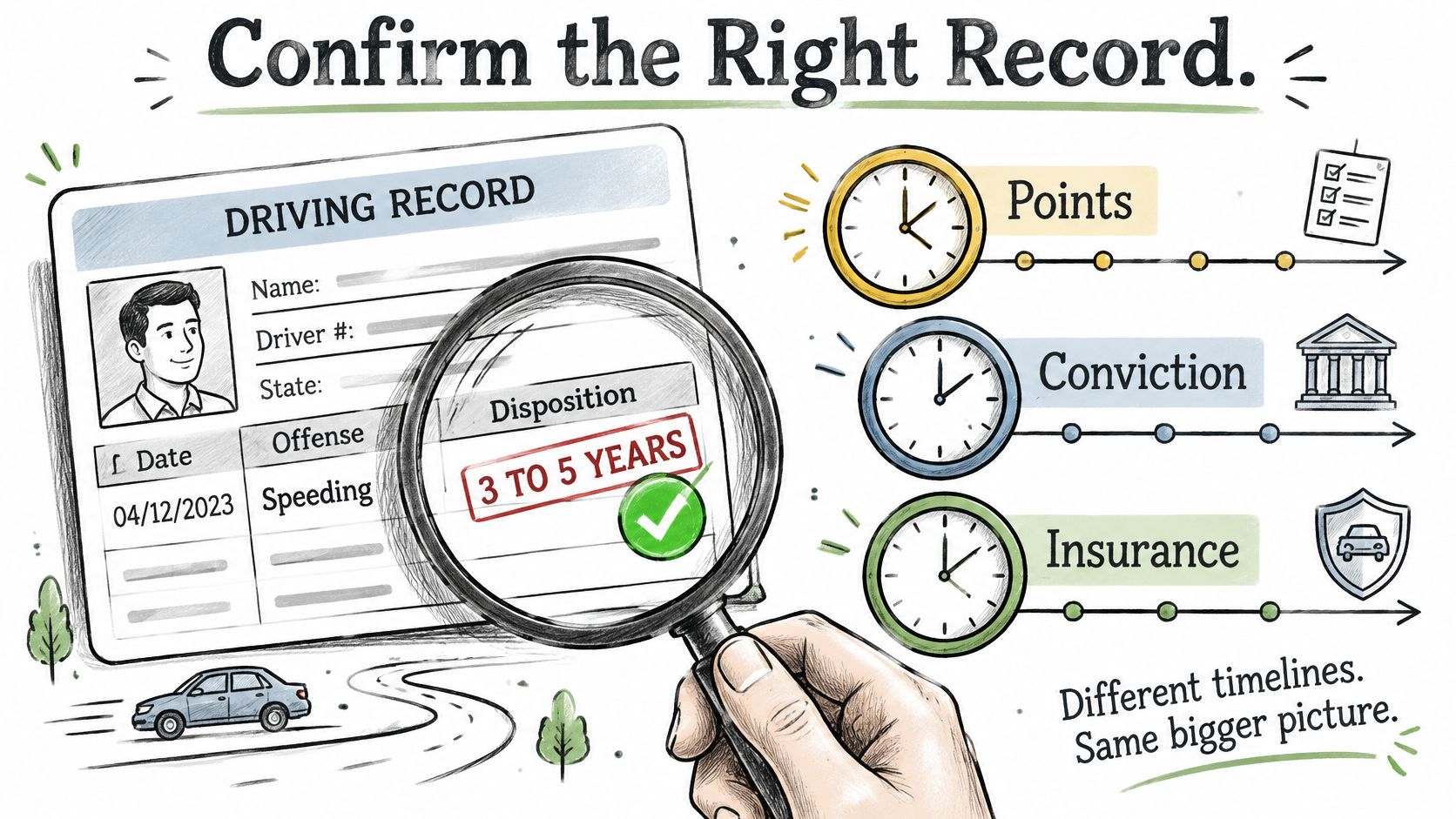
A coordinator doesn't need to become a traffic lawyer to organize a sound review. The immediate job is narrower: identify driving duties, obtain appropriate records, verify unclear outcomes, and apply an established policy without confusing a citation with a conviction.
A coordinator's checklist for today
- Identify driving assignments. Include occasional transport, not just roles labeled “driver.”
- Confirm the written standard. Make sure reviewers use the same criteria for comparable responsibilities.
- Request appropriate driving records. Investigate relevant licensing-state history and confirm how each report handles out-of-state events.
- Keep criminal screening distinct. Select it for the role's broader safety requirements, not as an assumed substitute for an MVR.
- Verify provider coverage. Ask which jurisdictions, records, and dispositions the search actually includes.
- Plan for corrections. Assign responsibility for applicant responses and any required notices before a difficult decision arises.
Before budgeting, confirm current pricing and what each search includes. Ask separately about driving-record access, criminal-search scope, address-history tools, result presentation, and notice support. Don't infer that a screening package includes every record your policy requires.
This video provides an additional resource for the screening conversation.
Finish the review with a short written explanation tied to the assignment. An approval, restriction, or decline should be understandable without asking a future coordinator to reconstruct your reasoning.
VolunteerBadge offers nonprofit volunteer background screening with address-history tools, plain-English results, and support for pre-adverse and final adverse action notices. Visit VolunteerBadge to confirm current pricing and criminal-search coverage, then arrange the appropriate motor vehicle records separately when a volunteer's role involves driving.
