
Are Traffic Violations Public Records a Guide for Nonprofits
Learn whether are traffic violations public records and how this impacts volunteer screening for nonprofits. Understand access, privacy, and compliance.
On this page
Yes, traffic convictions are generally public records, but the personal details attached to a driver's license are protected, so you can't just Google a volunteer's full driving history. In California, infraction records are generally destroyed after 3 years, while misdemeanor traffic records are generally destroyed after 5 years.
A volunteer coordinator often discovers the problem at the same moment a program begins requiring drivers. A basic background check returns a minor traffic offense, or returns nothing at all, but the organization still doesn't know whether the person has an active suspension, a relevant crash history, or a current state motor-vehicle record. The result feels incomplete because it is incomplete.
The answer to are traffic violations public records depends on which record you mean. A court docket and a Department of Motor Vehicles record are different sources, governed by different access rules. The conviction may be open for inspection, while the identifying information and administrative details attached to a driver's license require a lawful purpose and, often, authorization.
Table of Contents
- Are Traffic Violations Public Records
- The Difference Between Court Dockets and DMV Records
- How the DPPA Limits Your Access
- Why Self-Service Searches Fail Nonprofits
- Understanding Record Longevity And Expiration
- Building A Compliance-First Screening Policy
- How VolunteerBadge Simplifies Driving Checks
Are Traffic Violations Public Records
A nonprofit may be preparing transportation for a youth event when a standard criminal background check returns a minor traffic infraction. The court result confirms that a case existed, but it may not show whether the volunteer's license is valid now, suspended, or associated with a record in another state. That gap can affect a real screening decision.
Traffic violations are generally government records in the United States, but access depends on the record type and jurisdiction. Under Vehicle Code section 1808, official government actions involving driving privileges, including convictions, driving violations, accidents, suspensions, and revocations, are open to public inspection. The California DMV confirms that addresses and Social Security numbers are excluded from that public framework (California DMV privacy and information-sharing rules).
The federal Driver's Privacy Protection Act of 1994 sets the practical boundary. The DPPA limits disclosure of personal information from state motor-vehicle records, while the traffic violation itself is treated differently. New York DMV lists a driver's photograph, Social Security number, driver-identification number, name, address, telephone number, and medical information among protected details. It distinguishes those details from crashes, driving violations, and driver status (New York DMV's DPPA explanation).
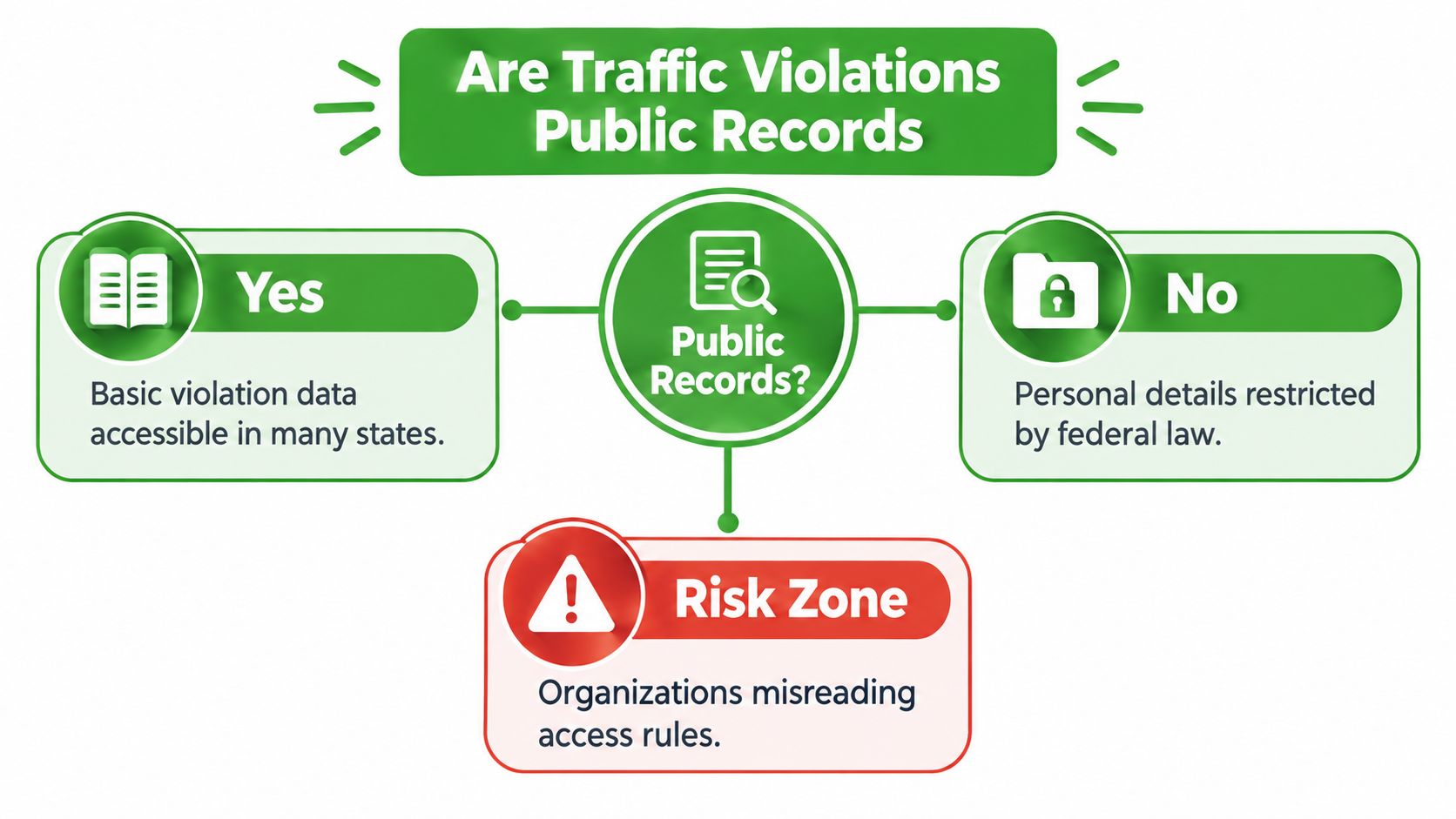
Public does not mean searchable by anyone
A court may allow public inspection while requiring an in-person visit or direct contact with the clerk. The Superior Court of California, San Diego County, explains that vehicle-code violations, infractions, and some local traffic offenses may require contacting or visiting the court where the case was heard because some files are unavailable online.
A standard criminal search can therefore miss the driving details a nonprofit needs. It may query criminal court sources without requesting a state motor-vehicle record, and it may not identify every jurisdiction connected to the volunteer. Organizations designing multi-state screening questions can compare state-specific rules in this 2026 guide to Florida traffic background checks, which shows how another jurisdiction handles court versus DMV access.
The practical rule is simple: “public traffic record” describes possible access, not permission to obtain every piece of driver information. A lawful driving check must match the request to the record sought, the jurisdiction involved, and the organization's permitted purpose.
The Difference Between Court Dockets and DMV Records
A nonprofit may find a traffic case in a public court docket and still lack the driving information needed for screening. The repositories are separate, and each answers a different operational question.
A court docket records a legal proceeding and its outcome. A state motor-vehicle record, or MVR, tracks the administrative history of a driver's license. The National Driver Register provides a federal pointer to certain serious records, not a complete nationwide driving file.
- Court docket: Was a citation or traffic case filed, and what was the disposition?
- State DMV record: Is the license valid, suspended, revoked, or associated with recorded violations and other state-held information?
- National Driver Register: Which state may hold a record involving a suspension, revocation, denial, or serious traffic offense?
California shows why source and timing must be assessed together. Official driving actions may be open to public inspection, while court retention limits what remains available. California courts generally destroy infraction files after 3 years and misdemeanor traffic files after 5 years (San Diego Superior Court traffic case retention guidance). A court search today may therefore differ from an older DMV record or a record maintained in another state.
| Source Type | What It Shows | Typical Retention | Accessibility |
|---|---|---|---|
| Court docket | Citation, charge, conviction, disposition, and case activity | Varies by court and offense. See the California retention figures above for examples. | Public inspection may be available, but some files require court contact or an in-person request |
| State motor-vehicle record | License status, driving violations, convictions, crashes, suspensions, and revocations | Varies by state, violation, and administrative action | Access is controlled by state procedures and privacy rules |
| National Driver Register | An indicator of which state may hold certain serious records | It points to a state record rather than storing the underlying content | It does not provide the complete driver record |
A vendor's phrase “driving check” is incomplete unless it identifies the source. Court research may establish a case disposition without showing current license status. An MVR may show an administrative action without replacing the underlying court file. Review what shows up on an MVR alongside this MVR check overview to clarify what each search can provide.
The practical rule is direct: public access to a docket does not authorize access to every DMV detail. Match the request to the record sought, the jurisdiction involved, and the nonprofit's permitted purpose.
How the DPPA Limits Your Access
A nonprofit may find a traffic conviction in a public court docket and still be unable to obtain the person's full driving profile from a DMV. The Driver's Privacy Protection Act (DPPA) regulates the release of personal information in state motor-vehicle records. Its practical effect is a boundary between information about a driving event and the identifiers attached to the driver.
As covered earlier, the DPPA shields identifiers while leaving crash, violation, and status data outside the protected definition. Consent and the requester's permitted purpose determine what a DMV may release. State procedures still control the application process, so access varies by jurisdiction.
Three sources, three different limitations
The court, DMV, and National Driver Register answer different screening questions:
- Court records provide legal context. They may show the charge, disposition, and offense category. Access depends on the court, the jurisdiction, and how long the record remains available.
- DMV records provide driving context. They may show license status, violations, and administrative actions. A requester needs a lawful basis under applicable federal and state rules.
- The National Driver Register provides a lead. NHTSA describes it as an indicator system that identifies the state that may hold a relevant record. It does not contain the underlying driver-record content (NHTSA traffic-record systems report).
The U.S. Supreme Court upheld the DPPA's regulation of personal information in state DMV records in Reno v. Condon, 528 U.S. 371 (2000) (Cornell LII case summary). Consent is one route through the restrictions, but it does not replace the need to document the screening purpose or follow state procedures.
A public conviction and a private driver profile can exist at the same time. Screen the record you need, not every record you can find.
For organizations, authorization should be specific, documented, and tied to an actual role requirement. A volunteer who transports children raises a different screening question from a volunteer who works in a library without driving duties. A standard criminal background check may capture the court event while missing the current license status or driving history that determines whether the volunteer can legally drive. That gap is why nonprofits should request an authorized motor-vehicle record when driving is part of the role.
Why Self-Service Searches Fail Nonprofits
Self-service searches fail because they're designed around an individual checking their own record, not an organization building a repeatable screening program. A state DMV portal may require exact identifying information, may limit the requester's access, and may not combine records from other states. Even a successful search can answer only one state's question.
The online approach also encourages the wrong assumption: if the result is blank, the person has no driving history. A blank result may instead mean the search used the wrong repository, the court no longer retains the record, the volunteer held a license elsewhere, or the organization lacked access to the relevant DMV data.
A compliant route for organizations
Use a defined process rather than trial and error:
- Define the driving requirement. Identify whether the role involves transporting people, operating an organization-owned vehicle, making deliveries, or driving vulnerable participants.
- Tell the applicant what you need. Explain that the organization may request a motor-vehicle record, separate from a criminal background check.
- Obtain written authorization. Use a disclosure and authorization process that identifies the purpose of the request and follows applicable privacy and consumer-reporting requirements.
- Use an approved records channel. Request the relevant state MVR through a provider or process authorized to handle the data. Don't treat a public court page as a substitute.
- Check jurisdiction coverage. Ask where the volunteer has been licensed or lived when that information is relevant, because a home-state search won't necessarily reveal out-of-state records.
- Review and document the result. Record the source, date, disposition, license status, and decision rationale without retaining unnecessary personal information.
The National Driver Register won't solve the aggregation problem by itself. It can indicate which state may hold a record involving a suspension, revocation, denial, or serious traffic offense, but the requesting organization still needs the underlying state record.
Teams evaluating identity and screening workflows can also compare the limitations of app-based verification with a dedicated volunteer background-check process. The key is to match the tool to the record type, rather than assume one consumer lookup covers every driving risk.
Understanding Record Longevity And Expiration
A traffic record isn't permanent just because it's public, and it doesn't automatically disappear on a universal schedule. Retention depends on the jurisdiction, offense, record type, and related license action. A court may destroy an older file while the DMV continues reporting a conviction or suspension, or another state may retain a serious offense for much longer.
California and Wisconsin illustrate the difference. California DMV reports that most two-point violations remain reportable for 10 years, while other traffic convictions are generally reported for 3 years. Wisconsin reports that serious convictions can remain for as long as 55 years, while many other convictions remain for about 5 years or until related suspension or revocation matters close (California DMV driver-record request guidance).
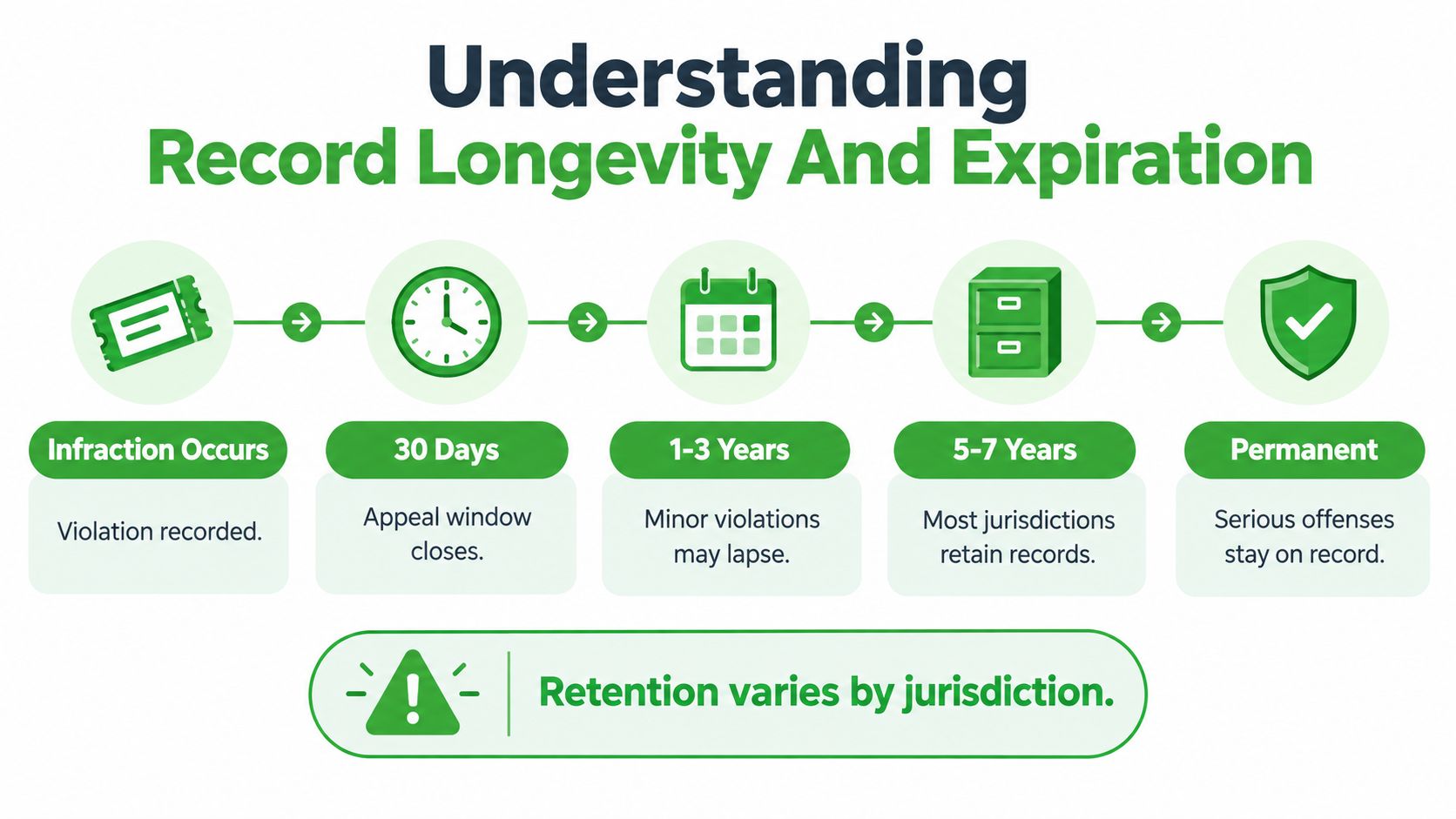
Why fixed lookback rules create bad decisions
A universal lookback policy can produce opposite errors. It may exclude a volunteer for an old minor infraction that no longer has practical relevance, or overlook a serious offense that remains visible under another state's retention rules. It can also confuse a citation with a conviction, a crash with a moving violation, or a closed suspension with a current license restriction.
Use role-specific criteria instead:
- Non-driving role: A minor historical infraction may have little connection to the volunteer's duties.
- Occasional driver: Recent moving violations, unresolved license issues, and patterns relevant to safe operation deserve closer review.
- Youth or vulnerable-person transport: Current license status, serious offenses, and unresolved administrative actions are directly relevant.
- Organization-owned vehicle operator: The policy should identify who reviews the MVR and how often the organization rechecks status.
The California DMV allows individuals to challenge inaccurate traffic-violation or conviction information through the court or DMV correction process. That means a screening decision shouldn't end with an unexplained rejection. Give the volunteer a clear way to review disputed information and provide corrections.
Retention isn't merely a database issue. It determines whether the organization is evaluating current risk, stale history, or an incomplete record.
For broader background-screening context, organizations can also review how long background checks go back, while keeping in mind that criminal-record and motor-vehicle retention rules aren't interchangeable.
Building A Compliance-First Screening Policy
A defensible policy begins with the role, not the database. Ask whether driving is an actual responsibility, then define which records matter for that responsibility. A nonprofit shouldn't impose the same driving standard on a volunteer who sorts donated books and a volunteer who transports children.
The organization should also separate eligibility from relevance. A minor ticket may be legally reportable yet have little bearing on a non-driving role. An unresolved suspension may be highly relevant to any role that requires driving, even if the underlying court case is difficult to locate.
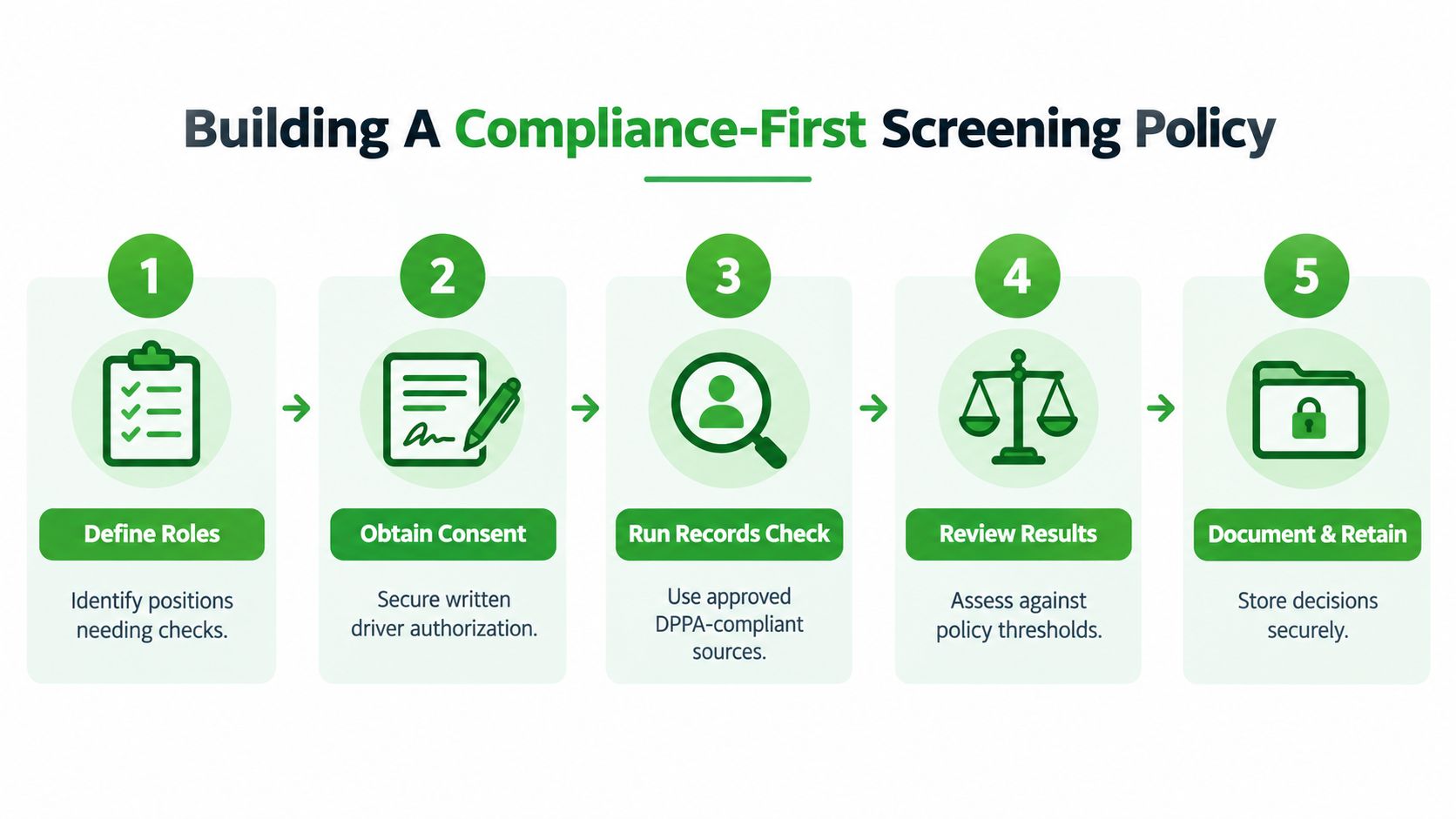
Five decisions to make before ordering a check
- Define roles. List the positions that drive, transport participants, deliver goods, or use organization vehicles.
- Obtain consent. Tell applicants what you'll request and secure the necessary written authorization before accessing protected DMV information.
- Select the source. Use the appropriate state motor-vehicle process, not only a criminal court search or a generic public-record lookup.
- Set review criteria. Distinguish citations, convictions, crashes, suspensions, revocations, and current license status. Tie each criterion to a documented safety concern.
- Create a correction path. Let the applicant challenge inaccurate information and give decision-makers a consistent way to reconsider the result.
The California DMV states that addresses and Social Security numbers aren't shared as part of public inspection, while driving actions may be open to inspection (California DMV records and privacy information). That split should shape your data-minimization rule. Collect what the role requires, restrict access internally, and avoid circulating unnecessary identifiers.
Policy test: If you can't explain why a particular driving record matters to a specific volunteer role, it probably shouldn't be an automatic disqualifier.
A specialized consumer reporting agency can reduce operational mistakes by handling disclosures, authorizations, source selection, and adverse-action procedures in one workflow. That doesn't remove the nonprofit's responsibility to define relevance, but it makes the process more consistent and easier to audit.
How VolunteerBadge Simplifies Driving Checks
The practical challenge isn't just finding a traffic record. It's connecting the right source to the right person, obtaining the necessary permission, interpreting the result fairly, and documenting the decision. A nonprofit that searches only court records may miss DMV information, while a team that requests DMV data informally can create privacy and authorization problems.
A workflow built for volunteer screening should make those distinctions visible:
- Start with the application. Identify whether the role requires driving and explain the separate motor-vehicle-record request.
- Capture authorization before the search. Don't wait until a result appears to address disclosure and consent requirements.
- Check identity and address history. Use known jurisdictions to reduce the chance of overlooking a state where the volunteer held a license or received a violation.
- Separate result types. Display court dispositions, license status, suspensions, and other driving details as distinct findings rather than one blended risk score.
- Give the reviewer context. A result should show the event, date, disposition, and source so the decision-maker can apply the role-based policy.
- Support dispute handling. If the volunteer challenges an inaccurate record, pause the decision and follow the applicable correction and adverse-action process.
VolunteerBadge is positioned as a licensed consumer reporting agency for nonprofit screening, with workflows for disclosures, authorizations, address history, national criminal searches, and FCRA-related notices. Its screening scope includes county, state, and federal court sources, alongside other identity and watchlist checks, but a nonprofit should still confirm that the specific motor-vehicle record product and state process match its role and legal requirements.
The important operational benefit is separation. A national criminal search isn't presented as a replacement for an MVR, and a public court result isn't treated as proof of current license status. That distinction helps coordinators avoid both under-screening and unnecessary collection of personal information.
For a fair review, define the outcome before the search begins. Decide which findings trigger clarification, which require escalation, and which are irrelevant to non-driving work. Store the decision securely, limit access to staff with a legitimate need, and document why the result did or didn't affect eligibility.
A compliant process won't make every jurisdiction simple. It will make the organization's choices explainable, repeatable, and tied to the actual safety responsibilities of the volunteer role.
VolunteerBadge helps nonprofits manage volunteer screening with digital disclosures and authorizations, identity and address-history checks, criminal searches, and FCRA-oriented workflows. Visit VolunteerBadge to build a screening process that treats public court records and protected DMV data as the different sources they are.
