
Does NLP Work? What It Does Well and Where It Fails
Does NLP work? Yes for narrow language tasks, but accuracy, hallucinations and bias vary. See real benchmark numbers and nonprofit use cases.
On this page
Yes, NLP performs well on narrow language tasks, and leading models match or slightly exceed estimated human performance on GLUE, as the benchmark discussion below explains. That score measures performance on the benchmark's defined tasks; it does not establish that a model understands people or records as humans do.
For a nonprofit reviewing volunteer applications, the practical test is whether a system preserves what a record says, handles negation such as “no conviction found,” and treats applicants consistently. It may sort comments or identify a missing address field, but a high benchmark score alone cannot show that it will do so reliably.
Table of Contents
- Where NLP Works Today and Where It Does Not
- How NLP Systems Read Text and Which Approach Fits
- How Accurate NLP Is on Standard Language Tasks
- Where NLP Gets Things Wrong and How to Guard Against It
- Bias and Fairness Across Names, Languages and Groups
- Practical NLP Uses for Volunteer Screening Teams
- Decide Whether NLP Fits Your Volunteer Screening Workflow
Where NLP Works Today and Where It Does Not
NLP works best on narrow, well-defined language tasks. GLUE, introduced in 2018, brought together nine sentence and sentence-pair tasks, including sentiment, acceptability, textual entailment, similarity, and question-answering-style reasoning. Early systems scored about 70.0 out of 100; within roughly 14 months, leading pretrained Transformer models reached 88.4, and RoBERTa reached approximately 88.5, slightly above the estimated human baseline (GLUE benchmark history).
That result is a meaningful technical milestone, but its meaning is limited. It shows that systems became highly effective at classification and inference within the benchmark's task definitions and data distribution. It doesn't establish general understanding, or prove a model will handle a nonprofit's records accurately. When fixed tests become familiar targets, a model's ability to score well can outpace its ability to handle unfamiliar wording or incomplete evidence.
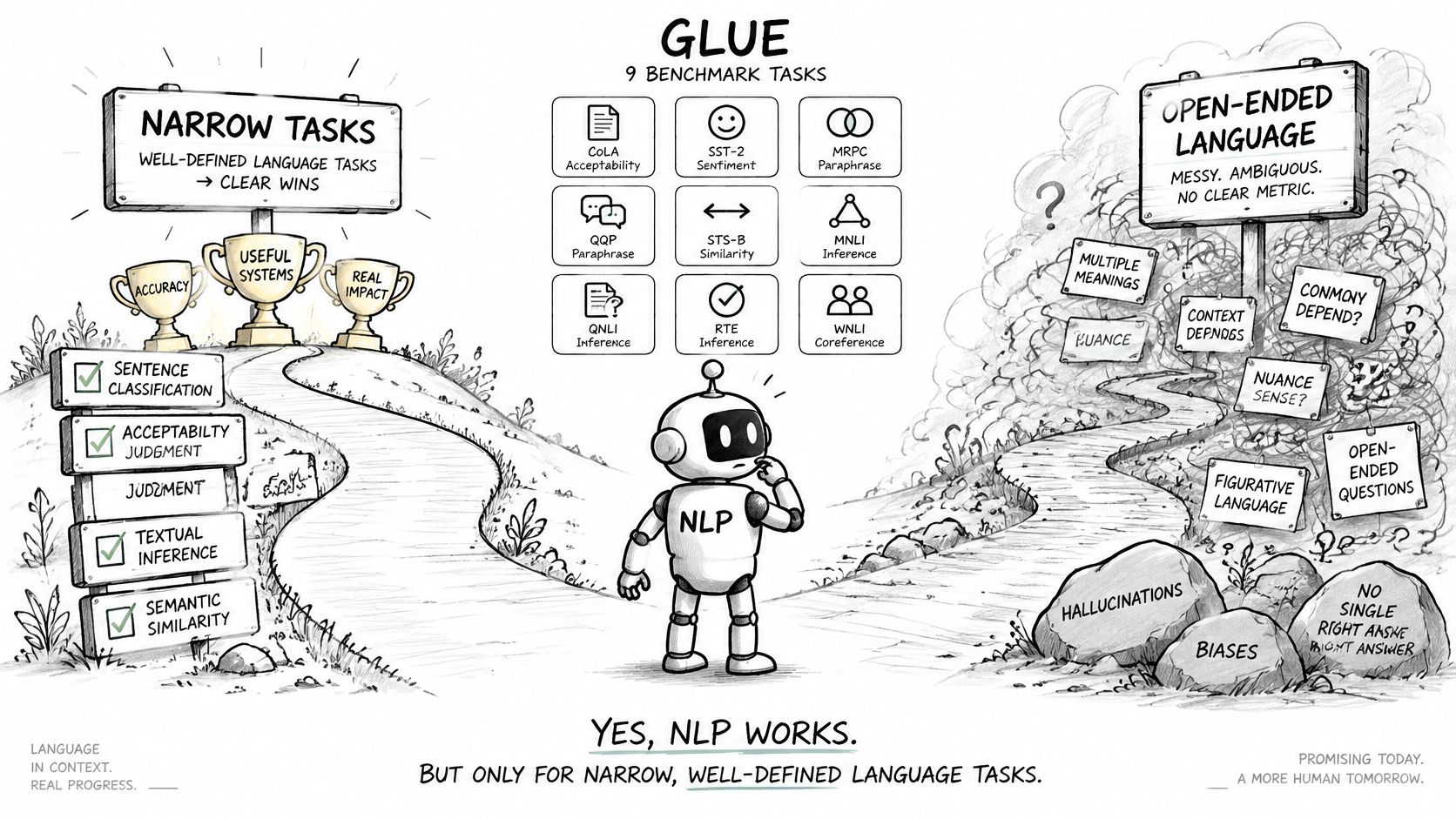
The difference becomes clearer when tasks are separated by consequence:
| Task type | Does NLP work? | Why |
|---|---|---|
| Sentiment classification | Works well | Narrow label set and large, well-studied datasets |
| Duplicate-question detection | Works well | Clear pass-or-fail judgment on paired text |
| Extracting named fields from applications | Works with checks | Each extracted value needs to map to source text |
| Summarizing records | Works with human review | A summary can add details absent from the record |
| Deciding eligibility or adverse action | Does not work alone | Requires verified records and legally controlled workflows |
Sentiment labels and duplicate detection have relatively bounded outputs. Field extraction can also be useful, provided staff can trace every value back to the application or record. Summaries need closer review because fluent wording can hide a mistaken or invented claim.
If a task resembles a well-defined benchmark and errors are cheap to catch, NLP is a strong candidate. If a wrong output could change someone's eligibility, don't run it unattended.
How NLP Systems Read Text and Which Approach Fits
NLP turns words into patterns a computer can act on, such as a category, a set of extracted fields, or a drafted response. Think of the process as a clerk working through an application. A rule-based clerk follows a checklist and recognizes only the phrasings the checklist anticipates. A statistical clerk learns patterns from labeled examples. A pretrained Transformer reads words in context, using surrounding sentences to help interpret what each word means.
A typical workflow breaks the text into smaller units, identifies details, assigns labels, and may generate new language. Tokenization divides text into pieces a model can process. Entity extraction finds items such as names, dates, and places. Classification assigns a category, such as “address gap” or “complete.” Generation produces text, for example a summary or a response.
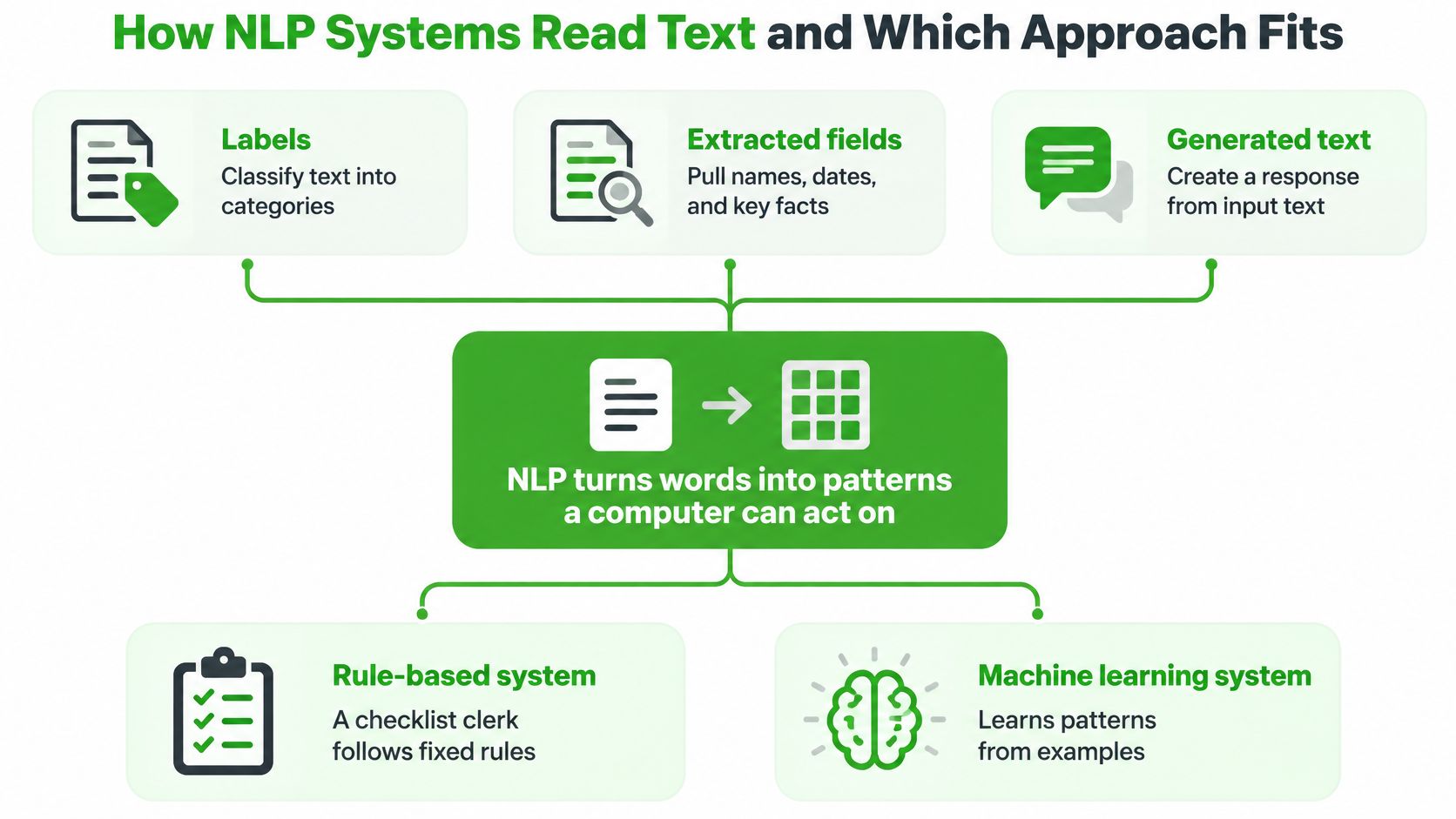
Each approach has a different trade-off. A fixed rule can be transparent but brittle; a model trained on examples can recognize more patterns but may miss context. Generative systems offer flexibility, but their ability to produce polished text doesn't guarantee that the text is supported by the input.
| Approach | How it works | Strength | Weakness |
|---|---|---|---|
| Rule-based systems | Hand-written patterns, dictionaries, and keyword lists | Predictable and easy to audit | Breaks on wording nobody anticipated |
| Classical machine learning | Statistical models trained on labeled examples | Works with modest data and runs cheaply | Needs labeled data and misses wider context |
| Pretrained Transformers | Learn word meaning from context across large text collections, then fine-tune for a task | High accuracy on classification and inference | Needs task-specific validation and can be hard to explain |
| Generative large language models | Predict likely next words to produce new text | Flexible for summarizing and drafting | Can produce fluent claims the source doesn't support |
Most real products combine approaches. A rule may route a case, a model may classify a passage, and a person may review the record. The more open-ended the system's output, the more important it is to check what the system relied on and whether its claims match the source.
How Accurate NLP Is on Standard Language Tasks
An accuracy score answers a specific question: how often did a system return the expected label on a particular test set? It doesn't reveal whether the test set resembles an organization's applications or whether errors are more costly in one direction than another.
The reported GLUE figures illustrate how much scores can vary across tasks. SST-2 sentiment classification reaches 96.4% in a reference result and 96.9% in a replicated run, while CoLA linguistic acceptability falls from 68.0% to 65.3%. QNLI question-answering inference reaches 94.7%, and QQP duplicate-question detection reaches 92.2%; the reported results don't provide replicated figures for those two tasks. The spread reflects differences in linguistic complexity, dataset size, and label ambiguity, not one universal measure of NLP ability (GLUE task scores and validation guidance).
| Task | What it checks | Reference score | Replicated score |
|---|---|---|---|
| Sentiment classification (SST-2) | Whether a text expresses positive or negative sentiment | 96.4% | 96.9% |
| Question-answering inference (QNLI) | Whether a passage contains the answer to a question | 94.7% | Not reported |
| Duplicate-question detection (QQP) | Whether two questions ask the same thing | 92.2% | Not reported |
| Linguistic acceptability (CoLA) | Whether a sentence is grammatically acceptable | 68.0% | 65.3% |
Read an accuracy claim in three steps:
- Identify the task and dataset. A score for sentiment classification doesn't tell you how well the system will find address gaps.
- Check replication and uncertainty. Look for repeated evaluations and confidence intervals, which show how much a result could fluctuate.
- Test against your own examples. Use records representative of the applications and documents your staff handle.
Accuracy isn't always the right measure. Precision tells you how often a flagged item is relevant; recall tells you how many relevant items the system finds. A false flag and a missed discrepancy can have different consequences, so decide which error matters more for each task before setting a threshold.
Benchmarks can still tell us something about ordinary user experience. A 2024 EMNLP study using the User Reported Scenarios dataset found that benchmark scores for 10 large language model services correlated with human preferences at 0.95 for real-world experience and 0.94 for pairwise annotations (the EMNLP study of user-reported scenarios). That relationship doesn't answer whether a system handles an incomplete screening record, interprets negation, or makes a safe recommendation about eligibility.
Where NLP Gets Things Wrong and How to Guard Against It
A generative model can write a clear, convincing summary that states something absent from the record. The cause is fundamental: language models predict likely sequences of words, not truth or legal validity. A sentence can sound coherent and still be unsupported.
Automatic text measures don't necessarily catch that problem. Metrics such as ROUGE can have very low precision when used to evaluate factual errors, and a score can create a misleading impression of how well a system detects hallucinations. Research on hallucination evaluation warns that performance can also appear better when an automatic measure doesn't align with human judgments (research on hallucination evaluation and factuality).
| Failure mode | What it looks like | Safeguard |
|---|---|---|
| Hallucinated detail | A summary states a conviction absent from the record | Reject any value without a matching source field |
| Negation confusion | “No conviction found” is read as a conviction | Test negated phrasing and route contradictions to a reviewer |
| Incomplete records | The system fills a missing address period with an assumption | Flag gaps instead of inferring missing data |
| Fluent but unsupported output | A polished paragraph has no traceable source | Log each input and output pair, and link claims to sources |
| Metric mismatch | A high ROUGE score accompanies weak factual accuracy | Measure precision and false-negative rates per task |
A safer design restricts generation to normalized source data and requires each factual claim to point to a specific field or record. If the system can't find support, it should reject the value or flag the case rather than complete the story. Keep an audit trail, and send ambiguous or contradictory records to a trained reviewer.
Measure error rates separately for entity extraction, address-discrepancy detection, and record summarization. Fluency and a single text-overlap score can't substitute for knowing which facts the model got right, which it missed, and which it made up.
Bias and Fairness Across Names, Languages and Groups
A strong average score can hide weaker performance for people who are less represented in the system's data. For a nonprofit, that risk can show up in summaries that preserve some applicants' details accurately but distort or omit others.
A 2025 evaluation of three summarization-capable language models found systematic demographic disparities: demographic fidelity was lowest for adult-focused summaries, and underrepresented populations were more likely to receive hallucinated information. A review of 64 studies published from 2019 to 2024 also found substantial variation in how researchers defined and evaluated hallucinations, with details such as annotator demographics and agreement measures often omitted (the 2025 study on demographic fidelity in summaries).
Those limits matter when a system encounters unfamiliar names, accents, or naming conventions. A model may misread a name as a different entity, omit a detail, or treat a less familiar phrasing as anomalous. For multilingual programs, performance in one language doesn't establish that the system will work in another. Teams assessing international use can check language coverage before recommending global fit, then test the actual languages and records they expect to process.
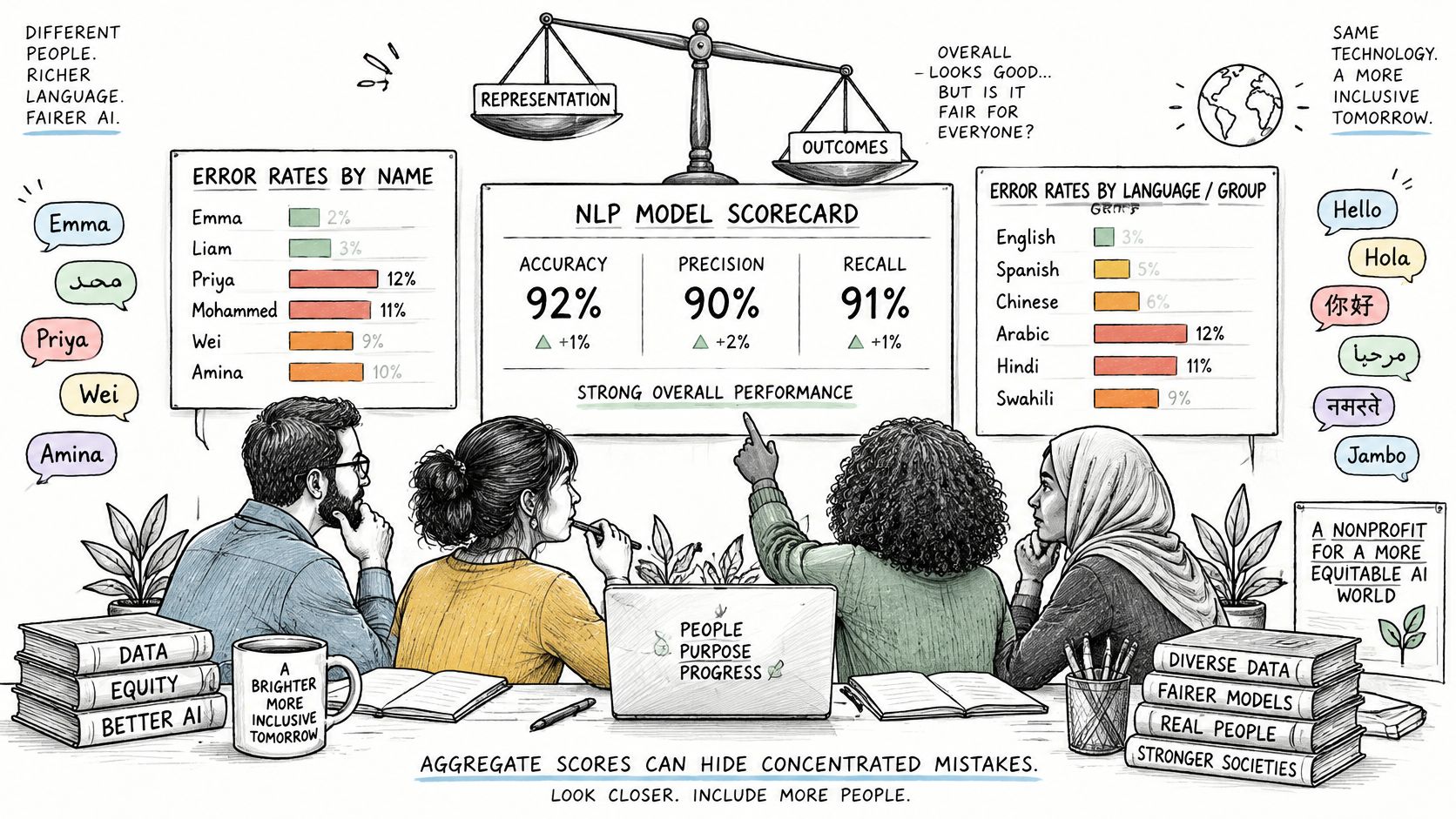
A practical audit should examine the records the organization serves, not only the system's overall score:
- Sample records across relevant groups. Include variation in names, languages, and document wording.
- Measure errors per group. Look separately for missed fields, incorrect extractions, and unsupported claims.
- Compare output with source wording. Keep enough context for reviewers to confirm what the applicant or record says.
- Check for sensitive inferences. The system shouldn't infer personal characteristics that aren't in the source.
- Offer a correction process. Give staff a clear way to challenge a disputed output and record the resolution.
For a broader look at the human process surrounding checks, nonprofits can review this guide to how to screen volunteers. NLP can reduce routine administrative work, but fair use requires subgroup testing, traceable evidence, and human review before consequential action.
Practical NLP Uses for Volunteer Screening Teams
For high-stakes volunteer screening, NLP is useful as an assistant, not as the final decision-maker. A 2025 study found that hallucination-detection performance declined by up to 45.9% under human-aligned evaluation compared with commonly used ROUGE evaluation; another reported that open-source models failed to detect hallucinations in roughly 30–35% of test cases across medical, legal, and financial domains. The same research identifies negation as a particular challenge, including the difference between “no conviction found” and “a conviction found” (the 2025 research on hallucination detection).
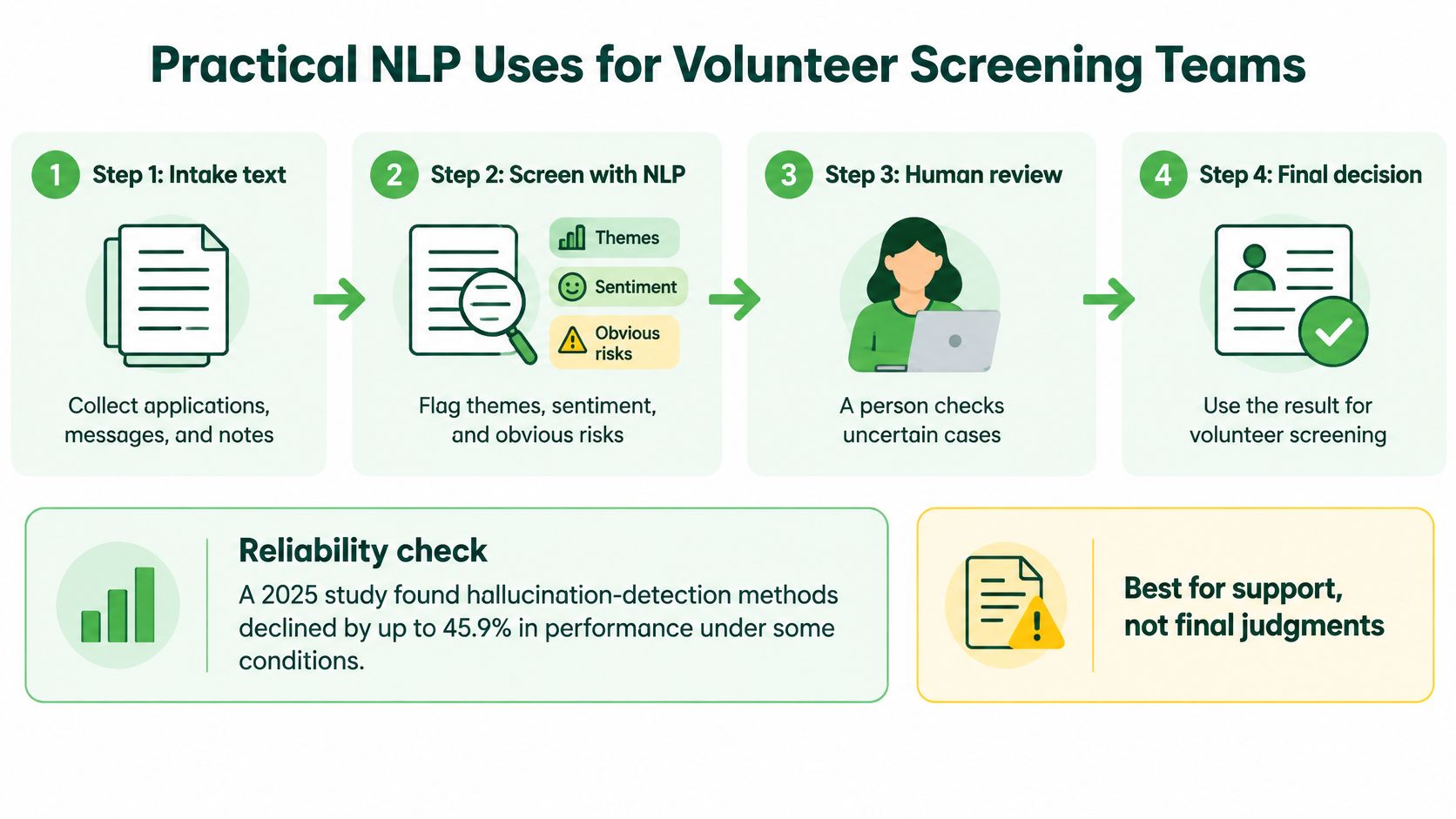
That evidence doesn't make NLP useless. It points to a safer division of labor: the system organizes information and exposes uncertainty; a person verifies the record and makes the consequential judgment.
Application intake: Extract names, prior addresses, and roles, then link each value to the precise application field it came from. If the system can't show the source, treat the value as unverified.
Address comparison: Compare applicant-provided history with verified records and flag omitted counties, timeline gaps, and inconsistent dates before a search. A gap should prompt a question or review, not an inferred address.
Explanation routing: Classify explanation text and send incomplete or contradictory records to a staff member. If an applicant's explanation conflicts with a record, present both rather than resolving the conflict automatically.
Natural-language requests: A staff member may describe a check using information such as a name, birth date, and last known city. A natural-language interface can parse the request and submit it for processing, but it shouldn't convert an uncertain match into a final conclusion.
NLP can organize and explain evidence. A trained reviewer still needs to decide what the evidence means for the volunteer-screening process.
Teams considering public online information can also review guidance on social media screening. The same principle applies: use automated tools to surface material for review, not to turn uncertain text into an unattended eligibility decision.
The following video offers another view of the screening workflow:
Decide Whether NLP Fits Your Volunteer Screening Workflow
NLP is a go for a narrow support task when staff can check its work against source records. It's a no-go as an unattended eligibility or adverse-action decision-maker. A responsible pilot starts with a defined task, a representative test set, and clear rules for what happens when the model is unsure.
Use a go-or-no-go checklist
- Define one task. Start with a specific job, such as extracting application fields or flagging address gaps. Avoid launching a broad “screen this person” instruction without specifying what the system should produce.
- Test past applications. Compare system outputs with reviewer findings, including for groups and records that may be underrepresented in the test set.
- Require source-linked claims. Staff should be able to trace each extracted field or summary statement back to its source.
- Set escalation rules. Send contradictory, incomplete, or unverifiable records to a trained person instead of prompting the system to guess.
- Keep consequential decisions with staff. Eligibility and adverse-action decisions belong in verified, legally controlled workflows.
For background on automated tools and screening, teams can read this guide to automated background checks. The important test is operational: can staff see why the system flagged a record, confirm the underlying evidence, and correct a mistaken result?
Start with a 30-application pilot as a proposed test, not a performance guarantee. Compare every NLP-flagged discrepancy with reviewer findings, note missed discrepancies as well as false flags, and include records with incomplete or contradictory information. Expand only if the results meet the organization's documented standards and reviewers can still trace outputs to their sources.
VolunteerBadge offers nonprofits a natural-language interface, REST API, and webhooks for submitting background-check requests, alongside screening results in plain English. Visit VolunteerBadge to see whether its screening workflow fits a carefully tested, human-reviewed use of NLP.
