
8 Non Profit Organizations Mission Examples That Work
8 real non profit organizations mission examples for volunteer, youth, and faith-based groups, plus tips to write and align one with trust-building.
On this page
Most boards are told to write something short, warm, and memorable. That advice is why so many mission statements sound impressive and still fail the first real decision. A working non profit organization's mission names who is served, what must change, and how the work gets done. If volunteers carry that work, the same sentence has to shape recruitment, screening, and the reasons families trust you.
I judge a draft by one test. Can a coordinator read it and know which roles touch children, patients, or people in crisis, and which checks those roles require before anyone is deployed? If the answer is no, you have a slogan. Print it on a wall if you want. Don't let it run the program.
These eight examples move fast on purpose. National charities, youth programs, and faith-based ministries each show a different way to write the sentence so the volunteer duty is obvious. Red Cross puts volunteers inside the method. Girl Scouts and Boys & Girls Clubs name the change they want in young people. Big Brothers Big Sisters stakes everything on one trusted adult. Habitat for Humanity, Special Olympics, Boy Scouts of America, and Make-A-Wish show how shared building, inclusion, character, and critical illness each create a different screening obligation. Use them to write yours, not to copy their voice.
Table of Contents
- 1. American Red Cross Mobilizing Volunteers and Donors
- 2. Girl Scouts of the USA Building Courage, Confidence, and Character
- 3. Boys and Girls Clubs of America Reaching Full Potential
- 4. Big Brothers Big Sisters One-to-One Mentoring
- 5. Habitat for Humanity Building Homes, Communities, and Hope
- 6. Special Olympics Sports, Courage, and Friendship
- 7. Boy Scouts of America Ethical and Moral Choices
- 8. Make-A-Wish Foundation Granting Wishes for Children with Critical Illnesses
- 8 Mission Statement Examples at a Glance
- Write Your Mission, Then Make Your Screening Policy Prove It
1. American Red Cross Mobilizing Volunteers and Donors
The American Red Cross mission states that it prevents and alleviates human suffering in the face of emergencies by mobilizing the power of volunteers and the generosity of donors. Volunteers are the method, not a staffing shortcut you bolt on after the slogan is printed.
Say a chapter opens a shelter after a wildfire and runs a blood drive the same week. One role meets families who just lost a home. The other handles health procedures and donor records. The mission doesn't let you call both jobs "helper."
Screening when the clock is loud
Urgency is the trade-off. A delay slows relief. An unscreened adult in a shelter with children creates a trust failure no thank-you note repairs. I would hold a nonclinical role for a day before I deploy someone with a blank check.
Practical rule: Print the mission in the handbook so every role maps to suffering prevented, not to a generic title.
- Split the risk: Shelter contact, blood services, and health training are not the same duty.
- Screen first: Do it before deployment when the role touches vulnerable people, even if the response is urgent.
- Refuse the extra: Work that no longer alleviates emergency suffering is mission creep.
The donor half of the sentence matters too. Gifts that support charitable programs should be described as what keeps that volunteer mobilization funded.
2. Girl Scouts of the USA Building Courage, Confidence, and Character
Girl Scouting develops girls of courage, confidence, and character, who make the world a better place. That mission is valuable because the outcomes are traits you can observe, not a vague promise to support youth.
The strengths and the cracks in that sentence are easier to see side by side.
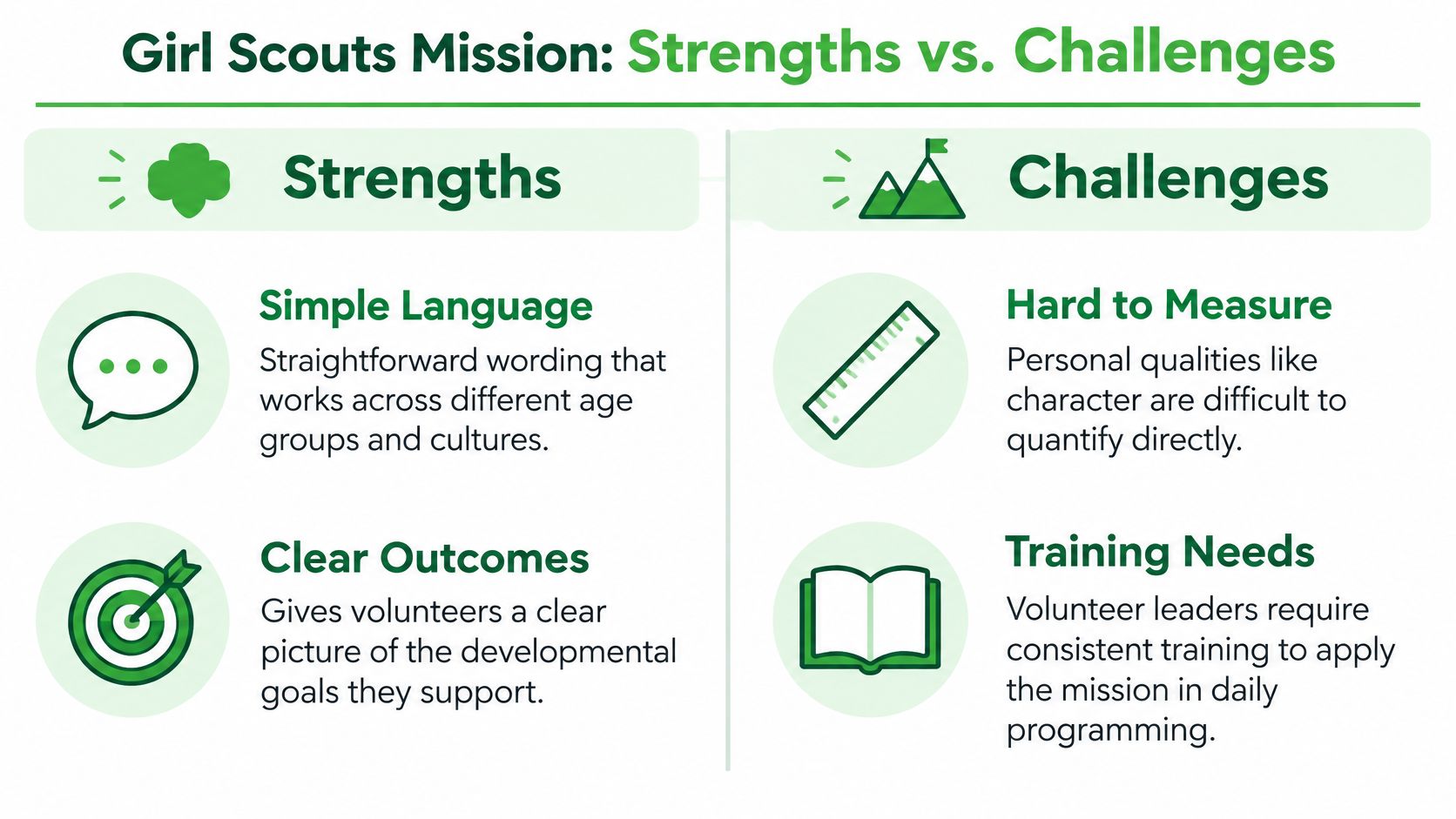
A troop leader planning badge work and a camp counselor running an outdoor challenge are both trying to make courage visible. Courage in a meeting looks like a girl speaking up. Courage at camp looks like a supervised climb. If your own mission names traits, write what each trait looks like in the adult role, or volunteers will improvise.
The trade-off is specificity versus warmth. "Character" inspires parents. It doesn't tell you whether the adult is alone with minors. Unsupervised access is the line I wouldn't blur.
- Define the trait in the role: A mentor models confidence. A driver doesn't need the same script.
- Check adults with minors: Require background checks for volunteers with unsupervised access, and file the result.
- Keep camp and troop rules aligned: Same mission, same documentation, or families hear two different safety stories.
What doesn't work is a values poster with no file behind it. Parents trust the program that can show who was cleared to lead the overnight, not the program with the prettier sentence.
3. Boys and Girls Clubs of America Reaching Full Potential
The mission is to enable all young people, especially those who need us most, to reach their full potential as productive, caring, responsible citizens. "Especially those who need us most" is the operational clause. It tells you where mentors go first.
Say your club has twenty volunteer slots and a waiting list in two neighborhoods. A generic mission would fill the slots with whoever applies. This one pushes recruitment toward youth facing the highest barriers, then builds after-school tutoring and mentoring around that priority. Teen leadership roles inside the club belong in the same sentence. Members practice being caring, responsible citizens by volunteering, not only by being served.
Equity without a soft screening standard
Prioritizing greatest need doesn't lower the bar for adults. It raises the cost of a bad match. Pair the background check with a written code of conduct and a two-adult rule in rooms and vans. What fails is recruiting "any caring adult" and hoping proximity to kids produces potential. Caring isn't a screening result.
I would write the recruitment ad from the mission. "Mentors for youth who need us most" attracts a different applicant than "fun volunteers wanted," and it gives you a clean reason to decline a role that never meets a young person.
4. Big Brothers Big Sisters One-to-One Mentoring
Big Brothers Big Sisters creates and supports one-to-one mentoring relationships that help young people build confidence and reach their potential. The method is the mission. One adult, one child, often for a year or more, in the community or inside a school partnership.
That structure makes safeguarding the product, not the paperwork around it. A weekly community match puts an adult in cars, homes, and unstructured time. A school-based match is narrower, and the screening file should say so. Same brand, different exposure, different questions.
Families don't experience your mission as a sentence. They experience it as the adult you allowed near their child.
A 2025 NTEN data report found that more than 79% of nonprofit respondents identified staff time as a data-collection challenge. That's the trade-off. You still collect consent, identity, and the checks that justify a match. You skip the extra biography nobody will govern. Explain the screening steps during recruitment, and re-screen on a set schedule for long matches. Matching first and screening later breaks the program, because the relationship is the program. For why the check itself isn't optional, start with why background checks matter before you promise a family a mentor.
5. Habitat for Humanity Building Homes, Communities, and Hope
Faith shows up in the mission, and it shows up on the job site.
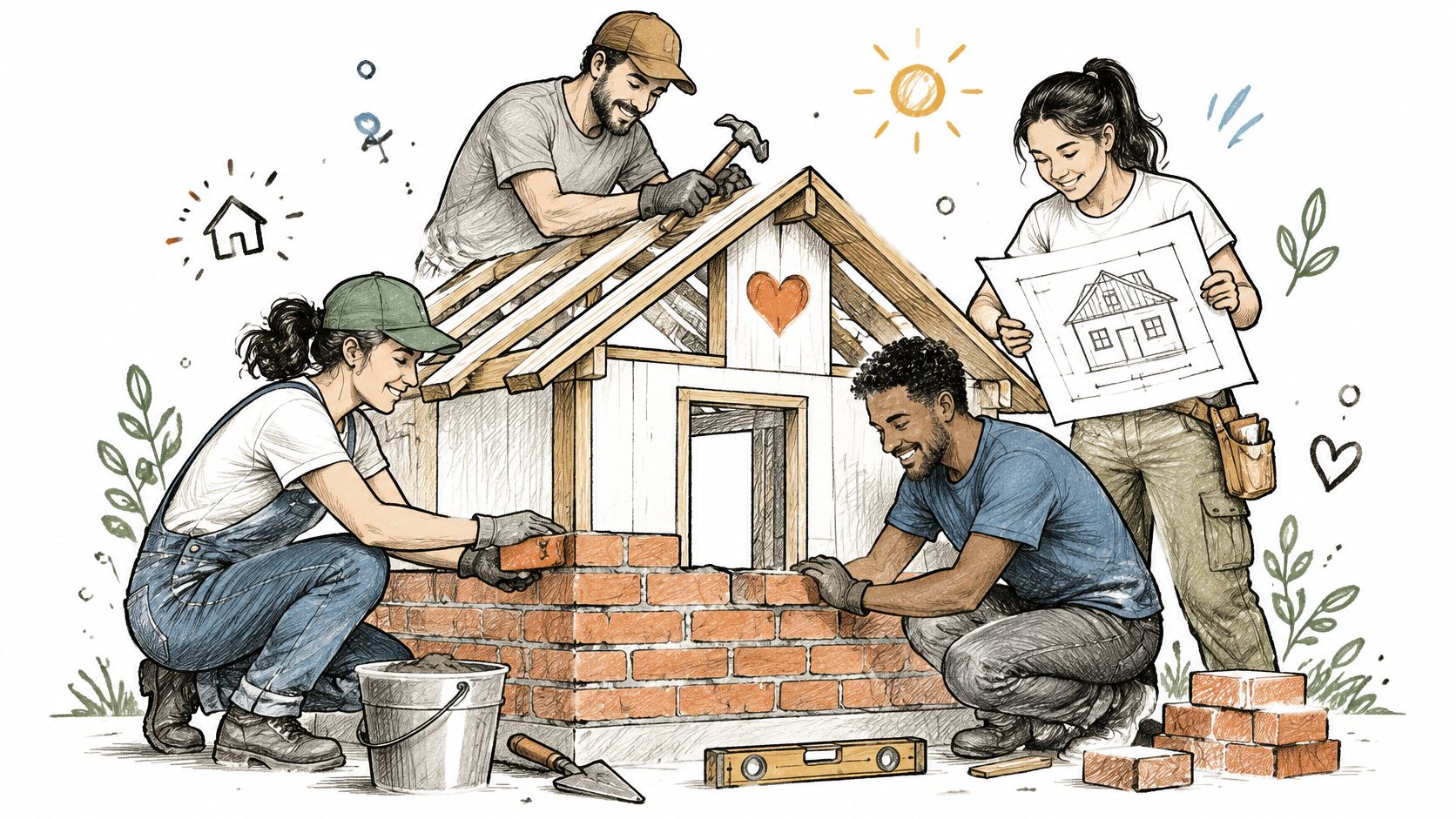
Seeking to put God's love into action, Habitat for Humanity brings people together to build homes, communities and hope. Faith is the motive. The observable work is people building alongside a family. Weekend crews from churches and companies frame and paint. ReStore volunteers sort donations that fund more houses. Both roles serve the same outcome if you keep the house and the family in view.
In 2024, 62% of nonprofit organizations surveyed said building community wealth and well-being was a major focus of their work, according to the Nonprofit Finance Fund's 2025 State of the Nonprofit Sector Survey. A build day can serve that aim, or it can become a photo stop that never meets the homeowner.
Site work is still people work
Volunteers stand next to families, kids, and neighbors. Document the role, the tools, and the screening before someone swings a hammer where residents are present. Adapt the faith language if you aren't a ministry, and keep the core, which is people working together for a shared home. Loose "anyone can show up Saturday" signups fail that test. Good nonprofit volunteer management treats the build roster, the safety talk, and the family boundary as one system.
A short site briefing beats a long mission reprint nobody reads in the mud. Watch how a crew hears the purpose before the work starts.
6. Special Olympics Sports, Courage, and Friendship
Special Olympics provides year-round sports training and athletic competition for children and adults with intellectual disabilities, so they can develop fitness, demonstrate courage, experience joy, and share friendship with families and the community. It's long. It's also precise about who is served and which outcomes count.
Coaches at weekly practices and officials at a regional meet aren't the same volunteer. Both can be alone with an athlete for a moment. That moment is why I require background checks for coaches and anyone with one-on-one contact, then document boundary training.
The finish line only means something if the coach beside the athlete was cleared to be there.

Two versions, one standard
Use a short line in recruitment. Keep the full mission in coach training. What fails is shrinking the statement until "intellectual disabilities" disappears, because that phrase sets the safeguarding and inclusion bar. Friendship isn't a reason to skip supervision. It's the reason supervision has to feel respectful, not suspicious.
Say you're recruiting twenty event volunteers for a weekend. The short mission gets them in the door. The full text, plus a check for anyone paired with an athlete, is what lets a family treat the finish line as safe.
7. Boy Scouts of America Ethical and Moral Choices
The Boy Scouts of America prepares young people to make ethical and moral choices over their lifetimes by instilling the values of the Scout Oath and Law. Success isn't a badge count. It's a decision a young person can still make years later.
A troop meeting that teaches ethics through outdoor skills, and a Court of Honor led by volunteer leaders, only works if every adult uses the same standard. Tie the role to the Oath and Law in the position description. An adult who won't accept two-deep leadership doesn't fit the mission, no matter how skilled they are with a map.
Character programs outside scouting face the same test. Teaching integrity through youth soccer still needs an adult policy, because integrity taught by an uncleared coach is a contradiction.
- Write the value into the job: If the Oath expects trustworthiness, the leader file should show a completed screening before youth contact.
- Use two-deep leadership: No adult works with youth alone.
- Don't wait for a ceremony: Screen before the first meeting, not before the Court of Honor.
A values mission without a supervision rule is how organizations talk about moral choices and then leave youth with one adult in a parking lot.
8. Make-A-Wish Foundation Granting Wishes for Children with Critical Illnesses
Make-A-Wish grants the wishes of children with critical illnesses. Short, one population, one outcome. That brevity is a strength on a badge, a sign, and an onboarding slide, because a volunteer can repeat it under stress.
Wish granters who sit with a family and plan the experience carry a different duty than volunteers who staff a community fundraiser. Homes and hospitals raise confidentiality, boundaries, and health privacy. Celebration crews still represent the child in public. Screen the home and hospital roles, and document boundary and confidentiality training before the first visit. I wouldn't send a cheerful untrained volunteer into a hospital room because the mission "only" says wishes.
Brevity is for recall, not for thinner files
What doesn't work is treating the short sentence as permission to skip files. Brevity helps memory. It doesn't shrink the population's vulnerability. If your mission names critical illness, disability, or minors, your screening policy has to name those same people. Put the one-sentence mission on the volunteer badge, and keep the privacy rules on the same card.
Say a granter meets a family on Thursday. The family should already know who was cleared, what they may not post, and how to reach the coordinator if a boundary slips. That conversation is the mission, spoken out loud.
8 Mission Statement Examples at a Glance
| Organization | Core Focus | Statement Length | Volunteer Role | Best Lesson for Your Mission |
|---|---|---|---|---|
| American Red Cross | Preventing and alleviating suffering in emergencies | Medium | Volunteers drive disaster response, blood services, and humanitarian aid | Name volunteers as a core resource and connect their work to impact |
| Girl Scouts of the USA | Building girls' courage, confidence, and character | Short | Troop leaders, mentors, and camp staff support youth development | Describe the qualities your programs aim to develop |
| Boys & Girls Clubs of America | Helping young people, especially those facing barriers, reach their potential | Long | Mentors and volunteers support youth programs and leadership | Let equity guide volunteer recruitment and program priorities |
| Big Brothers Big Sisters | Supporting young people through one-to-one mentoring | Medium | Adult volunteers build long-term mentoring relationships | Make the volunteer method and commitment clear |
| Habitat for Humanity | Bringing people together to build homes, communities, and hope | Medium | Volunteers build homes and support community programs | Connect hands-on service to a shared, visible outcome |
| Special Olympics | Providing sports opportunities and fostering personal and social growth for people with intellectual disabilities | Long | Volunteer coaches, officials, and event staff support athletes | Define who you serve and the outcomes that matter |
| Boy Scouts of America | Preparing young people to make ethical and moral choices | Medium | Volunteer leaders deliver programs and model shared values | Tie volunteer expectations to clear, shared principles |
| Make-A-Wish Foundation | Granting wishes for children with critical illnesses | Short | Volunteers plan wishes, support families, and host events | Keep the mission concise and specific about whom you serve |
Write Your Mission, Then Make Your Screening Policy Prove It
Use one fill-in line. We [how] so that [who] can [what change]. If volunteers are the how, say so. If the who includes children, patients, or families in crisis, the screening policy should name those groups the same week you approve the sentence.
Three steps that keep the sentence honest
- Draft with the people who deploy: Write it with coordinators, not only a board retreat, so the verbs match real roles.
- Test it on volunteers: Read it to three current volunteers and ask which tasks it doesn't cover. Cut anything they can't connect to a person served.
- Align screening with the named populations: Minors, home visits, medical settings, and one-to-one matches get checks, supervision rules, and a written record. Roles that never meet those people don't need the same file.
A 2025 Points of Light report notes that 72% of nonprofits say volunteers improve service quality, while only 25% of funders agree. Hours logged won't close that gap. Show the role, the training, and the outcome for the person served. The same report notes that few nonprofits have the resources to measure deeper outcomes for communities and society, so start with safety and quality indicators you can file.
Across 35 countries, a Johns Hopkins-led comparative study published in 2003 found the nonprofit sector included approximately 39.5 million full-time-equivalent workers, including 12.6 million full-time-equivalent volunteers. That scale is why a pretty sentence isn't a safeguarding plan.
Trust with families depends on documented, FCRA-compliant screening. We built VolunteerBadge because the organizations that could least afford background checks were paying the most. Churches, schools, camps, and nonprofits nationwide can create a free account and run a fully FCRA-compliant check for $5, with no contract and no monthly fee.
The promise: Your mission statement is a promise. Your screening policy is how families know you keep it.
VolunteerBadge provides churches, schools, camps, and nonprofits with FCRA-compliant volunteer background checks featuring plain-language results, ensuring the people named in your mission are screened before deployment. You can post roles, track hours, and maintain a compliance roster while each check remains linked to the duty your mission creates. Visit VolunteerBadge to open a free account and screen your first volunteer without a contract.
