
What Is a 10 Panel Drug Test? Panels, Windows and Results
What is a 10 panel drug test? Learn which drugs it screens for, how long results last, and how to read positive and negative results.
On this page
A 10-panel drug test is a multi-drug screen, usually of urine, that checks ten drug groups at once, and the exact list depends on the laboratory and the order.
If two tests both say 10-panel, do they necessarily check for the same drugs? No, and that difference matters more than the number on the box. Think of a panel as a menu of tests ordered together, not a promise that every laboratory serves the same menu.
For volunteer coordinators, schools, churches, and nonprofit programs, the useful question isn't whether someone passed. It's what the laboratory tested, how it reached its result, and what that finding can reasonably contribute to a screening decision.
Table of Contents
- What a 10-Panel Drug Test Covers Drug by Drug
- Urine, Oral Fluid and On-Site Formats
- How a 10-Panel Test Turns a Sample Into a Result
- How Long Each Drug Stays Detectable
- Reading Positive and Negative Results
- What a 10-Panel Test Does Not Prove
- Choosing and Specifying a 10-Panel Test
What a 10-Panel Drug Test Covers Drug by Drug
A drug group can contain several substances measured together or separately. An opiate category, for example, may cover codeine and morphine, while a separate category targets oxycodone-related substances. Two panels can both count to ten and still measure different drugs.
The laboratory requisition, meaning the written or electronic testing order, identifies the actual menu. A product label gives you a starting point, but it does not establish which individual drugs or metabolites the laboratory will measure.
The ten drug groups in a common 10-panel test
The federal urine thresholds below come from the Department of Transportation's urine-testing cutoff schedule. They are federal benchmarks, and a commercial panel may set different levels.
| Code | Drug group | What it detects | Federal urine cutoff (initial) |
|---|---|---|---|
| THC | Cannabis | Marijuana metabolite | 50 ng/mL |
| COC | Cocaine | Cocaine metabolite | 150 ng/mL |
| AMP | Amphetamines | Amphetamine and methamphetamine | 500 ng/mL |
| MET | Methamphetamine | Methamphetamine | Included in the combined amphetamine/methamphetamine screen above |
| OPI | Opiates | Codeine and morphine | 2,000 ng/mL |
| OXY | Oxycodone group | Oxycodone and oxymorphone | 100 ng/mL |
| PCP | Phencyclidine | Phencyclidine | 25 ng/mL |
| BZO | Benzodiazepines | Benzodiazepine medicines | Not included in this DOT cutoff schedule |
| BAR | Barbiturates | Barbiturate medicines | Not included in this DOT cutoff schedule |
| MTD | Methadone | Methadone | Not included in this DOT cutoff schedule |
A metabolite is a substance the body produces while processing a drug. Testing for a metabolite works like looking for a footprint rather than the person who left it: the print confirms someone passed through, and the metabolite confirms the body processed the drug.
Notice that AMP and MET can appear as separate lines on a commercial device even though the federal benchmark groups them together. An OPI line works the same way. It tells you the screen looked for codeine, morphine, or related analytes at or above a cutoff, and it says nothing by itself about oxycodone, which sits in its own row.
Why the category names matter
The DOT's opioid-panel notice explains that its program remained a five-panel test after expanding opioid coverage. Counting categories and counting separately measured substances are different tasks.
Commercial expanded panels may add benzodiazepines, barbiturates, and methadone, or use other combinations. A familiar category name does not guarantee coverage of every medicine in that family.
If your concern goes beyond screening and involves possible opioid dependence, opioid rehab in Northern California is a separate kind of resource. A testing menu and a treatment assessment answer different questions.
Before ordering, match every row you need against the laboratory's named analyte list, which is the particular substance each line on the panel measures. That list defines what a negative result rules out.
Urine, Oral Fluid and On-Site Formats
You'll usually encounter urine testing, but some programs use oral fluid, collected from the mouth. The specimen matters because a laboratory must interpret findings using the method and thresholds established for that specimen.
The federal authorized-testing-panel guidelines distinguish urine and oral-fluid testing. Don't apply a urine detection estimate to an oral-fluid order just because the drug names look similar.
A cup, a card, or a laboratory order
An integrated urine cup combines collection and screening in one device. A dip card has test strips that contact a separately collected urine specimen.
Products such as the Dochek Amazewell urine cup and Abbott multi-drug dip card illustrate these physical formats. Neither format, by itself, tells you whether the program includes documented custody, laboratory confirmation, or medical review.
| Format | What the reader encounters | What to establish before use |
|---|---|---|
| Integrated urine cup | A collection container with screening strips | Read time, analyte menu, and confirmation arrangements |
| Urine dip card | A card placed into a collected specimen | Handling instructions and how the specimen is retained |
| Laboratory order | Collection followed by laboratory analysis | Validity checks, reporting rules, and review procedures |
| Oral-fluid collection | A mouth-collected specimen | The laboratory's specimen-specific testing specifications |
Speed isn't the same as finality
On-site devices provide a preliminary immunoassay reading without waiting for laboratory transport. Staff must follow the device's reading instructions rather than interpreting a line whenever it's convenient.
A laboratory-based program can integrate analytical testing with specimen-validity checks and confirmation when needed. However, those services should be specified in the order, not assumed from the word laboratory.
Practical rule: Choose the format partly by how much weight the result will carry, not simply by how quickly a line appears.
For a decision affecting employment or volunteer eligibility, arrange the follow-up process before collecting anything. Staff shouldn't discover after an unexpected screen that they have no documented way to send the specimen for confirmation.
How a 10-Panel Test Turns a Sample Into a Result
A defensible result comes from a process, not just a test strip. Collection records establish whose specimen was tested, analytical methods establish what was detected, and medical review helps interpret legitimate explanations.
The SAMHSA Medical Review Officer Guidance Manual describes the distinction between screening and confirmation. For amphetamine/methamphetamine in federal urine testing, the initial cutoff is 500 ng/mL and the confirmation cutoff is 250 ng/mL, illustrating that the stages use different decision limits.
The collection-to-report sequence
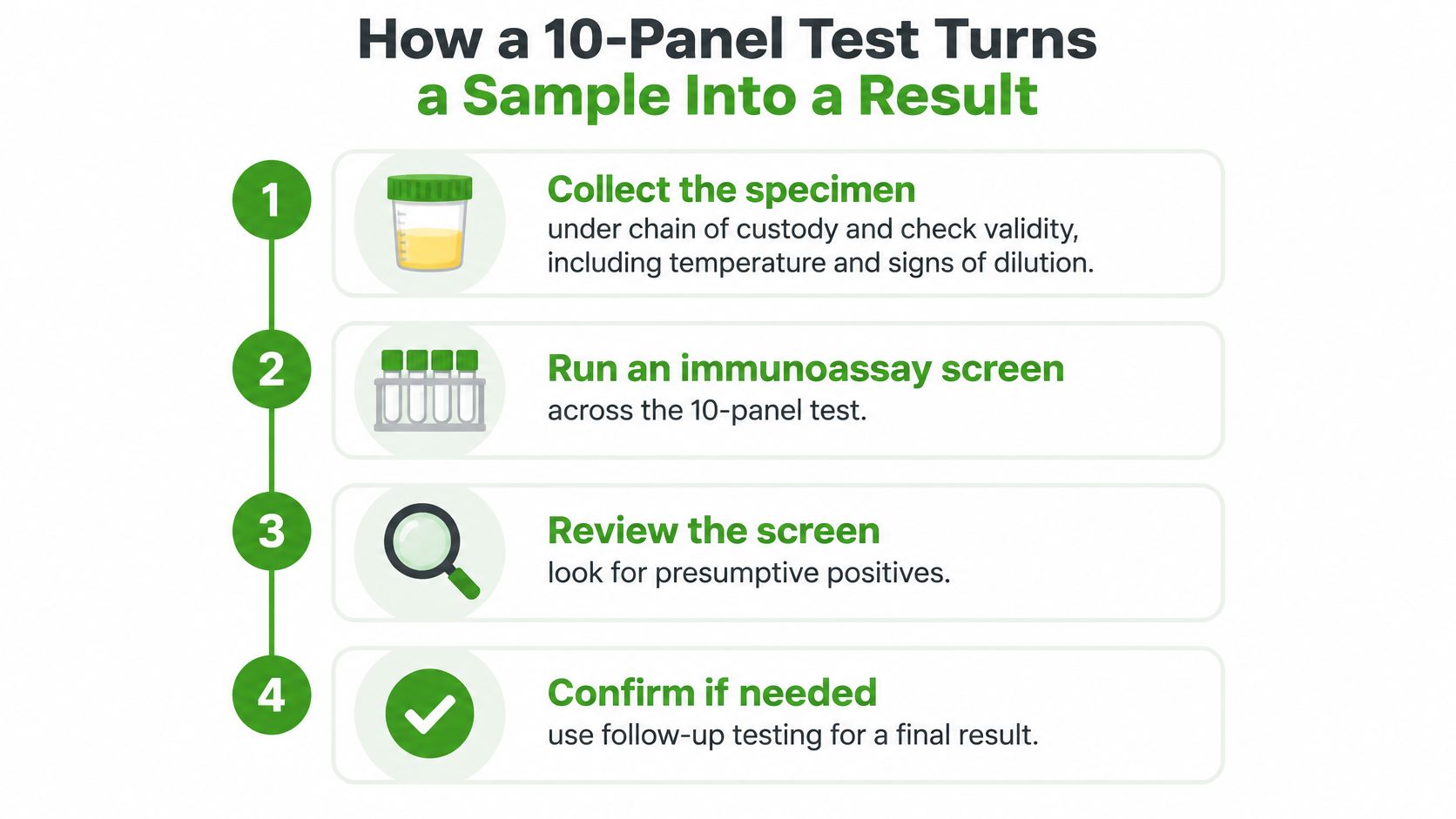
Collect and document the specimen. Follow chain-of-custody procedures, record identifying information, and check validity indicators, including collection temperature and evidence of dilution. This helps the program assess whether the specimen can support a reliable result.
Run the immunoassay screen across the ordered groups. This method suits high-volume screening, but its reactions aren't specific enough to settle every unexpected finding.
Confirm a presumptive positive. A screening result that meets the initial threshold goes to a more specific method, such as gas chromatography–mass spectrometry or liquid chromatography–tandem mass spectrometry. These methods identify the target compound rather than relying only on a broad screening reaction.
Apply the reporting rules. A result below the applicable threshold is reported negative, while a confirmed finding meeting the confirmation threshold is analytically positive.
Complete medical review where the program requires it. A medical review officer evaluates relevant prescription information and other legitimate medical explanations before the program finalizes the reported outcome.
The diagram summarizes the analytical path from collection to confirmation.
Why confirmation changes the meaning
An immunoassay works somewhat like a sorting tool: it identifies specimens that need closer inspection. Confirmation performs that closer inspection by examining characteristics specific to the target substance.
The different thresholds don't mean the laboratory lowered its standards halfway through. Screening and confirmation use different methods, so each needs its own established decision limit.
A presumptive positive is a reason to complete the process, not a reason to skip it.
A useful report or supporting laboratory specification should identify the analytes tested, cutoffs applied, and confirmation status. Coordinators also need to distinguish the laboratory's analytical finding from the medically reviewed result they're authorized to receive.
How Long Each Drug Stays Detectable
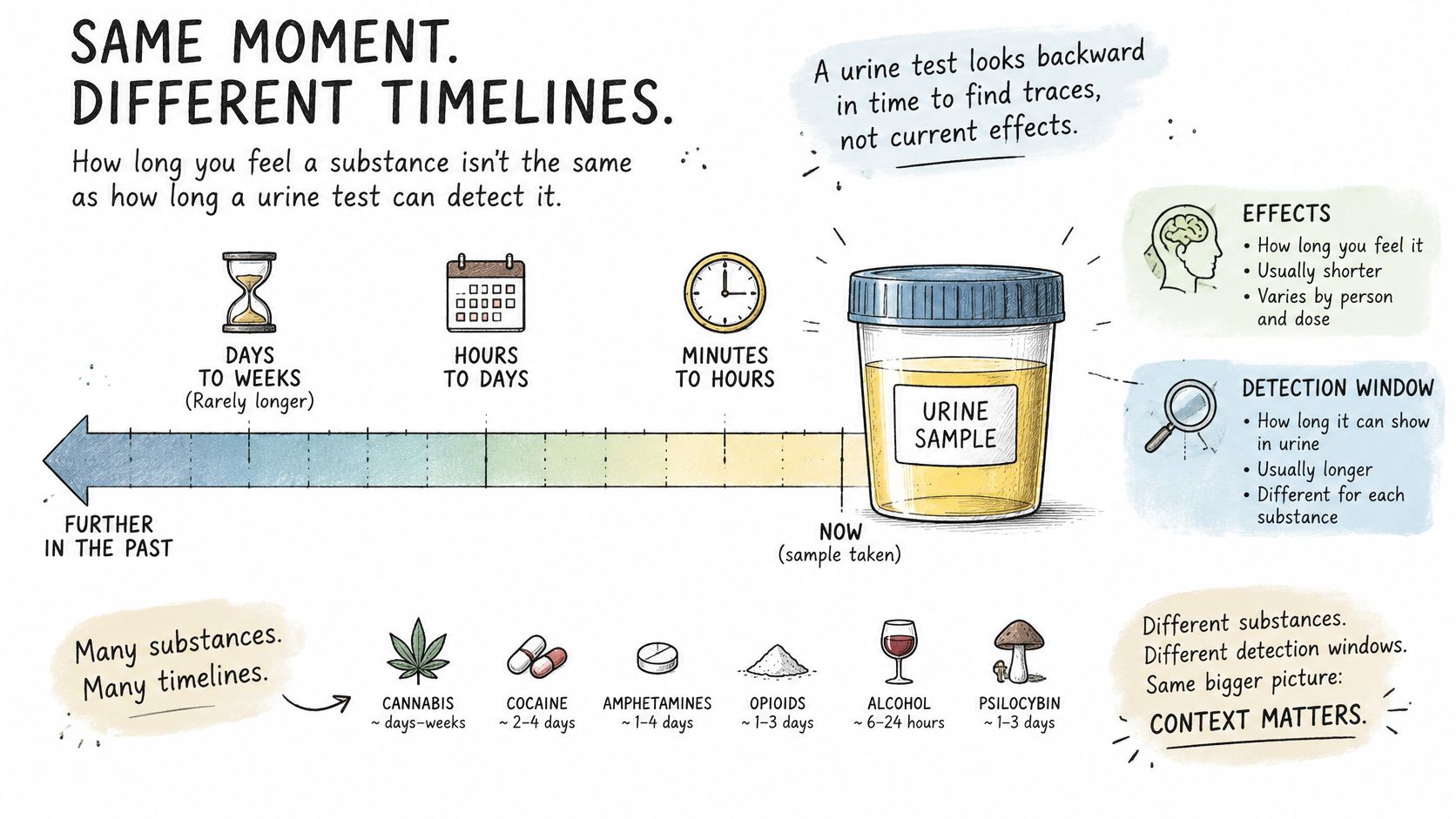
A drug's effects can fade within hours while its metabolites remain measurable for days. A detection window is the period after use during which a test may still identify a substance or its metabolites, and it answers a different question than impairment does.
Testing.com's general urine guidance places many substances at roughly one to three days, while describing longer windows for certain use patterns. These are reference estimates, not promises about an individual specimen.
This visual highlights the difference between detecting past exposure and assessing present effects.
Typical urine detection windows
| Substance or use pattern | Typical urine detection window | What changes the window |
|---|---|---|
| Most common substances, single use | About 1 to 3 days as a broad reference, not a substance-specific guarantee | Dose and individual metabolism |
| Benzodiazepines, chronic use of long-acting medicines | About 10 days or longer | Type of medicine and length of use |
| Heavy cannabis use | Up to 30 days | Frequency of use; occasional use generally clears sooner |
| Barbiturates | A few days for short-acting agents; long-acting agents can remain detectable well beyond the broad reference | The particular barbiturate, dose, and use pattern |
| Methadone | Commonly a few days after a single use, with repeated dosing extending the window | Target analyte, cutoff, and use pattern |
| Fentanyl | Commonly a few days after exposure, with the exact window tied to the specimen and method used | Target analyte, testing method, and use pattern |
A metabolite works like a receipt left in a drawer. Different receipts remain readable for different lengths of time, and finding one doesn't tell you precisely when the purchase happened.
The same principle applies to repeated use. A person's dose, frequency, metabolism, and the laboratory's threshold all affect whether a specimen still meets the reporting criteria.
Why a window isn't a deadline
Treat the table as a orientation guide rather than an appointment calculator or a reconstruction of someone's behavior. The broad estimate for common substances doesn't establish a reliable window for every drug group on a panel.
The panel's name can be misleading. The number 10 counts drug groups, and the laboratory requisition, not the product label, determines which analytes and cutoffs apply. Two orders both labeled "10-panel" can produce different effective windows for the same substance. For barbiturates, methadone, and fentanyl in particular, the useful estimate is the one attached to the assay the laboratory ran, and oral-fluid testing needs its own interpretation on a different scale.
For another explanation of drug testing, the following video provides additional viewing.
A specimen collected well after the relevant window can't establish what happened earlier. Record the collection date whenever you evaluate a result.
Reading Positive and Negative Results
A result is a decision against a threshold, not a measurement of how much someone consumed. Negative doesn't necessarily mean no trace was present, and positive doesn't identify the dose.
Testing.com's explanation of 10-panel drug testing describes medication cross-reactions, prescription review, and the detection-window estimates above: many substances are detectable for roughly one to three days, long-acting benzodiazepines with chronic use for about 10 days or longer, and heavy cannabis use for up to 30 days.
An unexpected positive needs an explanation
Some amphetamine immunoassays can react to pseudoephedrine or phentermine, as Testing.com explains. That's different from confirming that the target illicit substance was present.
There's another distinction: a prescription medicine may contain the substance the laboratory detects. A confirmed finding can therefore be analytically correct while still having a legitimate medical explanation.
Say a volunteer takes a prescribed benzodiazepine. The appropriate response is to follow the confidential review process, not to ask a program supervisor to decide whether the medication is acceptable based on a test-strip photograph.
The medical review officer's role is to examine relevant documentation under the program's rules. Volunteers should provide medication information through that designated process, rather than circulating their medical history among coordinators.
A negative result needs context too
An omitted substance can't produce a positive on a test that never looked for it. Likewise, collection outside the detection window can produce a negative result even when earlier use occurred.
For example, a coordinator concerned about fentanyl needs to establish whether the order included fentanyl testing. A negative OPI line alone doesn't answer that specific question.
Keep a short interpretation record:
- Analyte identified: Record the specific substance or metabolite, not just positive.
- Cutoff applied: Preserve the applicable screening or confirmation threshold.
- Confirmation status: Distinguish a preliminary reaction from a confirmed finding.
- Medical review outcome: Record the authorized outcome without collecting unnecessary medical details.
- Collection date: Preserve when the specimen was obtained.
Before acting: Separate the screening reaction, the confirmed laboratory finding, and the medically reviewed report.
Adverse decisions should wait until the required confirmation and review are complete. A positive may reflect earlier lawful use, while a negative may reflect timing or limited coverage rather than the absence of all drug use.
What a 10-Panel Test Does Not Prove
A clear report can still leave the most important questions unanswered. Several familiar assumptions stretch a narrow laboratory finding into a much broader judgment, and for organizations responsible for children or vulnerable adults, that overreading can create false reassurance as easily as unfair exclusion.
A label isn't a universal specification
Assumption: Every 10-panel test uses the same list. The number works like a combo-meal number at a restaurant: it says how many items come with the order, while the kitchen still decides what those items are. Two products can share the 10-panel name and test different substance lists, because the requisition that accompanies the order is what the laboratory runs.
The SAMHSA drug-testing resources describe federal requirements effective July 7, 2025, including fentanyl's addition to authorized urine and oral-fluid panels and required urine confirmation for norfentanyl. A commercial product can still leave fentanyl off the menu unless the named list includes it.
Assumption: Alcohol is automatically covered. A drug panel is built from drug analytes, so alcohol calls for a separately ordered test. That separate test shows up in other settings under different rules, as the discussion of alcohol checks in Georgia DUI cases illustrates for a context where alcohol screening is ordered on its own.
A laboratory finding isn't a fitness verdict
Assumption: A negative result proves someone is safe to supervise children. A drug test answers one question: did the specimen contain a listed analyte above the reporting threshold? Boundaries, safeguarding knowledge, references, and conduct around children sit outside that question entirely. A youth program still needs role-appropriate selection, training, supervision, and reporting procedures.
Assumption: A positive result proves impairment or dependence. A threshold-based finding shows a substance or metabolite was present at or above a cutoff. It cannot establish intoxication at the time of collection, the exact time of use, or a substance use disorder. Those questions call for different evidence and, where appropriate, clinical assessment.
| Question | Can the drug test settle it by itself? |
|---|---|
| Did a selected analyte meet the test's reporting criteria? | Yes |
| Was the person impaired while volunteering? | No |
| Does the person have a substance use disorder? | No |
| Is the person suitable to work with children? | No |
The first row is the only question the laboratory is built to answer.
Assumption: The broadest panel is automatically safest. A longer menu can surface prescribed treatment unrelated to the role and adds confidential review work to the process. Collecting more information creates responsibilities, and a bigger panel does not automatically produce better decisions.
Keep that boundary in mind when a report arrives. The result documents chemistry against a specified list, and everything else a placement decision depends on comes from outside the report.
Choosing and Specifying a 10-Panel Test
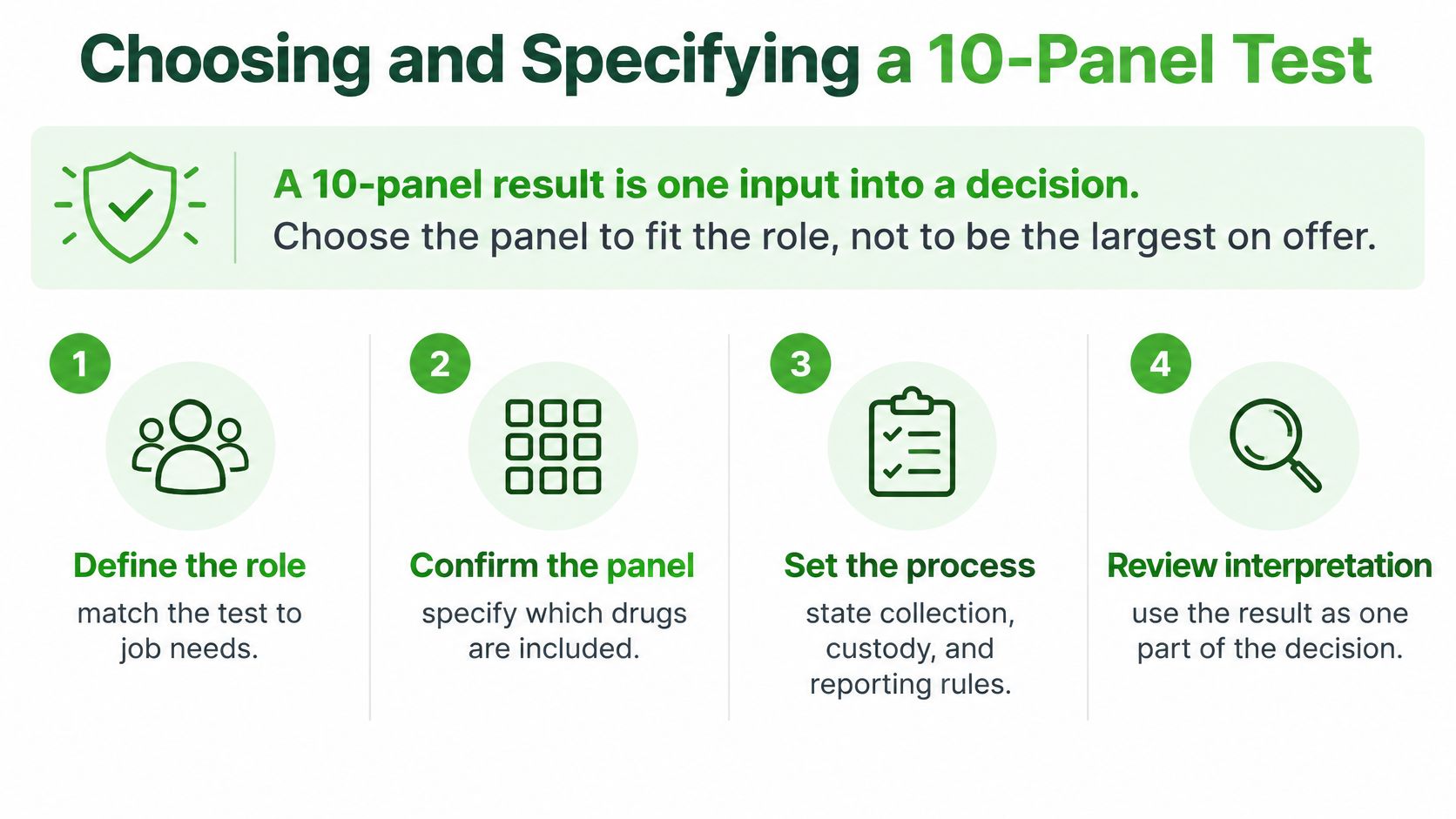
A drug-test result is one input into a decision. Choose the panel to fit the volunteer's responsibilities rather than buying the largest menu available.
Start by describing the role: who the volunteer works with, whether they drive, whether they work unsupervised, and what harm the policy is intended to prevent. Testing requirements should follow that assessment.
Put the specification in writing
- Get the analyte list in writing and compare it with the role, because the requisition establishes what the laboratory tests.
- Confirm the cutoff schedule and whether presumptive positives receive GC-MS or LC-MS/MS confirmation, so a screening reaction isn't mistaken for a final finding.
- Check fentanyl and norfentanyl explicitly, because their inclusion can't be inferred from the panel label.
- Name the prescription reviewer and document what happens when a legitimate medicine explains a finding, so supervisors aren't making medical judgments.
- Set consent, confidentiality, and adverse-action procedures before collection, because sensitive results need a defined handling process.
- Decide when collection occurs and whether the result supports a single decision or an ongoing program, so testing has a clear purpose rather than an improvised schedule.
The checklist below summarizes how role definition and interpretation fit into the purchase decision.
Compare the service, not just the unit price
A screening device and an ordered testing service aren't interchangeable purchases. Check whether the quoted amount includes collection, documented custody, validity testing, confirmation, medical review, and reporting.
A youth program and an adult volunteer desk may require different screening approaches. Neither should use price alone to decide what information to collect or how much confidence to place in it.
2026 list prices for 10-panel tests
| Product and seller | Listed price | Cost per test |
|---|---|---|
| Dochek Amazewell urine cup, Global Industrial | $74.95 for 25 tests in 2026 | About $3.00 |
| Standard 10-panel urine drug test, National Drug Screening | $69 per test in 2026 | $69 |
| Healgen Scientific multi-drug screen cup, Drug Testing for Less | $88 for 25 tests in 2026 | About $3.52 |
| Abbott 10-panel dip card, Drug Testing for Less | $97.50 for 25 tests in 2026 | About $3.90 |
These are seller-listed products and prices, not evidence that every option includes equivalent services. For budgeting considerations beyond the device itself, consult the guide to drug-test costs.
Give staff a usable policy
Write the process so a replacement coordinator could follow it without guessing. Identify who orders tests, who receives results, who can access medical information, and who handles disputed findings.
Keep clinical information separate from routine scheduling and volunteer rosters. A supervisor generally needs the authorized eligibility outcome, not an unrestricted copy of someone's prescription history.
Finally, have the policy reviewed for the jurisdiction and role before implementation. An organization's obligations depend on applicable law and the work involved, and a test result should remain one documented input, not a verdict about the whole person.
We offer volunteer background screening with national criminal searches, sex offender registry checks, and a built-in FCRA-compliant workflow. Keep that background-screening process distinct from laboratory drug testing, and visit VolunteerBadge to set up applications, authorization, and background checks for your volunteer program.
