
What Is Non CDL? a Plain-English Guide for Volunteers
What is non CDL? Learn what the term means, which vehicles need a CDL, and how nonprofits screen volunteer drivers safely.
On this page
Non-CDL means the vehicle or operation does not meet the federal thresholds that require a Commercial Driver's License. The main triggers are a rating of 26,001 pounds or more, a design for 16 or more occupants including the driver, and placardable hazardous materials.
You're the person holding the church van keys on a Thursday night while a parent texts that they can drive the youth group if someone just says yes. The card in their wallet looks valid. The mix-up is treating that license class as if it also answers whether their driving record is safe enough for your passengers. Those are two separate questions, and volunteer leaders blend them every week.
Table of Contents
- What Non-CDL Really Means in Plain Language
- The Weight, Passenger and Cargo Triggers That Decide It
- Where Nonprofit Vehicles Usually Fall in the Non-CDL Range
- Driving Records and MVR Checks for Volunteer Drivers
- State Rules and Myths That Lead Organizations Astray
- Confirm Your Vehicle Rules Before the First Ride
What Non-CDL Really Means in Plain Language
A church board asks whether a volunteer can drive its 12-passenger van to a weekend retreat. Nobody is getting paid. The trip is ministry, not a freight contract. The answer still turns on the vehicle and the trip, not on the paycheck.
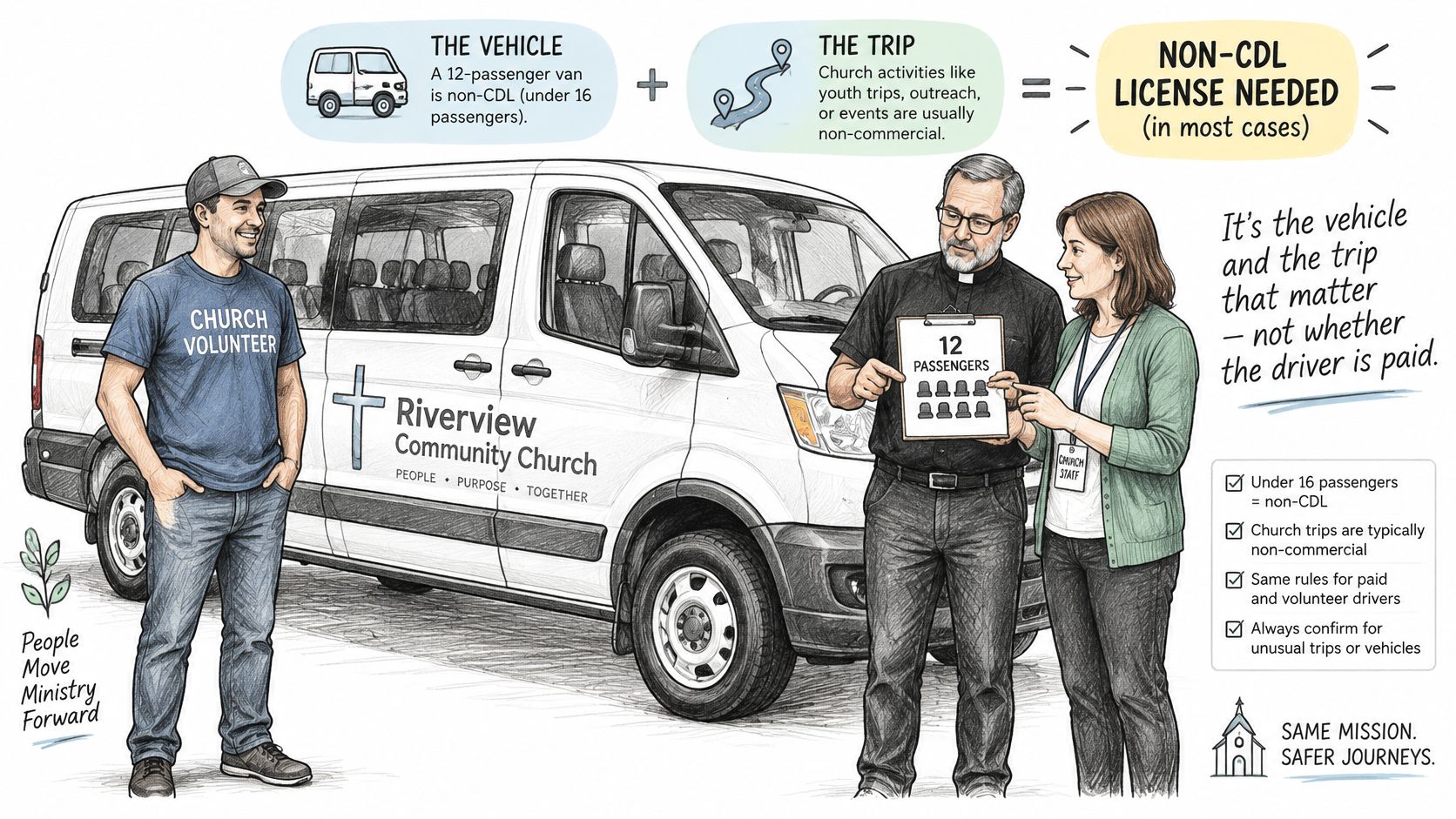
In the United States, non-CDL generally means a driver's license that is not a Commercial Driver's License because the vehicle or operation doesn't meet federal CDL thresholds, according to Federal Motor Carrier Safety Administration guidance. The driver can usually use an ordinary state license for that van, as long as the rating, the seats, and the cargo stay under those federal lines.
Think of a CDL the way you think of a specialty trade license. A general handyman can change a lamp without an electrician's license. The job changes once the work reaches the main panel. Driving works the same way. Everyday cars, SUVs, and many vans stay in the ordinary-license lane. Cross a federal line, and the license category changes even if the driver is a volunteer.
Non-CDL is not the same as noncommercial
A vehicle used for an organization's work can still be a commercial motor vehicle while it sits under the CDL line. FMCSA guidance says a vehicle or combination of at least 10,001 pounds but less than 26,001 pounds may be a commercial motor vehicle, yet a CDL is generally not required solely because of that weight. The driver may operate that commercially used vehicle with an ordinary state-issued license and still face other transportation, safety, medical, or employer requirements. State rules can add licensing duties, so the exact answer depends on the state, the configuration, and the use.
Practical rule: An ordinary license ends the CDL question. It doesn't end the safety, medical, insurance, or screening questions.
Before anyone drives, answer two things. What does the vehicle weigh and seat, and how will you use it on this trip? The next check is the exact federal lines.
The Weight, Passenger and Cargo Triggers That Decide It
The modern federal CDL system became a national licensing framework on April 1, 1992, when drivers of specified commercial motor vehicles began being required to hold a CDL, as the FMCSA passenger carrier guidance explains. The rule is long-standing. Weight is only one of three triggers.
| Vehicle or operation | Federal trigger | CDL required? | What it means for nonprofits |
|---|---|---|---|
| Gross vehicle or combination weight rating under 10,001 lb | No weight trigger | Non-CDL | Typical car, SUV, or light pickup used for volunteer errands |
| Rating from 10,001 to 26,000 lb | Weight alone doesn't trigger a CDL | Usually non-CDL | May still be a commercial motor vehicle with federal operating rules |
| Rating of 26,001 lb or more, including the applicable towed unit | Weight trigger | CDL generally required | Large box trucks and heavy trailer combinations |
| Designed to carry 16 or more occupants including the driver | Passenger trigger | CDL required | Applies even when the vehicle is under 26,001 lb |
| Transporting placardable hazardous materials | Cargo trigger | CDL required | Applies regardless of ordinary weight classification |
Federal guidance identifies those three major triggers: a gross vehicle or combination weight rating of 26,001 pounds or more, transportation of 16 or more passengers including the driver, or hazardous materials in quantities requiring placarding. A rating from 10,001 through 26,000 pounds generally falls into the non-CDL range for weight, although it may still qualify as a commercial motor vehicle and may be subject to federal operating rules.
One added seat can change the category
Passenger capacity matters for churches, schools, and other groups because a vehicle can look like an ordinary van and still cross the line. A vehicle under 26,001 pounds may still require a CDL if it is designed to carry 16 passengers including the driver. Say a retreat van is built for 15 people, driver included, and its door-plate rating is 9,500 pounds. Weight alone leaves it non-CDL. Add a 16th seat in the design, and the passenger trigger applies even though the scale reading never moved.
Non-CDL describes the license category, not a universal exemption from transportation regulation. If your fleet includes a straight truck, read when box truck drivers need a CDL before you assume the cab is "just a big van."
Run this check on any vehicle before the first trip:
- Rated weight: Read the gross vehicle weight rating on the door plate, not a guess from the odometer.
- Every seat: Count the driver. Design capacity decides the passenger trigger, not how many people you plan to load today.
- The trailer: Add the applicable towed unit. A light van plus a heavy trailer can reach 26,001 pounds as a combination.
- The cargo: Paint, fuel, cleaners, and propane can require placards. Placardable hazardous materials require a CDL regardless of ordinary weight.
Where Nonprofit Vehicles Usually Fall in the Non-CDL Range
Most volunteer fleets live under the CDL lines, until one number moves. Use the decisive figure first, then ask what would flip the answer.
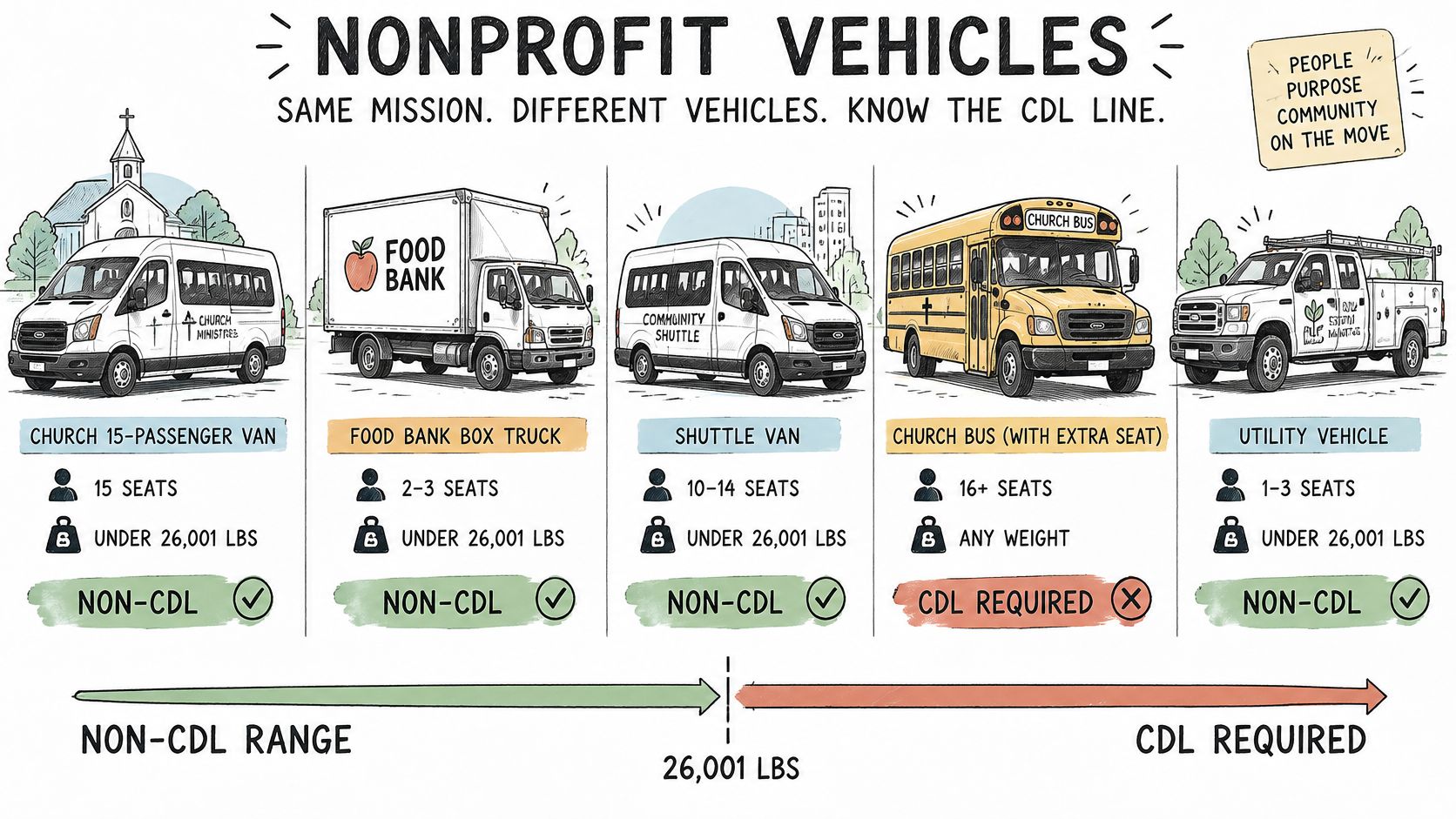
| Vehicle | Decisive number | CDL required? | What changes the answer |
|---|---|---|---|
| Church 15-passenger van | 15 seats including the driver | Non-CDL | A 16th seat requires a CDL |
| Food bank box truck | Rated under 26,001 lb | Usually non-CDL | Commercial motor vehicle rules may still apply |
| Youth league minivan with trailer | Combined rating including towed unit | CDL if the combination is 26,001 lb or more | Trailer weight can push the combination over that line |
| After-school 9-seat van | 9 seats including the driver | Non-CDL | State passenger rules may still apply |
| Volunteer personal car with mileage reimbursement | Ordinary passenger car | Non-CDL | Insurance and screening matter more than license class |
Five vehicles, five different decisive numbers
A church 15-passenger van stays non-CDL while those 15 seats include the driver and the rating stays under the weight line. The flip is a 16th designed seat, not a full load on Sunday.
A food bank box truck rated under 26,001 pounds is usually non-CDL for weight. It can still be a commercial motor vehicle, so read the door plate and ask the insurer what driver rules apply to that truck. Don't treat "no CDL" as "no file."
A youth sports minivan looks harmless until the equipment trailer is hitched. Add the towed unit to the combination rating. If that total is 26,001 pounds or more, the weight trigger is met.
An after-school 9-seat van is typically non-CDL on seats and, in ordinary use, on weight. Your state may still have passenger-vehicle rules, so the DMV check isn't optional just because nine is well under sixteen.
A volunteer in a personal car who gets mileage reimbursement is generally non-CDL. The license class is the easy part. Your insurance and your driving-record screen decide whether that parent should carry kids.
Ask three questions for every vehicle: what is the rated weight, how many occupants including the driver, and what is this trip for?
Write the answers on the vehicle folder. A later volunteer shouldn't have to reconstruct them from memory.
Driving Records and MVR Checks for Volunteer Drivers
A valid non-CDL license only proves the state issued that class of license. It doesn't prove the record behind it is clean.
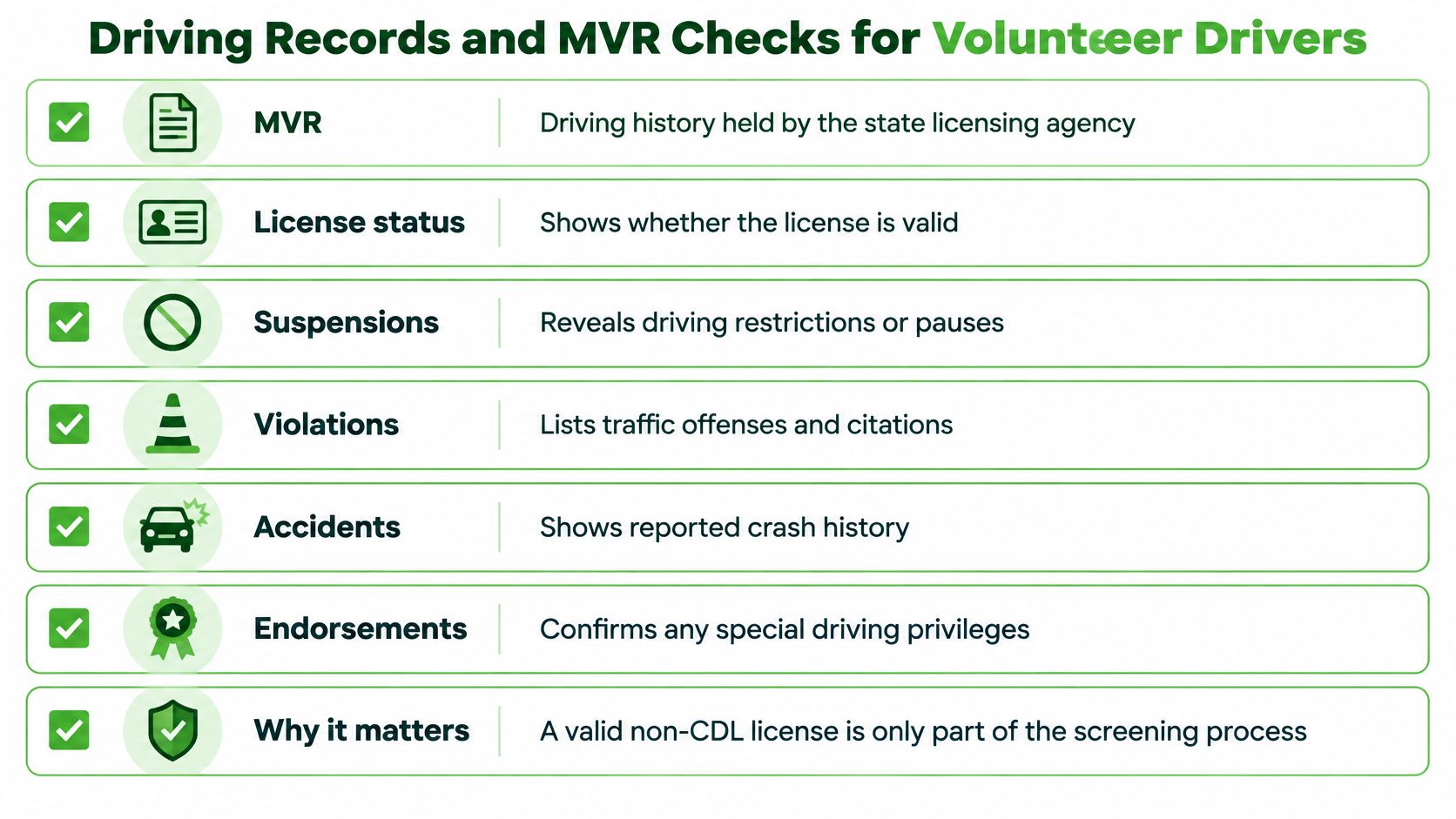
A motor vehicle record (MVR) is the driving history a state licensing agency holds. It shows license status, suspensions, violations, accidents, and endorsements. A card can look current in a wallet while the state file shows a suspension, a recent citation, or a crash. That gap is why organizations that understand what is non CDL still pull the record before the first passenger ride.
This short walk-through shows how a coordinator reads an MVR before approving a driver.
A six-step screen you can repeat
- Get written consent. If a third party pulls the report, deliver the required FCRA disclosure first. Consent is what makes the pull lawful, not a favor the volunteer is doing you.
- Request the MVR from the state that issued the license. A report from the wrong state can miss the suspension that matters. Our guide to what an MVR check includes walks through that state file in plain language.
- Confirm the license is valid and matches the class you need. An expired card, a restriction, or the wrong class fails this step even when the person drives well.
- Review violations and accidents over a set lookback, often three to five years. A defined window stops each reviewer from using a different memory.
- Compare the file to written criteria approved in advance, such as no active suspension and a cap on recent points. Criteria set after you see a favorite volunteer's record aren't criteria.
- Document the decision and the reason. A later board, insurer, or parent should be able to see why this driver was approved or declined.
An MVR is a separate step from a criminal background check. One looks at driving. The other looks at criminal courts. Neither replaces the other. Check the criteria with your insurer, because insurers often set their own driver rules on top of the license class.
State Rules and Myths That Lead Organizations Astray
The myth most likely to cause a bad yes is this one: a vehicle under 26,001 pounds has no federal rules. The corrected fact sits right beside it. It may still be a commercial motor vehicle with operating and record requirements.
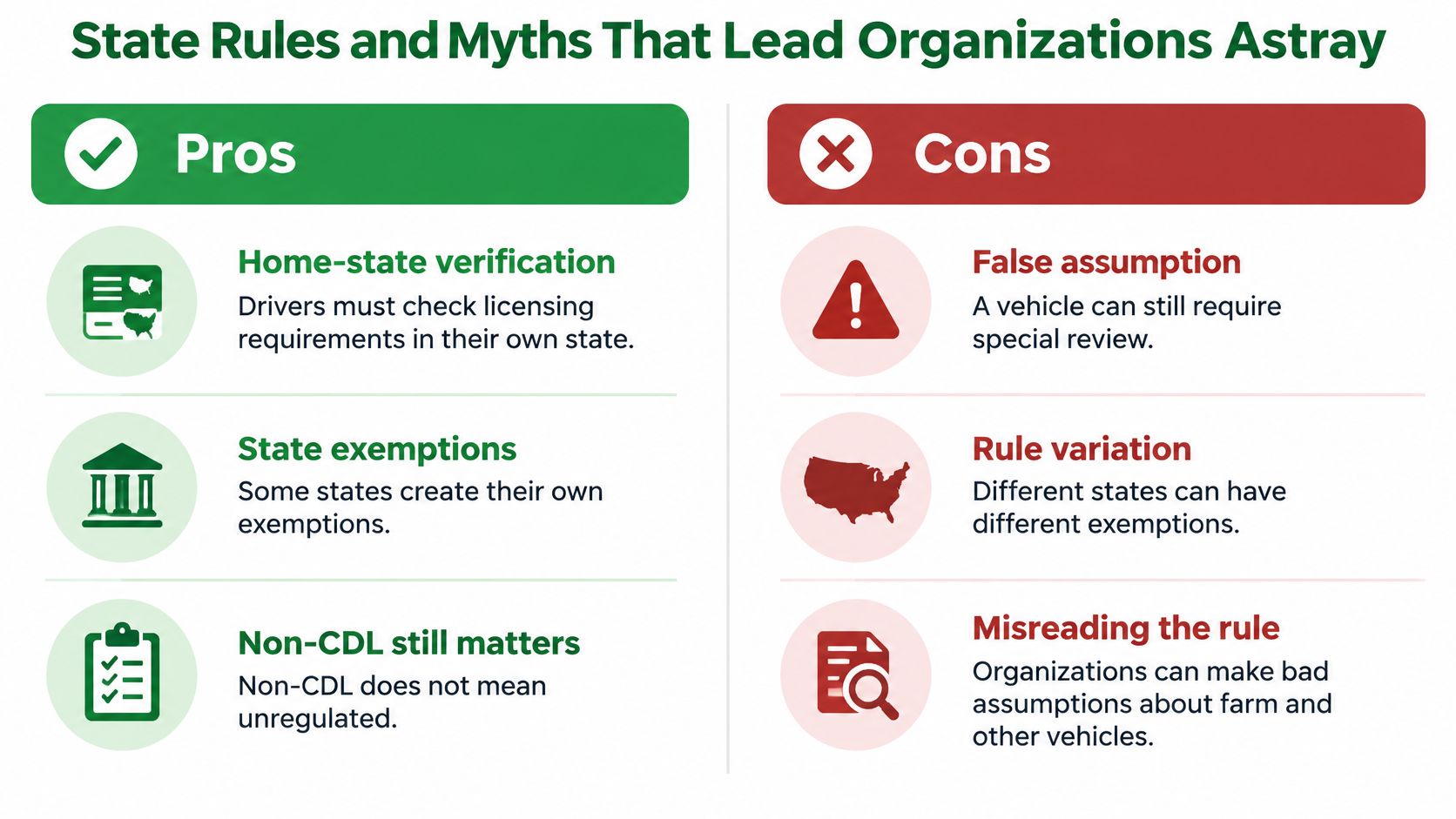
FMCSA guidance illustrates the split. A vehicle or combination at or above 10,001 pounds may trigger federal safety or electronic-record requirements while still not requiring a CDL, whereas a rating of 26,001 pounds or more may require one. Non-CDL doesn't mean unregulated.
Three mix-ups that send the wrong driver out
Unpaid means exempt. It doesn't. The answer depends on vehicle weight, passenger capacity, hazardous-materials status, commercial purpose, and the driver's home state, not merely on whether the driver is paid. A volunteer behind a large van, bus, trailer, or box truck can still need a CDL.
A valid non-CDL license means a clean driving record. It doesn't. Status, suspensions, violations, and crashes live on the MVR. Whether traffic violations are public records is a different question from whether your screening file includes them.
The federal chart is the last word. It isn't. FMCSA says drivers must verify licensing requirements in their home states, and states can create exemptions, including for some farm vehicles. A farm exemption on a neighbor's truck doesn't transfer to your church van.
Separate the license question from medical certification, hours-of-service, registration, insurance, and employer policy. Then check the state DMV for any passenger-vehicle rule or endorsement before the first trip.
Confirm Your Vehicle Rules Before the First Ride
A valid license settles only the license question. Before the first ride, put the remaining checks in one vehicle file:
- Confirm the insurer covers volunteer driving in each vehicle and get its driver rules in writing.
- Confirm the license class and any passenger endorsement with the state DMV, using the vehicle's rated weight and seat count. Record the date of the confirmation.
- Pull each driver's MVR with written consent and apply the criteria you approved in advance.
- Run a criminal background check separately. It does not show driving violations or replace the MVR. VolunteerBadge reports include built-in FCRA compliance, and screening is pay-as-you-go with no subscription, minimums, or contract.
- Record each decision and its reason, then set a re-check date based on your organization's policy. For context on volunteer responsibilities, read Volunteers and the law. A written pre-trip checklist can make the routine easier to repeat; this chauffeured celebration transportation safety guide offers a separate vehicle-safety checklist.
This week, collect the rated weight and seat count for every vehicle you use. Confirm the insurer and DMV requirements before the first trip.
VolunteerBadge offers FCRA-compliant volunteer background checks with no subscription or contract. Start with the vehicle folder, then run volunteer checks at VolunteerBadge.
