
BCI Background Check Explained: Coverage, Speed and Rules
What a BCI background check covers, how it differs from FBI checks, how long it takes, and what nonprofits must do before screening volunteers.
On this page
If a BCI result comes back with a hit, does that mean the volunteer is unsafe? Most programs treat the report like a verdict. It is not one.
A BCI background check tells you which criminal-history files a particular agency searched. What you do next decides whether the person can serve: confirm identity, read the disposition, and apply written role criteria. A name match can belong to someone else. An arrest can end in a dismissal. A conviction from another decade can be unrelated to the task you are filling.
This guide answers the lookup questions first, then shows how a nonprofit acts on a result without turning screening into a pass or fail.
Table of Contents
- What a BCI Background Check Covers and Who Runs It
- BCI and FBI Checks Compared Side by Side
- What a BCI Check Searches and What It Misses
- How Long BCI and FBI Checks Take
- Reading BCI Results Without Jumping to Conclusions
- How Nonprofits Run a Compliant Volunteer Screen
- Decide Which BCI Check Your Volunteers Need
What a BCI Background Check Covers and Who Runs It
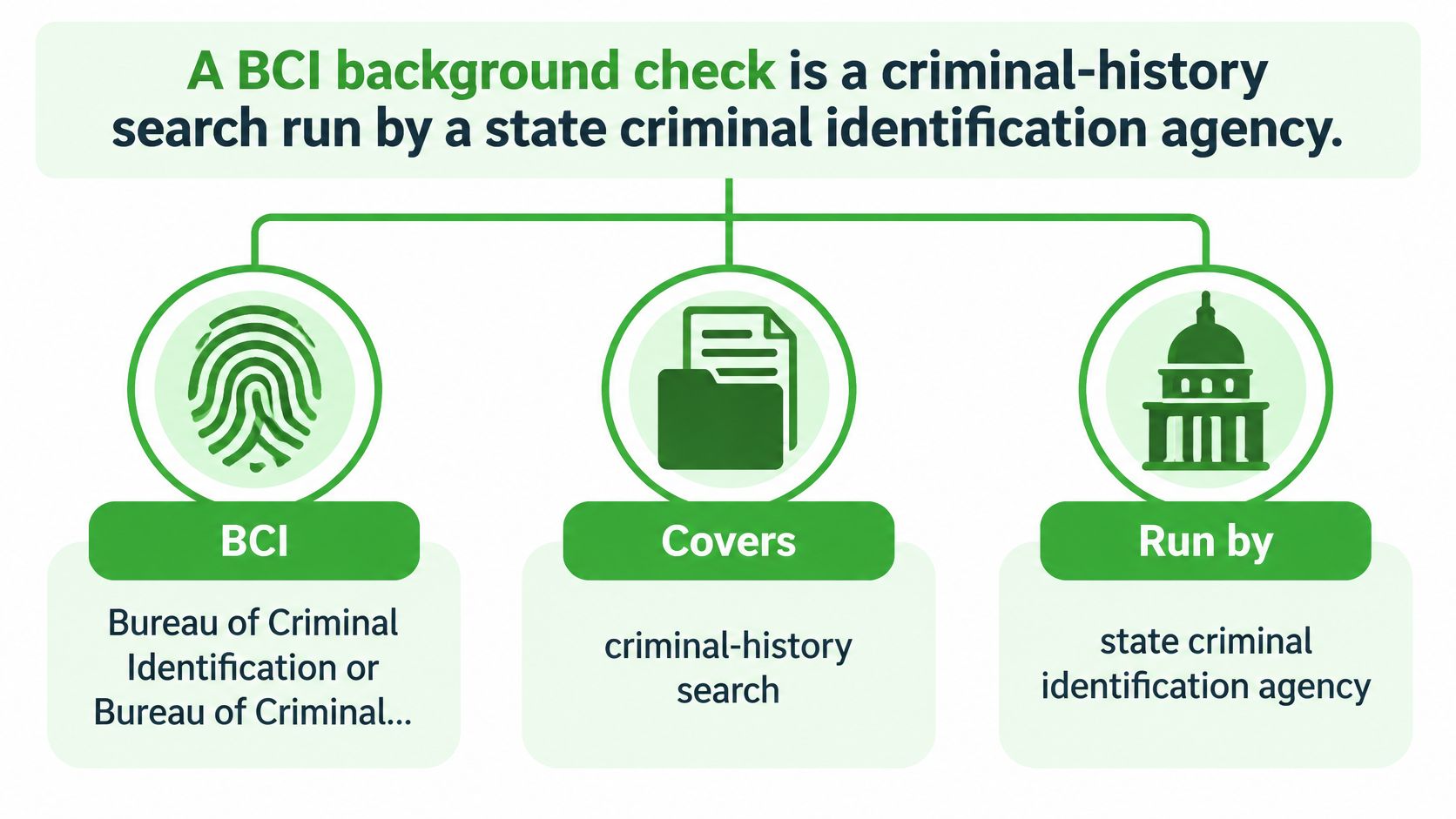
A BCI background check is a criminal-history search run by a state criminal identification agency. BCI stands for Bureau of Criminal Identification or Bureau of Criminal Investigation, depending on the state. Ohio uses Bureau of Criminal Investigation. Read the agency named on your own form instead of assuming every state uses the same title.
Think of a state search as your local library catalog. An FBI check is the national catalog that pulls in records from many libraries. Ordering the wrong catalog means you walk away believing a book was never written, when it was only shelved somewhere else.
No single universal database exists. Records originate with federal, state, local, tribal, and in some cases foreign criminal-justice agencies, while states continue to maintain and update many records themselves. The FBI privacy assessment of its fingerprint identification systems notes that by 2016 the FBI's system contained criminal-history records for more than 56.8 million different individuals, many with multiple encounters with the justice system. That national file still depends on what agencies submit. The National Crime Prevention and Privacy Compact, signed into law on October 9, 1998, set a framework for interstate exchange of criminal-history information and for authorized noncriminal-justice uses. Coverage, identity matching, updates, and lawful access still rest on interconnected repositories, not one complete national source.
Three questions that name the check
Before anyone is scheduled, write down three facts from the request itself.
- The state. Which state's repository is the form asking you to search?
- The agency on the form. Is it that state's Bureau of Criminal Investigation, Bureau of Criminal Identification, or another named office?
- Whether fingerprints are required. A name-based state search and a fingerprint submission are different orders, with different matching strength.
If the form names fingerprints and a specific purpose, you are not ordering a generic background check. You are ordering the search that the statute or the program wrote down. Keep a copy of that form with the volunteer's file so a later reviewer can see exactly which catalog was opened.
BCI and FBI Checks Compared Side by Side
| Feature | State BCI check | FBI fingerprint check |
|---|---|---|
| Data source | State criminal repository | FBI identification records fed by federal and state agencies |
| Identity matching | Name and date of birth in most cases | Fingerprints |
| Geographic scope | Records held in that state | Nationwide, from participating federal and state agencies |
| Fingerprint retention | Set by state law | Governed by FBI and federal rules |
| Typical role | Local volunteer or employee screen | Licensing, federal or fingerprint-mandated roles |
What each row changes for your program
Data source. A state BCI check looks at that state's criminal repository. An FBI fingerprint check searches identification records that federal and state agencies feed into the national system. The same person can look clear on the state file while a case exists in another state's submission.
Identity matching. Most state name-based checks match on name and date of birth. Common names collide, and a missing middle name makes the collision worse. Fingerprints tie the search to the person, which is why licensing boards and many youth-serving roles require them.
Geographic scope. The state file covers records held in that state. The FBI search reaches nationwide only to the extent participating agencies submitted fingerprints and later updates. It is not a tour of every courthouse.
A database screen is not a substitute for a legally mandated fingerprint check, such as an FBI or Live Scan check, although it can be the primary screen when no statute requires prints. If you are sorting state options, our guide to a state background check walks through what a state repository returns.
Fingerprint retention. Once prints are taken, state law sets how long a state agency keeps them and who may use them. FBI and federal rules govern retention on an FBI check. Ask that agency which retention rule applies before you submit prints, and tell the volunteer the answer you received.
Typical role. A state BCI check fits a local volunteer or employee screen when that is the level the program chose or the state named. An FBI fingerprint check fits licensing, federal roles, and any post where fingerprints are mandated. Using the lighter search because it is faster does not satisfy the heavier rule.
What a BCI Check Searches and What It Misses
A BCI check searches criminal-history records held by the state. In plain terms, that usually means arrests with dispositions, convictions, and, in some states, pending cases. It does not rebuild a person's whole life from every courthouse in the country, and it does not verify employment, driving, or education.
Purpose has to match the request
A search run for criminal justice is a different authorization from a noncriminal-justice check used for employment, licensing, or volunteer eligibility. The reason on the request has to match the role. If the purpose code is wrong, the agency can reject the submission or return a file you are not allowed to use for that decision.
Fingerprint retention follows the same split. After prints are submitted, the agency's rules decide how long they stay on file. State law sets use and deletion for a state check. Don't promise a volunteer that prints will be destroyed on a date you made up.
Scale does not equal a finished story
Screening volume is large, and gaps remain. A U.S. Government Accountability Office review reported that approximately 120 million criminal-history record checks were conducted through the FBI for noncriminal-justice purposes from fiscal years 2009 through 2013, an average of roughly 24 million checks per year. Those checks commonly support employment, licensing, and work with children and older adults. An FBI criminal-history summary generally identifies the submitting agency, arrest date, arrest charge, and known disposition. Completeness has varied. In the GAO's nationwide survey, 20 states reported in 2012 that more than 75% of their arrest records included dispositions, compared with 16 states in 2006. Some records still lack a dismissal or a conviction. If you treat the arrest line as proof of wrongdoing, you can exclude someone the court already cleared.
Blind spots to mark on every file
- Out-of-state residence: The state repository will not show a case from a state where the person used to live.
- Missing final dispositions: The arrest is listed, and the outcome is blank.
- Sealed or expunged matters: State law may bar you from seeing them or from using them.
- Name-only matches: A common name can attach someone else's case to your volunteer.
- Records not yet entered: A court event from last week may not be in the repository yet.
Practical rule: Write down which jurisdictions you searched. When the applicant lived elsewhere, you still need a county search or an FBI check for those places before you call the file complete.
How Long BCI and FBI Checks Take
| Check type | Typical turnaround | Main cause of delay |
|---|---|---|
| State name-based BCI check | Often same day to a few business days | Name matches that need manual review |
| FBI fingerprint check | Several days to several weeks | Fingerprint capture and agency queue |
| Commercial database screen | Up to 72 hours | Human review of possible records |
A state name-based check is often the fastest of the three. It slows when several people share a name and someone has to compare dates of birth and addresses by hand. That pause is a safety step, not a broken system.
Fingerprint checks add capture at a livescan site, electronic submission, and then the agency queue. In a busy season, plan on several weeks. Our note on how long a fingerprint background check takes covers why the capture appointment, not the database, is often the long pole.
A commercial database screen can come back within up to 72 hours. A reviewer looks at any possible record before it is reported, so you should not see a raw, unexamined hit as the final product.
A planning sequence you can put on the calendar
- List every required check on day one, including any fingerprint mandate.
- Send the application and written consent before you publish the shift schedule.
- Book fingerprinting the same week it is required. Waiting for a convenient Saturday is how start dates slip.
- Set the first unsupervised shift around the slowest check, not the fastest one.
- Track status, and follow up only after the agency's stated window has passed.
What you do while the file is open
Don't start unsupervised service. Write the interim decision in the volunteer file. A pending check is never a clear check.
Your written policy should say whether supervised service may begin while a check is pending, who approves that service, and how the decision is recorded.
A coach in the room is a different risk from a driver alone with a child. If you allow supervised hours, name the supervisor, the tasks that are off limits, and the date you will stop those hours if the report is still open.
Reading BCI Results Without Jumping to Conclusions
| Result | What It Proves | Next Step |
|---|---|---|
| Arrest with no final disposition | Only that an arrest was recorded | Find the final outcome before deciding |
| Conviction with matching identifiers | A conviction in that jurisdiction | Compare the offense to role criteria and time elapsed |
| Name-only match | Nothing until identity is confirmed | Verify date of birth, address and aliases |
| Dismissed or sealed matter | Not a finding of conduct | Check state rules on whether it can be considered |
An arrest shows that an event was recorded. It does not show that the person committed the offense. The entry may also omit whether charges were filed, dropped, or dismissed. Reading the charge title out loud in a staff meeting and then voting "no" skips the only facts that make the record usable.
The EEOC's arrest and conviction guidance recommends weighing the nature and seriousness of the offense, the time elapsed since the offense or sentence completion, and the nature of the role. Write those three factors against youth programs, home visits, transportation, financial duties, and vulnerable-adult services before any report arrives. An arrest-only hit needs extra care, because an arrest does not establish that criminal conduct occurred, and the record can be inaccurate.
Confirm the person before you count the record
When a possible criminal record appears, a real reviewer checks the identifiers, the dates, and the jurisdiction to verify whether it belongs to the applicant. Match date of birth, address history, and aliases. A name-only match is not a decision.
Keep allegations, pending cases, and convictions separate when the law treats them differently. Our walkthrough on how to read a background check shows how those labels look on a report page.
Say a volunteer driver has a shoplifting arrest that was dismissed years ago. That file calls for a different sentence of reasoning than a recent conviction for a vehicle offense. Write that sentence into the file so two reviewers, months apart, reach the same outcome on the same facts.
State and local fair-chance rules can limit when you ask, what notice you send, and which records you may consider. Federal guidance does not erase those local rules. Check them before you exclude anyone.
How Nonprofits Run a Compliant Volunteer Screen
A useful screen is a sequence, not a single search. The order below keeps the role in charge of the decision.
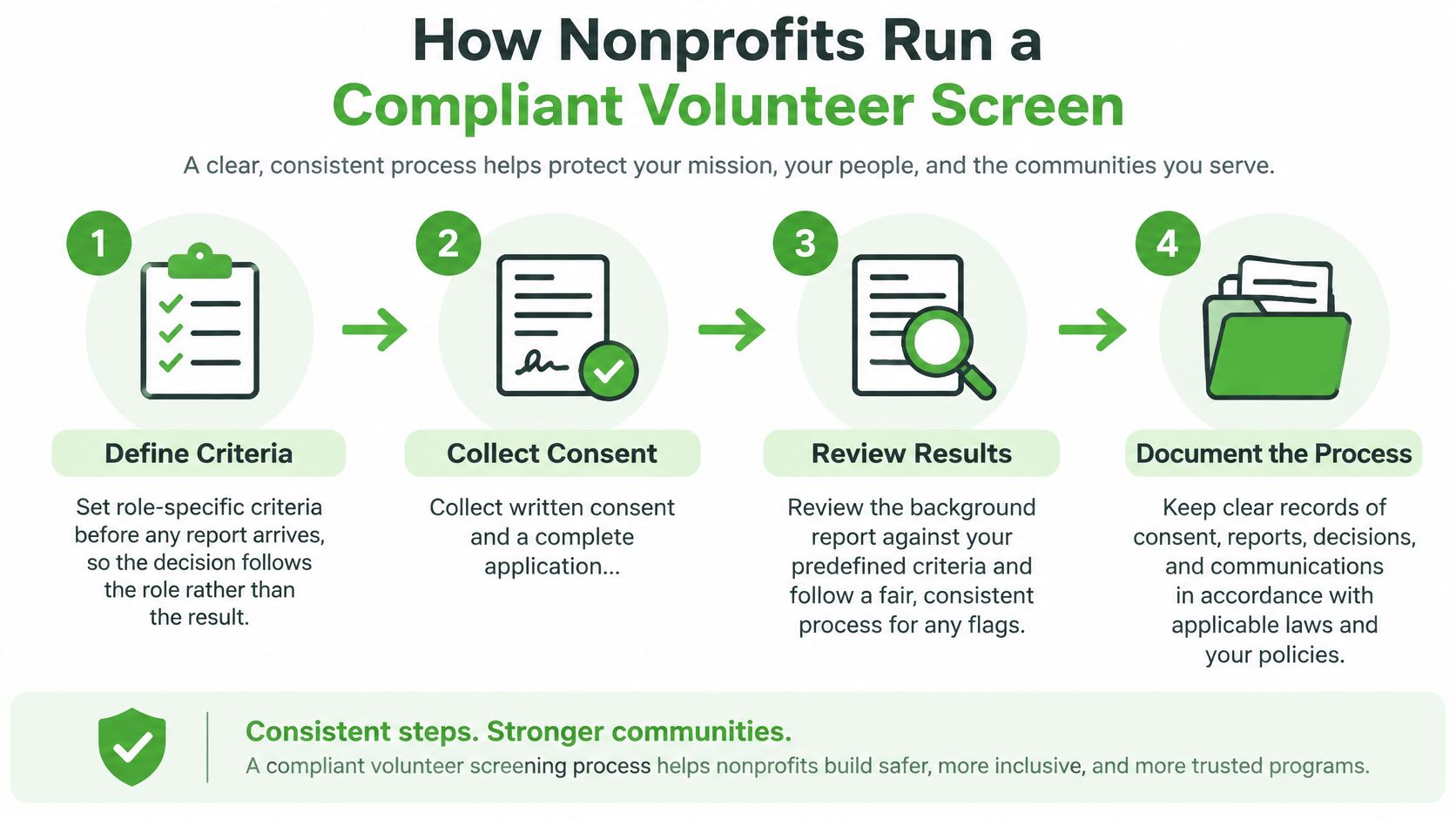
- Set role-specific criteria before any report arrives. The decision then follows the role, not the shock of a hit. A treasurer and a snack-table helper do not share the same risk list, so write the list while the file is still blank.
- Collect written consent and a complete application, including address history. Running a volunteer background check takes three steps. You build the application, we verify address history, then you run the check. Compare that history with the record so a missing year is visible before anyone interprets a case.
- Order the level the statute or program requires, and record the purpose on the request. A mismatched reason code wastes the fingerprint appointment and can produce a file you cannot lawfully use.
- Send any possible match to one named reviewer who confirms identity and disposition. A group email is a poor place to debate someone else's case.
- If you may exclude the person based on a consumer report, send a pre-adverse action notice with a copy of the report and the FTC's Summary of Rights, then hold the decision through a dispute window.
- If the decision stands, send a post-adverse action notice stating that it was based on information in a consumer report.
- Keep the report version, the delivery timestamps, and the final decision record, then delete the data on your retention schedule.
Why the hold exists
The FTC's plain-language guide on background checks treats those notices as requirements. Before adverse action, you give the person a notice, a copy of the report you relied on, and a copy of the Summary of Rights. If you go ahead, the later notice states that the decision was based on the consumer report. The hold separates "record found" from "decision made," so the applicant can challenge a mismatch before you close the door. The same controls apply when the role is unpaid, if screening decides eligibility for trust, access, supervision, or work with vulnerable people.
Youth and school programs often pair screening with training on what staff must report. Mandated reporting coursework for school staff from Premiere Education covers how New York school personnel identify and report suspected child abuse. That training sits beside the background check. It does not replace it.
Tell volunteers the timing and any cost before they apply. Offer an accommodation if fingerprinting or an online form is a barrier because of a disability. Name who may adjudicate reports, usually a program director and one backup, and limit who else can open the file.
This short walkthrough is a useful model for explaining consent, notices, and what a volunteer is allowed to dispute.
Decide Which BCI Check Your Volunteers Need
| Role or requirement | Check to order | Add-on |
|---|---|---|
| Statute, funder or licensing body mandates fingerprints | FBI fingerprint check, no database substitute | Follow the named check level |
| Youth, home-visit or vulnerable-adult role | State BCI check plus FBI fingerprint check where required | County search for every prior residence |
| Low-risk unpaid role, no statutory rule | Database screen with address history verification | Documented role review |
Start with the rule that names the check. If a statute, a funder, or a licensing body mandates fingerprints, order that FBI fingerprint check. Don't swap in a database screen and call the requirement met.
For youth, home-visit, or vulnerable-adult roles, pair the state BCI check with an FBI fingerprint check where it is required, and add a county search for every place the applicant lived. A single in-state file misses the years they spent elsewhere.
For a low-risk unpaid role with no statutory rule, a database screen plus address-history verification can be the primary screen, backed by a documented role review. You still apply the same standards to every applicant.
The EEOC's background check guidance says background information cannot be used in a way that creates unlawful disparate impact, and it recommends applying the same standards to everyone. When a consumer reporting company is used, applicants must get notice and a chance to dispute inaccurate or incomplete reports. Common names, old records, sealed matters, and gaps between courts can produce a misleading hit. A church, a youth league, or a food bank should write an individualized decision without passing sensitive details through a board thread.
A background check costs $5 per check, or less when you buy credits in bulk. If we cannot confidently validate that a criminal record belongs to the applicant, we do not bill for that result and we refund the check. Every volunteer background check report includes built-in FCRA compliance, and the platform has no contracts. Choose a process that supports notice, dispute, and report-version steps, and that states fees and any refund rule in writing before the first order.
Act on this today
- Confirm the statute or funder rule that names the check level.
- Document role criteria before the first report arrives.
- Order the check that rule requires, not the one that happens to be open in a browser tab.
- Set the notice steps so pre-adverse and post-adverse letters are ready before anyone is excluded.
VolunteerBadge helps nonprofits run volunteer screens with written consent, address-history checks, plain-language results, and FCRA notices when a result may lead to exclusion. Use it for the database screen your low-risk roles allow, and keep any legally required fingerprint check on its own track. Visit VolunteerBadge to set up the next cohort with the criteria and notice steps already in place.
