
State Background Check Explained: What It Covers and Costs
Learn what a state background check covers, how it differs from national and county checks, what it costs, and the FCRA steps nonprofits must follow.
On this page
If a vendor sells you a "state background check," have you bought a legal pathway, or just a label that sounds official? Most coordinators treat the phrase as one product with one result. It isn't. A state background check is a search of records held by one state's criminal-history repository, or of registries that state controls, under rules that state wrote. The name on the invoice doesn't tell you which pathway you used, who may see the result, or whether that result is even legal for the role.
Table of Contents
- State, County and National Checks Compared at a Glance
- How a State Record Gets Built and Shared
- Which Check Each Volunteer Role Needs
- Order, Verify and Document a State Check
- Timing, Costs, Blind Spots and Rescreening
State, County and National Checks Compared at a Glance
A state background check searches records held by one state's criminal-history repository or its registries, while a national check pulls from many jurisdictions at once. Those searches overlap. They don't replace each other. A volunteer program often runs two or three of them because each source stops at a different edge.
| Check type | Where records come from | Main limitation |
|---|---|---|
| State repository check | One state's criminal-history repository | Coverage depends on what that state reports and automates |
| County court search | Local courthouse and county court records | Covers only the counties actually searched |
| National database search | Commercial multi-jurisdiction court records and registries | Compiled data can lag, so a possible hit needs verification |
| FBI fingerprint check | FBI criminal-history file, submitted through state or an approved channel | Requires fingerprints and is slower to complete |
| Sex offender registry search | All 50 state sex offender registries | Covers registered offenders only |
State repository check. This is the classic state search. You're asking one state's central file what it has on file for that person. If the county never sent the disposition, the repository won't show it.
County court search. Courts keep the original case file. A county background check is how you confirm a possible match, or how you look in a county the state file never fully absorbed. It only covers the counties you search.
National database search. Vendors compile court records and registries from many places. It's a wide first pass, not a courthouse file. A possible hit still needs a person to compare name, date of birth, and jurisdiction before you treat it as the applicant's record.
FBI fingerprint check. Prints tie the record to the person more tightly than a name does. You need an approved channel, and the wait is longer because prints have to be taken and matched.
Sex offender registry search. This looks for people who are already registered. It doesn't stand in for a criminal-history search.
The same label can mean different data from one state to the next, because each state controls its own repository. Find the row that matches the role, then read the table again before you order anything.
How a State Record Gets Built and Shared
How does a state background check become a record you can rely on? The answer depends on the path information takes from a local court to a state repository, and on whether that information makes the journey.
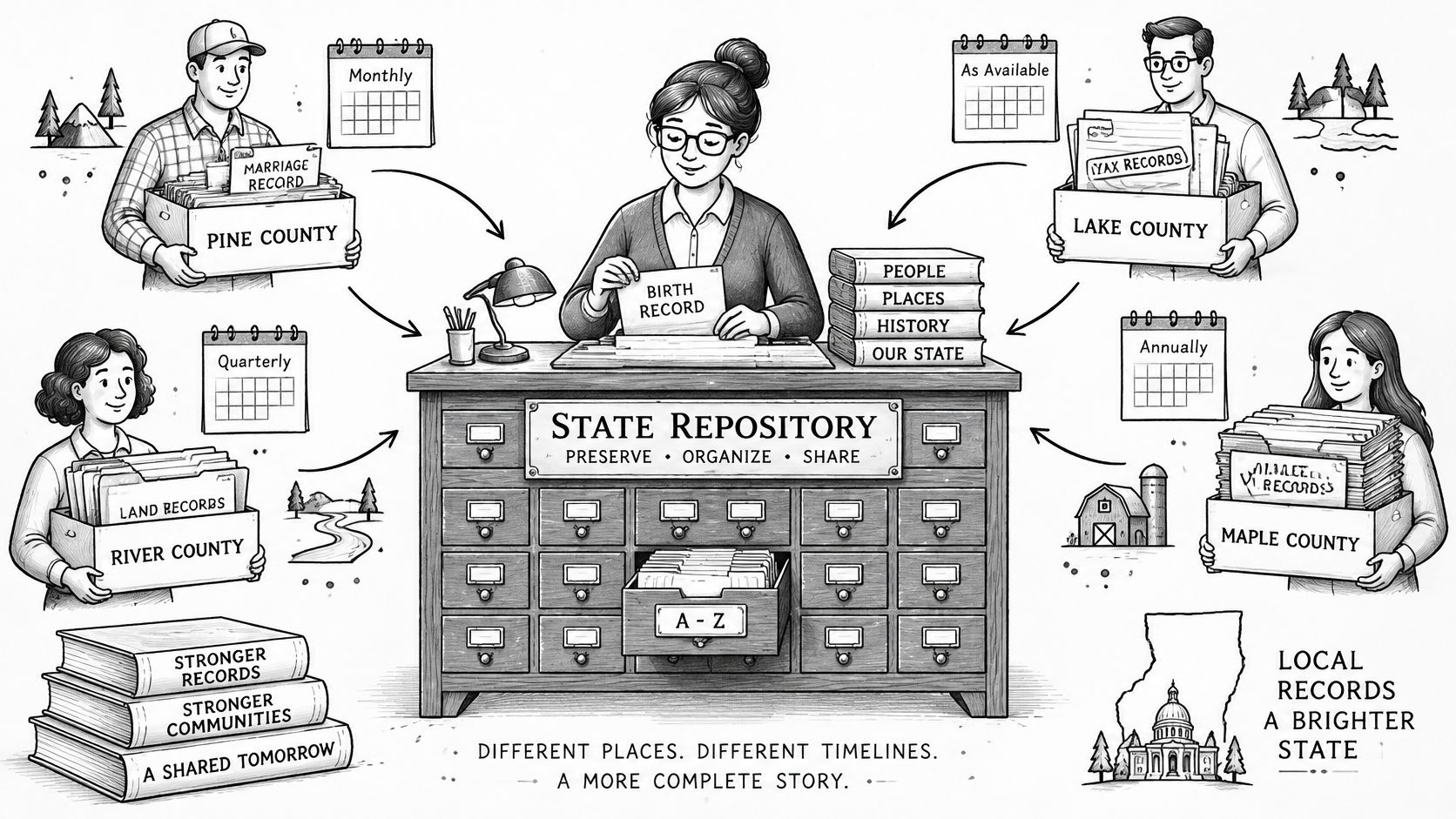
A state repository works like a regional library catalog. County courts and agencies are its branches, each sending records in its own format and on its own schedule. The catalog can only include information that those branches report.
The process has several steps. A court or prosecutor records a charge and, later, its outcome. The local agency sends that disposition to the state repository, where it is stored for authorized requesters to search. If a step is missed, the record may not appear. An arrest without a recorded outcome, or a case that never reached the state repository, can leave a gap.
Why firearm checks show the structure
The federal firearm system makes the shared design easier to see. The FBI's NICS operations report traces the system to the Brady Handgun Violence Prevention Act of 1993, which required the U.S. Attorney General to establish an electronic system for quickly determining whether a proposed transfer would violate federal or state law. After five years of work by the Department of Justice, FBI, ATF, and state and local agencies, the National Instant Criminal Background Check System (NICS) became operational on November 30, 1998.
States have different roles in this process. Some send checks through the FBI. Others operate as "full-point-of-contact" jurisdictions and make the eligibility decision themselves. The state named on a report identifies the data source and decision-maker, not a uniform level of coverage. For other screening purposes, the same principle applies: a state label describes a legal pathway and data source, not a guarantee that every county record is included.
What the volume does and doesn't prove
State participation is central to the system. From November 30, 1998, through December 31, 2022, NICS processed 443,172,700 background checks. State users handled 272,208,227, while the FBI's NICS Section handled 170,964,473, according to the FBI's NICS operations report.
In 2022, the system processed 31,596,646 firearm-related checks: 21,339,651 by state users and 10,256,995 by the FBI's NICS Section. The FBI reported an immediate determination rate of 91.36% for transactions processed by its own section. Most of those inquiries received an initial answer without extended research, according to the same 2022 NICS operations report.
A fast answer reflects the speed of the system, not the completeness of the underlying records. Completeness still depends on what each state reported.
A check is a screening transaction. It does not, by itself, mean a sale was completed, a permit was issued, or a volunteer was approved.
Three questions for any state report
Before relying on a state result, ask three questions:
- Which repository was searched? Look for the state file, not only the vendor's product name.
- When was it last updated? A stale record may omit recent dispositions.
- Were dispositions included? A charge without an outcome is not a conviction, and it does not establish that no relevant record exists.
If the report cannot answer these questions, you do not yet know which records it covers.
Which Check Each Volunteer Role Needs
A “state background check” can refer to different records and legal pathways. Choose based on the volunteer's duties and the rules that govern the role, then confirm the required search with the responsible authority. The table gives common starting points, not a substitute for that confirmation.
| Role or setting | Usually required | Often added | Confirm with |
|---|---|---|---|
| Youth sports coach or mentor | Criminal record search and sex offender registry search | Address history and reference checks | State youth-program rules |
| Church or faith-based volunteer | National database search | Fingerprint check where state law requires it for child contact | Denomination and state rules |
| School or after-school volunteer | State repository check and sex offender registry search | Fingerprint check where law requires it | School district policy |
| Licensed childcare or health-related role | FBI fingerprint check | State repository check | State licensing agency |
| Adult-only community volunteer | National database search | County search for flagged matches | Organization policy and applicable state law |
For a youth coach or mentor, a criminal-record search and sex offender registry search are a common starting point. Address history can help distinguish applicants with similar names, while references add context that a record search cannot provide. Whether either check is required, or whether fingerprints are necessary, depends on the applicable program rules.
Same label, different legal pathways
Utah illustrates how a state may control who receives criminal-history information and under what conditions. Utah's 2025 criminal-history statute limits dissemination to specified entities and requires a signed waiver explaining that a check will occur, who will see the information, and how it will be used. Rules differ by jurisdiction, so do not assume that a search available to one organization is authorized for another.
A commercially obtained name search may not satisfy a state-administered or fingerprint-based clearance required by a statute or licensing program. VolunteerBadge's $5 database check is not a substitute for a legally mandated fingerprint (FBI, Live Scan) check, although it can serve as the primary screen where permitted. Put the distinction in your volunteer screening policy, so coordinators know which result is a screening tool and which clearance the law requires.
Some clinics and health ministries also use medical virtual assistants for remote support. The assistant service does not determine the screening pathway for a volunteer. If a role involves children or health records, confirm the applicable requirements with the licensing agency or other named authority before ordering a check.
Cross-border volunteers
Suppose a church is based in State A and an applicant lives in State B. The rules for using the result may follow the organization's program or work location, while the relevant criminal-history repository may be in the applicant's home state. Those are separate questions: one concerns permission and procedure, the other concerns where records may be held. Confirm both with the appropriate authority before ordering.
Four questions before you order
The role and jurisdiction determine the check, not the other way around. Settle these questions first:
- Role and state. What duties will the volunteer perform, and which state's rules apply?
- Fingerprint. Does the law require fingerprinting, or is it an added screening option?
- Consent. Is there signed consent and a notice explaining who will see the result and how it will be used?
- Rescreening. What interval will the program follow, and is it documented in writing?
Match the role to the table, then confirm the pathway with the authority in its last column. If that authority requires a qualified-entity fingerprint clearance, order that clearance rather than treating a database search as its replacement.
Order, Verify and Document a State Check
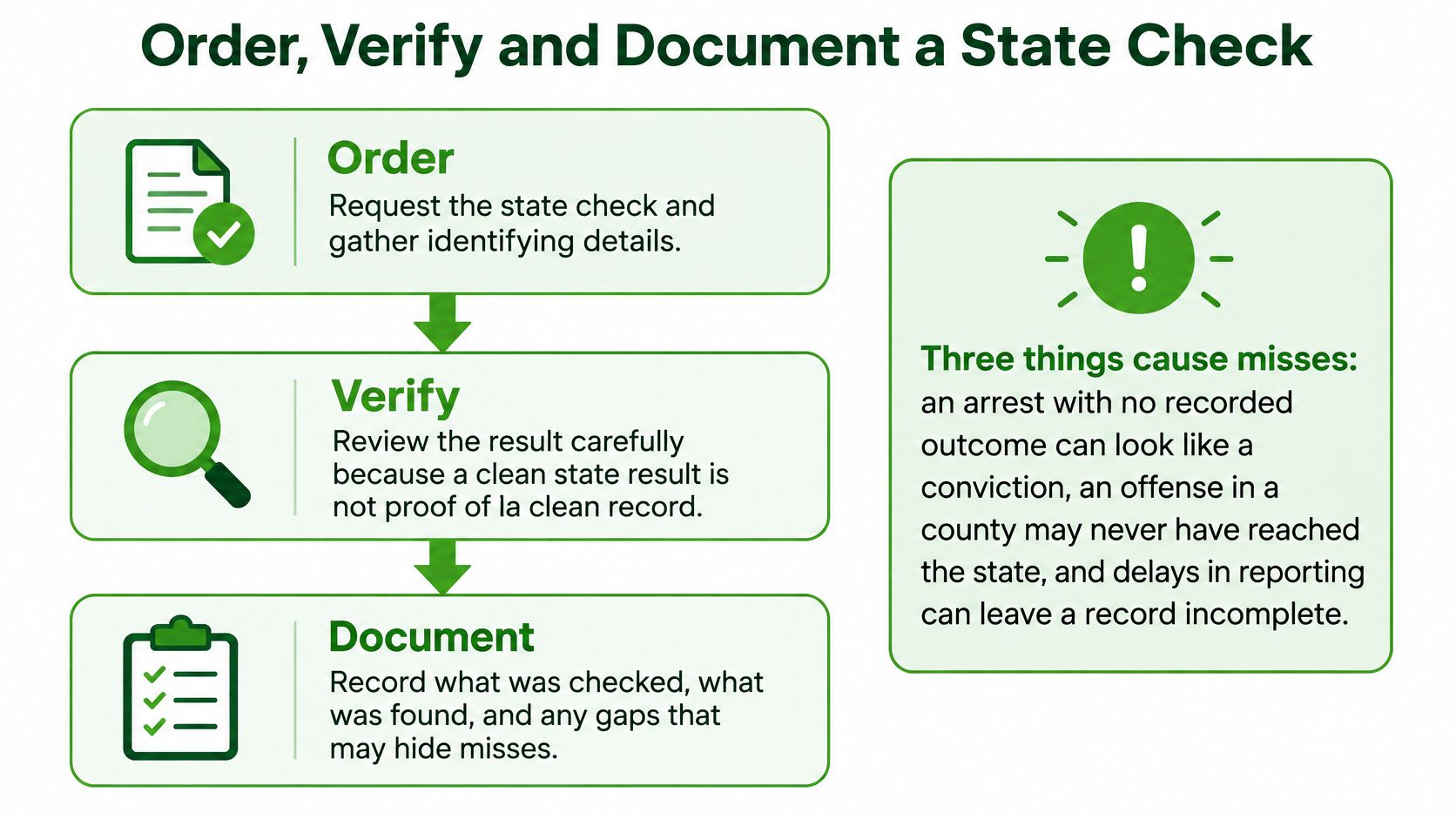
A clean state result is not proof of a clean record. Three things cause misses. An arrest with no recorded outcome can look like a conviction. An offense in a county may never have reached the state repository. A common name can produce a false match.
The Bureau of Justice Statistics' 2020 survey found that the 50 states, the District of Columbia, and Guam collectively maintained 114,376,500 criminal-history records, with more than 95% automated. Automation doesn't guarantee that every record is current, complete, or immediately searchable for noncriminal-justice purposes. Treat each state search as a repository-specific data task, not as proof of nationwide coverage.
That same year, 49 states, the District of Columbia, and Guam processed 20,302,100 fingerprint records, and about 63% supported licensing, employment, or other noncriminal-justice functions, compared with 37% used for criminal-justice purposes. Fingerprints are already a large share of how states release history outside policing. A name search is a different product.
Eight steps, and why each one exists
- Confirm the repository. Use the role table and name the exact state file or fingerprint channel the role requires. Ordering the wrong pathway wastes the fee and can leave you out of compliance.
- Get a signed disclosure and authorization. The form should say a check will occur, who will see the results, and how you'll use them. You need that consent before a consumer reporting agency can run the file.
- Verify identity. Collect full name, aliases, date of birth, and seven years of address history, then compare the addresses to the application. Address history is how you spot a common-name collision before you accuse the wrong person.
- Submit once, with the same identifiers. Use a consumer reporting agency or an authorized state channel, and don't change the name spelling or the date of birth between the application and the order.
- Separate arrests from dispositions. Read identifiers, dates, and jurisdiction. A charge is not a conviction. A dismissed case is not a blank history either.
- Verify a possible match at the source. When a possible criminal record appears, a real reviewer should check the identifiers, the dates, and the jurisdiction before anyone decides it belongs to the applicant. Escalate to the county or courthouse when the state file is thin.
- Follow the notice sequence if you might reject. Send a pre-adverse action notice with a copy of the report and time to respond. If the decision stands, send a final adverse action notice. FCRA duties apply whenever a third-party provider runs the check, including for volunteers.
- Document the file. Record the source, the search date, and the decision, then store it under your retention rule. A later complaint is much easier to answer when the file shows what you searched and what you didn't.
Practical rule: Don't make an adverse decision on a possible match you haven't verified at the county or courthouse.
Drivers who transport kids or clients need more than a motor-vehicle file. Background screening beyond an MVR is the right frame when the role includes keys, routes, or unsupervised time in a vehicle. Document that extra search the same way you document the state repository result, including any gap you couldn't close.
Timing, Costs, Blind Spots and Rescreening
How long will a state background check take, and what can it tell you? The answer depends on the legal pathway and the records searched. Timing varies with how quickly a state repository returns results, whether a possible match needs county verification, whether fingerprints are required, and the provider's processing time. VolunteerBadge's checks have an up to 72-hour turnaround for the database search. That does not include time to schedule a fingerprint appointment or complete a courthouse search.
What the bill is really made of
A screening budget may include the report fee, fingerprint or Live Scan fees when required, and a later fee if you screen again. Ask what each charge covers and what turnaround to expect before ordering. A state repository search and a national criminal report are different data pathways, so compare what each covers, not just the headline price. The background check pricing guide explains how to assess report costs and possible add-ons.
VolunteerBadge's process has three steps: build the application, let VolunteerBadge verify address history, then run the check. The address history check is free and included with every volunteer application. It can flag gaps or inconsistencies before you use a background check credit, giving you a chance to clarify an applicant's history.
What a clear result still misses
A clear search cannot show offenses that were never reported, sealed or expunged records, an identity match assigned to the wrong person, noncriminal misconduct, or conduct that occurs after the search date. Screening is a point-in-time check of identity and available records. It is one layer of a safety plan, not continuous supervision.
A larger database may widen the records searched, but it cannot fill every gap. State repositories differ, and a state label does not guarantee that every county record is current or included. Check which jurisdiction and record sources the chosen pathway covers, especially when a role involves regular contact with children or other vulnerable people.
Some roles may also be subject to ongoing monitoring requirements. Florida's legislative analysis noted that screening entities may be required to use its state Rap Back service for people screened through the Clearinghouse. If your state offers an ongoing monitoring service, confirm whether the role or program must enroll. A one-time repository search may not meet that requirement.
A rescreening plan that survives a quiet year
- Fixed interval. Choose a recurring cycle, such as every year or every two years, and record the next date in the volunteer file.
- Event triggers. Consider a new check after a reported incident, a move into a role with youth contact, or a change to driving or overnight duties.
- References. Contact references as part of the broader review. Criminal-record searches cannot capture every concern about conduct or reliability.
- Role safeguards. Use two-adult rules, transportation restrictions, and a written incident-reporting path between checks.
A rescreening schedule works best when it is tied to the role and the rules that apply in the relevant jurisdiction. Record the search date, source, and next review date so coordinators can see what has been checked and what remains due. Screening can reduce uncertainty, while supervision, training, and clear reporting channels address risks a records search cannot reveal.
VolunteerBadge provides FCRA-compliant national criminal checks for nonprofits, with searches of county, state, and federal courts, sex offender registries in all 50 states, FBI Most Wanted, OFAC sanctions, and global watchlists. Its $5 check is a database search, not a substitute for a fingerprint check when the law requires one. Choose the pathway based on the role, jurisdiction, and applicable consent requirements before ordering a check.
