
Is DUI a Traffic Violation? What Each Charge Means
Is DUI a traffic violation? Often it is a criminal misdemeanor or felony, plus a separate license action. Learn how it shows on background checks.
On this page
A DUI is traffic-related, but in most states it's prosecuted as a criminal misdemeanor, aggravating facts can make it a felony, and it can trigger a separate license action. The standard adult blood alcohol concentration threshold is 0.08 g/dL, while Utah uses a lower 0.05 g/dL limit.
If an application calls a DUI a traffic violation, does that tell you whether there's a criminal case or whether the applicant can legally drive? It doesn't. For nonprofit leaders, the useful distinction is between the traffic-related charge, the criminal court outcome, and the action on the person's license, not just whether the incident happened behind the wheel.
Table of Contents
- Where a DUI Falls Between Traffic, Misdemeanor and Felony
- Why a DUI Weighs More Than a Traffic Ticket
- How Prosecutors Prove a DUI Case
- How a DUI Appears on a Background Check
- Setting Role-Based Criteria for DUI Records
- Running the FCRA Steps Before a Decision
Where a DUI Falls Between Traffic, Misdemeanor and Felony
DUI describes driving-related conduct, not a uniform legal classification. An ordinary DUI commonly falls within criminal misdemeanor law, while qualifying prior convictions or serious harm can support a felony charge. Some lower-level alcohol-related driving offenses are instead classified as noncriminal traffic infractions.
The National Highway Traffic Safety Administration's drunk-driving guide identifies 0.08 grams per deciliter (g/dL) as the standard adult BAC threshold across all 50 states, the District of Columbia, and Puerto Rico, with Utah using 0.05 g/dL. The following comparison separates the offense classification from the potential license consequence.
DUI classification by case and jurisdiction
| Case | Typical classification | Separate license action | Criminal record |
|---|---|---|---|
| Adult, first offense, BAC 0.08 g/dL or higher | Misdemeanor in most states | Possible | Yes, if criminally charged, but not necessarily a conviction |
| Adult in Utah, BAC 0.05 g/dL or higher | Per-se DUI; the applicable statute and facts determine the charge level | Possible | Yes, if criminally charged |
| Repeat offense in Colorado, three or more qualifying priors | Class 4 felony | Possible | Yes, felony case |
| Driver under 21 in Colorado, BAC 0.02 to 0.05, first violation | Class A traffic infraction | Possible | Not a criminal charge |
| Driver under 21 in Colorado, second or subsequent violation | Class 2 traffic misdemeanor | Possible | Yes, misdemeanor case |
| Injury, death, or aggravating facts | Felony in many jurisdictions | Possible | Yes, if criminally charged |
| Failed or refused chemical test | Administrative action, independent of the court outcome | Usually yes, under applicable state rules | Only if there's also a criminal charge |
Read across each row rather than treating the classification column as the whole answer. A misdemeanor charge describes a criminal allegation. A license suspension describes a restriction on driving privileges. Neither tells you, by itself, that the person was convicted.
Colorado illustrates why the exact offense matters. Its ordinary DUI and DUI per-se offenses are misdemeanors, but qualifying repeat offenses become felonies. Its lower-level underage alcohol offense also shows why an alcohol-related driving entry shouldn't automatically be labeled a criminal DUI.
Practical rule: A driving-related record can be criminal without being a felony, and a license action can exist without proving a criminal conviction.
For screening, public accessibility is another question entirely. Understanding whether traffic violations are public records helps explain where an entry might be found, but public access doesn't establish its seriousness or outcome.
Before assigning a category, check the state statute, the filed offense level, and any aggravating facts. Don't infer the classification from the applicant's wording, an abbreviated report label, or the fact that another state handles a similar offense differently.
Why a DUI Weighs More Than a Traffic Ticket
Think of an ordinary speeding ticket as a road-rule citation that may be resolved by paying a fine. A DUI is closer to a serious incident report that can also lead to criminal proceedings and a review of driving privileges. The analogy isn't a legal classification, but it explains why calling both matters traffic violations can be misleading.
The difference is easier to recognize when the records are placed side by side.
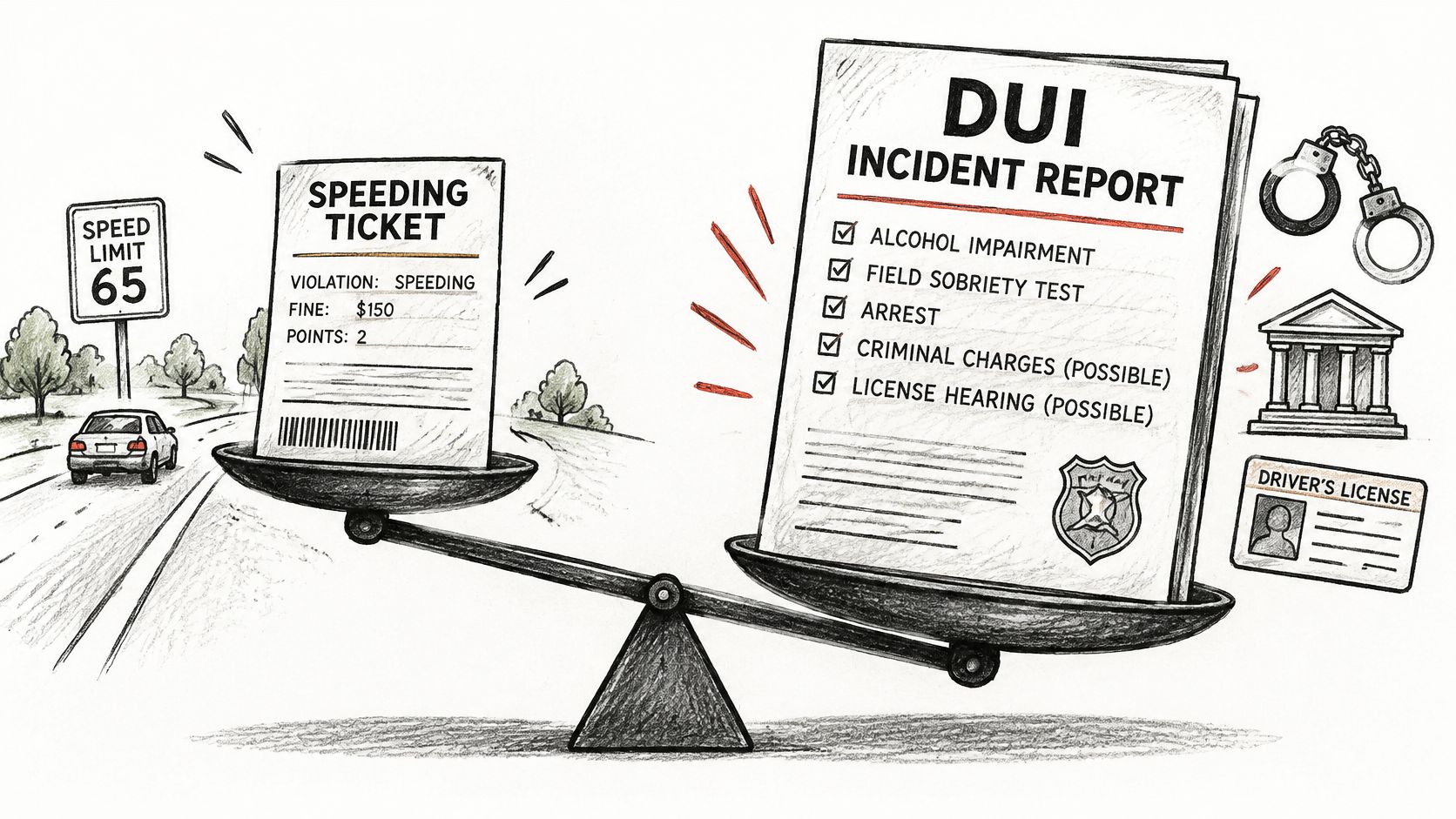
The NHTSA alcohol-impaired-driving countermeasures guide reports 13,384 deaths in U.S. crashes involving alcohol-impaired drivers in 2021, approximately 31% of all U.S. motor-vehicle fatalities that year. Those figures concern crashes involving a driver or motorcycle rider whose BAC met the agency's alcohol-impaired-driving definition, not every crash in which someone had consumed alcohol.
Serious risk without automatic assumptions
These deaths explain why lawmakers use more than monetary penalties to address impaired driving. Criminal sanctions address unlawful conduct, while license restrictions address whether someone may continue driving. For a nonprofit transporting passengers, both questions deserve attention.
That public-safety context doesn't establish what happened in an individual applicant's case. A coordinator still needs the actual charge, court outcome, and current driving status rather than an assumption based on national fatalities.
Treat the risk seriously without treating an allegation as a finding of guilt.
The video below provides additional context for the discussion.
State-specific explanations are useful when a report uses unfamiliar terminology. Readers reviewing a North Carolina matter can explore North Carolina DWI consequences through the Law Office of Bryan Fagan, then verify the actual charge against the relevant court record.
The important distinction isn't that every traffic ticket is harmless. It's that traffic describes the setting of the conduct, not the full legal exposure.
How Prosecutors Prove a DUI Case
Prosecutors can pursue a DUI through a per-se alcohol offense or an impairment-based offense. The difference concerns what they must prove, not whether the person looked obviously intoxicated to a casual observer.
The two routes work like two doors into the same courthouse. One asks whether the driver operated a vehicle with a blood alcohol concentration that crossed a statutory line. The other asks whether alcohol or drugs affected the person's ability to drive. Either door can lead to a conviction, and the choice between them shapes the evidence the prosecution gathers.
Under the standard described in NHTSA's impaired-driving program guidelines, operating at 0.08 g/dL or higher, or 0.05 g/dL in Utah, is illegal per se, while drug-impaired driving is unlawful in all 50 states and the District of Columbia. Once the applicable statutory BAC element is established, prosecutors generally don't need separate proof of visible impairment, although they must still prove the offense's other elements.
This comparison shows the different evidentiary focus.
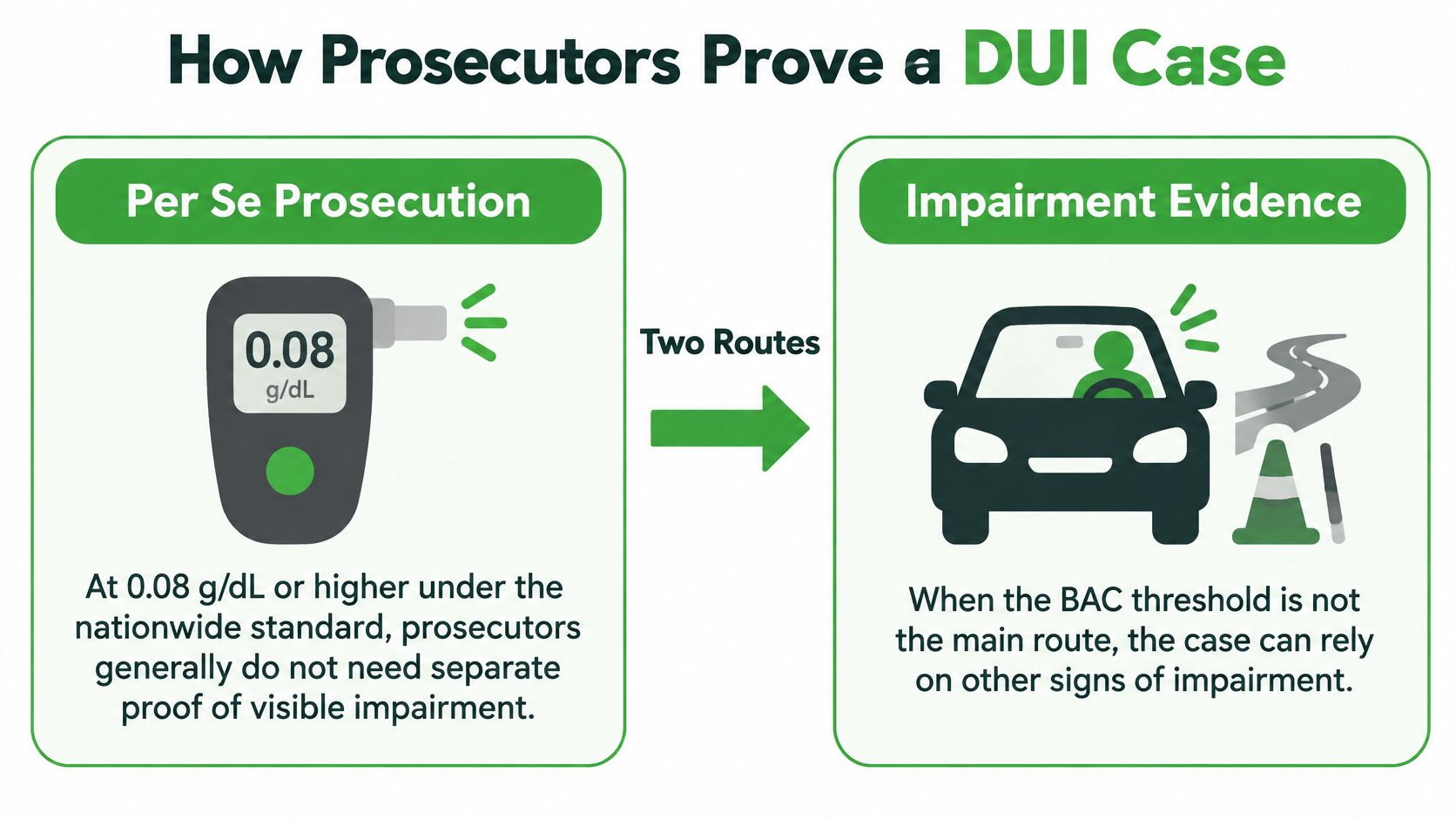
Per-se evidence and impairment evidence
| Proof route | Central issue | Common misunderstanding |
|---|---|---|
| Per-se prosecution | Whether the driver operated a vehicle with a prohibited BAC under the applicable statute | The driver must also appear visibly intoxicated |
| Impairment-based prosecution | Whether alcohol or drugs affected driving ability as the statute requires | Being below the per-se alcohol threshold rules out a charge |
For an impairment-based case, the focus shifts to evidence that the person's ability to drive was affected. A driver below the per-se alcohol threshold can still face an impairment allegation. Legal access to a substance, including a prescribed medication, also doesn't establish that driving after taking it was lawful.
A crash isn't a prerequisite for an ordinary DUI charge. Say a driver is stopped without striking another vehicle. If the evidence establishes the applicable offense, the absence of a collision doesn't eliminate the case.
The separate license proceeding
A failed or refused chemical test can also start an administrative process that runs alongside the criminal case. Many states impose a prompt administrative suspension or revocation after a failed or refused test, independent of the criminal case's final outcome. The actual procedure and available challenges must be checked under state law.
For a screener, the practical consequence is timing and separation. A licensing agency and a criminal court may finish their work at different points, so a pending case and a license restriction shouldn't be forced into a single outcome field. A single stop can leave three distinct traces: the charge describing the conduct, the criminal case resolving guilt, and the license action governing driving. Treating them as one record lets a generic traffic label hide what the criminal file contains.
How a DUI Appears on a Background Check
A DUI-related incident can generate a driving-record event and a criminal-record event. Different record sources answer different questions, so a report should preserve the distinction between an allegation, a court result, and a restriction on driving.
DUI-related record types and what each one proves
| Record type | What it establishes | Question to ask |
|---|---|---|
| Arrest | A police contact, not a finding of guilt | Was it followed by a charge? |
| Criminal charge | The filed offense and its level | Is it a misdemeanor or felony in that jurisdiction? |
| Conviction or disposition | The court outcome or recorded resolution | Was there a conviction, a plea resulting in a judgment, or a dismissal? |
| License suspension or revocation | An action on the driving privilege, separate from the court case | Is the license suspended now? |
| Motor-vehicle record entry | A driving-history event, which may include a DUI-related administrative action | Does it match the criminal record? |
An arrest entry doesn't establish that prosecutors filed a case. A filed charge doesn't establish a conviction. Even a disposition needs careful reading because a dismissal and a conviction aren't interchangeable screening facts.
Under Florida's DUI statute, DUI is punishable by fines and possible imprisonment. Florida also permits an administrative suspension based on test results, illustrating why a court search alone may not answer the driving-eligibility question.
Match the incident, then verify the outcome
California's DMV likewise treats an administrative suspension as a matter concerning the driving privilege, independent of the criminal court case. An applicant could therefore have a DMV proceeding and a prosecution arising from the same incident without those proceedings producing identical results.
For example, a coordinator might receive a motor-vehicle record showing a suspension while a criminal report lists a pending charge. Those aren't necessarily conflicting records. They may describe different actions taken after the same stop.
A guide to what an MVR check shows can help coordinators choose the right record source. An MVR isn't a substitute for a court disposition, and a criminal search isn't proof of current license status.
Before interpreting an entry, verify:
- Disposition: Obtain the court's recorded outcome, not just the original allegation.
- Offense date: Separate the incident date from later filing or resolution dates.
- Jurisdiction: Identify the court and licensing agency involved.
- Current license status: Check whether the restriction remains active and whether any driving conditions apply.
Setting Role-Based Criteria for DUI Records
Does a DUI record matter if no crash occurred? It can for a safety-sensitive volunteer assignment, but an organization shouldn't treat every DUI-related entry as an automatic reason to exclude someone. Start with the actual duties and the verified outcome, not the broadest possible interpretation of risk.
Substance-related offenses also require careful reading. Washington legislative materials on impaired driving describe conduct involving alcohol, cannabis, drugs, or their combined influence. Don't assume a DUI abbreviation means alcohol alone, or infer a medical condition from an offense label.
The following checklist highlights the role-specific questions.
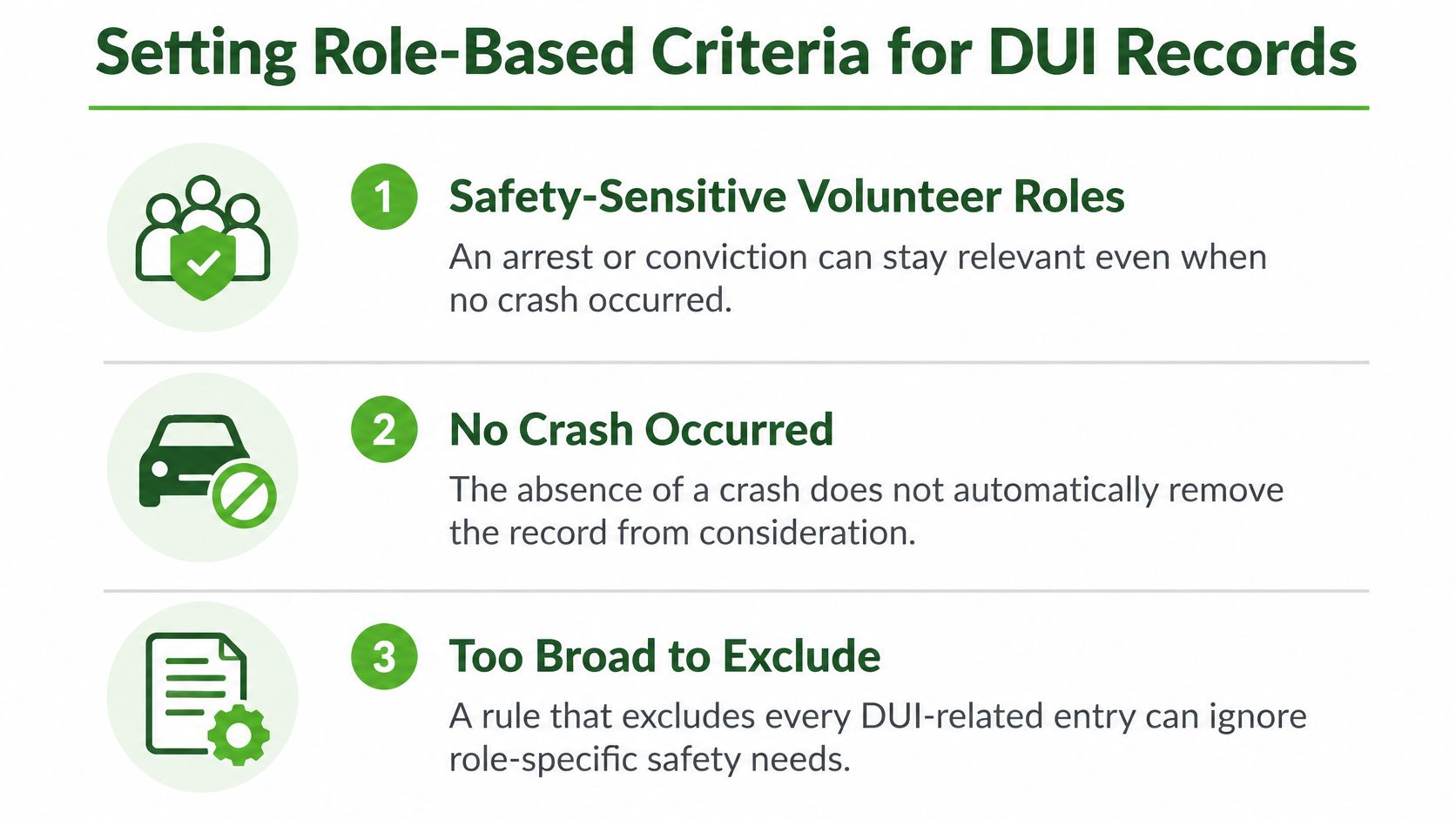
Write standards around the assignment
A volunteer transporting children or operating an organization's vehicle warrants closer driving-related review than someone formatting newsletters remotely. For the driving role, current eligibility, restrictions, and relevant offense history directly affect whether the person can perform the assignment safely and lawfully. For the remote role, explain any proposed exclusion rather than importing the driver standard automatically.
Use a written review checklist:
- Confirm the disposition. Don't substitute an arrest for a conviction.
- Confirm the offense date. Assess the record's relevance to the present assignment.
- Check qualifying repeat history. Verify separate incidents rather than counting duplicate entries.
- Note the substance category when legally available. Avoid speculation or unnecessary medical inquiries.
- Apply state restrictions. Check which records your organization may consider and how it may use them.
Decision standard: Apply the same individualized criteria to applicants seeking the same duties, while allowing relevant differences in verified facts.
Consider whether a non-driving assignment is appropriate when driving eligibility is the specific concern. That isn't a promise of placement or a substitute for legal review. It's a way to connect the decision to the work instead of imposing an organization-wide ban without examining the role.
Running the FCRA Steps Before a Decision
Don't decide from the traffic violation label alone. Before considering exclusion, establish that the report concerns the applicant and that you understand what each entry represents. A well-documented review protects against both overlooking a relevant conviction and treating an unresolved allegation as proven conduct.
Use this confirmation sequence:
- Identify the jurisdiction and offense level. Check the actual statute and filed charge.
- Match related entries. Reconcile arrest, charge, disposition, and license information so duplicate records don't become apparent repeat offenses.
- Apply written role criteria. Record the connection between the verified information and the proposed duties.
- Document the preliminary reason. Explain the concern before starting any adverse-action process.
Follow the applicable consumer-report process
When obtaining a third-party consumer report for a covered purpose, determine the applicable FCRA requirements before ordering it. Volunteer screening can require attention to the arrangement and jurisdiction, so have counsel confirm the rules that govern your program. The FCRA compliance guide for nonprofits provides a practical starting point.
For screening subject to the employment-purpose procedures, follow the sequence:
- Disclose and obtain authorization. Provide a standalone disclosure and obtain written authorization before the check.
- Review against the assignment. Evaluate the report using the documented role criteria.
- Send pre-adverse-action materials. If you may act adversely based on the report, provide the notice, a copy of the report, and the required summary of rights.
- Allow a reasonable response period. Give the applicant an opportunity to identify errors or provide relevant information. Don't treat a preliminary decision as final.
- Send the final notice if appropriate. If the decision stands, issue the required adverse-action notice with the applicable information about the reporting agency and dispute rights.
Identity validation matters before any of these decisions. If we at VolunteerBadge can't confidently validate that a criminal record belongs to the applicant, we don't bill for that result and refund the check.
Pull the full record, read the disposition, and complete the applicable notice and response process before finalizing a volunteer decision.
VolunteerBadge offers nonprofit criminal background screening with free address history verification, and each criminal check uses one credit with no hidden fees. Visit VolunteerBadge to support a screening process that evaluates DUI-related criminal information accurately while keeping court outcomes and driving eligibility distinct.
