
How Far Back Can Criminal Background Checks Go? 2026 Guide
How far back can criminal background checks go? See lookback periods for convictions, arrests, civil and traffic records, plus state rules for nonprofits.
On this page
Under federal law, convictions can be reported at any age, while arrests, dismissed charges, and most civil items generally drop off after seven years. State law can shorten either window.
Popular advice still tells coordinators to order a seven-year check and stop there. That shortcut is how volunteer programs miss an old conviction that federal law still allows, or keep a dismissed charge that should already be off the report. How far back criminal background checks go is a split answer, not a single number, and the rest of this guide walks from that myth to a lookback your board can defend.
Table of Contents
- Why the Seven-Year Rule Is Only Half the Answer
- Lookback Periods for Each Record Type
- How the Seven-Year Clock Starts and Stops
- How State Law Shortens or Extends the Window
- Volunteer Checks Compared With Employment Checks
- Why an Old Record Can Still Be the Wrong Record
- Set a Lookback Rule Your Nonprofit Can Defend
Why the Seven-Year Rule Is Only Half the Answer
Ask a room of volunteer coordinators how far back a criminal check goes and most of them will say seven years. They repeat it because vendors print it on order forms and because it sounds like a clean national rule. It isn't.
Under the federal Fair Credit Reporting Act, criminal convictions have no federal time limit. Arrests and most other non-conviction items generally drop off after seven years. Think of a library. Convictions sit on a permanent shelf. Arrests and dismissed charges sit on a shelf with a return date.
Three facts decide any real answer.
- Record type: A felony, a misdemeanor, an arrest, a civil judgment, and a traffic ticket don't share one clock.
- Disposition: What the court finally did, whether that was a conviction, a dismissal, an acquittal, or a seal, changes what a reporting agency may show.
- Jurisdiction: The county that created the record, the state where the volunteer lives, and the state where your program runs can each tighten the federal baseline.
A record that is legally reportable is not automatically a reason to turn someone away. The legal ceiling and the lookback your nonprofit should use are different decisions. The usable line is this: potentially seven years for many non-conviction records, potentially longer for convictions, and shorter wherever state law requires it.
Lookback Periods for Each Record Type
The same report can contain records with different clocks. An arrest that did not lead to a conviction is generally subject to a seven-year federal reporting limit, while a conviction has no federal time limit. The Equal Employment Opportunity Commission background-check guidance explains this distinction. A record's legal reporting window is separate from the period your nonprofit should consider relevant to a particular role.
In 1998, Congress amended the FCRA through the Consumer Reporting Employment Clarification Act, removing the federal seven-year cap on convictions. That change means a conviction may be reportable regardless of age under federal law, though state rules can impose limits. The FCRA also removes the seven-year limits on certain adverse information when the person is expected to earn at least $75,000 a year. That pay exception is unlikely to apply to an unpaid volunteer role.
Read the table as a federal ceiling, not a recommendation for every screening policy. Identify the record type, check the federal rule, and then consider state law and the duties of the volunteer role.
| Record type | Federal FCRA lookback | State or practical limit | Key point |
|---|---|---|---|
| Felony conviction | No federal time limit | Set by state; some states restrict employment use | Reportable at any age under the federal rule |
| Misdemeanor conviction | No federal time limit | Set by state; some states seal or limit | Same federal rule as felonies |
| Arrest with no conviction | 7 years from the arrest date | Some states bar use entirely | An arrest alone does not prove conduct |
| Pending charge | 7 years from the charge date | Check the state statute before reporting | The clock does not wait for resolution |
| Dismissed or acquitted charge | 7 years from the original arrest or charge | Some states bar reporting | A dismissal does not restart the clock |
| Civil suit or civil judgment | 7 years from filing or judgment date | Follow the state's civil-record statute | Listed among adverse non-conviction items |
| Paid tax lien | 7 years from the payment date | Follow the state's lien statute | Mainly relevant to financial roles |
| Minor traffic conviction | No federal time limit | Many screens limit them to driving roles | Motor vehicle records follow separate DMV rules |
| Sealed or expunged record | Not reportable where legally sealed | Governed by state statute | Confirm disposition before any decision |
How the rows behave
Felony and misdemeanor convictions follow the same federal rule: age alone does not make a conviction unreportable. State law may seal a record, limit its use, or set reporting restrictions. Even where a conviction may legally appear, consider whether it is relevant to the volunteer's actual responsibilities.
Arrests, pending charges, and dismissed cases are different from convictions. For these non-conviction records, the federal seven-year period generally runs from the arrest or charge date, not from the date the case closes. A long-open case does not make the clock wait for its outcome. Because an accusation is not a finding of guilt, distinguish arrests and convictions before deciding how a record should affect an application.
Civil suits, civil judgments, and paid tax liens also fall within the table's seven-year adverse-information categories. Their relevance depends on the role. A record involving financial obligations may matter for a volunteer handling funds, while it may have little connection to tutoring duties.
Minor traffic convictions can have no federal reporting time limit, but that does not make a criminal search the right tool for assessing driving. If a volunteer will transport children or older adults, use a motor-vehicle check that follows the state's DMV retention rules, and organize your driving record review with a driving-record review planner.
Sealed or expunged records generally should not be reported where the law has sealed them. An index hit may not show the final status, so confirm the disposition before treating it as current or using it in a decision.
The federal column describes what may be reported, not what every nonprofit should collect or consider. A defensible policy connects the record type and its age to the role, while respecting state limits.
How the Seven-Year Clock Starts and Stops
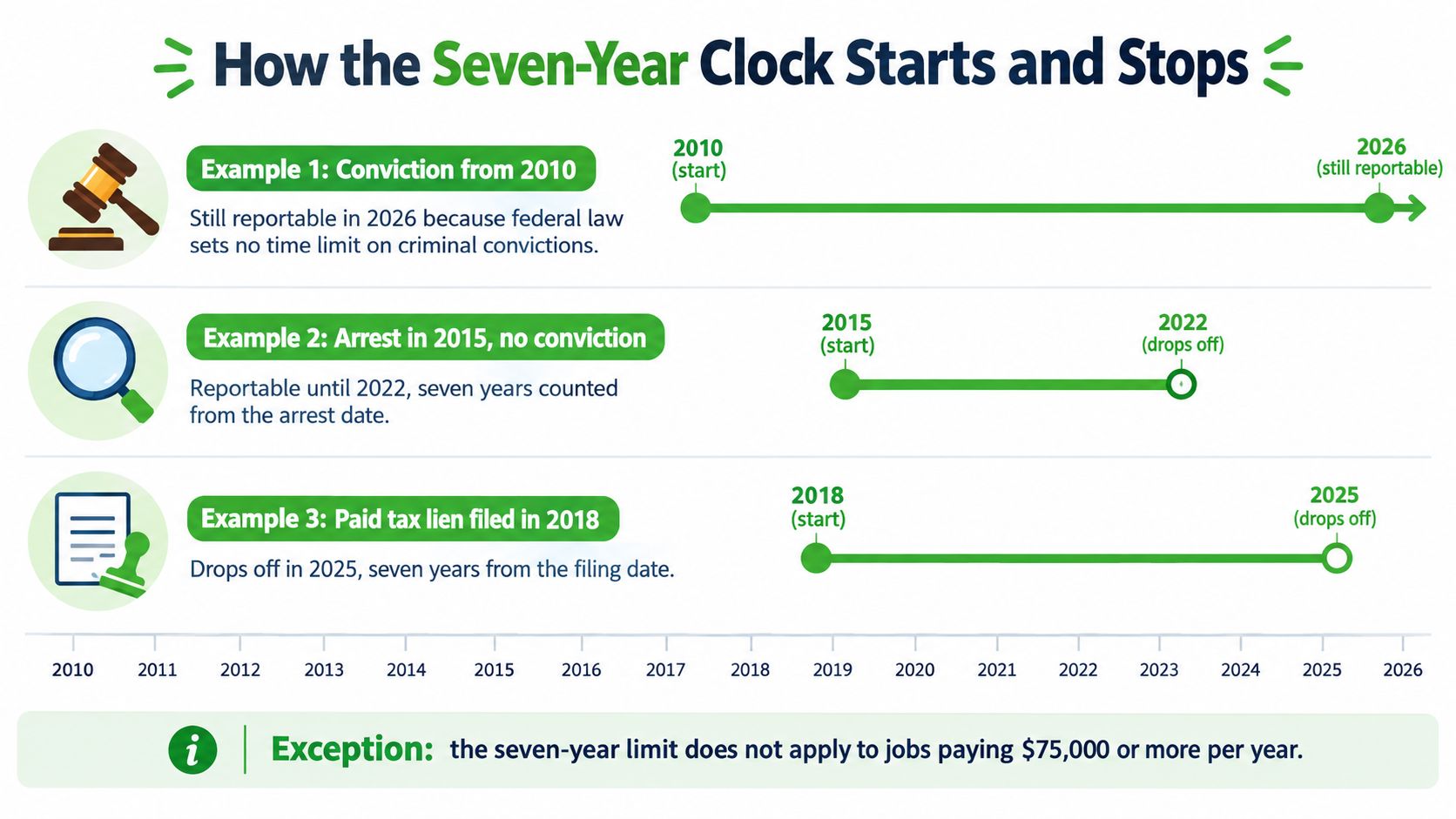
A report may emphasize the court's disposition date, but that date is not always the one that starts the reporting clock. Under the federal Fair Credit Reporting Act, the seven-year restriction generally applies to adverse non-conviction information, such as arrests. Criminal convictions can be reported without a federal time limit. Each adverse item has its own period, so a later dismissal does not restart the clock.
Three dated stories
A conviction from 2010. Suppose an after-school program screens a volunteer in 2026 and finds a misdemeanor conviction from 2010. Federal law does not impose a seven-year reporting limit on that conviction. Whether the program should consider it depends on the role and applicable state law, not age alone. A conviction may remain reportable even when a more recent dismissed charge is restricted. That distinction matters to organizations serving youth, schools, churches, and older adults.
An arrest in March 2016, dismissed in 2019. The charge remained open for three years before the court dismissed it. If a 2024 report still lists it, the relevant starting point is generally the March 2016 arrest, not the 2019 disposition. Seven years from the arrest is around March 2023, so the dismissal does not give the item a fresh seven-year period.
A charge filed in 2021 and still pending in 2025. A case can remain open for years, but its later resolution does not automatically start a new reporting period. For an adverse non-conviction item, the relevant event date is generally the arrest or charge date, rather than the date the court finally acts.
A later court date does not reopen a closed reporting window. Count from the event date, then check the record type and applicable law.
State rules can change the result, so these examples do not produce the same answer everywhere.
A three-step check on any report
- Find the event date. Check the arrest or charge date for non-conviction information, rather than the report's print date or the case's disposition date.
- Count seven years for non-conviction items. If that period has passed, the item generally falls outside the federal reporting window, subject to applicable law.
- Match the record type. Federal law does not give criminal convictions the same seven-year cutoff. Non-conviction information is generally subject to it.
A short walkthrough of how reporting windows are calculated can help make the dates easier to follow on a report.
How State Law Shortens or Extends the Window
Federal rules are a floor for what a reporting agency may omit, not a promise that every state will allow the full federal window. A state can impose a shorter reporting period, and that local ceiling wins for people and programs covered by it.
California is the clearest case. For many employment-related checks, criminal conviction information is generally limited to seven years, calculated from the date of conviction or the person's release from incarceration under the governing rule, according to this California background-check overview. Fair-chance rules there generally stop employers from asking about conviction history before a conditional job offer. The employer then has to look at the offense, the time that has passed, and the link to the job, rather than rejecting the person automatically.
A "seven-year check" in that setting is a state ceiling. Next door, another state may still allow conviction reporting with no end date. Copying California's number into a Texas church policy, or ignoring it for a California school program, both create trouble.
Levers to check before you set a window
- Non-conviction limits: Some states bar reporting of arrests, dismissals, or acquittals even inside seven years.
- Ban-the-box and fair-chance rules: These control when you may ask, often not until a conditional offer, even when the record itself is reportable.
- Sealing and expungement statutes: A conviction the federal baseline would allow can be legally closed in the state that entered it.
- Local ordinances: A city rule can be tighter than the state statute that sits above it.
- Role-specific statutes: Youth, school, and childcare programs often have their own required searches that don't follow a generic employment window.
When the volunteer, the court, and the program sit in different states
Name three places: the county court that created the record, the state where the volunteer lives, and the state where the program operates. When those don't match, a conservative policy applies the narrowest of the rules that actually cover that person and that role. Statutes move. Confirm the current text before you lock a window into a handbook.
Volunteer Checks Compared With Employment Checks
| Factor | Volunteer check | Employment check |
|---|---|---|
| Typical purpose | Child safety and trust in unsupervised roles | Hiring, promotion, or reassignment |
| FCRA employment rules | Often outside the definition; vendors often follow FCRA anyway | Apply in full |
| Lookback approach | Same record rules, usually narrowed by role risk | Same record rules, weighed under EEOC factors |
| Disclosure and authorization | Recommended; required by some state or child-protection rules | Required under FCRA |
| Adverse action steps | Usually not triggered under FCRA for unpaid roles; confirm with counsel | Pre-adverse notice, waiting period, final notice |
| Who decides | Board or coordinator under written policy | HR with legal review |
The row most nonprofits skip is the second one. FCRA disclosure and adverse-action steps attach to consumer reports used for employment purposes. An unpaid volunteer often falls outside that definition, so the federal notice sequence may not be legally required. Many screening vendors still run the FCRA steps, because the same file format serves employers and nonprofits. Whether your state pulls volunteers back inside those duties is a question for counsel, not for a vendor checkbox. A plain explanation of when the FCRA covers a criminal check helps a board see which steps are legal duties and which are good practice.
Unpaid does not mean unregulated.
State child-protection statutes, school rules, and your own written policy still bind a volunteer program. An employment check, by contrast, usually needs written disclosure and authorization, a pre-adverse notice with a copy of the report, time to dispute errors, and a final adverse-action notice.
Same record, different role
A volunteer tutor for minors warrants a conviction search and a sex-offender registry check shaped by the state's youth rules. A dismissed shoplifting charge from eight years ago shouldn't drive that decision.
A volunteer who counts the offering or holds the concession cash warrants a look at fraud and theft convictions inside a window you wrote down in advance. An old traffic ticket doesn't belong in that file.
A volunteer who stocks shelves, with no children, money, or vehicles, warrants a narrower scope. Ordering the deepest search you can buy doesn't make that role safer. It mostly creates records you then have to ignore, fairly and on paper.
Household employers hit a similar split when they screen caregivers. Families comparing safer nanny hiring practices are really doing the same job: match the search to unsupervised access, not to a generic seven-year package.
Why an Old Record Can Still Be the Wrong Record
Say two men named James Carter live in neighboring counties. One was convicted in 2009. The other wants to coach your rec league. A national index attaches the 2009 case to the coach because the names match and an old address overlaps. The conviction may be old enough to report under federal law and still be the wrong person.
Reportable is not the same as reliable. The CFPB's 2024 supervisory highlights pressed consumer reporting companies to keep reasonable procedures against duplicative or impermissibly old criminal information, and a 2024 CFPB advisory opinion reiterated that a later event can't reopen an expired reporting period. For a nonprofit, the operational point is sharper: an old record can be legally showable and still be unusable if it names the wrong person, drops a favorable disposition, or can't be confirmed at the court that entered it.
Common names, several past addresses, interstate moves, and courts that don't share data all raise that risk. A national search can point at possible hits. It doesn't replace a look at the originating court before you take adverse action.
Address history is the map. Omitted cities, gaps in the timeline, dates that don't line up, and name variations tell you which counties and which aliases still need a search.
- Confirm identity: Match date of birth and a full address history before you treat any hit as the volunteer's.
- Search aliases: Maiden names, hyphenated names, and common misspellings hide older cases.
- Verify each hit at the court: Pull the case from the clerk, not only from the index.
- Confirm the final disposition: A conviction, a dismissal, and a pending case are not interchangeable.
- Check for sealing: An expunged case that lingers in a database shouldn't survive a source check.
The standard worth writing down is simple. Go as far back as the law permits, and only as far as you can verify.
Set a Lookback Rule Your Nonprofit Can Defend
A record's legal reporting window and your organization's lookback rule answer different questions. The FCRA sets limits on what a consumer reporting agency may report; your policy decides what is relevant to a volunteer role. The EEOC's enforcement guidance on arrest and conviction records identifies three factors for assessing criminal records: the offense's nature and seriousness, time since the offense or sentence, and the role's duties. An arrest alone does not establish that the conduct occurred, so it should not be the sole reason to reject someone.
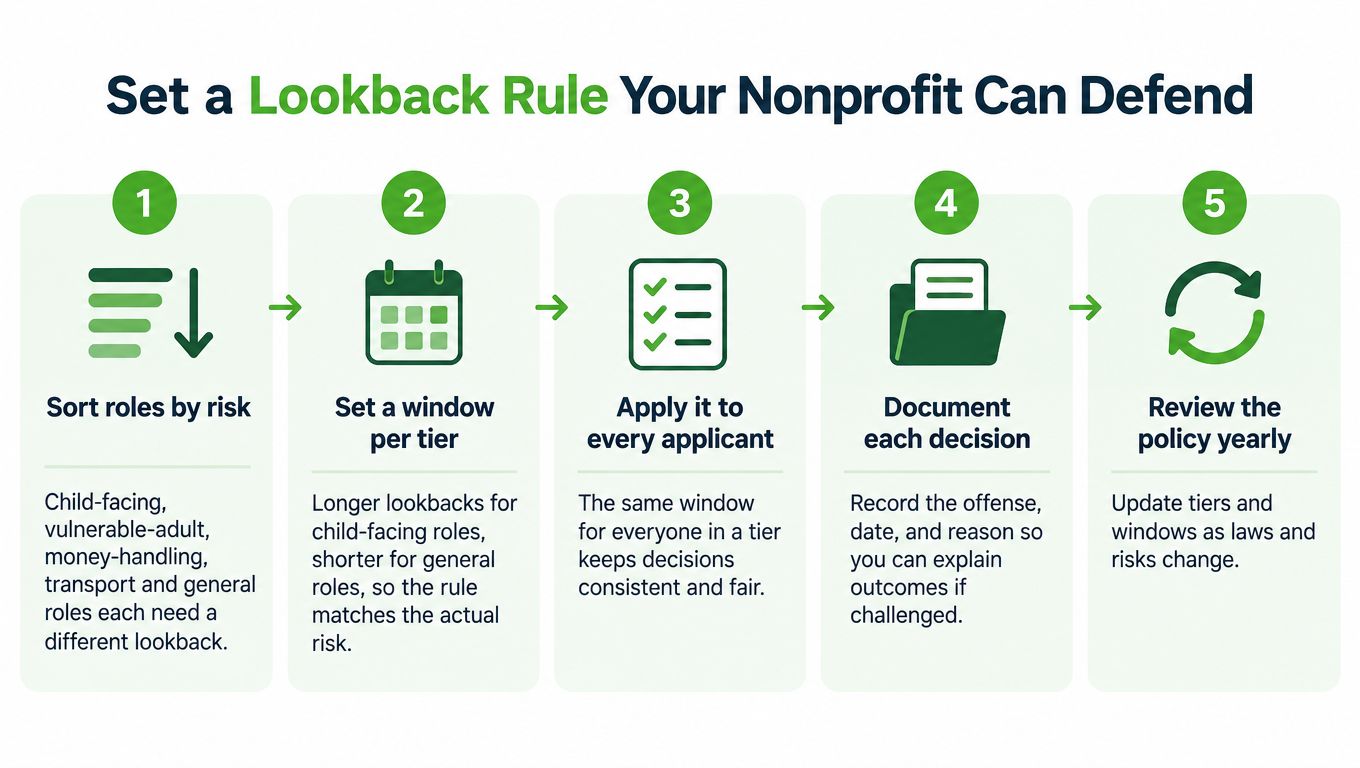
Build the policy in order. Clear role tiers make each later decision easier to explain and apply consistently.
- Sort roles by risk. Child-facing work, vulnerable-adult support, handling money, driving, and general help do not carry the same risks. One lookback for every role treats a nursery volunteer and a bulletin folder as if their duties were identical.
- Set the record scope for each tier. Where state law permits, a child-facing role may call for a broader conviction history. General roles may use a shorter conviction window. For money-handling roles, focus on relevant fraud or theft rather than unrelated traffic matters.
- Distinguish convictions, arrests, charges, and dispositions in writing. Their reporting rules and timelines can differ. “Seven years of criminal history” is too vague if coordinators interpret it differently.
- Apply the state rule that governs the person and account for sealed cases. A sealed case should not influence the decision, even if a database still displays it.
- Check identity before assessing a record. Compare address history, name variations, and date of birth before deciding whether a possible match belongs to the volunteer.
- Verify each hit with the originating court. An index entry is not enough. Confirm the final disposition before making a decision.
- Explain the role-related reason in writing. Consider the seriousness of the conduct, time elapsed, and actual duties. A blanket rule against anyone with a record does not explain why a particular case matters for a particular role.
- Send required notices and allow time to dispute an error. Even when a volunteer role falls outside strict FCRA adverse-action requirements, giving the person the report and an opportunity to correct a mismatch can prevent a decision based on the wrong James Carter.
Put the role tiers, record scope, and decision steps in a written volunteer screening policy, then have the board approve it. When comparing providers, ask how they verify county records and handle notices. VolunteerBadge is a consumer reporting agency offering national criminal searches across county, state, and federal courts, along with an automated address-history pull. Compare those features with the tiers in your policy, rather than choosing a product because it offers the longest history.
Write the one-page policy and secure board approval before ordering the next check. That gives coordinators a consistent rule to follow, while leaving room to apply the relevant law and assess each role fairly.
