
Ban the Box States: Which 10 Laws Apply in 2026
Ban the Box States compared: effective dates, public and private coverage, volunteer exceptions, and what each law means for background checks.
On this page
“Just remove the criminal-history checkbox” is incomplete advice. Your nonprofit also needs to decide when staff may ask questions, when they may order a background check, and how they'll evaluate the results. Moving a question off the application won't fix a screening invitation that goes out too early.
The opposite assumption is risky, too: a law written for employers doesn't automatically cover every unpaid volunteer. Employee coverage and volunteer coverage are separate questions. A church hiring a program director and recruiting unpaid pantry volunteers shouldn't assume the same legal rule applies to both.
For nonprofit directors comparing ban the box states, the useful distinction is not just whether a state appears on a list. It's which employers and roles the rule covers, what event permits an inquiry, and whether city or county requirements add another step. Consistent treatment also matters when preventing discrimination, especially if different coordinators handle similar applicants.
The state-by-state guidance below separates practical screening recommendations from legal requirements. Where the available sources don't establish an effective date, employee-count threshold, or volunteer exemption, those details aren't presented as settled law. Don't configure a live application around an unverified threshold. Confirm coverage for the actual role and location, then translate that answer into form wording, staff permissions, and a documented screening sequence.
Table of Contents
- 1. Hawaii
- 2. Massachusetts
- 3. Illinois
- 4. New Jersey
- 5. Connecticut
- 6. Minnesota
- 7. Colorado
- 8. Washington
- 9. Maryland
- 10. Pennsylvania
- How the 10 ban-the-box states differ on coverage, timing, and first effective year
- What Ban-the-Box Means for Your Volunteer Screening Next
1. Hawaii
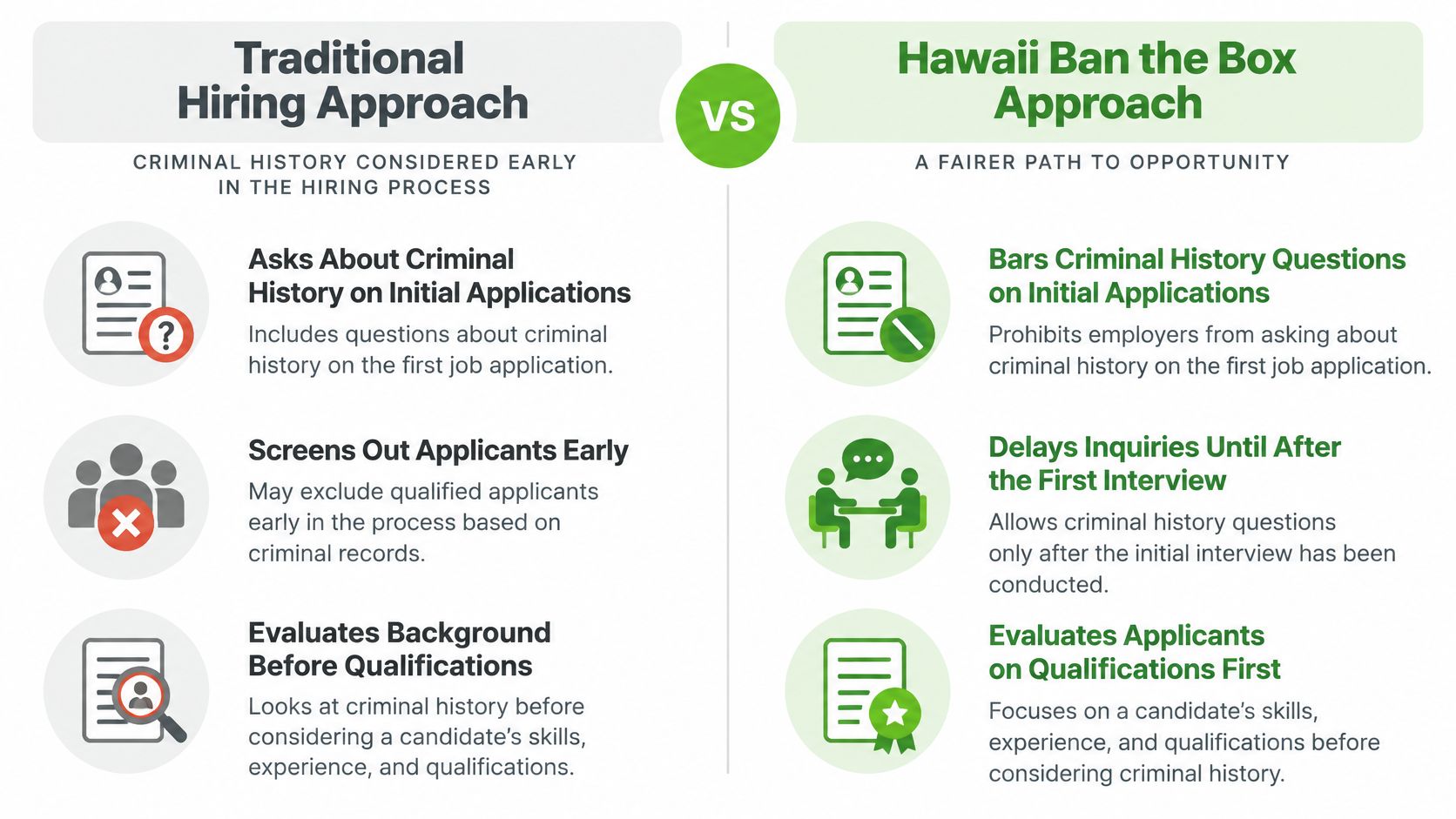
Hawaii's statewide ban-the-box policy dates to 1998, making it an early example of a state restricting criminal-history questions in hiring. The National Employment Law Project's state and local guide documents that history. It does not establish that every unpaid volunteer role is covered by an employment law.
For a nonprofit, determine whether the role is covered before setting the application's wording or screening sequence. Confirm when the law permits an inquiry. An interview invitation and a conditional offer are different stages.
Keep the application focused on qualifications
For an unpaid reception volunteer at a community center, the initial form can ask about availability, customer-service skills, references, and willingness to complete any screening required for the role. It should not ask applicants to describe convictions unless the applicable rule permits that question at that stage.
Use wording such as: Placement is subject to completion of the screening required for this role. Keep criminal-history information in a separate, access-controlled process, and start that process only at the approved stage.
If a report raises a concern, pause before sending a rejection. A pre-adverse action letter gives the applicant notice before a final adverse decision and is part of the required FCRA process when applicable.
Document how the record relates to the volunteer's duties. The report provides information; your organization makes the placement decision.
2. Massachusetts
Massachusetts illustrates why removing a question and managing a fair review are different tasks. The state's November 2010 reform barred incarceration-history questions on initial applications, according to the U.S. Department of Labor's Massachusetts study summary.
That application restriction shouldn't be converted into an unsupported assumption about every later inquiry or every volunteer role. A nonprofit using Criminal Offender Record Information, commonly called CORI, needs a process that distinguishes access to records from permission to use particular information in a decision.

Separate record review from program recruitment
Consider an after-school nonprofit recruiting tutors. Program staff can assess subject knowledge and availability, while a designated screening reviewer handles sensitive criminal-record information.
Before that reviewer makes a recommendation, establish:
- Record status. Distinguish an arrest, a pending matter, and a conviction rather than treating them as equivalent.
- Role relevance. Identify the duties and access that create a specific concern.
- Applicant response. Record corrections or explanations before closing the review.
Our explanation of arrests versus convictions helps staff recognize those distinctions.
Keep the review record separate from general scheduling notes. A tutor's supervisor needs to know whether placement is approved, not receive an unrestricted copy of sensitive background information.
3. Illinois
Illinois inquiry timing must come from the rule that applies to your organization, not from a national template that treats application, interview, and offer restrictions as identical.
Employee-count thresholds also need a clear answer. Before relying on a size-based exemption, confirm which counting method applies and whether another state or local requirement affects the role.

Give the screening trigger an owner
A food bank recruiting a paid warehouse supervisor and unpaid delivery assistants should maintain separate role records. Copying the employee application into the volunteer portal can apply the wrong inquiry timing to volunteers.
For each role, document coverage, permitted inquiry stage, required checks, and decision authority. Assign a staff member to release the screening invitation at the approved stage instead of sending it automatically when someone applies.
Practical rule: A later screening stage may be organizational policy, even when it is not the legal minimum. Label it accurately.
A post-offer workflow may simplify administration, but it can delay placement if no one schedules the record review. Tell applicants that placement remains conditional, and keep them from unsupervised duties while a required review is unresolved.
Use a controlled sequence, with a named owner for each step.
4. New Jersey
A cleaner application doesn't guarantee a fairer selection process. A field experiment involving 15,000 fictitious applications in New Jersey and New York City examined employer behavior before and after ban-the-box policies, according to J-PAL's evaluation summary.
For a nonprofit director, the operational lesson is to control what happens before screening as carefully as what happens afterward. Staff shouldn't replace a prohibited criminal-history question with guesses based on a person's name, neighborhood, employment gap, or appearance.
Standardize the first conversation
Suppose a youth arts charity recruits event volunteers. Give coordinators the same qualification questions about availability, relevant experience, and ability to perform the assignment.
Use a short scoring guide with concrete criteria. “Available for the scheduled event” is useful; “seems like our kind of person” isn't.
- Application wording. Keep early questions focused on qualifications and the role.
- Interview notes. Record the applicant's answers, not assumptions about their history.
- Screening review. Apply the approved inquiry trigger and role-specific criteria consistently.
When a report arrives, don't confuse how far a search reaches with what the organization may legally consider. Our guide to how far back criminal background checks can go explains why those are separate issues.
Review advancement and rejection patterns as well as completed checks. A fair-chance policy can fail before anyone orders a report.
5. Connecticut
The first Connecticut question is which process covers this particular role, not whether the organization calls everyone a volunteer. Document the role's duties, compensation arrangement, work location, and screening obligations before deciding which application restrictions govern it.
Don't insert an employee threshold into your policy unless you've confirmed it against the applicable rule. An unsupported threshold can cause staff to stop checking coverage precisely when a local requirement or role-specific obligation matters.
Write the assessment around actual access
Say a library recruits volunteers to shelve books and separately recruits volunteers to run children's activities. Those assignments create different access and supervision conditions, even if both appear on the same recruitment page.
A useful review form asks the reviewer to describe:
- The assignment. Identify contact with children, money, vehicles, keys, or confidential information.
- The concern. Explain how legally usable record information relates to those duties.
- The available controls. Consider supervision, restricted access, or a different assignment where appropriate.
- The decision. Record the reason and the applicant information considered.
These are practical assessment fields, not a substitute for any statutory factors that apply.
Avoid a free-text application prompt asking applicants to explain anything that might appear in a background check. It can collect criminal-history information before the approved stage and expose sensitive details to staff who don't need them.
Move the review, not just the checkbox.
6. Minnesota
A Minnesota nonprofit needs a precise internal definition of when an applicant advances to screening. “Later in the process” is too vague for a coordinator deciding whether to ask a question during a telephone call.
The approved trigger should appear in the written procedure and in the screening system. Confirm the legally permitted stage for the covered role, then make sure staff don't trigger an earlier inquiry through reference calls, informal conversations, or automated emails.
Design for both interviewed and non-interviewed roles
Consider a conservation charity that interviews volunteer team leaders but selects occasional cleanup volunteers through a registration form. Those recruitment paths don't contain the same milestones.
Don't tell staff to screen after the interview if some applicants never have one. Define the approved event for each path, subject to the applicable legal rule.
For example, the charity could assess qualifications, identify a proposed placement, and then release the required screening invitation at its approved stage. That is an operating design, not a statement that every Minnesota role has an identical statutory trigger.
A workflow isn't consistent if staff have to invent the missing step whenever an applicant follows a different recruitment path.
Keep a timestamp for advancement and a separate timestamp for the screening order. If a concern requires review, preserve the assessment and response record rather than recording only a final approval or rejection.
This makes the sequence understandable to the next coordinator who inherits the file.
7. Colorado
An application can solicit criminal history without displaying a checkbox. Prompts about past mistakes, legal trouble, or barriers to trust can invite the same information in less obvious language.
For Colorado recruitment, audit the entire applicant experience: the role advertisement, registration form, interview script, screening invitation, and onboarding email. Confirm the applicable timing rule before deciding where criminal-history questions belong.

Replace broad exclusions with role requirements
Say a community garden recruits volunteers who sometimes transport equipment. Instead of announcing that applicants must have a clean background, describe the actual duties and the screening required for the assignment.
Clean background is not a decision standard. It doesn't tell staff which information matters, how to handle an error, or when an applicant can respond.
Use these distinctions in the procedure:
- Qualification review. Can the applicant perform the role?
- Screening authorization. Has the applicant completed the appropriate disclosure and authorization process?
- Record assessment. Does legally usable information create a role-related concern?
- Final decision. Have the applicable notice and response steps been completed?
A delayed check can reduce unnecessary early collection of sensitive information. It won't help if the organization still rejects every applicant whose report contains any record.
Keep safeguarding requirements explicit, and assess discretionary concerns separately from mandatory disqualifications.
8. Washington
Washington deserves a deliberate update review rather than a copied application template. Boostpoint's state-law roundup identifies 2026 changes involving conditional-offer timing, restrictions on adverse decisions based on arrest records, and a written six-factor individualized assessment for convictions.
That secondary summary is a reason to verify the applicable implementation date, employer coverage, exceptions, and required assessment language before changing a live workflow. It isn't enough to assume that every organization and volunteer role follows the same schedule.
Prepare the review before ordering the report
Suppose a Washington charity recruits volunteer drivers. Staff should know who reviews a possible record, which legally permitted criteria apply, and how the applicant can supply corrections before a report arrives.
Don't leave those decisions to a dispatcher trying to fill an open route. Prepare the assessment form, assign a reviewer, and identify who may authorize a final placement decision.
An arrest entry and a conviction require different treatment. A report containing either still doesn't make the decision for you.
Audit recruitment language, too. Statements excluding anyone with any criminal history can undermine a process intended to evaluate the person and the assignment.
For a volunteer position, separately confirm whether the employment rule reaches the role and whether a safeguarding requirement changes the screening sequence. Fair-chance review and mandatory safety checks must be reconciled, not treated as competing policies.
9. Maryland
A small payroll isn't a complete coverage analysis. For Maryland operations, confirm any applicable employer-size threshold, how employees are counted, and whether the volunteer's actual location introduces a local rule.
Don't count volunteers as employees merely to simplify the spreadsheet. Don't exclude them from legal analysis merely because they're unpaid, either. Record the role classification and the reason for the coverage conclusion.
Use location-specific routing
Say a regional charity recruits volunteers through a shared website but assigns them to different Maryland programs. Ask where the applicant will serve before selecting the screening workflow.
The application should collect enough location information to route the person correctly without collecting criminal history prematurely. Keep that routing separate from the applicant's residential address when the assignment takes place elsewhere.
- Coverage record. Identify the employer, role classification, work location, and applicable rules.
- Timing control. Define the event that releases the screening invitation.
- Decision control. Require review before an adverse decision becomes final.
A uniform post-offer policy may be administratively useful, but call it your policy unless the applicable law requires that exact stage. This distinction helps staff understand which steps they can change and which they can't.
If the applicant disputes a record, hold the tentative decision for the applicable review process. Scheduling pressure shouldn't turn a preliminary concern into an automatic rejection.
10. Pennsylvania
Pennsylvania highlights a distinction that national lists often obscure: a public-sector policy is not automatically a private-nonprofit mandate. NELP explains that statewide fair-chance policies generally concern public employment, while some also regulate private employers, in its fair-chance hiring overview.
A nonprofit therefore needs to identify the source and scope of the rule rather than relying on a state's appearance in a roundup. Government employment rules, local requirements, contractual obligations, and mandatory volunteer clearances are different controls.
Keep mandatory clearances on their own track
Consider a Pennsylvania mentoring program recruiting adults who will work with children. The coordinator should identify mandatory clearances before deciding whether a general database check is sufficient.
Removing an early criminal-history question doesn't eliminate a legally required clearance. Conversely, a mandatory check doesn't authorize staff to disregard every other rule governing information use and applicant treatment.
Safeguarding distinction: A required clearance answers a legal eligibility question. A discretionary record assessment answers whether particular information affects this placement.
Write both tracks into the procedure. Identify the required clearance, the permitted screening stage, who receives the result, and how unresolved findings affect assignment.
For discretionary review, document duties and relevant concerns rather than relying on a general sense of risk. Keep applicants informed about outstanding steps, but don't promise clearance or placement before the required process is complete.
How the 10 ban-the-box states differ on coverage, timing, and first effective year
The table compares the rules described here, but it is not a substitute for checking the rule that applies to a specific volunteer role. These laws often regulate employment, and volunteer coverage may differ. Confirm the current rule, its effective date, and whether it covers the role and organization before changing an application or screening sequence.
| State | Coverage and timing | Notable feature |
|---|---|---|
| Hawaii | Most private employers. Criminal-history questions generally follow the first interview. | The article identifies Hawaii's 1998 policy as the first statewide ban-the-box law. |
| Massachusetts | Private employers. Criminal-history questions are prohibited on initial applications. | CORI access and use rules govern criminal-record information. |
| Illinois | Coverage and timing depend on the applicable rule. | Applicants may have an opportunity to respond to adverse information. |
| New Jersey | Private employers. Criminal-history inquiries generally follow a conditional offer. | Includes enforcement provisions and state guidance. |
| Connecticut | Criminal-history questions are prohibited on initial applications, with inquiries delayed until later. | Specific factors must be considered before an adverse decision. |
| Minnesota | Private employers. Inquiries generally follow an interview or conditional offer, depending on the scenario. | Timing depends on the hiring scenario. |
| Colorado | Public and private employers. Inquiries generally follow interview selection or, in some cases, a conditional offer. | Part of a broader state fair-chance framework. |
| Washington | Coverage expanded over time. Criminal-history inquiries are restricted until later in the hiring process. | Job ads that exclude people with records are also restricted. |
| Maryland | Private employers. Criminal-history inquiries follow a conditional offer. | Builds on earlier public-sector rules. |
| Pennsylvania | No broad private-employer coverage is described here. State-agency policy delays inquiries. | The policy applies to state agencies. |
The practical difference is the point at which a form may ask about criminal history and the point at which screening may begin. Treat those as separate decisions. Confirm current coverage and effective dates for the role and location, then set the application wording and screening sequence accordingly.
What Ban-the-Box Means for Your Volunteer Screening Next
Ban-the-box compliance is a sequence, not an application edit. Start with the role and work location, determine coverage, identify the permitted inquiry stage, and define how staff will handle the results. Keep the legal requirement separate from any more protective organizational policy you choose to adopt.
For volunteer programs, the coverage question comes first. A state employment law doesn't automatically apply to every unpaid role, and an employee-count threshold shouldn't be copied into a volunteer policy without checking its scope. Have counsel resolve the uncertain classification or exemption, then record the answer in language a coordinator can follow.
Turn the answer into application wording
An initial volunteer application can focus on duties, availability, qualifications, references, and willingness to complete required screening. Remove criminal-history questions wherever the applicable rule requires it, including open-ended prompts that invite the same information.
Next, define the screening trigger. Name the staff member authorized to release the invitation, and prevent automated messages from requesting information before that stage. Keep the appropriate FCRA disclosure, authorization, and adverse-action procedures in the workflow rather than assuming fair-chance timing replaces them.
When information raises a concern, verify the record and assess its legal usability before evaluating relevance. Record the connection to the assignment, consider the applicant's response, and preserve the notices and decision history. Guidance on salvaging job offers with HiredBySkill can help staff approach a flagged result as a review issue rather than an automatic rejection.
Keep safeguarding and fair-chance procedures connected
A legally mandated fingerprint check, including an FBI or Live Scan requirement, isn't replaced by a database search. A database search can serve as your primary screen where appropriate, but it doesn't satisfy a different check that the law specifically requires.
VolunteerBadge includes built-in FCRA disclosure language, a digital authorization signature, and adverse-action notices. We also guide customers through the required waiting period between pre-adverse and final notices. Those tools support the process; your organization still needs to select the correct timing and make the role-specific decision.
Before publishing your next recruitment form, assign an owner to review its wording, coverage determination, screening trigger, and response process. Test the complete applicant path, including rejection and dispute handling, rather than checking only that the criminal-history box is gone.
VolunteerBadge offers volunteer background screening with digital disclosure and authorization, plain-English results, and guided adverse-action steps. Visit VolunteerBadge to build screening into your nonprofit's approved fair-chance workflow while keeping required safeguarding checks in place.
