Mouth Swab Test Explained: Windows, Accuracy and Limits
Learn how a mouth swab test works, how long it detects drug use, how accurate it is, and when it fits volunteer or workplace screening.
On this page
A clean line on a mouth swab test can feel like proof of a clean history. It isn't. The swab examines saliva over a short period of recent exposure, so a negative result can occur because collection took place after that period ended, the level was below the cutoff, or the sample was too thin.
That gap trips up youth leagues, churches, and volunteer programs. People want one quick test to stand in for a full history. A mouth swab test answers a narrower question: was a listed drug present recently, at a level the device can report? Longer history needs a different specimen. Any decision that affects a role needs a written policy and a laboratory confirmation before someone is turned away.
Table of Contents
- Detection Windows and Trade-offs Against Urine, Hair and Blood
- What a Mouth Swab Covers, Including Alcohol
- How to Take and Read a Mouth Swab Test
- What Affects Accuracy and False Results
- Where Mouth Swab Testing Is Accepted Officially
- When a Mouth Swab Fits Volunteer and Youth Screening
- Decide Whether a Mouth Swab Test Fits Your Program
Detection Windows and Trade-offs Against Urine, Hair and Blood
A mouth swab test, also called an oral-fluid test, checks saliva and mainly shows recent exposure, not a long record of use. The SAMHSA overview of urine and oral-fluid drug testing reports that oral-fluid detection windows depend on the substance but generally run from several minutes to as long as 2 days after use, while urine testing can detect some substances from several hours to up to 2 weeks.
The window is short for a practical reason. Oral fluid can carry the parent drug soon after someone uses it, rather than waiting on metabolites the body has already processed. Think of the swab as a snapshot taken at the door, not a photo album of the last month. For cannabis, published testing guidance in that same SAMHSA overview describes detection beginning within minutes and running through much of the roughly 3-to-10-hour impairment window. Dose, route, cutoff, collection quality, and metabolism all move that result.
| Specimen | Typical detection window | Best suited to | Main limitation |
|---|---|---|---|
| Mouth swab (oral fluid) | Several minutes to about 2 days | Recent exposure | Short window; sensitive to collection |
| Urine | Several hours to up to 2 weeks for some substances | Recent to moderate-term use | Longer window; privacy during collection |
| Blood | Hours | Impairment at the time of testing | Invasive; very short window |
| Hair | Up to about 90 days | Longer-term history | Cannot show use in the most recent days |
What the swab does well and where it falls short
On-site speed is the main advantage. Collection is observed, no restroom is required, and a rapid screen can be read while the person is still present. That fits a recent-use question, such as a post-incident check or a safety-sensitive shift that starts in an hour.
The limits are just as concrete. Concentrations in saliva are lower than in urine, so a late collection can miss a drug that urine would still show. Technique matters. A non-negative strip is only presumptive until a lab confirms it. And a negative swab is not proof of abstinence. If your board is also weighing what each method costs to run, the breakdown in our guide to drug test cost is the place to compare options before you lock a policy.
Reading rule: A positive points toward recent use. A negative cannot rule out earlier use. Use oral fluid for recent-use screening, urine or hair when you need a longer history, and blood only when the question is impairment at the moment of the test.
Employers and volunteer programs should also keep detection separate from impairment. A lab finding is not the same thing as being unfit to drive or coach. When a result can change someone's eligibility, use confirmatory laboratory procedures and the legal safeguards that apply to your program.
What a Mouth Swab Covers, Including Alcohol
Most oral-fluid devices screen a fixed panel of named drugs. The result covers only the drugs printed on the device or the lab report. An unlisted substance will not appear, even if the person used it an hour earlier.
A standard drug swab does not measure alcohol. Alcohol is a different test. If your program needs an alcohol check, use a separate method, such as a breath test or a laboratory alcohol assay, and read the two results as two answers. Mixing them into one "passed" or "failed" line hides which question you asked.
Before you adopt a device, run three checks.
- Panel and cutoffs. List every drug class the panel covers, and confirm the device states its cutoffs. A five-panel and a broader panel are not interchangeable. If you are unsure what a numbered panel includes, start with what is a 10 panel drug test and match that list to your written policy.
- Alcohol, yes or no. If the insert never mentions alcohol, assume it is not measured. Budget a second method rather than hoping the drug swab will catch it.
- Same panel at the lab. The laboratory that confirms a non-negative should use the same drug classes and cutoffs you told volunteers about. A screen and a confirmation that don't match will produce arguments you can't defend.
The panel and the cutoff decide what any later line can mean. Collection only works if those two choices are already settled.
How to Take and Read a Mouth Swab Test
The collection itself is a fast sample read on site. Any non-negative still goes to a laboratory before you act. The steps below follow a typical professional device. Always use the insert in the box you opened, because pad time and read time differ by brand.
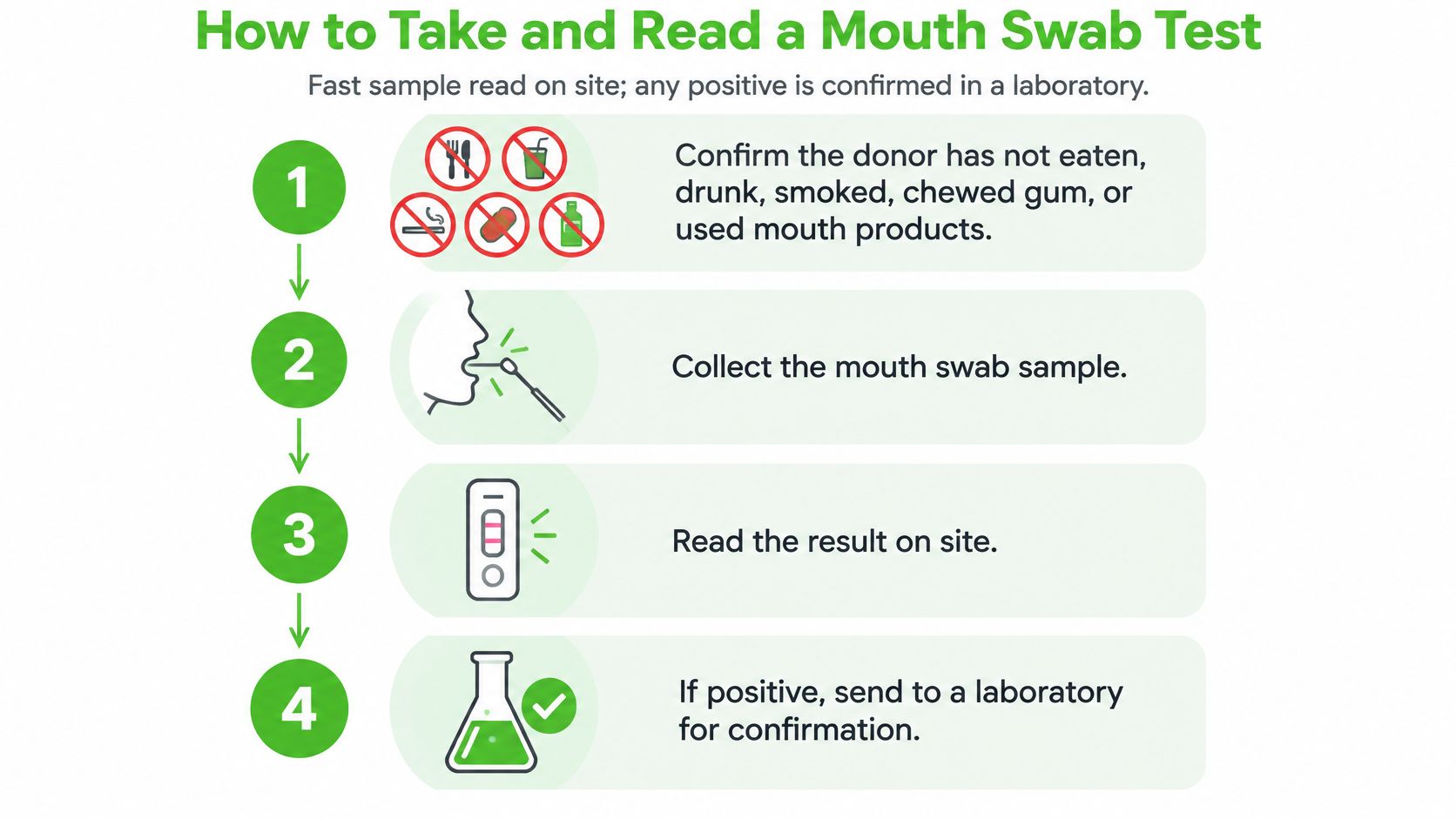
The collection sequence
- Clear the mouth first. Confirm the donor has not eaten, drunk, smoked, chewed gum, or put anything in the mouth for the period the device specifies, often about 10 minutes. Residue and rinsing change the fluid you are about to measure. The most common slip is a bottle of water "just to wet the mouth" a minute before the swab.
- Check the kit, then glove up. Look at the seal and the expiry date, and put on gloves before you touch the pad. An open pouch or a past-date cartridge is not a valid test, and a bare-hand collector is hard to defend later.
- Swab cheek and gum. Have the donor move the pad along the inner cheek and gum line for the time the device requires, usually one to two minutes, without touching the tip. Stopping early because "it looks wet" is the usual miss, and a thin sample can read invalid.
- Seat the pad in the buffer. Insert the swab into the buffer vial or cartridge and close it the way the insert shows. A loose cap leaks fluid and can void the control line. If an indicator window exists, wait until it shows enough volume.
- Read on the clock. Read the rapid screen at the stated time, typically within 5 to 15 minutes. Reading early, or leaving the strip on a table and checking it an hour later, both invent lines that were never there.
- Write the record while you remember it. Log the time, the collector, what you observed, and any irregularity, and keep the chain of custody intact. A missing time makes a later dispute into a guess.
- Hold every non-negative. Treat a missing test line as presumptive and send that specimen for laboratory confirmation. Never remove someone from a role on the strip alone.
What a valid read looks like
A valid device shows its control indicator. If that mark is missing, the test is invalid. Recollect with a new device. When the control is present, read the drug lines only inside the stated time window. A line in the test region is generally negative for that drug. A missing line is non-negative, which means "send it," not "guilty."
Say the control line is faint but present, and one drug line is absent at minute 8 of a 10-minute read. You log it, seal the specimen, and wait for the lab. You do not tell the coach the person failed.
What Affects Accuracy and False Results
A negative mouth swab is not clearance. It means this sample, read against this cutoff, did not report a listed drug. Collection quality is what decides whether that sentence is even trustworthy.
The SAMHSA oral-fluid collection guidance notes that concentrations change with stimulated versus unstimulated collection, how the device recovers fluid, and whether pressure or centrifugation is used. Two devices, used on the same person minutes apart, can measure different amounts. Picture two cups under the same tap: one catches a splash, the other sits until it fills. You would not treat those volumes as the same drink.
Oral fluid also carries lower analyte concentrations than urine, and the detection window is shorter, so the assay cutoff and analytical sensitivity decide false negatives near the end of that window. Recent food, drink, medication, smoking, or drug contact in the mouth can leave local contamination. That residue can lift a reading without matching what is in the blood. The American Dental Association, as cited in that guidance, treats oral-fluid testing as an accessible sample but notes that concentrations may not reflect systemic levels, and that clinical use needs validation for the specific purpose.
| Factor | Effect on the result | Control step |
|---|---|---|
| Recent food, drink, smoking or medication | Local residue can raise readings without reflecting blood levels | Enforce the device waiting period and record it |
| Collection timing near the window's end | Concentrations can fall below the cutoff, causing a false negative | Record collection time against the known use timeline |
| Assay cutoff and sensitivity | Lower cutoffs extend the reportable window; weak sensitivity misses low levels | Confirm the cutoff and sensitivity the lab uses |
| Collection method and device | Stimulation, fluid recovery and pressure change the measured concentration | Follow the manufacturer's procedure exactly |
| Rapid strip read alone | Instant readings can be wrong in either direction | Send every non-negative for laboratory confirmation |
Why the lab step is not optional
A rapid strip can miss a low level, or it can flag residue that a mass-spectrometry confirmation will not support. Collectors should follow the manufacturer's abstinence and collection instructions, document timing and anything odd, preserve chain of custody, and send non-negative screens for confirmatory laboratory testing. Decisions belong to that confirmed result, not to an instant line.
Where Mouth Swab Testing Is Accepted Officially
Federal workplace rules turned oral fluid from a convenience product into a regulated method. In October 2019, SAMHSA finalized Mandatory Guidelines for Federal Workplace Drug Testing Programs using oral fluid, effective for federal employee testing on January 1, 2020, as described in NDASA's account of the market shift to oral fluid.
The U.S. Department of Health and Human Services projected that about 7% of the federal program's 150,000 annual specimens, roughly 10,500 samples, would start as oral-fluid tests, with gradual growth toward roughly 30% of all federal tests over four years. The same rulemaking said oral-fluid science had not met federal standards in 2004, but had advanced enough by 2022 to be accepted as an alternative method for identifying illicit drug use in the federal workplace. The U.S. Department of Transportation later proposed allowing laboratory-based oral-fluid testing for regulated transportation programs, subject to certification requirements.
What that means outside a federal agency
Acceptance rested on validated science, certified laboratories, chain-of-custody controls, and formal rules. Speed of collection was never the reason the method was approved. A church, league, or nonprofit is not automatically inside those federal programs. If your roles are regulated, the regulation picks the method. If they are not, state law and your own written policy do.
Before you copy a federal form into a volunteer handbook, read practical compliance guidance from HR Management 365 and then check your state statute with counsel. A swab that is lawful for a federal employee can still be the wrong tool, or an unlawful one, for a Sunday-school helper.
When a Mouth Swab Fits Volunteer and Youth Screening
A youth soccer league wants a check before the season starts and asks whether a mouth swab test will "cover everyone." The answer depends on the duty, not on how fast the kit is.
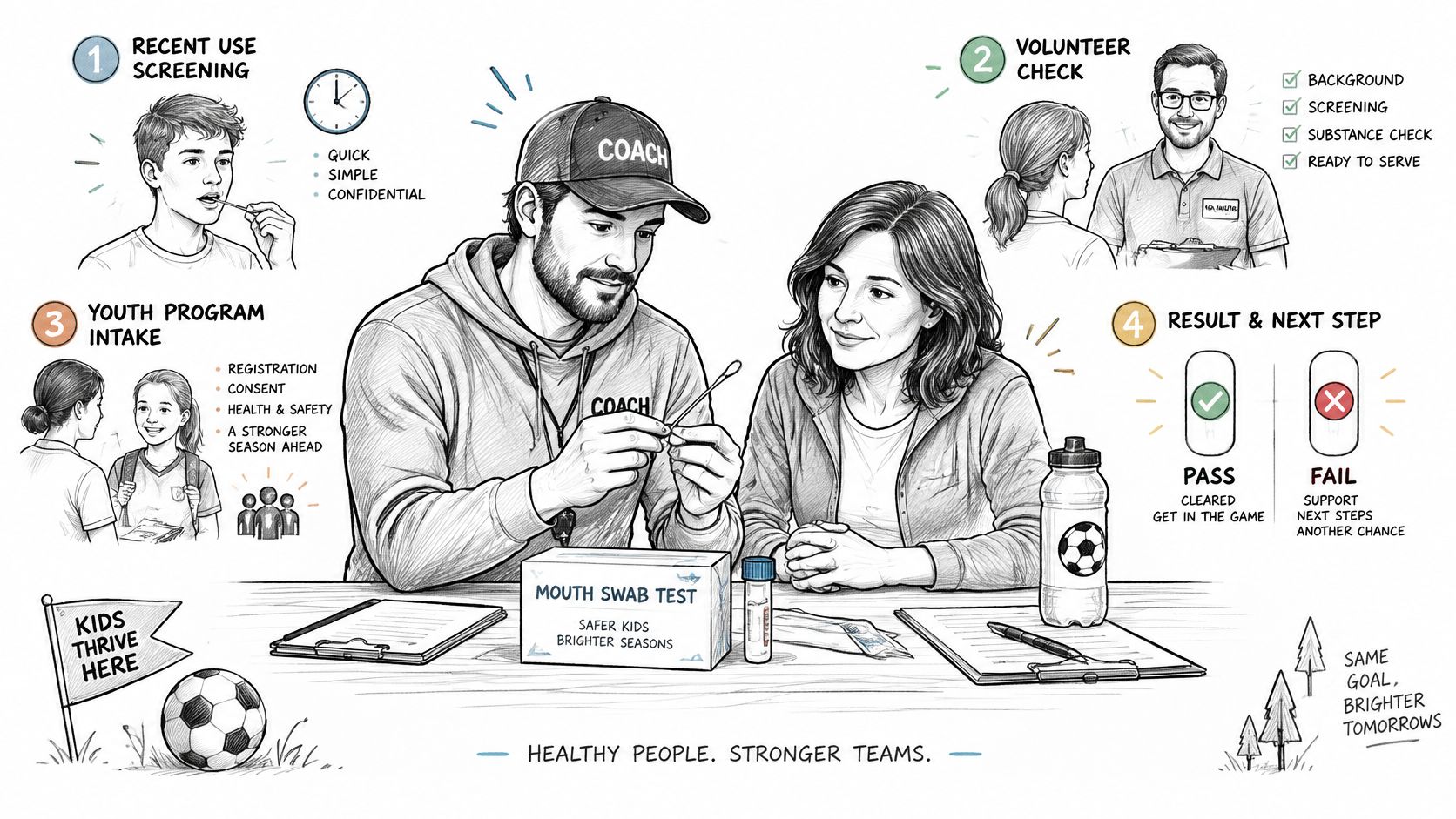
A league coach on the sideline. The question is recent use before safety-sensitive duties. A swab can serve as the screen, paired with a written policy, signed consent, and laboratory confirmation of every non-negative. It does not replace a criminal-history check for someone who will be alone with minors.
A church volunteer who stocks the food pantry. There is no safety-sensitive duty and no recent-use question. A swab usually does not fit. A role-based background check is the better tool, and adding a drug test because the kit is cheap creates a record you may not be allowed to use.
A volunteer who drives children to games. This can fit, but only under a written, regulated policy that names laboratory confirmation and follows state rules for drivers. An on-site strip with no lab and no policy is not that program.
An employee in a federally regulated safety job. The applicable federal or transportation program decides. You don't freelance a device because the coordinator prefers saliva to urine.
| Scenario | Swab suitability | Why and what to pair it with |
|---|---|---|
| Youth sports league, on-site screen before safety-sensitive duties | Fits as a screen | Answers a recent-use question; pair with written policy and laboratory confirmation |
| Church volunteer with no safety-sensitive role | Usually does not fit | No recent-use question applies; use a role-based background check instead |
| Volunteer driver transporting children | Fits only under a written, regulated policy | Safety-sensitive role; confirm laboratory-based testing and state rules |
| Employee in a federally regulated safety role | Fits where regulation permits | Follow the applicable federal or transport program rules |
The principle is simple. The swab answers whether someone used recently. It does not answer whether they have ever used.
If a non-negative appears, pause the placement, send the specimen for confirmation, and give the person a chance to respond before you close the role. A short walk-through of how programs talk about that pause is in the video below.
For the history side of screening, identity should be anchored before any result is filed. We match identity to an SSN trace, address history, and date of birth, with a government ID and a live selfie, so the drug result and the person record are not two strangers in the same folder.
Decide Whether a Mouth Swab Test Fits Your Program
Use a mouth swab test when the question is recent exposure, the policy is written, and a laboratory confirms every non-negative that can change someone's role. If any of those three is missing, the kit will outrun your process.
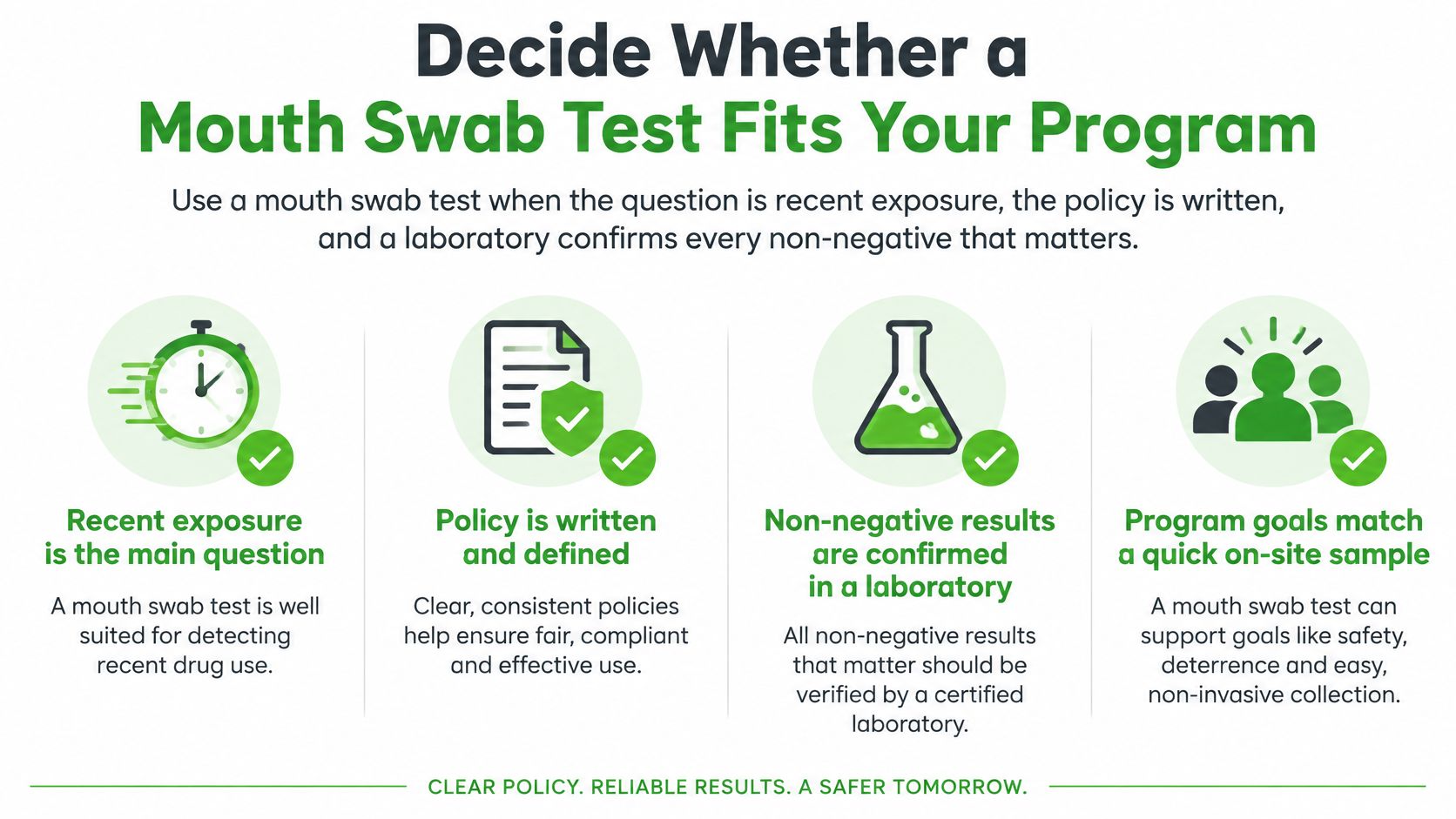
Walk these questions with your board before you buy boxes.
- Is the risk recent impairment or a long history? Recent exposure can justify oral fluid. A months-long pattern points to urine or hair.
- Does a written policy name the purpose, the screen, and the consequence? If the consequence is "we'll decide later," you are not ready. A volunteer screening policy should say who is tested, when, and what a confirmed result does.
- Have you confirmed consent, state law, and any regulatory rule? Consent on a clipboard is not the same as a lawful authorization.
- Are collectors trained on the device insert and chain of custody? An untrained collector produces disputes, not evidence.
- Is laboratory confirmation built into every non-negative that carries a consequence? If the answer is no, stop.
- Does your process treat a negative as "no finding of recent use," not as clearance? Write that sentence into the policy so a later reader doesn't upgrade it.
- Is there a path for a non-negative that includes confirmation, review, and a chance to respond? That path should name who calls the person and who may not.
If those answers hold, adopt the swab as a recent-use screen with confirmation behind it. If they don't, stay with urine or hair, or with the screening you already run well. Have legal counsel review the policy before the first collection. A live compliance roster with automated re-screening alerts can sit beside that policy so expirations don't depend on a spreadsheet.
VolunteerBadge helps nonprofits run FCRA-compliant volunteer screening beside the safety checks a mouth swab test can't replace, including criminal-history search, consent, and adverse-action notices when a placement has to change. If your league or ministry is building that process, start with a clear policy and a check that matches the role. Visit VolunteerBadge to set up screening for your next volunteer.
