
What Is Mission Creep in Nonprofits and How to Stop It
What is mission creep in nonprofits? Learn how program drift and scope expansion strain resources, hurt reputation, and how boards can prevent it.
On this page
Mission creep is the gradual expansion of a nonprofit's programs, services, or role beyond its original stated purpose. The problem isn't the first new idea, it's the moment the board keeps saying yes without a rule for when to stop.
Your staff feels it first. The donor confusion, the blurry fundraising copy, and the creeping burnout usually show up later, after the organization has already started acting like three different nonprofits stitched together.
A small community arts nonprofit starts with classes and exhibits, then absorbs an after-school tutoring program because a board member knows the principal, a mental health support group because the need is real, and a neighborhood food pantry because a donor wants to help "where it matters." Each move sounds reasonable in isolation. Five years later, nobody can say what the organization is supposed to be, and the executive director is managing programs that don't fit together.
That's mission creep in practice, not as a slogan, but as an operating failure. It's the gradual expansion of activities, populations served, or organizational role beyond what the founding documents, current resources, and stated strategy can responsibly sustain.
Practical rule: the first extra program rarely breaks a nonprofit. The fifth one does, because by then the board has normalized expansion without redesigning accountability.
Table of Contents
- The Moment a Mission Starts to Slip
- Where the Term Came From and Why It Still Matters
- Mission Creep, Program Drift, and Strategic Adaptation
- How Mission Creep Shows Up in Nonprofits
- What Scope Expansion Costs Nonprofits Over Time
- Prevention Strategies for Boards and Volunteer Coordinators
- A Board-Ready Checklist for the Next Meeting
The Moment a Mission Starts to Slip
A board chair says yes because the need is real. The executive director says yes because the grant deadline is tomorrow. A volunteer coordinator says yes because the request came from someone respected in the community. None of those decisions is outrageous on its own. Together, they create an organization that keeps adding responsibility without ever deciding what gets removed.
That's why mission creep is so hard to spot in the room where it starts. Nobody votes for collapse. They vote for a tutoring pilot, then a support group, then pantry distribution, and each addition looks like service, not drift. The damage comes from the pattern, not the single item on the agenda.
What mission creep means in operating terms
Mission creep is the gradual expansion of a program or agency beyond its original mandate. In a nonprofit, that means the organization starts serving new populations, delivering new services, or taking on new civic roles that the mission, budget, staff capacity, and governance structure were never built to hold.
The risk isn't abstract. As the original mandate gets stretched, the organization is more likely to duplicate functions, weaken accountability, and create higher coordination costs as more activities pile up without a formal redesign of the operating model, a concern spelled out in the National Taxpayers Union Foundation's analysis of mission creep (NTUF on costly duplication and ineffectiveness).
That's the line boards keep missing. It's not “Can we do this once?” It's “What happens when this becomes permanent?”
The decision rule most boards never write down
The dangerous moment is usually the fifth yes, not the first. By then, the mission is no longer guiding decisions. It's being used to justify decisions already made.
If you run a nonprofit, ask a simple question before you approve the next new program. What, exactly, are you willing to stop doing if this gets added? If the answer is “nothing,” you're not governing, you're accumulating.
Where the Term Came From and Why It Still Matters
The phrase grew out of early 1990s reporting on the U.S. intervention in Somalia. Reporters used it when objectives began outrunning the original mandate, resources, and exit plan. A widely cited account says a February 12, 1993 story described the mission as having “unofficially widened its role” from humanitarian relief to rebuilding houses, digging wells, and creating police forces, helping move the phrase into public discourse (Foreign Policy's historical account).
That history gives nonprofit boards a practical warning. A mandate stretched beyond its intent resembles a charter rewritten through repeated approvals. Resources stretched beyond capacity become staff exhaustion, volunteer overload, and unfunded obligations. An absent exit plan leaves the board unable to close a program because donors, partners, or community expectations have made it politically difficult.
Why the military frame fits nonprofit governance
The U.S. Army later formalized a related warning in field doctrine, describing units that faced “shifting guidance” or took on more than their current mandate allowed. The same historical review notes that development. For nonprofit governance, the questions are direct: Who authorized the expansion? What resources support it? What condition ends it?
A board that cannot answer those questions has approved an obligation without approving a governance system. Treat each new responsibility as an expansion-versus-accountability tradeoff. If scope grows, authority, staffing, funding, oversight, and an exit decision must grow with it.
Merriam-Webster describes the term as the gradual broadening of an organization's original objectives, a pattern also associated with function creep (Merriam-Webster word history).
That definition still matters because mission creep is not limited to military operations. It appears wherever an organization keeps accepting responsibility without redesigning its controls. Before approving a new service, population, or public role, require a written mission-fit test, a named decision owner, a capacity check, and a clear review point. A new activity that passes those tests may be strategic adaptation. One that bypasses them is mission creep, regardless of how worthy the cause sounds.
Mission Creep, Program Drift, and Strategic Adaptation
These terms get mashed together all the time, and that's how boards talk themselves into sloppy decisions. Mission creep is not the same thing as program drift, scope creep, or strategic adaptation. If you don't separate them, you'll either overreact to necessary change or underreact to real damage.
The cleanest way to think about it is by scale and authority. Mission creep is organizational. Program drift is inside one program. Scope creep is project-level. Strategic adaptation is deliberate and approved.
| Concept | Scale | Decision Authority | Reversibility | Risk Level |
|---|---|---|---|---|
| Mission Creep | Organization-wide expansion beyond the stated mission | Board and leadership, often by habit instead of design | Hard to reverse once embedded | High |
| Program Drift | One program quietly shifts its target, service model, or outcomes | Program staff, managers, or funder pressure | Moderate | Moderate |
| Scope Creep | A project picks up extra deliverables without new resources | Project lead or sponsor, sometimes informally | Easier if caught early | Moderate to high |
| Strategic Adaptation | Planned evolution in response to real change | Board-approved and documented | Deliberate, so reversible by design | Lower, if governed well |
If you want a practical parallel outside nonprofits, a practical guide to managing risk can help teams think in terms of triggers, controls, and escalation paths rather than vague concern. The language of risk management is useful because mission creep is rarely a single bad choice, it's a chain of unreviewed approvals (Safety Space on managing risk in project management).
Don't confuse adaptation with drift
A nonprofit can absolutely grow. A food pantry can expand services, a church can add care ministries, and a youth league can professionalize operations. That doesn't automatically equal mission creep.
The test is simple. Was the change board-approved, documented, and tied to a revised strategy, or did it happen because someone kept saying, “We're already helping, so let's keep going”? That second posture is not strategy. It's emotional inertia.
How Mission Creep Shows Up in Nonprofits
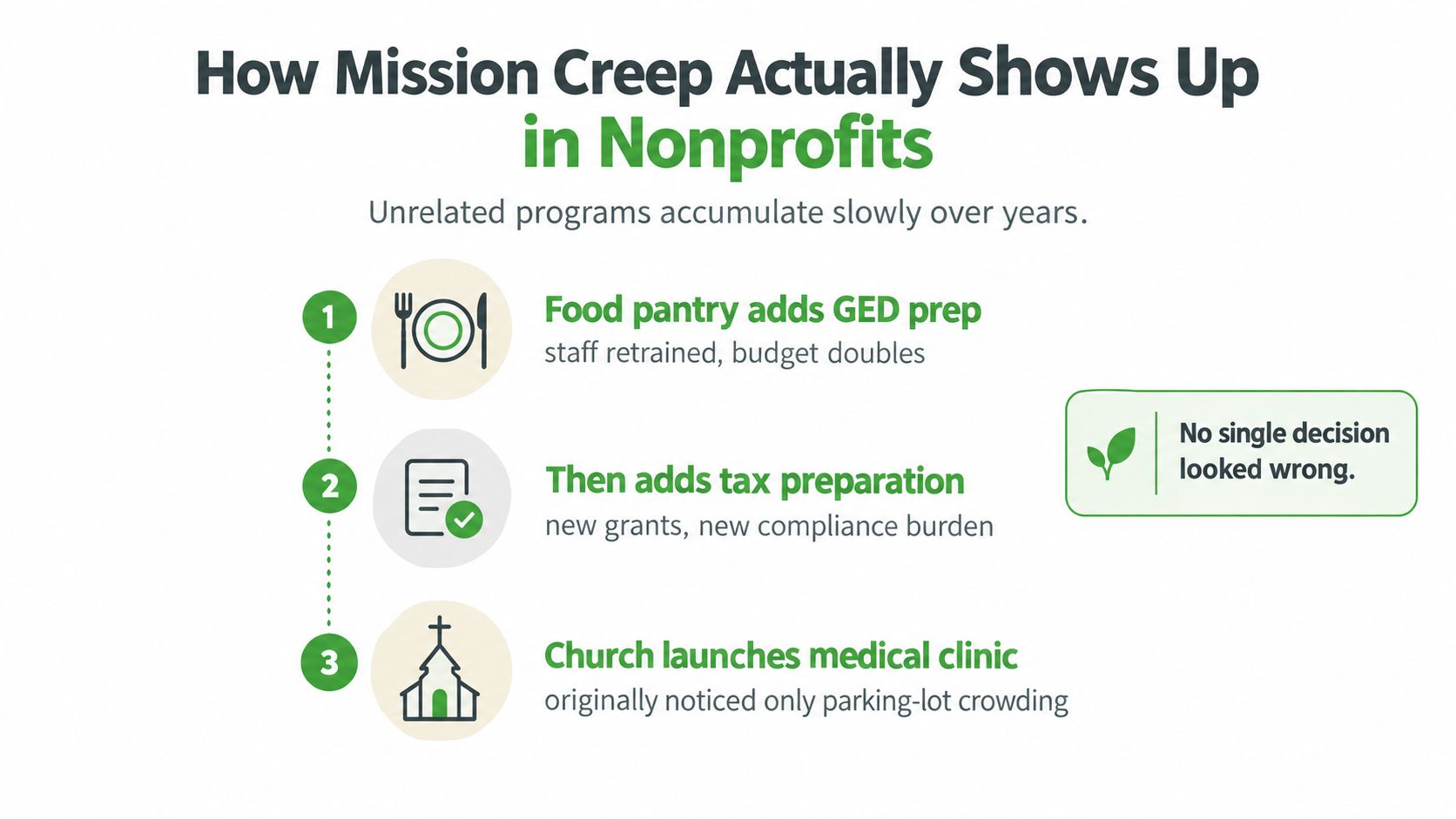
A food pantry starts by distributing groceries. A volunteer notices guests need help finding work, so the pantry adds GED preparation. A donor then offers funding for financial stability, and tax preparation follows. Each decision sounds reasonable. Together, they create new training, compliance, scheduling, and supervision demands without a corresponding budget or staffing plan.
Churches and community groups follow the same pattern. A church opens its parking lot to people waiting for services, sees an unmet medical need, and launches a clinic. A youth sports league takes over field maintenance because nobody else will do it, then manages rental logistics for outside groups because the process is already in place. Habit eventually hides the question every board should keep asking: does this activity still fit the mission, and who is accountable for its ongoing cost?
It rarely begins with one dramatic vote
Mission creep usually forms through a series of small approvals. A board member promotes an idea tied to a personal connection. A grant opportunity introduces another. A donor request adds a third. Because no single proposal seems large enough to reject, the organization keeps accepting work without setting a limit.
Meeting minutes can reveal the pattern early. Repeated phrases such as “pilot,” “helpful addition,” “community asked,” and “low lift” signal that the board is approving expansion without a defined review date, owner, or stop rule. Ambition is not the warning sign. Growth without accountability is.
Problems begin at the accumulation point
A program that made sense as a temporary response can become a permanent line item before anyone reviews its mission fit. Staff hired or trained for one purpose may then serve five, while volunteer coordinators inherit unrelated duties and spend their time managing complexity instead of service.
Use a clear board checkpoint: if no one can explain why the program belongs within the nonprofit's mission rather than with a partner organization, pause approval and require a documented case. A reasonable yes can still become an expensive habit when nobody sets a boundary.
What Scope Expansion Costs Nonprofits Over Time
Scope expansion first strains resources. Budgets get divided among unrelated activities, fundraising appeals become vague, and grant restrictions stop matching how funds are used. Donors notice when one appeal appears to support several programs without naming a clear priority.
The next cost is staff and volunteer burnout. A new program adds scheduling, training, documentation, reporting, and troubleshooting. Unless the board removes other work, those duties land on people who are already carrying the core workload. Volunteer coordinators then spend more time managing complexity and less time supporting service delivery.
Reputation erodes faster than boards expect
Major donors, foundation funders, and community partners need a coherent account of what the organization does. A shifting public identity weakens confidence because people cannot tell which outcomes deserve support.
Boards should apply a simple test: can the organization explain its purpose and success in one sentence? If not, leaders should treat the problem as drift until they can show how the expanded activity strengthens the mission and who remains accountable for its cost. A broader program portfolio requires a stronger explanation, not a looser one.
Compliance problems follow expansion
A youth-serving organization that adds activities without updating screening, liability, and supervision policies creates immediate exposure. New programs can produce background-screening gaps, coverage mismatches, and audit questions about whether operations still fit the organization's stated charitable purpose.
Volunteer-heavy organizations feel this quickly because responsibilities spread before controls do. Review the guidance on volunteers and the law when tightening procedures. Good intentions do not remove requirements for clear supervision, screening, and accountability.
| Cost Category of Mission Creep | What It Looks Like | Who Notices First |
|---|---|---|
| Resource Strain | Split budgets, scattered fundraising, grant mismatch | Finance staff, development staff |
| Burnout | More duties with no workload reset | Executive director, coordinators, volunteers |
| Reputation Damage | Confusing story, muddled donor asks, partner skepticism | Major donors, funders, community partners |
| Legal and Compliance Exposure | Screening gaps, liability mismatches, audit questions | Compliance leads, board treasurer, outside auditors |
The operating pattern is consistent. Expansion without accountability hides its costs before it displays them. Boards should require a mission-fit decision, named owner, funding source, and review point before calling added scope growth. Otherwise, the organization pays through strained capacity, weakened trust, and preventable compliance risk.
Prevention Strategies for Boards and Volunteer Coordinators
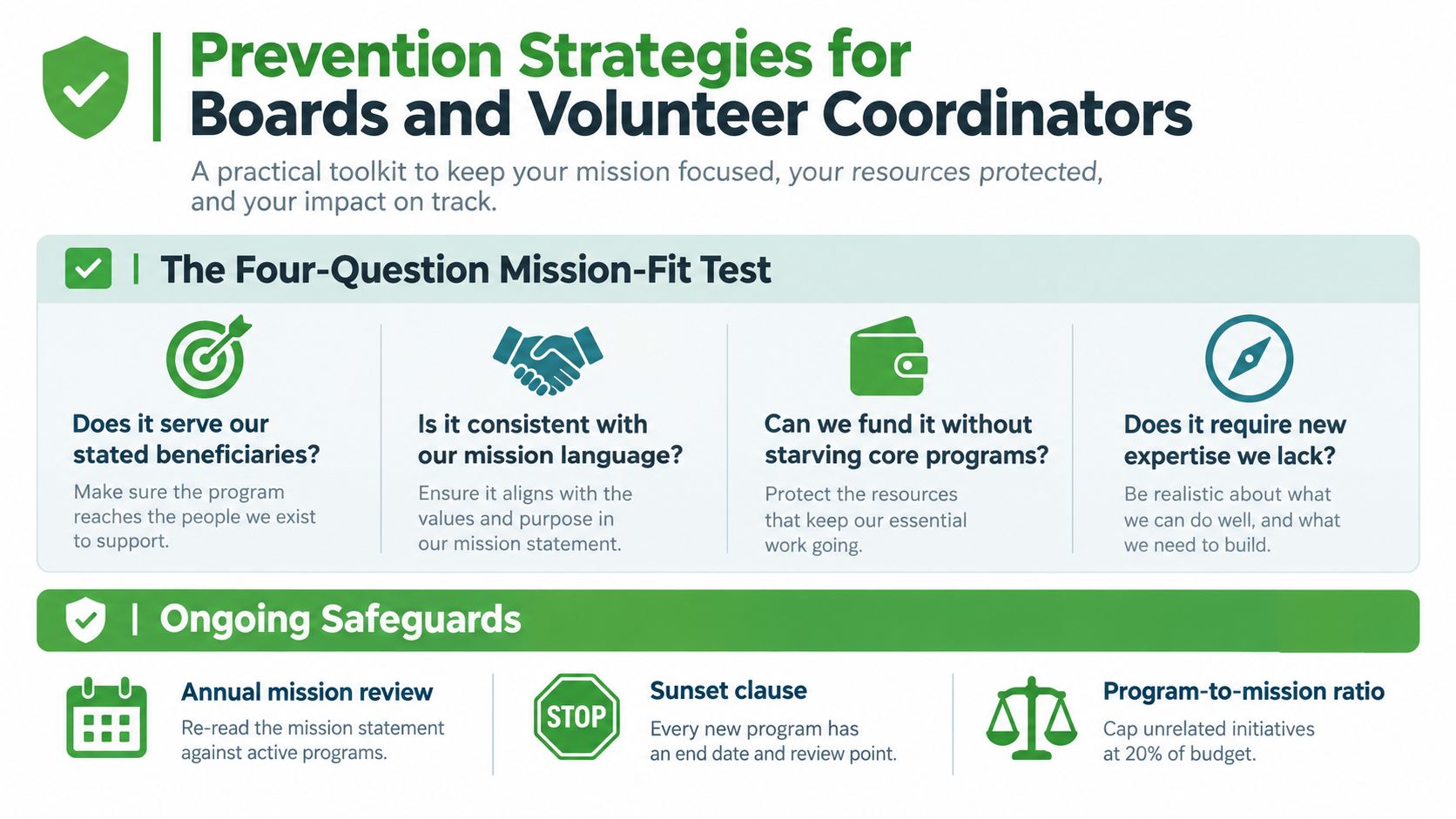
Start with a mission-fit test before any new initiative gets approved. If you can't answer all four questions cleanly, the answer is no or not yet.
- Does it serve our stated beneficiaries? If the new idea helps a different group, you're already drifting.
- Could a peer organization do this better? If yes, partnership beats duplication.
- Does our board have competence here? If not, you're guessing with someone else's community need.
- What do we stop doing to fund it? If nothing gets cut, the mission is absorbing cost without discipline.
A yearly program audit should follow the same logic. Re-read the mission statement, list every active program, compare activity hours to core purpose, check whether revenue sources match the work being done, and compare beneficiary demographics to founding documents. If the story in your board packet doesn't match the story in your marketing, the organization is already split in two.
Hard rule: if more than 20% of staff time goes to non-core programs, or if fundraising copy no longer matches the mission statement, pause new approvals until alignment is restored.
Put guardrails into governance, not vibes
A standing mission-alignment agenda item keeps drift visible. A designated creep skeptic on the board makes sure someone is allowed to say no without being treated like a problem. A written decision rule for off-mission requests protects staff from having to improvise every time a well-meaning outsider makes a pitch.
If your nonprofit relies heavily on volunteers, pair the mission review with onboarding discipline. The internal guidance on volunteer onboarding is a smart complement because new programs usually fail first at intake, training, and role clarity.
You should also make every new program carry a sunset clause and a review date. If the board won't agree to an end point, it's not a pilot. It's an annexation.
A Board-Ready Checklist for the Next Meeting
A board approves a new service, staff absorb the workload, and donors later ask why the organization is doing something outside its founding purpose. Stop that sequence with one decision rule: expand scope only when accountability expands with it.
Use these questions before approval:
- Mission fit: Does the proposal follow written mission language, or are we bending that language to justify it?
- Funding fit: Does the funding support the proposed work, or would restricted dollars subsidize unrelated activity?
- Capacity fit: Have we confirmed staff time, volunteer coverage, supervision, and training?
- Risk fit: Have we checked compliance, screening, and liability before approval? The nonprofit compliance guide covers the baseline.
- Exit fit: Does the proposal have a sunset date, success measure, and review point, or will it become another permanent obligation?
Require a clear answer to every question. A vague answer is a governance warning, not permission to proceed. If the board cannot identify the owner, resources, controls, and review date, defer the vote until those details are documented.
The board should record the decision, including which mission language supports the program and what evidence will trigger revision or closure. That record keeps future approvals consistent and gives staff a defensible boundary when new requests arrive.
If services are expanding faster than controls, VolunteerBadge provides volunteer screening, verification, and reporting in one place, including FCRA-compliant checks for $4.95 each, so the next expansion vote has a defined oversight process.
