Six Church Controls That Pass on Paper and Fail in Practice

Ask a church whether it follows the two-adult rule and the answer is yes. Ask how it checks, and the answer is that the rota shows two names. Those are not the same claim — a couple alone in the nursery is two names, and it is exactly what the rule was written to prevent. Six controls with the same shape, and what to check instead.
On this page
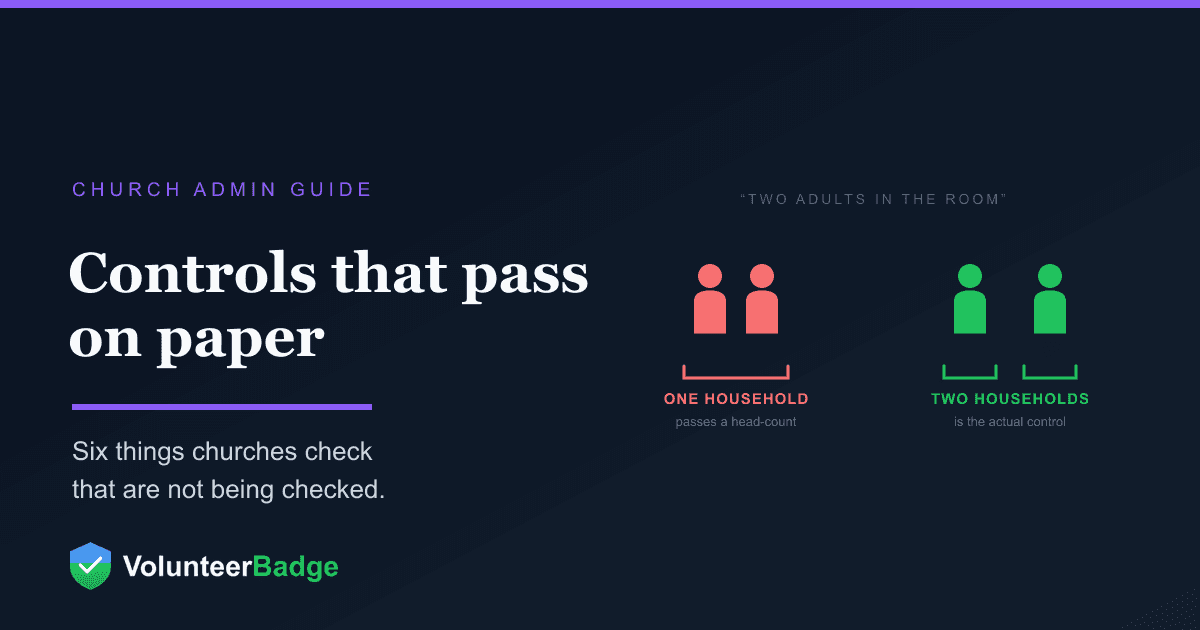
Ask almost any church whether it follows the two-adult rule and the answer is yes. Ask how it checks, and the answer is that the rota shows two names in every room. Those are not the same claim. A married couple alone in the nursery is two names, and it is precisely the situation the rule was written to prevent — because the control was never about how many bodies are present. It is about two people being present who would not cover for one another.
That gap — between a policy that reads as satisfied and a control that is actually working — turns out to be the shape of six different things churches do. Here they are, with what to check instead. Every workbook mentioned is free and linked at the bottom.
1. “Two adults” versus “two unrelated adults”
The two-adult rule is the most widely adopted child-safety control in churches, and many church insurance policies now expect it. The usual phrasing is two screened, unrelated adults present in every classroom, vehicle or enclosed space during any activity involving children.
Every rota template counts adults. Almost none check the second word.
What a rota template checks
That two names appear in the room. A couple, a parent and their adult child, two siblings — all pass. The policy reads as satisfied and the reason it exists has been removed.
What to check instead
Give every volunteer a household or family code, and count distinct households in the room rather than adults. One line of arithmetic, and the case a head-count cannot see becomes visible while the rota is still a draft.
This is not a hypothetical failure. Couples volunteer together because it is convenient — same car, same service, same childcare problem solved. A rota built from who is available naturally produces it, and nobody involved has done anything wrong. That is exactly why it needs to be caught mechanically rather than noticed.
2. The waiting period, and the Sunday morning it gets waived
Alongside screening, most church child-protection policies include a waiting period: someone must have been attending for a set time — six months is the most commonly adopted figure — before they may serve with children.
The reasoning is sound and worth stating plainly, because a policy people understand gets followed. Grooming behavior is visible over months to a community that knows someone. A background check tells you about the past that was recorded; a waiting period gives a congregation time to know somebody. They catch different things.
3. Two counters, and the pair who count every week
Church finance guidance is close to unanimous on how offerings should be counted: at least two people, unrelated to each other, who are not the treasurer or the financial secretary, with the person who counts separated from whoever records the receipt and reconciles the bank statement.
The part that is written down almost as often — and tracked almost never — is rotation. Counters should be drawn from a pool rather than being a fixed pair.
The reason is the same as the two-adult rule, and it deserves to be said without euphemism: two-person controls assume the two people would not cover for each other. A reliable pair who count together every single week for three years satisfy the written policy perfectly, and the assumption underneath it has quietly stopped being true. This is not an accusation about anybody. It is a fact about how controls work.
Illustrative, not data — the point is that the middle case passes an audit of the policy as written.
The last one is worth dwelling on because it is the most common finding in church fraud cases and it is almost never a scheme. One person stayed behind to finish up. The money was counted alone, and there was no independent record of what there was before it left the building. The control that would have prevented it protects the volunteer who did the counting at least as much as it protects the money — which is the argument to make when someone says this all feels like distrust.
4. The four giving-statement mistakes that recur every January
These are federal rules and they are specific, which makes them checkable. The thresholds below are general figures — confirm anything that matters for your church with a CPA who works with churches.
A donor needs a written acknowledgment for a single gift of $250 or more
Note the word single. This is per contribution, not per year, and it is the part most often misunderstood — a member who gave $50 a week has no single gift over the threshold, and a member who gave once at Christmas may well have. The acknowledgment must state the name of the organization, the amount of any cash contribution, and a statement about goods and services.
A quid pro quo gift over $75 needs a written disclosure from the church
Where someone pays more than $75 and receives something in return, the church must tell them that the deductible amount is limited to the excess over the value of what they received, and give a good-faith estimate of that value. Banquet tickets, concert tickets and fundraiser dinners all land here, and it is the church's obligation to issue the disclosure rather than the donor's to work it out.
A gift earmarked for a named individual is generally not deductible
If a donor directs money through the church to a specific person, it is generally treated as a gift to that person. Issuing a giving statement for it does the donor no favor at all. Where a church wants to help a particular family — and churches constantly do — the route is a benevolence fund the church itself decides on, which is section 5.
For a non-cash gift, describe the item and do not state its value
The acknowledgment describes what was given. Valuation is the donor's responsibility. A church that helpfully writes a number on the acknowledgment has taken on something that was never its job, and may have made the figure harder rather than easier for the donor to defend.
5. Benevolence: the log should record who decided, not what was paid
For contributions to a benevolence fund to be treated as gifts to the church rather than to an individual, the church must have full control of the funds and discretion over their use. A donor may suggest who they would like helped, but the suggestion has to be advisory and non-binding, and the donor has to understand the church can decline it.
That has a direct consequence for what the record should look like, and most benevolence spreadsheets get it backwards. They record payments: who received what, when. A payments log evidences money leaving.
What evidences control is the sequence:
6. “Restricted” and “designated” are not the same word
Most church accounts have one column called funds. Underneath it sit two categorically different things.
Restricted
Money given or raised for a stated purpose. The restriction comes from outside the church — from a donor, or from the appeal the money was raised under — and the church must use it that way. It cannot decide later to spend it on something else.
Designated
Money the church itself set aside from its general fund for a purpose. The church made that decision, so the church can unmake it. It is a plan, not an obligation.
The practical consequence is what happens when a fund goes into deficit. A designated fund overspent is a planning problem: the church changes its own plan. A restricted fund overspent means general money has been spent against a promise made to donors, and that is a different conversation with a different set of people.
It is almost always an accident. Somebody drew from the account that had money in it. But it is far easier to explain and correct at the finance meeting where it first appears than at the one where somebody else finds it — and it is invisible while both kinds of fund share a column.
What churches usually pay for all this
Church management platforms typically price by module and by church size. Individual modules — services and scheduling, giving, check-ins — commonly run $15 to $75 a month each, and a church of around 500 using several of them can reasonably expect $100 to $200 a month, or roughly $1,200 to $2,400 a year. Several vendors have real free tiers for smaller churches, which is worth knowing before anyone signs anything.
That is not an argument against the platforms. Check-in labels, member logins, online giving and text reminders are things a spreadsheet genuinely cannot do, and past a certain size the alternative is worse.
It is an argument that a church of ninety people should not be paying a monthly fee to find out whether two people from the same household are on the nursery rota. That is a formula.
The workbooks
Every check described above is built into a free, branded Excel workbook. No account, no email gate. Every threshold, interval and waiting period is a cell you fill in, because they are set by your denomination, your insurer and your own policy — and there are deliberately no array formulas anywhere, so nothing quietly returns a different answer in a different spreadsheet.
- Children’s Ministry Rota & Two-Adult Rule Checker — sections 1 and 2: households counted rather than heads, and the waiting period computed from first attendance.
- Offering Count & Counter Rotation Log — section 3, including the pair-key check that finds a fixed pair.
- Contribution Substantiation Checker — section 4, all four mistakes.
- Benevolence Request & Decision Log — section 5, arranged around who decided.
- Designated & Restricted Fund Tracker — section 6.
- Church Serving Rota & Burnout Watch — the seventh thing, which is that the same eight people are doing everything and nobody has counted.
All six sit on the church & ministry toolkit hub.
Where screening fits
Both rotas hold a screening date, and the honest thing to say is that a check is only true on the day it ran. A children's worker screened in 2024 and still serving in 2026 has a two-year-old check and a spreadsheet cell that says so in the same confident black text as one run last week. The rota computes expiry against your policy; it cannot re-run the check.
The workbooks work fine if you screen elsewhere and keep the dates by hand — they are registers, and you owe us nothing for them. If you would rather the dates maintained themselves, VolunteerBadge screens church volunteers for $5 per adult with automatic rescreening on a schedule you set. See background checks for churches.
Common questions
Is the two-adult rule required by law?
Generally no. It is a widely adopted child-safety practice and many church insurance policies now expect it, but it is not usually statute. What applies to your church is set by your denomination, your insurer, your state and your own adopted policy. Mandatory reporting of suspected abuse is an entirely separate matter, is set by state law, and applies to individuals regardless of what any church policy says.
Why do churches use a six-month waiting period before serving with children?
The common reasoning is that a background check reports what was recorded in the past, while a waiting period gives a congregation time to actually know someone — and concerning behavior tends to be visible over months to a community that knows a person. Six months is the most commonly adopted figure but it is a policy choice, not a legal threshold, and denominations and insurers differ.
What has to be on a church giving statement?
For a single contribution of $250 or more, a donor needs a written acknowledgment from the church stating the organization's name, the amount of any cash contribution, a description — but not a value — of any non-cash contribution, and a statement about goods and services: either that none were provided, or a description and good-faith estimate of what was, or, where applicable, that the only thing provided was an intangible religious benefit. Confirm the current requirements with a CPA experienced with churches.
Can a donor tell the church who to help with their gift?
They can suggest. For the contribution to be treated as a gift to the church rather than to that individual, the church must retain full control and discretion, the suggestion must be advisory and non-binding, and the donor must understand the church can decline it. A gift genuinely earmarked for a named individual is generally treated as a gift to that person and is not deductible.
How many people should count the offering?
Church finance guidance consistently says at least two, unrelated to each other, who are not the treasurer or financial secretary, drawn from a rotating pool rather than being a fixed pair, with counting separated from recording and reconciliation. These are practices and insurer expectations rather than law, and your own policy governs.
A note on sources
Contribution substantiation and disclosure thresholds come from IRS material on written acknowledgments and quid pro quo contributions, read in September 2026; they are general federal figures and are not a determination about any particular gift. Child-safety practices reflect published guidance from church insurers and denominational sample policies. Counting controls reflect published church finance and insurer guidance. Software pricing is an indicative range from published vendor pricing and software directories in September 2026 and changes frequently. VolunteerBadge and ScreenForge Labs, LLC are not affiliated with or endorsed by the Internal Revenue Service, any denomination, or any church insurer. This article is not legal, tax or compliance advice.
