
Unhappy at Work? Why Starting a Nonprofit Might Be the Purpose You’ve Been Missing
Only 20% of employees worldwide are engaged at work, and most people say their job is where they look for purpose. This guide looks at the research on job dissatisfaction, tells how Joel Bigelow left a 13-year job to start Endure Athletics, and includes a free passion survey that matches you to the kind of nonprofit you could build.
On this page
It usually shows up on Sunday night. The dread before another week of work that pays the bills but doesn’t seem to matter to anyone. If that’s you, you are far from alone. And the answer may not be a better job. It may be a calling you haven’t found yet, one that puts your time, your talents and your love to work for the people around you.
The short answer: most workers are not engaged in their jobs, and most say their work is where they look for a sense of purpose. When a job can’t carry that weight, serving others often can. For some people that means volunteering. For others it means starting a nonprofit, often a 501(c)(3), around a need they can’t stop thinking about. This guide covers the research, the stories of founders who made that move, a passion survey to point you in a direction, and the practical steps to get started.
How many people are unhappy at work?
More than you might think. Gallup’s State of the Global Workplace report, based on surveys throughout 2025, found that only 20% of employees worldwide are engaged at work. Another 64% are not engaged, and 16% are actively disengaged. Four in ten said they felt a lot of stress the previous day.1 In the United States, Gallup puts engagement at 31%, with 17% actively disengaged, close to the lowest level in a decade.2,3
Pew Research Center found that half of U.S. workers are extremely or very satisfied with their job overall, 38% are somewhat satisfied, and 12% are not satisfied. Only 30% are highly satisfied with their pay, and about a quarter with their chances for promotion.4 In the American Psychological Association’s 2025 Work in America survey, 54% of workers said job insecurity has had a significant impact on their stress at work.5
To be fair, the picture isn’t all bleak. The Conference Board’s 2025 survey recorded the highest overall job satisfaction since it began in 1987, at 69.3%. But the gap by age is striking: 57.4% of workers under 25 are satisfied, compared with 72.4% of those 55 and older.6 Being satisfied with a job and finding meaning in it are also not the same thing.
The purpose gap
That second point is where it gets interesting. In a McKinsey survey, 70% of employees said their sense of purpose is largely defined by their work. But while 85% of executives and upper managers said they were living their purpose at work, only 15% of frontline managers and employees said the same.7
Living their purpose at work (McKinsey)
People want that meaning badly. In BetterUp’s research with 2,285 American professionals, 9 out of 10 said they would trade some of their future earnings for work that is always meaningful.8 When most of us look to our jobs for purpose, and most jobs can’t supply it, the result is the restless, stuck feeling so many people describe.
The problem may not be your job. It may be your purpose.
From a Christian point of view, that restlessness makes sense. We were not made only to earn a living. Scripture says we were made for something:
“For we are his workmanship, created in Christ Jesus for good works, which God prepared before that we would walk in them.” Ephesians 2:10
That doesn’t mean everyday work is meaningless. Paul tells us to “work heartily, as for the Lord, and not for men” (Colossians 3:23), whatever the job is. Plenty of people find deep purpose as nurses, teachers, plumbers and accountants. But when the job feels empty no matter how hard you work, it’s worth asking a different question. Not “what job should I have?” but “who has God put in my path to love?”
Jesus was clear about what matters most:
“‘You shall love the Lord your God with all your heart, with all your soul, and with all your mind.’ This is the first and great commandment. A second likewise is this, ‘You shall love your neighbor as yourself.’” Matthew 22:37-39
Many people who feel unfulfilled at work have simply never found the place where their gifts meet someone else’s need. Peter describes exactly that: “As each has received a gift, employ it in serving one another” (1 Peter 4:10). When people find that place, work often stops being the only thing that has to carry their sense of meaning.
Joel Bigelow’s story: from a steel company to Endure Athletics
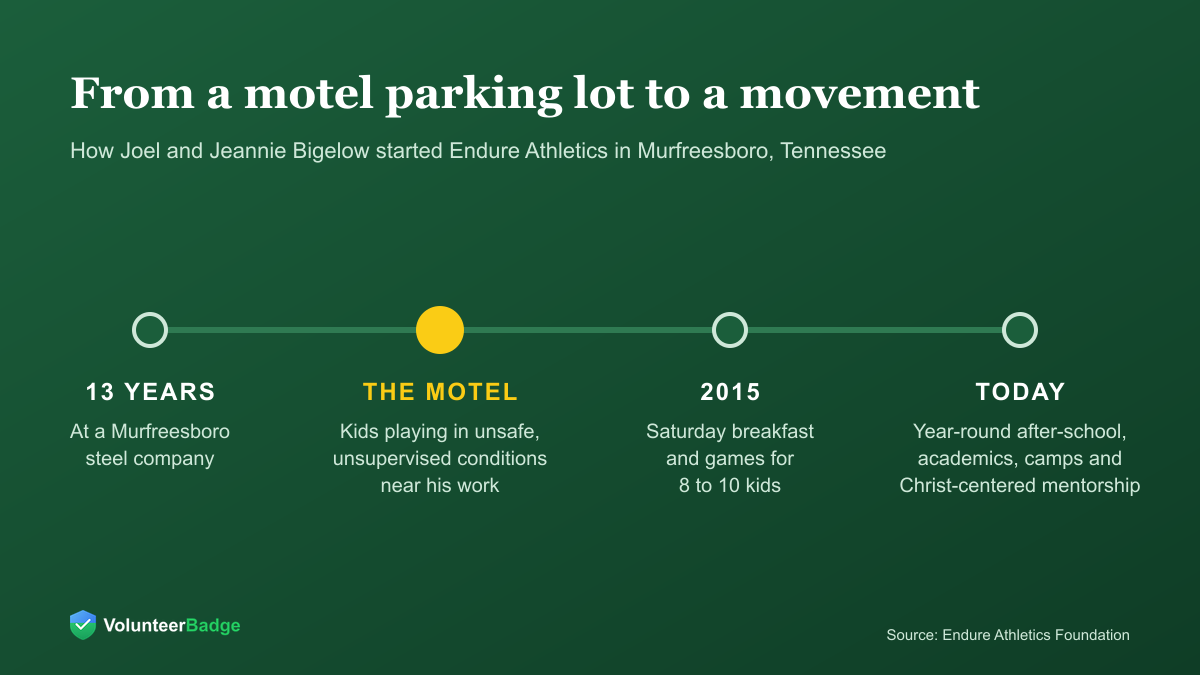
Joel Bigelow spent 13 years at a steel company in Murfreesboro, Tennessee.9 After the 2009 recession, he wanted work with more meaning, work that changed people’s lives.10
He found it close to his workplace. Day after day, Joel saw children who called a run-down motel home, playing in unsafe conditions with no one watching over them. Endure Athletics describes what went through his mind: “Someone needs to believe in these kids.”9
So Joel and his wife, Jeannie, did something about it. In 2015 they founded Endure Athletics, starting with a Saturday morning of breakfast and games for 8 to 10 kids.9 Joel later told the Murfreesboro Pulse that breakfast and sports were a natural way to start a relationship with the kids.11 The family sold their home to fund the work, trusting God to provide. As Joel put it, “We rely on God completely.”10
Today Endure Athletics is a 501(c)(3) that gives homeless children and youth a free, safe, structured place for fitness, athletics, literacy and Christ-centered mentorship. What began as one Saturday program has grown into year-round after-school activities, academic support, summer camps and mentoring that have served hundreds of children. After ten years, Joel stepped down in 2025, and Jeannie became Executive Director that September.9 You can learn more or support their work at endureathletics.org.
Notice what Joel didn’t do. He didn’t start with a business plan, a building or a big budget. He started with kids he could see from where he already was, and a Saturday morning he could give.
“Allow the little children to come to me! Don’t forbid them, for God’s Kingdom belongs to such as these.” Mark 10:14
Five more founders who followed the need
Joel’s story isn’t unusual. The organizations featured in VolunteerBadge’s Impact Stories are full of people who saw a gap close to home and decided to fill it. None of them started with everything figured out.
Brandi Pillow, braveONE (Conroe, Texas)
When Brandi Pillow’s daughter was diagnosed with Type 1 Diabetes, the family got doctors, a nutritionist and a binder. What they didn’t get was someone who had lived it. Brandi founded braveONE in 2025 to pair kids with T1D with trained adult mentors who have T1D themselves. In its first year it made more than 50 matches across 19 states, and more than 150 families are waiting for one. Read braveONE’s story.
Tetyana Klymko, Well Chicago
Tetyana’s own children needed an affordable after-school program, and there weren’t many in her community. When program cuts across Chicago hit even more families, she started one. Well Chicago reached nearly 200 kids in less than a year with free and affordable arts, STEM and civic learning. Read Well Chicago’s story.
Catherine Stephenson, IROSA Cares (Stamford, Connecticut)
After more than 35 years as an educator, Catherine founded IROSA Cares in December 2023 and named it after her parents, Ira and Rose. Her students packed 10,000 meals in a single 9/11 Day of Service, and the work now continues year-round through an Impact Club for grades 5 through 8. Read IROSA Cares’ story.
Alison Barry, WorldTutors (Southport, Connecticut)
Alison, a homeschooling mom of eight, had already delivered more than 1.2 million books through Wonderland BookSavers when a school partner in Uganda asked for tutors. In 2023 she started WorldTutors, which offers free one-on-one virtual tutoring to students who wouldn’t otherwise have it. Read WorldTutors’ story.
Nijeria Jones, The DESIRE+ Collective (Martinsville, Virginia)
Nijeria, a therapist and researcher, didn’t want her doctoral research to live only in a dissertation. In 2025 she launched the Collective to turn it into healing programs, mentoring and events where Black women, especially plus-size Black women in the South, can be seen and supported. Read the Collective’s story.
Each of these founders started with a need they could see and a gift they already had. That’s the pattern to look for in your own life.
Give more than your wallet: your time, your talent and your love
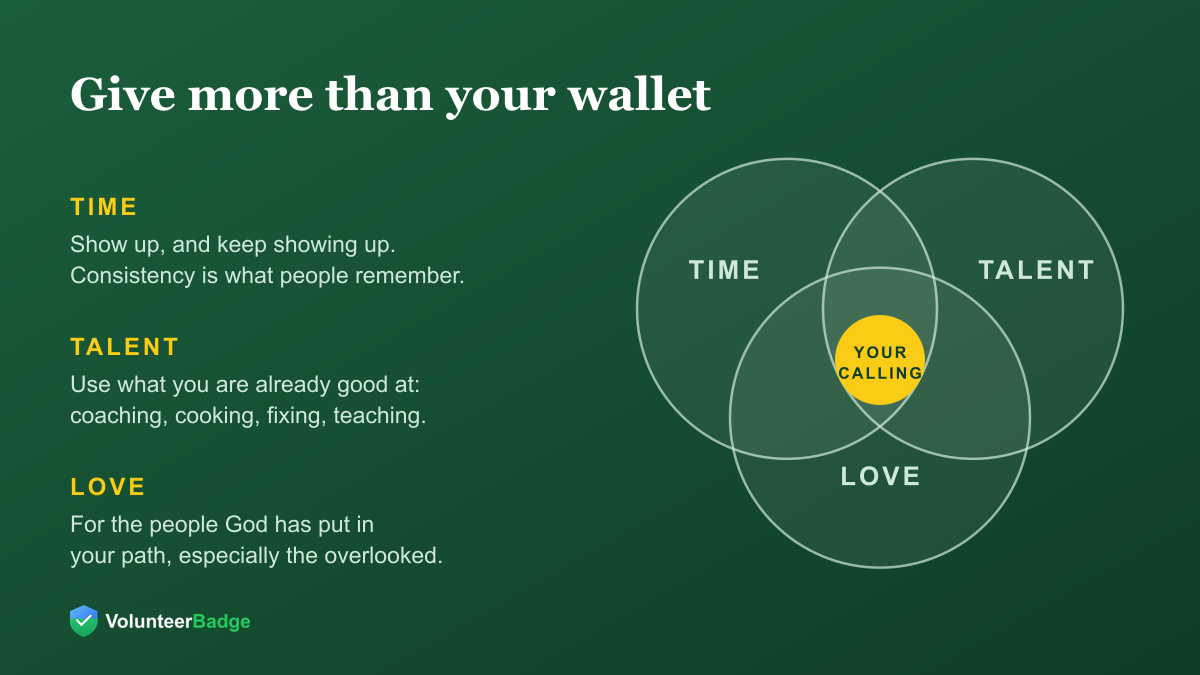
Writing a check matters, and nonprofits depend on donors. But the people who find the most fulfillment usually give something more personal. John puts it plainly:
“My little children, let’s not love in word only, or with the tongue only, but in deed and truth.” 1 John 3:18
- Your time. Showing up every week is what kids and families remember. Consistency builds the trust that no donation can buy.
- Your talents. The coach, the cook, the carpenter, the bookkeeper and the teacher all have something a local nonprofit needs. Romans 12 lists gifts of serving, teaching, encouraging, giving and showing mercy, and says to use each one.
- Your love. Love on people. Learn names, listen to stories, and treat the people you serve as neighbors, not projects.
Millions of Americans already do this. According to the U.S. Census Bureau and AmeriCorps, 75.7 million people formally volunteered through an organization in the year ending September 2023, giving an estimated 4.99 billion hours worth over $167 billion. Another 137.5 million informally helped their neighbors.12
Serving others may also be good for the one who serves. A 2013 review of studies in BMC Public Health found that volunteers had a lower risk of death than non-volunteers (about 22% lower across five cohort studies) along with better scores on depression, life satisfaction and well-being. The authors are careful to say this shows an association, not proof that volunteering causes it, since healthier people may be more likely to volunteer.13 Still, it echoes something Isaiah wrote long ago: “if you pour out your soul to the hungry, and satisfy the afflicted soul: then your light will rise in darkness” (Isaiah 58:10).
How to find the need in your own community
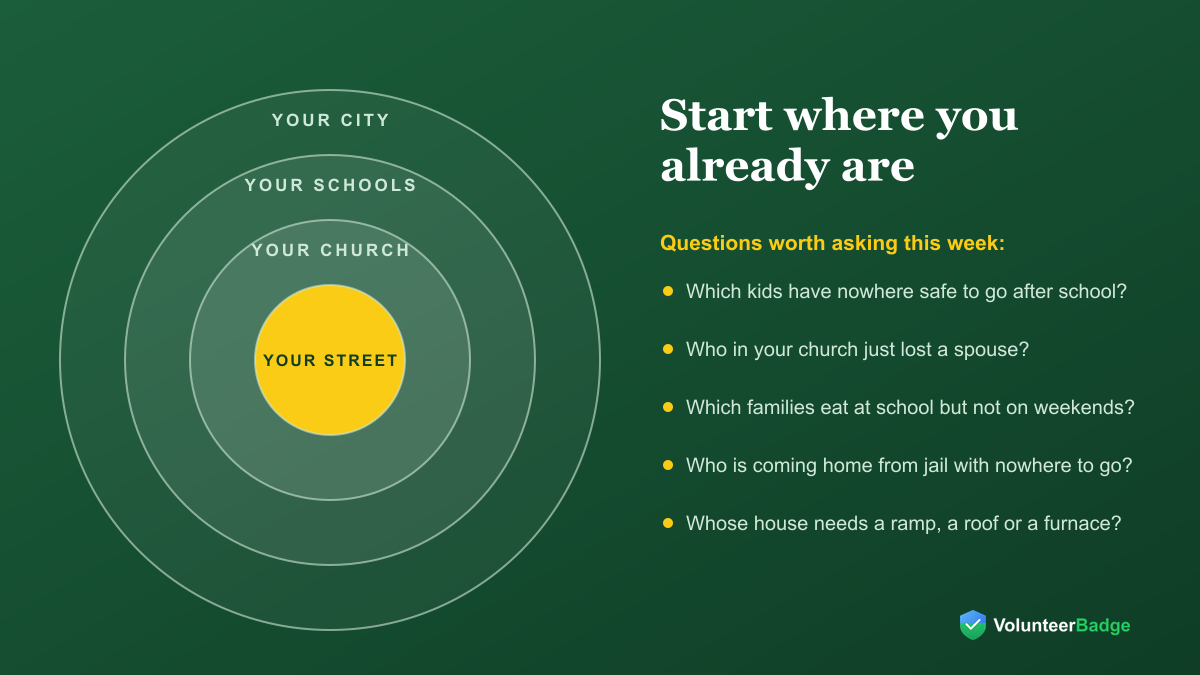
Joel didn’t have to travel to find his calling. He saw it near where he worked. When the exiles in Babylon asked how to live in a place they didn’t choose, God told them to “seek the peace of the city” where they were (Jeremiah 29:7). The same is true for most of us. Start with the circles you’re already in:
- Your street. Who lives alone? Whose yard, ramp or roof needs work they can’t afford?
- Your church. Ask your pastor who is hurting: a widow, a family with a new diagnosis, someone just out of prison.
- Your schools. Teachers and counselors know which kids go home to an empty house or an empty fridge.
- Your city. Call the local food pantry, shelter or senior center and ask one question: “What do you wish you had more of?”
Pay attention to what stays with you. Proverbs says, “Don’t withhold good from those to whom it is due, when it is in the power of your hand to do it” (Proverbs 3:27). The need you can’t stop thinking about, matched with something you’re already good at, is often your answer.
Take the passion survey: what kind of nonprofit should you start?
Answer seven quick questions about what breaks your heart, what you’re good at and how much time you have. Click Generate to see the kind of nonprofit you might build, a verse to carry with you, a founder already doing that work and your next step.
The interactive survey needs JavaScript. In short: think about whose situation stays with you, what people already come to you for and how much time you can give. Then start with the four steps below.
From job to calling: four steps
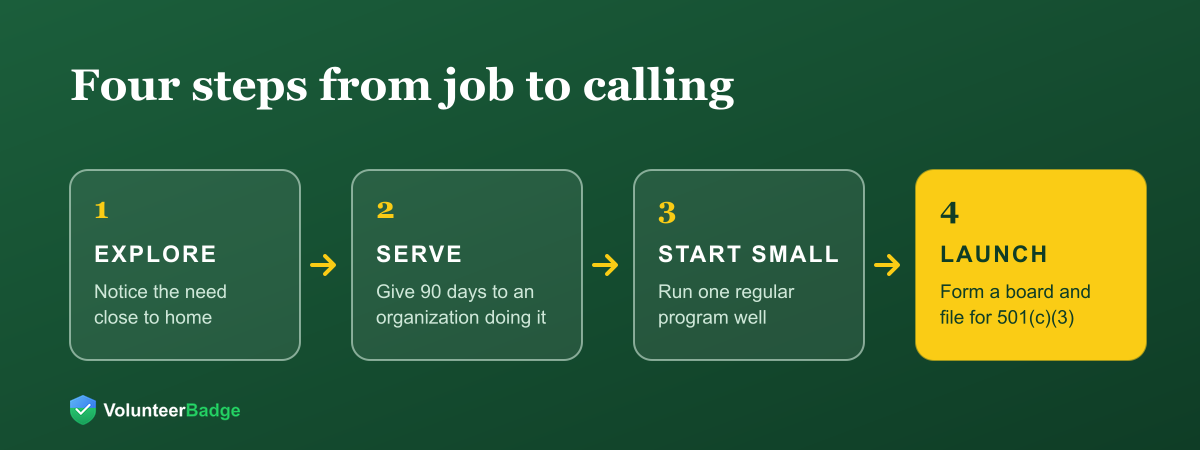
Please don’t quit your job tomorrow. The founders above built their organizations step by step, and most people should too.
- Explore. Spend a month noticing. Pray over what you find, and talk to the people already serving.
- Serve. There are already about 1.48 million 501(c)(3) organizations in the U.S.14 One of them may be doing the work you care about and need exactly your gifts. Give it 90 days of consistent service and you’ll learn the need from the inside.
- Start small. If the gap is still there, start one simple, regular program, the way Endure Athletics started with a Saturday breakfast. Track who you serve from day one.
- Launch. When you have the need, a few committed people and the time, form a board and make it official. Our nonprofit startup roadmap and 501(c)(3) founder checklist walk through incorporating, getting an EIN, adopting bylaws and applying for tax-exempt status.
One practical note: if your calling involves children, seniors or other vulnerable people, protect them from the start. Screen every volunteer and write down a simple safety policy before your first program. VolunteerBadge runs FCRA-compliant volunteer background checks for $5, with no monthly fees, so even a brand-new nonprofit can afford to screen everyone.
“Let us not be weary in doing good, for we will reap in due season, if we don’t give up.” Galatians 6:9
Already living your calling? Tell your story on The Sign-In Table
The Sign-In Table is the VolunteerBadge podcast about the people behind the sign-in table: the founders and leaders who built something from nothing. Every other Friday at noon Eastern, co-founder Matt Angerer talks with a nonprofit leader about why they started, what is changing because of their work, and how listeners can help. Listen at thesignintable.com or on the VolunteerBadge YouTube channel.
If you’re already pursuing your passion and serving others, we want to amplify your story. Tell us what you’re doing through the podcast guest form, and we’ll be in touch. You can also share your organization’s work through an Impact Story.
Frequently asked questions
Is it normal to be unhappy at work?
Yes, it’s common. Gallup found that only 20% of employees worldwide and 31% in the U.S. are engaged at work, and Pew found that half of U.S. workers are not highly satisfied with their jobs. Feeling stuck doesn’t mean something is wrong with you. It may mean your work isn’t connected to a purpose you care about.
How do I find my passion in life?
Look where three things overlap: a need that stays with you, a talent people already come to you for, and time you can give consistently. Start close to home, serve alongside people already meeting that need, and pay attention to what energizes you. The passion survey in this guide can help you name a direction.
Should I quit my job to start a nonprofit?
Usually not right away. Most founders start by volunteering or running a small program while they keep their job. Once you’ve confirmed the need, built a small team and have the time to lead, you can decide whether to form a nonprofit and whether it could ever become your full-time work.
How do I start a 501(c)(3) nonprofit?
In general, you recruit a founding board, incorporate as a nonprofit in your state, get an EIN from the IRS, adopt bylaws and apply for 501(c)(3) tax-exempt status. Requirements vary by state, so check your state’s rules. VolunteerBadge’s nonprofit startup roadmap and 501(c)(3) founder checklist walk through each step.
What does the Bible say about finding purpose by helping others?
Scripture teaches that we are created for good works (Ephesians 2:10), that loving our neighbor is the second great commandment (Matthew 22:37-39), and that each of us has gifts to use in serving one another (1 Peter 4:10). Jesus said that serving “the least of these” is serving him (Matthew 25:40).
How can I help my community without giving money?
Give your time and your talents. Mentor a child, tutor a student, cook for a shelter, fix a neighbor’s home, visit a senior who lives alone, or use your professional skills to help a local nonprofit. Consistent, personal service is often what people need most.
Sources
- State of the Global Workplace: 2026 Global Data Summary, Gallup (April 2026; data collected January to December 2025).
- Employee Engagement indicator, Gallup (accessed September 2026).
- U.S. Employee Engagement Sinks to 10-Year Low, Gallup (January 13, 2025).
- Americans’ job satisfaction in 2024, Pew Research Center (December 10, 2024).
- 2025 Work in America Survey, American Psychological Association (2025).
- Job Satisfaction 2025, The Conference Board (2025).
- Help your employees find purpose, or watch them leave, McKinsey & Company (April 5, 2021).
- Workers Value Meaning at Work, BetterUp (2018).
- Our Story, Endure Athletics Foundation (accessed September 2026).
- Breaking Chains, Murfreesboro City Lifestyle (accessed September 2026).
- Endure Athletics: Teaching Life Skills Through Sport, Murfreesboro Pulse (April 2017).
- Civic Engagement and Volunteerism, U.S. Census Bureau with AmeriCorps (November 19, 2024).
- Is volunteering a public health intervention? A systematic review and meta-analysis of the health and survival of volunteers, Jenkinson et al., BMC Public Health (2013).
- How many nonprofits are there in the US?, USAFacts, from IRS data for 2022 (November 16, 2023).
Scripture quotations are from the World English Bible, which is in the public domain. Founder details for braveONE, Well Chicago, IROSA Cares, WorldTutors and The DESIRE+ Collective come from their published VolunteerBadge Impact Stories.
