Every Youth Sports Control Ends on the Sideline

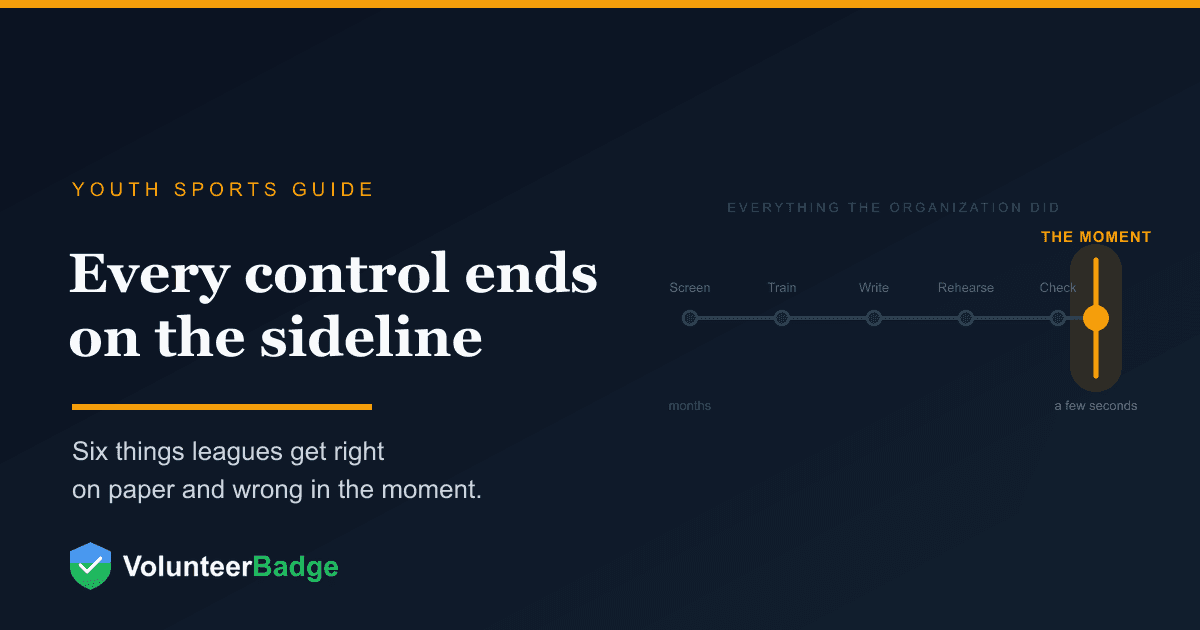
A player takes a hit, gets up slowly, says they are fine, and somebody has about eight seconds to decide. Everything the organization did in the preceding six months either helps that person decide or it does not — and that is the only test any of it ever faces. Six controls, what each is actually for, and the specific way each one fails.
On this page
A player takes a hit, gets up slowly, and says they are fine. Somebody has about eight seconds to decide whether they go back in. Everything the organization did in the preceding six months — the screening, the training, the policies somebody wrote in August — either helps that person decide, or it does not. That is the only test any of it ever faces.
Most youth sports controls are designed to be auditable. Rather fewer are designed to be usable at speed by a volunteer with a whistle and thirty people looking at them. This is a guide to the six that matter most, what each one is actually for, and the specific way each fails. Every workbook mentioned is free and linked at the bottom.
1. The only step that is entirely within a coach’s control
Every U.S. state has a youth-sports concussion law. They differ on plenty — who may clear an athlete, what written clearance must contain, how long must pass — but they converge on the first step: an athlete suspected of a concussion comes out, and does not go back in that day.
That step is unusual, and it is worth naming why. Almost every other control in this guide depends on somebody else doing something: a provider evaluating, an administrator processing, a board approving. Removal depends on one person on a sideline, in the moment, with no paperwork.
The phrase that has done more good in youth sports than any policy document is four words long: when in doubt, sit them out. It works because it is usable in eight seconds, which is the actual design constraint.
What a record-keeping system can contribute is narrow but real: it can make the removal visible afterwards. A season review that counts suspected concussions where the athlete was not removed immediately is the single most useful number a youth sports organization can produce about itself, because that number is entirely about the organization's own behavior.
2. The step that is nobody’s to shortcut
After removal comes the part where organizations most often drift, usually with good intentions. Return-to-play generally requires two things: written clearance from a licensed health care provider qualified to evaluate concussion, and a graduated, symptom-limited progression where the athlete has to stay symptom-free to advance and drops back a step if symptoms return.
How it drifts
Not through defiance. Through a parent saying the doctor said it was fine, a text message that was meant to be followed by a note, a tournament on Saturday, and a coach who has no way to check what stage anyone is at. Nobody decides to skip the protocol.
What closes the gap
A record where the athlete’s status cannot read as cleared until the written clearance exists, a provider is named, every progression step has a date, and any state minimum has passed. Then “can they play Saturday” has an answer that is not a memory.
3. The rules that break by circumstance, not by defiance
Abuse-prevention policies in youth sports concentrate on a predictable handful of situations, and they are predictable because they are the situations where an adult ends up alone with a child:
- One-on-one interactions — and the specific case every program eventually faces, which is the last athlete waiting for a ride.
- Electronic communication — private messages, group chats, social media contact.
- Local travel — whether an adult may transport an athlete one-on-one.
- Team travel — room assignments, supervision, who is awake and where.
- Locker rooms and changing areas — who may be present, and the rule on phones.
- Treatment and training contact — who may tape, stretch or touch an athlete, and whether anyone else is there.
Most organizations have a written rule for most of these. Far fewer can say who is trained on it. Fewer again can say who checks. That progression — written, then trained, then monitored — is the honest way to grade a policy, and a policy that stops at written is a document rather than a control.
Here is the part that gets missed. These rules do not get broken by people deciding to break them. They get broken by circumstance:
The exception log is the tell. A program that has one, and uses it, is a program where people believe they can report an awkward situation without being treated as a suspect. That belief is worth more than the policy it sits under.
4. Five credentials, five clocks, one person
A youth sports volunteer typically holds several unrelated credentials: a background check, an abuse-prevention training, a concussion training, a first aid or CPR card, and sometimes a coaching licence. Different issuers, different renewal cycles, no shared expiry.
Tracked as one row per person with one status — which is how almost every league tracks it — the four that are current hide the one that is not.
One person, five clocks. A single status column for this coach would show whatever the last person to look at it decided.
The fix is unglamorous: one row per credential, not per person, with expiry computed from each credential’s own completion date and cycle, and a separate statement of which credentials each role requires before any contact with athletes. That last distinction matters — some credentials are gates and some are things you would like people to have, and a list that does not separate them cannot tell you who is actually cleared.
5. The arithmetic that produces forfeited games
Age eligibility runs off a cutoff date, not a current age. The question is not how old a player is; it is how old they were on a specific date your league picked.
That distinction sounds trivial and is not, because the error it produces is silent. Nobody notices a mis-registered player at registration. They notice in week six, when somebody checks a roster after a close result — and by then the games have been played.
6. The booster-club question with an actual body count
This one has nothing to do with the sideline and everything to do with whether the organization still exists in five years.
Booster clubs commonly credit money a family raised against that family’s own fees, dues or travel costs — often called an individual fundraising account. It feels obviously fair. You raised it, you benefit.
The IRS position is that crediting amounts raised by a participant against that participant’s own costs is a private benefit, and private benefit is inconsistent with tax-exempt status. This is not a theoretical exposure: the Tax Court has upheld revoking exempt status for booster clubs that allowed parents to meet mandatory assessments through their own fundraising. It is one of very few nonprofit practices with a documented record of actually costing organizations their exemption.
What makes it hard is that the IRS stopped short of a blanket prohibition, and guidance from booster-club membership bodies generally expects any such activity to be insubstantial and participation to be voluntary. Which means the honest answer to “are we allowed to do this” is: it depends on how much, and on whether anyone was required to take part.
What most clubs know
That individual accounts are “a grey area”, usually from someone at another club. No number attached, no idea whether their own club is near a line or nowhere near it.
What to actually have
The share of total allocations credited to individual families, and whether each fundraiser was genuinely voluntary. Those two facts are what a CPA who works with booster clubs needs, and neither is hard to produce.
Note what that does not include: a verdict. Where your line sits is a professional judgment about your club, and any article — this one included — that tells you it is fine or not fine is guessing about an organization it has never seen.
What leagues usually pay for this
League management platforms price in a few shapes. Team-level tools run from free up to around $150 a year per team, with payment processing on top. Larger league platforms tend toward a setup fee plus a transaction percentage, or an annual licence starting in the high hundreds — one widely deployed option starts around $800 a year plus processing.
None of which is an argument against them. Online registration, payment collection, scheduling and parent communication are real problems a spreadsheet does not solve, and at any scale a league is genuinely better off buying that.
It is an argument that the six things in this article — which are the six things that actually carry risk — are formulas, and a league should not be waiting on a purchase order to have them.
The workbooks
Free, no account, no email gate. Every threshold, cutoff, requirement and interval is a cell you fill in, because they are set by your league, your governing body and your state. There are deliberately no array formulas anywhere, so nothing quietly returns a different answer in a different spreadsheet.
- Concussion & Return-to-Play Log — sections 1 and 2. Opens on a READ THIS FIRST sheet, and cannot clear anyone.
- Athlete Protection Self-Audit — section 3, including the exception log.
- Coach & Volunteer Certification Matrix — section 4, one row per credential.
- Player Registration & Age Eligibility — section 5, age computed at your cutoff.
- Booster Club Fundraising & Private-Benefit Check — section 6, the share and nothing more.
- Team Travel & Lodging Plan — counts adults in every vehicle and room.
All six sit on the youth sports toolkit hub.
Where screening fits
One of those five clocks is a background check, and the honest thing to say about it is that it is only true on the day it ran. A coach checked in 2024 and still on the sideline in 2026 has a two-year-old check and a spreadsheet cell that says so in exactly the same confident black text as one run last week.
There is also a budget problem specific to this sector. At $20 to $40 a head, a league that needs to screen dozens of coaches, assistants and team parents every season starts making choices about who gets checked — and the person who ends up unscreened is rarely the head coach. VolunteerBadge screens at $5 per adult with automatic rescreening on a schedule you set, which is a price at which a league can stop choosing. See background checks for youth sports.
Common questions
Who can clear an athlete to return after a concussion?
A licensed health care provider qualified to evaluate and manage concussion — never a coach, an administrator, a parent, an athlete or a spreadsheet. Exactly who qualifies, what the written clearance must contain, and what minimum period must pass are set by your state law and your league rules, and they differ. Confirm yours rather than relying on a general description.
What is a graduated return-to-play protocol?
A stepwise, symptom-limited progression an athlete works through after a concussion, staying symptom-free to advance and dropping back a step if symptoms return. The specific steps come from your provider and your state or league protocol. Any list of steps published in an article, including a placeholder in a template, is not your protocol.
Do youth sports coaches need background checks?
Requirements vary by state, by sport and by affiliation, and many leagues and governing bodies require them as a condition of participation regardless of state law. Screening is also only one of several gates — training, references and a written policy do work a check cannot. Confirm what applies to your organization from the body that sets it.
Can a booster club credit fundraising to individual families?
It is a private-benefit issue rather than a clear yes or no. The IRS position is that crediting amounts a participant raised against that participant’s own costs is a private benefit, and exempt status has been revoked over it. The IRS stopped short of prohibiting it outright, and guidance generally expects any such activity to be insubstantial and voluntary. Get the share your club is running at, then take it to a CPA experienced with booster clubs.
How do you calculate age eligibility for a youth sports league?
From the league’s cutoff date, not from today. Compute how old each player was on that date using their date of birth, then check it against your division’s age band. Take this season’s cutoff from this season’s rules — some leagues have changed theirs.
What should a youth sports organization actually measure about itself?
Two numbers are worth more than the rest combined. First, suspected concussions where the athlete was not removed from play immediately — that one is entirely about your own behavior. Second, how many exceptions to your protection rules were logged; a low number usually means they are happening and not being written down rather than that they are not happening.
A note on sources
Concussion practice reflects state youth-sports concussion laws and published return-to-play guidance read in September 2026; every U.S. state has such a law and they differ materially, so confirm your own. Athlete-protection practice reflects published abuse-prevention policy frameworks used in U.S. youth sport. Booster-club material reflects published IRS guidance on private benefit and reporting of Tax Court decisions upholding revocations. Software pricing is an indicative range from published vendor pricing and software directories in September 2026 and changes frequently. VolunteerBadge and ScreenForge Labs, LLC are not affiliated with or endorsed by the U.S. Center for SafeSport, the U.S. Olympic & Paralympic Committee, any national governing body, any league, or the Internal Revenue Service. This article is not medical, legal, tax or compliance advice.
