
OFAC Check Requirements for Nonprofits in 2026
Learn which OFAC check requirements apply to nonprofits, how to judge potential matches fairly, and which records and reports you must keep.
On this page
The popular advice to search a name against an OFAC list and reject anyone who gets a hit is incomplete, and the rejection rule is wrong. A name hit is an alert, not a confirmed match. A nonprofit needs someone to compare identifiers, decide what the alert means, and preserve the reasoning before the relevant activity proceeds.
Practical OFAC check requirements concern more than the search itself. Your organization needs defined screening moments, documented dispositions, and an escalation process that distinguishes an unresolved identity question from prohibited activity. A search result without those controls leaves your volunteer coordinator making a legal judgment from a similarity score.
Table of Contents
- Who Must Screen and When Under OFAC Rules
- The Five Parts of a Risk-Based Screening Program
- How to Screen a Name and Document the Result
- Resolving Common-Name, Alias and Transliteration Alerts
- Reporting Deadlines After a Confirmed Match
- A Worked Example of Clearing a Common-Name Alert
- Confirm Your Screening Program Before Your Next Volunteer
Who Must Screen and When Under OFAC Rules
OFAC sanctions prohibitions apply to every U.S. person, including nonprofit organizations. There isn't a universal volunteer-screening checklist that substitutes for understanding the sanctions restrictions relevant to your activities. Screening is a practical control for meeting that obligation, and its depth should reflect your organization's exposure.
Separate the legal duty from your chosen operating procedure. A rule requiring compliance with sanctions doesn't mean OFAC prescribes the same onboarding process for a neighborhood food pantry and a charity funding overseas partners. Your policy translates that duty into decisions staff can execute.
Assign screening to the relationship
Use the following as a recommended operating model, not a claim that OFAC mandates these exact job titles or donor thresholds. An internal gift threshold allocates review effort; it doesn't exempt smaller gifts from sanctions restrictions.
Screening moments and re-screening triggers by relationship
| Relationship | Screen when | Re-screen when | Hit decided by |
|---|---|---|---|
| Volunteers and staff | Before first shift or onboarding | Name, date of birth or address changes; list updates | Compliance lead with a second reviewer |
| Donors | Before accepting a gift above your policy threshold | Repeat large gifts; list updates | Finance or compliance lead |
| Vendors and contractors | Before the first payment | Bank or payment detail changes; list updates | Finance lead, with legal review for a credible match |
| Grantees and partner organizations | Before signing the agreement | Ownership or leadership changes; program location changes; relevant list updates | Program lead with legal review |
| Payment recipients and wires | Before release of funds | Every new payee; any changed bank details; relevant list updates | Finance lead, holding payment while the alert is reviewed |
| Programs in higher-risk locations | Before launch and at each new site | Any change in location, partner or activity; relevant list updates | Legal or compliance counsel |
Give every role a backup. A payment shouldn't proceed merely because the finance lead is away, and a volunteer coordinator shouldn't be forced to clear an unresolved alert to keep a shift staffed.
For organizational relationships, a name-only search may leave material questions unanswered. Changes in ownership, leadership, geography, or the intended activity deserve review even when the organization's name hasn't changed.
Write a defensible re-screening schedule
OFAC doesn't set a universally applicable screening interval. Choose a schedule your staff can administer, then explain why it fits your exposure to U.S.-origin services, foreign locations, and payment flows.
A local program with stable participants can use a different operating cadence from a charity regularly releasing international payments. Event-driven checks remain important in either case: a changed identity field or new payment destination shouldn't wait for a routine review.
Practical rule: Put screening before the point at which your organization commits resources, releases funds, or begins potentially restricted activity, not after someone discovers a problem.
The Five Parts of a Risk-Based Screening Program
A name search is like testing a smoke alarm. It tells you something useful at that moment, but it doesn't establish that the building has sound wiring, a maintenance schedule, or an inspection log.
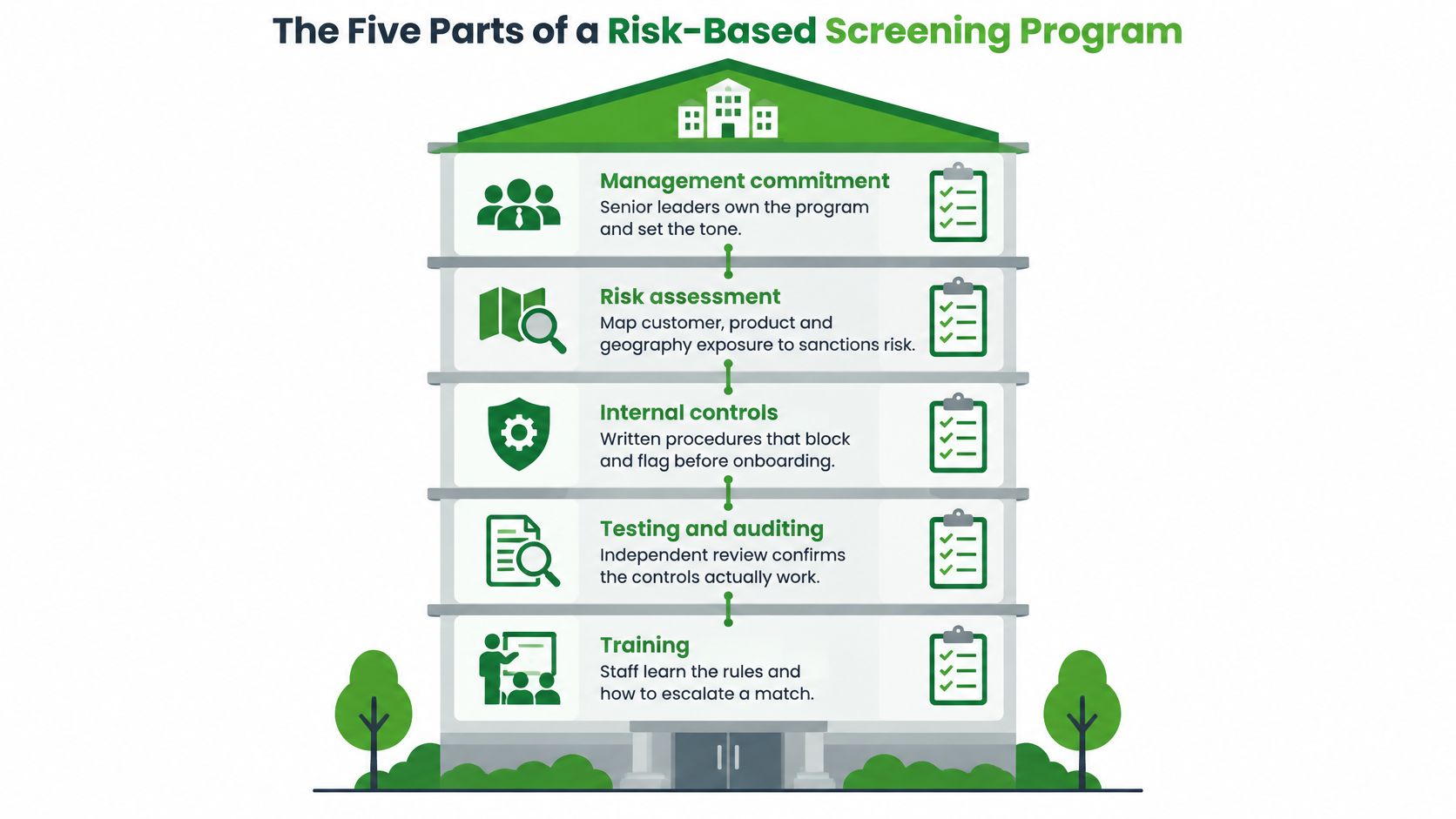
OFAC's compliance framework takes the broader view. Its introductory guidance identifies five foundational elements: management commitment, risk assessment, internal controls, testing and auditing, and training.
The components work together rather than as separate paperwork exercises.
Turn the framework into nonprofit responsibilities
Management commitment means leadership gives a named owner authority to pause activity and resolve problems. Approving a policy isn't enough if staff are then pressured to bypass it when a donor or program director wants an immediate answer.
Risk assessment asks where sanctions exposure enters your work. Map volunteers, donors, vendors, partners, locations, and payment routes rather than assuming nonprofit status makes the organization low risk.
Internal controls convert those findings into instructions. Your volunteer screening policy should identify the information collected, the relevant lists, the escalation route, and the evidence retained.
For a comparison from another transaction setting, CEFCore's discussion of screening borrowers against OFAC lists provides useful context for placing sanctions review before a financial commitment. Nonprofits should adapt the control point to their own activities rather than copy lending procedures wholesale.
Check whether staff can use the policy
Testing and auditing should examine actual completed files. Select cleared alerts and ask whether another reviewer could follow the recorded reasoning, then test whether the process catches missing information and overdue reviews.
Training should focus on decisions staff encounter:
- Volunteer coordinators need to recognize an alert and route it without promising clearance.
- Finance staff need authority to suspend a payment pending review.
- Reviewers need to distinguish supporting evidence from assumptions about a person's identity.
Keep the structure proportionate. A local volunteer program may need a concise procedure and designated reviewers, while an organization moving funds abroad needs more extensive controls and specialist support.
The useful self-check isn't whether your policy sounds thorough. It's whether staff can name the lists they screen, the identifiers they compare, and the person authorized to sign off.
How to Screen a Name and Document the Result
Start with a repeatable review process, not a search box. The OFAC Framework for Compliance Commitments supports controls for evaluating potential matches, documenting decisions, and responding to changing risks.
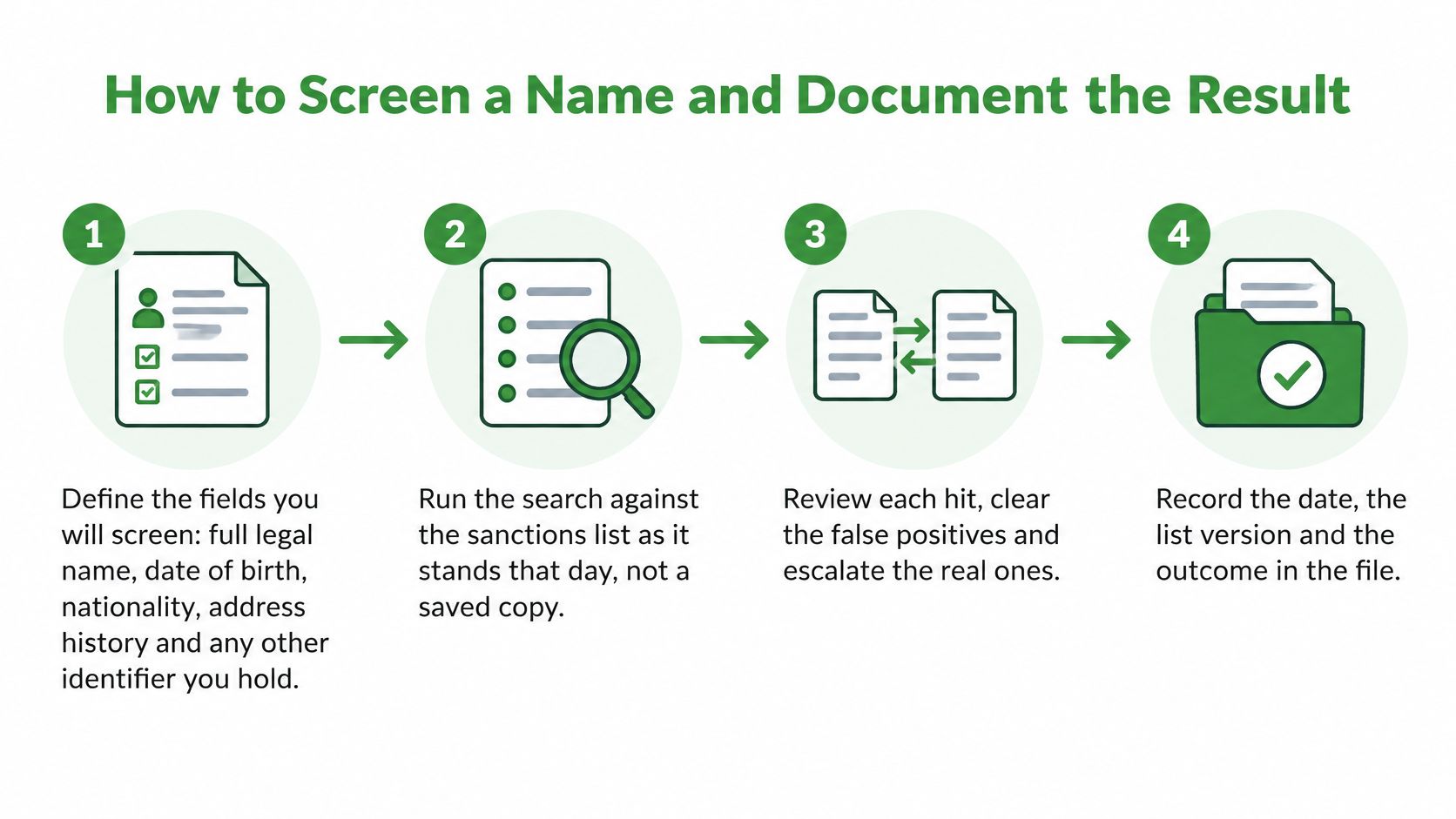
The practical sequence is collection, search, comparison, and disposition.
Build a reproducible screening record
Define the identity fields. Collect the full legal name and use date of birth, nationality, address history, and other available identifiers relevant to resolving identity. The common slip is collecting only a name, then discovering that reviewers have nothing useful to compare when an alert appears.
Specify the lists and preserve the search context. Name the Specially Designated Nationals and Blocked Persons List, commonly called the SDN List, and relevant non-SDN lists within OFAC's Consolidated Sanctions List in your procedure. Record the search time and list version or update timestamp; a generic statement that someone passed OFAC doesn't establish what was checked.
Open an alert for each potential hit. Keep the applicant's record separate from the listed party's record until you've compared them. Don't copy a screening tool's match label into your final decision as though the software had established identity.
Compare identifiers individually. Examine available birth dates or birth years, listed aliases, countries, addresses, and identification numbers, recognizing that entries don't all contain the same fields. Missing information is an unresolved question, not evidence that the people differ.
Record a usable disposition. Use cleared, held, or escalated, with the reviewer's name and a concise explanation tied to evidence. A held or escalated alert remains open; don't let an administrative status change accidentally authorize onboarding.
Escalate credible matches before relevant activity proceeds. Give compliance or counsel the underlying list entry, applicant information, and comparison notes. Sending only a screenshot of a name score forces the next reviewer to restart the investigation.
Connect future checks to events. Record identity changes, changed payment details, relevant list updates, and regulatory changes as review triggers under your policy. Don't rely on staff remembering to rerun a search after editing a volunteer's profile.
Close the file without losing the reasoning
A complete cleared screen contains the screened fields, search timestamp, list information, reviewer, disposition, and supporting reason, with no unresolved alerts. A completed search and a completed review aren't interchangeable.
Keep your compliance documentation organized around that distinction. Restrict access to sensitive identity documents, but make the decision record available to authorized reviewers who need to reconstruct it.
Use the accompanying video as a training supplement, not as a replacement for your written procedure.
Resolving Common-Name, Alias and Transliteration Alerts
More screening isn't automatically better compliance. If your matching settings produce alerts reviewers can't investigate properly, adding searches can increase the backlog without improving decisions.
Rejecting a volunteer solely because of a similar name creates fairness and operational problems. Ignoring supporting identity evidence creates sanctions risk. OFAC's frequently asked questions direct organizations to use their documented procedures when investigating potential matches, rather than treating every name resemblance as a confirmed identity.
Match the response to the evidence
Use this decision table as an adjudication aid. It doesn't replace legal analysis of the applicable sanctions program.
| Alert pattern | What to compare | Typical disposition and record |
|---|---|---|
| Common name with a different birth year | Reliability of the applicant's birth information; all listed birth dates; other identifiers | Clear when reliable identifiers establish a different person. Record the conflicting information and its basis. |
| Different transliterations of a name | Available original-language information, alternate spellings, aliases, birth details, and ID information | Hold if spelling is the only distinction. Clear only when additional evidence supports a different identity. |
| Listed alias or former name | Applicant's former names, listed aliases, birth details, and identifying documents | Escalate when the alias aligns with supporting identifiers. An alias isn't inherently a weaker match. |
| Incomplete birth date | Known birth components, any listed date ranges, country information, and ID number | Hold and request appropriate identification through an approved channel. An absent month or day doesn't resolve the alert. |
| Mismatched country in address history | Whether the country refers to nationality, birthplace, residence, or another identifier | Continue review unless independent identifiers justify clearance. A country difference alone is weak evidence. |
| Credible overlap across identifiers | Birth details, aliases, ID numbers, location history, and the applicable entry | Stop the relevant activity, restrict access as appropriate, and escalate to counsel. Record the evidence and action time. |
A reviewer needs to distinguish contradictory information from information that merely isn't present. An applicant's address history may not include every place they've lived, and nationality isn't the same field as residence.
A high name score isn't proof of identity. A low score isn't permission to ignore matching identifiers.
Keep clearance and legal action separate
Clearing a false positive answers an identity question. Determining whether to block property, reject a transaction, stop another activity, or proceed answers a different legal question.
Don't let a reviewer use a temporary hold as a final disposition. Assign an owner, specify what evidence is missing, and establish the next review action so the case doesn't remain indefinitely unresolved.
Communicate through approved procedures. You can request ordinary identity-verification information without making accusations or sharing sensitive screening details; don't improperly disclose sanctions information or investigative reasoning. Counsel should guide communications in a credible-match case.
Reporting Deadlines After a Confirmed Match
Reports concerning blocked property and rejected transactions must be submitted through the OFAC Reporting System within 10 business days of the action; an annual blocked-property report covers holdings as of June 30 and is due by September 30. These obligations require more than forwarding an alert to your bank and assuming the matter is finished.
A confirmed identity match doesn't, by itself, establish that every reporting obligation applies. Counsel must determine what happened to the property or transaction, which sanctions restrictions govern, and what your organization must report.
Put filing responsibility on the calendar
The operational distinctions are important:
OFAC reporting deadlines and enforcement windows
| Obligation | Deadline | Applies to |
|---|---|---|
| Report blocked property or rejected transaction | Within 10 business days of the action | Persons subject to applicable reporting rules for blocked property or rejected transactions |
| Annual report of blocked property | Holdings as of June 30, report due September 30 | Persons holding blocked property, including financial institutions |
For a hypothetical calendar example, assume a payment is rejected on Tuesday, March 3, 2026. Applying the business-day reporting period, the filing would be due Tuesday, March 17, 2026, assuming no intervening federal holiday and subject to confirming the applicable counting rules.
Don't treat that filing date as the target for starting the investigation. Finance needs time to assemble transaction information, counsel needs time to confirm the reporting basis, and the designated filer needs access to the reporting system. Working backward from the deadline, each of those steps should have its own internal cutoff.
Separate reporting from enforcement exposure
The extended civil enforcement window for violations under the International Emergency Economic Powers Act or the Trading with the Enemy Act is a separate issue from the immediate reporting calendar. Because enforcement exposure reaches back years, historical decisions may matter long after the original event. That window affects document retention and past reviews, never how long staff can wait to report an action.
For leadership planning, review OFAC penalties for noncompliance alongside your escalation procedure. The immediate priority is a named filing owner and a backup, not a discussion of penalties while the reporting clock continues.
Log the exact action time, property or transaction details, legal determination, responsible filer, and submission confirmation. An internal decision to hold activity isn't automatically the same as legally blocking property, so have counsel confirm the classification before filing. A misclassified report can create as many problems as a late one.
A Worked Example of Clearing a Common-Name Alert
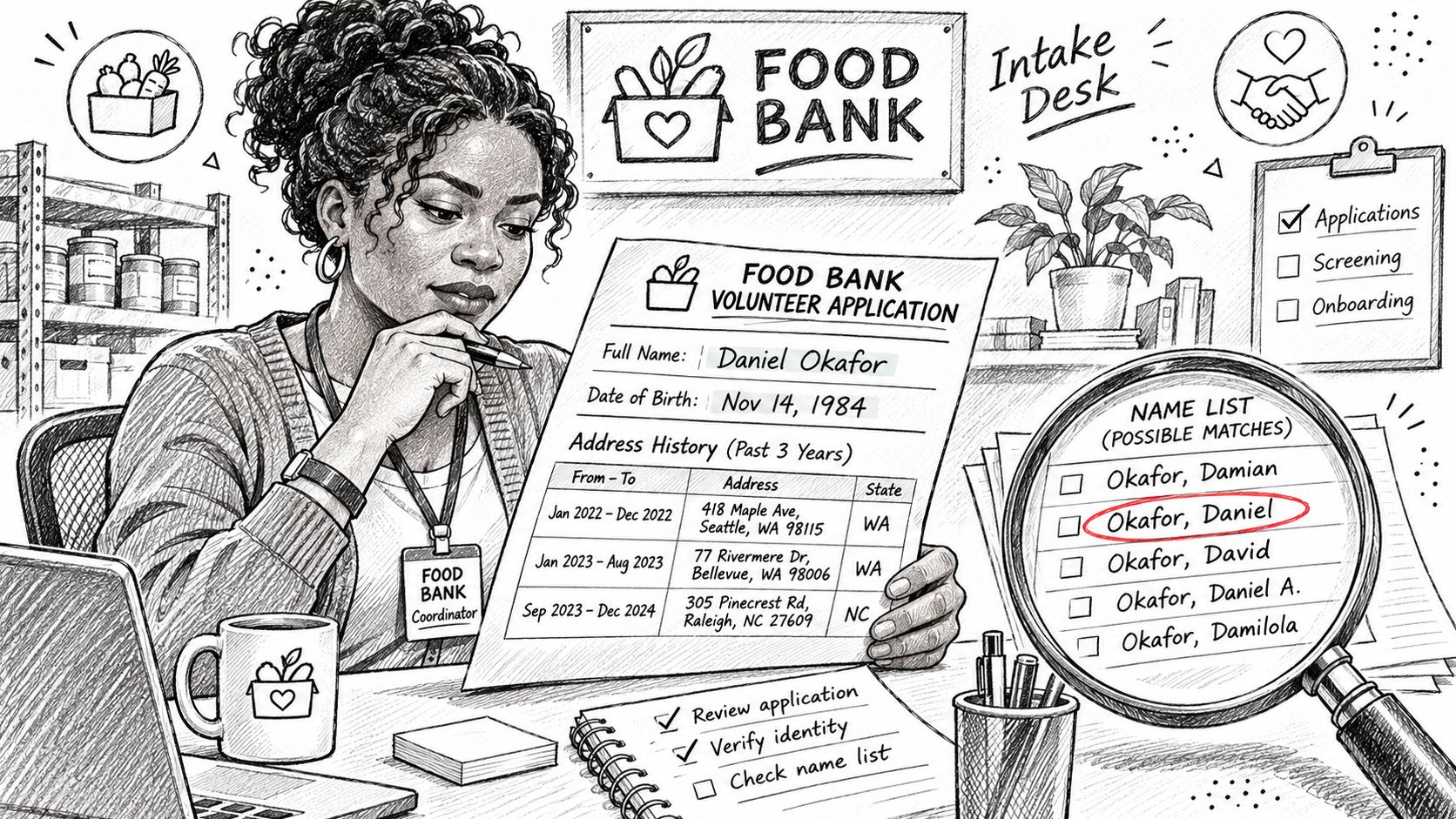
Consider a hypothetical food bank onboarding a volunteer named Daniel Okafor. His application contains a full name, verified birth information, and address history, and the search returns a similar name on a sanctions list.
The coordinator doesn't reject the application or activate the volunteer's access. She routes the alert to the designated reviewer while the identity question remains open.
The scenario illustrates the review task a food bank might face.
Follow the comparison in order
In this fictional example, Daniel's application gives a 1985 birth year, while the listed entry gives 1962, a 23-year difference. The reviewer checks the applicant's identity evidence and confirms that the listed record doesn't offer an alternative birth date that overlaps.
The application also contains three years of address history across two U.S. states. The country in the listed record doesn't appear in that history, but the reviewer treats that as supporting context rather than conclusive proof.
No other available identifier overlaps. With reliable birth information establishing the distinction and no conflicting evidence left unresolved, the reviewer clears the alert and records why.
Illustrative review file
| Field | Recorded content |
|---|---|
| Screened identity | Full legal name, verified birth information, available address history |
| Search context | Actual search timestamp and list version or update timestamp |
| Search logic | Name search with the tool's recorded matching settings |
| Match rationale | Similar name; conflicting verified birth information; no other identifier overlap |
| Reviewer | Named authorized reviewer and required approval |
| Disposition | Cleared, with the evidence basis preserved |
The written reason should explain the decision, not merely say false positive. For example, it can state that verified birth information conflicts with the listed identity and that the remaining available identifiers don't establish an overlap.
Change the evidence and the outcome changes
In a different version of the hypothetical case, the birth date matches and the listed country appears in Daniel's history. The reviewer stops the relevant activity, restricts access as appropriate, and sends the evidence to counsel without claiming that a screening score alone proves a prohibited relationship.
Preserve the application fields, search context, comparison notes, and every disposition change. The Federal Register recordkeeping amendment addresses extending relevant retention requirements from five to ten years, making an old deletion schedule unsafe to assume is current.
Have legal or compliance personnel confirm the controlling retention rule for the transaction and sanctions program before enabling automatic deletion. The file must support reconstruction of the decision, not just display its final status.
Confirm Your Screening Program Before Your Next Volunteer
Make the process usable this week. A concise procedure that staff follow is more valuable than a detailed manual nobody can apply under time pressure.
Complete the operating checklist
Write the policy. Name the sanctions lists, identity fields, authorized clearance reviewer, and person responsible for escalating credible matches. Give the backup reviewer the same written authority.
Map the relationships. Assign screening moments to volunteers, donors, vendors, grantees, partners, and payees. Check who owns the handoff between program staff and finance.
Set the review schedule. Document the interval and its risk rationale, plus the identity, payment, location, and list changes that require earlier action.
Create the decision log. Include search context, compared identifiers, reviewer, disposition, reason, and unresolved follow-up. Keep a held case visibly different from a cleared case.
Test completed files. Sample recent cleared alerts and check whether another authorized reviewer can reproduce the reasoning. Fix missing fields before staff use the template again.
Train the decision-makers. Practice a common-name alert and a credible-match escalation. Include approved identity requests and restrictions on improper disclosure.
Assign a program owner to evaluate relevant list updates and completed alert cases for policy changes. That doesn't mean rewriting the policy after every event; it means someone is accountable for deciding whether the controls still fit.
Starting point: Ask the person who clears volunteers to show you a completed alert file and explain the evidence behind the decision.
Our checks include OFAC sanctions lists and global watchlists alongside FBI Most Wanted and sex offender registries in all 50 states, giving your team screening results to review within its documented process. Visit VolunteerBadge to create a free account, invite a volunteer, and run a fully FCRA-compliant check for $5, with no contract or monthly fee.
