
Arrest Without Conviction Background Check: What to Know
Learn how an arrest without conviction background check appears, what the FCRA and state laws allow, and how to screen volunteers fairly.
On this page
Most of what you'll read about an arrest without conviction background check repeats one reassuring line. If the case didn't end in a conviction, the reasoning goes, the arrest can't count against the applicant. It's the kind of advice that sounds careful and gets repeated because it's comforting, and it's wrong in three different ways at once.
Plenty of arrest entries do show up on reports. Many of them are legal for a screening company to report and perfectly legal for you to read. A smaller group is legal to report but not lawful to use, and another group is legal to use and still indefensible in practice. Treating all three as the same question is how organizations end up rejecting a Sunday school volunteer over a 2014 charge that was dropped before lunch.
The order matters more than any single rule. A record appearing is a data event. Being reportable is a legal question about the vendor, the calendar and the state. Being usable is a decision about the role, the conduct behind the entry and whether the volunteer had a chance to explain. This guide walks through those three questions in the order a screening decision happens, because the most expensive mistakes come from skipping ahead.
Table of Contents
- What Shows Up After an Arrest Without Conviction
- State Laws That Override the Federal Seven-Year Rule
- Why an Arrest Is Not Proof of Conduct
- How to Calculate the Reporting Window
- Criteria for Weighing a Flagged Arrest
- Common Mistakes and the Pre-Decision Checklist
What Shows Up After an Arrest Without Conviction
An arrest without a conviction can appear on a background check. When it does, it lands as an arrest entry, often with a note reading "no disposition" or nothing at all. That line records an action by police; it says nothing about what a court did with the case.
The confusion starts with the phrase "criminal record." Volunteers hear "guilty of something." Screeners see "a row came back." Neither reading is precise enough to act on, because the meaning lives in the disposition attached to the row. A dismissal, an acquittal, a diversion program someone completed and a conviction are four different facts, and only one of them is a finding of guilt.
The table below sorts the outcomes you'll meet. Read it with two separate questions in mind: whether federal law even lets the vendor hand you the entry (column three), and what the entry may legitimately contribute to your decision (column four). Blending those questions is where most screening mistakes begin. Under federal law, non-conviction entries carry a limited reporting window that works like an expiration date on the vendor's copy of the entry, while a conviction carries no federal time limit at all. States can shorten the window further, which is why the same row can be readable in one state and off-limits in another.
| Record status | Typically appears on report | Federal reporting window | Permitted use |
|---|---|---|---|
| Arrest, no charge filed | Often, if the database captured the entry | Time-limited; runs from the arrest entry | Only as an unresolved event; verify the disposition first |
| Charges dismissed | Yes, until the disposition is verified | Time-limited; runs from the arrest entry | Not as adverse information |
| Acquitted | Yes, until the disposition is verified | Time-limited; runs from the arrest entry | Not as adverse information |
| Diversion or deferred adjudication | Yes, depends on source data | Time-limited once the outcome is non-conviction | Only after checking state rules |
| Charge still pending | Yes | No settled outcome; reassess when resolved | Hold the decision until the case resolves |
| Conviction | Yes | No federal time limit | Permitted, with role-relevance review and applicant notice |
The third column is a calendar rule, and it operates independently of the fourth. An entry can sit inside its window, reach your report legally and still carry no weight in the decision, because the first three rows contain an event while only the last row contains a finding.
Two Rows That Cause Most of the Trouble
Diversion and deferred adjudication. A completed program can look like a conviction in a commercial database long after the court file was updated, closed or sealed. Verify the disposition before treating it as anything at all.
The pending charge. There's no outcome to weigh yet, so there's nothing to decide. Put the file in a hold state with a review date instead of guessing at where the case will land.
Court and law-enforcement data can also drop the ending entirely, omitting a dismissal, an acquittal or a decision not to file charges. An arrest-only line with no disposition tells you an event happened and nothing more; the next step is always to pull the outcome.
Reports that group entries this way are easier to review and far easier to defend later. If you're comparing vendors, browse background check capabilities to see how a report that separates dispositions by row looks next to a flat list of charges.
The rule to carry forward: an entry that can't be marked as adverse information on its own can't drive a decision on its own. An arrest line on a report is a prompt to look deeper, and the disposition is where that look starts.
State Laws That Override the Federal Seven-Year Rule
Say a volunteer in California has an arrest-only entry from 2023 and no charge was ever filed. The entry sits well inside the federal reporting window, so a vendor may hand it over without hesitation. California bars reporting arrests that did not result in conviction. That entry shouldn't reach your desk at all, and if it does, it isn't a lawful basis for a decision about the volunteer.
The EEOC's guidance on arrest and conviction records names the gap directly, warning that "appears on the report" does not necessarily mean "lawfully usable for this decision." The same guidance notes that conviction records may be reported indefinitely under federal law while non-conviction arrest records may not, and that other jurisdictions restrict employers from considering non-conviction records even when a database technically contains them.
Three Layers, One Entry
Most guides blur these. Keep them separate in your own policy.
Reporting. Whether the screening company may put the entry on the report at all. This is the vendor's legal obligation, and a good vendor suppresses restricted records before delivery.
Disclosure. Whether the entry is shared with the person who decides. Some records are reportable but shouldn't be surfaced to a volunteer coordinator without context.
Decision-making. Whether you may weigh it. This is your obligation, and it's governed by your state, your role and your documentation.
| State or group | Rule on non-conviction arrests | What it means for a volunteer screen |
|---|---|---|
| California | Bars reporting arrests that did not result in conviction | Do not use an arrest-only entry, even if the vendor shows it |
| New York | Generally bars reporting arrests unless they resulted in conviction or remain pending | Check disposition before any use of an arrest-only entry |
| Other states | Several restrict employers from considering non-conviction records, even when a database technically contains them | Confirm the rule in each state where the volunteer lives or serves |
Record Relief Changes the Answer Over Time
Sealed and expunged records shouldn't appear at all, and Clean Slate and automatic-sealing laws keep pushing older entries out of legal use. The data doesn't always follow. Commercial databases and even courthouse portals can lag behind a sealing order for months, so an entry can be legally stale while still visible.
Practical rule for national and remote programs: list every state where the volunteer has lived and every state where they'll serve, then apply the strictest rule that touches them. One volunteer can be covered by two sets of rules at once.
Before you order any check, build a short state lookup that answers one question for each volunteer location: can a non-conviction arrest be reported here, and can it be used? Two columns, three or four states for most organizations, updated once a year.
Why an Arrest Is Not Proof of Conduct
A smoke alarm going off tells you something reacted to a concern. It says nothing about whether there was a fire or who might have started one. An arrest works the same way: it records that law enforcement had a reason to act, and the legal process decides what that reason amounted to.
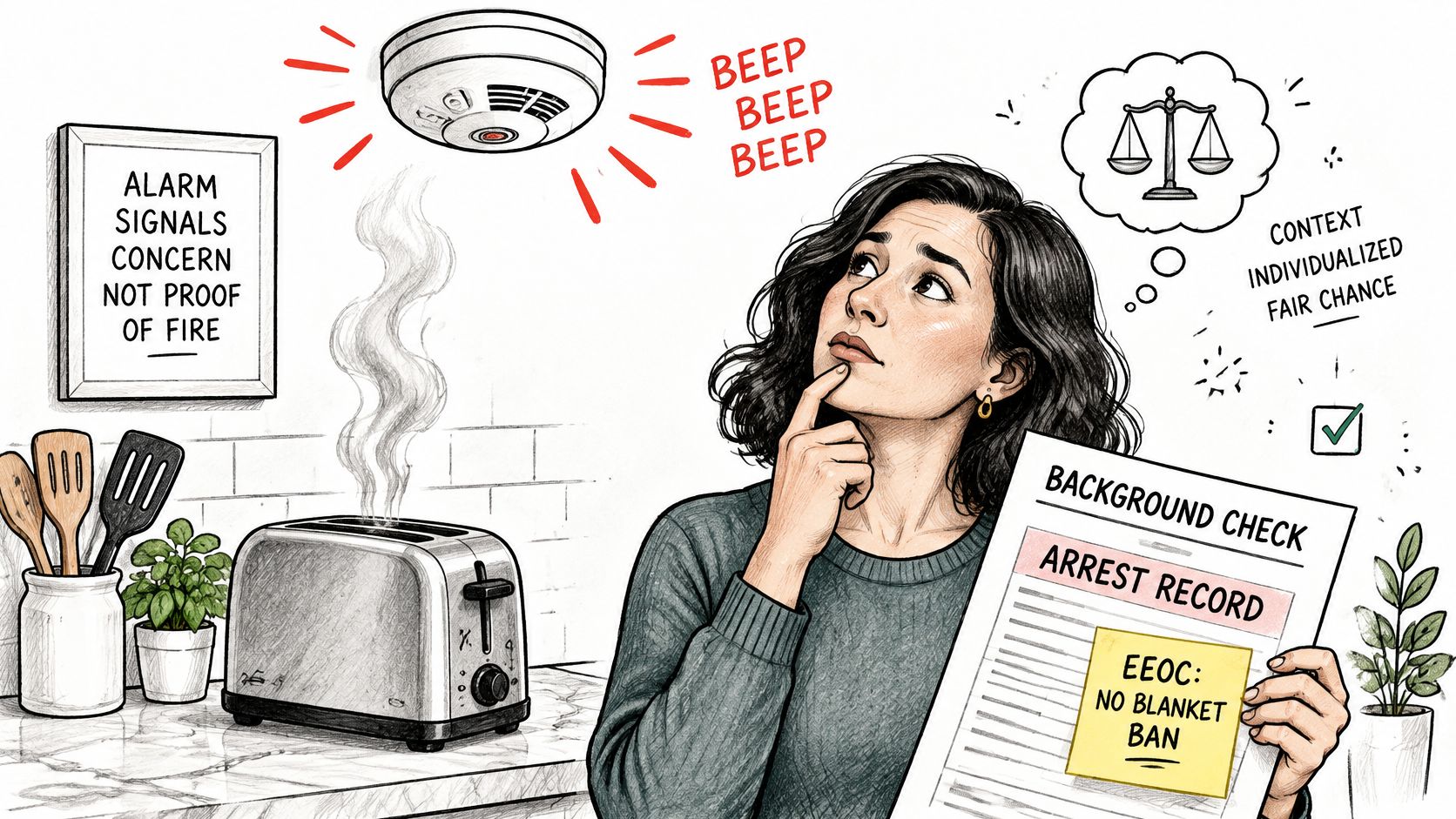
Three separate questions get blurred whenever a report shows an arrest entry: whether the record appears at all, whether state law permits it to be reported, and whether it may be used in the decision. The EEOC's arrest and conviction guidance answers the third one directly. Employers cannot refuse to hire someone because the person was arrested, and an arrest record alone isn't reliable evidence of criminal conduct. The agency's position reaches back to a 1990 policy statement on arrest records, while its 1987 policy statement treated convictions as more reliable evidence that criminal conduct occurred. Suspicion followed by a process, versus a process that reached a finding: that's the distinction in two dates.
Two Technical Reasons the Record Can Be Wrong
The first is misidentification. Arrest records can carry the wrong person's name, birth date or county, and a common name makes it worse. The second is a missing disposition. Court and law-enforcement feeds often stop at the arrest and never publish the dismissal, acquittal or decision not to charge.
Here's how that can play out in practice. A coordinator opens a report and sees a 2011 arrest with no outcome listed. The case was dismissed that same year, but nobody updated the database, so the line still looks open. Deciding on that row means deciding on a fact you don't have.
What the law does permit is narrower and more useful. You may look into the conduct behind the arrest when it relates to the role, and you should give the volunteer a chance to explain the circumstances. The conduct has to connect to the duties, not to the label. Reading the disposition of a case correctly is what separates a dismissed matter from a pending one, because the disposition is the only part of the entry that carries meaning.
Separate arrests from convictions on every report before anyone forms a view. A false inference of guilt doesn't just create legal exposure under discrimination principles. It also screens out qualified volunteers who did nothing wrong.
How to Calculate the Reporting Window
The window isn't a guess. It's arithmetic on one date, and the date has to be the right one.
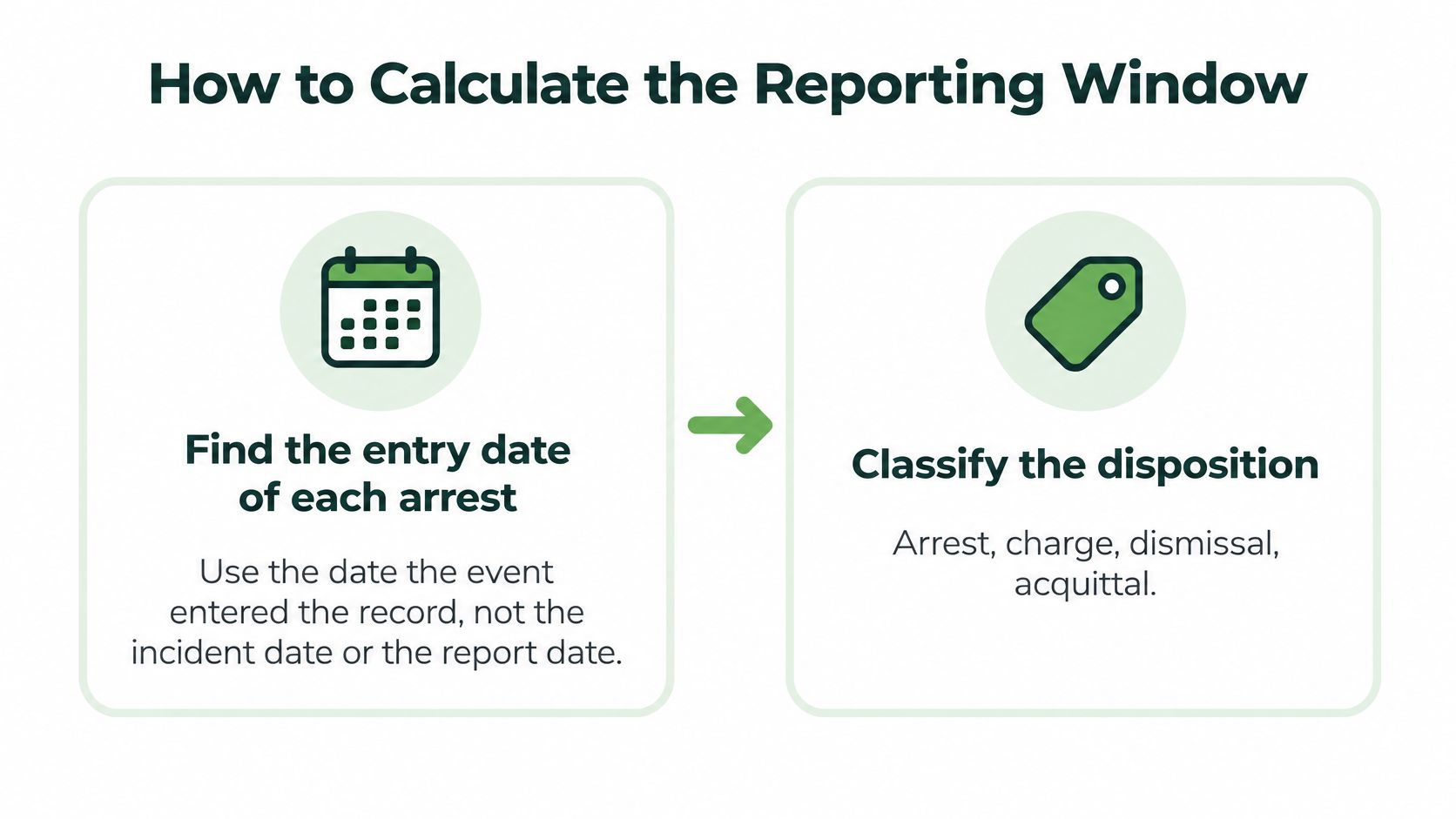
The federal rule is set out in the FTC's FCRA interpretation, which explains that the seven-year period for an arrest runs from its date of entry and is not restarted by later events. The same provision's time limit generally doesn't apply to records of conviction, though an arrest underlying a conviction remains subject to the arrest-reporting period as an arrest entry.
- Find the entry date. That's the date the event entered the record, not the incident date and not the day your report was generated.
- Classify the disposition. Arrest, charge, dismissal, acquittal, diversion or conviction. Every step below depends on this tag being right.
- Add seven years to a non-conviction arrest entry. An entry dated 3 March 2017 stayed inside the federal window until 3 March 2024. Run that same entry in 2026 and it's stale, so it should be suppressed rather than shown as current adverse information.
- Test the clock against later paperwork. A refiling, a probation review or a new docket number doesn't move the anchor date, because the window is measured from the arrest entry.
- Handle convictions separately. No federal time limit applies to the conviction itself, but role relevance and state rules still do.
- Check the state. Apply the stricter of the state where the volunteer lives and the state where they serve.
- Suppress and record. Remove the stale entry from the view and log the suppression with the date and the source you used.
- Save the calculation date with the file. If the decision is questioned next year, the saved date is what lets you rebuild the same answer.
The Detail That Trips People Up
When an arrest led to a conviction, the report may contain two rows for one event. The conviction row carries no federal reporting limit. The arrest row underneath it is still an arrest entry, and the timing rule for arrests still governs that row.
If your team regularly argues about lookback periods, a plain explanation of how far back criminal background checks can go is worth circulating before the next screening cycle, because most disputes are really date arguments wearing a policy costume.
Criteria for Weighing a Flagged Arrest
A flagged arrest isn't a verdict. It's a question: what does this record mean for this role, with this volunteer, right now? A defensible review answers that question in writing, applies the same criteria to every applicant, and leaves a trail you could hand to a board member a year later.
The EEOC's small-business guidance on criminal records frames the review around exactly three things: the role-specific risk, the seriousness and nature of the conduct, and the time elapsed. Two more criteria make the file complete.
The Five Things Every Review Records
- Role relevance. Does the documented conduct connect to what the volunteer does? Youth contact, transportation, money handling, overnight supervision and personal caregiving each create a different set of relevant risks, and a record that matters for one may be irrelevant to another.
- Seriousness and nature of the conduct. A single old misdemeanor and a pattern of violent offenses aren't the same question, and your sheet should say so before anyone opens a file.
- Time elapsed. Recent conduct weighs more than something from a decade ago, and the sheet should name the cutoffs rather than leaving them to mood.
- Documentation. An arrest label with no disposition isn't evidence of conduct. If the only thing on the report is the label, you don't have a fact to weigh.
- A chance to explain. The volunteer should be able to describe what happened, and that response belongs in the file.
Every criterion has to survive one question: can you say why it matters for this role? That's business necessity in plain terms. If the honest answer is "it's our policy," the criterion isn't doing the work.
Two Files, Two Answers
A youth coach with a dismissed 2013 charge for a non-violent offense has no documented conduct connected to coaching duties. The review records the dismissal, notes the absence of role relevance, and closes.
A driving volunteer with a recent conviction for a traffic offense is a different file. The conduct is documented, recent and directly tied to the duty of transporting people. That's the kind of record a defensible review can act on, with notice and a chance to respond.
Write the criteria sheet before you review any individual, then apply it without edits. Criteria invented after looking at a name are the ones that fail when someone asks how you decided.
Close by writing a one-page criteria sheet for each volunteer role you screen. Youth mentor, driver, treasurer and nursery helper need different sheets, and the differences should be visible to anyone who reads them. A solid guide to reading a background check report makes the same point from the reviewer's side.
Common Mistakes and the Pre-Decision Checklist
The costliest mistakes come from conscientious coordinators, the ones who see an entry on a report and treat its arrival as permission to act. A record appearing on a report, state law allowing it to be reported, and your policy permitting you to weigh it are three separate questions. A process that only answers the first will eventually exclude someone it should not.
Treating an arrest as a conviction. The fix is structural: read dispositions separately on every report, and refuse to let a row with no finding sit in the same column as a conviction.
Skipping the disposition check. When a possible record appears, a real reviewer checks the identifiers, the dates and the jurisdiction to confirm it belongs to the applicant. That step catches both misidentification and a dismissal the database summary missed.
Blanket no-arrests rules. Mechanical rules applied without considering job-relatedness can create unlawful disparate impact based on race or national origin, which the EEOC's guidance on criminal-record screening treats as a live risk. Individualized review is the defensible version of the same policy.
Ignoring state limits for remote volunteers. A volunteer who lives in one state and serves in another is covered by both. Match their locations to the state rules before the report is ordered, not after it surprises you.
Keeping stale entries. Once the reporting window closes, suppress the entry and record the suppression. A stale line in a file is a liability with a timestamp on it.
Missing notices. First confirm whether the FCRA applies to the screen you are running, because notice duties depend on it. Where it applies and a decision relies on a consumer report, send the pre-adverse action notice, allow time to respond, then send the adverse action notice if the decision stands.
The Checklist for Every Flagged Entry
Run these seven checks in order, because each one gates the next.
- Confirm the disposition against the court record, not the database summary.
- Confirm identifiers, meaning name, date of birth, dates and jurisdiction all match the volunteer.
- Check state limits for every state where the volunteer lives and serves.
- Calculate the window from the entry date, not the incident date.
- Apply the role criteria written before the file arrived.
- Give the volunteer a chance to explain, and keep the response in the file.
- Record the decision, its reasons and the calculation date.
One limitation to state plainly, because it prevents a bad assumption later. Our $5 database check is not a substitute for a legally mandated fingerprint check through the FBI or Live Scan, though it can serve as the primary screen for programs that are not required to run one.
VolunteerBadge was built for volunteer programs rather than hiring departments. Reports arrive in plain English with step-by-step FCRA guidance, and the platform generates pre-adverse and adverse action notices when a decision needs them, at $5 per check with no monthly fees. If you would rather spend your review time on the files that need judgment and let the calendar rules handle themselves, visit VolunteerBadge and run your first check.
