
Background Check Authorization Template and How to Use It
Get a copy-ready background check authorization template, learn the FCRA disclosure rules, and handle results and adverse action the right way.
On this page
You've got volunteers waiting to start, a screening account ready to use, and an application form that already asks for a signature. Then someone asks whether that signature authorizes a background check. If the consent sits beside a liability release or inside a general acknowledgment, you don't want to discover the problem after ordering the report.
A useful background check authorization template makes the disclosure understandable, captures a deliberate authorization, and gives your coordinator a reliable record. The copy below is a starting point for counsel to confirm, not a substitute for reviewing your volunteer roles, state requirements, and screening workflow.
Table of Contents
- Copy-Ready Authorization Template With Required Fields
- Why the Disclosure Must Stand Alone
- How to Present, Sign and Store the Form
- Reading Results Without Automatic Rejection
- Adverse Action Steps Under FCRA
- Confirm Your Template Before the First Volunteer Applies
Copy-Ready Authorization Template With Required Fields
Volunteer Background Check Disclosure
[Organization Name] may obtain a consumer report about you from a consumer reporting agency to evaluate your eligibility to serve as a volunteer in the role of [Volunteer Role]. The report may contain information about your criminal history and other background information relevant to that role.
Authorization
I authorize [Organization Name] to obtain the consumer report described above for this volunteer eligibility decision. If I sign electronically, I agree to use an electronic signature to provide this authorization.
Printed name: [Full Legal Name]
Signature: [Applicant Signature]
Date: [Date Signed]
Keep this disclosure and authorization separate from your administrative intake fields. The table below describes the accompanying information to collect, not additional language to paste into the standalone disclosure. Counsel should confirm whether the electronic-signing language needs separate disclosures for your signing method.
Required fields for a volunteer authorization form
| Field | What to enter | Why it matters |
|---|---|---|
| Full legal name | Name exactly as on government ID | Reduces matches to the wrong person with a common name |
| Aliases and former names | Maiden names, nicknames used in records, and prior legal names | Helps locate records under other names |
| Date of birth | Full date from ID, entered through a secure intake method | Provides an important identifier for matching records |
| Address history | Current and prior addresses covering the period established for your screening process | Identifies jurisdictions to search and exposes missing or stale addresses |
| Purpose statement | Volunteer eligibility for the named role | Gives the screening a defined, role-related purpose |
| Disclosure text | A standalone paragraph identifying the consumer report | Keeps the explanation clear and separate from unrelated paperwork |
| Authorization and signature | A distinct agreement, signature, and signing date | Records affirmative permission rather than a general application acknowledgment |
| State notice field | Applicable notice identified during legal review, delivered separately when necessary | Supports jurisdiction-specific requirements without crowding the disclosure |
| Accuracy attestation | Applicant confirms that the identifying information supplied is accurate | Creates a record of what the applicant confirmed before ordering |
Add [Organization Contact Name], [Email], and [Phone] to the accompanying intake instructions. Applicants need somewhere to send a correction without putting sensitive identifiers into a general volunteer inbox.
The accuracy attestation belongs with the intake information. A practical starting sentence is: “I confirm that the identifying information I have provided is accurate and complete to the best of my knowledge.” It shouldn't waive rights, excuse reporting errors, or promise that the applicant will never dispute a result.
Before using the template:
- Replace every bracket. Name the actual organization and volunteer role, not just the program's nickname.
- Delete unrelated material. Don't add participation terms, conduct rules, fundraising permissions, or a liability release.
- Send it independently. Deliver the disclosure and authorization as their own document, not merely as a page hidden inside a longer packet.
Why the Disclosure Must Stand Alone
A disclosure buried in an application can look perfectly reasonable to the coordinator who built it. The applicant may see something different: a long form to complete before joining the program, with no obvious distinction between contact details, participation terms, and permission to investigate their background.
The legal concern is the document itself, not whether someone eventually signed it. In its 2017 decision in Syed v. M-I, LLC, the Ninth Circuit explained the standalone disclosure requirement and the 1998 amendment permitting authorization on the same document, while preserving the rule that the document otherwise consist solely of the required disclosure.
That framework concerns consumer reports obtained for employment purposes. Whether it covers an unpaid volunteer depends on the facts and applicable state law. Don't assume coverage either way, and have counsel confirm the wording before applying employment-oriented FCRA language to your program.
Where otherwise sensible forms fail
Consider a children's program intake form. The disclosure paragraph appears between questions about availability and emergency contacts, followed by a signature accepting the entire application. The coordinator knows the paragraph is there, but the applicant has to distinguish it from unrelated questions and acknowledgments.
A liability waiver creates a different problem. Adding a sentence consenting to background checks beside release language doesn't turn the waiver into a clean authorization document. It combines permission to obtain information with an attempt to allocate liability, even though those serve different purposes.
The practical fix is a separate document with its own heading, a clear explanation of the report, and no unrelated release language. Keep administrative convenience from dictating the legal document's contents.
Readability test: Give the disclosure page to someone who hasn't seen your application packet. Ask what information the organization may obtain and why.
If they need the rest of the application to answer, revise the disclosure. If they understand the check but think they're also surrendering legal rights, remove the language causing that impression and send the revised version for review.
How to Present, Sign and Store the Form
A clean form still needs a controlled ordering process. The FTC's background-check guidance for employers distinguishes written permission from general application language and explains the requester's certification responsibilities before a reporting company furnishes a report.
Use the following process to keep delivery, permission, and ordering connected.
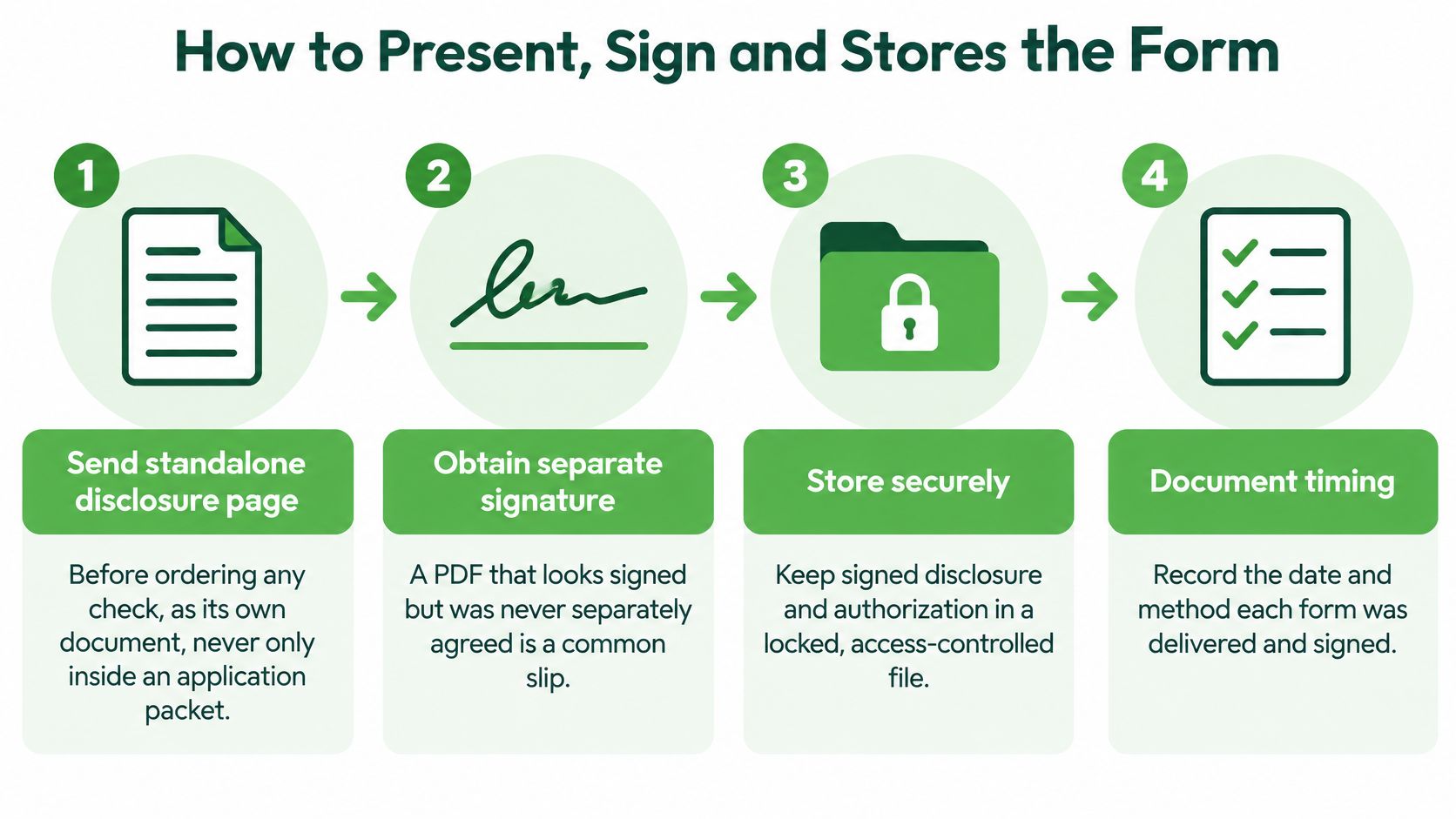
From delivery to the order
Send the disclosure before ordering. Deliver it as an independently identifiable document and record how it was presented. The common slip is treating a PDF attached to an application packet as proof that the applicant received a clear disclosure.
Capture affirmative authorization. Use a dedicated signature or equivalent electronic consent event, with any applicable electronic-consent disclosures addressed. A checkbox shared with a waiver doesn't provide the same evidence of a distinct agreement.
Resolve identity gaps first. Compare the legal name and birth date against the applicant's ID, collect former names, and ask the applicant to correct incomplete address history through a secure channel. An omitted move can send the search toward the wrong jurisdictions; don't guess the missing address without confirmation.
Define any continuing scope. If your program intends to obtain later reports under an ongoing authorization, make that scope clear and have counsel approve it. Don't assume an old signature automatically supports every future search; in our process, applicants authorize each check digitally, and the documentation is stored automatically.
Preserve what the applicant saw. Keep the rendered disclosure, exact authorization wording, identity data used, signature event, and timestamps together. Saving only today's editable template won't establish which version an earlier applicant signed.
Complete the requester certification. Confirm that your organization has provided the reporting agency with the required certification before the report is furnished. The mistake is filing a provider's general compliance statement instead of checking that your organization's certification covers the actual disclosure and authorization process.
Keep an answerable file
Use an access-controlled repository, not a shared folder available to every program volunteer. Give coordinators access according to their responsibilities, and avoid retaining unnecessary ID copies merely because the upload tool allows them.
Your compliance documentation process should identify who owns the file, how versions are preserved, and how records are retrieved. Keep the records available for the full retention period established in your written policy after legal review, with secure disposal instructions when that period ends.
A useful file should answer a dispute without relying on the coordinator's memory. You should be able to establish what was disclosed, what was authorized, when permission was given, and which identifiers supported the order.
Reading Results Without Automatic Rejection
An arrest alone doesn't establish that criminal conduct occurred. The EEOC says excluding someone solely because of an arrest isn't job-related and consistent with business necessity; the relevant question is whether reliable information about the underlying conduct matters to the position.
In its report on criminal conduct and federal suitability decisions, the EEOC reports that 20,462 of 91,852 closed civil-service adjudication cases, or 22.3%, involved criminal-conduct issues between fiscal years 2018 and 2020. Of determinations involving a criminal-conduct issue, 76% were favorable, allowing the person to work in the federal government, while 2% were unfavorable.
Those are federal civil-service outcomes, not predictions for your volunteer program. They illustrate why a flag should begin a review rather than substitute for a decision.
Give the reviewer a verification checklist, not just a status label.

Common results and the check to run before deciding
| Result | What it usually means | Check before deciding |
|---|---|---|
| Conviction that relates to the volunteer role | The conduct may be relevant to the role | Compare it against written role criteria and document the reasoning |
| Arrest with no conviction | The arrest doesn't prove conduct | Don't exclude on the arrest alone; review reliable underlying facts |
| Record matched on name only | A common name may have produced a false match | Have a human reviewer confirm birth date, address, and jurisdiction |
| Record outside your written time window | The record needs assessment against your established relevance standard | Apply the same time standard consistently, subject to applicable legal requirements |
| County record that cannot be verified | The record's accuracy or connection to the applicant remains unresolved | Verify it before deciding; don't treat an uncertain record as established fact |
Separate identity from suitability
First ask whether the record belongs to the applicant. Only after that should you assess its relevance to the assignment. For example, a role transporting children raises different responsibilities from a supervised event-registration role.
When a possible criminal record appears in our process, a real reviewer checks the identifiers, dates, and jurisdiction to verify whether it belongs to the applicant. Your program manager still needs to evaluate the verified information under the organization's screening policy.
Use a guide to reading background-check results to train anyone who will review reports. Write the role-related criteria before ordering the first check, identify who can resolve uncertain cases, and apply the criteria consistently to every volunteer.
Adverse Action Steps Under FCRA
Before adopting this sequence, confirm with counsel how FCRA applies to unpaid volunteers in your situation. Where the process applies, the applicant needs a genuine opportunity to challenge inaccurate information before the organization makes its final decision.
The FTC's guidance on background checks and required disclosures explains the pre-adverse and final-notice obligations. Treat the following as a controlled decision process, not an automated rejection sequence.
Use the flowchart as an orientation, but have counsel set the response period for your circumstances rather than treating an illustrated interval as a universal deadline.
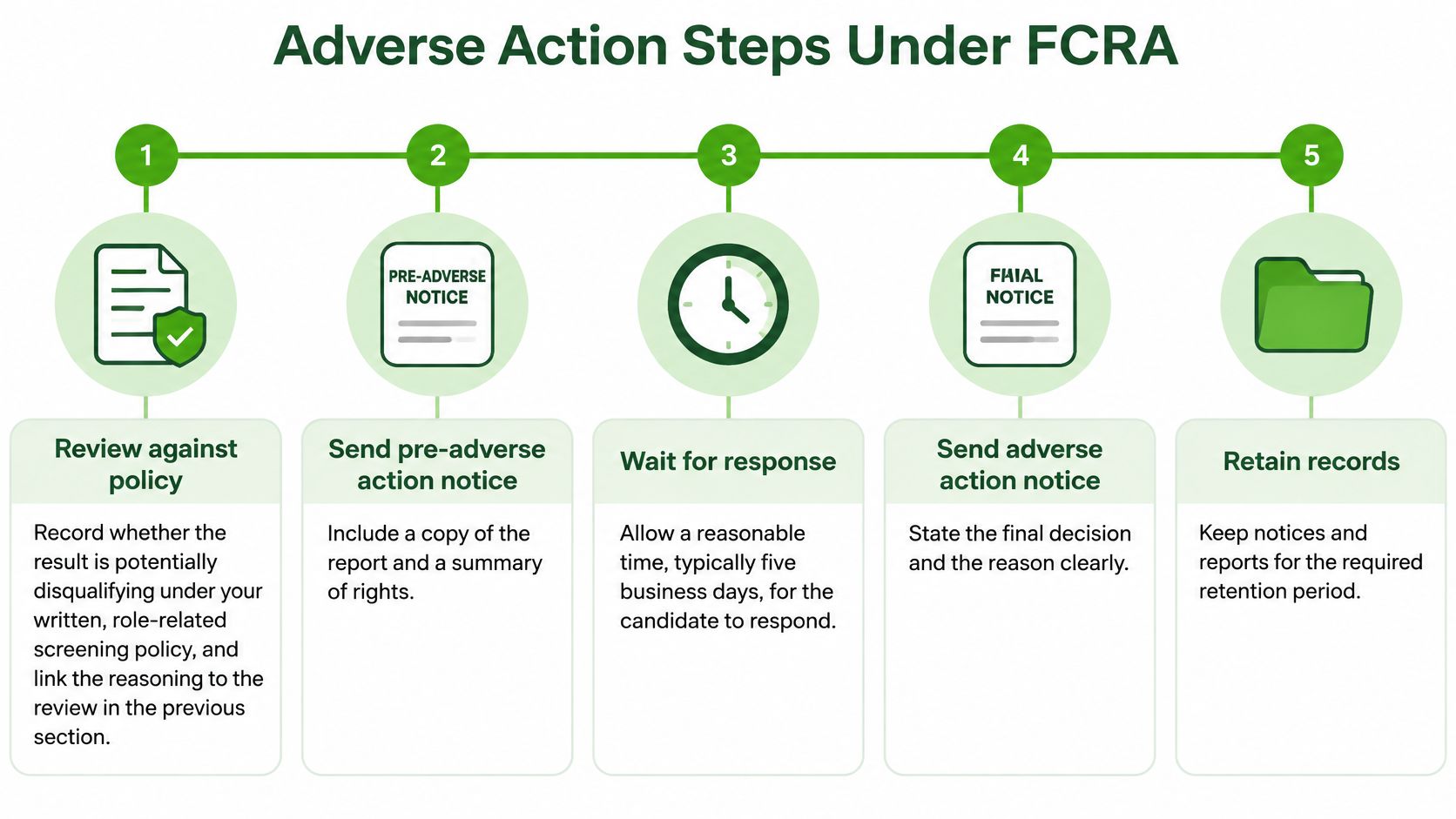
Complete the decision in order
Document the policy concern. Record why verified information may disqualify the applicant under the written criteria for the role. Don't decide first and create a justification afterward.
Send the pre-adverse notice. Include the report relied upon and the FCRA Summary of Rights. Sending the report alone leaves out a required part of the applicant's review materials.
Allow a meaningful response period. Establish a counsel-approved deadline and a usable contact method, and don't finalize the decision while that opportunity remains open. A deadline that effectively prevents the applicant from reviewing or challenging the report defeats the purpose.
Investigate disputes and mismatches. Route disputed information through the appropriate review process and correct the organization's file when a record belongs to someone else. Confidence in a name match isn't a reason to ignore contrary identifiers.
Send the final notice if the decision stands. Identify the reporting company, explain that it didn't make the decision, and provide the required dispute-related information. Sending only this final notice skips the applicant's earlier opportunity to respond.
When a result requires adverse action under FCRA, we generate the notice, and the customer reviews and sends it. The organization remains responsible for its decision and timing; use the adverse-action notice requirements guide to check the file before release.
Assign responsibility beyond the form
Use the same written criteria for employees and volunteers doing comparable work unless there's a documented reason to distinguish them. For broader context on assigning compliance responsibilities, Benely's HR compliance explainer is a useful companion to your screening procedure.
Include this video in coordinator training alongside the written checklist.
Confirm Your Template Before the First Volunteer Applies
Review the complete workflow before you invite applicants. A polished background check authorization template won't compensate for missing notices, an undefined retention policy, or a coordinator who can order reports without checking consent.
Run a launch check
- Document separation: The disclosure is independently presented, with no unrelated release language.
- Affirmative permission: The authorization has its own signature or electronic consent event.
- Complete identifiers: Staff know how to resolve missing names, birth dates, or addresses securely.
- Decision procedure: The adverse-action sequence is written down and assigned to named staff.
- Record handling: The retention period, access permissions, and disposal method are established.
- Jurisdiction review: Counsel has checked applicable state notices and program-specific screening obligations.
A database criminal check isn't a replacement for legally mandated fingerprint screening, such as an FBI or Live Scan check. Our $5 database check can be the primary screen, but where law or program rules require fingerprinting, add that process to the workflow rather than treating the database result as an alternative.
Pilot the complete file
Start with a single volunteer and inspect the resulting file as though you were answering a dispute. Can another authorized coordinator retrieve the signed version, establish the order sequence, and understand the decision without asking the original coordinator?
Walk through a correction scenario as well. If the volunteer reports a misspelled former name or disputes a county record, staff should know who pauses the decision and where the correction is recorded.
For complementary guidance on recruitment and onboarding, browse employer guides from LatoJobs, while keeping your volunteer-specific legal review separate. This week, send your template and adverse-action procedure to counsel or your insurer for review, then begin the pilot after resolving their comments.
VolunteerBadge lets you create a free account, invite a volunteer, and run a fully FCRA-compliant background check for $5, with no contract and no monthly fee. Visit VolunteerBadge to put digital authorization and documented screening into your pilot workflow, using the template and review process your counsel has approved.
