
FCRA Summary of Rights: What It Says and When to Use It
Learn what the FCRA summary of rights includes, when it must be provided, and how it applies to volunteer background checks and adverse action.
On this page
You're ready to approve a new volunteer when the background report flags a criminal record. The applicant says it isn't theirs, and your screening folder contains an authorization form, an old rights summary, and no clear instructions about what happens next. Before you send a rejection, you need to separate the documents that permit screening from the documents that protect someone after a report raises a concern.
The FCRA Summary of Rights belongs to that second group. For a nonprofit coordinator, knowing what it says is only part of the job. You also need to know when to deliver it, who investigates disputed information, and why unpaid service doesn't automatically remove federal screening obligations.
Table of Contents
- The Rights Every FCRA Summary Lists
- When the Summary Must Be Provided
- Why Volunteer Screening Falls Under the FCRA
- Adverse Action Steps From Report to Final Notice
- Disputing a Record That Is Wrong or Belongs to Someone Else
- How the Summary Changed From 1996 to 2018
- Confirm Your Volunteer Screening Documents Before Your Next Check
The Rights Every FCRA Summary Lists
A volunteer receives a background report and an accompanying rights summary. Their first question may be reasonable: why does a document about credit reporting accompany a criminal background check?
The Fair Credit Reporting Act reaches beyond credit bureaus. The federal Summary of Your Rights Under the Fair Credit Reporting Act describes protections that also matter when specialty consumer reporting agencies compile employment and other background information. The standardized notice, developed through the federal model-form process, tells consumers how to obtain information, identify mistakes, and challenge what an agency reports.
Think of it as the safety card in an airplane seat pocket. Standardized instructions give everyone a common starting point. But handing someone the card doesn't replace your responsibility to follow the procedure.
Core rights listed in the FCRA Summary of Rights
| Right | What it lets the consumer do | Statutory anchor |
|---|---|---|
| Obtain a copy of a consumer report | Request the file the agency holds on them | 15 U.S.C. § 1681g |
| Receive a free report in covered situations | Get a no-cost copy when the statute entitles them | FCRA free-disclosure provisions |
| Dispute incomplete or inaccurate information | Ask the agency to investigate and correct or delete qualifying information | FCRA dispute and reinvestigation provisions |
| Obtain a credit score | Request a score in situations the statute covers | FCRA credit-score disclosure provisions |
| Request a free report from the agency | Use the agency's contact method identified through the disclosure process | 15 U.S.C. § 1681g |
These are core rights, not a substitute for the complete official notice. Other protections in the model address matters such as access to consumer information and identity theft.
For broader context about the law's reach, the Superior Credit Repair FCRA explainer offers a supplemental explanation. Use educational material to build understanding, not to replace the official summary.
Practical rule: Check your document against the core rights, but distribute the complete applicable official model rather than writing your own shortened version.
For a flagged volunteer, the right to dispute is especially important. It turns an apparent screening result into something the person can examine and contest before you treat it as established fact.
When the Summary Must Be Provided
For employment-purpose volunteer screening, the critical organizational delivery point is before an adverse decision based on the report. The summary accompanies the report in the pre-adverse-action package, giving the volunteer information they can use while a decision is still pending.
The summary isn't the same document as the permission to run a check. The consumer-disclosure statute, 15 U.S.C. § 1681g, places the rights summary within the FCRA's disclosure system and specifies information about file access, free disclosures, disputes, and credit scores. Your workflow must distinguish those post-report rights from the disclosure and authorization used before obtaining a report.
Screening stages and when the summary is required
| Stage | Document in play | Summary of Rights required |
|---|---|---|
| Before the report is obtained | Standalone disclosure and signed authorization | No, not solely because you're obtaining a report; keep it separate from the authorization |
| Routine check with no adverse result | Report and disclosure kept on file | No organizational pre-adverse delivery trigger, unless adverse action follows |
| Report may lead to an adverse decision | Pre-adverse notice with a copy of the report | Yes, provide it with the report |
| Decision is final | Final adverse action notice | Notice includes agency contact and dispute rights; summary already delivered |
The distinction matters when interpreting the workflow illustration: disclosure and authorization come first, but that doesn't mean the summary must accompany every request for permission.
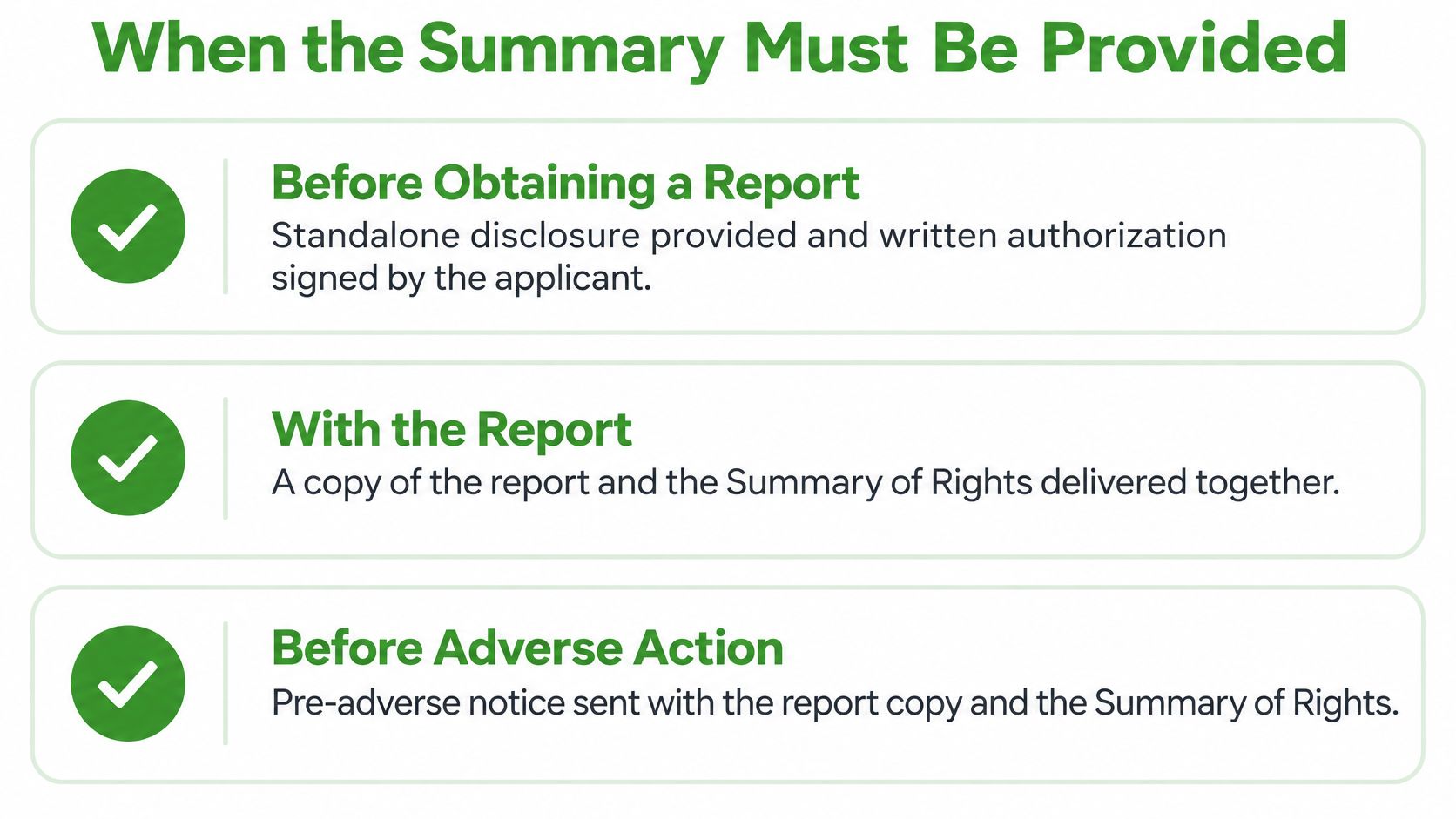
Keep the summary distinct, complete, and readable. Don't bury it inside a signature page or assume a general privacy policy communicates the same rights.
Before a screening batch, check that:
- Disclosure is ready. The standalone screening disclosure is available before anyone orders a report.
- Authorization is recorded. The volunteer's written permission is retained.
- Pre-adverse documents are prepared. Staff can deliver the report and applicable official summary together.
- Delivery is traceable. Your records identify the report version, recipient, delivery method, and timestamp.
These are organizational workflow controls. Consumer reporting agencies may have separate disclosure duties, so a routine approval doesn't mean the person has no right to obtain information.
Why Volunteer Screening Falls Under the FCRA
“We don't pay our volunteers” isn't a reliable reason to skip FCRA procedures. The relevant question is how your organization obtains and uses the information, not whether the applicant receives wages.
The FTC's credit-reporting guidance explains the federal framework for users of consumer reports; the FTC's position is that employment purposes may include volunteer service at organizations staffed partly or entirely by unpaid workers. A nonprofit using a consumer reporting agency should therefore treat volunteer screening as employment-purpose screening rather than assume an exemption.
Which screening setups trigger FCRA duties for volunteers
| Screening setup | FCRA applies | What to provide |
|---|---|---|
| Report from a consumer reporting agency | Yes, treat volunteer screening as employment-purpose screening | Disclosure, authorization, and the report and summary before a report-based adverse decision |
| Internal reference check with no consumer report | Generally no | Follow applicable state rules and internal privacy safeguards |
| Government fingerprint or background program | Governed by that program's rules; assess any separate consumer-report component | Follow the agency's process and keep records |
A volunteer sign-up process should identify which screening route the organization uses.
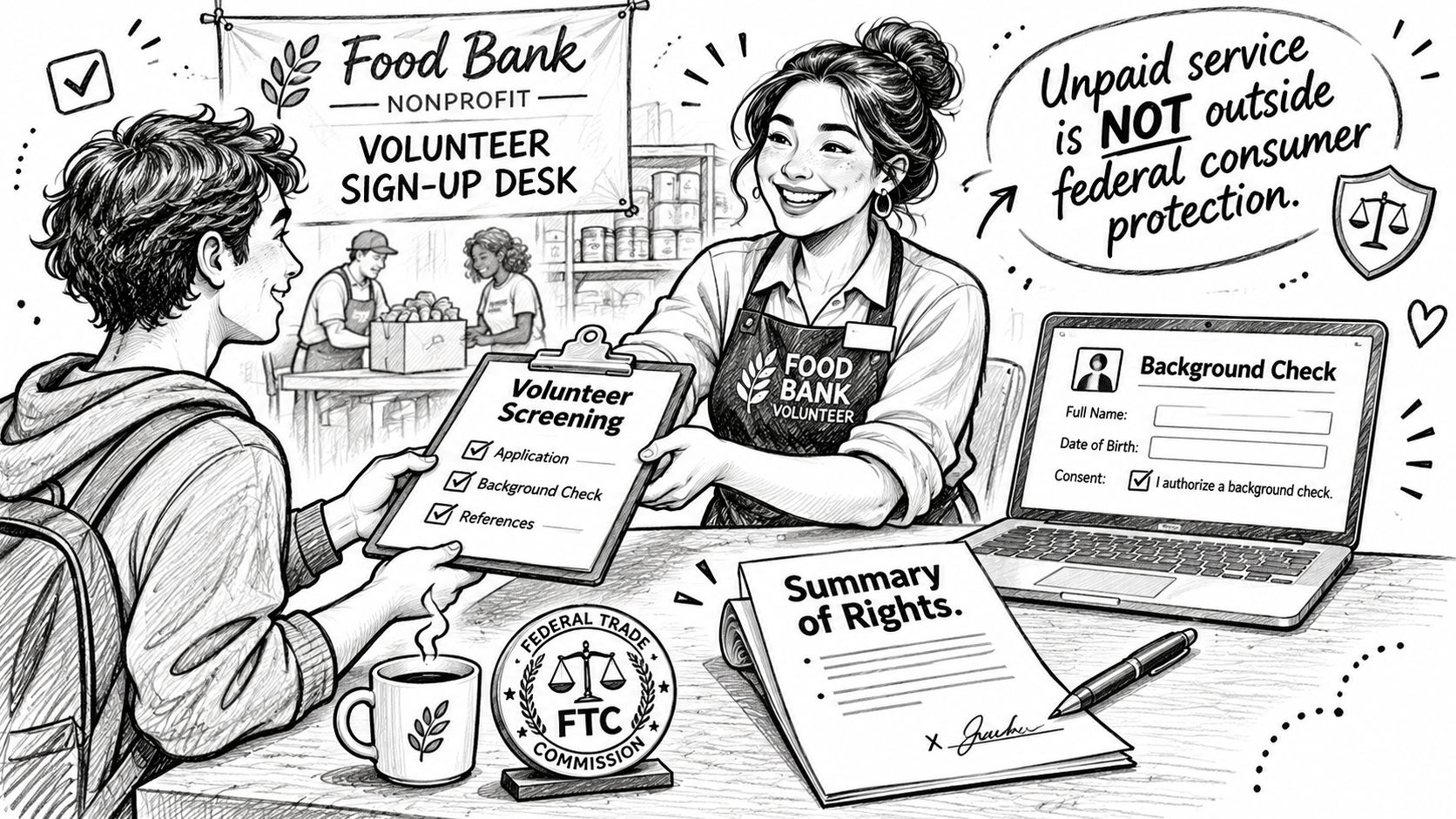
Start with who supplies the information. A coordinator calling a reference directly isn't necessarily doing the same thing as purchasing a compiled background report. A private company compiling criminal records for eligibility decisions can be supplying a consumer report even though the document contains no credit history.
Next, identify what decision the report supports. If your church uses it to decide who may supervise children, label that purpose in the screening file. Our explanation of whether the FCRA applies to criminal background checks addresses that boundary in more detail.
Finally, check state requirements separately. A state-mandated fingerprint check doesn't automatically replace a private-report workflow, and federal compliance doesn't establish that every state screening requirement has been met.
Record the supplier, report type, eligibility purpose, and legal framework before screening starts. Don't try to reconstruct that reasoning after an applicant questions the decision.
Adverse Action Steps From Report to Final Notice
Adverse action is a process, not a rejection template. If report information may lead you to decline a volunteer, restrict their placement, or make another unfavorable eligibility decision, keep the decision open while the person has an opportunity to respond.
Use this flow as an overview, then assign a staff owner to each operational step.
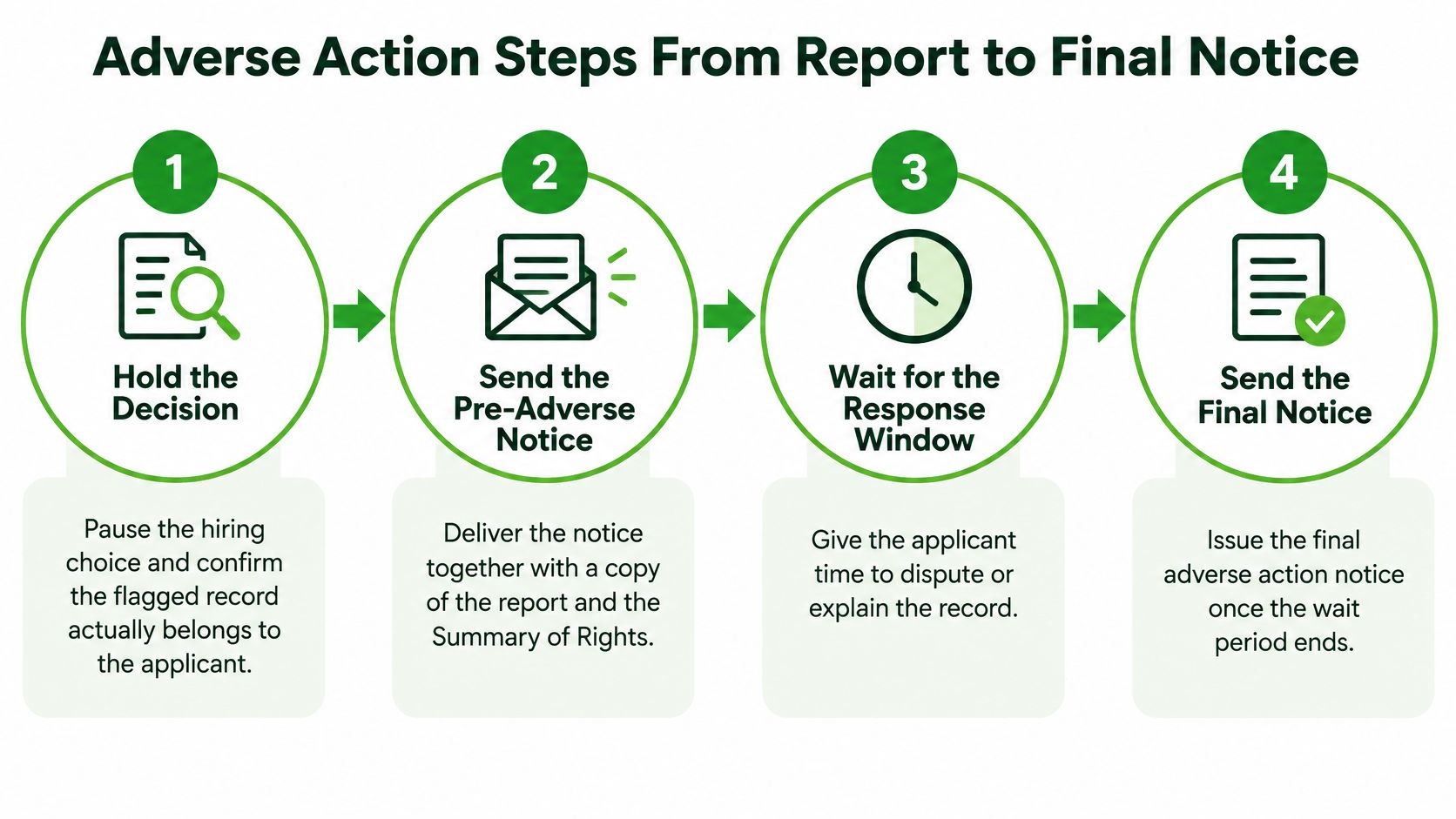
Hold the decision and inspect the match. Check whether identifiers support connecting the record to this applicant. Don't treat a similar name as sufficient confirmation or announce a final rejection while calling it preliminary.
Send the pre-adverse package. Include the notice, the report you're considering, and the Summary of Rights. A pre-adverse action letter should communicate that the organization is considering an unfavorable decision, not that it has already made one.
Allow a meaningful response period. Confirm the timing appropriate to your jurisdiction and circumstances rather than inventing a universal deadline. Account for delivery problems and responses received before finalization.
Review the response and any agency findings. Separate factual corrections from explanations about an accurate record. If a dispute could change the basis for rejection, don't ignore it because your calendar reminder has arrived.
Send the final notice if you proceed. Include the reporting agency's contact information, explain that the agency didn't make your decision and can't explain your reasons, and identify the consumer's report-access and dispute rights. Make the organization's decision unmistakable.
Preserve the audit trail. Keep the reviewed report version, notice copies, delivery evidence, dispute correspondence, and decision rationale. Restrict access to staff who need the information.
Keep responsibility with the organization
When a result requires adverse action under the FCRA, we generate the notice, and the customer reviews and sends it. We also guide customers through the waiting period between pre-adverse and final adverse-action notices. That support doesn't replace your review of the applicant's response.
Use the accompanying video as another way to review the sequence with staff.
A final notice sent too early defeats the practical purpose of the preliminary notice. The volunteer needs a real opportunity to influence a decision, not merely documentation of a decision already made.
Disputing a Record That Is Wrong or Belongs to Someone Else
A database hit alone doesn't establish that you have a complete, accurate, usable basis for rejection. A result may concern another person, omit the outcome of a case, or fail to reflect a court order.
Under the FTC's FCRA rights summary, consumers can dispute incomplete or inaccurate information, and reporting agencies generally must investigate and correct or delete qualifying information, usually within 30 days. That agency investigation is different from your nonprofit's eligibility review.
Record problems, causes and the response that resolves them
| Problem | Usual cause | Action to take |
|---|---|---|
| Record belongs to someone else | Same or similar name and date of birth | Volunteer supplies identifying information securely and disputes with the agency |
| Arrest or charge with no outcome | Missing court disposition | Volunteer obtains the court outcome and submits it for investigation |
| Sealed or expunged case still listed | Court order not reflected in the file | Volunteer provides the order and disputes the entry |
| Incomplete identity data | Name variants or missing details | Volunteer supplies documents that help the agency assess the match |
| Record older than the reporting period | Outdated entry still in the file | Volunteer disputes the entry as obsolete under the applicable reporting rules |
An entry's age doesn't establish a universal deletion rule. The relevant reporting restrictions must be assessed for the record and circumstances.
Separate accuracy from eligibility
Say a report lists a charge but no disposition. Your coordinator shouldn't convert “outcome missing” into “convicted.” The volunteer can request the court outcome and submit it to the reporting agency, while your organization identifies what information it still needs.
Now consider an accurate record that the volunteer believes shouldn't disqualify them. The reporting agency investigates factual accuracy. Your nonprofit applies its eligibility policy and any relevant legal requirements; asking the agency to decide whether someone is suitable confuses those responsibilities.
For practical help identifying background check errors, compare the disputed entry with the applicant's identifiers and available court documentation. Use secure channels rather than asking someone to email sensitive identity documents to a shared volunteer inbox.
A flagged record is a question to resolve, not a verdict. Give the applicant a named contact and a clear route to the reporting agency.
The escalation path should stay understandable: the volunteer disputes the entry, the agency investigates, the organization reviews the result, and only then does the organization resolve the eligibility decision on an appropriate record.
How the Summary Changed From 1996 to 2018
A volunteer coordinator opens a shared drive and finds a file named "FCRA rights summary, approved." Nobody remembers which version it is. That gap is exactly what this history explains: the summary is a living document, and a saved copy goes stale.
The FTC's rulemaking history traces the summary to the 1996 amendment adding Section 609(c), the first model issued in 1997, and the FACT Act signed December 4, 2003, which revised the model-distribution requirements.
The model summary works like a standard lease template. The underlying law keeps getting amended, and each amendment can change what the template must say. A template downloaded in one decade can describe protections that no longer match the statute.
Milestones in the FCRA summary of rights
| Year | Change to the summary | What it means today |
|---|---|---|
| 1996 | Consumer Credit Reporting Reform Act adds Section 609(c) | Establishes the statutory foundation for an FTC-defined summary |
| 1997 | FTC issues its first two-page model | Agencies could initially use a substantially similar version |
| 2003 | FACTA revises Section 609(c) | Requires distribution of the FTC model and expands identity-theft protections |
| 2018 | Congress amends the FCRA to require a security freeze notice | The updated model tells consumers they can place and lift a security freeze |
Each row changed what the document has to say, not how it looks. An old attachment can still resemble an official notice while missing protections the current version carries.
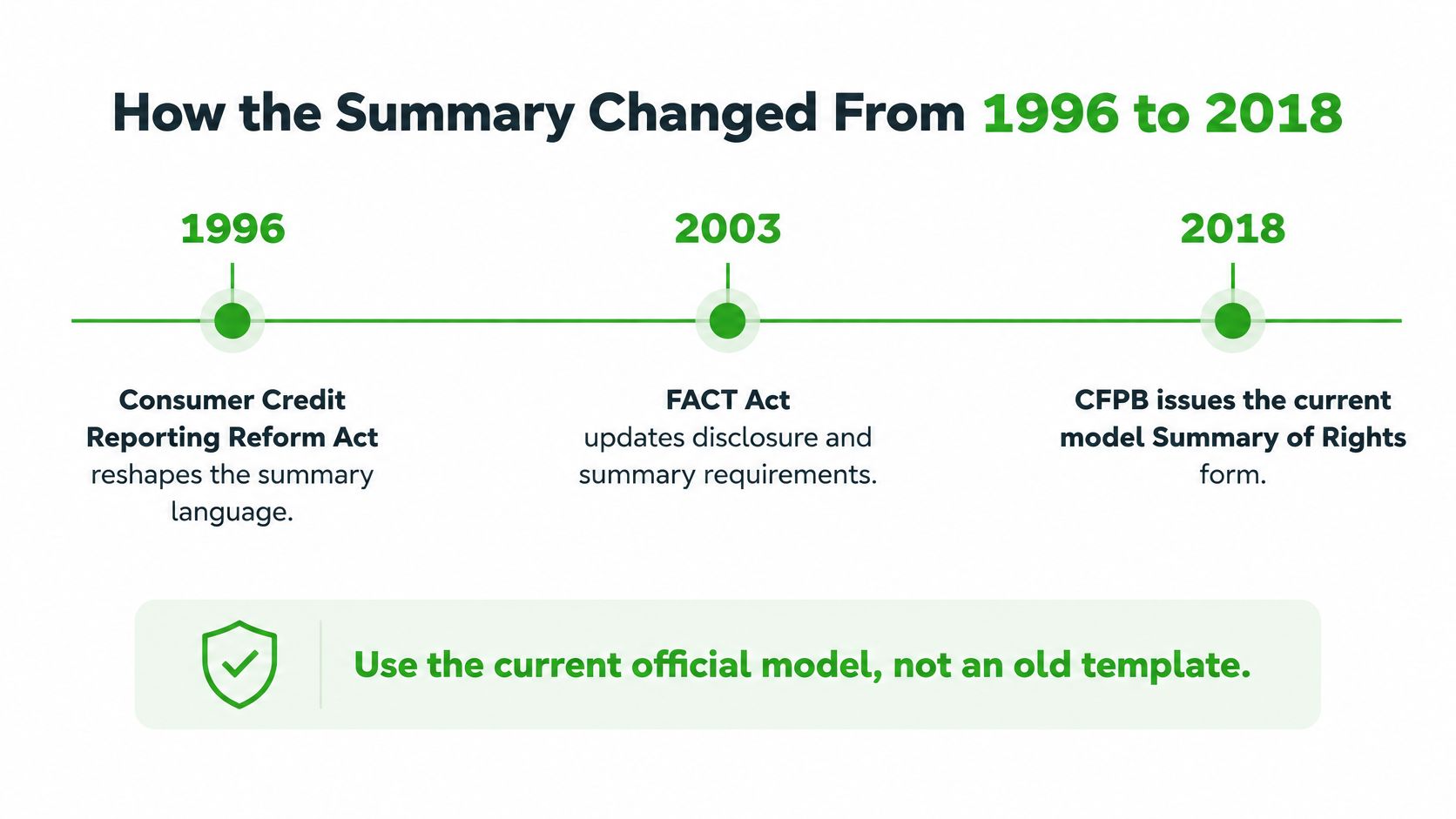
For a program that treats volunteer checks as employment-purpose screening, the decision point is straightforward: the version attached to an adverse action package must be the current model, not the one a predecessor saved.
Document-control check: Replace the master attachment deliberately, note where the replacement came from, and pull obsolete copies out of shared folders and email templates.
Use the current applicable official model, not a historical example or a coordinator's rewritten explanation. Earlier permission to use substantially similar language belonged to an older framework, and it is not a license to improvise the notice your applicants receive today.
Confirm Your Volunteer Screening Documents Before Your Next Check
Make document readiness part of screening preparation, not something staff address after a difficult result. The coordinator who orders a report should know who handles a disputed match and who approves a final notice.
The scale of consumer-report disputes reinforces the need for that preparation. Nationwide consumer reporting agencies closed more than 1.3 million complaints with non-monetary relief in 2024, according to a CFPB update on its consumer complaint system. That figure covers nationwide agencies, not volunteer screening specifically, but it's a practical reminder to prepare for corrections.
Make the workflow repeatable
- Check the master documents. Keep the applicable official summary separate from disclosure and authorization.
- Inspect the preliminary package. Confirm staff can attach the actual report under consideration.
- Test the recordkeeping. Verify that delivery evidence and dispute correspondence remain accessible to authorized reviewers.
- Assign decision ownership. Name the person who reviews corrections before the organization acts.
Every volunteer application in our platform includes built-in FCRA disclosure language and a digital authorization signature. You can test the application-to-report workflow with an initial volunteer before expanding screening across a program.
For your next practical step, pull your current summary and disclosure and compare them against the core-rights table. Check both content and purpose: a signed permission form cannot stand in for a rights notice.
VolunteerBadge offers volunteer screening with built-in disclosure and digital authorization, plus guidance for handling report-based adverse action. Visit VolunteerBadge to create a free account, invite a volunteer, and run your first FCRA-compliant check for $5, with no contract or monthly fee.
