
FCRA Background Check Consent Form: What to Include
Learn what an FCRA background check consent form must include, how to keep it standalone, and how to avoid common compliance mistakes for volunteers.
On this page
70% of surveyed U.S. organizations reported in 2024 that they did not always follow the FCRA adverse-action process, according to Checkr's State of Screening Compliance 2024 survey. That single figure reframes the whole subject. The breakdown rarely happens at the signature line. It happens the week after the report arrives.
Signing a form is the easy part. A coordinator can collect a signature in two minutes. What determines whether that signature holds up is what the organization does next: whether the disclosure sat alone on its page, whether the authorization covered the second and third check, whether the decision that followed was individualized, and whether anyone can prove any of it eighteen months later.
This is a working guide to the FCRA background check consent form for volunteer programs. It covers what goes on the page, what has to come off it, the wording that survives recurring screening, and the record that answers the question a lawyer will ask.
Table of Contents
- What a Compliant FCRA Consent Form Must Contain
- State Rules and Sample Authorization Wording
- How Consent Fits Into the Full FCRA Process
- Renewing Consent for Recurring Volunteer Screening
- Acting on a Report Without an Automatic Veto
- Common Mistakes and a Pre-Signature Audit
What a Compliant FCRA Consent Form Must Contain
A compliant FCRA background check consent form is two legal acts printed on one page. Under the Fair Credit Reporting Act, 15 U.S.C. § 1681b, an organization generally may not obtain a consumer report for employment purposes unless, before the report is procured, the applicant first receives a clear and conspicuous written disclosure that a report may be obtained, and then gives written authorization to order it. The statute adds a structural rule that breaks more volunteer programs than any other: the disclosure must appear in a document consisting solely of that disclosure. The authorization may sit on that same standalone page.
Read that requirement as a page designer rather than a lawyer. The page has exactly one job.
| Element | What the law requires | Practical example |
|---|---|---|
| Standalone disclosure | Must be in a document consisting solely of the disclosure | A one-page form titled Background Check Disclosure |
| Notice that a report may be obtained | Clear and conspicuous, given before the report is ordered | We may obtain a consumer report about you for volunteer eligibility |
| Written authorization | The applicant's written permission to obtain the report, which may sit on the same standalone document | Signature and date line below the disclosure |
| Screening purpose | Identifies why the report is sought | Volunteer eligibility for a youth mentoring program |
| Scope and duration | Recurring checks must be stated clearly and conspicuously | Checks may repeat while the applicant volunteers in children's programs |
| Electronic signature | Attributable assent with an identifiable signer and timestamp | Typed name and timestamp, not a prechecked box |
| Organization certification | The organization certifies disclosure, authorization, FCRA compliance and no misuse | Certification kept on file and sent to the screening agency |
A one-page form for a youth mentoring program
Six lines, one page, nothing stapled behind it. This is what the document looks like when it's built to survive a challenge:
Background Check Disclosure
We may obtain a consumer report about you from a consumer reporting agency for volunteer eligibility in the [Organization] youth mentoring program. The report may include criminal history, sex offender registry results, and identity verification.
I authorize [Organization] to obtain a consumer report about me for volunteer eligibility. I understand the report may be requested before I begin service and may be repeated while I serve in children's programs. I understand I will receive a copy of any report and a summary of my rights before any adverse decision.
Signature: __________ Date: __________
The statute recognizes consent given electronically when the application is made by computer or similar means, so a digital signature satisfies the written-authorization requirement, provided the process captures something you can attribute to a named person. A typed full name with a timestamp does that. A prechecked box does not.
What has to come off the page
The FTC's guidance for employers using consumer reports permits the disclosure and authorization in a single document and allows limited additional explanatory language, as long as that language doesn't obscure or dilute the notice. In practice, "limited" means a sentence or two. Strip out:
- Liability releases and waivers. A clause asking a volunteer not to sue sits in direct tension with the notice you're handing them.
- Volunteer-status or at-will statements. Those belong in the handbook, not above the signature line.
- The rest of the application. Emergency contacts, references, availability, and skills each move to their own step.
- Photo and media releases. Separate signature, separate page.
- Privacy policy walls. Link to the policy from the application footer instead of pasting it into the consent document.
The removal test: delete everything except the disclosure and the authorization. If the page that remains doesn't tell a stranger what will be ordered, why it's being ordered, and what they're agreeing to, the page isn't finished.
A plain one-page layout beats an elegant disclosure buried on page four of a six-page application every time. The moment a coordinator has to explain where the disclosure lives, the form has already failed.
State Rules and Sample Authorization Wording
Federal law is the floor of the building, not the roof. A handful of states and cities add their own notice, timing, or content rules, and a form copied from a national template won't reflect any of them. New York's Article 23-A of the Correction Law, alongside the New York City Fair Chance Act, restricts how and when criminal history may be considered, which means a form built for a mentoring role may need different framing for a role with driving duties. Other jurisdictions require their own notice page or a dedicated checkbox.
Build the jurisdiction checklist before you build the form:
- One version per state where you recruit, named for state and revision date, such as Consent_NY_2026-01.
- An addendum page for states with their own notice requirement, so the core disclosure page stays untouched.
- A calendar reminder to re-read the state text annually. Statutes get amended; templates don't update themselves.
- Counsel review for any form used to screen adults who will be alone with minors, where role duties shape what you may ask.
Then write authorization language that carries its own weight. This is a workable starting point:
I authorize [Organization] to obtain a consumer report about me for volunteer eligibility, including updates while I serve in this program. I understand I will receive a copy of any report and a summary of my rights before any adverse decision.
That sentence names the purpose, contemplates repeat checks, and tells the volunteer what happens before a decision goes against them. Adapt the program name and duration, then have counsel read it against the law of every state where you place volunteers. This is general information, not legal advice, and the current text of a statute always outranks an article.
How Consent Fits Into the Full FCRA Process
A signed authorization is the first gate in an FCRA screening process, not the final compliance record. Before ordering a report, the organization needs a permissible purpose and documented authorization. If a report may lead to an adverse decision, the organization must follow the required steps before making that decision.
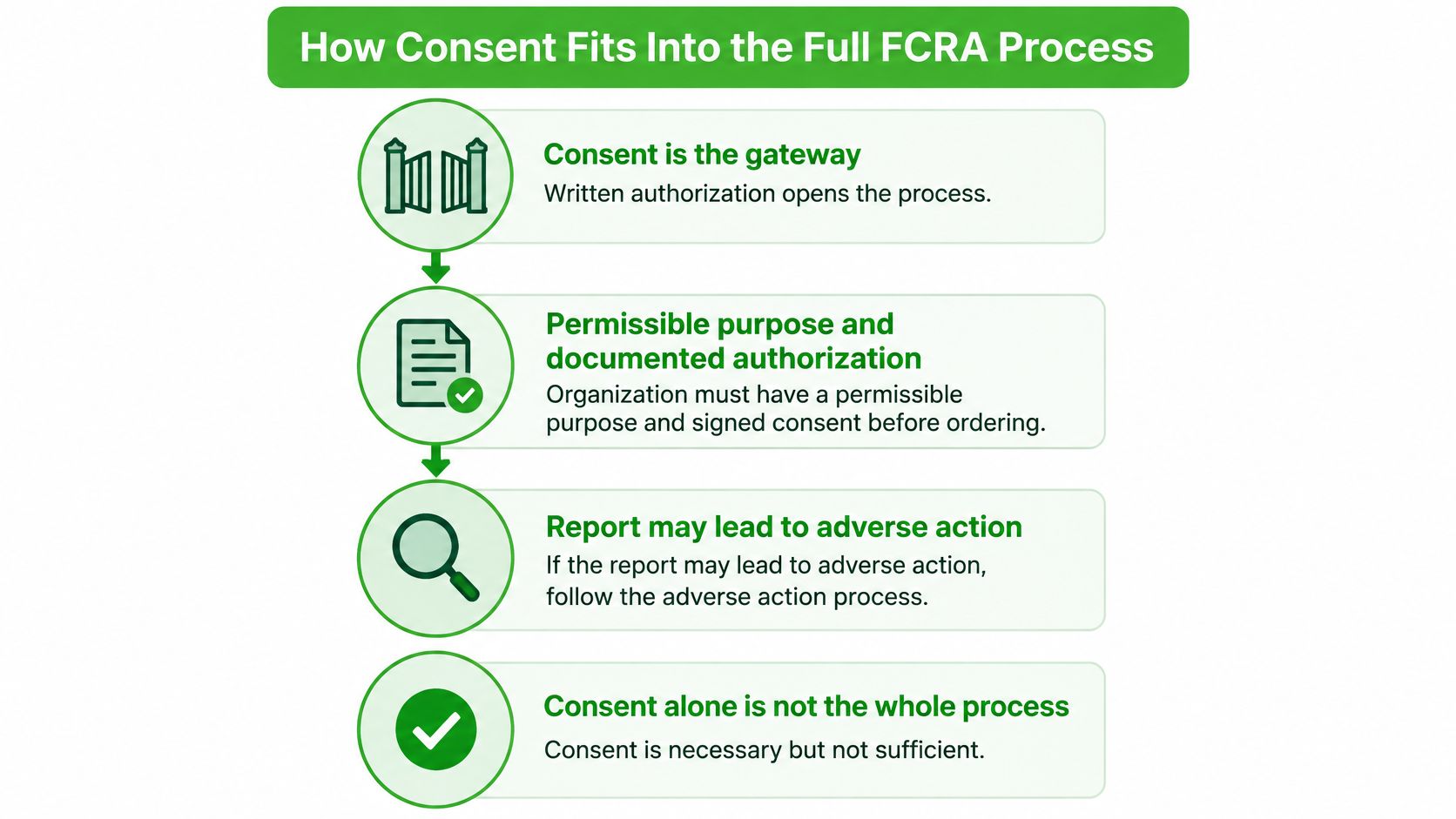
A volunteer may dispute information after receiving a pre-adverse-action notice. The consumer reporting agency must reinvestigate the dispute and correct inaccurate information under the FCRA. Build time for that process into the decision schedule rather than treating the report as the last step.
| Stage | Timing | What the law requires | Evidence to keep |
|---|---|---|---|
| Before ordering | Before the report is procured | Disclosure and written authorization | Signed form version, signer, timestamp |
| Ordering the report | After authorization | Permissible purpose in place | Request record and purpose note |
| Potential adverse action | Before any final decision | Copy of the report and FCRA Summary of Rights | Dated notice and copy of report sent |
| Applicant response | Before the final decision | Applicant can identify inaccuracies | Written response or note of no response |
| Dispute reinvestigation | After a dispute is received | Reasonable reinvestigation and correction of inaccurate information | Dispute log and outcome |
| Written results | After reinvestigation | Provide the consumer with the results | Copy of results sent |
An electronic signature alone does not show which disclosure the volunteer saw. Keep a record of the disclosure and authorization wording, who signed, when they signed, and how those details connect to the screening request. VolunteerBadge's volunteer application includes FCRA disclosure language and a digital authorization signature.
The evidence trail should answer two questions: was authorization obtained before the search, and did the organization complete the required steps before making an adverse decision? The FCRA compliance process for nonprofits explains how those duties fit into volunteer screening.
Renewing Consent for Recurring Volunteer Screening
A March authorization for sideline coaching may not give clear notice of a later check when the volunteer returns in October or takes on van-driving duties. The FCRA requires a clear and conspicuous disclosure and written authorization under 15 U.S.C. § 1681b. A form that names neither the program nor how long consent applies leaves the volunteer without notice of later checks.
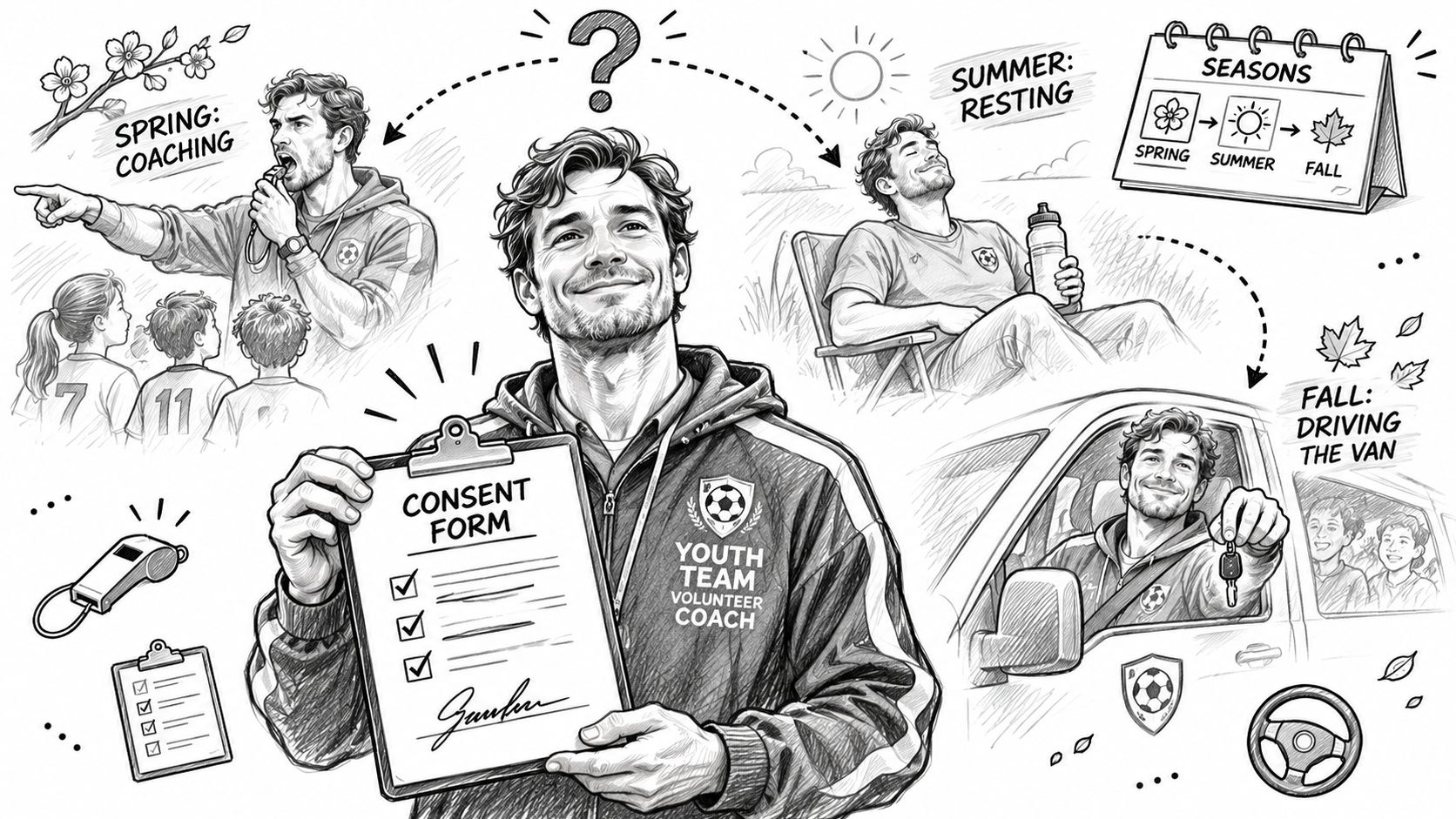
The authorization can state its scope directly: “We may obtain a consumer report each year while you serve as a volunteer in children's programs, and again if you move into a role with driving, overnight, or transportation duties.” That approach gives volunteers notice while reducing repeated paperwork. A broad phrase such as “at any time for any purpose” may be easier to administer, but it does not tell the volunteer which programs or future checks the authorization covers.
Set a renewal rule in the written volunteer screening policy, and apply it consistently:
- A role change: Get renewed authorization when duties expand to transport, overnight care, or one-on-one mentoring.
- A return after a break: Decide what length of absence triggers a fresh signature, then record that threshold.
- A move to another program or campus: Confirm that the existing authorization covers the new program, or obtain a new one.
- A recurring check: State the screening interval in the authorization and track the renewal date in the volunteer record.
Consent is the first gate; the record of what the volunteer agreed to matters later. Retain the signed authorization with the program and scope it covers, along with the date it was signed and the date of each subsequent check. Keep report information confidential and limit access to people who need it for the screening process. Choose one approach, a time-limited form or separate authorizations for distinct programs, and document how coordinators should apply it.
Acting on a Report Without an Automatic Veto
A signed form settles nothing about the decision. It opens a process, and the process is where the legal exposure concentrates. The EEOC's guidance on arrest and conviction records recommends limiting criminal-history inquiries to information that is job-related and consistent with business necessity, and describes individualized assessment as notice of the concern, an opportunity to respond, and genuine consideration of what the person provides.
Treat that as four steps, in this order:
- Notify the volunteer of the specific concern. Name the record and the duty it touches. "Something came up" gives nobody a fair chance to respond.
- Set a real response window. Days, not hours, and a named person to send information to.
- Read what comes back. A certificate of rehabilitation, a discharge document, a dated explanation, a reference from a previous volunteer supervisor. Each one changes the analysis.
- Decide against the role, not the record. A twenty-year-old shoplifting conviction and a recent financial fraud charge land differently for a treasurer and differently again for a van driver.
The timing matters as much as the reasoning. Where local rules push criminal-history questions later in the selection process, an authorization signed at intake doesn't license an immediate review of a criminal record. The answer turns on state or local law, the duties of the role, and whether your process creates an early inquiry that the jurisdiction doesn't allow.
Consent never waives fair-chance or anti-discrimination protections either. A volunteer who signs an authorization still keeps every right to an individualized decision and to a challenge based on how a record was used. If rejection is possible, the report and rights summary go out before the decision is final, then the volunteer gets a genuine opportunity to respond. Our breakdown of the pre-adverse action letter walks through that packet line by line.
A valid signature never rescues an overbroad or badly timed process. It just documents that the process started.
Common Mistakes and a Pre-Signature Audit
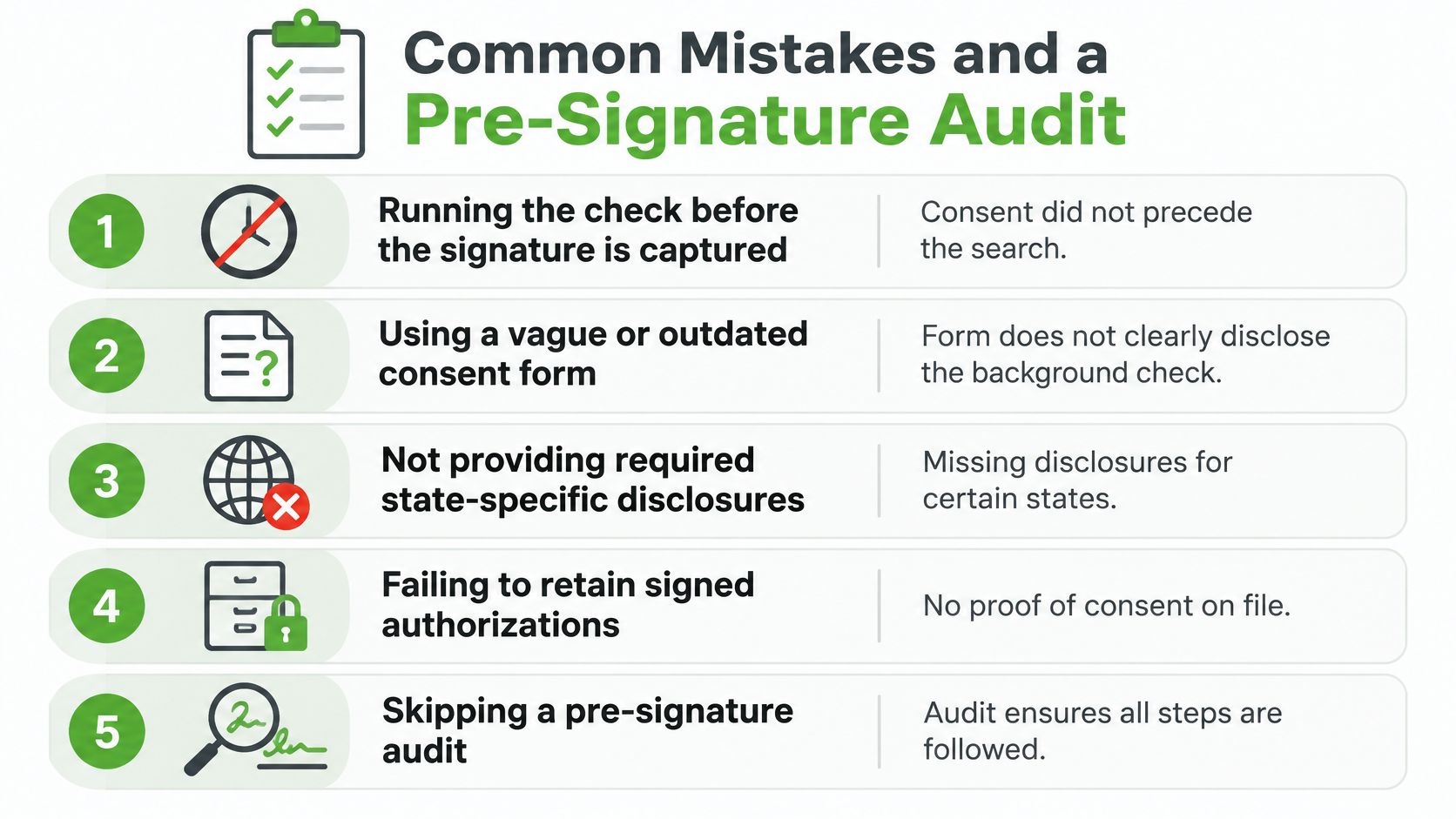
Most form failures are operational, not editorial. Only one of the seven below is really about wording.
| Mistake | Why it creates risk | Fix |
|---|---|---|
| Running the check before signature | Consent did not precede the search | Capture signed authorization before ordering |
| Prechecked box or unnamed click-through | No attributable assent | Require an active signature with signer identity |
| Disclosure inside a general application | Disclosure is not standalone | Use a separate one-page disclosure |
| Open-ended authorization | Scope and duration are unclear | State the program, purpose and duration |
| Form version not kept | Cannot prove what the applicant saw | Store version, timestamp and signed copy |
| Form not updated after changes | Outdated purpose or legal text | Review the form when programs or rules change |
| No certification of purpose | Organization cannot show permissible purpose | Keep signed certification with the request |
The ordering error is the most common and the most damaging. A coordinator emails the screening provider on Monday and hands over a paper form on Thursday because the volunteer was at practice. The report was already requested. Nothing after that fixes the sequence.
Prechecked boxes and unnamed click-throughs cause a quieter problem. If the record shows a box that was already ticked, or a session with no identifiable signer, there's no assent to point to. Lost form versions hurt the same way: a coordinator who can't produce the exact text the volunteer saw during a dispute has no answer when the volunteer says the wording was different.
Seven errors, one audit. Run this before the next volunteer signs anything:
- Check the page. Does the disclosure sit on a document containing only the disclosure and authorization?
- Check the signer. Is there a name, a timestamp, and something tying the signature to that person?
- Check the scope. Is recurring screening written in plain language a volunteer can read once and understand?
- Check the file. Are the form version, the signed copy, and the purpose certification stored together with the request?
- Check the exit. Are the adverse-action steps written down, including the report copy, the rights summary, and the response window?
Here is the operational version of the same sequence:
Every one of those failures is a records failure before it's a legal one. A program that keeps the signed version, the timestamp, and the certification has something to show. A program that keeps a memory of a conversation does not.
Memory is not a record. Every step should be provable from the file, by someone who wasn't in the room.
VolunteerBadge builds the FCRA disclosure, the digital authorization, and the stored audit record into every volunteer application, so the signed version and its timestamp sit with the screening request instead of in a coordinator's inbox. You can create an application in minutes, invite a volunteer, and run a fully compliant check, with the adverse-action workflow guided step by step if a result calls for one. Start at VolunteerBadge and put the first gate on solid ground.
