Nothing Fails While You Are Holding It

A rescue, a wildlife rehabilitator and a land trust look like three unrelated organizations. Operationally they are the same thing: each takes responsibility for something that cannot speak for itself, holds it a while, and hands it on. Almost nothing in this sector fails while somebody is holding it — it fails at the handover. Six records, and the handover each one exists to survive.
On this page
A rescue, a wildlife rehabilitator and a land trust look like three unrelated kinds of organization. Operationally they are the same thing: each takes responsibility for something that cannot speak for itself, holds it for a while, and hands it on. Everything they record is a link in a chain of custody — and almost nothing in this sector fails while somebody is holding it. It fails at the handover.
That is not a metaphor, it is where the incidents actually cluster. The animal that arrives without its file. The foster space that was counted twice. The year nobody visited the property. Six records, what handover each one exists to survive, and how each one fails. Every workbook mentioned is free and linked at the bottom.
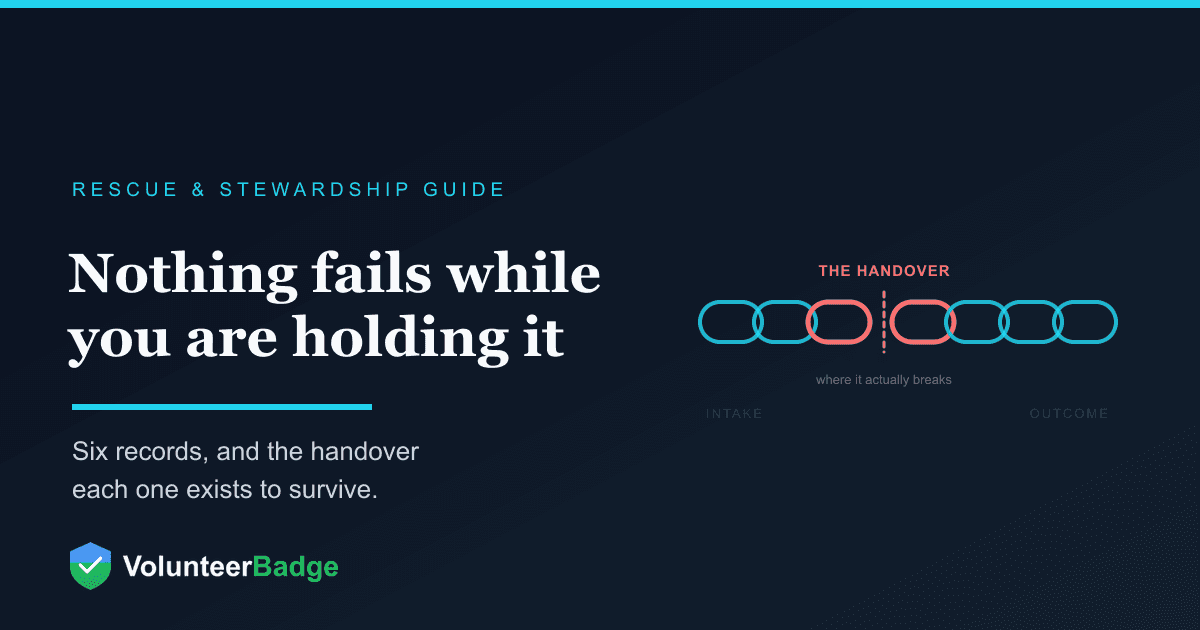
The links are where the work happens. The dashed ones are where the record has to survive being passed to somebody who was not there for the previous step.
1. Capacity: the number that is wrong precisely when you need it
A rescue without a building has exactly one resource, and it is foster capacity. It almost always lives in a coordinator’s head plus a group chat, and that arrangement works well for months — right up until the call comes in on a Friday night and the honest answer is “let me ask around.”
What makes it fail is not disorganization. It is that a hand-maintained count degrades in one direction only. Placements get added to it in the moment, because somebody is arranging them. Placements get removed from it later, if anyone remembers, once an adoption has gone through and the paperwork is done and the excitement has passed.
The count everyone keeps
“We have about six spaces.” Assembled from memory and a scroll back through messages. It is usually low, because the freed-up spaces are the ones nobody announced.
The count worth having
Open spaces derived from placement records: leave a placement’s end date blank and the space is taken, fill it in and it frees itself. The number becomes a consequence of the record rather than a second thing to maintain.
The practical benefit is not tidiness. It is that a derived count is still right in November, and that the answer to an intake call is a screen rather than a round of texts.
2. The handover: a relay is a chain, and chains fail at links
Transport is the clearest case because the handovers are literal. A relay moves an animal through four drivers and two states, and the moments things go wrong are not the driving. They are the car park meetings: the animal that arrives without its folder, the crate that goes to the wrong car, the leg after this one that nobody actually booked.
Two checks catch most of it, and both are arithmetic:
- Does each leg start where the previous leg ended? Number the legs and compare them. A mismatch is precisely the situation where an animal waits at a meeting point for a driver who was never scheduled.
- Is the paperwork valid on the day of the run, not today? Moving animals across a state line commonly requires a veterinary inspection certificate, requirements are set by both the origin and the destination state, and these documents often carry a validity window measured in days. A certificate that is fine today and expires on Thursday is not fine for a Saturday run — and a check against today’s date will happily tell you it is.
That second one is worth sitting with, because it is the general form of a mistake this whole sector makes. Comparing a document’s validity against now rather than against when it will be used is the same error as a rota that says a coach is cleared today for a trip next month.
3. Where the record is not evidence of compliance — it is the compliance
Wildlife rehabilitation is different from the rest of this sector in a way that is easy to miss. Holding, treating, transporting or releasing wildlife generally requires a permit, and the records are commonly a condition of that permit. The log is not documentation of the work; keeping it is part of the work.
The fields recur across jurisdictions, which is why a shape can be described at all:
4. The gap that only exists on a calendar
Land trusts commonly carry one obligation above all others: monitor every conservation easement at least once a year, and document it. There is a trap in the phrasing that catches organizations doing the work perfectly well.
“Everything has been monitored in the last twelve months” is a rolling window. “Everything was monitored during 2027” is a calendar year. They sound identical. They are not.
Fifteen months apart. Passes a rolling twelve-month test at almost every point, and has a calendar year in the middle with no visit in it.
The fix is one formula, and it is the harder test on purpose. Two related things are worth computing alongside it: the last on-the-ground visit tracked separately from aerial or remote monitoring, since a periodic in-person visit is commonly expected even where remote monitoring happens in between — and the state of the baseline documentation, which is the report describing the property’s condition when the easement was granted.
Baseline is worth flagging above monitoring, and this is the one piece of sequencing in the article we would argue about with anybody. A missed monitoring visit is a gap you can close next season. A baseline report that was never completed, or was never signed by the landowner, is the document that gets argued about a decade later, when everyone who was actually on the property has moved on and the only account of what was there is the one nobody signed.
5. The rate that flatters whoever calculates it
Live-outcome and live-release rates are the headline number in animal welfare, and they are unusually easy to compute in a way that means nothing.
Two things decide whether the figure is honest, and neither is the arithmetic:
- What is in the denominator. Outcomes recorded, or intakes? An animal still in care is not an outcome either way, and a rate computed against intakes will drift as the population in care changes — which is not a change in performance.
- Whether the hard outcomes get recorded at all. A rate calculated from a roster that quietly loses its worst cases is not a rate. This is rarely deliberate; deaths in care and euthanasia decisions are the entries people most reasonably want to stop thinking about, and a spreadsheet with no obvious place to put them is an invitation to put them nowhere.
One figure worth adding that nobody asks for: the longest current stay. Averages hide it completely, and it is where behavior deteriorates and where the animal nobody is thinking about actually lives.
6. The default nobody should ship
This one is about templates rather than about rescues, and it is why our vaccination workbook arrives with an empty protocol tab.
Vaccination intervals are veterinary and legal questions. They differ by species, by age, by product, by state, and by an organization’s own shelter medicine protocol. Rabies is regulated separately again — which vaccines qualify, at what age, at what interval, who may administer them, and what certificate must be issued are set by state and sometimes county law.
A template that shipped an interval would be making a veterinary decision, at scale, on behalf of organizations it has never met, that would be followed by people who reasonably assume the number came from somewhere. The blank is not laziness and it is not caution for its own sake. It is that a confident default here is worse than an empty cell, because somebody would use it.
What a workbook can legitimately do is arithmetic: take the intervals your veterinarian gives you and compute every due date from them, then flag what is overdue before an adoption event rather than during one.
An honest word about the software
Unlike some sectors we have written about, the tooling here is not obviously overpriced. One widely used shelter platform charges per adoption rather than a subscription — a few dollars each, with transfers and returns to owner free — which for a small rescue is a genuinely reasonable deal, and it buys adoption workflows, public listings, payment handling and medical records that a spreadsheet does not.
So the case for these workbooks is narrower than usual, and worth stating accurately. They are for organizations that do not have that software yet, and for the jobs that sit outside it: foster capacity across a network of homes, a transport relay spanning four drivers and two states, and land stewardship, which shelter software does not address at all.
The workbooks
Free, no account, no email gate. Every threshold, interval and requirement is a cell you fill in. No array formulas anywhere, so nothing quietly returns a different answer in a different spreadsheet.
- Foster Home Capacity & Placement Tracker — section 1, capacity derived rather than counted.
- Rescue Transport Relay Planner — section 2, the chain check and the run-date comparison.
- Wildlife Rehabilitation Intake & Disposition Log — section 3. Not an official form.
- Conservation Easement Monitoring Tracker — section 4, the calendar-year test.
- Animal Intake & Outcome Log — section 5, including the longest current stay.
- Animal Vaccination & Medical Due Dates — section 6, with the blank we will not fill in.
All six sit on the animal rescue & land stewardship toolkit hub.
Where screening fits, which is not everywhere
None of those six is a screening product, and it is worth saying so plainly: take all six and never speak to us again.
Where our own work does touch this sector is narrower and, we think, real. Fostering means an adult takes an animal into their home and gives out an address. Transport means someone drives alone with an animal across state lines. Both are roles rescues fill quickly, under pressure, from people who volunteered enthusiastically at exactly the moment capacity was short — which is the situation where identity matters more than usual, and where a name-only check clears a name rather than a person. VolunteerBadge screens volunteers for $5 per adult with photo-ID and biometric verification. See screening for animal rescues.
Common questions
What records must a wildlife rehabilitator keep?
Commonly a log of every animal taken into custody including the date received, place of origin, species, condition on arrival, who brought it in, treatment given, and the disposition with its date — retained for a set period and reported annually. The specific required fields, the retention period and the reporting deadline are set by your permit conditions and your state and federal authorities and they differ, so confirm yours rather than relying on any general description.
How often must a conservation easement be monitored?
Commonly at least once per calendar year, with the monitoring documented promptly, and with periodic on-the-ground monitoring expected even where aerial or remote monitoring is used in between. What binds your organization comes from your easement documents, your own adopted policies and any body you are accredited by — and an individual easement's terms can be stricter than your general policy.
How do you calculate a live release rate?
Live outcomes divided by outcomes, but the definition is the hard part rather than the division. Decide explicitly whether the denominator is outcomes recorded or intakes, how transfers, returns to owner and returns to field are treated, and how animals still in care are handled. If you report the figure to a funder or coalition, use their definition rather than your own — different frameworks handle these differently and a number computed one way and reported into another is comparable-looking and wrong.
What paperwork is needed to transport rescue animals across state lines?
Requirements are set by both the origin and the destination state and commonly include a veterinary inspection certificate with a validity window. Confirm both states before the run is scheduled, and check certificate validity against the run date rather than against today.
How many foster homes does a rescue need?
The wrong question, and the reason capacity feels permanently short. What determines whether you can say yes to an intake is how many open spaces exist right now for the right species among homes actually available — not how many homes are on the list. Track spaces rather than homes, and separately track approved homes that have never been asked, because that second list is usually where the next open space comes from.
Why do vaccination templates not include standard intervals?
Ours does not, deliberately. Intervals differ by species, age, product, state and an organization's own shelter medicine protocol, and rabies is regulated separately. A template supplying an interval would be making a veterinary decision for organizations it has never met, and it would be followed. Take the intervals from your veterinarian and let a workbook do the arithmetic on them.
A note on sources
Wildlife rehabilitation record-keeping reflects state and federal permit conditions and published agency guidance read in September 2026; requirements differ by permit and jurisdiction and your own conditions govern. Easement monitoring practice reflects published land trust stewardship guidance. Shelter software pricing reflects published vendor pricing in September 2026 and changes. VolunteerBadge and ScreenForge Labs, LLC are not affiliated with or endorsed by the U.S. Fish and Wildlife Service, any state wildlife agency, the Land Trust Alliance, the Land Trust Accreditation Commission, or any shelter software vendor. This article is not veterinary, legal or compliance advice.
