
What Information Is Needed for Background Check in 2026
Find out what information is needed for background check: identifiers, address history, consent and role details that keep results accurate.
On this page
If you collect every detail you can find about a volunteer, have you made the background check safer, or just created more opportunities to match the wrong person?
Knowing what information is needed for background check starts with separating identity details from decision-making information. You need enough information to identify the applicant, authorization to obtain the report, and a clear description of the volunteer's duties. You don't need an unrestricted collection of personal history.
For nonprofit coordinators, the most useful approach is deliberate: collect relevant information, resolve inconsistencies, and review records before drawing conclusions. The U.S. procedures below focus on screening through consumer reporting agencies, with particular attention to identity accuracy and fair decisions.
Table of Contents
- Core Details and the Pre-Search Check
- Why Name and Date of Birth Are Not Enough
- How to Get Written Consent Before the Search
- Role Details That Change What You Ask For
- Address History and Where Records Live
- Reading Results Without Jumping to Conclusions
Core Details and the Pre-Search Check
Collect the applicant's full legal name, other names used, date of birth, current and relevant prior addresses, approved identifiers where lawful, contact information, and identity-verification evidence, then confirm authorization before ordering the report.
Use the legal name as it appears on the applicant's government ID. For example, Maria Elena Ruiz may previously have used Maria Ruiz-Lopez, so searching only her current surname could leave part of her history unexplored. Keep both names attached to the same application rather than creating separate applicant files.
The table below is an intake baseline, not permission to collect everything indiscriminately. A government ID can support verification without requiring you to keep an unnecessary copy in an ordinary volunteer folder.
Personal details required for a background check
| Detail | What it does | Example entry |
|---|---|---|
| Full legal name | Anchors the search to the identity on the application | Maria Elena Ruiz |
| Other names used | Accounts for former surnames, nicknames and aliases associated with records | Maria Ruiz-Lopez |
| Date of birth | Separates people who share a name | Complete birth date entered securely |
| Current address | Sets the first county or state to assess for searching | Current residential address, including unit and postal code |
| Address history, seven years in this example workflow | Identifies other courts that may hold records | Prior counties listed with residence dates |
| Social Security number | Enables an SSN trace where lawful | Provided through the secure authorization workflow |
| Email and phone number | Supports verification and follow-up contact | Contact details confirmed with the applicant |
| Government ID | Supports the identity match against the applicant | Driver's license or passport |
The seven-year history is an example intake policy, not a universal legal requirement. Choose the history period appropriate to your lawful screening scope, and explain that period on the application.
Use a pre-search gate
At VolunteerBadge, the process is to build the application, have us verify address history, and then run the check. Your coordinator can turn that sequence into a practical release checklist:
- Build the application. Include the relevant fields above, written role duties, and the applicant's access level. Name the person responsible for reviewing possible records.
- Resolve the history. Mark missing fields and ask about unexplained gaps or overlapping residence dates. Record whether a field is unnecessary, unavailable, or awaiting clarification.
- Release the search. Confirm that signed authorization is on file and unresolved identity questions have been routed for review.
Don't make every blank an automatic rejection. An applicant who has never used another name should be able to indicate that, rather than inventing an entry.
Copy the relevant rows into your intake form today. Check the name and birth date against the applicant's ID through your approved verification process, and keep sensitive identifiers out of routine email.
Why Name and Date of Birth Are Not Enough
A name alone is like a street address without a house number: several people can fit the description. Adding a birth date helps, but you still need to determine whether the remaining records belong to your applicant.
Say your applicant is Michael Johnson, and a search returns another Michael Johnson who shares his birth year. A matching year isn't a complete birth-date match, and neither name similarity nor a partial date establishes identity. The reviewer needs additional attributes before treating that record as relevant.
The illustration shows why identity details work better together.
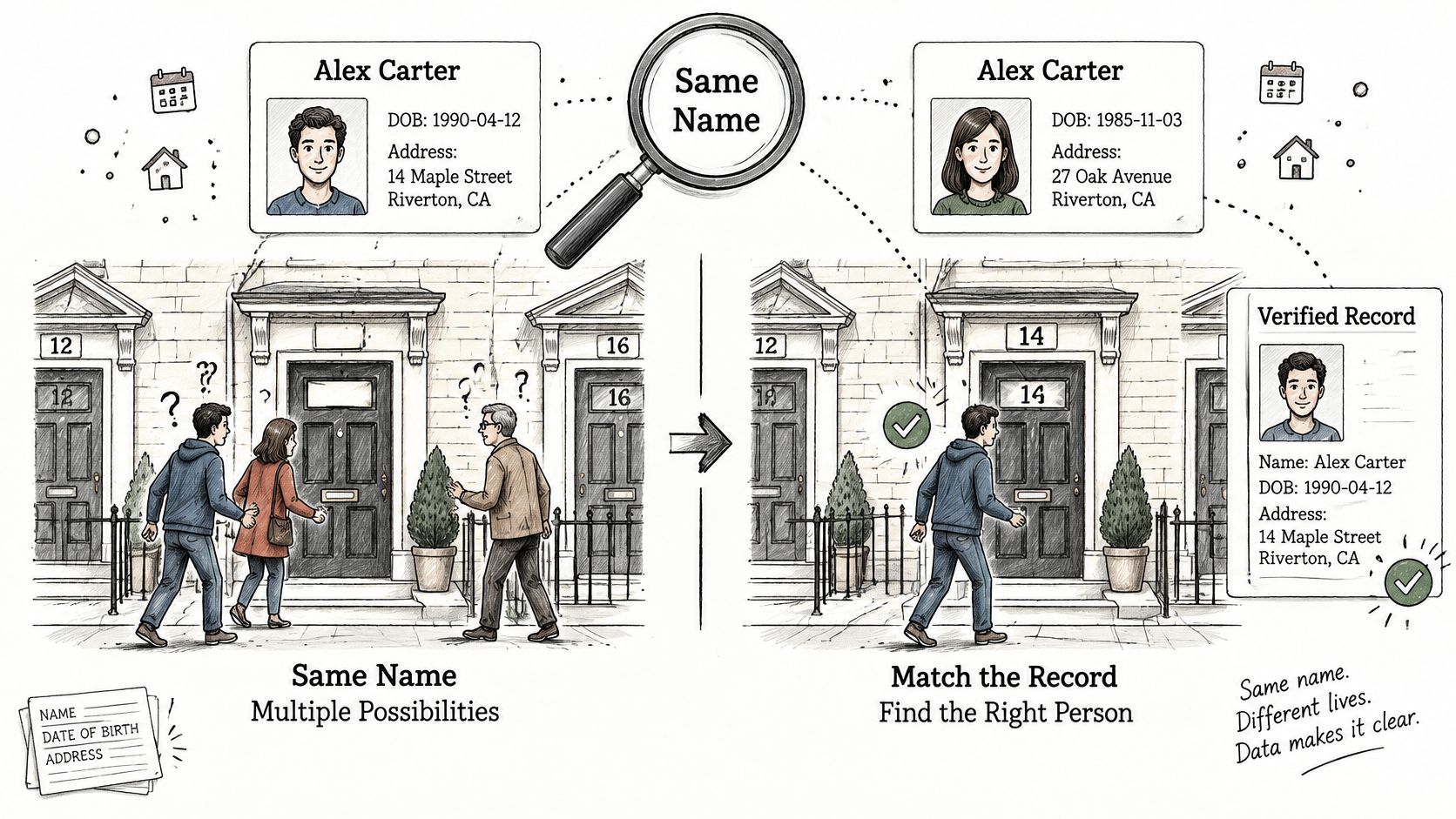
The National Institute of Standards and Technology's identity-proofing guidance identifies name, date of birth, and physical address as core identity attributes, recognizes supporting contact details, and calls for limiting personal information to what's necessary to resolve and validate identity.
For Michael, the complete birth date may eliminate an apparent match. His residential history may distinguish him from someone who has always lived elsewhere. An approved SSN trace can support identity and address-history work, but it isn't proof of criminal conduct.
Collect enough, not everything
Data minimization means collecting what your specific screening process needs, rather than assembling a personal dossier. Don't add unrelated family details, personal account passwords, or other information because an application form has room.
Our identity-matching process uses an SSN trace, address history, and date of birth, supported by government ID and a live selfie. These are complementary checks, not interchangeable substitutes.
Practical rule: When identifiers conflict, resolve the conflict before interpreting a possible record.
If Michael's application and identity document show different birth dates, pause and ask him to confirm the correct entry. A transcription error needs correction, not a theory about dishonesty.
The same approach applies when an applicant declines to provide a Social Security number or birth date:
- Record the response neutrally. Note what wasn't supplied without labeling the applicant untrustworthy.
- Use approved alternatives only. An alternative identifier must fit the lawful verification process.
- Route the file to manual review. Don't guess, substitute another person's details, or launch an unreliable search.
Missing information is a question to resolve. It isn't a finding about someone's character.
How to Get Written Consent Before the Search
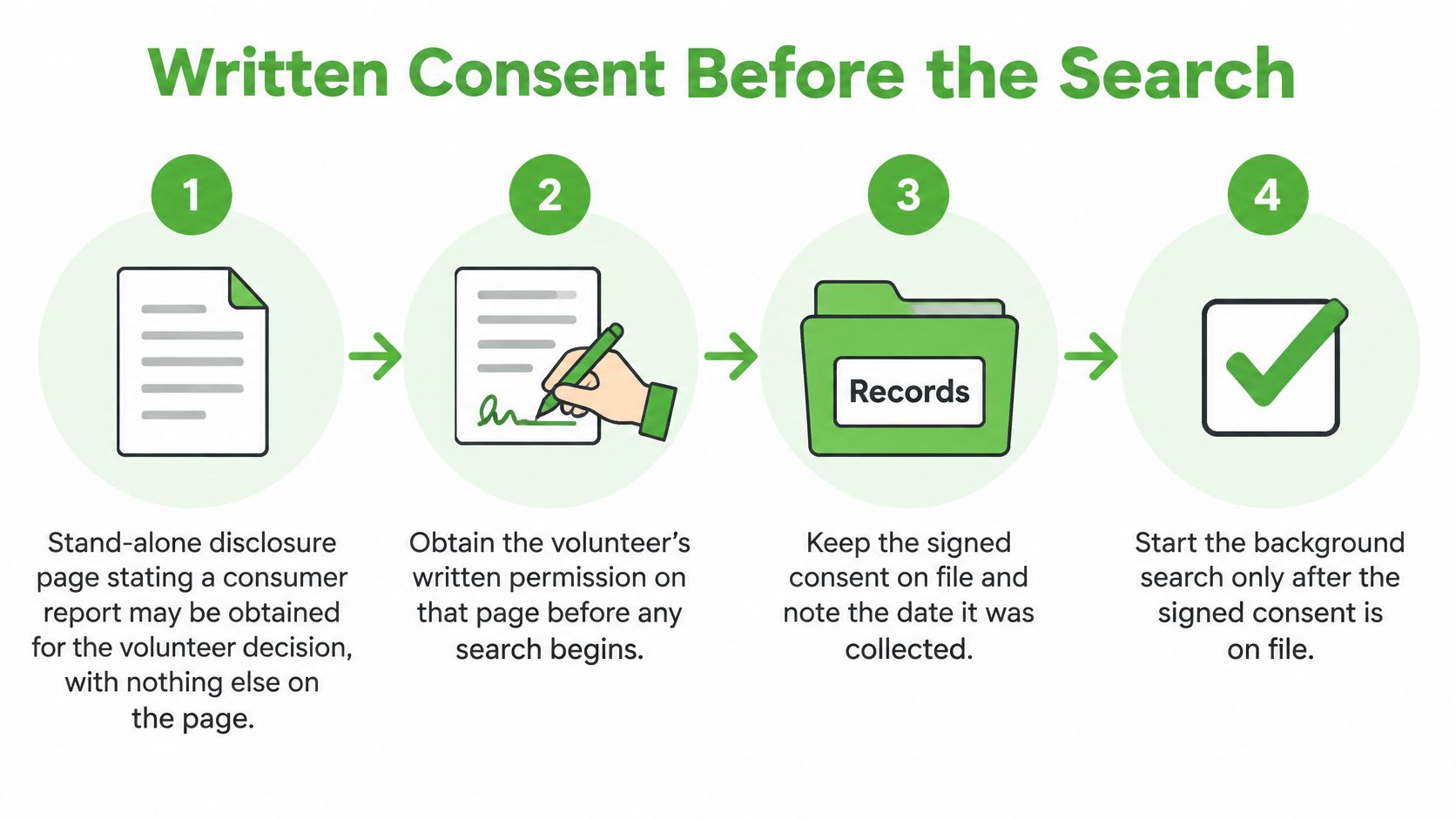
Having someone's identifying information doesn't give you permission to order a consumer report. For U.S. FCRA-regulated screening, the disclosure and authorization process must happen before procurement.
The Federal Trade Commission's guidance on using consumer reports explains the stand-alone disclosure, written authorization, permissible-purpose requirements, and notices associated with adverse decisions. Use these requirements to design the workflow, rather than treating consent as a document to collect afterward.
Make authorization a release condition
Prepare a stand-alone disclosure. Clearly state that a consumer report may be obtained for the volunteer decision, using a document devoted to that disclosure. The common mistake is burying the language inside a volunteer handbook, liability waiver, or general application terms.
Obtain written authorization. Capture the applicant's signed permission, or electronic consent where the application setting permits it. A verbal agreement or an unchecked acknowledgment isn't a substitute for recorded authorization.
Describe continuing screening clearly. If reports may be obtained repeatedly during service, make that continuing scope clear and conspicuous. Don't assume an applicant understands ongoing screening from language that describes only an initial application.
Record the permissible purpose and authorization date. Keep the volunteer role and reason for obtaining the report in the screening file before ordering. Avoid vague entries that don't connect the request to an actual organizational decision.
Check the scope against the intake. Confirm that the person, identifiers, and intended screening activity align with what was authorized. Don't reuse an old form for a materially different screening purpose without reviewing its suitability.
Secure the records. Restrict access to signed forms and intake information, and establish a retention and secure-disposal plan appropriate to applicable requirements. A shared spreadsheet containing unrestricted sensitive identifiers is a poor substitute for controlled storage.
Prepare for a potentially adverse result. Before an adverse decision, provide the pre-adverse-action notice, report copy, and FCRA Summary of Rights. The common mistake is announcing rejection first and sending the review materials afterward.
This process graphic highlights the authorization checkpoints.
Keep the notices distinct
A pre-adverse-action notice isn't the final rejection notice. If the organization ultimately takes adverse action, the final notice must identify the reporting company and explain the applicable dispute and report-access rights.
Use our background-check consent form guide to review how your application presents permission. Keep responsibility with a named coordinator so a completed application doesn't accidentally trigger a search before authorization is documented.
Role Details That Change What You Ask For
A role title is a label on a door. It does not show what is inside the room. A "coach" might run a supervised Saturday clinic, or might drive children home with no staff present. Collect the duties that change what that person can do unsupervised. Extra personal details beyond those duties do not make the screen more accurate.
Extra information by volunteer role
| Volunteer role | Extra detail to record | Why it matters |
|---|---|---|
| Youth coach or childcare helper | Supervision level and contact with minors | Sets the relevant scope of the check |
| Driver or transport volunteer | Vehicle use and passenger contact | Links offense types to the duties |
| Cash handling or finance volunteer | Access to money and accounts | Ties the review to financial responsibility |
| Program visitor for vulnerable adults | Scope of access and supervision | Supports individualized review |
| Office or admin volunteer | Whether access is unsupervised | Allows a narrower scope |
Match the screen to the work. The same applicant may need a wider scope for transporting participants than for preparing mailings at a staffed desk.
The EEOC's arrest and conviction guidance recommends weighing the nature and seriousness of an offense, the time elapsed, and the nature of the job. Writing down actual responsibilities gives the reviewer that job context, so a record is judged against the duties rather than against a generic volunteer label.
Describe access in concrete terms
A youth coach's application should separate supervised group activities from time alone with children. Note whether the coach transports participants or messages them privately. The word "coach" does not carry those facts. Our background-check guide for coaches is a role-specific starting point for that worksheet.
For transport volunteers, record whether they drive an organization vehicle or their own, and whether passengers ride with them. For finance volunteers, separate counting donations beside a staff member from opening accounts alone.
A visitor in a vulnerable-adult program may stay in a staffed common room or enter private residences. An office volunteer may sort public flyers, or may hold keys and open confidential files. Office work can still mean broad access.
Write down what the volunteer can do without supervision: people, vehicles, money, files, and keys.
Separate coordination from legal judgment
Organizing role descriptions, forms, and policy drafts is administrative work. A virtual legal assistant can help assemble that paperwork. Legal interpretation and approval of screening criteria stay with qualified counsel.
Also separate a database screen from a fingerprint screen required by law. A database check does not replace a legally mandated FBI or Live Scan fingerprint check, although it can serve as the primary screen where that is appropriate.
Before you choose the screening scope, put four items on the intake form: duties, supervision level, sites the person will cover, and access to people, property, money, and information. Those four items set the review. One rule applied to every volunteer does not.
Address History and Where Records Live
Suppose Sarah applies to volunteer and lists only her current Phoenix address. Elsewhere on her application, she mentions living in Pima County before moving. If the coordinator treats Phoenix as her entire residential history, the search plan may overlook a relevant jurisdiction.
Her earlier residence isn't suspicious. It's a reason to complete the application and determine where records may need verification.
This example shows how an application detail becomes a geographic search question.
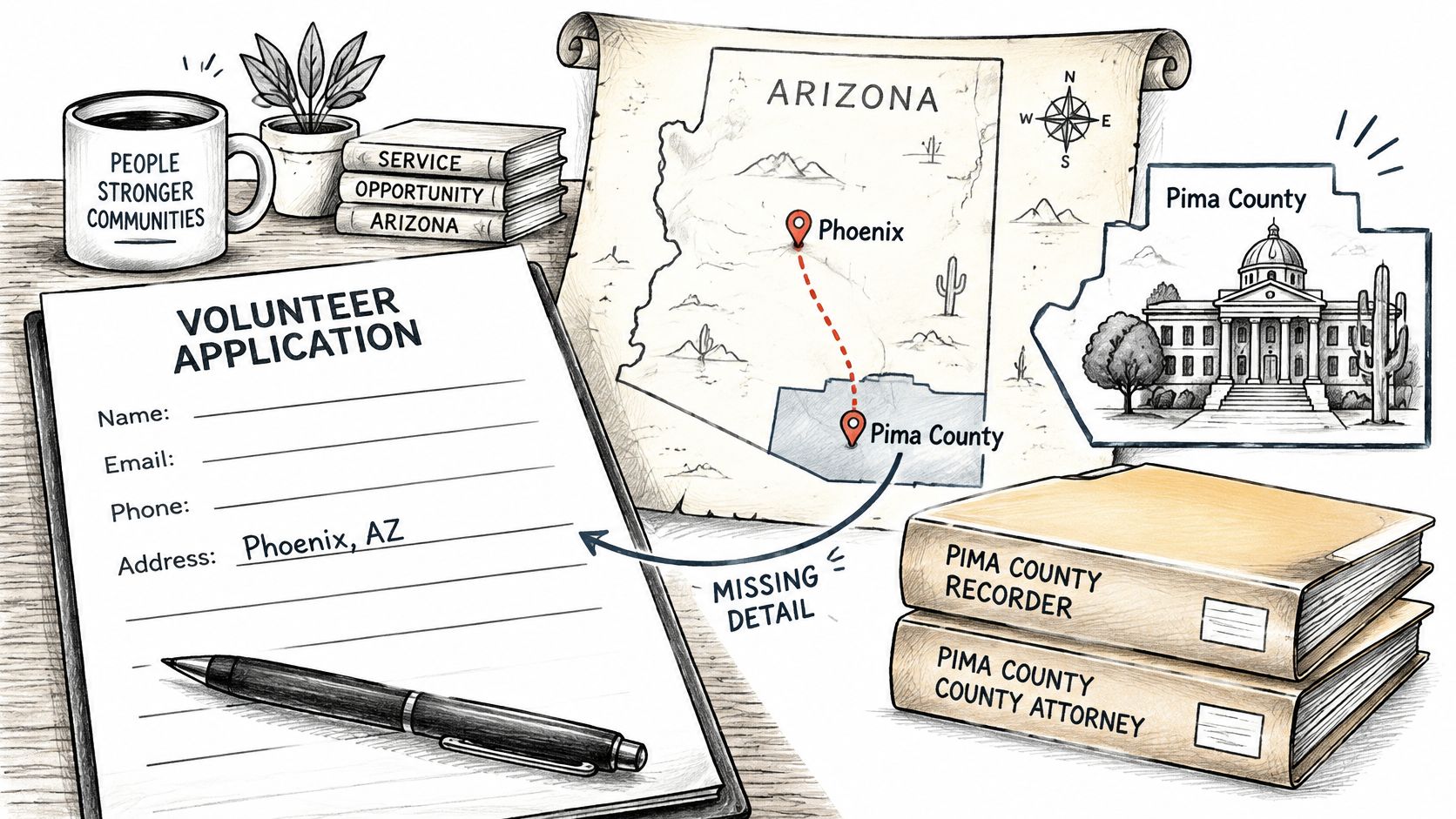
Criminal records aren't maintained in a single universal court database. The EEOC's guidance on arrest and conviction records discusses criminal-record information and accuracy concerns, reinforcing the need to distinguish record types and verify relevant information rather than treating a search result as complete by default.
A national database search reaches the records available through its sources. Sarah's prior residence helps identify whether a county court, state repository, or registry needs closer attention.
Build a residential timeline
For a hypothetical application requesting seven years of addresses, Sarah should list the residences within that requested period and explain the dates as accurately as she can. Don't describe that example window as a universal legal standard or confuse address collection with rules about which records may be reported.
Review the timeline for practical questions:
- Unexplained gaps. Ask whether Sarah stayed elsewhere, omitted a temporary residence, or entered a date incorrectly.
- Overlapping dates. Clarify whether she maintained multiple residences or rounded her move dates.
- Different names. Feed relevant former names uncovered during clarification into the authorized search process.
- Jurisdiction details. Confirm the county rather than assuming the city name tells you everything.
The accompanying video provides another way to consider the application-to-search process.
Confirm locations before interpreting results
Sarah's current address establishes where she lives now. Her residential timeline helps determine where else to look and supplies context when a similarly named person appears in another location.
Don't treat an address-history entry as proof that Sarah committed an offense there. Confirm the residence with her when necessary, identify the jurisdiction, and then assess the actual record independently.
Before reading results, complete the requested timeline and document which jurisdictions need checking. A clear location history makes the search more purposeful without expanding it into unrelated personal information.
Reading Results Without Jumping to Conclusions
A database hit is a starting point, not a verdict. Your reviewer still needs to establish whose record it is, what happened, and whether the information is relevant to the volunteer's responsibilities.
An arrest records that someone was taken into custody. A charge is an accusation, a conviction reflects a finding or accepted plea of guilt, and a disposition describes how a case was resolved. These terms aren't interchangeable.
The EEOC's criminal-record guidance for small businesses warns that arrest information may be inaccurate or incomplete and that an arrest alone doesn't establish criminal conduct. Don't convert an incomplete case entry into a conclusion the court record doesn't support.
Work through the record in context
- An arrest without a conviction. Confirm the identity and look for the case outcome. Don't label the applicant guilty because the report contains an arrest entry.
- An unresolved record. Determine whether the case is pending or whether the available record lacks an updated disposition. Seek clarification rather than filling the gap with an assumption.
- An identifier mismatch. A different birth date or conflicting identity detail requires investigation. A familiar name doesn't justify attributing the record to the applicant.
- An old conviction. Examine the offense, elapsed time, and relationship to the proposed duties. Age alone doesn't answer relevance, and the existence of a conviction shouldn't replace a documented assessment.
At VolunteerBadge, when a possible criminal record appears, a real reviewer checks the identifiers, dates, and jurisdiction to determine whether it belongs to the applicant. Your organization's decision-maker then needs to evaluate the verified information within the role's responsibilities.
Apply a repeatable review
Ask these questions before accepting a result:
- Does the identity match? Resolve conflicting identifiers.
- Does the jurisdiction fit? Investigate unexpected locations without assuming they prove a mismatch or a match.
- What is the timing and outcome? Establish dates and disposition.
- How does it relate to the duties? Apply the documented relevance criteria.
Give the applicant a meaningful opportunity to review and dispute potentially disqualifying information before the decision. Our guide to reading a background check can help coordinators interpret report terminology.
Decision note: Identify the verified record, the relevance test applied, and the reason for the outcome.
Keep that note factual and confidential. The goal isn't to gather the most information, but to make a supportable decision using accurate, relevant information.
VolunteerBadge offers a free address-history check with every volunteer application and background screening for $5 per check, or less with bulk credits. Visit VolunteerBadge to build your application, verify the applicant's address history, and run the check after authorization is on file.
