
Fail Background Check: Reasons, FCRA Rights and Fixes
Learn what a fail background check really means, why records get flagged, and how to use your FCRA rights to dispute errors before any decision.
On this page
You're ready to schedule a new volunteer, or you've accepted a job offer, when a background report comes back flagged. The report lists a court case, an unfamiliar name, or an arrest you thought was resolved. Your immediate question is whether you've failed the background check.
A flag is a finding to verify, not a verdict. Start by separating two questions: Is the information accurate and yours? If it is, does it affect eligibility for this particular role? The screening company supplies the information. The organization makes the eligibility decision.
Table of Contents
- Why a Background Check Gets Flagged
- What Happens After a Flag Appears
- Sealed, Expunged and Dismissed Records
- How to Dispute an Inaccurate Record Step by Step
- Decide Each Flagged Volunteer on Written Criteria
Why a Background Check Gets Flagged
Criminal-history records aren't limited to serious convictions. They can include arrests, minor offenses, incomplete case histories, and entries that don't clearly show what happened in court.
Historical testimony submitted to the EEOC estimated 49.7 million individuals with criminal records on state files after adjusting for duplicates across states, equivalent to 23.8% of the U.S. adult population using the 2000 population baseline. That's historical context, not a current prevalence estimate, but it illustrates why finding a record and establishing current risk are different tasks.
Common causes of a background check flag
Read the entry itself before interpreting a status label. Look for the person's identifiers, the court, the case number, and the disposition, meaning the recorded outcome.
| Flag cause | What the report shows | First action |
|---|---|---|
| Name or date-of-birth match | Record belongs to someone with a similar name | Compare SSN trace, date of birth, and address information |
| Arrest with no recorded outcome | Arrest entry without charge or disposition | Get the court disposition from the county clerk |
| Dismissed or expunged charge | Old charge still listed | Request certified disposition and any expungement order |
| Pending case already closed | Status shows open | Check the county docket for current status |
| Address gap or alias | Jurisdiction not searched | Run address history and alias searches |
| Undisclosed conviction | Conviction absent from application | Ask the applicant to explain before deciding |
An address gap is a coverage question, not proof of misconduct. Likewise, an apparent match doesn't establish that the record belongs to the applicant.
Accurate convictions also require attention. In 2023, 39% of respondents surveyed by HireRight said previously undisclosed criminal convictions were the candidate discrepancy most often found during pre-employment checks, according to SHRM's coverage of the survey. Don't assume an omission was intentional without checking the application's wording and hearing the explanation.
For additional background on how criminal searches work, the Law Office of Bryan Fagan guidance provides useful context for understanding the process.
Sorting rule: Check identity and case outcomes first. Move confirmed convictions to role-specific review, not automatic rejection.
What Happens After a Flag Appears
A coordinator should treat a flagged report as a reason to pause approval while reviewing the finding. It's not a reason to announce that the applicant has failed before checking the underlying information.
Federal experience illustrates the distinction. For fiscal years 2018 through 2020, the EEOC's federal civil-service report reported that 76% of determinations involving criminal-conduct issues were favorable, while 2% were unfavorable. These are federal civil-service findings, not a nonprofit approval benchmark.
The practical lesson is narrower than a promise of approval: a record can warrant review without requiring exclusion. The reviewer still needs to determine what happened, whether the information is complete, and why it matters for the duties involved.
Follow the notice sequence before a negative decision
For employment reports, the FTC's employer background-check guidance describes disclosure, written authorization, pre-adverse notice, an opportunity to review the report, and final adverse notice. It also explains the right to request an additional free report within 60 days after adverse action.
Volunteer arrangements can raise different coverage questions. A nonprofit should confirm how the FCRA and applicable state or local requirements apply to its program rather than assuming every volunteer arrangement has identical legal treatment.
The following is a working process for covered screening decisions, not a universal timetable.
| Stage | What the organization must do | What the applicant can do | Timing |
|---|---|---|---|
| Disclosure and authorization | Give a standalone written disclosure and obtain signed authorization | Read the disclosure and sign only if they agree | Before ordering the report |
| Pre-adverse notice | Send the report and the FCRA Summary of Rights | Review the report and identify errors | Before the negative decision, allowing sufficient response time |
| Dispute and review | Keep the decision preliminary, route disputes to the reporting agency, and review corrections | Send court records and a written explanation | Allow review and address the dispute before finalizing |
| Final adverse notice | Identify the agency, state it didn't decide, and explain report and dispute rights | Request the additional free report and dispute inaccuracies | After completing the preliminary review |
Don't substitute a rigid internal deadline for a meaningful opportunity to respond. Set a documented response period that accounts for applicable requirements, delivery, and the circumstances of the dispute.
Our pre-adverse-action letter guide can help coordinators distinguish the preliminary notice from the final decision. A preliminary notice shouldn't tell someone that rejection is already irreversible.
Keep the review traceable
Assign a named reviewer rather than leaving the decision to whoever opens the report first. That person should maintain a clear file containing:
- Authorization and report version: Preserve what the applicant authorized and the report reviewed.
- Verification notes: Record the identifiers, jurisdiction, case number, and outcome checked.
- Notices and delivery dates: Keep copies of communications and when they were sent.
- Applicant response: Save supporting documents, explanations, and the reviewer's response to them.
Our reports include built-in FCRA compliance, and we don't require contracts. The organization still needs to make and document its own eligibility decision.
A database match isn't a completed suitability review. Don't rescind an offer or turn away a volunteer simply because a preliminary entry looks concerning.
For youth and vulnerable-adult programs, keep unsupervised access on hold while approval remains incomplete. Explain the temporary status neutrally, and share sensitive report information only with people responsible for the review.
Sealed, Expunged and Dismissed Records
The state and case type determine the available remedy. Start with the court where the case was filed, not a general assumption that an old record should have disappeared.
Dismissal, sealing, and expungement aren't interchangeable. A dismissal describes a case outcome; sealing or expungement involves additional legal treatment of the record. Their effects, eligibility rules, and disclosure consequences require jurisdiction-specific review.
Match the remedy to the record
| Record type | Typical report status | Remedy |
|---|---|---|
| Arrest with no charges filed | May appear without an outcome | Obtain documentation of the outcome and dispute an incomplete or inaccurate entry |
| Dismissed charge | May still be listed | Request the certified dismissal and dispute inaccurate status or impermissible reporting |
| Expunged or sealed record | May still appear in some databases | Provide the court order and dispute the entry |
| Pending case | Appears as open | Get the docket and request current-status documentation from the clerk |
| Conviction eligible for sealing | May remain reported before sealing | Check state eligibility rules and petition the court where appropriate |
A report that accurately identifies a dismissal isn't the same as one that incorrectly identifies a conviction. Specify the actual problem: wrong status, missing outcome, wrong person, or reporting that shouldn't occur under the applicable rules.
Build a court-document file
Ask the clerk for a certified disposition identifying the case and its outcome. If the case was sealed or expunged, obtain the signed order and confirm that its case number matches the report.
Keep copies of the docket, disposition, order, and correspondence together. Don't send your only original document to a screening company.
- For an open-status error: Identify the docket entry showing closure and ask the clerk what documentation confirms it.
- For a sealed-record issue: Supply the order rather than assuming a commercial database has already updated.
- For reporting-age questions: Have the applicable federal and state rules checked against the record type and screening purpose.
Don't assume there's a universal expiration date for criminal-history reporting. Get legal help when sealing eligibility is contested, an appeal affects the outcome, or an organization continues relying on information you believe cannot lawfully be considered.
How to Dispute an Inaccurate Record Step by Step
A useful dispute identifies the entry, explains what's wrong, and supplies evidence. The FTC's background-check rights guidance explains applicants' rights to challenge inaccurate or incomplete information and request an additional free report within 60 days of the decision.
Use this visual checklist to organize the documents you'll need.
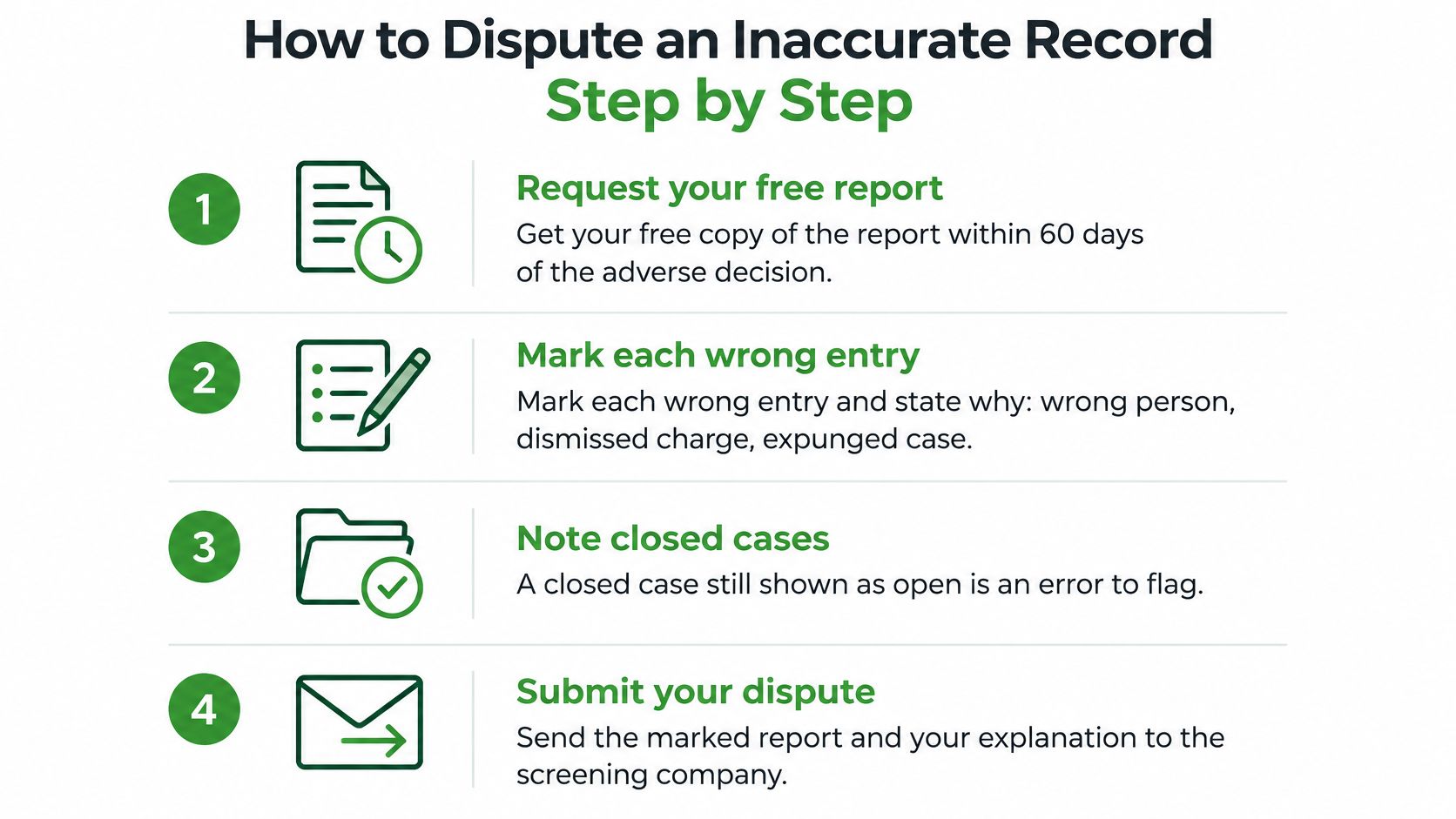
Prepare and submit a specific dispute
Request the complete report. Use the screening company's contact information in the notice. Save the report and accompanying correspondence so you can identify exactly what the organization received.
Mark each disputed entry. Write a specific explanation beside each item, such as wrong person, duplicate entry, dismissed charge shown as a conviction, or closed case shown as pending. Include the report reference and case number where available.
Collect supporting documents. Request a certified disposition, dismissal, or sealing order from the relevant court. For an identity mismatch, use the reporting agency's secure process for submitting identifying documents rather than emailing sensitive information casually.
Send the dispute to the consumer reporting agency. Attach the marked report, explanation, and supporting records, and keep a dated copy of everything submitted. Ask for confirmation of receipt and the expected reinvestigation timetable.
Notify the organization separately. Explain which finding you've challenged and ask it to hold or reopen its review. Send relevant court evidence, but recognize that an accuracy dispute and an eligibility assessment address different questions.
Check the corrected report. Ask for written confirmation of the reinvestigation outcome and review whether each challenged item was addressed. Send the corrected report to the coordinator and request confirmation that the eligibility review is complete.
Our guide to background-check errors can help you describe the issue clearly. Disputing only with the employer or coordinator doesn't correct the screening company's file.
Know what verification should involve
In our review process, a real reviewer checks identifiers, dates, and jurisdiction when a possible criminal record appears to verify whether it belongs to the applicant. That identity check serves a different purpose from deciding whether verified conduct matters for a role.
This video provides additional background-check context.
Challenge the specific information you believe is wrong. You don't need to claim that every negative screening decision is unlawful to request an accurate report.
Decide Each Flagged Volunteer on Written Criteria
An arrest alone isn't evidence that criminal conduct occurred. The EEOC's guidance on arrest and conviction records says employment exclusions should be fact-based, job-related, and consistent with business necessity. Nonprofit coordinators can use that assessment discipline while confirming which legal requirements govern their volunteer roles.
Fair review requires a discussion of verified conduct and actual responsibilities, not assumptions about a person's character.
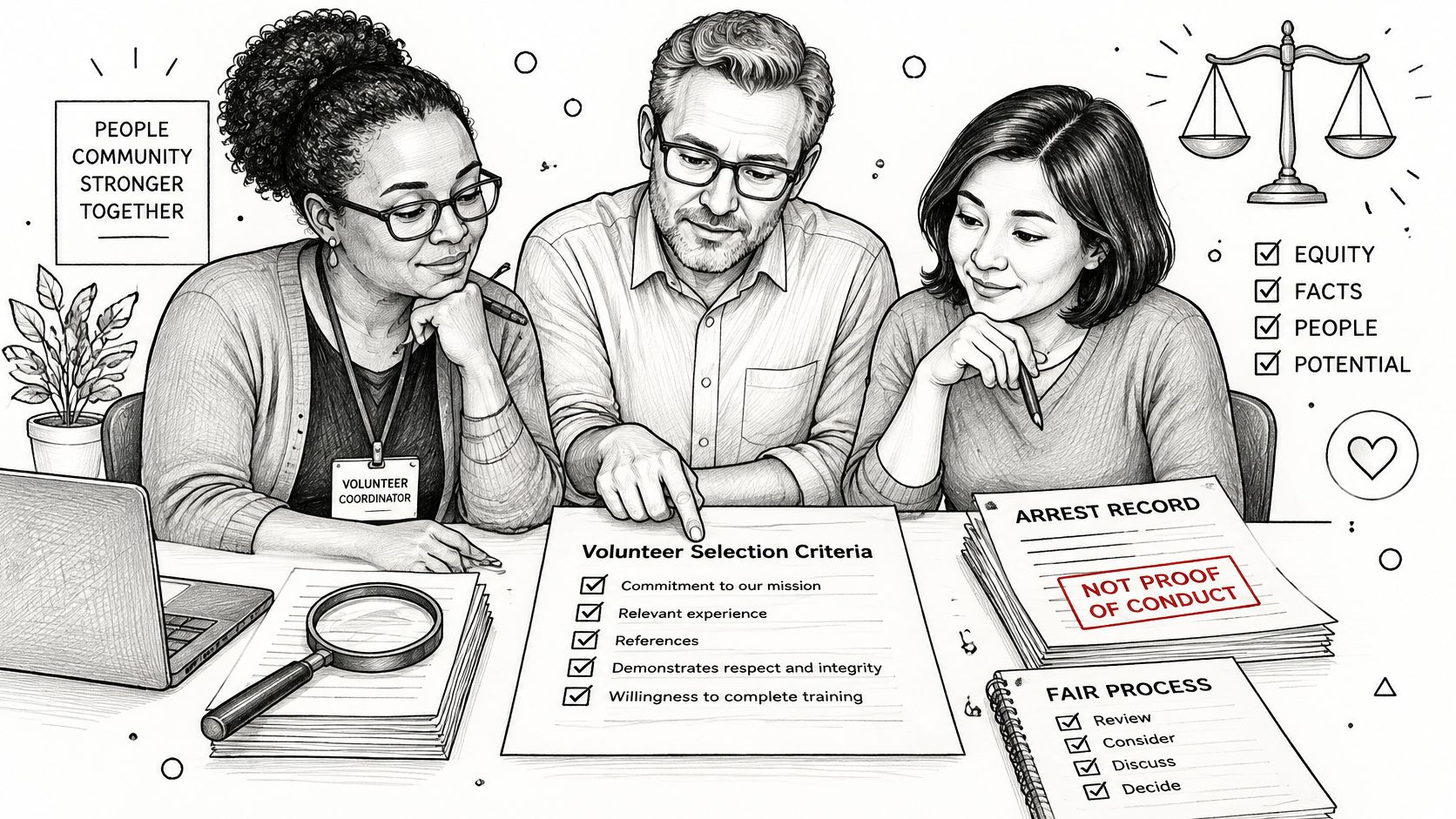
Write the reason in role-specific terms
Use a written volunteer-screening policy to guide each assessment. Record the facts rather than checking an unexplained fail box.
- Nature and gravity: Describe the verified conduct and its seriousness without treating an allegation as a conviction.
- Elapsed time: Note time since the offense or sentence completion, using a consistent method.
- Role access: Identify contact with children or vulnerable adults, control of money, transportation duties, or access to sensitive data.
- Individual circumstances: Consider rehabilitation, relevant training, references, and the applicant's explanation where appropriate.
Say an applicant has a verified financial conviction and would reconcile donations. Explain the connection between the conduct and financial access, then assess whether applicable rules and appropriate controls permit another assignment. Don't assume that the same finding has identical relevance to supervised event setup.
Keep screening within a broader safety process
A clean report doesn't establish how someone will behave. Pair checks with interviews, references, boundaries, supervision, training, and a clear way to report concerns.
Our $5 database check can be the primary screen, but it isn't a substitute for a legally mandated fingerprint check, including FBI or Live Scan checks where required.
This week, assign each flagged application to a reviewer, apply the written criteria, and record the role-specific reason for the outcome. Check that similarly situated applicants receive consistent treatment before closing the file.
VolunteerBadge offers volunteer background screening with real-reviewer verification of possible criminal matches and a built-in FCRA workflow. Visit VolunteerBadge to build your volunteer application and support a documented review process before a flagged finding becomes an eligibility decision.
